cooling Hyundai Getz 2003 Owner's Guide
[x] Cancel search | Manufacturer: HYUNDAI, Model Year: 2003, Model line: Getz, Model: Hyundai Getz 2003Pages: 444, PDF Size: 13.82 MB
Page 398 of 444
6- 8 DO-IT-YOURSELF MAINTENANCE
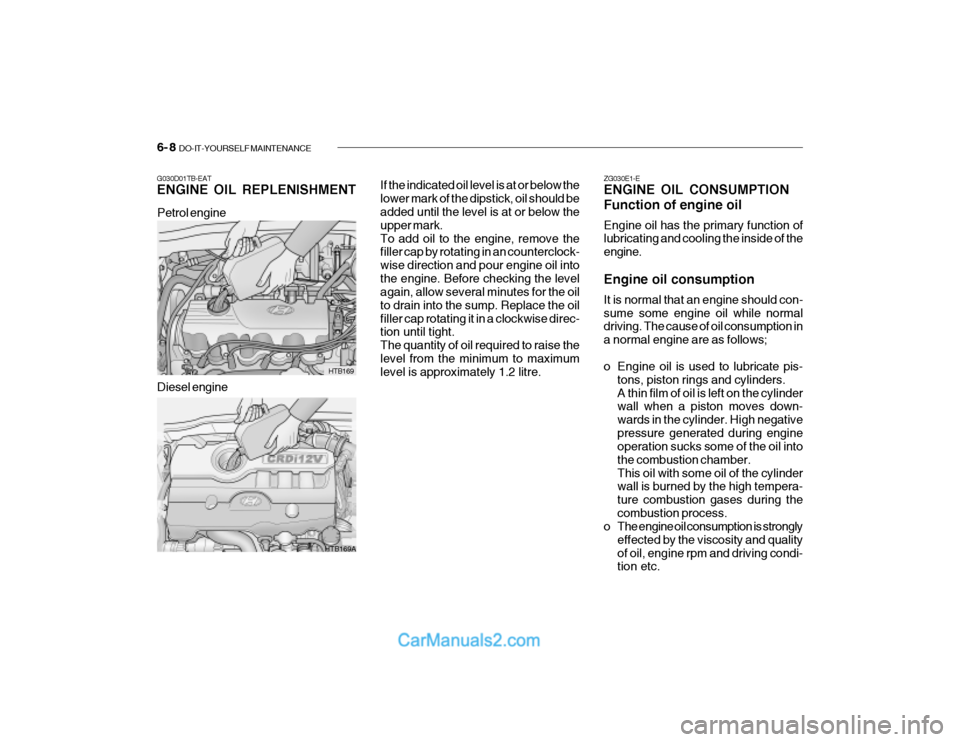
Petrol engine
HTB169
HTB169A
Diesel engine
G030D01TB-EAT ENGINE OIL REPLENISHMENT
If the indicated oil level is at or below the lower mark of the dipstick, oil should be added until the level is at or below the upper mark.To add oil to the engine, remove the filler cap by rotating in an counterclock- wise direction and pour engine oil intothe engine. Before checking the level again, allow several minutes for the oil to drain into the sump. Replace the oilfiller cap rotating it in a clockwise direc- tion until tight. The quantity of oil required to raise thelevel from the minimum to maximum level is approximately 1.2 litre.ZG030E1-E ENGINE OIL CONSUMPTION Function of engine oil Engine oil has the primary function of lubricating and cooling the inside of the engine. Engine oil consumption It is normal that an engine should con- sume some engine oil while normal driving. The cause of oil consumption in a normal engine are as follows;
o Engine oil is used to lubricate pis-
tons, piston rings and cylinders. A thin film of oil is left on the cylinder wall when a piston moves down- wards in the cylinder. High negativepressure generated during engine operation sucks some of the oil into the combustion chamber.This oil with some oil of the cylinder wall is burned by the high tempera- ture combustion gases during thecombustion process.
o The engine oil consumption is strongly
effected by the viscosity and qualityof oil, engine rpm and driving condi- tion etc.
Page 401 of 444

DO-IT-YOURSELF MAINTENANCE 6- 11
HTB170A
Diesel engine Only ethylene glycol based coolant with a corrosion inhibitor suited to aluminium alloy engine components should be used in the cooling system. No further additives or inhibitors should be used.The coolant specific gravity should be checked as prescribed in the mainte- nance schedule to ensure adequatefrost and corrosion protection. In addi- tion, the engine coolant must be re- placed at the specified interval sincethe corrosion inhibitor properties dete- riorate with time. It is important to note that whilst anincrease in the concentration of anti freeze gives an increase in the level offrost protection, a solution which is in excess of 65% anti freeze will result in reduced frost protection and engineoverheating. Therefore the recom- mended concentration of 50% should not be exceeded for general use.The use of methanol based anti freeze compounds may result in engine over- heating and will invalidate the vehiclewarranty. NOTE: It is imperative that vehicles fitted with an air conditioning system have a coolant concentration of the rec- ommended strength at all times. Theuse of the air conditioning system when the cooling system is filled with water only will result in theheater matrix freezing and subse- quently bursting.
SG050C1-E Engine Coolant Level The engine coolant level may be ob- served through the side of the plasticcoolant reservoir (expansion tank) when the engine is cold. If the level is below the "LOW" mark, add coolant of thecorrect concentration until the level is between the "LOW" and "Full" marks. If the level falls below the "LOW" mark ona regular basis despite being topped up, consult a Hyundai dealer. SG050D1-E To Change the engine Coolant The engine coolant should be changed at those intervals specified in the ve- hicle maintenance schedule in Section5. NOTE: Care should be taken to ensure that coolant is not allowed to spill ontothe paintwork since the finish may become damaged. If coolant spill- age occurs, the affected area shouldbe rinsed thoroughly with water.
Page 402 of 444

6- 12 DO-IT-YOURSELF MAINTENANCE
!
HTB172
HTB171
1. Park the vehicle on level ground and
ensure that the parking brake is firmly applied, and the engine allowed tocool. Do not attempt this operation whilst the engine is hot since burning orscalding may result.
2. Prepare a suitable receptacle to col-
lect the displaced coolant and posi-tion this under the radiator drain tap.
3. With the heater temperature control
set to the "HOT" position, removethe radiator cap and open the radiator drain tap. 5. Prepare a suitable quantity of new
engine coolant (refer to section 9)and pour this into the radiator.
6. Start the engine with the radiator cap
still removed and continue to addcoolant as the level decreases as air is expelled from the system. Whenthe level remains constant, replace the radiator cap and replenish the coolant reservoir.
7. When the engine is hot, check to ensure that no coolant leaks arepresent.
4. When the engine coolant has drained completely, close the drain tap en-suring that this is not over tightened. WARNING:
The cooling fan is controlled by en- gine coolant temperature and may sometimes operate even when theengine is not running. Use extreme caution when working near the blades of the cooling fan so that youare not injured by a rotating fan blade. As the engine coolant tem- perature decreases, the fan will auto-matically shut off. This is a normal condition.
Page 407 of 444
DO-IT-YOURSELF MAINTENANCE 6- 17
!
!
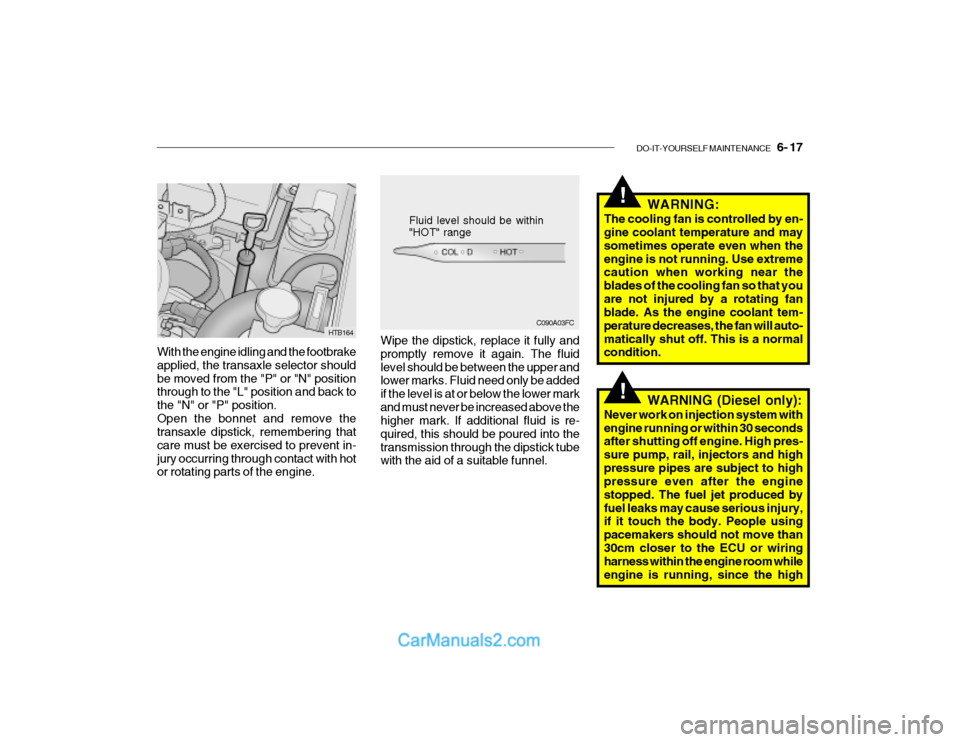
With the engine idling and the footbrake applied, the transaxle selector shouldbe moved from the "P" or "N" position through to the "L" position and back to the "N" or "P" position.Open the bonnet and remove the transaxle dipstick, remembering that care must be exercised to prevent in-jury occurring through contact with hot or rotating parts of the engine.
C090A03FC
Fluid level should be within "HOT" range
HTB164 Wipe the dipstick, replace it fully and promptly remove it again. The fluid level should be between the upper and lower marks. Fluid need only be added if the level is at or below the lower markand must never be increased above the higher mark. If additional fluid is re- quired, this should be poured into thetransmission through the dipstick tube with the aid of a suitable funnel. WARNING:
The cooling fan is controlled by en-gine coolant temperature and may sometimes operate even when theengine is not running. Use extreme caution when working near the blades of the cooling fan so that youare not injured by a rotating fan blade. As the engine coolant tem- perature decreases, the fan will auto-matically shut off. This is a normal condition.
WARNING (Diesel only):
Never work on injection system with engine running or within 30 seconds after shutting off engine. High pres- sure pump, rail, injectors and highpressure pipes are subject to high pressure even after the engine stopped. The fuel jet produced byfuel leaks may cause serious injury, if it touch the body. People using pacemakers should not move than30cm closer to the ECU or wiring harness within the engine room while engine is running, since the high
Page 415 of 444
DO-IT-YOURSELF MAINTENANCE 6- 25
!
!
o If battery electrolyte is spilled onto
skin or into eyes, the effected area must be flushed with copiousamounts of water and medical assis- tance sought.
o If battery electrolyte is ingested, copious amounts of water or milkfollowed by an ant-acid (raw egg or milk of magnesia) must be drunk.Vomiting should not be induced and medical assistance must be sought.
o Batteries must only be charged in well venti-lated areas from whichnaked lights or sources of sparks are excluded.
o Ensure that children, pets or other unauthorized persons are kept awayfrom batteries.
o Do not allow anything to bridge the positive (+) and negative (-) termi-nals of the battery.
o Never invert the battery. The battery fitted during production is of the "Maintenance Free" type.
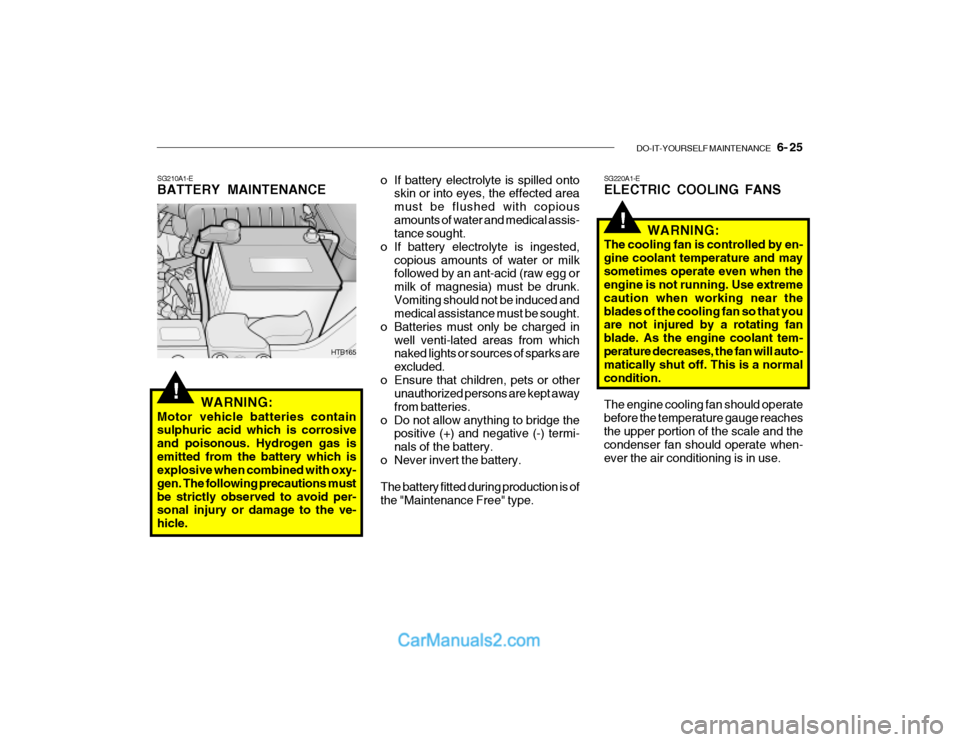
SG210A1-E BATTERY MAINTENANCE
WARNING:
Motor vehicle batteries contain sulphuric acid which is corrosive and poisonous. Hydrogen gas isemitted from the battery which is explosive when combined with oxy- gen. The following precautions mustbe strictly observed to avoid per- sonal injury or damage to the ve- hicle.
HTB165 SG220A1-E ELECTRIC COOLING FANS
WARNING:
The cooling fan is controlled by en- gine coolant temperature and maysometimes operate even when the engine is not running. Use extreme caution when working near theblades of the cooling fan so that you are not injured by a rotating fan blade. As the engine coolant tem-perature decreases, the fan will auto- matically shut off. This is a normal condition. The engine cooling fan should operate before the temperature gauge reachesthe upper portion of the scale and the condenser fan should operate when- ever the air conditioning is in use.
Page 441 of 444

10- 2 INDEX
A AIR BAG ................................................................... 1-29
AIR CONDITIONING SWITCH .................................1-74
AIR CONDITIONING SYSTEM MAINTENANCE ..... 6-19
AIR CLEANER FILTER ............................................. 6-14
ANTENNA ................................................................. 1-81
ANTI-LOCK BRAKE SYSTEM .................................. 2-13
ANTI-THEFT ALARM SYSTEM .................................. 1-7
ASHTRAY ................................................................. 1-52
AUTO FUEL CUT SWITCH...................................... 1-66
AUTOMATIC TRANSAXLE ......................................... 2-9AUTOMATIC TRANSAXLE FLUID ...........................6-16
BBATTERY MAINTENANCE ......................................6-25
BEFORE STARTING THE ENGINE ...........................2-3
BONNET RELEA SE .................................................. 1-60
BRAKE PEDAL FREEPLAY .....................................6-22
BRAKE SYSTEM CHECKING ..................................6-18
CCARE OF DISC ......................................................... 1-79
CARE OF SEAT BELTS ....... ....................................1-17
CARGO AREA COVER ............................................ 1-63
CATALYTIC CONVERTOR OPERATING PRECAUTIONS ...................................................... 7-3
CENTRAL DOOR LOCKS .......................................... 1-5
CHANGING A FLAT TYRE ......................................... 3-6 CHILD-PROOF REAR DOOR
LOCK .......................... 1-5
CHILD RESTRAINT SYSTEM ..................................1-21
CIGAR LIGHTER ...................................................... 1-51
CLUTCH PEDAL FREEPLAY................................... 6-22
COMBINATION IGNITION SWITCH AND STEERING LOCK ................................................... 2-3
CONSOLE TRAY ...................................................... 1-52
COOLANT TEMPERATURE GAUGE .......................1-42
DDAILY OPERATING CHECKS .................................... 6-6
DIGITAL CLOCK ....................................................... 1-51
DOOR LOCK S ............................................................ 1-5
DOOR WINDOWS .................................................... 1-10
DRINK HOLDER ....................................................... 1-52
DRIVE BELTS ........................................................... 6-23
DRIVING FOR ECONOMY .......................................2-14
E
EFFECTIVE BRAKING ............................................. 2-13
ELECTRIC COOLING FANS ....................................6-25
EMERGENCY TOWING ........................................... 3-12
EMISSION CONTROL SYSTEM ................................ 7-2
ENGINE COMPARTMENT .................... ..................... 6-2
ENGINE COOLANT CHECKING AND REPLACING ......................................................... 6-10
ENGINE OIL AND FILTER REPLACEMENT .............. 6-9
ENGINE OIL CONSUMPTION ................................... 6-8
Page 442 of 444

INDEX 10- 3
ENGINE OIL REPLENISHMENT ................................ 6-8
ENGINE OI L ............................................................... 6-6
F FRONT ASHTRAY .................................................... 1-52
FRONT SEAT ........................................................... 1-11
FRONT FOG LIGHT SWITCH .................................. 1-50
FUEL ECONOMY ....................................................... 2-7
FUEL GAUGE ........................................................... 1-41
FUEL RECOMMENDATIONS ..................................... 1-1
FUSE PANEL DESCRIPTION ..................................6-34
FUSIBLE LINKS ........................................................ 6-24
GGLOVE BOX ............................................................. 1-57
HHAZARD WARNI NG SYSTEM................................. 1-49
HEADLIGHT AIMING ADJUSTEM ENT ....................6-27
HEADLIGHT BULB ................................................... 6-28
HEADLIGHT LEVELING DEVICE SYSTEM .............1-53
HEAD RESTRAINT ADJ USTMENT .......................... 1-12
HEATED REAR WINDOW .............. .......................... 1-50
HEATING AND COOLING CONTROL .....................1-68
HEIGHT ADJUSTABLE FRONT SEAT SHOULDER BELT ................................................ 1-18
HORN ........................................................................ 1-67
HOW TO USE LUGGAGE ROOM ............................1-63I
IF THE ENGINE CANNOT BE CRANKED
................. 3-2
IF THE ENGINE OVERHEATS ................................... 3-4
IF THE ENGINE WILL NOT START ........................... 3-2
IF THE EVENT OF A PUNCTURE ............................. 3-6
IMMOBILISER SYSTEM ............................................. 1-4
INDIVIDUAL CIRCUIT FUSES .................................6-24
INSTRUMENT CLUSTER AND INDICATORS.........1-35
INTERIOR LIGHT ..................................................... 1-56
INTERIOR REAR VIEW MIRROR ............................ 1-59
JJUMP STARTING ....................................................... 3-3
KKEY POSITI ONS ........................................................ 2-3
LLIGHTING SW ITCH .................................................. 1-47
LUGGAGE BOARD ................................................... 1-65
LUGGAGE NET ........................................................ 1-65
LUGGAGE ROOM .................................................... 1-63
LUGGAGE UNDER TRAY .... .................................... 1-64
LUMBAR SUPPORT ADJUSTMENT ........................1-12