lock Hyundai Getz 2004 Owner's Manual
[x] Cancel search | Manufacturer: HYUNDAI, Model Year: 2004, Model line: Getz, Model: Hyundai Getz 2004Pages: 445, PDF Size: 12.16 MB
Page 339 of 445
FEATURES OF YOUR HYUNDAI 1- 81
!
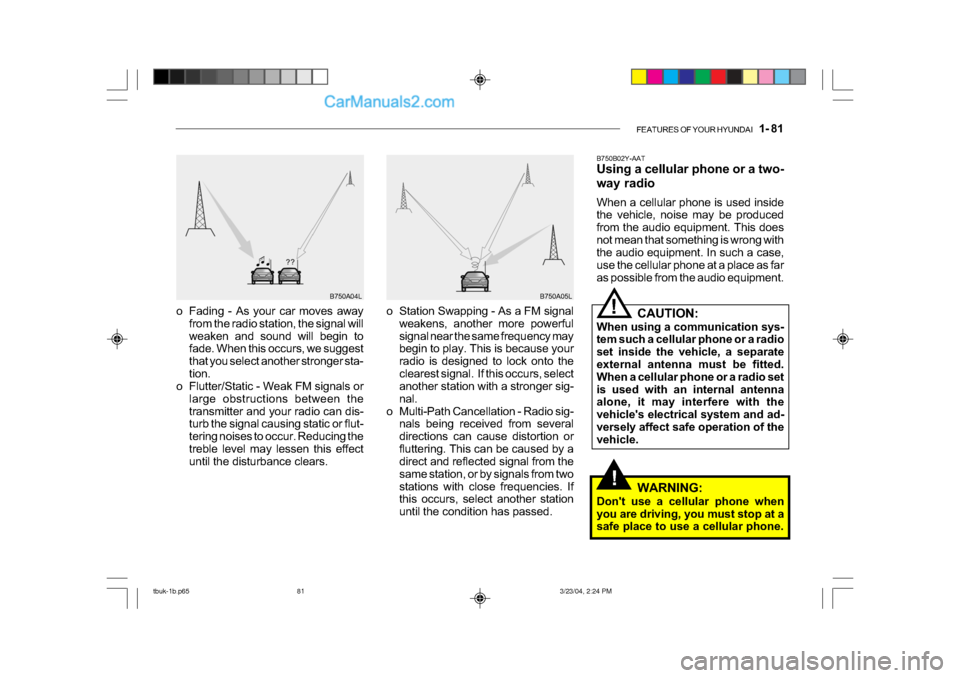
B750A04L B750A05L
o Station Swapping - As a FM signal weakens, another more powerful
signal near the same frequency may
begin to play. This is because your
radio is designed to lock onto the
clearest signal. If this occurs, select
another station with a stronger sig-
nal.
o Multi-Path Cancellation - Radio sig- nals being received from several
directions can cause distortion or
fluttering. This can be caused by a
direct and reflected signal from the
same station, or by signals from two
stations with close frequencies. If
this occurs, select another station
until the condition has passed.
o Fading - As your car moves away
from the radio station, the signal will
weaken and sound will begin to
fade. When this occurs, we suggest
that you select another stronger sta-
tion.
o Flutter/Static - Weak FM signals or
large obstructions between the
transmitter and your radio can dis-
turb the signal causing static or flut-
tering noises to occur. Reducing the
treble level may lessen this effect
until the disturbance clears. B750B02Y-AAT
Using a cellular phone or a two-
way radio
When a cellular phone is used inside
the vehicle, noise may be produced
from the audio equipment. This does
not mean that something is wrong with
the audio equipment. In such a case,
use the cellular phone at a place as far
as possible from the audio equipment.
!
CAUTION:
When using a communication sys-
tem such a cellular phone or a radio
set inside the vehicle, a separate
external antenna must be fitted.
When a cellular phone or a radio set
is used with an internal antenna
alone, it may interfere with the
vehicle's electrical system and ad-
versely affect safe operation of the
vehicle.
WARNING:
Don't use a cellular phone when
you are driving, you must stop at a
safe place to use a cellular phone.
tbuk-1b.p65 3/23/04, 2:24 PM
81
Page 342 of 445

1- 84 FEATURES OF YOUR HYUNDAI
HTB111
B870D01FC-GAT
ANTENNA
Roof Antenna
Your car uses a roof antenna to re-
ceive both AM and FM broadcast sig-
nals.
This antenna is a removable type. To
remove the antenna, turn the antenna
counterclockwise. To install the an-
tenna, turn the antenna clockwise.
o The playback head, capstan and
pinch rollers will develop a coating
of tape residue that can result in
deterioration of sound quality, such
as a wavering sound. They should
be cleaned monthly using a com-
mercially available head cleaning
tape or special solution available
from audio specialty shops. Follow
the supplier's directions carefully and
never oil any part of the tape player
unit.
o Always be sure that the tape is tightly wound on its reel before in-
serting in the player. Rotate a pencil
in the drive sprockets to wind up any
slack. B860A03L
NOTE:
Look at a tape before you insert it.
If the tape is loose, tighten it by
turning one of the hubs with a pen-
cil or your finger.
If the label is peeling off, do not put
it in the drive mechanism.
Do not leave tapes sitting where
they are exposed to hot, warm, or
high humidity, such as on top of
the dashboard or in the player.
If a tape is exposed to extreme heat
or cold, let it reach a moderate tem-
perature before putting it in the
player.
tbuk-1b.p65 3/23/04, 2:24 PM
84
Page 344 of 445
2. DRIVING YOUR HYUNDAIBefore starting the engine .............................................................. 2-3
Key position .................................................................................... 2-4Starting ............................................................................................ 2-5
Operating the manual transaxle ..................................................... 2-8
Automatic transaxle ........................................................................ 2-9
Effective Braking ........................................................................... 2-13
Anti-Lock brake system (ABS) ...................................................... 2-13
Driving for economy ...................................................................... 2-14
Winter Driving ............................................................................... 2-15
Trailer and Caravan Towing ......................................................... 2-17
2
tbuk-2.p65 3/23/04, 4:55 PM
1
Page 346 of 445
DRIVING YOUR HYUNDAI 2- 3
!
C020A01O-EAT BEFORE STARTING THE EN- GINE Before you start the engine, you should always:
1. Look around the vehicle to be sure
there are no flat tyres, puddles of oil or water or other indications of pos- sible trouble.
2. After entering the car, check to be
sure the parking brake is engaged.
3. Check that all windows, and lights are clean.
4. Check that the interior and exterior
mirrors are clean and in position.
5. Check your seat, seatback and
headrestraint to be sure they are intheir proper positions.
6. Close all the doors.
7. Fasten your seat belt and be sure
that all other occupants have fas- tened theirs.
8. Turn off all lights and accessories that are not needed.
9. When you turn the ignition switch to "ON" check that all appropriate warn-ing lights are operating and that youhave sufficient fuel. 10.Check the operation of warning
lights and all bulbs when key is inthe "ON" position.
WARNING: (DIESEL ENGINE)
To ensure that sufficient vacuum exists within the brake system dur-ing cold weather start-up condi-tions, it is necessary to run theengine at idle for several seconds after starting the engine. SC040A1-F COMBINATION IGNITION SWITCH AND STEERING LOCK To Start the Engine
o If your Hyundai is equipped with a
manual transaxle, place the shift lever in neutral and depress theclutch pedal fully.
o If your Hyundai has an automatic
transaxle, place the shift lever in "P" (park).
o To start the engine, insert the igni-
tion key and turn it to the "START" position. Release it as soon as theengine starts. Do not hold the key inthe "START" position for more that 15 seconds.
NOTE: For safety, the engine will not start if the shift lever is not in "P" or "N"Position (automatic transaxle).
tbuk-2.p65 3/23/04, 4:55 PM
3
Page 347 of 445
2- 4 DRIVING YOUR HYUNDAI
!
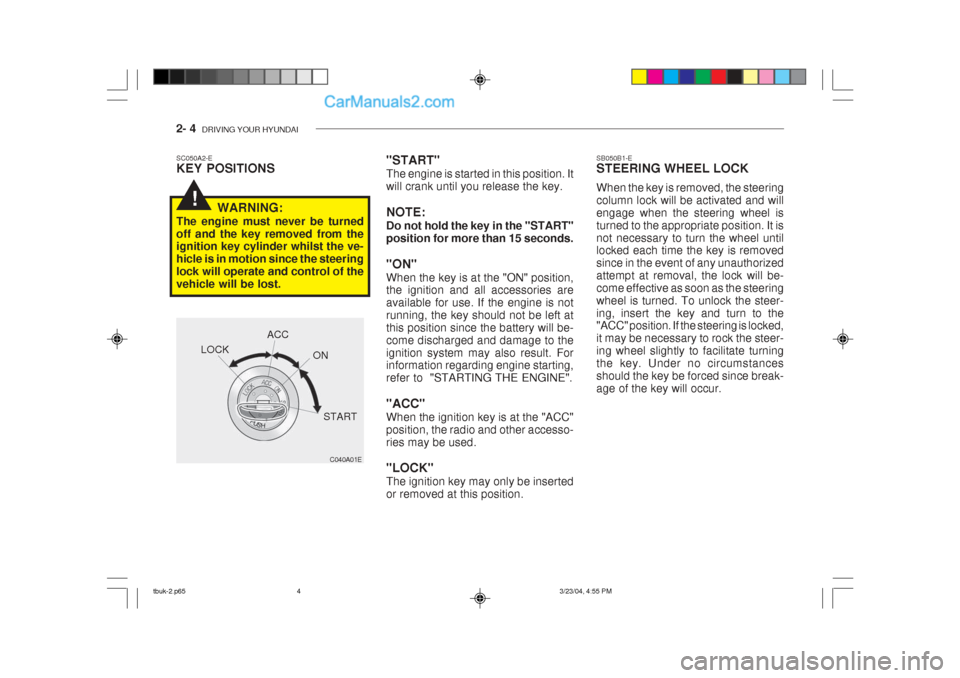
"START" The engine is started in this position. It will crank until you release the key. NOTE: Do not hold the key in the "START" position for more than 15 seconds. "ON" When the key is at the "ON" position, the ignition and all accessories are available for use. If the engine is notrunning, the key should not be left atthis position since the battery will be-come discharged and damage to theignition system may also result. For information regarding engine starting, refer to "STARTING THE ENGINE". "ACC" When the ignition key is at the "ACC" position, the radio and other accesso-ries may be used. "LOCK" The ignition key may only be inserted or removed at this position.SC050A2-E KEY POSITIONS
C040A01E
LOCK
ACC
ON
START
WARNING:
The engine must never be turned off and the key removed from the ignition key cylinder whilst the ve- hicle is in motion since the steeringlock will operate and control of thevehicle will be lost. SB050B1-E STEERING WHEEL LOCK When the key is removed, the steering column lock will be activated and willengage when the steering wheel isturned to the appropriate position. It isnot necessary to turn the wheel until locked each time the key is removed since in the event of any unauthorizedattempt at removal, the lock will be-come effective as soon as the steeringwheel is turned. To unlock the steer-ing, insert the key and turn to the "ACC" position. If the steering is locked, it may be necessary to rock the steer-ing wheel slightly to facilitate turningthe key. Under no circumstancesshould the key be forced since break-age of the key will occur.
tbuk-2.p65
3/23/04, 4:55 PM
4
Page 348 of 445
DRIVING YOUR HYUNDAI 2- 5
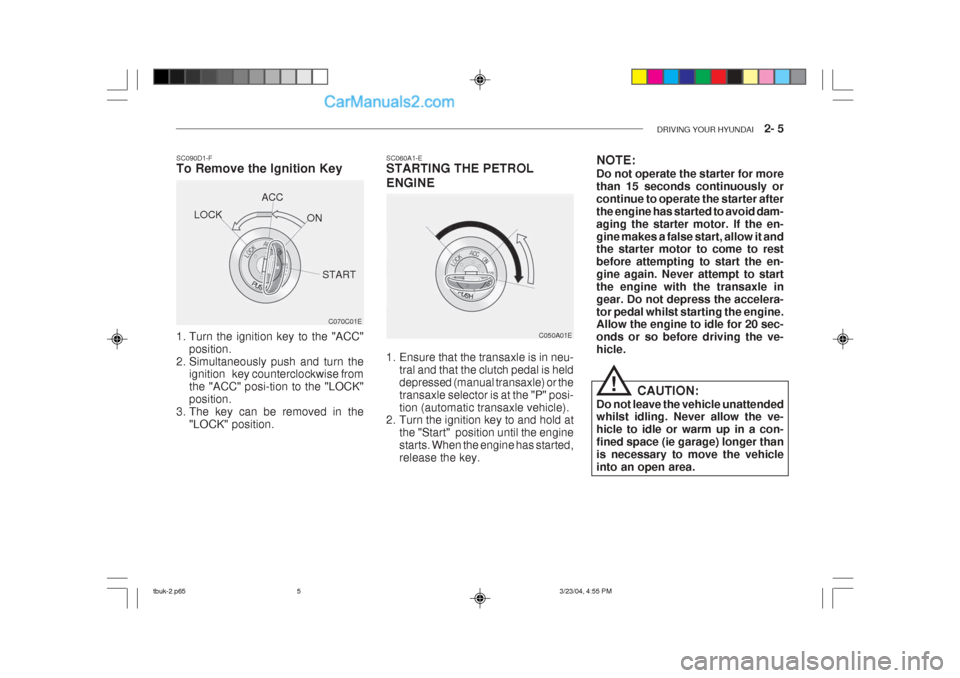
SC060A1-E STARTING THE PETROL ENGINE
C050A01E
1. Ensure that the transaxle is in neu- tral and that the clutch pedal is held depressed (manual transaxle) or thetransaxle selector is at the "P" posi-tion (automatic transaxle vehicle).
2. Turn the ignition key to and hold at
the "Start" position until the enginestarts. When the engine has started,release the key.
C070C01E
SC090D1-F To Remove the Ignition Key
1. Turn the ignition key to the "ACC"
position.
2. Simultaneously push and turn the ignition key counterclockwise from the "ACC" posi-tion to the "LOCK"position.
3. The key can be removed in the
"LOCK" position.LOCK
ACC
ON
START NOTE: Do not operate the starter for more than 15 seconds continuously orcontinue to operate the starter afterthe engine has started to avoid dam-aging the starter motor. If the en-gine makes a false start, allow it and the starter motor to come to rest before attempting to start the en-gine again. Never attempt to startthe engine with the transaxle ingear. Do not depress the accelera-tor pedal whilst starting the engine. Allow the engine to idle for 20 sec- onds or so before driving the ve-hicle.
CAUTION:
Do not leave the vehicle unattended whilst idling. Never allow the ve- hicle to idle or warm up in a con-fined space (ie garage) longer thanis necessary to move the vehicleinto an open area.
!
tbuk-2.p65 3/23/04, 4:55 PM
5
Page 349 of 445
2- 6 DRIVING YOUR HYUNDAI
C050B01HP
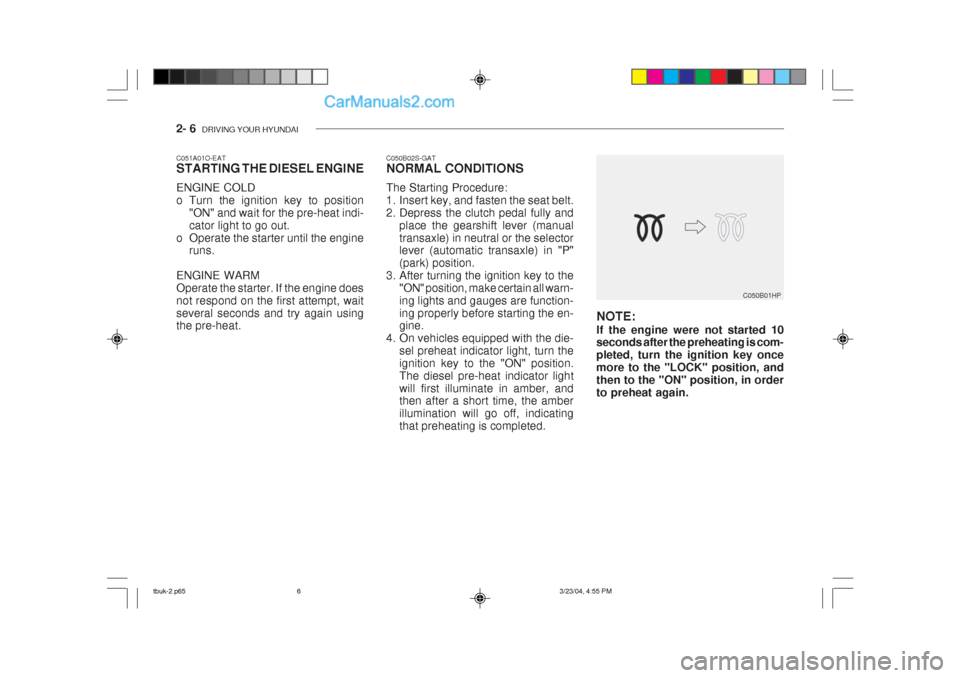
NOTE: If the engine were not started 10 seconds after the preheating is com- pleted, turn the ignition key oncemore to the "LOCK" position, andthen to the "ON" position, in orderto preheat again.
C051A01O-EAT STARTING THE DIESEL ENGINE ENGINE COLD
o Turn the ignition key to position
"ON" and wait for the pre-heat indi-cator light to go out.
o Operate the starter until the engine runs.
ENGINE WARMOperate the starter. If the engine doesnot respond on the first attempt, waitseveral seconds and try again using the pre-heat. C050B02S-GAT NORMAL CONDITIONS The Starting Procedure:
1. Insert key, and fasten the seat belt.
2. Depress the clutch pedal fully and
place the gearshift lever (manualtransaxle) in neutral or the selector lever (automatic transaxle) in "P" (park) position.
3. After turning the ignition key to the
"ON" position, make certain all warn-ing lights and gauges are function-ing properly before starting the en- gine.
4. On vehicles equipped with the die-
sel preheat indicator light, turn the ignition key to the "ON" position.The diesel pre-heat indicator lightwill first illuminate in amber, and then after a short time, the amber illumination will go off, indicatingthat preheating is completed.
tbuk-2.p65 3/23/04, 4:55 PM
6
Page 353 of 445
2- 10 DRIVING YOUR HYUNDAI
YC090A1-E SELECTOR POSITIONS o P (Park): With the selector in this position, no drive is transmitted from the engineand the transaxle output and thereforethe front wheels locked. The enginemay be started with the selector in this position.
!
CAUTION:
The selector must NEVER be shifted to the "P" position whilst the ve-hicle is in motion, otherwise seri-ous transaxle damage will result. DC110C1-E o R (Reverse): With the selector in this position, re- verse gear will be engaged. The en-gine may not be started with the selec-tor in this position.
CAUTION:
The selector must NEVER be shiftedto the "R" position whilst the ve-hicle is in motion.
! DC110D1-E o N (Neutral): With the selector in this position, no gear is selected and no drive is trans-mitted from the engine. The enginemay be started with the selector in thisposition.
!
CAUTION:
Do not coast with the selector at the "N" position. DC110E1-E o D (Drive): With the selector in this position, first gear will be engaged from rest and thetransmission will automatically upshiftto second, third and fourth depending upon the vehicle speed, throttle posi- tion and the position of the overdriveswitch. The engine may not be startedwith the selector in this position. DC110F1-E o 2 (Second Gear): With the selector in this position, first gear will be engaged from rest. Thetransmission will upshift to second geardepending upon the vehicle speed andthrottle position. No upshift to third or fourth will occur. The engine may not be started with the selector in thisposition. DC110G2-E o L (Low Gear): With the selector in this position, first gear will be engaged from rest. Noupshift will occur regardless of vehiclespeed and throttle opening. The en-gine may not be started with the selec-tor in this position.
!
CAUTION:
Do not move the selector to the "L" position when the vehicle speed isin excess of 50 m.p.h.
tbuk-2.p65 3/23/04, 4:55 PM
10
Page 356 of 445
DRIVING YOUR HYUNDAI 2- 13
SC140B1-E ANTI-LOCK BRAKE SYSTEM (Not all models) The Anti-Lock Brake System (ABS) is designed to prevent wheel lock-upduring sudden braking or on hazard-ous road surfaces. The ABS controlmodule monitors the wheel speed and controls the pressure applied to each brake. Thus, in emergency situationsor on slick roads, ABS will increasevehicle control during braking. NOTE: During ABS operation, a slight pul- sation may be felt in the brake pedal when the brakes are applied. Also, a noise may be heard in the enginecompartment whilst braking. Theseconditions are normal and indicatethat the anti-lock brake system isfunctioning properly.
located in the instrument cluster will beilluminated. When the overdrive switchis turned "ON", the transaxle functionsas a fully automatic four speed unitwith the maximum fuel economy po- tential of the vehicle being realized. SC140A1-E EFFECTIVE BRAKING Braking system performance and fric- tion material life are greatly affected by the driving style adopted. The follow-ing suggestions are made to assist inachieving the best results from thebraking system.
o Anticipate the road and conditions
ahead in order that heavy braking may be avoided.
o When descending long gradients,
use the engine to assist in retardingthe vehicle to minimize the possibil- ity of brake fade occurring.
o When trailer towing, ensure that the
trailer brakes function correctly and use engine braking to assist thevehicle braking system. o Use only genuine Hyundai replace-
ment brake pads and shoes to en-sure consistent friction characteris-tics and wear rates.
o After driving through deep water (e.g. fording), the brakes may be-come wet and performance reduced.Always check brake efficiency afteremerging from the water and dry thebrakes by lightly depressing thebrake pedal several times whilst driving slowly.
o Apply the parking brake only when the vehicle is at rest.
o Since the power assistance pro- vided by the brake servo is derived from the engine, coasting with the engine turned off or towing of the vehicle with the engine turned offwill result in greatly increased pedalpressures being required to stop thevehicle.
o Do not hold the vehicle on the up- grade with the accelerator pedal.This can cause the transmission tooverheat. Always use the brakepedal or parking brake.
tbuk-2.p65 3/23/04, 4:55 PM
13
Page 357 of 445
2- 14 DRIVING YOUR HYUNDAI
!WARNING:
ABS will not prevent accidents due to improper or dangerous drivingmaneuvers. Even though vehicle control is improved during emer- gency braking, always maintain asafe distance between you and ob-jects ahead. Vehicle speeds shouldalways be reduced during extremeroad conditions. The braking distance for cars equipped with an anti-lock brakingsystem may be longer than for thosewithout it in the following road con-ditions.
o Driving on rough, gravel or snow- covered roads.
o Driving with tyre chains installed.
o Driving on roads where the road
surface is pitted or has differentsurface height. These roads should be driven at reduced speeds. The safety features of an ABS equipped vehicle shouldnot be tested by high speed drivingor cornering. This could endangerthe safety of yourself or others. SC150A1-F DRIVING FOR ECONOMY You can save fuel and get more miles from your car if you follow these sug-gestions:
o Drive smoothly. Accelerate at a
moderate rate. Don't make "jack- rabbit" starts or full-throttle shiftsand maintain a steady cruisingspeed. Don't race between stop-lights. Try to adjust your speed tothat of the other traffic so you don't have to change speeds unneces- sarily.Avoid heavy traffic whenever pos-sible. Al-ways maintain a safe dis-tance from other vehicles so youcan avoid unnecessary braking. This also reduces brake wear. o Drive at a moderate speed. The
faster you drive, the more fuel your car uses. Driving at a moderatespeed, especially on the highway, isone of the most effective ways to reduce fuel consumption.
o Don't "ride" the brake or clutch pedal. This can increase fuel consumption and also increase wear on thesecomponents. In addition, driving withyour foot resting on the brake pedal may cause the brakes to overheat, which reduces their effectivenessand may lead to more serious con-sequences.
o Take care of your tyres. Keep them inflated to the recommended pres- sure. Incorrect infla-tion, either too much or too little, results in unnec-essary tyre wear. Check the tyrepres-sures at least once a month.
o Be sure that the wheels are aligned correctly. Improper alignment can result from hitting curbs or driving too fast over irregular surfaces. Pooralignment causes faster tyre wearand may also result in other prob-lems as well as greater fuel con-sumption.
tbuk-2.p65 3/23/04, 4:55 PM
14