heating Hyundai Getz 2004 Service Manual
[x] Cancel search | Manufacturer: HYUNDAI, Model Year: 2004, Model line: Getz, Model: Hyundai Getz 2004Pages: 445, PDF Size: 12.16 MB
Page 363 of 445
2- 20 DRIVING YOUR HYUNDAI
When being passed by a large ve- hicle, keep a constant speed andsteer straight ahead. If there is toomuch wind buffeting slow down toget out of the other vehicle's air turbulence.
8. When parking your car and trailer, especially on a hill, be sure to follow all the normal precautions. Turn yourfront wheel into the curb, set theparking brake firmly, and put the transaxle in 1st or Reverse (manual) or Park (automatic). In addition,place wheel chocks at each of thetrailer's tyres.
9. If the trailer has electric brakes,
start your vehicle and trailer mov- ing, and then apply the trailer brake controller by hand to be sure thebrakes are working. This lets youcheck your electrical connection atthe same time.
10. During your trip, check occasion- ally to be sure that the load issecure, and that the lights andany trailer brakes are still working.
11. Avoid jerky starts, sudden accel- eration or sudden stops.
12. Avoid sharp turns and rapid lane changes. 13. Avoid holding the brake pedal
down too long or too frequently.This could cause the brakes tooverheat, resulting in reduced brak-ing efficiency.
14. When going down a hill, shift into
a lower gear and use the enginebraking effect.When ascending a long grade,
downshift the transaxle to a lowergear and reduce speed to reduce chances of engine overloading and/ or overheating.
15. If you have to stop while going
uphill, do not hold the vehicle inplace by pressing on the accelera-tor. This can cause the automatic transaxle to overheat. Use the park- ing brake or footbrake.
NOTE: When towing check transaxle fluid more frequently. CAUTION:
If overheating should occur whentowing, (temperature gauge reads near red zone), taking the following action may reduce or eliminate theproblem.
1. Turn off the air conditioner.
2. Reduce highway speed.
3. Select a lower gear when going uphill.
4. While in stop and go traffic, place the gear selection in park or neu- tral and idle the engine at a higherspeed.
!
tbuk-2.p65 3/23/04, 4:55 PM
20
Page 367 of 445
3- 4 WHAT TO DO IN AN EMERGENCY
!
!
D030A01TB-EAT
IF THE ENGINE OVERHEATS
If the temperature gauge indicates
overheating:
1. Pull off the road and stop as soon as
it is safe to do so.
2. Place the gear selector lever in "P" (automatic), or neutral (manual
transaxle) and set the parking brake.
If the air conditioning is on, turn it off.
3. If coolant is running out under the car
or steam is coming out from under
the bonnet stop the engine. Do not
open the bonnet until the coolant has
stopped running or the steaming has
stopped. If there is no visible loss of
coolant and no steam, leave the
engine running and check to be sure
the engine cooling fan is operating.
If the fan is not running, turn the
engine off.
4. Check to see if the water pump drive belt is missing. If it is not missing,
check to see that it is tight. If the
drive belt seems to be satisfactory,
check for coolant leaking from the
radiator, hoses or under the car. (If
the air conditioning had been in use,
it is normal for cold water to be
draining from it). WARNING:
Whilst the engine is running, keep
hands and clothing away from mov-
ing parts such as the fan and drive
belts to prevent injury.
7. Switch ON the main beam
headlamps before carefully remov-
ing the jumper cables in the reverse
order of attachment. Once the
jumper cables have been removed,
switch "OFF" the main beam
headlamps.
CAUTION:
If the jump cable is incorrectly in-
stalled, damage to the vehicle elec-
trical system may occur, in particu-
lar the electronic components such
as the Fuel Injection system com-
puter and the Automatic transaxle
computer. The battery must never
be disconnected whilst the engine
is running.
!
WARNING (Diesel only):
Never work on injection system with
engine running or within 30 sec-
onds after shutting off engine. High
pressure pump, rail, injectors and
high pressure pipes are subject to
high pressure even after the engine
stopped. The fuel jet produced by
fuel leaks may cause serious in-
jury, if it touch the body. People
using pacemakers should not move
than 30cm closer to the ECU or
wiring harness within the engine
room while engine is running, since
the high currents in the Common
Rail system produce considerable
magnetic fields.
tbuk-3.p65 3/23/04, 4:24 PM
4
Page 368 of 445
WHAT TO DO IN AN EMERGENCY 3- 5
!
D040A01TB-EAT
TEMPORARY SPARE TYRE
(Not all models)
The following instructions for the tem-
porary spare tyre should be observed:
1. Check inflation pressure as soon as
practical after installing the spare
tyre, and adjust to the specified
pressure. The tyre pressure should
be periodically checked and main-
tained at the specified pressure
while the tyre is stored.
6. If the cause of the overheating can- not be found, wait until the engine
temperature has returned to nor-
mal. Then, if coolant has been lost,
carefully remove the radiator cap
and add water to bring the fluid level
in the reservoir up to the base of the
radiator fill opening. Fill the coolant
expansion tank to the halfway mark.
7. Proceed with caution until it is es-
tablished that the engine is operat-
ing normally. If the engine over-
heats repeatedly, the advice of a
Hyundai dealer should be sought. WARNING:
Do not remove the radiator cap when
the engine is hot since steam and
boiling water may be ejected from
the radiator resulting in burns or
scalding.
Inflation Pressure
Tyre Size
T105/70D14
420 kPa (60 psi)
2. The spare tyre should only be used temporarily and should be returned
to the luggage compartment as soon
as the original tyre can be repaired
or replaced.
3. Continuous use at speeds of over 50 mph(80 km/h) is not recom-
mended.
4. As the temporary spare tyre is spe- cifically designed for your car, it
should not be used on any other
vehicle.
Spare Tyre Pressure
YD050A1-E
SPARE TYRE
For Full Size (Not all models)
The following instructions for the FULL
SIZE spare tyre should be observed:
Check inflation pressure as soon as
possible after installing the spare tyre,
and adjust to the specified pressure.
The tyre pressure should be periodi-
cally checked and maintained at the
specified pressure while the tyre is
stored.
Spare Tyre Pressure
Tyre Size
Inflation Pressure
FULL SIZE
30 psi (210 kPa)
5. If the water pump drive belt is bro-
ken or coolant is leaking out, stop
the engine immediately and call the
nearest Hyundai dealer for assis-
tance.
! CAUTION:
Serious loss of coolant indicates
there is a leak in the cooling system
and this should be checked as soon
as possible by a Hyundai dealer.
tbuk-3.p65 3/23/04, 4:24 PM
5
Page 381 of 445
CORROSION PREVENTION AND APPEARANCE CARE 4- 5
SE050E1-E WINDOWS A proprietary glass cleaner should be used to clean the inside of the win-dows. However, the rear heated wind- shield must only be cleaned using a light horizontal cleaning action. Careshould be exercised to avoid the use of abrasive cleaners or contact with items of jewellery which may damage theheating elements.
tbuk-4.p65 7/3/2008, 4:09 PM
5
Page 402 of 445
DO-IT-YOURSELF MAINTENANCE 6- 11
HTB170A
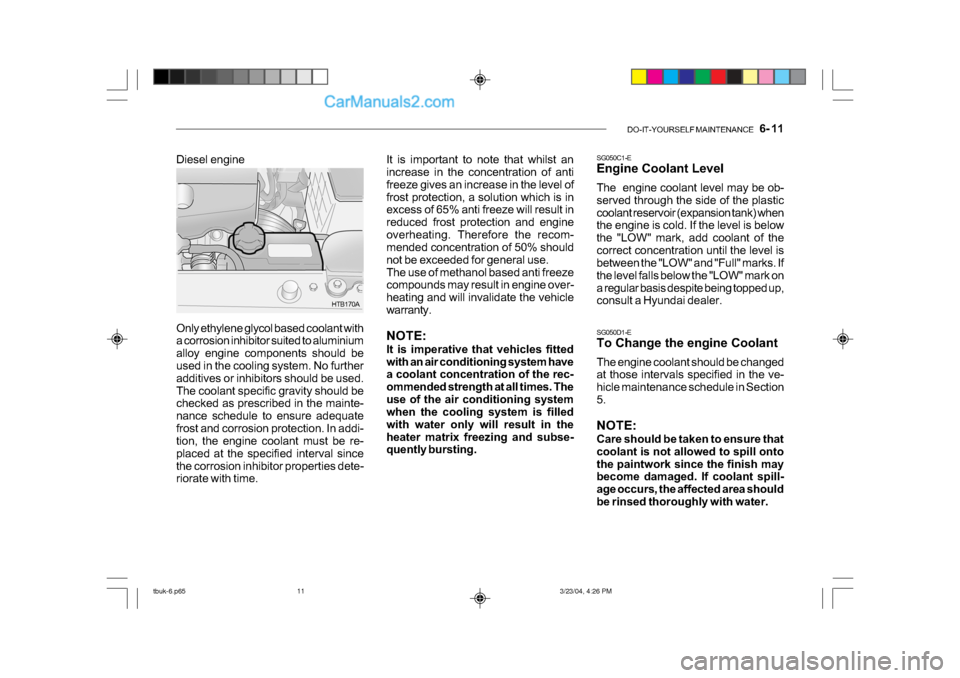
Diesel engine
Only ethylene glycol based coolant with
a corrosion inhibitor suited to aluminium
alloy engine components should be
used in the cooling system. No further
additives or inhibitors should be used.
The coolant specific gravity should be
checked as prescribed in the mainte-
nance schedule to ensure adequate
frost and corrosion protection. In addi-
tion, the engine coolant must be re-
placed at the specified interval since
the corrosion inhibitor properties dete-
riorate with time. It is important to note that whilst an
increase in the concentration of anti
freeze gives an increase in the level of
frost protection, a solution which is in
excess of 65% anti freeze will result in
reduced frost protection and engine
overheating. Therefore the recom-
mended concentration of 50% should
not be exceeded for general use.
The use of methanol based anti freeze
compounds may result in engine over-
heating and will invalidate the vehicle
warranty.
NOTE:
It is imperative that vehicles fitted
with an air conditioning system have
a coolant concentration of the rec-
ommended strength at all times. The
use of the air conditioning system
when the cooling system is filled
with water only will result in the
heater matrix freezing and subse-
quently bursting.
SG050C1-E
Engine Coolant Level
The engine coolant level may be ob-
served through the side of the plastic
coolant reservoir (expansion tank) when
the engine is cold. If the level is below
the "LOW" mark, add coolant of the
correct concentration until the level is
between the "LOW" and "Full" marks. If
the level falls below the "LOW" mark on
a regular basis despite being topped up,
consult a Hyundai dealer.
SG050D1-E
To Change the engine Coolant
The engine coolant should be changed
at those intervals specified in the ve-
hicle maintenance schedule in Section
5.
NOTE:
Care should be taken to ensure that
coolant is not allowed to spill onto
the paintwork since the finish may
become damaged. If coolant spill-
age occurs, the affected area should
be rinsed thoroughly with water.
tbuk-6.p65
3/23/04, 4:26 PM
11
Page 433 of 445
CONSUMER INFORMATION 8- 3
4.5Jx13
5.0Jx13
5.0Jx14
5.5Jx14
5.5Jx15
4.0Tx14 TYRE
SIZE
RIM
SIZE PRESSURE, kPa (PSI)
15/80R13
165/65R14
175/65R14
185/55R15
T105/70D14 REAR
210(30)
420(60) FRONT
230(33)
420(60)
UP TO 2
PERSONS UP TO
MAX. LOAD
REAR
230(33)
420(60)
FRONT
210(30)
420(60)
The engine number is stamped on the
engine block as shown in the drawing. I030A02TB-EAT
TYRE PRESSURES
In modern high-speed motoring, correct
tyre pressures are vitally important.
I010B01B
HTB263
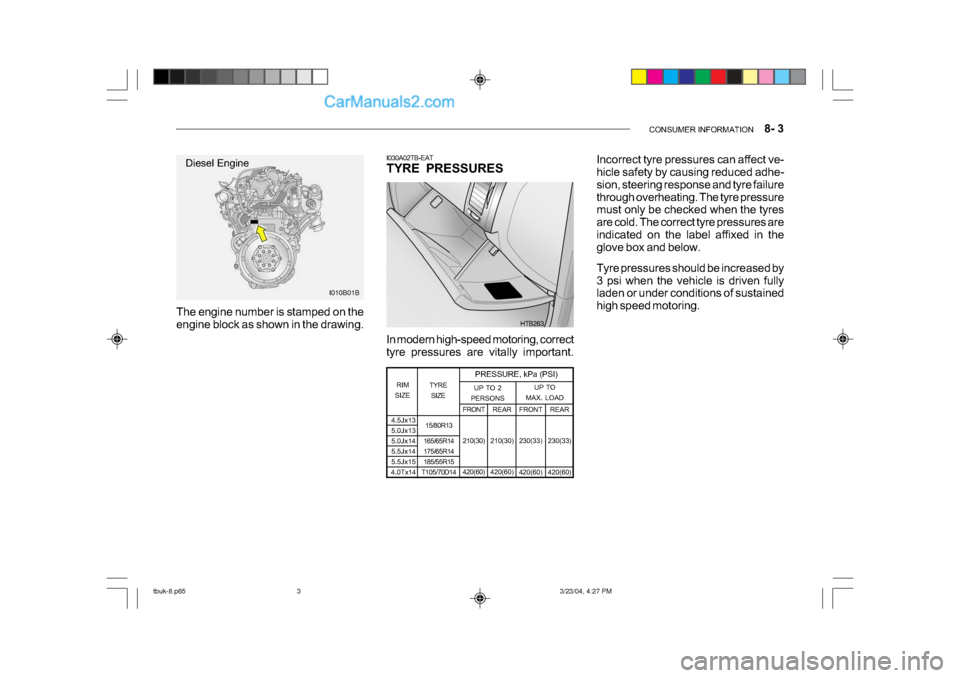
Diesel EngineIncorrect tyre pressures can affect ve-
hicle safety by causing reduced adhe-
sion, steering response and tyre failure
through overheating. The tyre pressure
must only be checked when the tyres
are cold. The correct tyre pressures are
indicated on the label affixed in the
glove box and below.
Tyre pressures should be increased by
3 psi when the vehicle is driven fully
laden or under conditions of sustained
high speed motoring.
tbuk-8.p65 3/23/04, 4:27 PM
3
Page 443 of 445
INDEX 10- 3
ENGINE OIL REPLENISHMENT ................................ 6-8
ENGINE OIL ................................................... ............ 6-6
F
FRONT ASHTRAY ... ................................................. 1-54
FRONT SEAT ................................................... ........1-11
FRONT FOG LIGHT SWITCH.................................. 1-52
FUEL ECONOMY ........ ............................................... 2-7
FUEL GAUGE ................................................... ........1-43
FUEL RECOMMENDATIONS ..................................... 1-1
FUSE PANEL DESCRI PTION.................................. 6-34
FUSIBLE LINKS ................................................... .....6-24
G
GLOVE BOX ................................................... ..........1-59
H
HAZARD WARNING SYSTEM .................................1-51
HEADLIGHT AIMING ADJUSTEMENT ....................6-27
HEADLIGHT BULB ................................................... 6-28
HEADLIGHT LEVELING DEVICE SYSTEM.............1-55
HEAD RESTRAINT ADJUSTMENT.......................... 1-14
HEATED REAR WINDOW ........................................1-52
HEATING AND COOLING CONTROL .....................1-71
HEIGHT ADJUSTABLE FRONT SEAT SHOULDER BELT ................................................ 1-19
HORN ................................................... .....................1-70
HOW TO USE LUGGAGE ROO M ............................1-66I
IF THE ENGINE CANNOT BE CRANKED
................. 3-2
IF THE ENGINE OVERHEATS ................................... 3-4
IF THE ENGINE WILL NOT START ........................... 3-2
IF THE EVENT OF A PUNCTURE ............................. 3-6
IMMOBILISER SYSTEM ............................................. 1-4
INDIVIDUAL CI RCUIT FUSES ................................. 6-24
INSTRUMENT CLUSTER AND INDICATORS .........1-37
INTERIOR LIGHT ................................................... ..1-58
INTERIOR REAR VIEW MIRROR ............................1-61
J
JUMP STARTING ..... .................................................. 3 -3
K
KEY POSITIONS ................................................... ..... 2-3
L
LIGHTING SWITCH .................................................. 1-49
LUGGAGE BOARD ...................................... .............1-67
LUGGAGE NET ................................................... .....1-67
LUGGAGE ROOM ................................................... .1-66
LUGGAGE UNDER TRAY........................................ 1-66
LUMBAR SUPPORT ADJUSTMENT........................ 1-13
tbuk-10.p65 3/23/04, 4:31 PM
3