check engine Hyundai Getz 2004 Workshop Manual
[x] Cancel search | Manufacturer: HYUNDAI, Model Year: 2004, Model line: Getz, Model: Hyundai Getz 2004Pages: 445, PDF Size: 12.16 MB
Page 298 of 445
1- 40 FEATURES OF YOUR HYUNDAI
!
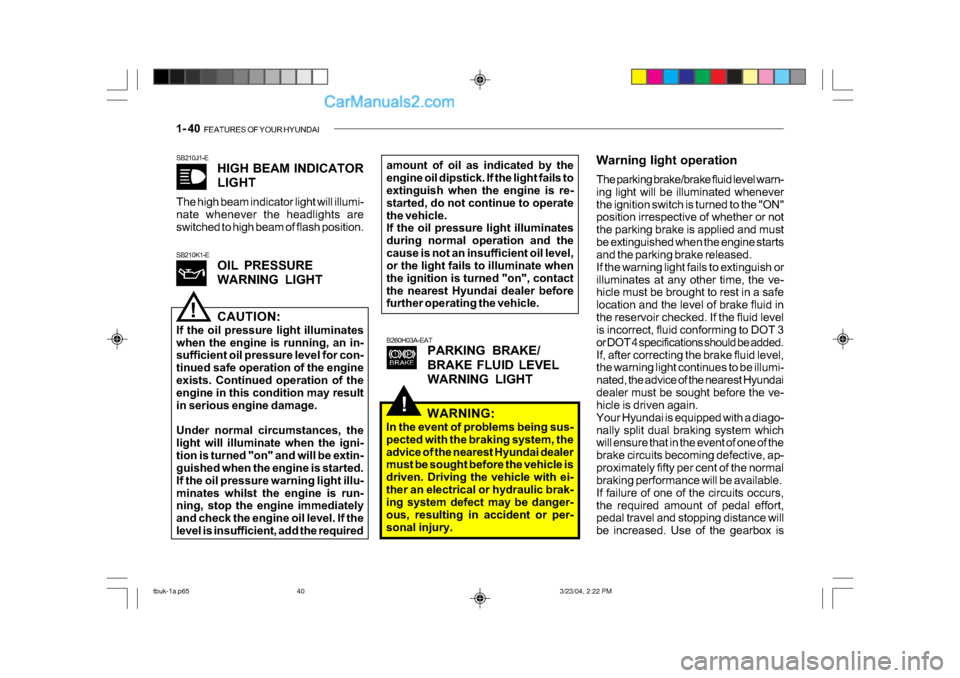
SB210J1-E
HIGH BEAM INDICATOR
LIGHT
The high beam indicator light will illumi-
nate whenever the headlights are
switched to high beam of flash position.
B260H03A-EATPARKING BRAKE/
BRAKE FLUID LEVEL
WARNING LIGHT
SB210K1-E
OIL PRESSURE
WARNING LIGHT
!CAUTION:
If the oil pressure light illuminates
when the engine is running, an in-
sufficient oil pressure level for con-
tinued safe operation of the engine
exists. Continued operation of the
engine in this condition may result
in serious engine damage.
Under normal circumstances, the
light will illuminate when the igni-
tion is turned "on" and will be extin-
guished when the engine is started.
If the oil pressure warning light illu-
minates whilst the engine is run-
ning, stop the engine immediately
and check the engine oil level. If the
level is insufficient, add the required amount of oil as indicated by the
engine oil dipstick. If the light fails to
extinguish when the engine is re-
started, do not continue to operate
the vehicle.
If the oil pressure light illuminates
during normal operation and the
cause is not an insufficient oil level,
or the light fails to illuminate when
the ignition is turned "on", contact
the nearest Hyundai dealer before
further operating the vehicle.
Warning light operation
The parking brake/brake fluid level warn-
ing light will be illuminated whenever
the ignition switch is turned to the "ON"
position irrespective of whether or not
the parking brake is applied and must
be extinguished when the engine starts
and the parking brake released.
If the warning light fails to extinguish or
illuminates at any other time, the ve-
hicle must be brought to rest in a safe
location and the level of brake fluid in
the reservoir checked. If the fluid level
is incorrect, fluid conforming to DOT 3
or DOT 4 specifications should be added.
If, after correcting the brake fluid level,
the warning light continues to be illumi-
nated, the advice of the nearest Hyundai
dealer must be sought before the ve-
hicle is driven again.
Your Hyundai is equipped with a diago-
nally split dual braking system which
will ensure that in the event of one of the
brake circuits becoming defective, ap-
proximately fifty per cent of the normal
braking performance will be available.
If failure of one of the circuits occurs,
the required amount of pedal effort,
pedal travel and stopping distance will
be increased. Use of the gearbox is
WARNING:
In the event of problems being sus-
pected with the braking system, the
advice of the nearest Hyundai dealer
must be sought before the vehicle is
driven. Driving the vehicle with ei-
ther an electrical or hydraulic brak-
ing system defect may be danger-
ous, resulting in accident or per-
sonal injury.
tbuk-1a.p65 3/23/04, 2:22 PM
40
Page 299 of 445
FEATURES OF YOUR HYUNDAI 1- 41
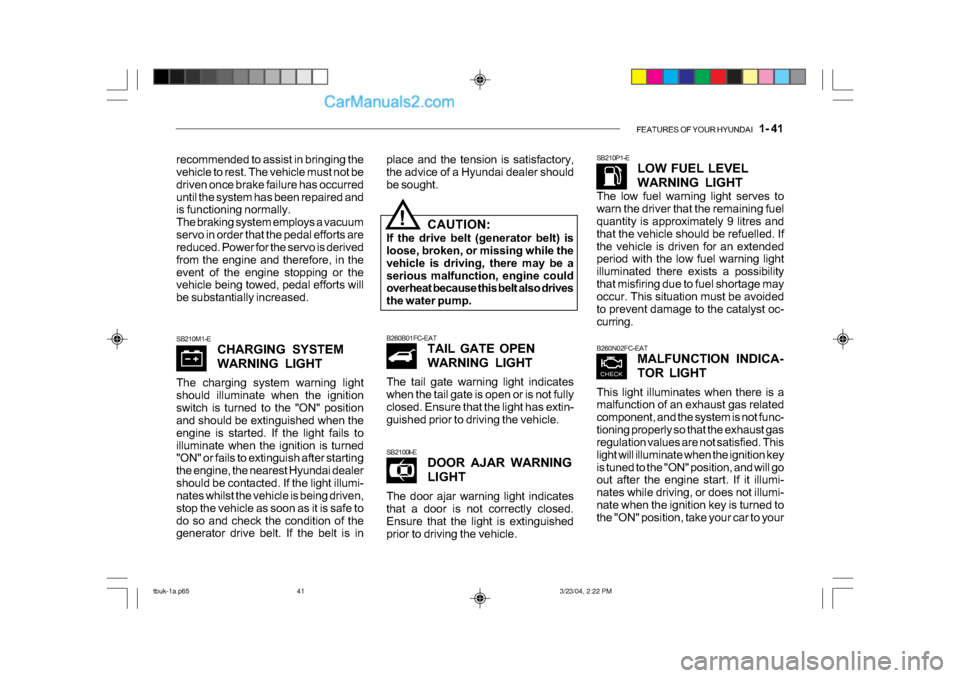
SB210M1-E
CHARGING SYSTEM
WARNING LIGHT
The charging system warning light
should illuminate when the ignition
switch is turned to the "ON" position
and should be extinguished when the
engine is started. If the light fails to
illuminate when the ignition is turned
"ON" or fails to extinguish after starting
the engine, the nearest Hyundai dealer
should be contacted. If the light illumi-
nates whilst the vehicle is being driven,
stop the vehicle as soon as it is safe to
do so and check the condition of the
generator drive belt. If the belt is in SB2100I-E
DOOR AJAR WARNING
LIGHT
The door ajar warning light indicates
that a door is not correctly closed.
Ensure that the light is extinguished
prior to driving the vehicle.
B260B01FC-EAT
TAIL GATE OPEN
WARNING LIGHT
The tail gate warning light indicates
when the tail gate is open or is not fully
closed. Ensure that the light has extin-
guished prior to driving the vehicle. SB210P1-E
LOW FUEL LEVEL
WARNING LIGHT
The low fuel warning light serves to
warn the driver that the remaining fuel
quantity is approximately 9 litres and
that the vehicle should be refuelled. If
the vehicle is driven for an extended
period with the low fuel warning light
illuminated there exists a possibility
that misfiring due to fuel shortage may
occur. This situation must be avoided
to prevent damage to the catalyst oc-
curring.
recommended to assist in bringing the
vehicle to rest. The vehicle must not be
driven once brake failure has occurred
until the system has been repaired and
is functioning normally.
The braking system employs a vacuum
servo in order that the pedal efforts are
reduced. Power for the servo is derived
from the engine and therefore, in the
event of the engine stopping or the
vehicle being towed, pedal efforts will
be substantially increased.
place and the tension is satisfactory,
the advice of a Hyundai dealer should
be sought.
CAUTION:
If the drive belt (generator belt) is
loose, broken, or missing while the
vehicle is driving, there may be a
serious malfunction, engine could
overheat because this belt also drives
the water pump.
!
B260N02FC-EAT MALFUNCTION INDICA-
TOR LIGHT
This light illuminates when there is a
malfunction of an exhaust gas related
component, and the system is not func-
tioning properly so that the exhaust gas
regulation values are not satisfied. This
light will illuminate when the ignition key
is tuned to the "ON" position, and will go
out after the engine start. If it illumi-
nates while driving, or does not illumi-
nate when the ignition key is turned to
the "ON" position, take your car to your
tbuk-1a.p65 3/23/04, 2:22 PM
41
Page 300 of 445
1- 42 FEATURES OF YOUR HYUNDAI
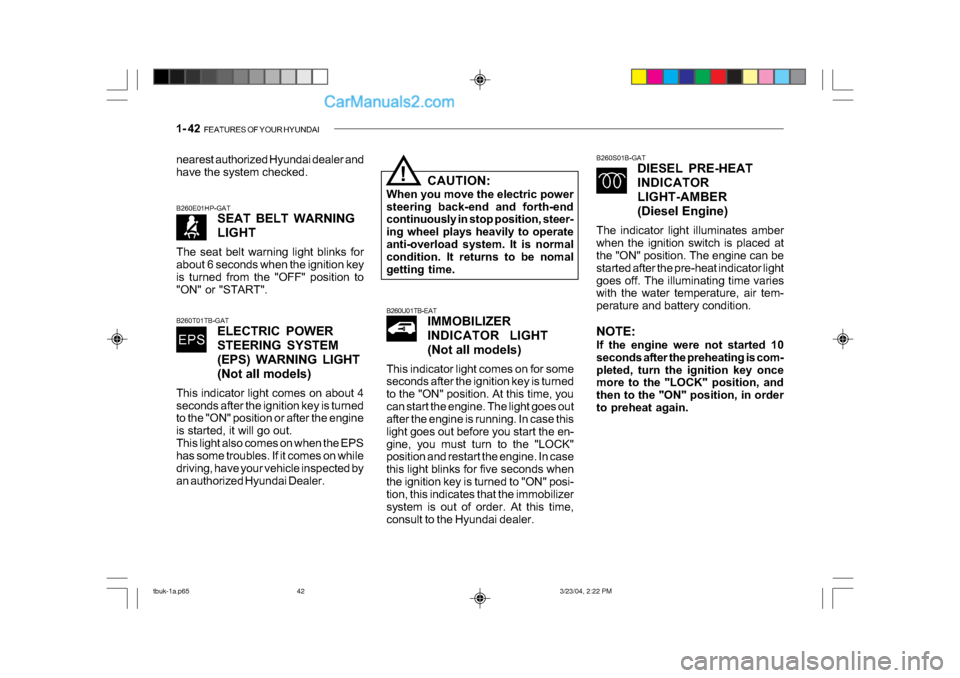
B260S01B-GAT
DIESEL PRE-HEAT
INDICATOR
LIGHT-AMBER
(Diesel Engine)
The indicator light illuminates amber
when the ignition switch is placed at
the "ON" position. The engine can be
started after the pre-heat indicator light
goes off. The illuminating time varies
with the water temperature, air tem-
perature and battery condition.
NOTE:
If the engine were not started 10
seconds after the preheating is com-
pleted, turn the ignition key once
more to the "LOCK" position, and
then to the "ON" position, in order
to preheat again.
B260T01TB-GAT
ELECTRIC POWER
STEERING SYSTEM
(EPS) WARNING LIGHT
(Not all models)
This indicator light comes on about 4
seconds after the ignition key is turned
to the "ON" position or after the engine
is started, it will go out.
This light also comes on when the EPS
has some troubles. If it comes on while
driving, have your vehicle inspected by
an authorized Hyundai Dealer. B260E01HP-GAT
SEAT BELT WARNING
LIGHT
The seat belt warning light blinks for
about 6 seconds when the ignition key
is turned from the "OFF" position to
"ON" or "START".
CAUTION:
When you move the electric power
steering back-end and forth-end
continuously in stop position, steer-
ing wheel plays heavily to operate
anti-overload system. It is normal
condition. It returns to be nomal
getting time.!
B260U01TB-EAT IMMOBILIZER
INDICATOR LIGHT
(Not all models)
This indicator light comes on for some
seconds after the ignition key is turned
to the "ON" position. At this time, you
can start the engine. The light goes out
after the engine is running. In case this
light goes out before you start the en-
gine, you must turn to the "LOCK"
position and restart the engine. In case
this light blinks for five seconds when
the ignition key is turned to "ON" posi-
tion, this indicates that the immobilizer
system is out of order. At this time,
consult to the Hyundai dealer.
nearest authorized Hyundai dealer and
have the system checked.
tbuk-1a.p65
3/23/04, 2:22 PM
42
Page 302 of 445
1- 44 FEATURES OF YOUR HYUNDAI
!
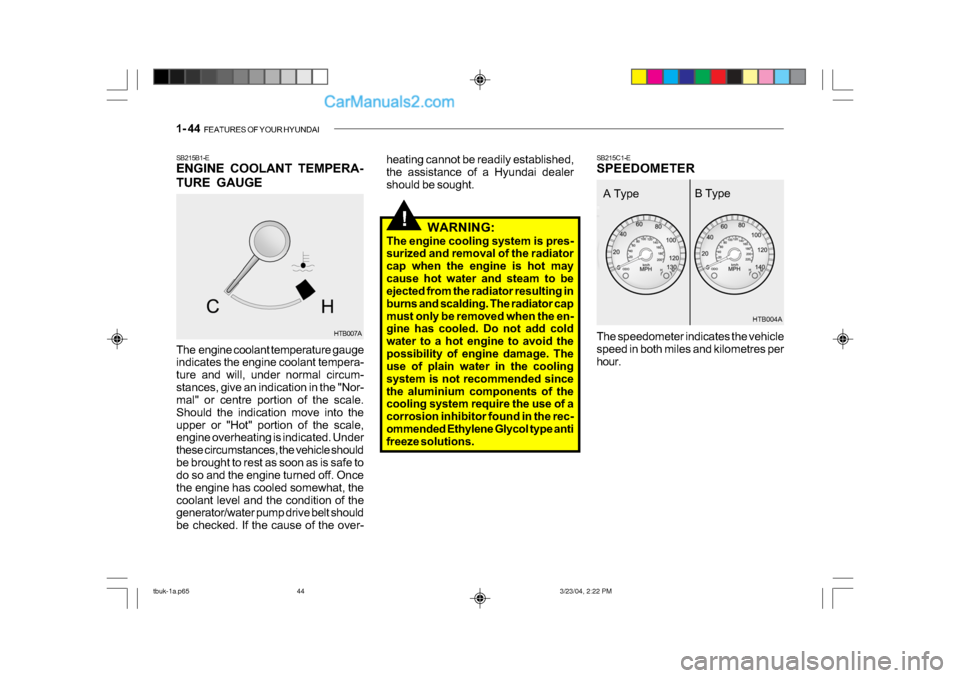
SB215B1-E
ENGINE COOLANT TEMPERA-
TURE GAUGE
The engine coolant temperature gauge
indicates the engine coolant tempera-
ture and will, under normal circum-
stances, give an indication in the "Nor-
mal" or centre portion of the scale.
Should the indication move into the
upper or "Hot" portion of the scale,
engine overheating is indicated. Under
these circumstances, the vehicle should
be brought to rest as soon as is safe to
do so and the engine turned off. Once
the engine has cooled somewhat, the
coolant level and the condition of the
generator/water pump drive belt should
be checked. If the cause of the over- SB215C1-E
SPEEDOMETER
HTB007A
heating cannot be readily established,
the assistance of a Hyundai dealer
should be sought.
HTB004A
The speedometer indicates the vehicle
speed in both miles and kilometres per
hour.
WARNING:
The engine cooling system is pres-
surized and removal of the radiator
cap when the engine is hot may
cause hot water and steam to be
ejected from the radiator resulting in
burns and scalding. The radiator cap
must only be removed when the en-
gine has cooled. Do not add cold
water to a hot engine to avoid the
possibility of engine damage. The
use of plain water in the cooling
system is not recommended since
the aluminium components of the
cooling system require the use of a
corrosion inhibitor found in the rec-
ommended Ethylene Glycol type anti
freeze solutions.
A Type B Type
tbuk-1a.p65
3/23/04, 2:22 PM
44
Page 321 of 445
FEATURES OF YOUR HYUNDAI 1- 63
!
SB440A2-E
REMOTE FUEL FILLER LID
RELEASE (Not all models)
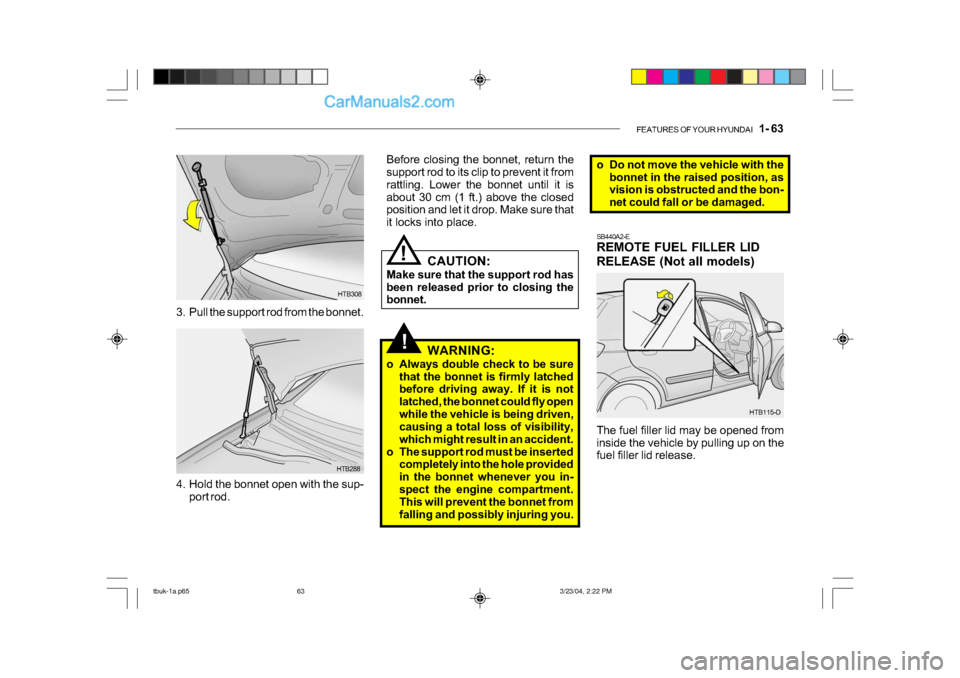
The fuel filler lid may be opened from
inside the vehicle by pulling up on the
fuel filler lid release.
HTB115-D
Before closing the bonnet, return the
support rod to its clip to prevent it from
rattling. Lower the bonnet until it is
about 30 cm (1 ft.) above the closed
position and let it drop. Make sure that
it locks into place.
HTB288
3. Pull the support rod from the bonnet.
HTB308
CAUTION:
Make sure that the support rod has
been released prior to closing the
bonnet.
4. Hold the bonnet open with the sup- port rod. WARNING:
o Always double check to be sure that the bonnet is firmly latched
before driving away. If it is not
latched, the bonnet could fly open
while the vehicle is being driven,
causing a total loss of visibility,
which might result in an accident.
o The support rod must be inserted completely into the hole provided
in the bonnet whenever you in-
spect the engine compartment.
This will prevent the bonnet from
falling and possibly injuring you. o Do not move the vehicle with the
bonnet in the raised position, as
vision is obstructed and the bon-
net could fall or be damaged.
!
tbuk-1a.p65 3/23/04, 2:22 PM
63
Page 326 of 445
1- 68 FEATURES OF YOUR HYUNDAI
!
B560B01O-EAT
AUTO FUEL CUT SWITCH
(Petrol Engine)
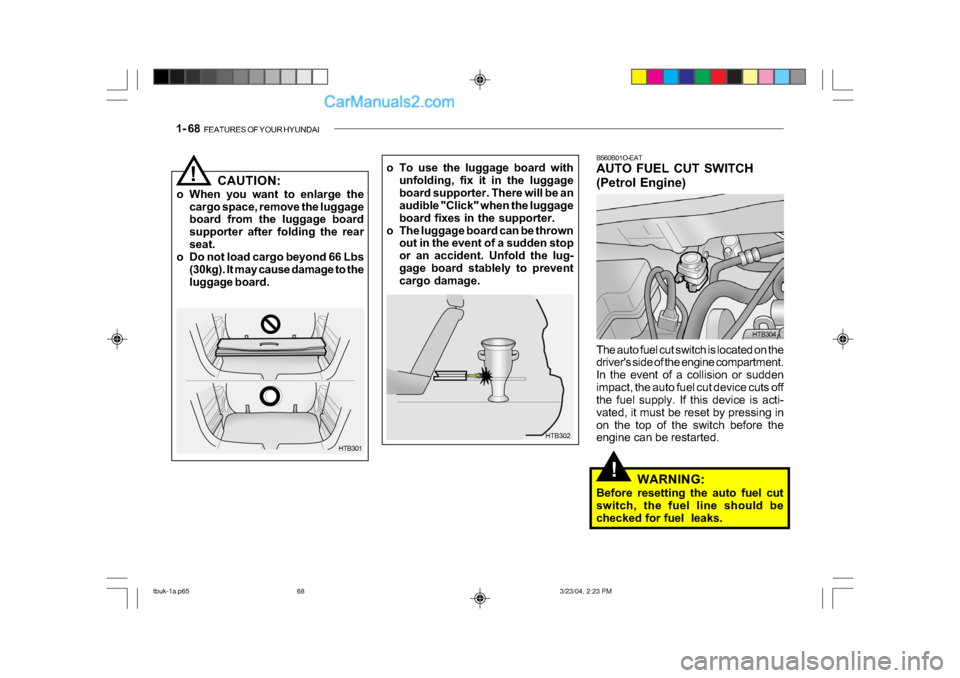
The auto fuel cut switch is located on the
driver's side of the engine compartment.
In the event of a collision or sudden
impact, the auto fuel cut device cuts off
the fuel supply. If this device is acti-
vated, it must be reset by pressing in
on the top of the switch before the
engine can be restarted. HTB304
WARNING:
Before resetting the auto fuel cut
switch, the fuel line should be
checked for fuel leaks.
o To use the luggage board with
unfolding, fix it in the luggage
board supporter. There will be an
audible "Click" when the luggage
board fixes in the supporter.
o The luggage board can be thrown out in the event of a sudden stop
or an accident. Unfold the lug-
gage board stablely to prevent
cargo damage.
HTB302
CAUTION:
o When you want to enlarge the cargo space, remove the luggage
board from the luggage board
supporter after folding the rear
seat.
o Do not load cargo beyond 66 Lbs
(30kg). It may cause damage to the
luggage board.
HTB301!
tbuk-1a.p65 3/23/04, 2:23 PM
68
Page 337 of 445
FEATURES OF YOUR HYUNDAI 1- 79
!
B760A01Y
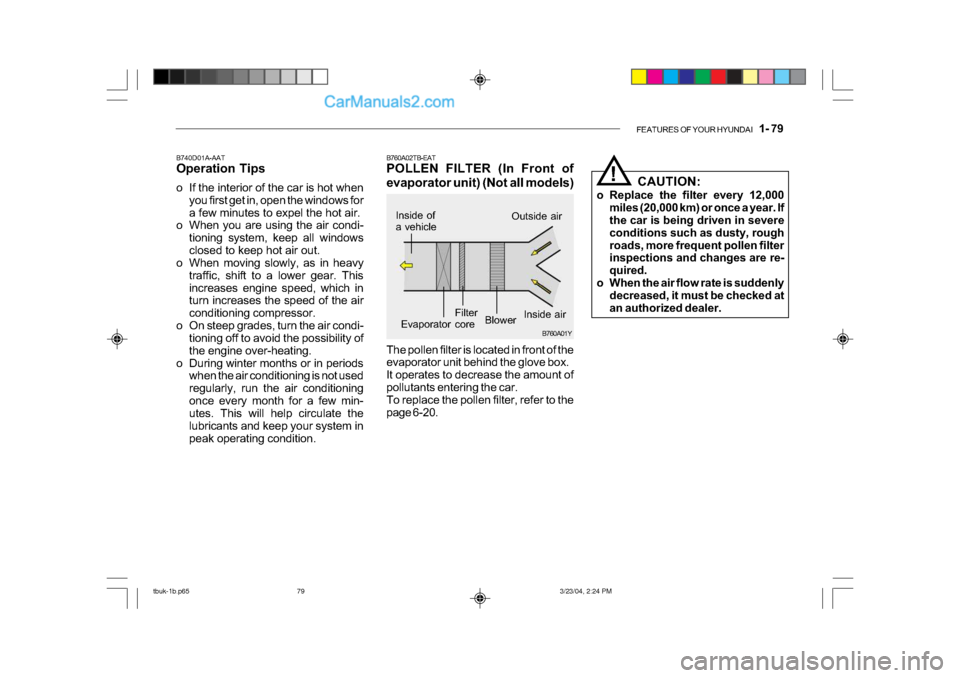
The pollen filter is located in front of the
evaporator unit behind the glove box.
It operates to decrease the amount of
pollutants entering the car.
To replace the pollen filter, refer to the
page 6-20.
B760A02TB-EAT
POLLEN FILTER (In Front of
evaporator unit) (Not all models)
B740D01A-AAT
Operation Tips
o If the interior of the car is hot when
you first get in, open the windows for
a few minutes to expel the hot air.
o When you are using the air condi-
tioning system, keep all windows
closed to keep hot air out.
o When moving slowly, as in heavy
traffic, shift to a lower gear. This
increases engine speed, which in
turn increases the speed of the air
conditioning compressor.
o On steep grades, turn the air condi- tioning off to avoid the possibility of
the engine over-heating.
o During winter months or in periods when the air conditioning is not used
regularly, run the air conditioning
once every month for a few min-
utes. This will help circulate the
lubricants and keep your system in
peak operating condition. Inside of
a vehicle
Evaporator core
Filter
BlowerOutside air
Inside air CAUTION:
o Replace the filter every 12,000 miles (20,000 km) or once a year. If
the car is being driven in severe
conditions such as dusty, rough
roads, more frequent pollen filter
inspections and changes are re-
quired.
o When the air flow rate is suddenly decreased, it must be checked at
an authorized dealer.
tbuk-1b.p65 3/23/04, 2:24 PM
79
Page 346 of 445
DRIVING YOUR HYUNDAI 2- 3
!
C020A01O-EAT BEFORE STARTING THE EN- GINE Before you start the engine, you should always:
1. Look around the vehicle to be sure
there are no flat tyres, puddles of oil or water or other indications of pos- sible trouble.
2. After entering the car, check to be
sure the parking brake is engaged.
3. Check that all windows, and lights are clean.
4. Check that the interior and exterior
mirrors are clean and in position.
5. Check your seat, seatback and
headrestraint to be sure they are intheir proper positions.
6. Close all the doors.
7. Fasten your seat belt and be sure
that all other occupants have fas- tened theirs.
8. Turn off all lights and accessories that are not needed.
9. When you turn the ignition switch to "ON" check that all appropriate warn-ing lights are operating and that youhave sufficient fuel. 10.Check the operation of warning
lights and all bulbs when key is inthe "ON" position.
WARNING: (DIESEL ENGINE)
To ensure that sufficient vacuum exists within the brake system dur-ing cold weather start-up condi-tions, it is necessary to run theengine at idle for several seconds after starting the engine. SC040A1-F COMBINATION IGNITION SWITCH AND STEERING LOCK To Start the Engine
o If your Hyundai is equipped with a
manual transaxle, place the shift lever in neutral and depress theclutch pedal fully.
o If your Hyundai has an automatic
transaxle, place the shift lever in "P" (park).
o To start the engine, insert the igni-
tion key and turn it to the "START" position. Release it as soon as theengine starts. Do not hold the key inthe "START" position for more that 15 seconds.
NOTE: For safety, the engine will not start if the shift lever is not in "P" or "N"Position (automatic transaxle).
tbuk-2.p65 3/23/04, 4:55 PM
3
Page 350 of 445
DRIVING YOUR HYUNDAI 2- 7
!
!
C055B01B-GAT STARTING AND STOPPING THE ENGINE FOR TURBO CHARGER INTERCOOLER (DIESEL EN-GINE)
(1) Do not race the engine or sudden
accelerate the engine immediately after start it. If the engine is cold,allow the engine to idle for severalseconds before it is driven to en-sure sufficient lubrication of the turbo charger unit.
(2) After high speed or extended driv- ing, requiring a heavy engine load, the engine should be allowed to idleabout 1 minute before turning it off.This idle time will allow the turbo charger to cool prior to shutting the engine off.
WARNING:
Do not turn the engine off immedi-ately after it has been subjected to a heavy load. Doing so may cause severe damage to the engine orturbo charger unit.
WARNING:
Be sure that the clutch is fully de-pressed when starting a manualtransaxle vehicle. Otherwise thereis the potential to cause damage tothe vehicle or injury to someone inside or outside the vehicle as a result of the forward or backwardmovement of the vehicle that willoccur if the clutch is not depressedwhen the vehicle is started. SC060B1-E FUEL ECONOMY The following suggestions are made to assist in achieving the greatest degreeof fuel economy.
o Maintaining a constant check on
fuel consumption will enable the most economical use pattern anddriving style to be adopted.
o Avoid using the vehicle for very short journeys if possible, particu-larly when a cold start is involved.
o Ensure that tyre pressures are main-
tained at the correct level.
o Use only the recommended grade
of fuel.
o Avoid carrying unnecessary weight,
and if a roof rack is in use, remove it as soon as possible after use.
o Anticipate the road and conditions ahead to enable adjustments in speed to be made smoothly. Avoidheavy acceleration and sharp brak-ing.
o Avoid cruising at unnecessary high
speeds.
5. Turn the ignition key to the "Start"
position and release it when theengine starts.
tbuk-2.p65 3/23/04, 4:55 PM
7
Page 354 of 445
DRIVING YOUR HYUNDAI 2- 11
C090H01A-EAT NOTE:
o The brake pedal should be de-
pressed when shifting from NEU- TRAL to a forward or reversegear.
o The brake pedal fully depressed
in order to move the shift lever from the "P" (Park) position to any of the other positions.
o It is always possible to shift from "R", "N", "D", "2", "L" position.
!
C090I02A-EAT
CAUTION:
o Shift into "R" and "P" only when the vehicle has completely stopped.
o Do not accelerate the engine in reverse or any of the forward positions with the brakes applied.
o Always apply the footbrake when shifting from "P" or "N", to "R", "D", "2" or "L" position.
o Do not use the "P" (Park) posi- tion in place of the parking brake. Always set the parking brake,shift the transaxle into "P" (Park)and turn off the ignition when you leave the vehicle, even mo- mentarily. Never leave the vehicleunattended whilst the engine isrunning.
o Check the automatic transaxle fluid level regularly, and add fluid as necessary. See the maintenance schedulefor the proper fluid recommen-dation. FC120D1-E General Operating Instructions
o The button in the selector handle
must be depressed before the se- lector can be moved.
o The engine may only be started
when the selector is at position "P" or "N".
o Ensure that the footbrake is firmly applied when shifting from "P" or "N" to "D", "2", "L" or "R" and viceversa.
o Always engage the parking brake when the vehicle is unattended,never use the "P" position in place ofthe parking brake.
o Under normal circumstances, the selector should be placed in the "D"position and the transaxle allowed to select the most ideal ratio for the circumstances. In this position maxi-mum fuel economy will be achieved.
o When descending steep gradients where engine braking is required,the selector should be placed at the "2" or "L" position depending upon the vehicle speed.
tbuk-2.p65 3/23/04, 4:55 PM
11