Air Hyundai Getz 2004 Manual Online
[x] Cancel search | Manufacturer: HYUNDAI, Model Year: 2004, Model line: Getz, Model: Hyundai Getz 2004Pages: 445, PDF Size: 12.16 MB
Page 260 of 445
1- 2 FEATURES OF YOUR HYUNDAI
B010A03O-EAT
FUEL RECOMMENDATIONS
Petrol Engines
THIS VEHICLE MUST ONLY BE OP-
ERATED WITH UNLEADED FUEL.
SERIOUS DAMAGE WILL RESULT
FROM THE USE OF LEADED FUEL. The use of leaded fuel in this vehicle will
result in irreversible pollution of the
catalyst element. Such pollution will
prevent correct operation of the cata-
lyst and give rise to increased operating
temperatures leading to the catalyst
element melting and restricting the ex-
haust flow along with an increase in
exhaust emission levels.
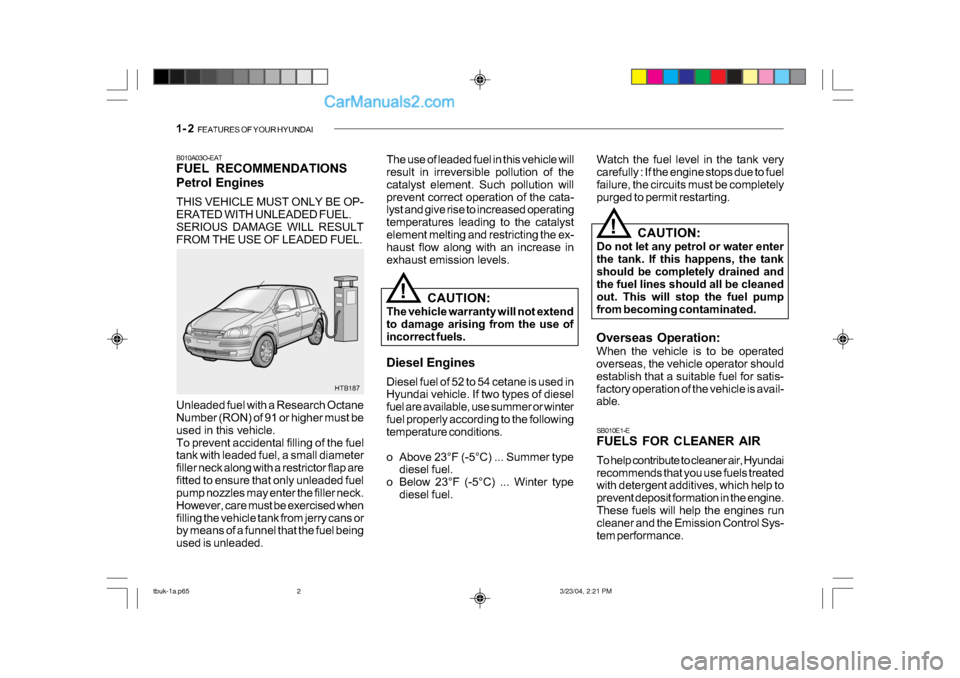
Unleaded fuel with a Research Octane
Number (RON) of 91 or higher must be
used in this vehicle.
To prevent accidental filling of the fuel
tank with leaded fuel, a small diameter
filler neck along with a restrictor flap are
fitted to ensure that only unleaded fuel
pump nozzles may enter the filler neck.
However, care must be exercised when
filling the vehicle tank from jerry cans or
by means of a funnel that the fuel being
used is unleaded. HTB187
!
CAUTION:
The vehicle warranty will not extend
to damage arising from the use of
incorrect fuels.
Diesel Engines
Diesel fuel of 52 to 54 cetane is used in
Hyundai vehicle. If two types of diesel
fuel are available, use summer or winter
fuel properly according to the following
temperature conditions.
o Above 23°F (-5°C) ... Summer type diesel fuel.
o Below 23°F (-5°C) ... Winter type diesel fuel.
! Watch the fuel level in the tank very
carefully : If the engine stops due to fuel
failure, the circuits must be completely
purged to permit restarting.
CAUTION:
Do not let any petrol or water enter
the tank. If this happens, the tank
should be completely drained and
the fuel lines should all be cleaned
out. This will stop the fuel pump
from becoming contaminated.
Overseas Operation:
When the vehicle is to be operated
overseas, the vehicle operator should
establish that a suitable fuel for satis-
factory operation of the vehicle is avail-
able. SB010E1-E
FUELS FOR CLEANER AIR
To help contribute to cleaner air, Hyundai
recommends that you use fuels treated
with detergent additives, which help to
prevent deposit formation in the engine.
These fuels will help the engines run
cleaner and the Emission Control Sys-
tem performance.
tbuk-1a.p65 3/23/04, 2:21 PM
2
Page 270 of 445
1- 12 FEATURES OF YOUR HYUNDAI
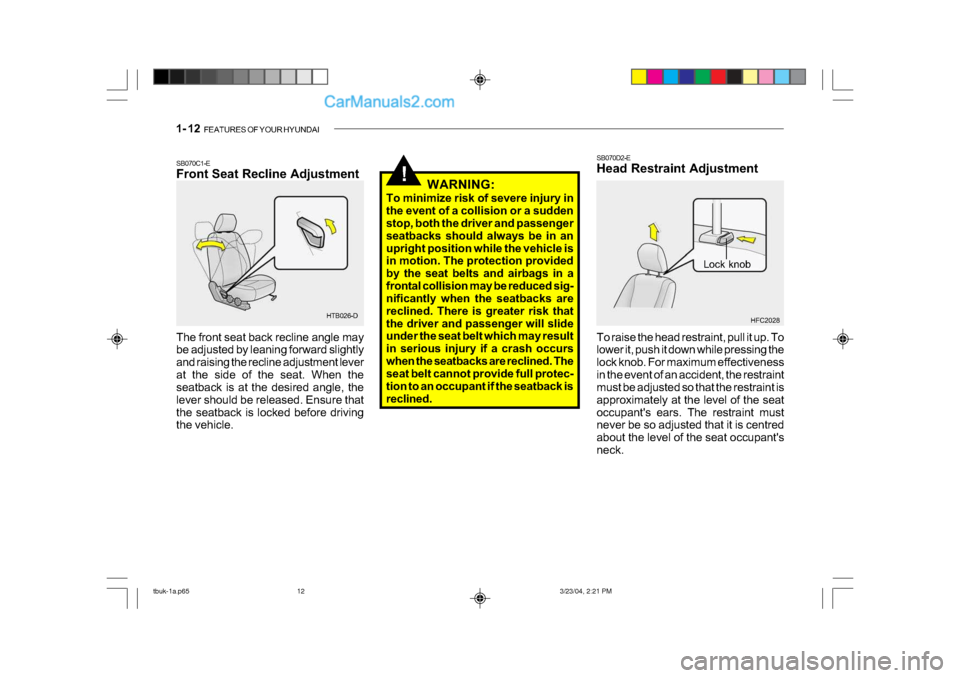
HFC2028
Lock knob
SB070D2-E
Head Restraint Adjustment
To raise the head restraint, pull it up. To
lower it, push it down while pressing the
lock knob. For maximum effectiveness
in the event of an accident, the restraint
must be adjusted so that the restraint is
approximately at the level of the seat
occupant's ears. The restraint must
never be so adjusted that it is centred
about the level of the seat occupant's
neck.SB070C1-E
Front Seat Recline Adjustment
HTB026-D
The front seat back recline angle may
be adjusted by leaning forward slightly
and raising the recline adjustment lever
at the side of the seat. When the
seatback is at the desired angle, the
lever should be released. Ensure that
the seatback is locked before driving
the vehicle.
!WARNING:
To minimize risk of severe injury in
the event of a collision or a sudden
stop, both the driver and passenger
seatbacks should always be in an
upright position while the vehicle is
in motion. The protection provided
by the seat belts and airbags in a
frontal collision may be reduced sig-
nificantly when the seatbacks are
reclined. There is greater risk that
the driver and passenger will slide
under the seat belt which may result
in serious injury if a crash occurs
when the seatbacks are reclined. The
seat belt cannot provide full protec-
tion to an occupant if the seatback is
reclined.
tbuk-1a.p65 3/23/04, 2:21 PM
12
Page 277 of 445
FEATURES OF YOUR HYUNDAI 1- 19
!
B170A01L
SB090K1-E
Replacement of Seat Belts
The entire seat belt assembly or as-
semblies should be replaced if the ve-
hicle has been involved in an accident
even if no damage is evident. Addi-
tional questions concerning seat belt
operation should be directed to a Hyundai
Dealer.
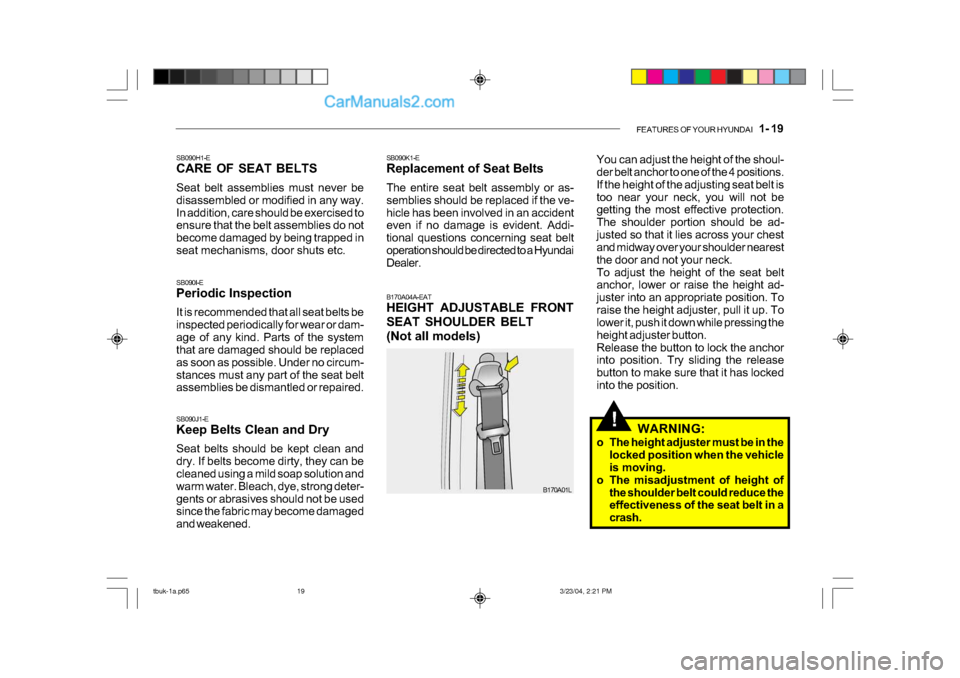
B170A04A-EAT
HEIGHT ADJUSTABLE FRONT
SEAT SHOULDER BELT
(Not all models)
You can adjust the height of the shoul-
der belt anchor to one of the 4 positions.
If the height of the adjusting seat belt is
too near your neck, you will not be
getting the most effective protection.
The shoulder portion should be ad-
justed so that it lies across your chest
and midway over your shoulder nearest
the door and not your neck.
To adjust the height of the seat belt
anchor, lower or raise the height ad-
juster into an appropriate position. To
raise the height adjuster, pull it up. To
lower it, push it down while pressing the
height adjuster button.
Release the button to lock the anchor
into position. Try sliding the release
button to make sure that it has locked
into the position.
WARNING:
o The height adjuster must be in the locked position when the vehicle
is moving.
o The misadjustment of height of the shoulder belt could reduce the
effectiveness of the seat belt in a
crash.
SB090H1-E
CARE OF SEAT BELTS
Seat belt assemblies must never be
disassembled or modified in any way.
In addition, care should be exercised to
ensure that the belt assemblies do not
become damaged by being trapped in
seat mechanisms, door shuts etc.
SB090I-E
Periodic Inspection
It is recommended that all seat belts be
inspected periodically for wear or dam-
age of any kind. Parts of the system
that are damaged should be replaced
as soon as possible. Under no circum-
stances must any part of the seat belt
assemblies be dismantled or repaired.
SB090J1-E
Keep Belts Clean and Dry
Seat belts should be kept clean and
dry. If belts become dirty, they can be
cleaned using a mild soap solution and
warm water. Bleach, dye, strong deter-
gents or abrasives should not be used
since the fabric may become damaged
and weakened.
tbuk-1a.p65
3/23/04, 2:21 PM
19
Page 281 of 445
FEATURES OF YOUR HYUNDAI 1- 23
Never allow children to ride in the
front passenger seat.
o Always make sure that the shoul-
der belt portion of the outboard
lap/shoulder belt is positioned
midway over the shoulder, never
across the neck or behind the
back. Moving the child closer to
the centre of the vehicle may help
provide a good shoulder belt fit.
The lap belt portion of the lap/
shoulder belt or the centre seat lap
belt must always be positioned as
low as possible on the child's hips
and as snug as possible.
o If the seat belt will not properly fit the child, Hyundai recommends
the use of an approved booster
seat in the rear seat in order to
raise the child's seating height so
that the seat belt will properly fit
the child.
o Never allow a child to stand up or kneel on the seat. o Never use an infant carrier or child
safety seat that "hooks" over a
seatback; it may not provide ad-
equate security in an accident.
o Never allow a child to be held in a person's arms while they are in a
moving vehicle, as this could re-
sult in serious injury to the child
in the event of an accident or a
sudden stop. Holding a child in a
moving vehicle does not provide
the child with any means of pro-
tection during an accident, even if
the person holding the child is
wearing a seat belt.
o If the child restraint seat is not
anchored properly, the risk of a
child being seriously injured or
killed in a collision greatly in-
creases.
WARNING:
o A child restraint system must be placed in the rear seat. Never in-
stall a child or infant seat on the
front passenger's seat.
Should an accident occur and
cause the passenger side airbag
to deploy, it could severely injure
or kill an infant or child seated in
an infant or child seat. Thus, only
use a child restraint in the rear
seat of your vehicle.
o Since a safety belt or child re-
straint system can become very
hot if it is left in a closed vehicle,
be sure to check the seat cover
and buckles before placing a child
there.
o When the child restraint system is
not in use, store it in the trunk or
fasten it with a safety belt so that it
will not be thrown forward in the
case of a sudden stop or an acci-
dent.
o Children who are too large to be in
a child restraint should sit in the
rear seat and be restrained with
the available lap/shoulder belts.!
tbuk-1a.p65 3/23/04, 2:21 PM
23
Page 282 of 445
1- 24 FEATURES OF YOUR HYUNDAI
!WARNING:
Do not install any child restraint sys-
tem in the front passenger seat.
Should an accident occur and cause
the passenger side airbag to deploy,
it could severely injure or kill an
infant or child seated in an infant or
child seat. Therefore, only use a child
restraint system in the rear seat of
your vehicle.
If you need to tighten the belt, pull more
webbing toward the retractor. When you
unbuckle the seat belt and allow it to
retract, the retractor will automatically
revert back to its normal seated pas-
senger emergency locking usage con-
dition.
NOTE:
o Before installing the child restraint
system, read the instructions sup-
plied by the child restraint system
manufacturer.
o If the seat belt does not operate as described, have the system
checked immediately by your au-
thorized Hyundai dealer.
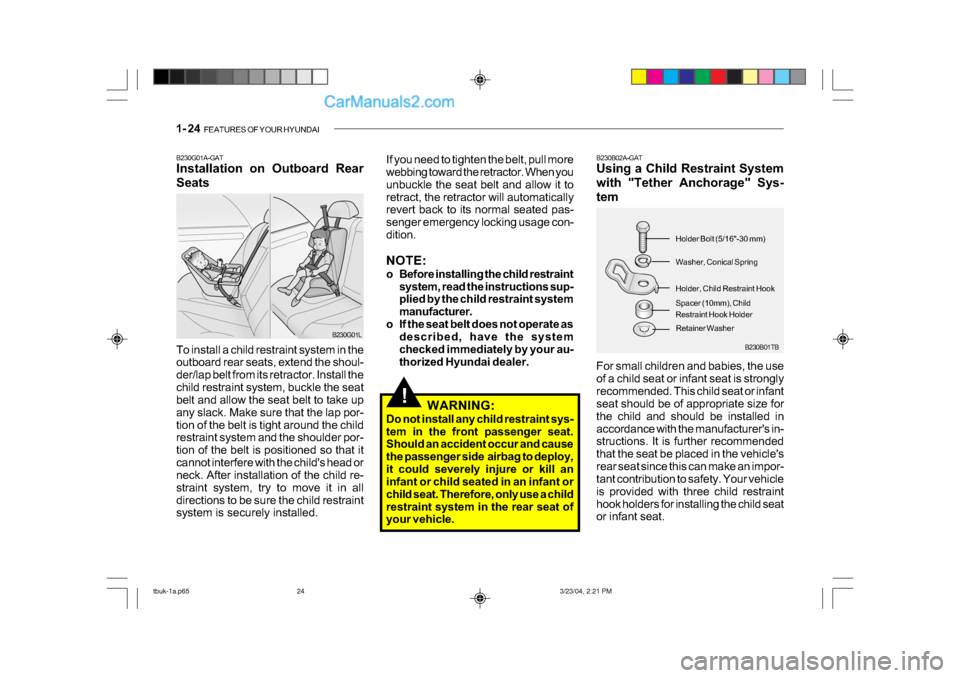
B230B01TB
B230B02A-GAT
Using a Child Restraint System
with "Tether Anchorage" Sys-
tem
For small children and babies, the use
of a child seat or infant seat is strongly
recommended. This child seat or infant
seat should be of appropriate size for
the child and should be installed in
accordance with the manufacturer's in-
structions. It is further recommended
that the seat be placed in the vehicle's
rear seat since this can make an impor-
tant contribution to safety. Your vehicle
is provided with three child restraint
hook holders for installing the child seat
or infant seat. Spacer (10mm), Child
Restraint Hook Holder
Holder Bolt (5/16"-30 mm)
Washer, Conical Spring
Holder, Child Restraint Hook
Retainer Washer
To install a child restraint system in the
outboard rear seats, extend the shoul-
der/lap belt from its retractor. Install the
child restraint system, buckle the seat
belt and allow the seat belt to take up
any slack. Make sure that the lap por-
tion of the belt is tight around the child
restraint system and the shoulder por-
tion of the belt is positioned so that it
cannot interfere with the child's head or
neck. After installation of the child re-
straint system, try to move it in all
directions to be sure the child restraint
system is securely installed.B230G01A-GAT
Installation on Outboard Rear
Seats
B230G01L
tbuk-1a.p65
3/23/04, 2:21 PM
24
Page 284 of 445
1- 26 FEATURES OF YOUR HYUNDAI
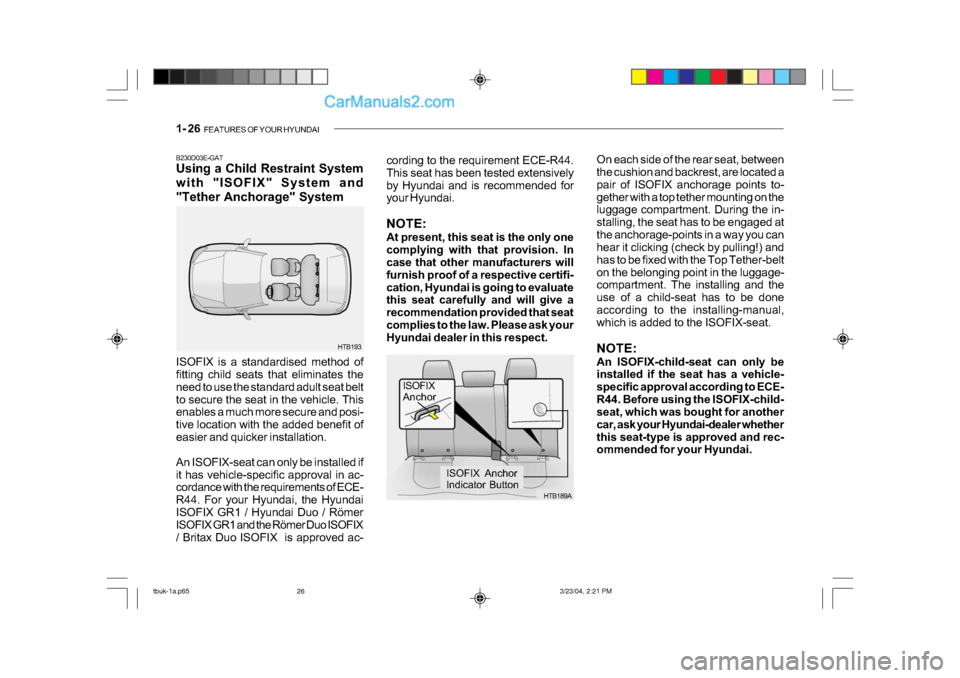
On each side of the rear seat, between
the cushion and backrest, are located a
pair of ISOFIX anchorage points to-
gether with a top tether mounting on the
luggage compartment. During the in-
stalling, the seat has to be engaged at
the anchorage-points in a way you can
hear it clicking (check by pulling!) and
has to be fixed with the Top Tether-belt
on the belonging point in the luggage-
compartment. The installing and the
use of a child-seat has to be done
according to the installing-manual,
which is added to the ISOFIX-seat.
NOTE:
An ISOFIX-child-seat can only be
installed if the seat has a vehicle-
specific approval according to ECE-
R44. Before using the ISOFIX-child-
seat, which was bought for another
car, ask your Hyundai-dealer whether
this seat-type is approved and rec-
ommended for your Hyundai.
cording to the requirement ECE-R44.
This seat has been tested extensively
by Hyundai and is recommended for
your Hyundai.
NOTE:
At present, this seat is the only one
complying with that provision. In
case that other manufacturers will
furnish proof of a respective certifi-
cation, Hyundai is going to evaluate
this seat carefully and will give a
recommendation provided that seat
complies to the law. Please ask your
Hyundai dealer in this respect.
HTB189A
ISOFIX
Anchor
ISOFIX Anchor
Indicator Button
B230D03E-GAT
Using a Child Restraint System
with "ISOFIX" System and
"Tether Anchorage" System
ISOFIX is a standardised method of
fitting child seats that eliminates the
need to use the standard adult seat belt
to secure the seat in the vehicle. This
enables a much more secure and posi-
tive location with the added benefit of
easier and quicker installation.
An ISOFIX-seat can only be installed if
it has vehicle-specific approval in ac-
cordance with the requirements of ECE-
R44. For your Hyundai, the Hyundai
ISOFIX GR1 / Hyundai Duo / R
Page 286 of 445
1- 28 FEATURES OF YOUR HYUNDAI
B180B01A-EAT
Pre-Tensioner Seat Belt
B180B01S-D
Your Hyundai vehicle is equipped with
driver's and front passenger's pre-
tensioner seat belts. The purpose of the
pre-tensioner is to make sure that the
seat belts fit tightly against the
occupant's body in certain frontal colli-
sions. The pre-tensioner seat belts can
be activated with the airbags.
The pre-tensioner seat belt operates in
the same way as an Emergency Lock-
ing Retractor (ELR) type of seat belt.
When the vehicle stops suddenly, or if
the occupant tries to lean forward too
quickly, the seat belt retractor will lock
into position. However, in certain frontal
collisions, the pre-tensioner will acti-
vate and pull the seat belt into tighter
contact against the occupant's body.
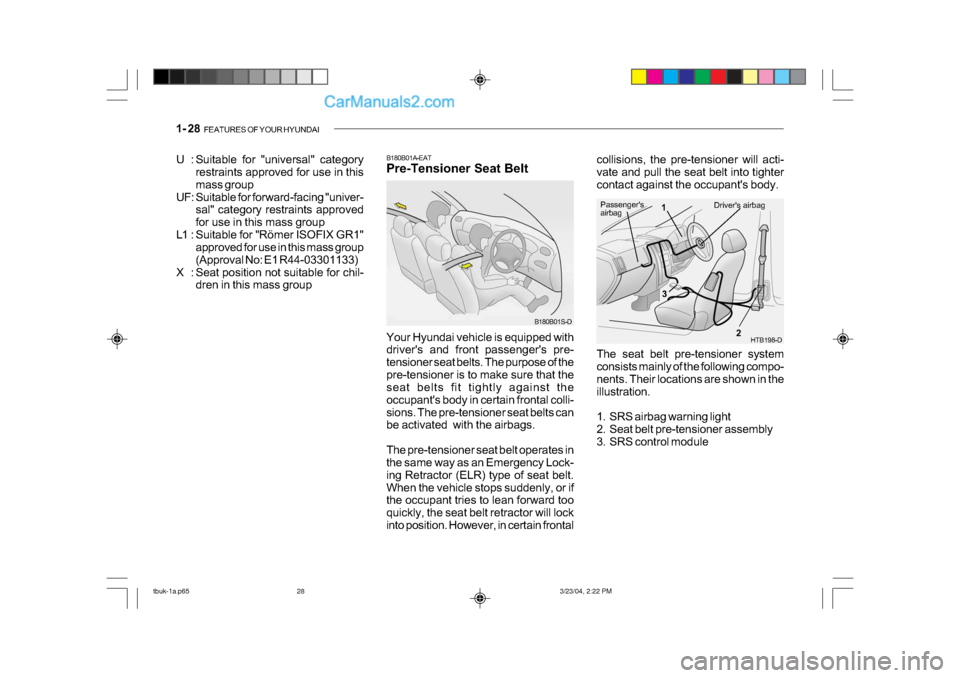
The seat belt pre-tensioner system
consists mainly of the following compo-
nents. Their locations are shown in the
illustration.
1. SRS airbag warning light
2. Seat belt pre-tensioner assembly
3. SRS control module HTB198-D
Driver's airbag1
2
3Passenger's
airbag
U : Suitable for "universal" category
restraints approved for use in this
mass group
UF: Suitable for forward-facing "univer- sal" category restraints approved
for use in this mass group
L1 : Suitable for "R
Page 287 of 445

FEATURES OF YOUR HYUNDAI 1- 29
!
o Although it is harmless, the fine
dust may cause skin irritation and
should not be breathed for pro-
longed periods. Wash your hands
and face thoroughly after an acci-
dent in which the pre-tensioner
seat belts were activated. it illuminates whilst the vehicle is
being driven, please have an au-
thorized Hyundai dealer inspect
the pre-tensioner seat belt or SRS
airbag system as soon as pos-
sible.
CAUTION:
o Because the sensor that activates the SRS airbag is connected with
the pre-tensioner seat belt, the SRS
airbag warning light on the
instrument panel will blink for
approximately 6 seconds after the
ignition key has been turned to the
"ON" position and then it should
turn off.
o If the pre-tensioner seat belt is not working properly, this warning
light will illuminate even if there is
no function of the SRS airbag sys-
tem.
If the SRS airbag warning light
does not illuminate when the igni-
tion key is turned to "ON", or if it
remains illuminated after blinking
for approximately 6 seconds, or if WARNING:
o Pre-tensioners are designed to op- erate only one time. After activa-
tion, pre-tensioner seat belts must
be replaced. All seat belts, of any
type, should always be replaced
after they have been worn during a
collision.
o The pre-tensioner seat belt assem-
bly mechanisms become hot dur-
ing activation. Do not touch the
pre-tensioner seat belt assemblies
for several minutes after they have
been activated.
o Do not attempt to inspect or re-
place the pre-tensioner seat belts
yourself. This must be done by an
authorized Hyundai dealer.
o Do not strike the pre-tensioner seat
belt assemblies.
!
!WARNING:
To obtain maximum benefit from a
pre-tensioner seat belt:
1. The seat belt must be worn cor- rectly.
2. The seat belt must be adjusted to the correct position.
NOTE:
o Both the driver's and front passenger's pre-tensioner seat
belts will be activated in certain
frontal collisions. The pre-
tensioner seat belts can be acti-
vated with the airbags. The pre-
tensioners will be activated under
these conditions even if the seat
belts are not being worn at the
time of the collision.
o When the pre-tensioner seat belts
are activated, a loud noise may be
heard and fine dust, which may
appear to be smoke, may be vis-
ible in the passenger compart-
ment. These are normal operating
conditions and are not hazard-
ous.
tbuk-1a.p65 3/23/04, 2:22 PM
29
Page 288 of 445
1- 30 FEATURES OF YOUR HYUNDAI
!
HTB201
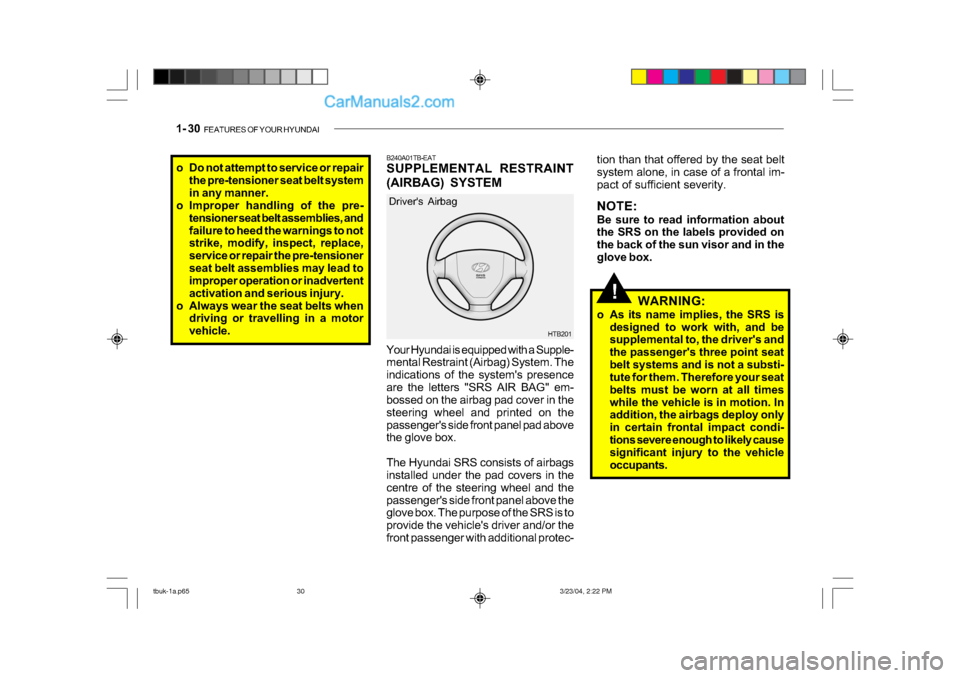
Driver's Airbag
Your Hyundai is equipped with a Supple-
mental Restraint (Airbag) System. The
indications of the system's presence
are the letters "SRS AIR BAG" em-
bossed on the airbag pad cover in the
steering wheel and printed on the
passenger's side front panel pad above
the glove box.
The Hyundai SRS consists of airbags
installed under the pad covers in the
centre of the steering wheel and the
passenger's side front panel above the
glove box. The purpose of the SRS is to
provide the vehicle's driver and/or the
front passenger with additional protec- B240A01TB-EAT
SUPPLEMENTAL RESTRAINT
(AIRBAG) SYSTEM
tion than that offered by the seat belt
system alone, in case of a frontal im-
pact of sufficient severity.
NOTE:
Be sure to read information about
the SRS on the labels provided on
the back of the sun visor and in the
glove box.
WARNING:
o As its name implies, the SRS is designed to work with, and be
supplemental to, the driver's and
the passenger's three point seat
belt systems and is not a substi-
tute for them. Therefore your seat
belts must be worn at all times
while the vehicle is in motion. In
addition, the airbags deploy only
in certain frontal impact condi-
tions severe enough to likely cause
significant injury to the vehicle
occupants.
o Do not attempt to service or repairthe pre-tensioner seat belt system
in any manner.
o Improper handling of the pre-
tensioner seat belt assemblies, and
failure to heed the warnings to not
strike, modify, inspect, replace,
service or repair the pre-tensioner
seat belt assemblies may lead to
improper operation or inadvertent
activation and serious injury.
o Always wear the seat belts when driving or travelling in a motor
vehicle.
tbuk-1a.p65 3/23/04, 2:22 PM
30
Page 289 of 445
FEATURES OF YOUR HYUNDAI 1- 31
o For maximum safety protection in
all types of crashes, all occupants
including the driver should always
wear their seat belts whether or
not an airbag is also provided at
their seating position to minimize
the risk of severe injury or death in
the event of a crash. Do not sit or
lean unnecessarily close to the
airbag while the vehicle is in mo-
tion.
o The SRS airbag system must de-
ploy very rapidly to provide pro-
tection in a crash. If an occupant is
out of position because of not
wearing a seat belt, the airbag may
forcefully contact the occupant
causing serious or fatal injuries.
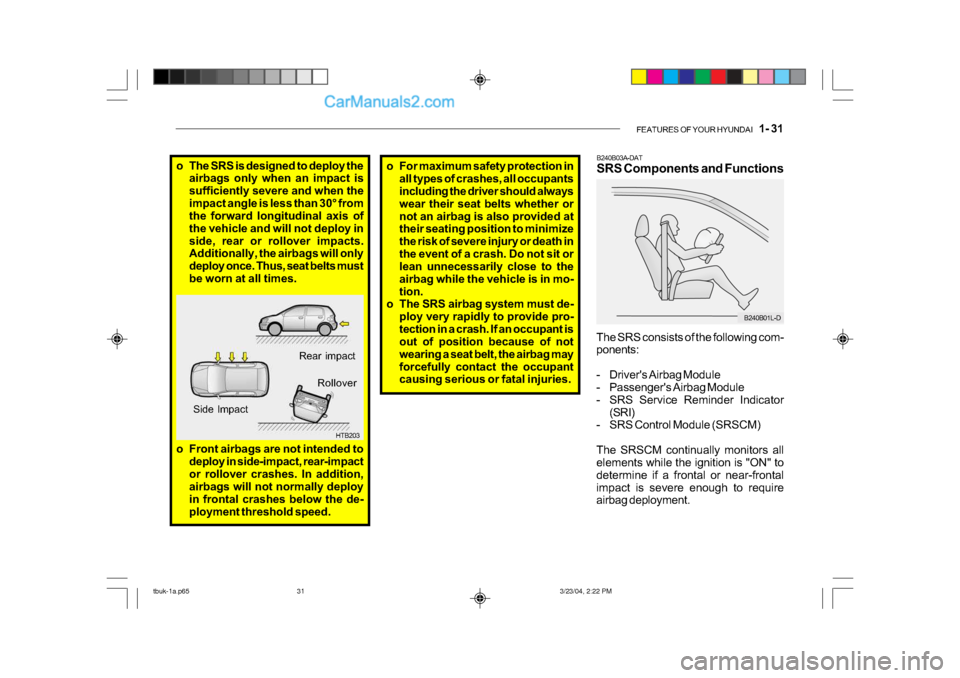
The SRS consists of the following com-
ponents:
- Driver's Airbag Module
- Passenger's Airbag Module
- SRS Service Reminder Indicator (SRI)
- SRS Control Module (SRSCM)
The SRSCM continually monitors all
elements while the ignition is "ON" to
determine if a frontal or near-frontal
impact is severe enough to require
airbag deployment. B240B03A-DAT
SRS Components and Functions
B240B01L-D
HTB203
Rear impact
Side Impact Rollover
o The SRS is designed to deploy the
airbags only when an impact is
sufficiently severe and when the
impact angle is less than 30