air conditioning Hyundai Getz 2005 Owner's Guide
[x] Cancel search | Manufacturer: HYUNDAI, Model Year: 2005, Model line: Getz, Model: Hyundai Getz 2005Pages: 437, PDF Size: 11.19 MB
Page 288 of 437

1- 76 FEATURES OF YOUR HYUNDAI
B670C02A-AAT Air Intake Control This is used to select fresh outside air or recirculation inside air.
FreshRecirculation
With the " " mode selected, airenters the vehicle from outside and is heated or cooled according to the otherfunctions selected. With the " " mode selected, air from within the passenger compartment isdrawn through the heating system and heated or cooled according to the other functions selected. HTB036
NOTE: It should be noted that prolonged operation of the heating system in " " mode will give rise to mistingof the windshield and side win- dows and the air within the passen- ger compartment will become stale.In addition prolonged use of the air conditioning with the " " mode selected may result in the air withinthe passenger compartment becom- ing excessively dry.B670D01TB-AAT Air Flow Control
This is used to direct the flow of air. Air can be directed to the floor, dashboard outlets, or windshield. Five symbolsare used to represent Face, Bi-Level, Floor, Floor-Defrost and Defrost air position. HTB038
Tbeng_1b.p65
3/9/2005, 4:59 PM
76
Page 291 of 437

FEATURES OF YOUR HYUNDAI 1- 79
B700A01A-AAT BI-LEVEL HEATING Your Hyundai is equipped with bi-level heating controls. This makes it pos-sible to have cooler air from the dash- board vents and warmer air from the floor outlets at the same time. To usethis feature:
o Set the air intake control to the fresh
air ( ) position.
o Set the air flow control at the bi-level ( ) position.
o Set the temperature control between "Cool" and "Warm".
B690A01A-AAT HEATING CONTROLS For normal heating operation, set the air intake control to the fresh air ( )position and the air flow control to the floor ( ) position. For faster heating, the air intake con-trol should be set in the recirculate ( ) position. If the windows fog up, set the air flowcontrol to the defrost ( ) position and the air intake control to the fresh air ( ) position.For maximum heat, move the tem- perature control to "Warm". B720A01TB-GAT DEFROSTING/DEFOGGING
HTB045-1
Use the heating/ventilation system to defrost or defog the windshield: To remove interior fog on the windshield:
o Set the air intake control to the fresh air ( ) position.
o Set the air flow control to the defrost
( ) position.
o For more rapid action, turn on the air conditioning.
o Set the temperature control to the
desired position.
o Set the fan speed control between
"1" and "4" position.
Tbeng_1b.p65 3/9/2005, 4:59 PM
79
Page 292 of 437

1- 80 FEATURES OF YOUR HYUNDAI
B740A01A-AAT AIR CONDITIONING SWITCH (If Installed)
B730A01FC-GAT Operation Tips
o To keep dust or unpleasant fumes
from entering the car through the ventilation system, temporarily set the air intake control at "Recircula- tion". Be sure to return the control to"Fresh" when the irritation has passed to keep fresh air in the ve- hicle. This will help keep the driveralert and comfortable.
o Air for the heating/cooling system is
drawn in through the grilles justahead of the windshield. Care should be taken that these are not blocked by leaves, snow, ice or other ob-structions.
o To prevent interior fog on the wind-
shield, set the air intake control tothe fresh air ( ) position and fan speed to the desired position.
To remove the frost or exterior fog on the windshield:
o Set the air intake control to the fresh
( ) position.
o Set the air flow control to the defrost ( ) position
o Set the temperature control to warm.
o Set the fan speed control to position
"3" or "4".
NOTE: When the A/C is operated continu- ously on the floor-defrost level ( ) or defrost level ( ), it may cause fog to form on the exterior wind-shield. If this occurs, set the air flow control to the face level posi- tion ( ) and fan speed control tothe low position. The air conditioning is turned on by pushing the A/C button on the heating/ air conditioning control panel.
HTB037
Tbeng_1b.p65
3/9/2005, 4:59 PM
80
Page 293 of 437

FEATURES OF YOUR HYUNDAI 1- 81
B740B02A-AAT AIR CONDITIONING OPERA- TION (Cooling)
B740C01A-AAT De-Humidified Heating
To use the air conditioning to cool the interior:
o Turn on the fan control switch (2).
o Turn on the air conditioning switch(4) by pushing in on the switch.The air conditioning indicator lightshould come on at the same time.
o Set the air intake control to the
position (5).
o Set the temperature control (1) to "Cool". ("Cool" provides maximumcooling. The temperature may bemoderated by moving the control toward "Warm".) HTB046-1
o Adjust the fan control (2) to the
desired speed. For greater cooling, turn the fan control to one of thehigher speeds or temporarily select
the position on the air intake control. For dehumidified heating:
o Turn on the fan control switch (2).
o Turn on the air conditioning switch
(4). The air conditioning indicator light should come on at the same time.
o Set the air intake control (5) to the fresh air ( ) position.
o Set the air flow control (3) to the face ( ) position.
o Adjust the fan control (2) to the
desired speed.
o For more rapid action, set the fan at one of the higher speeds.
o Adjust the temperature control (1) to provide the desired amount of warmth.
(1)
(2)
(3)
(4) (5) HTB046-1
(1)
(2)
(3)
(4) (5)
Tbeng_1b.p65 3/9/2005, 4:59 PM
81
Page 294 of 437

1- 82 FEATURES OF YOUR HYUNDAI
!
B760A01Y-1
The air conditioner filter is located in front of the evaporator unit behind the glove box.It operates to decrease the amount of pollutants from entering the car. To replace the air conditioner filter, referto the page 6-23.
B760A03TB-GAT AIR CONDITIONER FILTER
(In Front of evaporator unit)(If Installed)
B740D01A-AAT Operation Tips
o If the interior of the car is hot when
you first get in, open the windows for a few minutes to expel the hot air.
o When you are using the air condi-
tioning system, keep all windowsclosed to keep hot air out.
o When moving slowly, as in heavy
traffic, shift to a lower gear. Thisincreases engine speed, which in turn increases the speed of the air conditioning compressor.
o On steep grades, turn the air condi- tioning off to avoid the possibility ofthe engine over-heating.
o During winter months or in periods when the air conditioning is not usedregularly, run the air conditioningonce every month for a few min- utes. This will help circulate the lubricants and keep your system inpeak operating condition. Inside of a vehicle
Evaporator core
Filter
BlowerOutside air
Inside air CAUTION:
o Replace the filter every 15,000 km (10,000 miles) or once a year. If the car is being driven in severe con- ditions such as dusty, roughroads, more frequent air condi- tioner filter inspections and changes are required.
o When the air flow rate is suddenly decreased, it must be checked atan authorized dealer.
Tbeng_1b.p65 3/9/2005, 4:59 PM
82
Page 338 of 437

DRIVING YOUR HYUNDAI 2- 15
C150A01A-AAT SMOOTH CORNERING Avoid braking or gear changing in cor- ners, especially when roads are wet.Ideally, corners should always be taken under gentle acceleration. If you follow these suggestions, tire wear will beheld to a minimum.
o Keep your car in good condition. For
better fuel economy and reducedmaintenance costs, maintain yourcar in accordance with the mainte- nance schedule in Section 5. If you drive your car in severe conditions,more frequent maintenance is re- quired (see Section 5 for details).
o Keep your car clean. For maximum service, your Hyundai should bekept clean and free of corrosive materials. It is especially importantthat mud, dirt, ice, etc. not be al- lowed to accumulate on the under- side of the car. This extra weightcan result in increased fuel con- sumption and also contribute to cor- rosion.
o Travel lightly. Don't carry unneces- sary weight in your car. Weight re-duces fuel economy.
o Don't let the engine idle longer than necessary. If you are waiting (andnot in traffic), turn off your engineand restart only when you're ready to go.
o Remember, your Hyundai does not require extended warm-up. As soonas the engine is running smoothly, you can drive away. In very cold weather, however, give your engine a slightly longer warm-up period.
o Don't "lug" or "over-rev" the engine. Lugging is driving too slowly in toohigh a gear resulting in the engine bucking. If this happens, shift to alower gear. Over-revving is racing the engine beyond its safe limit. This can be avoided by shifting atthe recommended speeds.
o Use your air conditioning sparingly.
The air conditioning system is oper-ated by engine power so your fuel economy is reduced when you use it. C160A01A-AAT WINTER DRIVING The more severe weather conditions of winter result in greater wear andother problems. To minimize the prob- lems of winter driving, you should fol- low these suggestions: C160B01A-GAT Snowy or Icy Conditions To drive your vehicle in deep snow, it may be necessary to use snow tires or to install tire chains on your tires. If snow tires are needed, it is necessary to select tires equivalent in size and type to the original equipment tires.Failure to do so may adversely affect the safety and handling of your car. Speeding, rapid acceleration, suddenbrake applications, and sharp turns are potentially very hazardous prac- tices. During deceleration, use enginebraking to the fullest extent. Sudden brake applications on snowy or icy roads may cause skids to occur. Youneed to keep sufficient distance be- tween the vehicle in front and your vehicle. Also, apply the brake gently. Itshould be noted that installing tire
TBENG_2.P65
3/9/2005, 5:00 PM
15
Page 348 of 437
3- 4 WHAT TO DO IN AN EMERGENCY
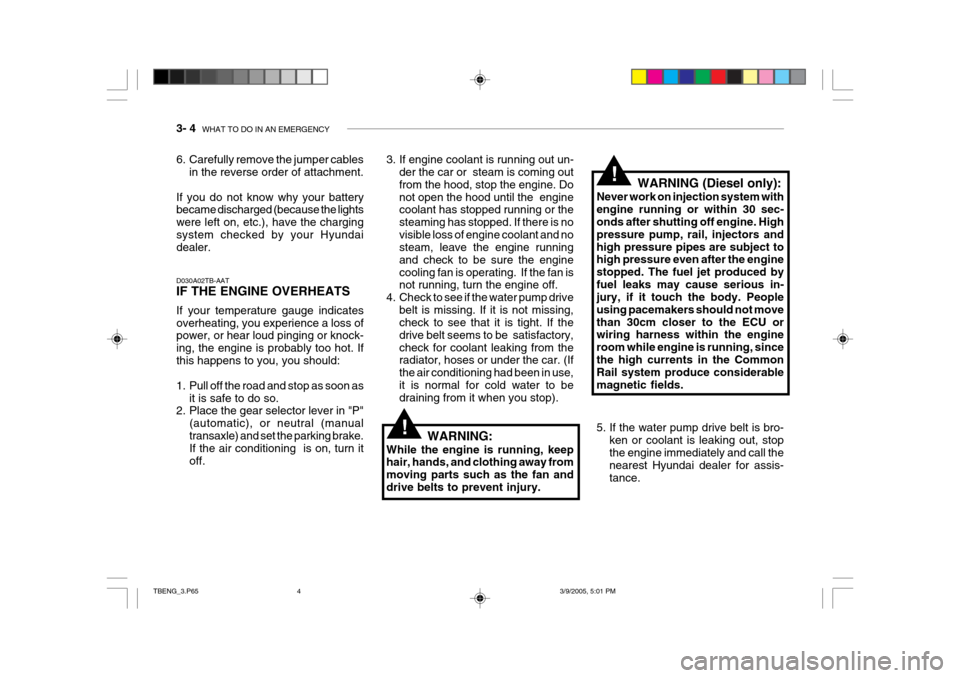
D030A02TB-AAT IF THE ENGINE OVERHEATS If your temperature gauge indicates overheating, you experience a loss of power, or hear loud pinging or knock- ing, the engine is probably too hot. Ifthis happens to you, you should:
1. Pull off the road and stop as soon as
it is safe to do so.
2. Place the gear selector lever in "P"
(automatic), or neutral (manual transaxle) and set the parking brake. If the air conditioning is on, turn it off.
6. Carefully remove the jumper cables
in the reverse order of attachment.
If you do not know why your battery became discharged (because the lights were left on, etc.), have the chargingsystem checked by your Hyundai dealer. 3. If engine coolant is running out un-
der the car or steam is coming out from the hood, stop the engine. Donot open the hood until the engine coolant has stopped running or the steaming has stopped. If there is novisible loss of engine coolant and no steam, leave the engine running and check to be sure the enginecooling fan is operating. If the fan is not running, turn the engine off.
4. Check to see if the water pump drive
belt is missing. If it is not missing,check to see that it is tight. If the drive belt seems to be satisfactory,check for coolant leaking from the radiator, hoses or under the car. (If the air conditioning had been in use,it is normal for cold water to be draining from it when you stop). WARNING (Diesel only):
Never work on injection system with engine running or within 30 sec- onds after shutting off engine. High pressure pump, rail, injectors andhigh pressure pipes are subject to high pressure even after the engine stopped. The fuel jet produced byfuel leaks may cause serious in- jury, if it touch the body. People using pacemakers should not movethan 30cm closer to the ECU or wiring harness within the engine room while engine is running, sincethe high currents in the Common Rail system produce considerable magnetic fields.
WARNING:
While the engine is running, keep hair, hands, and clothing away from moving parts such as the fan anddrive belts to prevent injury.
!
!
5. If the water pump drive belt is bro- ken or coolant is leaking out, stop the engine immediately and call the nearest Hyundai dealer for assis-tance.
TBENG_3.P65 3/9/2005, 5:01 PM
4
Page 370 of 437
5- 6 VEHICLE MAINTENANCE REQUIREMENTS
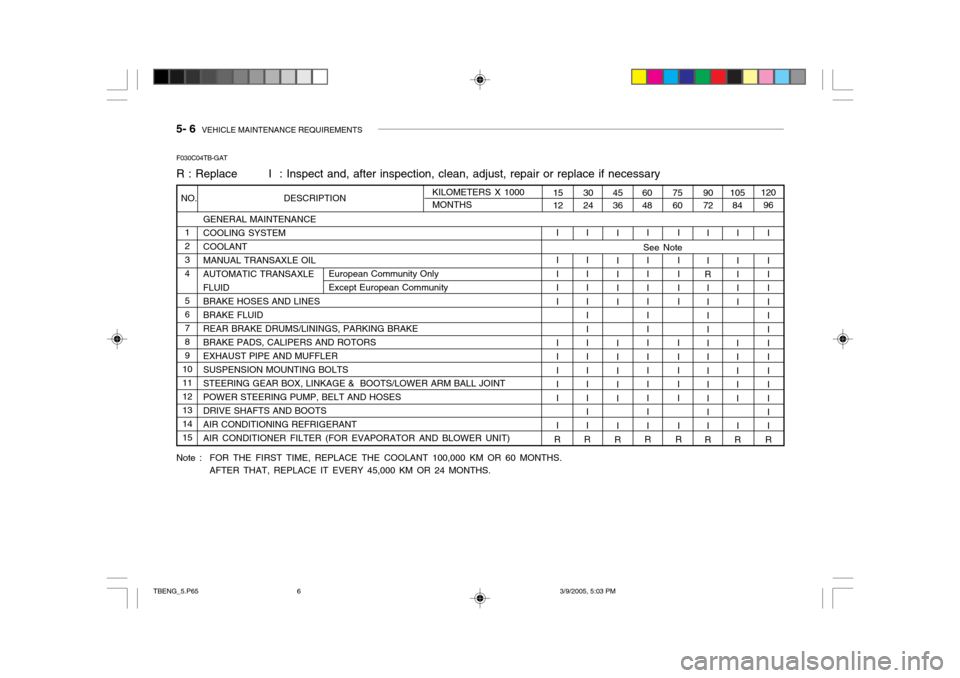
GENERAL MAINTENANCE COOLING SYSTEMCOOLANTMANUAL TRANSAXLE OILAUTOMATIC TRANSAXLEFLUIDBRAKE HOSES AND LINESBRAKE FLUIDREAR BRAKE DRUMS/LININGS, PARKING BRAKEBRAKE PADS, CALIPERS AND ROTORSEXHAUST PIPE AND MUFFLERSUSPENSION MOUNTING BOLTSSTEERING GEAR BOX, LINKAGE & BOOTS/LOWER ARM BALL JOINTPOWER STEERING PUMP, BELT AND HOSESDRIVE SHAFTS AND BOOTSAIR CONDITIONING REFRIGERANTAIR CONDITIONER FILTER (FOR EVAPORATOR AND BLOWER UNIT)
1234 5 6789
101112131415
Note : FOR THE FIRST TIME, REPLACE THE COOLANT 100,000 KM OR 60 MONTHS. AFTER THAT, REPLACE IT EVERY 45,000 KM OR 24 MONTHS.
F030C04TB-GAT R : Replace I : Inspect and, after inspection, clean, adjust, repair or replace if necessary
120
96
I I I IIII I IIIII I
R
105
84
I I I II
IIIII I
R
90 72
75 60
6048
I I
R
I III I IIIII I
R
I I II I
I I I II I
R
I I II I IIII I IIII
R
45 36
3024
I I I II
IIIII I
R
I I IIIII I IIIII I
R
15 12
I I III I IIII I
R
KILOMETERS X 1000 MONTHS
NO. DESCRIPTION
European Community Only Except European Community
See Note
TBENG_5.P65
3/9/2005, 5:03 PM
6
Page 375 of 437

VEHICLE MAINTENANCE REQUIREMENTS 5- 11
F070P01A-AAT
o Driveshafts and Boots
Check the drive shafts, boots and clamps for cracks, deterioration, or damage. Replace any damaged parts and, if necessary, repack the grease. F070Q01A-AAT
o Air Conditioning Refrigerant
Check the air conditioning lines and connections for leakage and damage. Check air conditioning performance according to the relevant shop manualif necessary.
TBENG_5.P65 3/9/2005, 5:03 PM
11
Page 376 of 437
6. Do-It-Yourself Maintenance
Engine compartment ...................................................................... 6-2
General checks ................................................................................ 6-6
Checking the engine oil .................................................................... 6-7
Changing the oil and filter ................................................................. 6-9
Checking and changing the engine coolant....................................6-13
Spark plugs .................................................................................... 6-15
Changing the air cleaner filter ......................................................... 6-17
Checking the transaxle oil (Manual)............................................... 6-18
Checking the transaxle fluid (Automatic)....................................... 6-19
Checking the brakes ...................................................................... 6-21
Air conditioning care ....................................................................... 6-22
Checking drive belts ...................................................................... 6-25
Checking and replacing fuses ........................................................ 6-26
Power steering fluid level ............................................................... 6-30
Replacement of bulbs .................................................................... 6-32
Fuse panel description ................................................................... 6-38
6
TBENG_6.P65 3/9/2005, 5:03 PM
1