Fuel line Hyundai Getz 2007 User Guide
[x] Cancel search | Manufacturer: HYUNDAI, Model Year: 2007, Model line: Getz, Model: Hyundai Getz 2007Pages: 463, PDF Size: 11.14 MB
Page 231 of 463
6- 36 DO-IT-YOURSELF MAINTENANCE
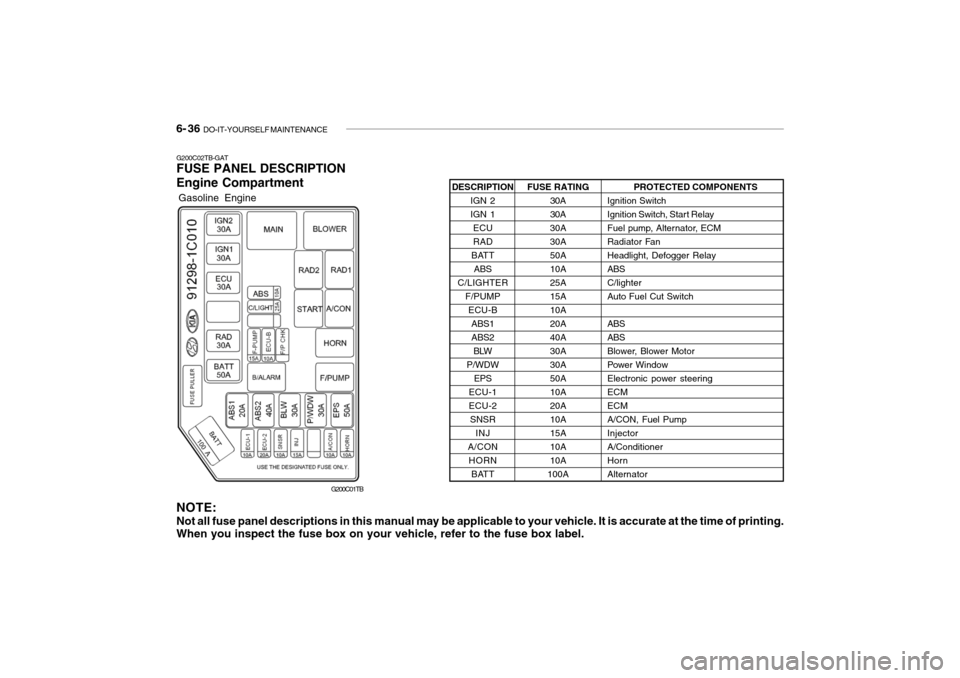
G200C02TB-GAT FUSE PANEL DESCRIPTION Engine Compartment
PROTECTED COMPONENTS
Ignition Switch
Ignition Switch, Start Relay
Fuel pump, Alternator, ECM
Radiator FanHeadlight, Defogger RelayABSC/lighterAuto Fuel Cut Switch ABS ABS
Blower, Blower Motor
Power WindowElectronic power steeringECMECMA/CON, Fuel PumpInjectorA/ConditionerHornAlternator
FUSE RATING
30A30A
30A30A50A10A25A15A10A20A40A30A30A50A10A20A10A15A10A10A
100A
DESCRIPTION
IGN 2IGN 1ECURAD
BATT ABS
C/LIGHTER F/PUMPECU-B ABS1ABS2BLW
P/WDW EPS
ECU-1ECU-2 SNSR INJ
A/CON HORN BATT
NOTE:
Not all fuse panel descriptions in this manual may be applicable to your vehicle. It is accurate at the time of printing. When you inspect the fuse box on your vehicle, refer to the fuse box label.
Gasoline Engine
G200C01TB
Page 237 of 463
EMISSION CONTROL SYSTEMS 7- 3
H020A01A-GAT
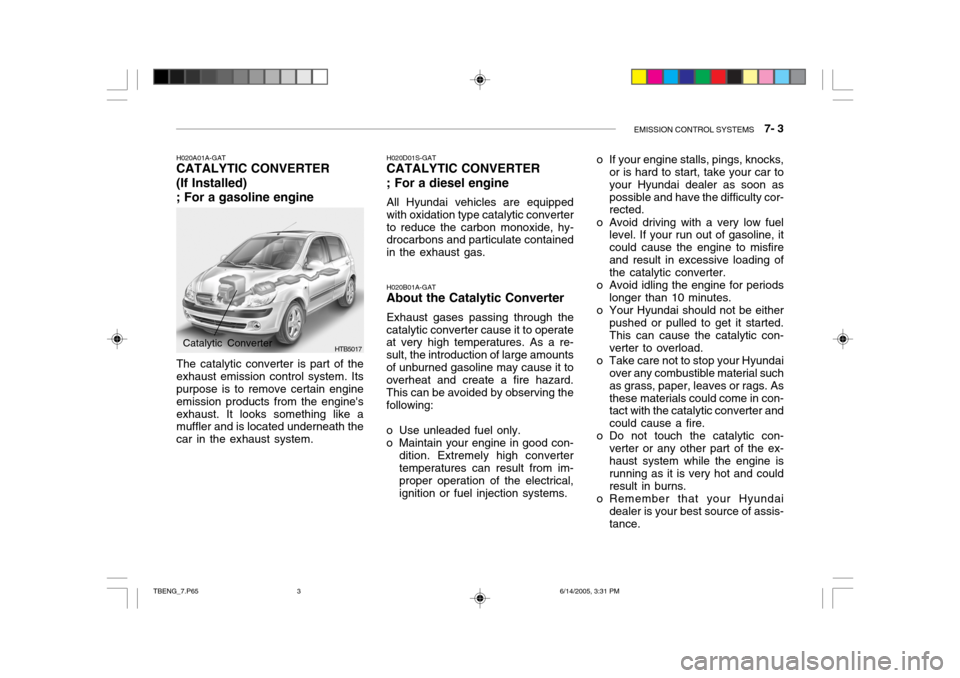
CATALYTIC CONVERTER (If Installed) ; For a gasoline engine
HTB5017
The catalytic converter is part of the exhaust emission control system. Its purpose is to remove certain engine emission products from the engine'sexhaust. It looks something like a muffler and is located underneath the car in the exhaust system.
Catalytic Converter H020B01A-GAT
About the Catalytic Converter
Exhaust gases passing through the
catalytic converter cause it to operate at very high temperatures. As a re- sult, the introduction of large amountsof unburned gasoline may cause it to overheat and create a fire hazard. This can be avoided by observing thefollowing:
o Use unleaded fuel only.
o Maintain your engine in good con-
dition. Extremely high converter temperatures can result from im- proper operation of the electrical,ignition or fuel injection systems.
H020D01S-GAT CATALYTIC CONVERTER ; For a diesel engine All Hyundai vehicles are equipped with oxidation type catalytic converterto reduce the carbon monoxide, hy- drocarbons and particulate contained in the exhaust gas.
o If your engine stalls, pings, knocks,
or is hard to start, take your car toyour Hyundai dealer as soon aspossible and have the difficulty cor- rected.
o Avoid driving with a very low fuel level. If your run out of gasoline, it could cause the engine to misfireand result in excessive loading of the catalytic converter.
o Avoid idling the engine for periods longer than 10 minutes.
o Your Hyundai should not be either pushed or pulled to get it started.This can cause the catalytic con- verter to overload.
o Take care not to stop your Hyundai over any combustible material suchas grass, paper, leaves or rags. Asthese materials could come in con- tact with the catalytic converter and could cause a fire.
o Do not touch the catalytic con-
verter or any other part of the ex-haust system while the engine is running as it is very hot and could result in burns.
o Remember that your Hyundai dealer is your best source of assis-tance.
TBENG_7.P65 6/14/2005, 3:31 PM
3
Page 268 of 463
1- 2 FEATURES OF YOUR HYUNDAI
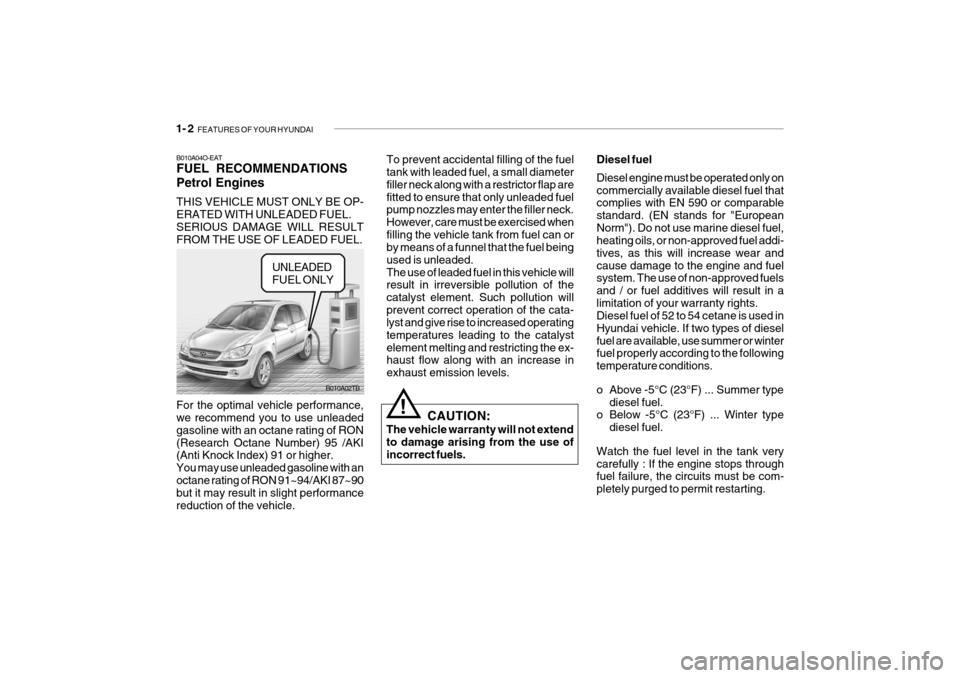
B010A04O-EAT FUEL RECOMMENDATIONS Petrol Engines THIS VEHICLE MUST ONLY BE OP- ERATED WITH UNLEADED FUEL. SERIOUS DAMAGE WILL RESULTFROM THE USE OF LEADED FUEL. To prevent accidental filling of the fuel tank with leaded fuel, a small diameter filler neck along with a restrictor flap arefitted to ensure that only unleaded fuel pump nozzles may enter the filler neck. However, care must be exercised whenfilling the vehicle tank from fuel can or by means of a funnel that the fuel being used is unleaded.The use of leaded fuel in this vehicle will result in irreversible pollution of the catalyst element. Such pollution willprevent correct operation of the cata- lyst and give rise to increased operating temperatures leading to the catalystelement melting and restricting the ex- haust flow along with an increase in exhaust emission levels.
For the optimal vehicle performance, we recommend you to use unleaded gasoline with an octane rating of RON(Research Octane Number) 95 /AKI (Anti Knock Index) 91 or higher. You may use unleaded gasoline with anoctane rating of RON 91~94/AKI 87~90 but it may result in slight performance reduction of the vehicle. B010A02TB
CAUTION:
The vehicle warranty will not extendto damage arising from the use of incorrect fuels.
! Diesel fuel Diesel engine must be operated only on commercially available diesel fuel that complies with EN 590 or comparable standard. (EN stands for "EuropeanNorm"). Do not use marine diesel fuel, heating oils, or non-approved fuel addi- tives, as this will increase wear andcause damage to the engine and fuel system. The use of non-approved fuels and / or fuel additives will result in alimitation of your warranty rights. Diesel fuel of 52 to 54 cetane is used in Hyundai vehicle. If two types of dieselfuel are available, use summer or winter fuel properly according to the following temperature conditions.
o Above -5°C (23°F) ... Summer type
diesel fuel.
o Below -5°C (23°F) ... Winter type
diesel fuel.
Watch the fuel level in the tank very carefully : If the engine stops through fuel failure, the circuits must be com- pletely purged to permit restarting.
UNLEADEDFUEL ONLY
Page 269 of 463

FEATURES OF YOUR HYUNDAI 1- 3
!
CAUTION:
o Do not let any gasoline or water enter the tank. This would make it necessary to drain it out and to bleed the lines to avoid jamming the injection pump and damagingthe engine.
o In winter, in order to cut down
incidents due to freezing, paraffinoil may be added to the fuel if the temperature drops to below -10°C. Never use more than 20%paraffin oil. Biodiesel Commercially supplied biodiesel blends of no more than 5% biodiesel, com- monly known as "B5 biodiesel" may be used in your vehicle if it meets EN14214 or equivalent specifications. (EN stands for "European Norm"). The use of biofuels made from rapeseed methylester (RME), fatty acid methyl ester (FAME), vegetable oil methyl ester (VME) etc. or mixing diesel withbiodiesel will cause increased wear or damage to the engine and fuel system. Repair or replacement of worn or dam-aged components due to the use of non approved fuels will not be covered by the manufactures warranty.
CAUTION:
o Never use any fuel, whether diesel or B5 biodiesel that fails to meetthe latest petroleum industry speci- fication.
o Never use any fuel additives or treatments that are not recom-mended or approved by the ve- hicle manufacturer.
! ZB010C1-E "Alternative fuels" Fuels which contain methanol or etha- nol must not be used. ZB010F2-A Fuels for Cleaner Air To help contribute to cleaner air, Hyundai recommends that you usefuels treated with detergent additives, which help to prevent deposit forma- tion in the engine. These fuels will helpthe engines run cleaner and increase the Emission Control System perfor- mance.
ZB010D1-E Operation in Foreign Countries Drivers of vehicles which are to be operated in foreign countries must sat-isfy themselves that:
o The vehicle meets all local regula-
tions with respect to insurance, speci- fications etc..
o The correct types and grades of fuel are available for satisfactory opera-tion of the vehicle.
Page 270 of 463

1- 4 FEATURES OF YOUR HYUNDAI
5) Avoid rapid acceleration and maxi-
mum throttle openings.
6) Avoid harsh braking during the first 100 miles of urban motoring or 1,000 miles of motorway driving to allow the friction facings of the brake padsand shoes to bed against the discs and drums properly.
7) No trailer towing should be under- taken during the running-in period.
B020B01FC-EAT (Diesel Engine) The longevity and performance of the vehicle are greatly affected by the care exercised during the first 1,000 miles ofmotoring. Because of modern manu- facturing techniques, rigid guidelines regarding maximum road speeds havebecome unnecessary. However, cer- tain precautions should be observed in order to obtain the best possible perfor-mance and useful life from the vehicle.
YB020A1-E BEFORE ENTERING THE VEHICLE
o Ensure that all windows, mirrors and
lamps are clean.
o Check condition of all tyres.
o Ensure that no fluid leaks are evi- dent.
o Ensure that the area around the ve- hicle is clear before driving off.
YB020B1-E AFTER ENTERING THE VEHICLE
o Ensure that all occupants fasten and correctly adjust seat belts.
o Ensure that seat and head restraint positions are adjusted for optimum safety, control and comfort.
o Adjust interior and exterior rear view mirrors.
o Verify correct operation of lamps,
horn and other electrical equipment.
o Ensure that warning lamps illumi- nate when ignition is turned on.
NOTE: Fluid levels such as engine oil, en- gine coolant, brake and windscreen washer fluid should be checked dailyor at each refuelling, whichever oc- curs sooner. B020A01FC-EAT RUNNING IN YOUR NEW HYUNDAI (Petrol Engine) The longevity and performance of the vehicle are greatly affected by the care exercised during the first 1,000 miles ofmotoring. Because of modern manu- facturing techniques, rigid guidelines regarding maximum road speeds havebecome unnecessary. However, cer- tain precautions should be observed in order to obtain the best possible perfor-mance and useful life from the vehicle.
1) Do not race the engine without a load
(i.e revving the engine in neutral).
2) During the first 500 miles the maxi-
mum engine speed should be re- stricted to 3,000 rpm and gradually increased thereafter.
3) Avoid prolonged constant speed op- eration. The internal components ofthe engine will become more quickly run in if the operation speed is variedduring the running-in period.
4) Never allow the engine to labour. Use
the gearbox freely and avoid largethrottle openings when the engine speed is below 1,500 rpm.
Page 341 of 463
FEATURES OF YOUR HYUNDAI 1- 75
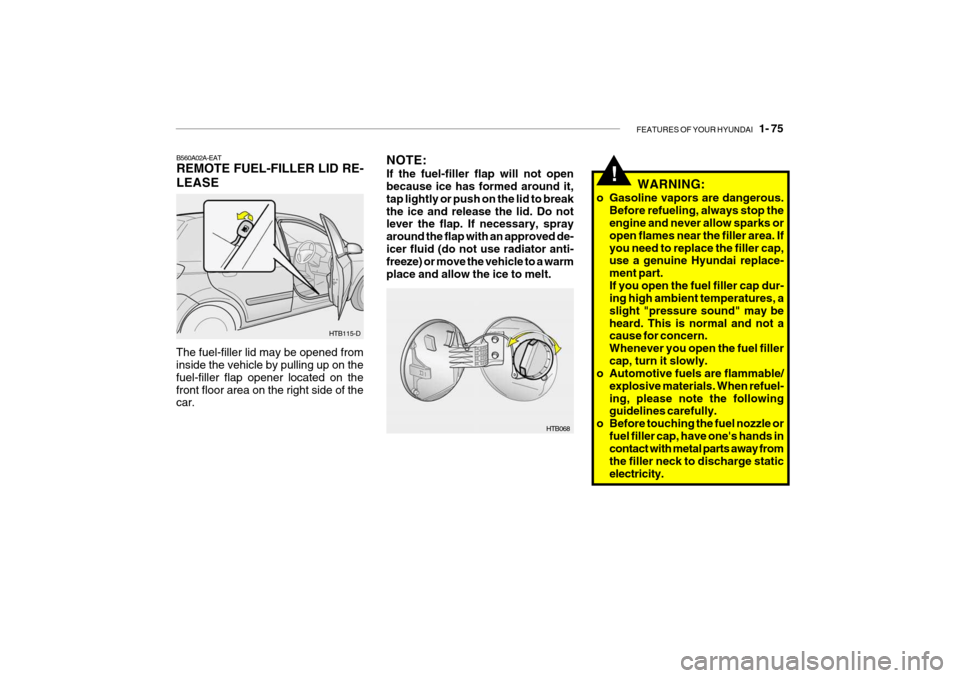
NOTE: If the fuel-filler flap will not open because ice has formed around it, tap lightly or push on the lid to breakthe ice and release the lid. Do not lever the flap. If necessary, spray around the flap with an approved de-icer fluid (do not use radiator anti- freeze) or move the vehicle to a warm place and allow the ice to melt.
HTB068
!WARNING:
o Gasoline vapors are dangerous. Before refueling, always stop the engine and never allow sparks or open flames near the filler area. Ifyou need to replace the filler cap, use a genuine Hyundai replace- ment part.If you open the fuel filler cap dur- ing high ambient temperatures, a slight "pressure sound" may beheard. This is normal and not a cause for concern. Whenever you open the fuel fillercap, turn it slowly.
o Automotive fuels are flammable/
explosive materials. When refuel-ing, please note the following guidelines carefully.
o Before touching the fuel nozzle or
fuel filler cap, have one's hands incontact with metal parts away from the filler neck to discharge staticelectricity.
B560A02A-EAT REMOTE FUEL-FILLER LID RE- LEASE
The fuel-filler lid may be opened from inside the vehicle by pulling up on the fuel-filler flap opener located on thefront floor area on the right side of the car. HTB115-D
Page 369 of 463
DRIVING YOUR HYUNDAI 2- 9
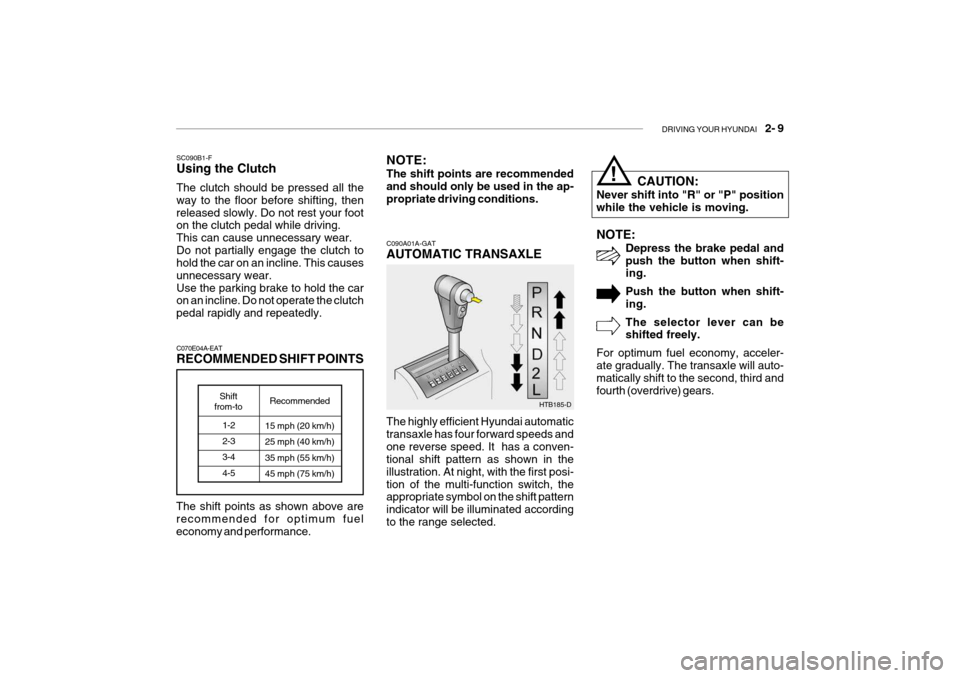
C070E04A-EAT RECOMMENDED SHIFT POINTS
1-2 2-3 3-44-5
Shift
from-to Recommended
15 mph (20 km/h)25 mph (40 km/h)35 mph (55 km/h) 45 mph (75 km/h)
The shift points as shown above are recommended for optimum fuel economy and performance. SC090B1-F Using the Clutch The clutch should be pressed all the way to the floor before shifting, thenreleased slowly. Do not rest your foot on the clutch pedal while driving. This can cause unnecessary wear.Do not partially engage the clutch to hold the car on an incline. This causes unnecessary wear.Use the parking brake to hold the car on an incline. Do not operate the clutch pedal rapidly and repeatedly.
HTB185-D
C090A01A-GAT AUTOMATIC TRANSAXLE The highly efficient Hyundai automatic transaxle has four forward speeds andone reverse speed. It has a conven- tional shift pattern as shown in the illustration. At night, with the first posi-tion of the multi-function switch, the appropriate symbol on the shift pattern indicator will be illuminated accordingto the range selected. CAUTION:
Never shift into "R" or "P" positionwhile the vehicle is moving. NOTE: Depress the brake pedal and push the button when shift- ing. Push the button when shift- ing. The selector lever can be shifted freely.
For optimum fuel economy, acceler-ate gradually. The transaxle will auto- matically shift to the second, third andfourth (overdrive) gears.
!
NOTE: The shift points are recommended and should only be used in the ap- propriate driving conditions.
Page 373 of 463
DRIVING YOUR HYUNDAI 2- 13
HTB217-D
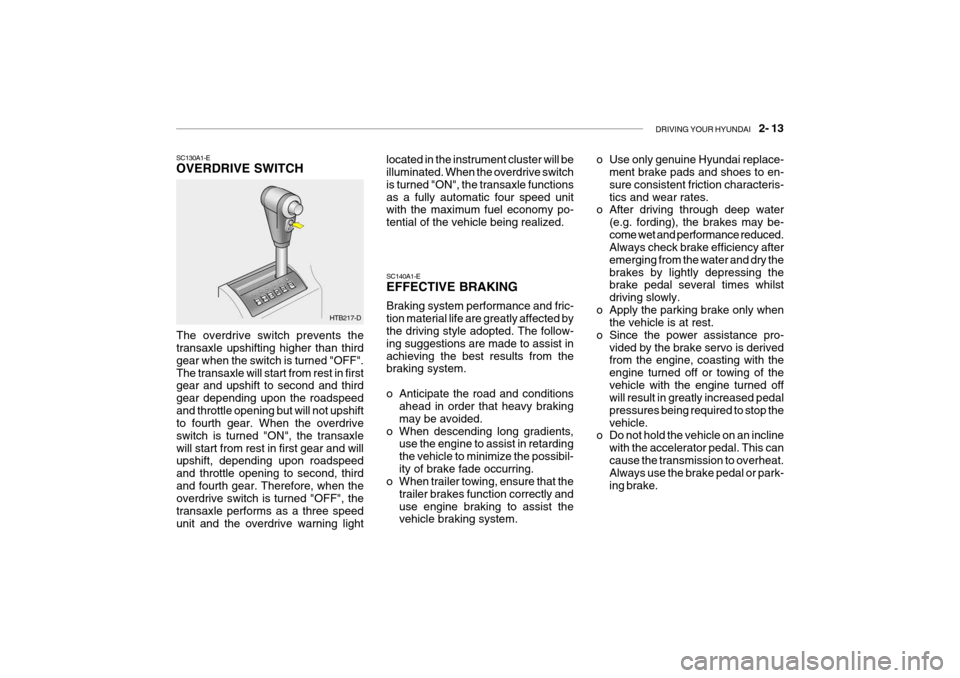
SC130A1-E OVERDRIVE SWITCH
The overdrive switch prevents the transaxle upshifting higher than third gear when the switch is turned "OFF".The transaxle will start from rest in first gear and upshift to second and third gear depending upon the roadspeedand throttle opening but will not upshift to fourth gear. When the overdrive switch is turned "ON", the transaxlewill start from rest in first gear and will upshift, depending upon roadspeed and throttle opening to second, thirdand fourth gear. Therefore, when the overdrive switch is turned "OFF", the transaxle performs as a three speedunit and the overdrive warning light located in the instrument cluster will be illuminated. When the overdrive switch is turned "ON", the transaxle functionsas a fully automatic four speed unit with the maximum fuel economy po- tential of the vehicle being realized. SC140A1-E EFFECTIVE BRAKING Braking system performance and fric- tion material life are greatly affected by the driving style adopted. The follow- ing suggestions are made to assist inachieving the best results from the braking system.
o Anticipate the road and conditions
ahead in order that heavy braking may be avoided.
o When descending long gradients, use the engine to assist in retardingthe vehicle to minimize the possibil-ity of brake fade occurring.
o When trailer towing, ensure that the
trailer brakes function correctly anduse engine braking to assist the vehicle braking system. o Use only genuine Hyundai replace-
ment brake pads and shoes to en- sure consistent friction characteris-tics and wear rates.
o After driving through deep water
(e.g. fording), the brakes may be-come wet and performance reduced. Always check brake efficiency after emerging from the water and dry thebrakes by lightly depressing the brake pedal several times whilst driving slowly.
o Apply the parking brake only when the vehicle is at rest.
o Since the power assistance pro- vided by the brake servo is derived from the engine, coasting with the engine turned off or towing of thevehicle with the engine turned off will result in greatly increased pedal pressures being required to stop thevehicle.
o Do not hold the vehicle on an incline
with the accelerator pedal. This cancause the transmission to overheat. Always use the brake pedal or park- ing brake.
Page 384 of 463
3- 2 WHAT TO DO IN AN EMERGENCY
HTB165
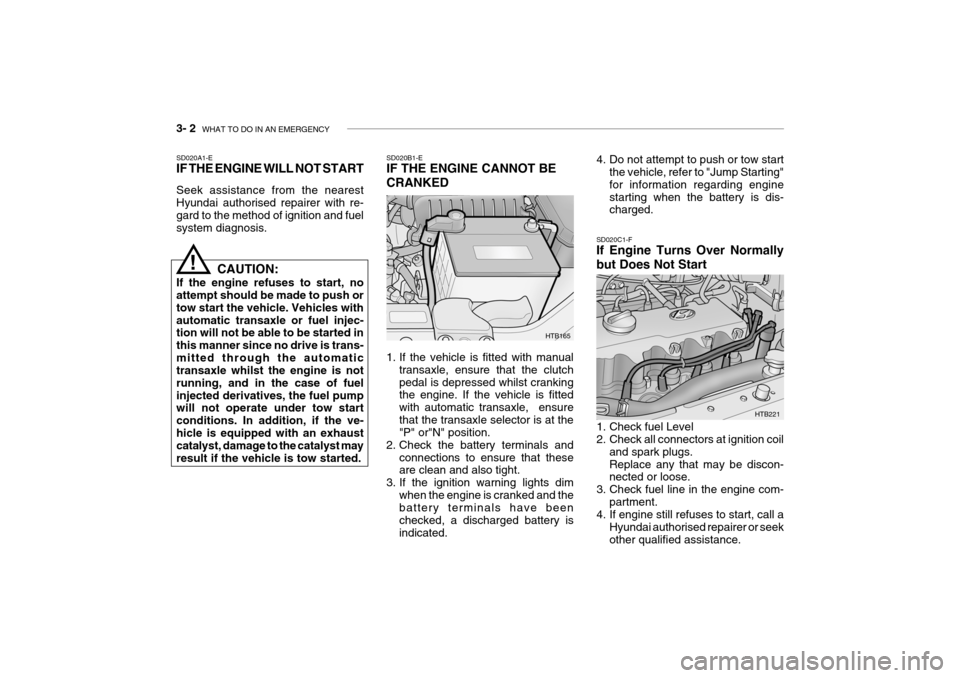
SD020B1-E IF THE ENGINE CANNOT BE CRANKED
1. If the vehicle is fitted with manual
transaxle, ensure that the clutch pedal is depressed whilst cranking the engine. If the vehicle is fitted with automatic transaxle, ensurethat the transaxle selector is at the "P" or"N" position.
2. Check the battery terminals and
connections to ensure that theseare clean and also tight.
3. If the ignition warning lights dim
when the engine is cranked and thebattery terminals have been checked, a discharged battery isindicated. SD020C1-F If Engine Turns Over Normally but Does Not Start
SD020A1-E IF THE ENGINE WILL NOT START Seek assistance from the nearest Hyundai authorised repairer with re- gard to the method of ignition and fuelsystem diagnosis.
!
HTB221
CAUTION:
If the engine refuses to start, no attempt should be made to push or tow start the vehicle. Vehicles withautomatic transaxle or fuel injec- tion will not be able to be started in this manner since no drive is trans-mitted through the automatic transaxle whilst the engine is not running, and in the case of fuelinjected derivatives, the fuel pump will not operate under tow start conditions. In addition, if the ve-hicle is equipped with an exhaust catalyst, damage to the catalyst may result if the vehicle is tow started. 4. Do not attempt to push or tow start
the vehicle, refer to "Jump Starting"for information regarding enginestarting when the battery is dis- charged.
1. Check fuel Level
2. Check all connectors at ignition coil and spark plugs. Replace any that may be discon- nected or loose.
3. Check fuel line in the engine com- partment.
4. If engine still refuses to start, call a
Hyundai authorised repairer or seek other qualified assistance.
Page 403 of 463

5- 2 VEHICLE MAINTENANCE REQUIREMENTS
SF020A1-E MAINTENANCE AND SERVICING REQUIREMENTS To ensure the continued reliability and safety of the vehicle, certain routinemaintenance operations are required at specific mileage or time intervals. It is the responsibility of the vehicle owner to ensure that the maintenance schedules shown in both this OwnersManual and the Warranty and Service Passport are adhered to. The new vehicle warranty may be invalidated if the routine maintenance operations are not performed in line with the recommendations outlinedand the safety and durability of the vehicle adversely affected. It is recommended that all mainte- nance operations with the exception of the daily operating checks are en-trusted to a Hyundai authorised re- pairer to ensure that the latest repairer and maintenance procedures andspecialised servicing tools are em- ployed. In addition, the use of genuine Hyundai replacement parts will ensurethat the vehicle safety and perfor- mance will not be compromised. NOTE:
The inspection and testing of cer-
tain electronic fuel injection/engine management and automatic trans- mission control systems require specialised electronic equipmentspecifically designed for Hyundai vehicles. The use of general pur- pose electrical test equipment mayresult in damage to the control unit microprocessors.
SF020C2-E
Specified Scheduled Procedures
The Specified scheduled procedures
are listed in the maintenance charts beginning at page 5-3. The opera- tions specified must be performed at the time or mileage intervals shownirrespective of whether the mileage interval has been reached before the specified time interval. Certain lubricants and components
degrade with both time and mileage(e.g. engine oil and brake fluid) and therefore it is not permissable to base the maintenance schedule upon mile-age alone. It is strongly recommended that the maintenance operations are performed by the factory-trained ordistributor-trained technicians at your Hyundai authorised repairer becauseof the need for specialised knowledge and tooling and to ensure that no possibility of invalidating the manufac-turers warranty exists.
The maintenance schedules relate to
vehicles operated under normal con- ditions, vehicles which are operated under adverse conditions will requiremore frequent maintenance which is described at page 5-6. NOTE:
Service schedules may change de-
pending on individual country needs. Please ask your localHyundai authorised repairer for a copy of the service schedule that relates to that country.
SF030B1-E
SERVICE HISTORY
It is important that all scheduled main-
tenance services are recorded in thewarranty and service passport to en-sure that proof of maintenance is avail- able when warranty service is required.