Time belt Hyundai Getz 2007 User Guide
[x] Cancel search | Manufacturer: HYUNDAI, Model Year: 2007, Model line: Getz, Model: Hyundai Getz 2007Pages: 463, PDF Size: 11.14 MB
Page 188 of 463

5- 4 VEHICLE MAINTENANCE REQUIREMENTS
ENGINE CONTROL SYSTEM MAINTENANCE (GASOLINE)
1 ENGINE OIL & FILTER
2 DRIVE BELT (WATER PUMP, ALTERNATOR & A/CON)
3 FUEL FILTER (MPI)
4 FUEL LINES, FUEL HOSES & CONNECTIONS
5 TIMING BELT
6 VAPOR HOSE & FUEL FILLER CAP
7 VACUUM & CRANKCASE VENTILATION HOSES
8 AIR CLEANER FILTER
9 SPARK PLUGS
10 VALVE CLEARANCE (1.1 L)
F030A01A-GAT SCHEDULED MAINTENANCE The following maintenance services must be performed to assure good vehicle control and performance. Keep receipts for all vehicle services to protect your warranty.Where both mileage and time are shown, the frequency of service is determined by whichever occurs first.
NO. DESCRIPTION105
84
R I I I 120
96
R I
R
I I II I
90 72
R I I
R I I
R
I
7560
R I I I
60 48
R I
R
II I II I
45 36
R I I
R
30 24
R I II II I
15 12
R I I I
KILOMETERS X 1000 MONTHS
F030B06TB-GAT R : Replace I : Inspect and, after inspection, clean, adjust, repair or replace if necessary
Note : (1) FOR EVERY 40,000KM: "R"
See Note (1)
Page 190 of 463

5- 6 VEHICLE MAINTENANCE REQUIREMENTS
GENERAL MAINTENANCE COOLING SYSTEMCOOLANT MANUAL TRANSAXLE OIL AUTOMATIC TRANSAXLEFLUIDBRAKE HOSES AND LINESBRAKE FLUIDREAR BRAKE DRUMS/LININGS, PARKING BRAKEBRAKE PADS, CALIPERS AND ROTORSEXHAUST PIPE AND MUFFLERSUSPENSION MOUNTING BOLTSSTEERING GEAR BOX, LINKAGE & BOOTS/LOWER ARM BALL JOINTPOWER STEERING PUMP, BELT AND HOSESDRIVE SHAFTS AND BOOTSAIR CONDITIONING REFRIGERANTAIR CONDITIONER FILTER (FOR EVAPORATOR AND BLOWER UNIT)
12 3 4 5 6789
101112131415
F030C05TB-GAT R : Replace I : Inspect and, after inspection, clean, adjust, repair or replace if necessary
120 96
I I IIII I IIIII I I
R
105
84
I I III
IIIII I
R
90 72
75 60
6048
I I
R
I II I IIIII I I
R
I I I I I
I I III I
R
I I I I IIII I IIIII
R
45 36
3024
I I III
IIIII I
R
I I IIII I IIIII I I
R
15 12
I I III I IIII I
R
KILOMETERS X 1000 MONTHS
NO. DESCRIPTION
European Community Only Except European Community
See Note (1)* See Note (2)*European Community Only Except European Community
Note : (1) FOR THE FIRST TIME, REPLACE THE COOLANT AT 100,000 KM OR 60 MONTHS. AFTER THAT, REPLACE IT EVERY 40,000 KM OR 24 MONTHS.
(2) FOR THE FIRST TIME, REPLACE THE COOLANT AT 48,000 KM OR 60 MONTHS. AFTER THAT, REPLACE IT EVERY 40,000 KM OR 24 MONTHS.
* : FOR YOUR CONVENIENCE, IT CAN BE REPLACED PRIOR TO IT'S INTERVAL WHEN YOU DO MAINTENANCE OF OTHER ITEMS.
Page 200 of 463

DO-IT-YOURSELF MAINTENANCE 6- 5
G020A02A-AAT GENERAL CHECKS Engine Compartment The following should be checked regu-larly:
o Engine oil level and condition
o Transaxle fluid level and condition
o Brake fluid level
o Clutch fluid level
o Engine coolant level
o Windshield washer fluid level
o Accessory drive belt condition
o Engine coolant hose condition
o Fluid leaks (on or below compo-
nents)
o Power steering fluid level
o Battery condition
o Air filter condition G020C01A-AAT Vehicle Interior The following should be checked each time when the vehicle is driven:
o Lights operation
o Windshield wiper operation
o Horn operation
o Defroster, heater system operation
(and air conditioning, if installed)
o Steering operation and condition
o Mirror condition and operation
o Turn signal operation
o Accelerator pedal operation
o Brake operation, including parking brake
o Manual transaxle operation, includ- ing clutch operation
o Automatic transaxle operation, in- cluding "Park" mechanism opera-tion
o Seat control condition and opera- tion
o Seat belt condition and operation
o Sunvisor operation If you notice anything that does not operate correctly or appears to befunctioning incorrectly, inspect it care- fully and seek assistance from your Hyundai dealer if service is needed.
G020B01A-AAT Vehicle Exterior The following should be checked monthly:
o Overall appearance and condition
o Wheel condition and wheel nut
torgue
o Exhaust system condition
o Light condition and operation
o Windshield glass condition
o Wiper blade condition
o Paint condition and body corrosion
o Fluid leaks
o Door and hood lock condition
o Tire pressure and condition
(including spare tire)
Page 217 of 463
6- 22 DO-IT-YOURSELF MAINTENANCE
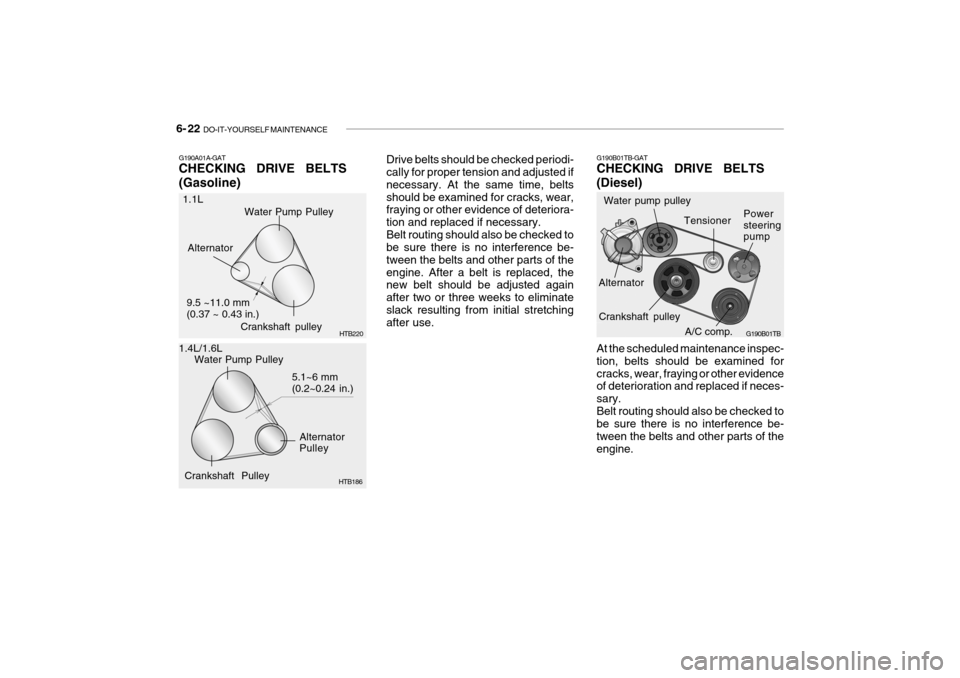
Drive belts should be checked periodi- cally for proper tension and adjusted if necessary. At the same time, beltsshould be examined for cracks, wear, fraying or other evidence of deteriora- tion and replaced if necessary.Belt routing should also be checked to be sure there is no interference be- tween the belts and other parts of theengine. After a belt is replaced, the new belt should be adjusted again after two or three weeks to eliminateslack resulting from initial stretching after use. G190B01TB-GAT CHECKING DRIVE BELTS (Diesel)
A/C comp.
Water pump pulley
G190B01TB
Alternator Power steering pump
At the scheduled maintenance inspec- tion, belts should be examined forcracks, wear, fraying or other evidence of deterioration and replaced if neces- sary.Belt routing should also be checked to be sure there is no interference be- tween the belts and other parts of theengine.Water Pump Pulley
Alternator Pulley
Crankshaft Pulley 5.1~6 mm(0.2~0.24 in.)
G190A01A-GAT CHECKING DRIVE BELTS (Gasoline)
HTB186
1.1L
1.4L/1.6L Crankshaft pulley
Alternator
HTB220
Water Pump Pulley
9.5 ~11.0 mm (0.37 ~ 0.43 in.)Tensioner
Crankshaft pulley
Page 286 of 463

1- 20 FEATURES OF YOUR HYUNDAI
SB090C1-E Larger Children Larger children should occupy the rear seat and be restrained at all times. Therestraint may take the form of a special safety belt or the original factory fitted seat belt used in conjunction with anapproved booster cushion depending upon the size and weight of the child. Under no circumstances should chil-dren be allowed to travel standing, kneel- ing or lying on the seat. Never allow children to ride in the frontpassenger seat. SB090O1-E Pregnant Women The use of a seat belt is recommended for pregnant women. The seat belt should be worn as low and snugly as possible across the hips, not across the abdo-men. A qualified Medical Practitioner should be consulted for further informa- tion. SB090E1-E Injured Persons A seat belt should be used when an injured person is being transported. Forspecific recommendations, the advice of a qualified Medical Practioner should be sought. SB090F1-E Seat Belt Occupancy The seat belts are designed to be used by one seat occupant only. The use ofa seat belt by more than one person increases the levels of injury which may be sustained in the event of an accident. B150G01A-EAT Do Not Lie Down To ensure that the maximum level of protection may be afforded by the seat belt system, all passengers should besitting in an upright position throughout the journey. The seat belt will be unable to afford maximum protection if thefront seats are at or near the fully reclined position.
SB090A1-E SEAT BELT PRECAUTIONS Seat belts should be worn at all times by all occupants front and rear. Thepossibility of injury or the severity of injuries suffered in the event of an accident will be greatly reduced by thewearing of seat belts. In addition the following recommenda- tions should be observed.
SB090B1-E Babies/Small Children Babies and small children must be restrained using a restraint system spe-cifically designed for this purpose. Un- der no circumstances should a child be carried in the vehicle without the use ofa suitable restraint which meets the regulations in force in the country where the vehicle is in operation.
Page 298 of 463
1- 32 FEATURES OF YOUR HYUNDAI
!WARNING:
To obtain maximum benefit from a pre-tensioner seat belt:
1. The seat belt must be worn cor- rectly.
2. The seat belt must be adjusted to the correct position.
NOTE:
o Both the driver's and front passenger's pre-tensioner seat belts will be activated in certainfrontal collisions. The pre- tensioner seat belts can be acti- vated with the airbags. The pre-tensioners will be activated under these conditions even if the seat belts are not being worn at thetime of the collision.
o When the pre-tensioner seat belts
are activated, a loud noise may beheard and fine dust, which may appear to be smoke, may be vis- ible in the passenger compart-ment. These are normal operating conditions and are not hazard- ous.
B180B01A-EAT Pre-Tensioner Seat Belt
HXG229-R
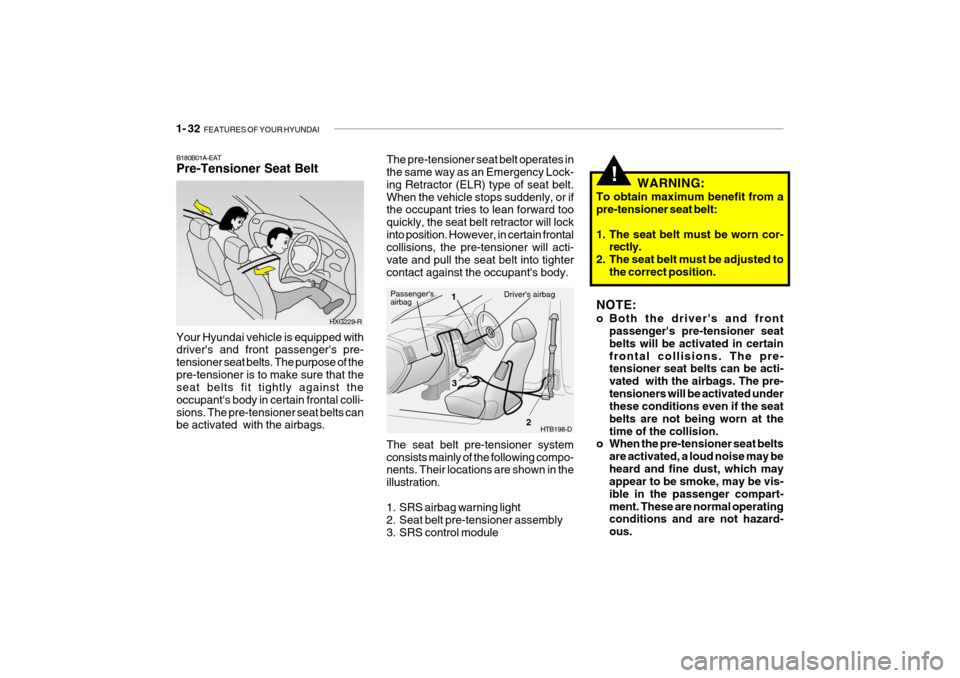
Your Hyundai vehicle is equipped with driver's and front passenger's pre- tensioner seat belts. The purpose of thepre-tensioner is to make sure that the seat belts fit tightly against the occupant's body in certain frontal colli-sions. The pre-tensioner seat belts can be activated with the airbags.The pre-tensioner seat belt operates in the same way as an Emergency Lock- ing Retractor (ELR) type of seat belt.When the vehicle stops suddenly, or if the occupant tries to lean forward too quickly, the seat belt retractor will lockinto position. However, in certain frontal collisions, the pre-tensioner will acti- vate and pull the seat belt into tightercontact against the occupant's body. The seat belt pre-tensioner system consists mainly of the following compo- nents. Their locations are shown in the illustration.
1. SRS airbag warning light
2. Seat belt pre-tensioner assembly
3. SRS control module HTB198-D
Driver's airbag1
2
3Passenger's airbag
Page 299 of 463
FEATURES OF YOUR HYUNDAI 1- 33
o Do not strike the pre-tensioner seat
belt assemblies.
o Do not attempt to service or re- pairer the pre-tensioner seat belt system in any manner.
o Improper handling of the pre- tensioner seat belt assemblies, andfailure to heed the warnings to notstrike, modify, inspect, replace, service or repairer the pre- tensioner seat belt assemblies maylead to improper operation or in- advertent activation and serious injury.
o Always wear the seat belts when driving or travelling in a motorvehicle.
!
o Although it is harmless, the finedust may cause skin irritation and should not be breathed for pro-longed periods. Wash your hands and face thoroughly after an acci- dent in which the pre-tensionerseat belts were activated. or if it illuminates whilst the ve- hicle is being driven, please have a Hyundai authorised repairer in-spect the pre-tensioner seat belt or SRS airbag system as soon as possible.
CAUTION:
o Because the sensor that activates the SRS airbag is connected with the pre-tensioner seat belt, the SRS airbag warning light on theinstrument panel will blink for approximately 6 seconds after the ignition key has been turned to the "ON" position and then it should turn off.
o If the pre-tensioner seat belt is not working properly, this warninglight will illuminate even if theSRS system is not functioning. If the SRS airbag warning light does not illuminate when the igni-tion key is turned to "ON", or if it remains illuminated after blinking for approximately 6 seconds, WARNING:
o Pre-tensioners are designed to op- erate only one time. After activa- tion, pre-tensioner seat belts must be replaced. All seat belts, of any type, should always be replaced after they have been worn during acollision.
o The pre-tensioner seat belt assem-
bly mechanisms become hot dur-ing activation. Do not touch the pre-tensioner seat belt assemblies for several minutes after they havebeen activated.
o Do not attempt to inspect or re-
place the pre-tensioner seat beltsyourself. This must be done by a Hyundai authorised repairer.
!
Page 300 of 463
1- 34 FEATURES OF YOUR HYUNDAI
HTB203
Rear impact
Side Impact Rollover
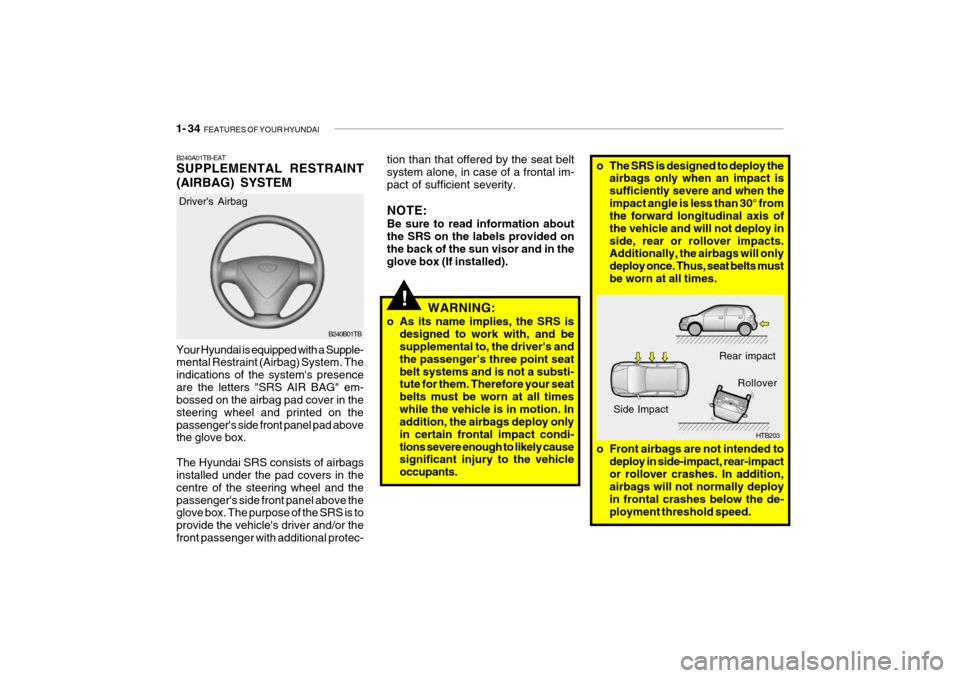
o The SRS is designed to deploy the
airbags only when an impact is sufficiently severe and when theimpact angle is less than 30° from the forward longitudinal axis of the vehicle and will not deploy inside, rear or rollover impacts. Additionally, the airbags will only deploy once. Thus, seat belts mustbe worn at all times.
o Front airbags are not intended to deploy in side-impact, rear-impactor rollover crashes. In addition, airbags will not normally deploy in frontal crashes below the de-ployment threshold speed.
!
B240B01TB
Driver's Airbag
Your Hyundai is equipped with a Supple- mental Restraint (Airbag) System. The indications of the system's presenceare the letters "SRS AIR BAG" em- bossed on the airbag pad cover in the steering wheel and printed on thepassenger's side front panel pad above the glove box. The Hyundai SRS consists of airbags installed under the pad covers in the centre of the steering wheel and thepassenger's side front panel above the glove box. The purpose of the SRS is to provide the vehicle's driver and/or thefront passenger with additional protec- B240A01TB-EAT SUPPLEMENTAL RESTRAINT (AIRBAG) SYSTEM
tion than that offered by the seat belt system alone, in case of a frontal im- pact of sufficient severity. NOTE: Be sure to read information about the SRS on the labels provided onthe back of the sun visor and in the glove box (If installed).
WARNING:
o As its name implies, the SRS is designed to work with, and besupplemental to, the driver's and the passenger's three point seatbelt systems and is not a substi- tute for them. Therefore your seat belts must be worn at all timeswhile the vehicle is in motion. In addition, the airbags deploy only in certain frontal impact condi-tions severe enough to likely cause significant injury to the vehicle occupants.
Page 306 of 463

1- 40 FEATURES OF YOUR HYUNDAI
B240C03Y-EAT SRS Care The SRS is virtually maintenance-free and there are no parts you can safely service by yourself. The entire SRSsystem must be inspected by an au- thorized Hyundai dealer in 10 years after the date that the vehicle wasmanufactured. Any work on the SRS system, such as removing, installing, repairering, or anywork on the steering wheel must be performed by a qualified Hyundai tech- nician. Improper handling of the SRSsystem may result in serious personal injury.
The airbags deploy only in certain side impact conditions severeenough to cause significant injury to the vehicle occupants.
o For best protection from the side
airbag system and to avoid beinginjured is by the deploying side impact airbag, both front seat oc-cupants should sit in an upright position with the seat belt prop- erly fastened. The driver's handsshould be placed on the steering wheel at the 9:00 and 3:00 o'clock positions. The passenger's armsand hands should be placed in their laps.
o Do not use any accessory seat covers.
o Use of seat covers could reduce or
prevent the effectiveness of the system.
o Do not install any accessories on
the side or near the side impactairbag.
o Do not use excessive force on the
side of the seat.
o Do not place any objects over the airbag or between the airbag andyourself.
!WARNING:
o The side impact airbag is supple- mental to the driver's and the passenger's three point seat belt systems and is not a substitute for them. Therefore your seat beltsmust be worn at all times whilst the vehicle is in motion.
Side airbag sensor
Important Safety Notes on the Side Impact Airbag system Following is a number of safety points concerning this system which should always be observed to ensure risk of injury is reduced in an accident. HTB072-D
o Do not place any objects (an um-
brella, bag, etc.) between the front door and the front seat. Such ob- jects may become dangerous pro-jectiles and cause injury if the supplemental side impact air bag inflates.
o To prevent unexpected deploy- ment of the side air impact bagthat may result in personal injury,avoid impact to the side airbag sensor when the ignition key is on.
Page 366 of 463
2- 6 DRIVING YOUR HYUNDAI
C050B01HP
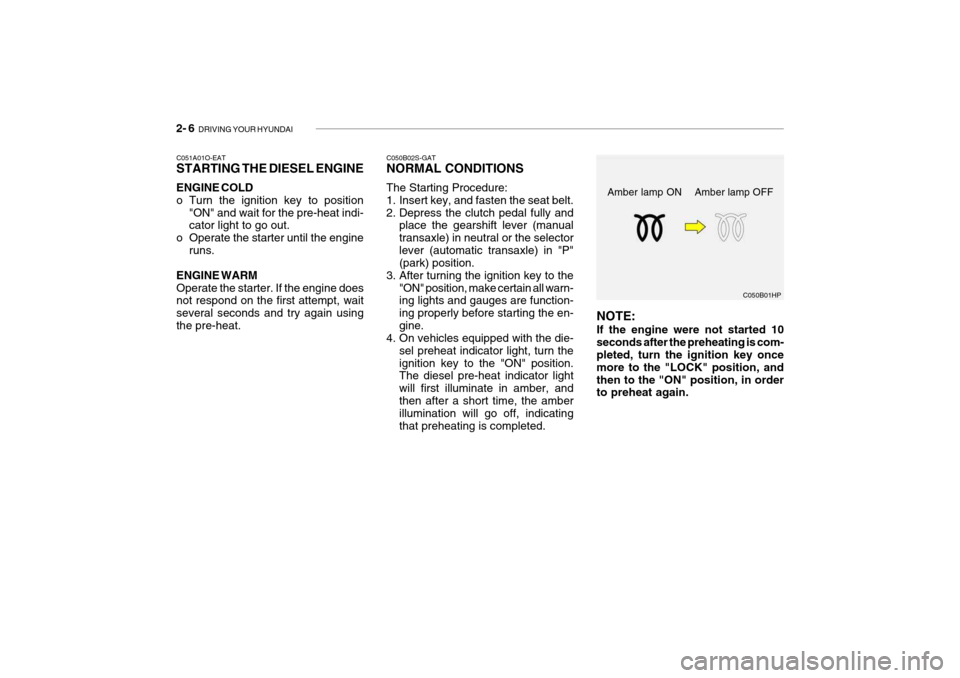
NOTE: If the engine were not started 10 seconds after the preheating is com- pleted, turn the ignition key once more to the "LOCK" position, andthen to the "ON" position, in order to preheat again.
C051A01O-EAT STARTING THE DIESEL ENGINE ENGINE COLD
o Turn the ignition key to position
"ON" and wait for the pre-heat indi- cator light to go out.
o Operate the starter until the engine
runs.
ENGINE WARM Operate the starter. If the engine does not respond on the first attempt, wait several seconds and try again usingthe pre-heat. C050B02S-GAT NORMAL CONDITIONS The Starting Procedure:
1. Insert key, and fasten the seat belt.
2. Depress the clutch pedal fully and
place the gearshift lever (manualtransaxle) in neutral or the selectorlever (automatic transaxle) in "P" (park) position.
3. After turning the ignition key to the "ON" position, make certain all warn-ing lights and gauges are function- ing properly before starting the en-gine.
4. On vehicles equipped with the die-
sel preheat indicator light, turn theignition key to the "ON" position. The diesel pre-heat indicator light will first illuminate in amber, andthen after a short time, the amber illumination will go off, indicating that preheating is completed. Amber lamp ON Amber lamp OFF