overdrive Hyundai Getz 2007 User Guide
[x] Cancel search | Manufacturer: HYUNDAI, Model Year: 2007, Model line: Getz, Model: Hyundai Getz 2007Pages: 463, PDF Size: 11.14 MB
Page 369 of 463
DRIVING YOUR HYUNDAI 2- 9
C070E04A-EAT RECOMMENDED SHIFT POINTS
1-2 2-3 3-44-5
Shift
from-to Recommended
15 mph (20 km/h)25 mph (40 km/h)35 mph (55 km/h) 45 mph (75 km/h)
The shift points as shown above are recommended for optimum fuel economy and performance. SC090B1-F Using the Clutch The clutch should be pressed all the way to the floor before shifting, thenreleased slowly. Do not rest your foot on the clutch pedal while driving. This can cause unnecessary wear.Do not partially engage the clutch to hold the car on an incline. This causes unnecessary wear.Use the parking brake to hold the car on an incline. Do not operate the clutch pedal rapidly and repeatedly.
HTB185-D
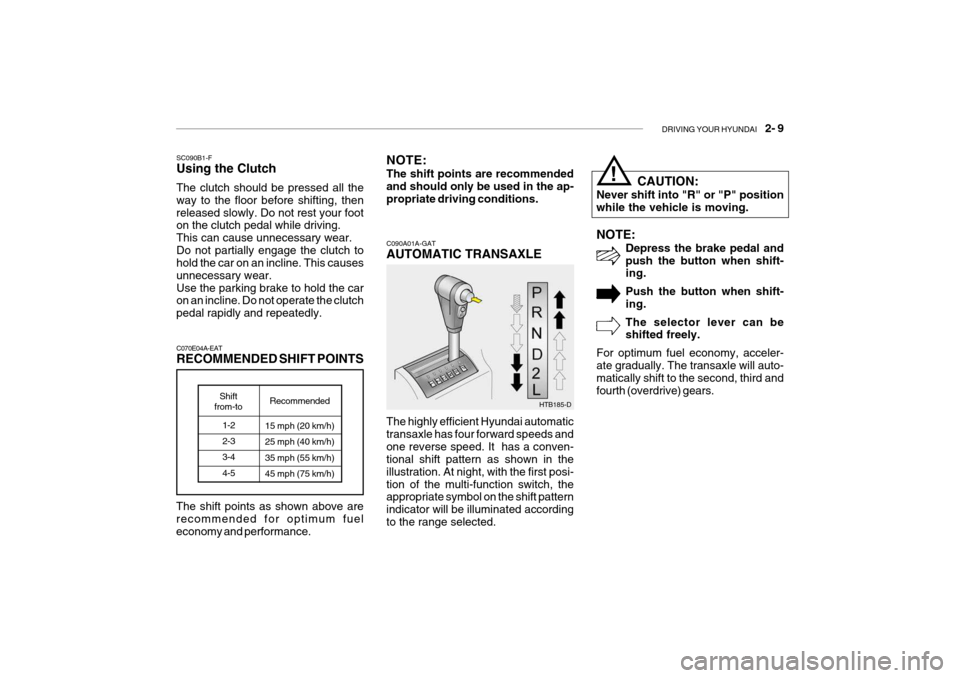
C090A01A-GAT AUTOMATIC TRANSAXLE The highly efficient Hyundai automatic transaxle has four forward speeds andone reverse speed. It has a conven- tional shift pattern as shown in the illustration. At night, with the first posi-tion of the multi-function switch, the appropriate symbol on the shift pattern indicator will be illuminated accordingto the range selected. CAUTION:
Never shift into "R" or "P" positionwhile the vehicle is moving. NOTE: Depress the brake pedal and push the button when shift- ing. Push the button when shift- ing. The selector lever can be shifted freely.
For optimum fuel economy, acceler-ate gradually. The transaxle will auto- matically shift to the second, third andfourth (overdrive) gears.
!
NOTE: The shift points are recommended and should only be used in the ap- propriate driving conditions.
Page 370 of 463
2- 10 DRIVING YOUR HYUNDAI
YC090A1-E SELECTOR POSITIONS o P (Park): With the selector in this position, no drive is transmitted from the engine and the transaxle output and thereforethe front wheels locked. The engine may be started with the selector in this position.
!
CAUTION:
The selector must NEVER be shifted to the "P" position whilst the ve-hicle is in motion, otherwise seri- ous transaxle damage will result. DC110C1-E o R (Reverse): With the selector in this position, re- verse gear will be engaged. The en-gine may not be started with the selec- tor in this position.
CAUTION:
The selector must NEVER be shifted to the "R" position whilst the ve- hicle is in motion.
! DC110D1-E o N (Neutral): With the selector in this position, no gear is selected and no drive is trans-mitted from the engine. The engine may be started with the selector in this position.
!
CAUTION:
Do not coast with the selector at the "N" position. DC110E2-E o D (Drive): Bring the car to a complete stop before shifting the selector lever to "D" posi-tion. With the selector in this position, first gear will be engaged from rest and thetransmission will automatically upshift to second, third and fourth depending upon the vehicle speed, throttle posi-tion and the position of the overdrive switch. The engine may not be started with the selector in this position. DC110F1-E o 2 (Second Gear): With the selector in this position, first gear will be engaged from rest. Thetransmission will upshift to second gear depending upon the vehicle speed and throttle position. No upshift to third orfourth will occur. The engine may not be started with the selector in this position. DC110G2-E o L (Low Gear): With the selector in this position, first gear will be engaged from rest. No upshift will occur regardless of vehiclespeed and throttle opening. The en- gine may not be started with the selec- tor in this position.
!
CAUTION:
Do not move the selector to the "L" position when the vehicle speed is in excess of 50 m.p.h.
Page 372 of 463
2- 12 DRIVING YOUR HYUNDAI
o When climbing steep gradients us-
ing large throttle openings, the transaxle may re-peatedly changebetween two adjacent ratios. This is a normal characteristic and may be prevented by cancelling the over-drive facility if the shifting occurs between third and fourth ratios, se- lecting position "2" if the shiftingoccurs between third and second ratios or selecting position "1" if the shifting occurs between first andsecond ratios.
o Never move the selector to or from
the "P" or "N" position with the ac-celerator depressed.
o Ensure that the overdrive switch is
at the "ON" position for maximumeconomy.
o If rapid acceleration is required, fully
depress the accelerator pedal. Inthis condition, the kickdown mecha- nism will be operated and the transaxle will automatically down-shift according to the vehicle speed. o The automatic transaxle may be used
to great effect if the vehicle becomesstuck in snow or mud by allowing thevehicle to be rocked to and fro. The engine speed should be held at ap- proximately 1,000rpm by means ofthe accelerator pedal and the selec- tor lever moved between the "D" and "R" positions to induce a rockingmotion.
o Do not depress the accelerator pedal
with the brakes applied and the se-lector at the "R", "D", "2" or "L" position.
o Turn the overdrive switch on for
good fuel economy and smooth driv-ing. But if engine braking is needed in the "D" range or if repeated up-shifting and downshifting between the 3rd and 4th gear is needed when climbing a gentle slope, it is recom-mended that the overdrive switch be turned off. Turn the overdrive switch back on immediately after-ward.
!WARNING:
o Avoid high cornering speeds.
o Do not make quick steering wheel movements, such as sharp lane changes or fast, sharp turns.
o Always wear your seat belts. In a collision crash, an unbeltedperson is significantly more likely to die than a person wearing aseatbelt.
o The risk of rollover is greatly in-
creased if you lose control of yourvehicle at highway speeds.
o Loss of control often occurs if two
or more wheels drop off the road-way and the driver oversteers to reenter the roadway.
o In the event your vehicle leaves the roadway, do not steer sharply.Instead, slow down before pulling back into the travel lanes.
o Never exceed posted speed limits.
o Excessive depressing of the
accelerater pedal under the tire slip condition such as moving out of the mud or fresh snow etc, may cause severe damage to thetransaxle. At this time, take other way such as towing.
Page 373 of 463
DRIVING YOUR HYUNDAI 2- 13
HTB217-D
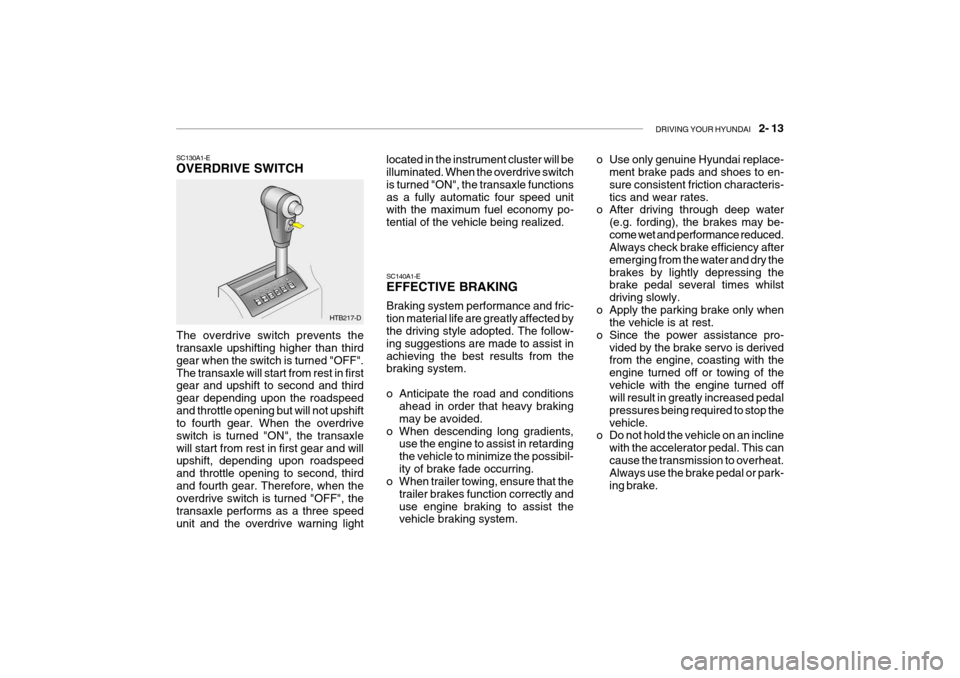
SC130A1-E OVERDRIVE SWITCH
The overdrive switch prevents the transaxle upshifting higher than third gear when the switch is turned "OFF".The transaxle will start from rest in first gear and upshift to second and third gear depending upon the roadspeedand throttle opening but will not upshift to fourth gear. When the overdrive switch is turned "ON", the transaxlewill start from rest in first gear and will upshift, depending upon roadspeed and throttle opening to second, thirdand fourth gear. Therefore, when the overdrive switch is turned "OFF", the transaxle performs as a three speedunit and the overdrive warning light located in the instrument cluster will be illuminated. When the overdrive switch is turned "ON", the transaxle functionsas a fully automatic four speed unit with the maximum fuel economy po- tential of the vehicle being realized. SC140A1-E EFFECTIVE BRAKING Braking system performance and fric- tion material life are greatly affected by the driving style adopted. The follow- ing suggestions are made to assist inachieving the best results from the braking system.
o Anticipate the road and conditions
ahead in order that heavy braking may be avoided.
o When descending long gradients, use the engine to assist in retardingthe vehicle to minimize the possibil-ity of brake fade occurring.
o When trailer towing, ensure that the
trailer brakes function correctly anduse engine braking to assist the vehicle braking system. o Use only genuine Hyundai replace-
ment brake pads and shoes to en- sure consistent friction characteris-tics and wear rates.
o After driving through deep water
(e.g. fording), the brakes may be-come wet and performance reduced. Always check brake efficiency after emerging from the water and dry thebrakes by lightly depressing the brake pedal several times whilst driving slowly.
o Apply the parking brake only when the vehicle is at rest.
o Since the power assistance pro- vided by the brake servo is derived from the engine, coasting with the engine turned off or towing of thevehicle with the engine turned off will result in greatly increased pedal pressures being required to stop thevehicle.
o Do not hold the vehicle on an incline
with the accelerator pedal. This cancause the transmission to overheat. Always use the brake pedal or park- ing brake.
Page 380 of 463
2- 20 DRIVING YOUR HYUNDAI
C190E02L
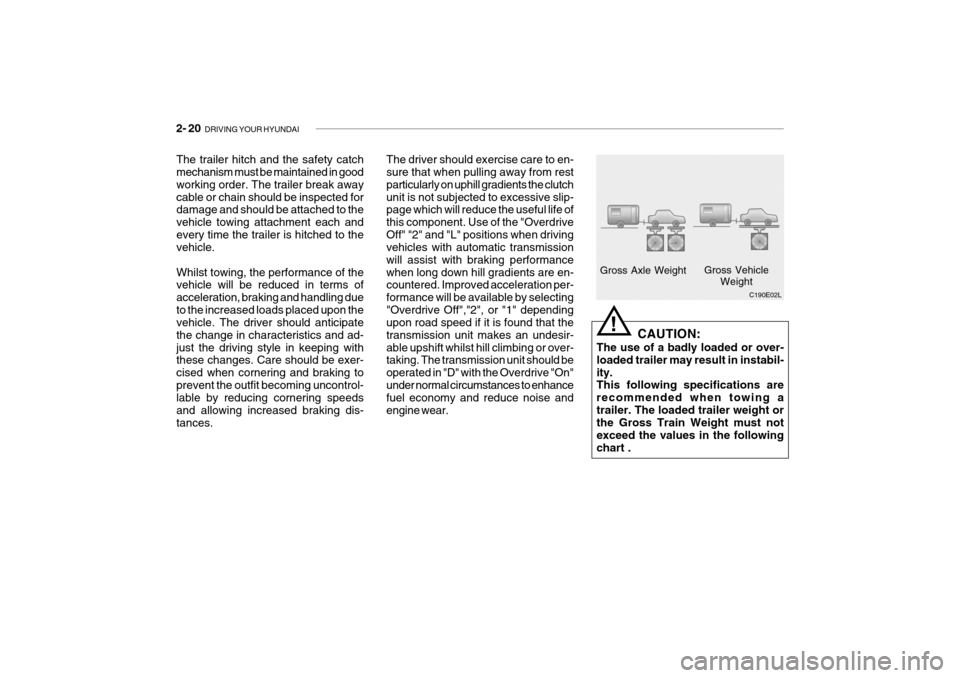
Gross Axle Weight
Gross Vehicle
Weight
The trailer hitch and the safety catch mechanism must be maintained in good working order. The trailer break awaycable or chain should be inspected for damage and should be attached to the vehicle towing attachment each andevery time the trailer is hitched to the vehicle. Whilst towing, the performance of the vehicle will be reduced in terms of acceleration, braking and handling dueto the increased loads placed upon the vehicle. The driver should anticipate the change in characteristics and ad-just the driving style in keeping with these changes. Care should be exer- cised when cornering and braking toprevent the outfit becoming uncontrol- lable by reducing cornering speeds and allowing increased braking dis-tances. The driver should exercise care to en- sure that when pulling away from rest particularly on uphill gradients the clutchunit is not subjected to excessive slip- page which will reduce the useful life of this component. Use of the "OverdriveOff" "2" and "L" positions when driving vehicles with automatic transmission will assist with braking performancewhen long down hill gradients are en- countered. Improved acceleration per- formance will be available by selecting"Overdrive Off","2", or "1" depending upon road speed if it is found that the transmission unit makes an undesir-able upshift whilst hill climbing or over- taking. The transmission unit should be operated in "D" with the Overdrive "On"under normal circumstances to enhance fuel economy and reduce noise and engine wear.
CAUTION:
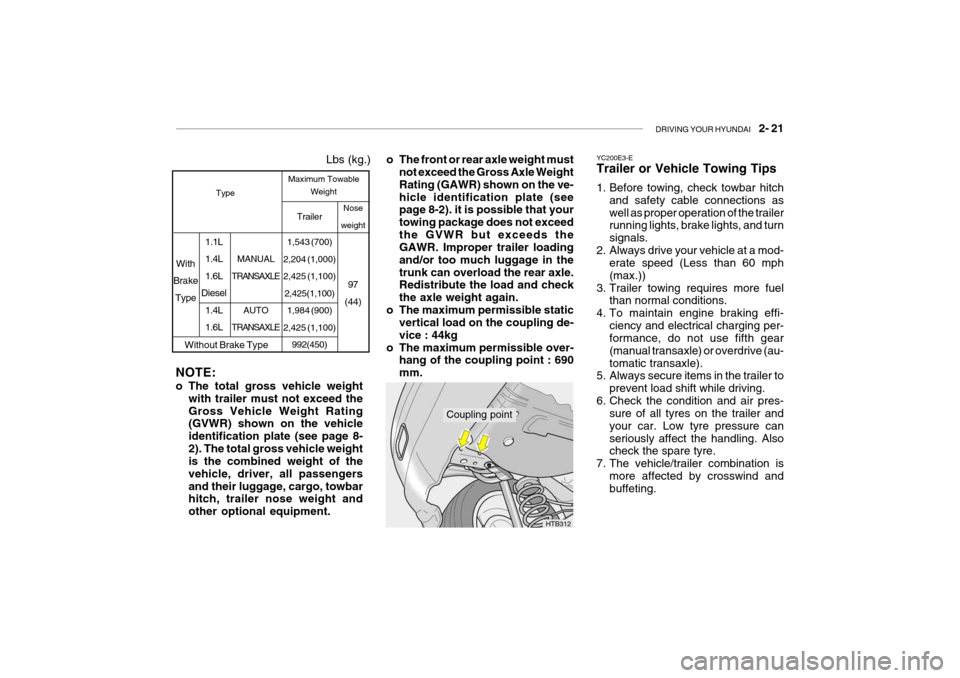
The use of a badly loaded or over-loaded trailer may result in instabil-ity. This following specifications are recommended when towing atrailer. The loaded trailer weight or the Gross Train Weight must not exceed the values in the followingchart .
!
Page 381 of 463
DRIVING YOUR HYUNDAI 2- 21
Coupling point
Nose
weight
97
(44)
Without Brake Type Trailer
1,543 (700)
2,204 (1,000) 2,425 (1,100) 2,425(1,100) 1,984 (900)
2,425 (1,100) 992(450)
MANUAL
TRANSAXLE
AUTO
TRANSAXLE
1.1L 1.4L1.6L
Diesel 1.4L1.6L
With
Brake Type Lbs (kg.)
Maximum Towable
Weight
Type
NOTE:
o The total gross vehicle weight with trailer must not exceed the Gross Vehicle Weight Rating (GVWR) shown on the vehicle identification plate (see page 8-2). The total gross vehicle weight is the combined weight of the vehicle, driver, all passengersand their luggage, cargo, towbar hitch, trailer nose weight and other optional equipment. o The front or rear axle weight must
not exceed the Gross Axle WeightRating (GAWR) shown on the ve-hicle identification plate (see page 8-2). it is possible that your towing package does not exceedthe GVWR but exceeds the GAWR. Improper trailer loading and/or too much luggage in thetrunk can overload the rear axle. Redistribute the load and check the axle weight again.
o The maximum permissible static vertical load on the coupling de-vice : 44kg
o The maximum permissible over- hang of the coupling point : 690mm. YC200E3-E Trailer or Vehicle Towing Tips
1. Before towing, check towbar hitch
and safety cable connections as well as proper operation of the trailer running lights, brake lights, and turn signals.
2. Always drive your vehicle at a mod- erate speed (Less than 60 mph(max.))
3. Trailer towing requires more fuel than normal conditions.
4. To maintain engine braking effi- ciency and electrical charging per- formance, do not use fifth gear (manual transaxle) or overdrive (au-tomatic transaxle).
5. Always secure items in the trailer to
prevent load shift while driving.
6. Check the condition and air pres- sure of all tyres on the trailer andyour car. Low tyre pressure canseriously affect the handling. Also check the spare tyre.
7. The vehicle/trailer combination is more affected by crosswind andbuffeting.
HTB312
Page 462 of 463

10- 4 INDEX
L LIGHTING SWITCH .................................................... 1-58
LUGGAGE BOARD ..................................................... 1-79
LUGGAGE NET .......................................................... 1-79
LUGGAGE ROOM ...................................................... 1-77
LUGGAGE UNDER TRAY ............... ...........................1-78
LUMBAR SUPPORT ADJUSTMENT ..........................1-15
MMAINTENANCE AND SERVICING REQUIREMENTS .................................................... 5-2
MAINTENANCE UNDER SEVERE USAGE CONDITIONS .......................................................... 5-6
MANUAL TRANSAXLE ............................................... 2-8
MANUAL TRANSAXLE LUBRICANT.......................... 6-14
MIRROR ..................................................................... 1-70
MULTI FUNCTION SWITCH .......................................1-57
OODOMETER ............................................................... 1-54
OUTSIDE REAR VIEW MIRROR .....................1-70 ~ 1-71
OUTSIDE REAR VIEW MIRROR HEAT ..................... 1-71
OVERDRIVE SWITCH ................................................ 2-13PPARKING
BRAKE ...................................................... 1-72
POLISHING ................................................................. 4-4
POLLEN FILTER ............................................... 1-92, 6-19
POWER OUTLET ....................................................... 1-63
POWER STEERING FLUID LEVEL ............................6-23
POWER STEERING HOSES ...................................... 6-23
POWER WINDOW ...................................................... 1-11
PROTECTING YOUR HYUNDAI FROM CORROSION ........................................................... 4-2
RREAR FOG LIGHT SWITCH ....................................... 1-62
REAR SEAT ............................................................... 1-16
REAR SEAT WARNI NG ............................................. 1-19
RECOMMENDED SHIFT SPEEDS ............................. 2-9
REMOTE FUEL FILLER LID RELEASE ...................... 1-74
REMOVAL OF WATER FROM THE FUEL FI LTER ................................................. 6-24
REPLACING LIGHT BULBS ....................................... 6-26
RUNNING IN YOUR NEW HYUNDAI ........................... 1-4
SSCHEDULED MAINTENANCE .................................... 5-3
SEAT ADJUSTMENT ................................................. 1-12
SEATBACK HOL DER ................................................. 1-77