air condition Hyundai Getz 2007 Owner's Guide
[x] Cancel search | Manufacturer: HYUNDAI, Model Year: 2007, Model line: Getz, Model: Hyundai Getz 2007Pages: 463, PDF Size: 11.14 MB
Page 179 of 463

4- 2 CORROSION PREVENTION AND APPEARANCE CARE
E010A01A-AAT CORROSION PROTECTION Protecting Your Hyundai from Corrosion: By using the most advanced design and construction practices to combatcorrosion, Hyundai produces cars of the highest quality. However, this is only part of the job. To achieve thelong-term corrosion resistance your Hyundai can deliver, the owner's co- operation and assistance is also re-quired. E010C01A-AAT High-Corrosion Areas If you live in an area where your car is regularly exposed to corrosive materi-als, corrosion protection is particularly important. Some of the common causes of accelerated corrosion areroad salts, dust control chemicals, ocean air and industrial pollution.
E010B01A-AAT Common Causes of Corrosion The most common causes of corro- sion on your car are:
o Road salt, dirt and moisture that is allowed to accumulate underneath the car.
o Removal of paint or protective coat- ings by stones, gravel, abrasion orminor scrapes and dents which leaveunprotected metal exposed to cor- rosion. E010D01A-AAT Moisture Breeds Corrosion Moisture creates the conditions in which corrosion is most likely to occur. For example, corrosion is accelerated by high humidity, particularly when tem-peratures are just above freezing. In such conditions, the corrosive mate- rial is kept in contact with the carsurfaces by moisture that is slow to evaporate. Mud is particularly corrosive becauseit is slow to dry and holds moisture in contact with the vehicle. Although themud appears to be dry, it can still retain the moisture and promote corrosion. High temperatures can also acceler-ate corrosion of parts that are not properly ventilated so the moisture can be dispersed. For all these rea-sons, it is particularly important to keep your car clean and free of mud or accumulations of other materials. Thisapplies not only to the visible surfaces but particularly to the underside of the car. E020A01A-AAT TO HELP PREVENT CORRO- SION You can help prevent corrosion from getting started by observing the follow- ing:
Page 180 of 463

CORROSION PREVENTION AND APPEARANCE CARE 4- 3
E020C01A-AAT Keep Your Garage Dry Don't park your car in a damp, poorly ventilated garage. This creates a fa- vorable environment for corrosion. This is particularly true if you wash your carin the garage or drive it into the garage when it is still wet or covered with snow, ice or mud. Even a heated ga-rage can contribute to corrosion un- less it is well ventilated so moisture is dispersed. E020D01A-AAT Keep Paint and Trim in Good Condition Scratches or chips in the finish should be covered with "touch-up" paint as soon as possible to reduce the possi-bility of corrosion. If bare metal is show- ing through, the attention of a qualified body and paint shop is recommended. E020E01A-AAT Don't Neglect the Interior Moisture can collect under the floor mats and carpeting to cause corro-sion. Check under the mats periodi- cally to be sure the carpeting is dry. Use particular care if you carry fertiliz-ers, cleaning materials or chemicals in the car. These should be carried only in propercontainers and any spills or leaks should be cleaned up, flushed with clear water and thoroughly dried.
E020B01A-AAT Keep Your Car Clean The best way to prevent corrosion is to keep your car clean and free of corro-sive materials. Attention to the under- side of the car is particularly important.
o If you live in a high-corrosion area —
where road salts are used, near the ocean, areas with industrial pollu-tion, acid rain, etc.—, you should take extra care to prevent corro- sion. In winter, hose off the under-side of your car at least once a month and be sure to clean the underside thoroughly when winteris over.
o When cleaning underneath the car,
give particular attention to the com-ponents under the fenders and other areas that are hidden from view. Do a thorough job; just dampening theaccumulated mud rather than wash- ing it away will accelerate corrosion rather than prevent it. Water underhigh pressure and steam are par- ticularly effective in removing accu- mulated mud and corrosive materi-als. o When cleaning lower door panels,
rocker panels and frame members,be sure that drain holes are keptopen so that moisture can escape and not be trapped inside to ac- celerate corrosion.
E030A02A-AAT WASHING AND WAXING Washing Your Hyundai Never wash your car when the surface is hot from being in the sun. Always wash your car in the shade. Wash your car frequently. Dirt is abra- sive and can scratch the paint if it is not removed. Air pollution or acid rain maydamage the paint and trim through chemical action if pollutants are al- lowed to remain in contact with thesurface. If you live near the ocean or in an area where road salts or dust con-
Page 190 of 463

5- 6 VEHICLE MAINTENANCE REQUIREMENTS
GENERAL MAINTENANCE COOLING SYSTEMCOOLANT MANUAL TRANSAXLE OIL AUTOMATIC TRANSAXLEFLUIDBRAKE HOSES AND LINESBRAKE FLUIDREAR BRAKE DRUMS/LININGS, PARKING BRAKEBRAKE PADS, CALIPERS AND ROTORSEXHAUST PIPE AND MUFFLERSUSPENSION MOUNTING BOLTSSTEERING GEAR BOX, LINKAGE & BOOTS/LOWER ARM BALL JOINTPOWER STEERING PUMP, BELT AND HOSESDRIVE SHAFTS AND BOOTSAIR CONDITIONING REFRIGERANTAIR CONDITIONER FILTER (FOR EVAPORATOR AND BLOWER UNIT)
12 3 4 5 6789
101112131415
F030C05TB-GAT R : Replace I : Inspect and, after inspection, clean, adjust, repair or replace if necessary
120 96
I I IIII I IIIII I I
R
105
84
I I III
IIIII I
R
90 72
75 60
6048
I I
R
I II I IIIII I I
R
I I I I I
I I III I
R
I I I I IIII I IIIII
R
45 36
3024
I I III
IIIII I
R
I I IIII I IIIII I I
R
15 12
I I III I IIII I
R
KILOMETERS X 1000 MONTHS
NO. DESCRIPTION
European Community Only Except European Community
See Note (1)* See Note (2)*European Community Only Except European Community
Note : (1) FOR THE FIRST TIME, REPLACE THE COOLANT AT 100,000 KM OR 60 MONTHS. AFTER THAT, REPLACE IT EVERY 40,000 KM OR 24 MONTHS.
(2) FOR THE FIRST TIME, REPLACE THE COOLANT AT 48,000 KM OR 60 MONTHS. AFTER THAT, REPLACE IT EVERY 40,000 KM OR 24 MONTHS.
* : FOR YOUR CONVENIENCE, IT CAN BE REPLACED PRIOR TO IT'S INTERVAL WHEN YOU DO MAINTENANCE OF OTHER ITEMS.
Page 191 of 463

VEHICLE MAINTENANCE REQUIREMENTS 5- 7
SEVERE DRIVING CONDITIONS
A - Repeatly driving short distance of less than 8km(5miles) in normal
tempera ture or less than 16km(10miles) in freezing temperature
B - Extensive engine idling or low speed driving for long distances
C - Driving on rough, dusty, muddy, unpaved, graveled or salt-spread roads
D - Driving in areas using salt or other corrosive materials or in very cold weather E - Driving in sandy areas
F - Driving in heavy traffic area over 32°C(90°F)
G - Driving on uphill, downhill, or mountain road
H - Towing a Trailer, or using a camper, or roof rack
I - Driving as a patrol car, taxi, other commercial use or vehicle towing
J - Driving over 170 Km/h(100 MPH)
K - Frequently driving in stop-and-go conditions
R R RR
I I I I
RR R
European community Only Except European community
ENGINE OIL AND FILTER AIR CLEANER FILTER SPARK PLUGSTIMING BELT BRAKE PADS, CALIPERS AND ROTORS REAR BRAKE DRUMS/LININGS/PADS,PARKING BRAKE STEERING GEAR BOX, LINKAGE & BOOTS/LOWER ARM BALL JOINTDRIVESHAFTS AND BOOTS MANUAL TRANSAXLE OIL AUTOMATIC TRANSAXLEFLUID
AIR CONDITIONER FILTER (For Evaporator and Blower unit)
F040A01TB-GAT
MAINTENANCE UNDER SEVERE USAGE CONDITIONS
The following items must be serviced more frequently on cars normally used under severe driving conditions. Refer to the chart below for the appropriate maintenance intervals. R : Replace I : Inspect and, after inspection, clean, adjust, repair or replace if necessary
MAINTENANCE ITEM
EVERY 7,500 KM OR 6 MONTHS MORE FREQUENTLY MORE FREQUENTLYEVERY 60,000 KM OR 48 MONTHS MORE FREQUENTLY MORE FREQUENTLY MORE FREQUENTLY EVERY 15,000 KM OR 12 MONTHS EVERY 100,000 KM EVERY 45,000 KMEVERY 40,000 KM MORE FREQUENTLY A, B, C, D, E, F, G, H, I, KC, E B, HD, E, F, G, I C, D, G, H C, D, G, H C, D, E, F C, D, E, F C, D, E, G, H, I, J A, C, E, F, G, H, I C, E
MAINTENANCE
INTERVALS DRIVING
CONDITION
MAINTENANCE
OPERATION
Page 195 of 463

VEHICLE MAINTENANCE REQUIREMENTS 5- 11
F070P01A-AAT
o Driveshafts and Boots
Check the drive shafts, boots and clamps for cracks, deterioration, or damage. Replace any damaged parts and, if necessary, repack the grease. F070Q01A-AAT
o Air Conditioning Refrigerant
Check the air conditioning lines and connections for leakage and damage. Check air conditioning performance according to the relevant shop manualif necessary.
Page 196 of 463

6. Do-It-Yourself Maintenance
Engine compartment ........................................................................ 6-2
General checks ................................................................................ 6-5
Checking the engine oil .................................................................... 6-6
Checking the engine coolant ............................................................ 6-9Changing the air cleaner filter ......................................................... 6-11
Filling the washer reservoir ............................................................ 6-13
Checking the transaxle oil (manual)............................................... 6-14
Checking the transaxle fluid (Automatic)....................................... 6-15
Checking the brakes ...................................................................... 6-17
Air conditioning care ....................................................................... 6-18
Changing the climate control air fil ter .............................................6-19
Checking drive belts ...................................................................... 6-22
Checking and replacing fuses ........................................................ 6-23
Checking the battery ...................................................................... 6-25
Checking electric cooling fans ....................................................... 6-26
Power steering fluid level ............................................................... 6-27
Replacement of bulbs .................................................................... 6-30
Fuse panel description ................................................................... 6-36
6
Page 200 of 463

DO-IT-YOURSELF MAINTENANCE 6- 5
G020A02A-AAT GENERAL CHECKS Engine Compartment The following should be checked regu-larly:
o Engine oil level and condition
o Transaxle fluid level and condition
o Brake fluid level
o Clutch fluid level
o Engine coolant level
o Windshield washer fluid level
o Accessory drive belt condition
o Engine coolant hose condition
o Fluid leaks (on or below compo-
nents)
o Power steering fluid level
o Battery condition
o Air filter condition G020C01A-AAT Vehicle Interior The following should be checked each time when the vehicle is driven:
o Lights operation
o Windshield wiper operation
o Horn operation
o Defroster, heater system operation
(and air conditioning, if installed)
o Steering operation and condition
o Mirror condition and operation
o Turn signal operation
o Accelerator pedal operation
o Brake operation, including parking brake
o Manual transaxle operation, includ- ing clutch operation
o Automatic transaxle operation, in- cluding "Park" mechanism opera-tion
o Seat control condition and opera- tion
o Seat belt condition and operation
o Sunvisor operation If you notice anything that does not operate correctly or appears to befunctioning incorrectly, inspect it care- fully and seek assistance from your Hyundai dealer if service is needed.
G020B01A-AAT Vehicle Exterior The following should be checked monthly:
o Overall appearance and condition
o Wheel condition and wheel nut
torgue
o Exhaust system condition
o Light condition and operation
o Windshield glass condition
o Wiper blade condition
o Paint condition and body corrosion
o Fluid leaks
o Door and hood lock condition
o Tire pressure and condition
(including spare tire)
Page 213 of 463
6- 18 DO-IT-YOURSELF MAINTENANCE
G140A01A-AAT AIR CONDITIONING CARE Keeping the Condenser Clean The air conditioning condenser (and engine radiator) should be checked periodically for accumulation of dirt,dead insects, leaves, etc. These can interfere with maximum cooling effi- ciency. When removing such accumu-lations, brush or hose them away care- fully to avoid bending the cooling fans. G140B01A-AAT Checking the Air Conditioning Operation
1. Start the engine and let it run at a
fast idle for several minutes with the air conditioning set at the maximum cold setting.
2. If the air coming out of the in-dash vents is not cold, have the air condi-tioning system inspected by yourHyundai dealer.
! CAUTION:
Running the air conditioning sys- tem for extended periods of timewith a low refrigerant level may damage the compressor.
G120E02TB-AAT Adding Brake Fluid
WARNING:
Handle brake fluid carefully. It can damage your vision if it gets intoyour eyes. Use only DOT 3 or DOT 4 specification fluid from a sealed container. Do not allow the fluidcan or reservoir to remain open any longer than required. This will pre- vent entry of dirt and moisture whichcan damage the brake system and cause improper operation.
!
To add brake fluid;
1) If it is necessary, remove the air cleaner cover.
2) Wipe away any dirt then unscrew the fluid reservoir cap.
3) Slowly pour the recommended fluid
into the reservoir using by a funnel. Do not overfill. Before using, check the condition of the funnel to prevent a mixture of a foreign substance.
4) Carefully replace the cap on the res- ervoir and tighten.
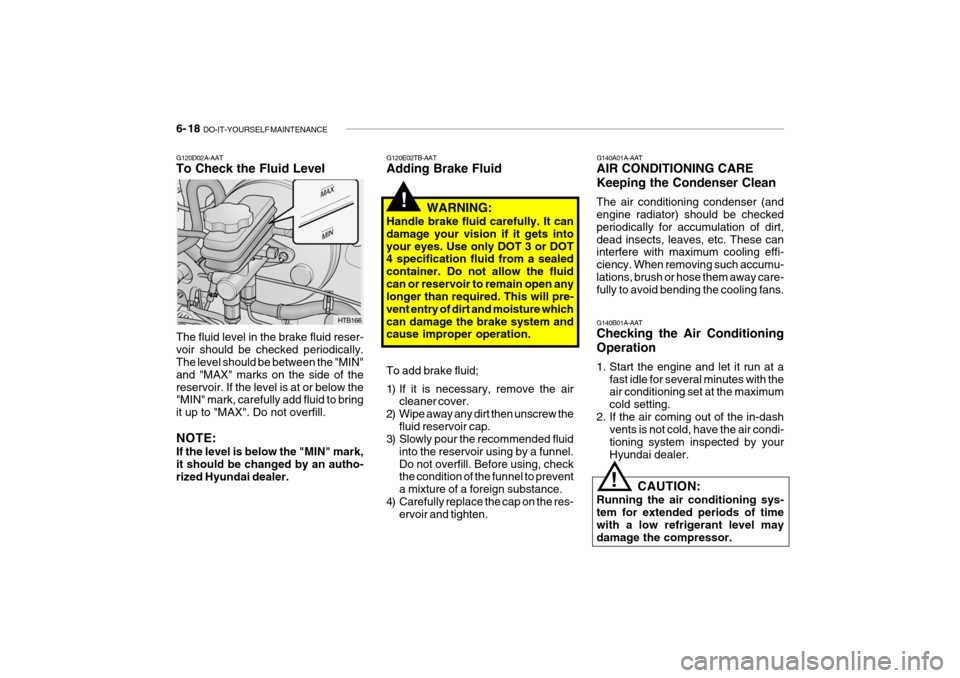
G120D02A-AAT To Check the Fluid Level
HTB166
The fluid level in the brake fluid reser- voir should be checked periodically. The level should be between the "MIN" and "MAX" marks on the side of thereservoir. If the level is at or below the "MIN" mark, carefully add fluid to bring it up to "MAX". Do not overfill. NOTE: If the level is below the "MIN" mark, it should be changed by an autho-rized Hyundai dealer.
Page 214 of 463
DO-IT-YOURSELF MAINTENANCE 6- 19
G140C01A-AAT Lubrication To lubricate the compressor and the seals in the system, the air condition-ing should be run for at least 10 min- utes each week. This is particularly important during cool weather whenthe air conditioning system is not oth- erwise in use. G140D01TB-GAT Checking the Compressor Drive Belt
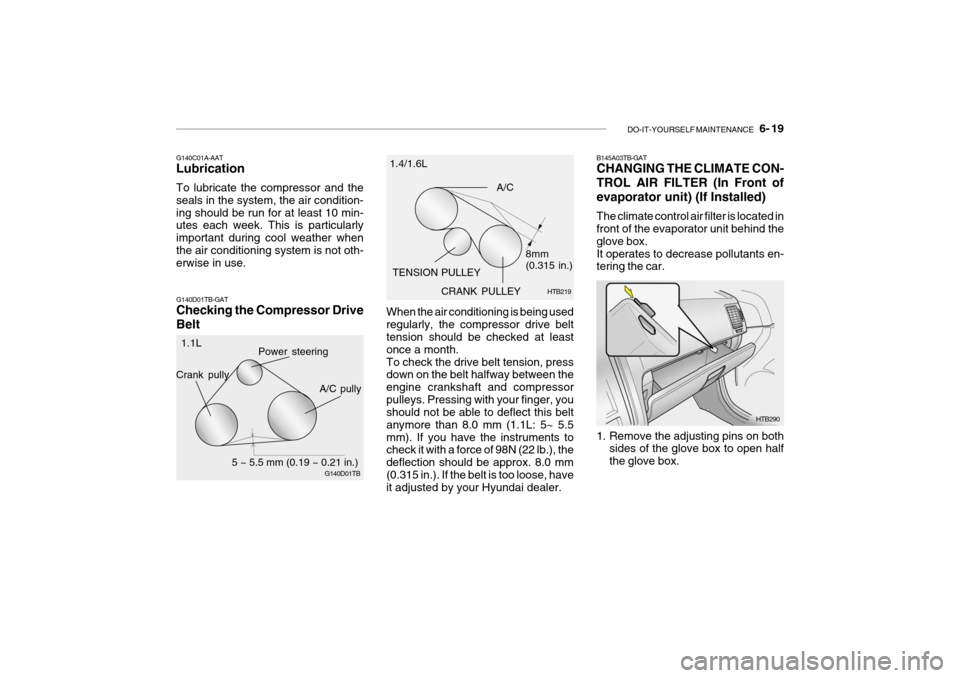
G140D01TB
Power steering
Crank pully
A/C pully
5 ~ 5.5 mm (0.19 ~ 0.21 in.)
1.1L
CRANK PULLEY
When the air conditioning is being used regularly, the compressor drive belt tension should be checked at least once a month.To check the drive belt tension, press down on the belt halfway between the engine crankshaft and compressorpulleys. Pressing with your finger, you should not be able to deflect this belt anymore than 8.0 mm (1.1L: 5~ 5.5mm). If you have the instruments to check it with a force of 98N (22 lb.), the deflection should be approx. 8.0 mm(0.315 in.). If the belt is too loose, have it adjusted by your Hyundai dealer. HTB219
A/C
TENSION PULLEY 8mm (0.315 in.)
1.4/1.6L
HTB290
B145A03TB-GAT CHANGING THE CLIMATE CON-
TROL AIR FILTER (In Front ofevaporator unit) (If Installed) The climate control air filter is located in front of the evaporator unit behind the glove box.It operates to decrease pollutants en- tering the car.
1. Remove the adjusting pins on both
sides of the glove box to open half the glove box.
Page 222 of 463
DO-IT-YOURSELF MAINTENANCE 6- 27
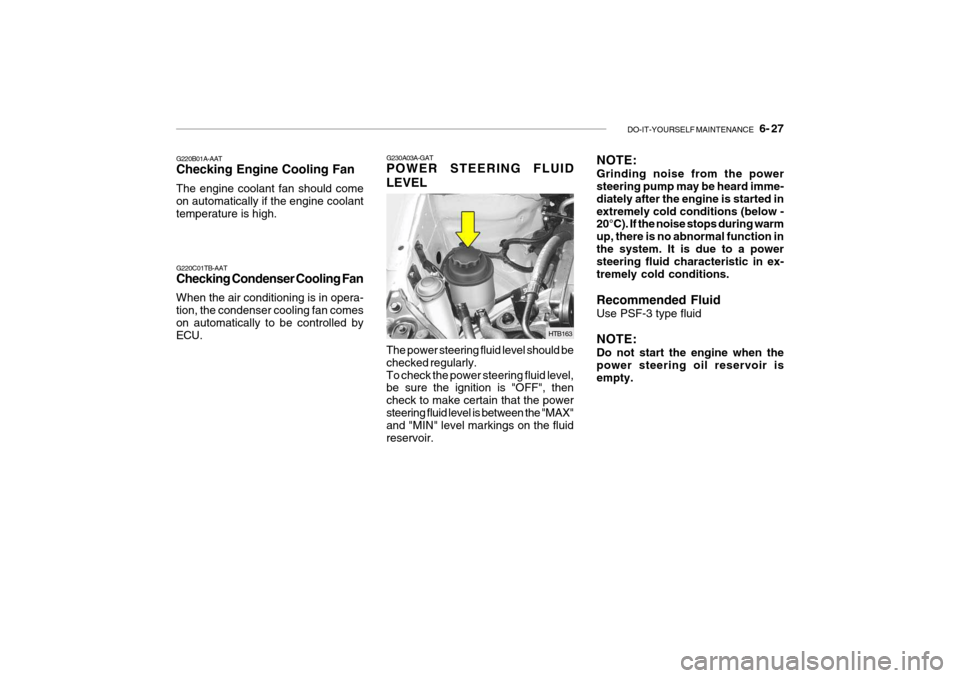
NOTE: Grinding noise from the power steering pump may be heard imme- diately after the engine is started inextremely cold conditions (below - 20°C). If the noise stops during warm up, there is no abnormal function inthe system. It is due to a power steering fluid characteristic in ex- tremely cold conditions. Recommended Fluid Use PSF-3 type fluid NOTE: Do not start the engine when the power steering oil reservoir is empty.G230A03A-GAT POWER STEERING FLUID LEVEL The power steering fluid level should be checked regularly.To check the power steering fluid level, be sure the ignition is "OFF", then check to make certain that the powersteering fluid level is between the "MAX" and "MIN" level markings on the fluid reservoir. HTB163
G220B01A-AAT Checking Engine Cooling Fan The engine coolant fan should come on automatically if the engine coolanttemperature is high. G220C01TB-AAT Checking Condenser Cooling Fan When the air conditioning is in opera- tion, the condenser cooling fan comes on automatically to be controlled by
ECU.