towing Hyundai Getz 2007 Owner's Guide
[x] Cancel search | Manufacturer: HYUNDAI, Model Year: 2007, Model line: Getz, Model: Hyundai Getz 2007Pages: 463, PDF Size: 11.14 MB
Page 380 of 463
2- 20 DRIVING YOUR HYUNDAI
C190E02L
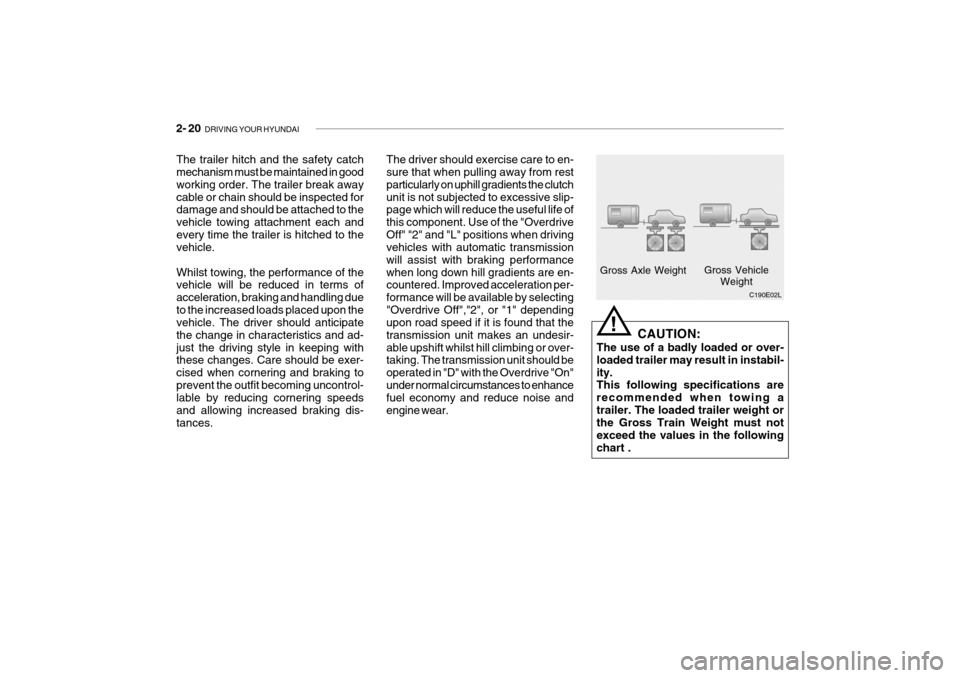
Gross Axle Weight
Gross Vehicle
Weight
The trailer hitch and the safety catch mechanism must be maintained in good working order. The trailer break awaycable or chain should be inspected for damage and should be attached to the vehicle towing attachment each andevery time the trailer is hitched to the vehicle. Whilst towing, the performance of the vehicle will be reduced in terms of acceleration, braking and handling dueto the increased loads placed upon the vehicle. The driver should anticipate the change in characteristics and ad-just the driving style in keeping with these changes. Care should be exer- cised when cornering and braking toprevent the outfit becoming uncontrol- lable by reducing cornering speeds and allowing increased braking dis-tances. The driver should exercise care to en- sure that when pulling away from rest particularly on uphill gradients the clutchunit is not subjected to excessive slip- page which will reduce the useful life of this component. Use of the "OverdriveOff" "2" and "L" positions when driving vehicles with automatic transmission will assist with braking performancewhen long down hill gradients are en- countered. Improved acceleration per- formance will be available by selecting"Overdrive Off","2", or "1" depending upon road speed if it is found that the transmission unit makes an undesir-able upshift whilst hill climbing or over- taking. The transmission unit should be operated in "D" with the Overdrive "On"under normal circumstances to enhance fuel economy and reduce noise and engine wear.
CAUTION:
The use of a badly loaded or over-loaded trailer may result in instabil-ity. This following specifications are recommended when towing atrailer. The loaded trailer weight or the Gross Train Weight must not exceed the values in the followingchart .
!
Page 381 of 463
DRIVING YOUR HYUNDAI 2- 21
Coupling point
Nose
weight
97
(44)
Without Brake Type Trailer
1,543 (700)
2,204 (1,000) 2,425 (1,100) 2,425(1,100) 1,984 (900)
2,425 (1,100) 992(450)
MANUAL
TRANSAXLE
AUTO
TRANSAXLE
1.1L 1.4L1.6L
Diesel 1.4L1.6L
With
Brake Type Lbs (kg.)
Maximum Towable
Weight
Type
NOTE:
o The total gross vehicle weight with trailer must not exceed the Gross Vehicle Weight Rating (GVWR) shown on the vehicle identification plate (see page 8-2). The total gross vehicle weight is the combined weight of the vehicle, driver, all passengersand their luggage, cargo, towbar hitch, trailer nose weight and other optional equipment. o The front or rear axle weight must
not exceed the Gross Axle WeightRating (GAWR) shown on the ve-hicle identification plate (see page 8-2). it is possible that your towing package does not exceedthe GVWR but exceeds the GAWR. Improper trailer loading and/or too much luggage in thetrunk can overload the rear axle. Redistribute the load and check the axle weight again.
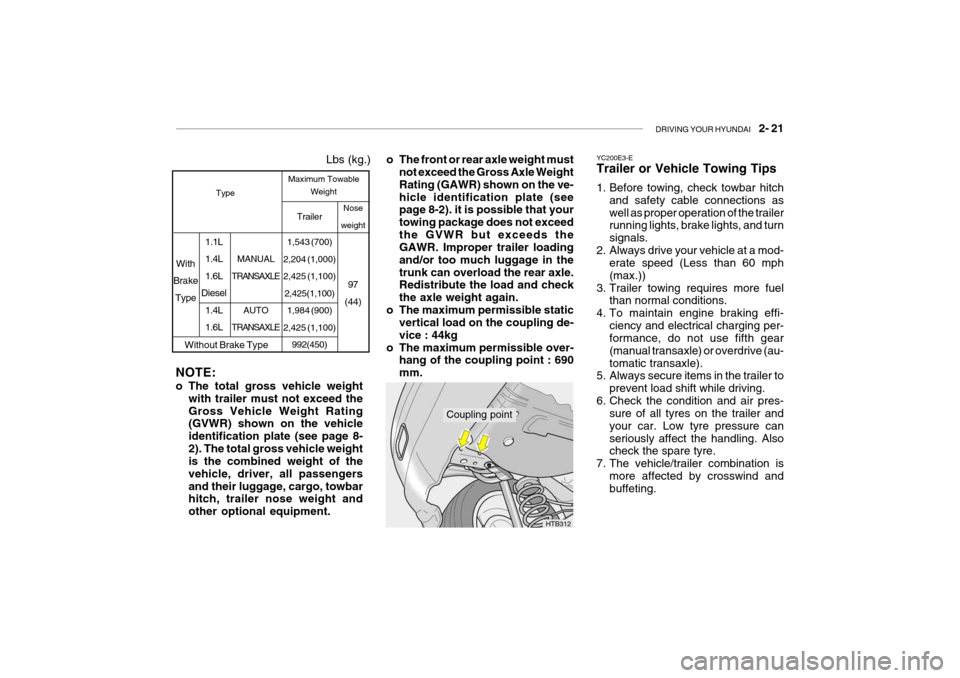
o The maximum permissible static vertical load on the coupling de-vice : 44kg
o The maximum permissible over- hang of the coupling point : 690mm. YC200E3-E Trailer or Vehicle Towing Tips
1. Before towing, check towbar hitch
and safety cable connections as well as proper operation of the trailer running lights, brake lights, and turn signals.
2. Always drive your vehicle at a mod- erate speed (Less than 60 mph(max.))
3. Trailer towing requires more fuel than normal conditions.
4. To maintain engine braking effi- ciency and electrical charging per- formance, do not use fifth gear (manual transaxle) or overdrive (au-tomatic transaxle).
5. Always secure items in the trailer to
prevent load shift while driving.
6. Check the condition and air pres- sure of all tyres on the trailer andyour car. Low tyre pressure canseriously affect the handling. Also check the spare tyre.
7. The vehicle/trailer combination is more affected by crosswind andbuffeting.
HTB312
Page 382 of 463

2- 22 DRIVING YOUR HYUNDAI
When being passed by a large ve- hicle, keep a constant speed and steer straight ahead. If there is toomuch wind buffeting slow down to get out of the other vehicle's air turbulence.
8. When parking your car and trailer, especially on a hill, be sure to followall the normal precautions. Turn yourfront wheel into the curb, set the parking brake firmly, and put the transaxle in 1st or Reverse (manual)or Park (automatic). In addition, we advise the use of wheel chocks at each of the trailer's tyres.
9. If the trailer has electric brakes, start your vehicle and trailer mov-ing, and then apply the trailer brakecontroller by hand to be sure the brakes are working. This lets you check your electrical connection atthe same time.
10. During your trip, check occasion-
ally to be sure that the load issecure, and that the lights and any trailer brakes are still working.
11. Avoid jerky starts, sudden accel- eration or sudden stops.
12. Avoid sharp turns and rapid lane
changes. 13. Avoid holding the brake pedal down
too long or too frequently. This could cause the brakes to over-heat, resulting in reduced braking efficiency.
14. When going down a hill, shift into a lower gear and use the enginebraking effect.When climbing a long grade, down-
shift the transaxle to a lower gearand reduce speed to reduce chances of engine overloading and/or overheating.
15. If you have to stop while going
uphill, do not hold the vehicle inplace by pressing on the accelera- tor. This can cause the automatic transaxle to overheat. Use the park-ing brake or footbrake.
NOTE: When towing check transaxle fluid more frequently. CAUTION:
If overheating should occur when towing, (temperature gauge reads near red zone), taking the followingaction may reduce or eliminate the problem.
1. Turn off the air conditioner.
2. Reduce highway speed.
3. Select a lower gear when going uphill.
4. While in stop and go traffic, place
the gear selection in park or neu- tral and idle the engine at a higher speed.
!
Page 383 of 463

3. WHAT TO DO IN AN EMERGENCY
If the engine will not start ................................................................ 3-2
Jump starting .................................................................................. 3-3
If the engine overheats ................................................................... 3-4
Spare tyre ....................................................................................... 3-5
In the event of a puncture ............................................................... 3-6
Vehicle Towing or Recovery .........................................................3-11
Emergency towing ........................................................................ 3-13
If you lose your keys ...................................................................... 3-14
3
Page 393 of 463
WHAT TO DO IN AN EMERGENCY 3- 11
HTB151
SD070K1-E AFTER CHANGING WHEELS The pressure of the spare tyre should be checked at the first available oppor-tunity. If any doubt exists as to the tyre pressure, the vehicle should be driven slowly to the nearest service stationand the tyre pressure checked and adjusted as required. D080A01O-GAT IF YOUR VEHICLE MUST BE TOWED If your vehicle has to be towed, it should be done by your Hyundai dealer or a commercial tow truck service. This will help assure that your vehicleis not damaged in towing. Also, profes- sionals are generally aware of local laws governing towing. In any case,rather than risk damage to your car, it is suggested that you show this infor- mation to the tow truck operator. Besure that a safety chain system is used and that all local laws are observed. It is recommended that your vehiclebe towed with a wheel lift and dollies or flatbed equipment with all the wheels off the ground.
!
CAUTION:
o Your vehicle can be damaged if towed incorrectly!
o Be sure the transaxle is in neu-
tral.
o When the engine will not start, be sure the steering is unlocked by placing the key in the "ACC" po-sition.
Wheel nut tightening torque: Steel wheel & aluminium alloy wheel: 90-110 N.m (65-80 lb.ft)
If the valve cap is lost from any of the valves, a replacement should be ob- tained and fitted at the first availableopportunity. The valve cap prevents the ingress of dirt which may cause the valve to stick and therefore leak and ispart of the valve sealing function. Ensure that the spare wheel, jack and wheel nut wrench as well tools are correctly located in the boot of the vehicle to prevent damage and noise.
Page 394 of 463
3- 12 WHAT TO DO IN AN EMERGENCY
!
!
1) If the vehicle is being towed with the
rear wheels on the ground, be sure the parking brake is released.
NOTE: Before towing, check the level of the automatic transaxle fluid. If it is below the "HOT" range on the dip-stick, add fluid. If you cannot add fluid, a towing dolly must be used.
2) If any of the loaded wheels or sus- pension components are damaged or the vehicle is being towed withthe front wheels on the ground, use a towing dolly under the front wheels.
o Manual Transaxle:
If you do not use a towing dolly,place the ignition key in the "ACC" position and put the transaxle in "N(Neutral)".
CAUTION:
Do not tow with the key removed orin the "LOCK" position when tow- ing from the rear without a towing dolly.
CAUTION:
o When towing the vehicle, take care not to cause damage to the bumper or underbody of the ve- hicle.
o Do not tow with sling type truck as this may cause damage to thebumper or underbody of the ve-hicle. HTB210
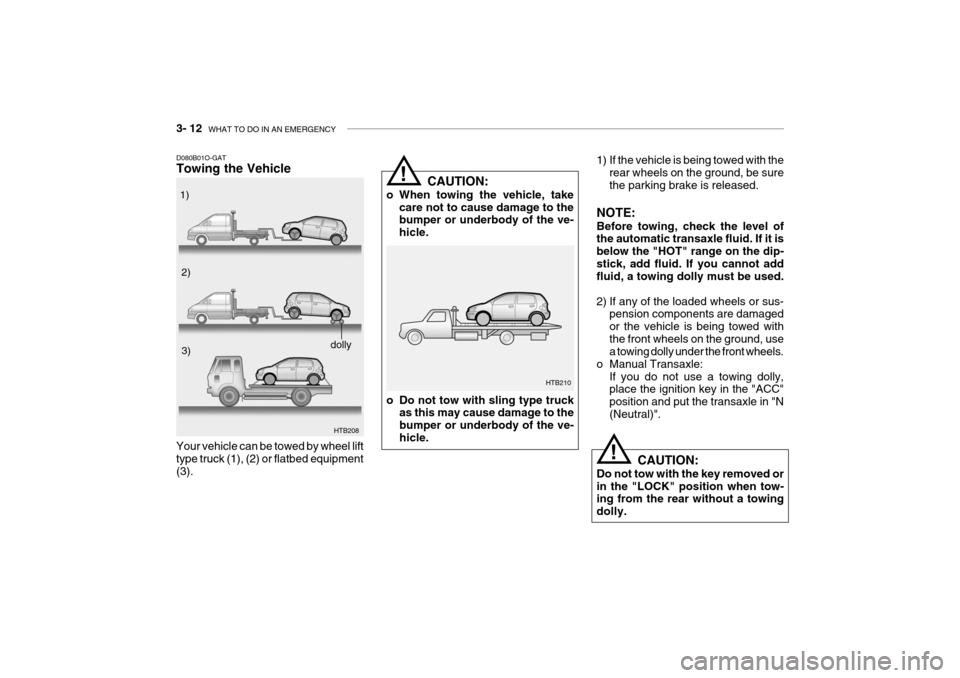
D080B01O-GAT Towing the Vehicle
HTB208
Your vehicle can be towed by wheel lift type truck (1), (2) or flatbed equipment (3). 1)
2)
3)
dolly
Page 395 of 463
WHAT TO DO IN AN EMERGENCY 3- 13
HTB209
!
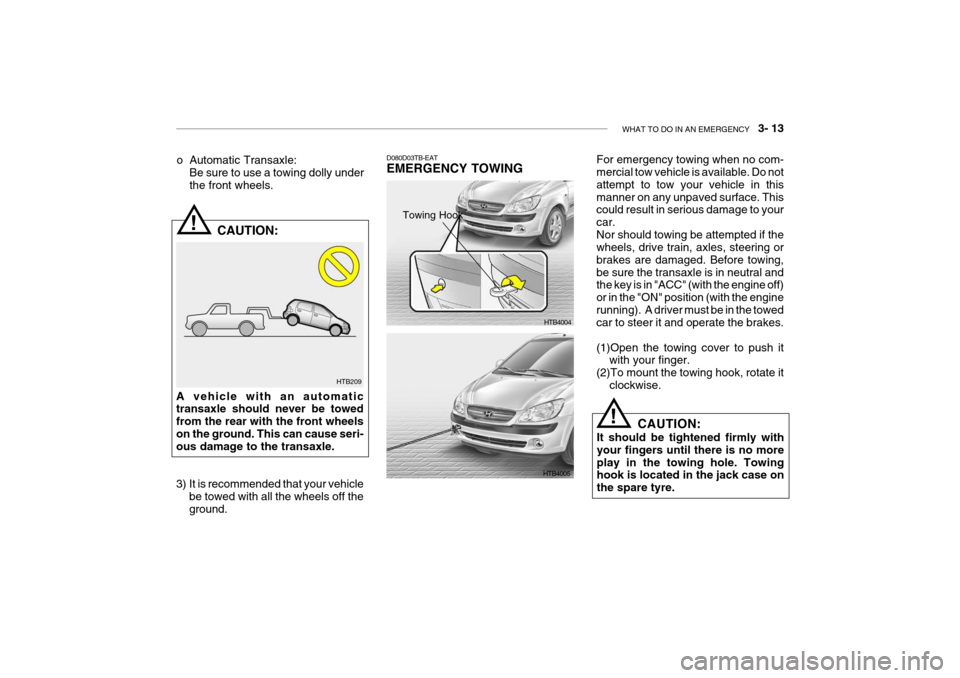
o Automatic Transaxle:
Be sure to use a towing dolly under the front wheels.
CAUTION:
A vehicle with an automatic transaxle should never be towed from the rear with the front wheelson the ground. This can cause seri- ous damage to the transaxle.
3) It is recommended that your vehicle be towed with all the wheels off the ground.
D080D03TB-EAT EMERGENCY TOWING For emergency towing when no com- mercial tow vehicle is available. Do not attempt to tow your vehicle in thismanner on any unpaved surface. This could result in serious damage to your car.Nor should towing be attempted if the wheels, drive train, axles, steering or brakes are damaged. Before towing,be sure the transaxle is in neutral and the key is in "ACC" (with the engine off) or in the "ON" position (with the enginerunning). A driver must be in the towed car to steer it and operate the brakes. (1)Open the towing cover to push it
with your finger.
(2)To mount the towing hook, rotate it clockwise.
HTB4004
HTB4005 CAUTION:
It should be tightened firmly with your fingers until there is no moreplay in the towing hole. Towing hook is located in the jack case on the spare tyre.
!
Towing Hook
Page 396 of 463

3- 14 WHAT TO DO IN AN EMERGENCY
D120A01A-EAT IF YOU LOSE YOUR KEYS Information about the key of immobiliser system will be found on page 1-4. CAUTION:
If the car is being towed with all four wheels on the ground, it can be towed only from the front. Be sure that the transaxle is in neu-tral. Do not tow at speeds greater
than 30 mph (50 km/h) and for more
than 15 miles(25 km).Be sure the steering is unlocked by placing the key in the "ACC" posi- tion.
!
(3)Attach a tow cable, chain or strap to
the towing hook on the front bumper.
Page 407 of 463

5- 6 VEHICLE MAINTENANCE REQUIREMENTS
MAINTENANCE UNDER SEVERE USAGE CONDITIONS
The following items must be serviced more frequently on cars normally used under severe driving conditions. Refer to the chart below for the appropriate maintenance intervals. R : REPLACE I : INSPECT AND, AFTER INSPECTION, CLEAN, ADJUST, REPAIRER OR REPLACE IF NECESSARY
F040A02TB-EAT
ENGINE OIL AND FILTER AIR CLEANER FILTERSPARK PLUGSTIMING BELTBRAKE PADSREAR BRAKE LININGS AND CYLINDERSSUSPENSION AND STEERING SYSTEM MANUAL TRANSAXLE OIL AUTOMATIC TRANSAXLE FLUIDPOLLEN FILTER(FOR EVAPORATOR AND BLOWER UNIT) EVERY 6,000 MILESMORE FREQUENTLY
MORE FREQUENTLY EVERY 37,000 MILES OR 48 MONTHSMORE FREQUENTLYMORE FREQUENTLY MORE FREQUENTLY EVERY 60,000 MILESEVERY 27,000 MILES
MORE FREQUENTLY
MAINTENANCE OPERATIONMAINTENANCE ITEM
R RR RI II
RR R A, B, C, D, E, F, G, H, I, K C, EB, I D, E, F, G, I C, D, G, HC, D, G, HC, D, E, F C, D, E, G, H, I, J E, F, G, H, I C,E
MAINTENANCE INTERVALS
DRIVING
CONDITION
SEVERE DRIVING CONDITIONS
A - Repeatly driving short distance of less than 5miles(8km) in normal temperature or less than 10miles(16km) in freezing temperature
B - Extensive engine idling or low speed driving for long distances
C - Driving on rough, dusty, muddy, unpaved, graveled or salt- spread roads
D - Driving in areas using salt or other corrosive materials or in very cold weather E - Driving in sandy areas
F - Driving in heavy traffic area over 90°F(32°C) G - Driving on uphill, downhill, or mountain roadH - Towing a Trailer, or using a camper, or roof rack
I - Driving as a patrol car, taxi, other commercial use or vehicle towing
J - Driving over 100 MPH(170 Km/h)K - Frequently driving in stop-and-go conditions
Page 454 of 463
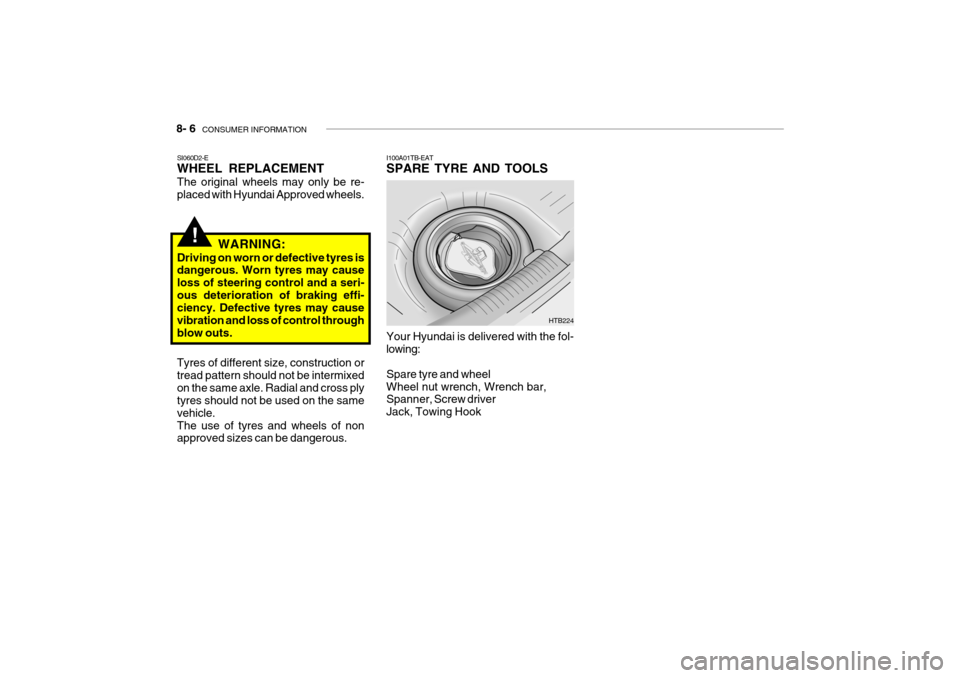
8- 6 CONSUMER INFORMATION
I100A01TB-EAT SPARE TYRE AND TOOLS Your Hyundai is delivered with the fol- lowing: Spare tyre and wheel Wheel nut wrench, Wrench bar, Spanner, Screw driver Jack, Towing Hook HTB224
!
SI060D2-E WHEEL REPLACEMENT The original wheels may only be re- placed with Hyundai Approved wheels.
WARNING:
Driving on worn or defective tyres isdangerous. Worn tyres may cause loss of steering control and a seri-ous deterioration of braking effi- ciency. Defective tyres may cause vibration and loss of control throughblow outs. Tyres of different size, construction or tread pattern should not be intermixedon the same axle. Radial and cross ply tyres should not be used on the same vehicle.The use of tyres and wheels of non approved sizes can be dangerous.