temperature Hyundai Getz 2007 Workshop Manual
[x] Cancel search | Manufacturer: HYUNDAI, Model Year: 2007, Model line: Getz, Model: Hyundai Getz 2007Pages: 463, PDF Size: 11.14 MB
Page 350 of 463
1- 84 FEATURES OF YOUR HYUNDAI
HTB033A-D
1
23
4 HTB034
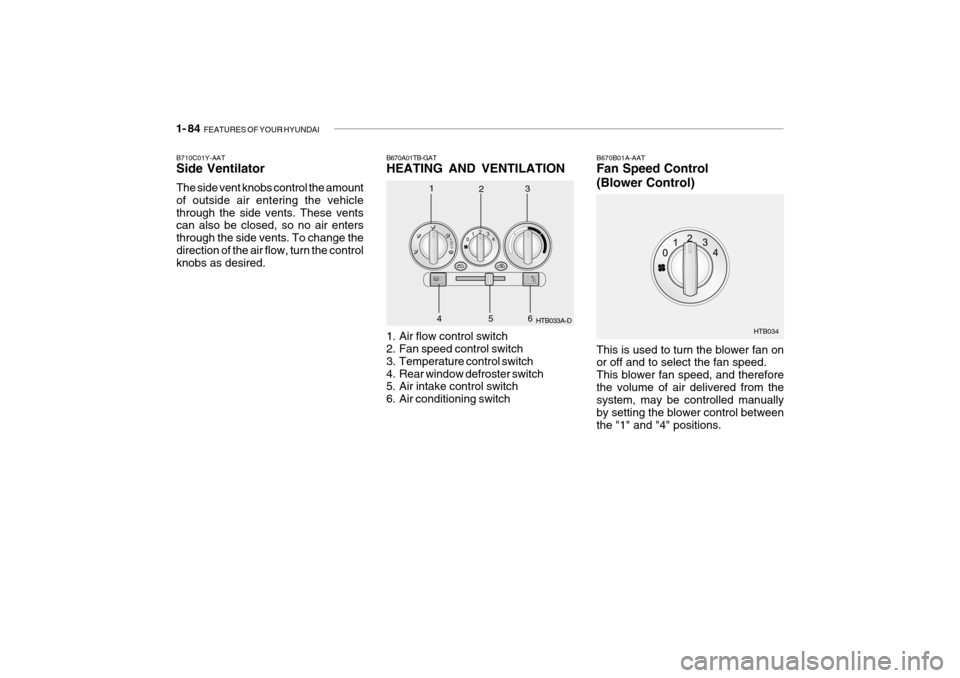
B670A01TB-GAT HEATING AND VENTILATION
1. Air flow control switch
2. Fan speed control switch
3. Temperature control switch
4. Rear window defroster switch
5. Air intake control switch
6. Air conditioning switch B670B01A-AAT Fan Speed Control (Blower Control) This is used to turn the blower fan on or off and to select the fan speed. This blower fan speed, and thereforethe volume of air delivered from the system, may be controlled manually by setting the blower control betweenthe "1" and "4" positions.
B710C01Y-AAT Side Ventilator The side vent knobs control the amount of outside air entering the vehiclethrough the side vents. These vents can also be closed, so no air enters through the side vents. To change thedirection of the air flow, turn the control knobs as desired.
56
Page 353 of 463
FEATURES OF YOUR HYUNDAI 1- 87
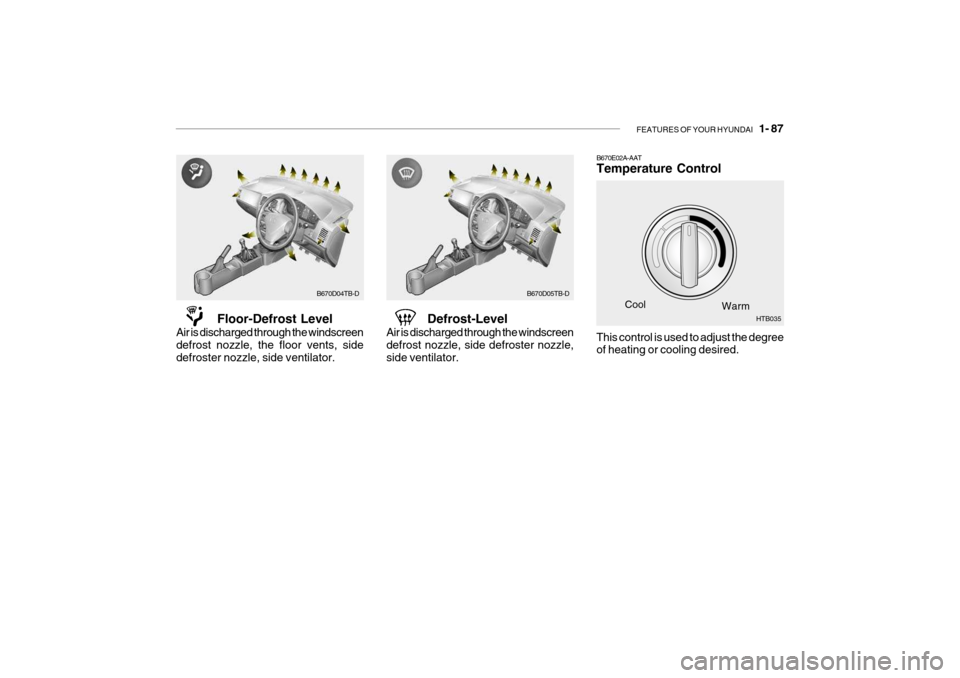
B670E02A-AAT Temperature Control
Cool Warm
Floor-Defrost Level
Air is discharged through the windscreen defrost nozzle, the floor vents, sidedefroster nozzle, side ventilator. Defrost-Level
Air is discharged through the windscreendefrost nozzle, side defroster nozzle,side ventilator.
This control is used to adjust the degree of heating or cooling desired. HTB035
B670D04TB-DB670D05TB-D
Page 354 of 463
1- 88 FEATURES OF YOUR HYUNDAI
B670B01A-AAT BI-LEVEL HEATING Your Hyundai is equipped with bi-level heating controls. This makes it pos-sible to have cooler air from the dash- board vents and warmer air from the floor outlets at the same time. To usethis feature:
o Set the air intake control to the fresh
air ( ) position.
o Set the air flow control at the bi-level ( ) position.
o Set the temperature control between "Cool" and "Warm".
B690A01A-AAT HEATING CONTROLS For normal heating operation, set the air intake control to the fresh air ( )position and the air flow control to the floor ( ) position. For faster heating, the air intake con-trol should be set in the recirculate ( ) position. If the windows fog up, set the air flowcontrol to the defrost ( ) position and the air intake control to the fresh air ( ) position.For maximum heat, move the tem- perature control to "Warm". B720A01TB-EAT DEFROSTING/DEFOGGING
HTB045-D
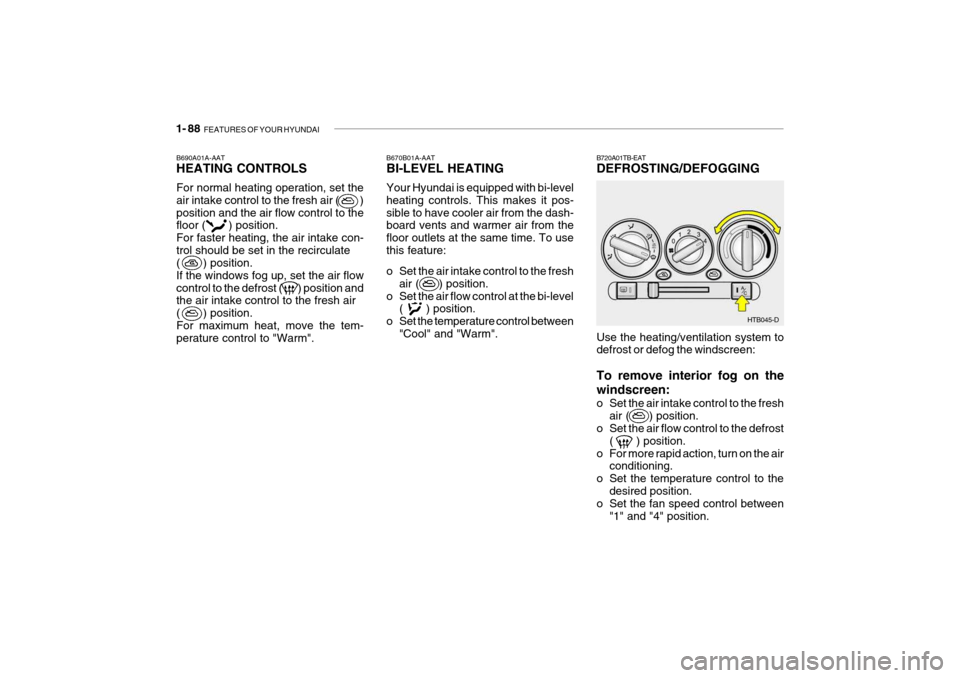
Use the heating/ventilation system to defrost or defog the windscreen: To remove interior fog on the windscreen:
o Set the air intake control to the fresh air ( ) position.
o Set the air flow control to the defrost
( ) position.
o For more rapid action, turn on the air conditioning.
o Set the temperature control to the
desired position.
o Set the fan speed control between
"1" and "4" position.
Page 355 of 463

FEATURES OF YOUR HYUNDAI 1- 89
B740A01A-AAT AIR CONDITIONING SWITCH (Not all models)
B730A01FC-EAT Operation Tips
o To keep dust or unpleasant fumes
from entering the car through the ventilation system, temporarily set the air intake control at "Recircula- tion". Be sure to return the control to"Fresh" when the irritation has passed to keep fresh air in the ve- hicle. This will help keep the driveralert and comfortable.
o Air for the heating/cooling system is
drawn in through the grilles justahead of the windscreen. Care should be taken that these are not blocked by leaves, snow, ice or other ob-structions.
o To prevent interior fog on the
windscreen, set the air intake controlto the fresh air ( ) position and fan speed to the desired position.
To remove the frost or exterior fog on the windscreen:
o Set the air intake control to the fresh
( ) position.
o Set the air flow control to the defrost ( ) position
o Set the temperature control to warm.
o Set the fan speed control to position
"3" or "4".
NOTE: When the A/C is operated continu- ously on the floor-defrost level ( ) or defrost level ( ), it may cause fog to form on the exteriorwindscreen. If this occurs, set the air flow control to the face level posi- tion ( ) and fan speed control tothe low position. The air conditioning is turned on by pushing the A/C button on the heating/ air conditioning control panel.
HTB037-D
Page 356 of 463
1- 90 FEATURES OF YOUR HYUNDAI
B740B02A-AAT AIR CONDITIONING OPERA- TION (Cooling)
B740C01A-AAT De-Humidified Heating
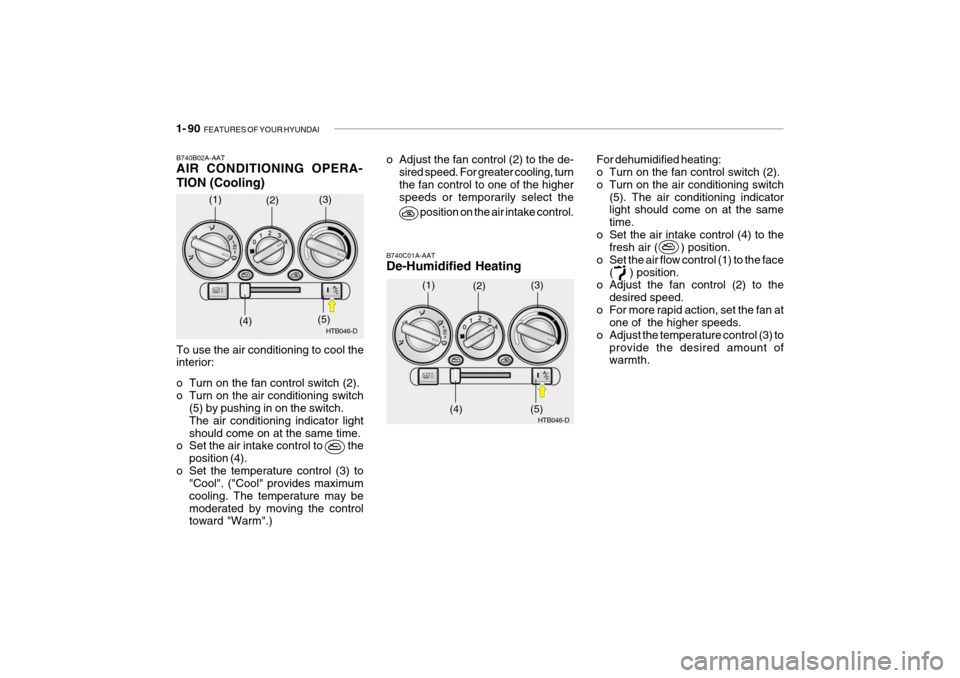
To use the air conditioning to cool the interior:
o Turn on the fan control switch (2).
o Turn on the air conditioning switch(5) by pushing in on the switch.The air conditioning indicator lightshould come on at the same time.
o Set the air intake control to the
position (4).
o Set the temperature control (3) to "Cool". ("Cool" provides maximumcooling. The temperature may bemoderated by moving the control toward "Warm".) HTB046-D
o Adjust the fan control (2) to the de-
sired speed. For greater cooling, turn the fan control to one of the higherspeeds or temporarily select the
position on the air intake control. For dehumidified heating:
o Turn on the fan control switch (2).
o Turn on the air conditioning switch
(5). The air conditioning indicator light should come on at the same time.
o Set the air intake control (4) to the fresh air ( ) position.
o Set the air flow control (1) to the face ( ) position.
o Adjust the fan control (2) to the
desired speed.
o For more rapid action, set the fan at one of the higher speeds.
o Adjust the temperature control (3) to provide the desired amount of warmth.
(1)
(2)
(3)
(4) (5)
HTB046-D
(1)
(2)
(3)
(5)
(4)
Page 378 of 463

2- 18 DRIVING YOUR HYUNDAI
SC170E1-E Windscreen Washers and Wip- ers The windscreen washer bottle should be filled with a solution of water and a proprietary winter screen wash addi-tive. The windscreen wipers should not be used if the blades are frozen to the windscreen or if they are coveredwith snow, before this is removed. NOTE: Never allow undiluted screen washer fluid additive to spill upon the paintwork or use engine cool- ant anti-freeze since damage to thepaintwork may result.
o When driving in extreme conditions,
the windscreen wiper blades may fail to clear the screen properly due to the formation of ice upon theblade edge. It will therefore be nec- essary to periodically remove such ice to restore their efficiency.
o If the power operated door mirrors become frozen, attempts to adjustthese may damage the mechanism.
ZC170D1-E Door Locks Should the door lock mechanism be- come frozen, a proprietary lock de-icer should be used. Alternatively, warm- ing the door key may thaw the doorlock. However, the key should be handled carefully to avoid burning the fingers.Never attempt to thaw a frozen door lock using hot water, since the water will eventually freeze and compoundthe problem. NOTE: The proper temperature for using the immobilizer key is from -40°F to 176°F (-40°C to 80°C). If you heat the immobilizer key over 176°F (80°C)to open the frozen lock, it may cause damage to the transponder in its head.
o The formation of snow or ice built up
inside the wheel arches may inter-fere with the road wheels or steeringmechanism. In such instances, un- usual noises or an increase in steer- ing effort may result. Therefore,ensure that the wheel arches are checked periodically and any accu- mulated snow or ice removed.
o It is advisable to carry emergency equipment including, torch, shovel,tow rope, blankets etc., if a journeyis to be undertaken into areas of severe road conditions.
Page 382 of 463

2- 22 DRIVING YOUR HYUNDAI
When being passed by a large ve- hicle, keep a constant speed and steer straight ahead. If there is toomuch wind buffeting slow down to get out of the other vehicle's air turbulence.
8. When parking your car and trailer, especially on a hill, be sure to followall the normal precautions. Turn yourfront wheel into the curb, set the parking brake firmly, and put the transaxle in 1st or Reverse (manual)or Park (automatic). In addition, we advise the use of wheel chocks at each of the trailer's tyres.
9. If the trailer has electric brakes, start your vehicle and trailer mov-ing, and then apply the trailer brakecontroller by hand to be sure the brakes are working. This lets you check your electrical connection atthe same time.
10. During your trip, check occasion-
ally to be sure that the load issecure, and that the lights and any trailer brakes are still working.
11. Avoid jerky starts, sudden accel- eration or sudden stops.
12. Avoid sharp turns and rapid lane
changes. 13. Avoid holding the brake pedal down
too long or too frequently. This could cause the brakes to over-heat, resulting in reduced braking efficiency.
14. When going down a hill, shift into a lower gear and use the enginebraking effect.When climbing a long grade, down-
shift the transaxle to a lower gearand reduce speed to reduce chances of engine overloading and/or overheating.
15. If you have to stop while going
uphill, do not hold the vehicle inplace by pressing on the accelera- tor. This can cause the automatic transaxle to overheat. Use the park-ing brake or footbrake.
NOTE: When towing check transaxle fluid more frequently. CAUTION:
If overheating should occur when towing, (temperature gauge reads near red zone), taking the followingaction may reduce or eliminate the problem.
1. Turn off the air conditioner.
2. Reduce highway speed.
3. Select a lower gear when going uphill.
4. While in stop and go traffic, place
the gear selection in park or neu- tral and idle the engine at a higher speed.
!
Page 386 of 463
3- 4 WHAT TO DO IN AN EMERGENCY
!
!
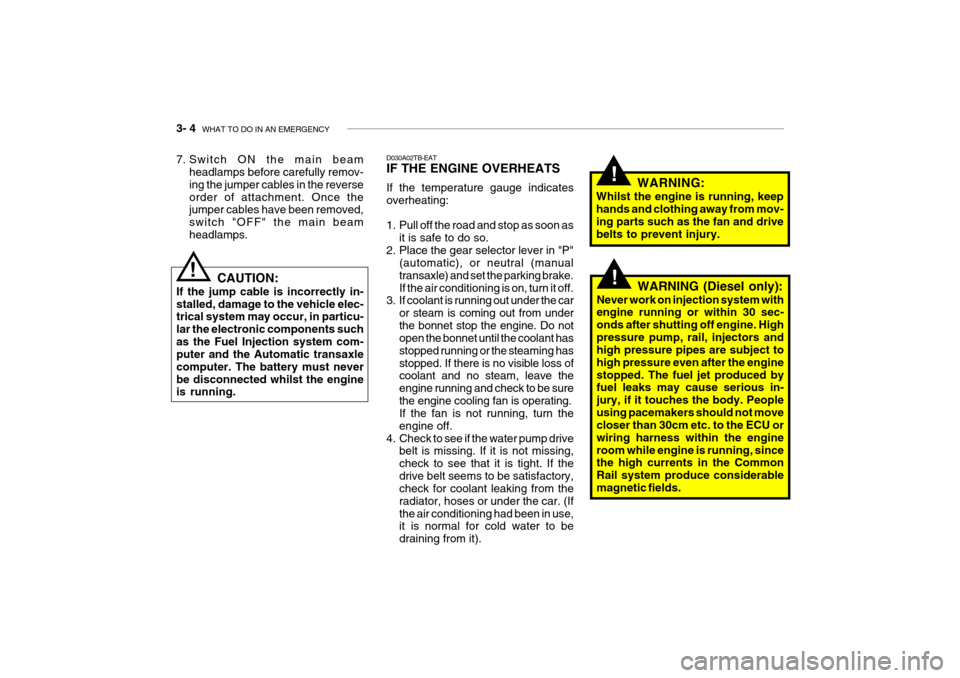
D030A02TB-EAT IF THE ENGINE OVERHEATS If the temperature gauge indicates overheating:
1. Pull off the road and stop as soon as
it is safe to do so.
2. Place the gear selector lever in "P" (automatic), or neutral (manual transaxle) and set the parking brake.If the air conditioning is on, turn it off.
3. If coolant is running out under the car
or steam is coming out from underthe bonnet stop the engine. Do not open the bonnet until the coolant has stopped running or the steaming hasstopped. If there is no visible loss of coolant and no steam, leave the engine running and check to be surethe engine cooling fan is operating. If the fan is not running, turn the engine off.
4. Check to see if the water pump drive belt is missing. If it is not missing,check to see that it is tight. If thedrive belt seems to be satisfactory, check for coolant leaking from the radiator, hoses or under the car. (Ifthe air conditioning had been in use, it is normal for cold water to be draining from it). WARNING:
Whilst the engine is running, keep hands and clothing away from mov- ing parts such as the fan and drivebelts to prevent injury.
7. Switch ON the main beam
headlamps before carefully remov-ing the jumper cables in the reverseorder of attachment. Once the jumper cables have been removed, switch "OFF" the main beamheadlamps.
CAUTION:
If the jump cable is incorrectly in-stalled, damage to the vehicle elec- trical system may occur, in particu- lar the electronic components suchas the Fuel Injection system com- puter and the Automatic transaxle computer. The battery must neverbe disconnected whilst the engine is running.
!
WARNING (Diesel only):
Never work on injection system with engine running or within 30 sec- onds after shutting off engine. Highpressure pump, rail, injectors and high pressure pipes are subject to high pressure even after the enginestopped. The fuel jet produced by fuel leaks may cause serious in- jury, if it touches the body. Peopleusing pacemakers should not move closer than 30cm etc. to the ECU or wiring harness within the engineroom while engine is running, since the high currents in the Common Rail system produce considerablemagnetic fields.
Page 387 of 463

WHAT TO DO IN AN EMERGENCY 3- 5
!
D040A01TB-EAT TEMPORARY SPARE TYRE (Not all models) The following instructions for the tem- porary spare tyre should be observed:
1. Check inflation pressure as soon as
practical after installing the spare tyre, and adjust to the specifiedpressure. The tyre pressure should be periodically checked and main- tained at the specified pressurewhile the tyre is stored.
6. If the cause of the overheating can- not be found, wait until the enginetemperature has returned to normal. Then, if coolant has been lost, care- fully remove the radiator cap and addwater to bring the fluid level in the reservoir up to the base of the radia- tor fill opening. Fill the coolant ex-pansion tank to the halfway mark. To ensure the correct water to cool- ant mix is obtained after top up,testing by an authorised repairer is required. WARNING:
Do not remove the radiator cap whenthe engine is hot since steam and boiling water may be ejected fromthe radiator resulting in burns or scalding.
Inflation Pressure
Tyre Size
T105/70D14 420 kPa (60 psi)
2. The spare tyre should only be used temporarily and should be returned to the luggage compartment as soonas the original tyre can be repairered or replaced.
3. Continuous use at speeds of over 50 mph(80 km/h) is not recom-mended.
4. As the temporary spare tyre is spe- cifically designed for your car, itshould not be used on any other vehicle.
Spare Tyre Pressure
5. If the water pump drive belt is broken
or coolant is leaking out, stop theengine immediately and call the near-est Hyundai authorised repairer for assistance.
! CAUTION:
Serious loss of coolant indicates there is a leak in the cooling system and this should be checked as soonas possible by a Hyundai authorised repairer.
7. Proceed with caution until it is estab-
lished that the engine is operating normally. If the engine overheatsrepeatedly, the advice of a Hyundai authorised repairer should be sought.
Page 399 of 463
CORROSION PREVENTION AND APPEARANCE CARE 4- 3
SE040A2-E VALETING Regular cleaning of the exterior paintwork serves two important func-tions. Firstly, the removal of abrasive dirt and contaminants will maintain the lustre of the paintwork and will preventdiscolouration and dulling due to pro- longed contact. Secondly, the presence of damagethrough impact or abrasion will be ap- parent allowing early rectification to be made thus preventing corrosion frombecoming established and spreading beneath the paint film. To avoid "water spotting" the vehicle should not bewashed in direct sunlight particularly in the case of vehicles having dark body colours. The heat from the sun rays isabsorbed by the paint film increasing the surface temperature. This action causes water used for washing toevaporate quickly leaving behind the deposits from the water and the sham- poo used.Use only a shampoo intended for the purpose and ensure that the body work is thoroughly wet to soften the dirt filmprior to attempting to remove this. After removing the dirt film with a soft sponge, the body work should be thor- oughly rinsed and then dried with agood quality chamois leather to pre- vent streaking or spotting of the paint work.Household detergents, solvents and abrasive cleaning materials should not be used in order to avoid damaging thepaint film. Plastic wheel covers should be cleaned using a sponge and water. Cast alloywheels should be cleaned using a mild soap or neutral detergent. Abrasive compounds must not be used since inthe event of these damaging the lac- quer coating, oxidization of the alu- minium wheel will occur, spoiling theappearance. The use of a toothbrush will facilitate cleaning between the wheel "spokes".
CAUTION:
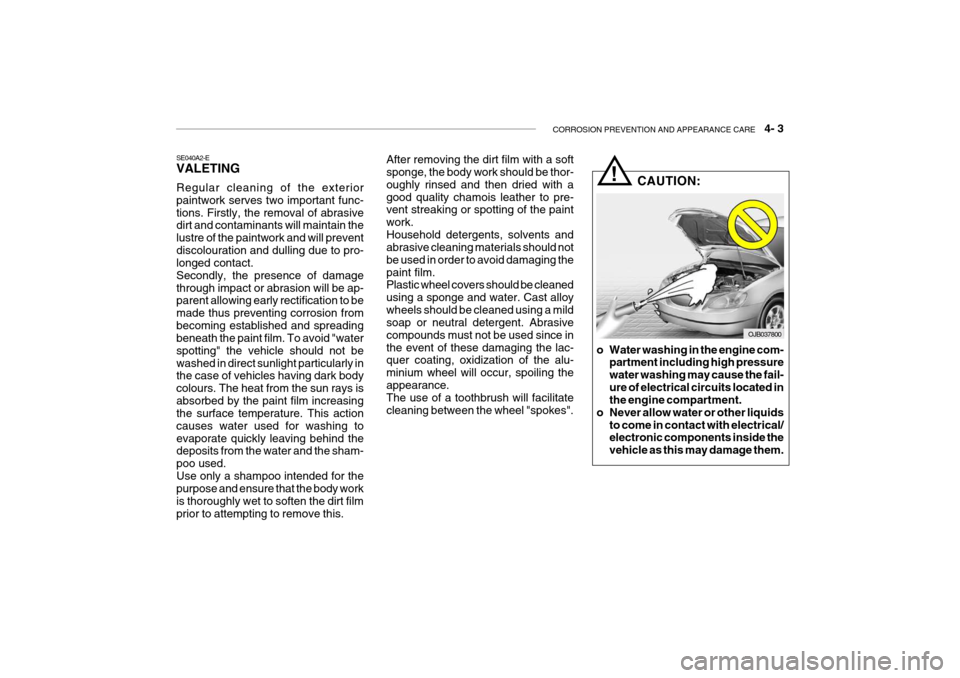
!
OJB037800
o Water washing in the engine com- partment including high pressure water washing may cause the fail-ure of electrical circuits located in the engine compartment.
o Never allow water or other liquids to come in contact with electrical/electronic components inside the vehicle as this may damage them.