Fan Hyundai Getz 2007 Owner's Manual
[x] Cancel search | Manufacturer: HYUNDAI, Model Year: 2007, Model line: Getz, Model: Hyundai Getz 2007Pages: 463, PDF Size: 11.14 MB
Page 31 of 463
FEATURES OF YOUR HYUNDAI 1- 19
WARNING:
o When you return the folded down seatback to its upright position, make sure the seat belts are in position to be accessible and tofunction properly.
o When you return the folded down
seatback to its upright position,be careful not to get your fingers or legs in.
o The purpose of the fold down rear seatback and the fold for-ward rear seat cushion is to in- crease cargo space. Do not allowpassengers to sit in the cargo area while the car is moving. This is not a proper seating positionand no seat belts are available for use when the seatback is folded down. Passengers whoare not properly seated and wear- ing seat belts could sustain seri- ous injuries or death in case ofan accident or a sudden stop.
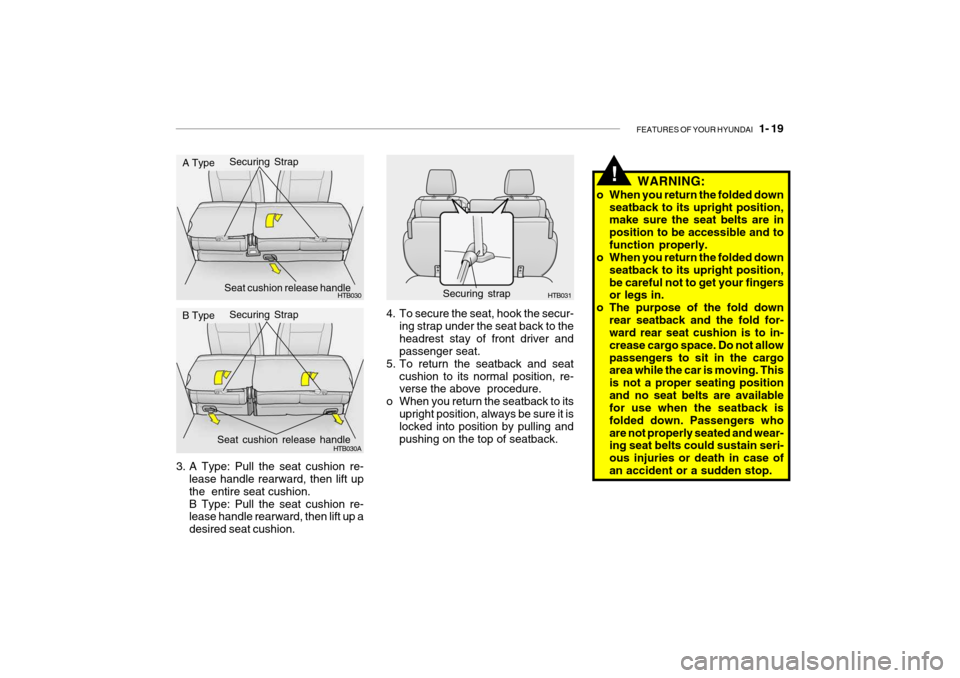
3. A Type: Pull the seat cushion re-
lease handle rearward, then lift upthe entire seat cushion.B Type: Pull the seat cushion re- lease handle rearward, then lift up a desired seat cushion.
A Type B Type 4. To secure the seat, hook the secur-
ing strap under the seat back to the headrest stay of front driver and passenger seat.
5. To return the seatback and seat cushion to its normal position, re-verse the above procedure.
o When you return the seatback to its upright position, always be sure it islocked into position by pulling and pushing on the top of seatback.
HTB030
Seat cushion release handle
HTB030A
Seat cushion release handle
HTB031Securing strap
!
Securing Strap Securing Strap
Page 33 of 463
FEATURES OF YOUR HYUNDAI 1- 21
B150A02A-GAT SEAT BELT PRECAUTIONS All occupants of the vehicle should wear their seat belts at all times. In-deed, your province's laws may re- quire that some or all occupants of the vehicle use seat belts.The possibility of injury or the severity of injury in an accident will be de- creased if this elementary safety pre-caution is observed. In addition, the following recommendations are made: B150B01Y-GAT Infant or Small Child Some countries require the use of child restraint systems for infants and small children. Whether this is requiredby law or not, it is strongly recom- mended that a child restraint seat or infant restraint system be used forinfants or small children weighing less than 18 kilograms (40 pounds). NOTE: Small children are best protected in an accident when properly re- strained by a child restraint sys-tem. B150C02A-AAT Larger Children Children who are too large for child restraint systems should occupy therear seat and use the available lap/ shoulder belts. The lap portion should be fastened snug on the hips and aslow as possible. Check belt fit periodi- cally. A child's squirming could put the belt out of position. Children are af-forded the most safety in the event of an accident when they are restrained by a proper restraint system in the rearseat. If a larger child (over age 13) must be seated in the front seat, the child should be securely restrained bythe available lap/shoulder belt and the seat should be placed in the rearmost position. Children under the age of 13should be restrained securely in the rear seat. NEVER place a rear facing child seat in the front seat of a vehicle.
B140A01TB
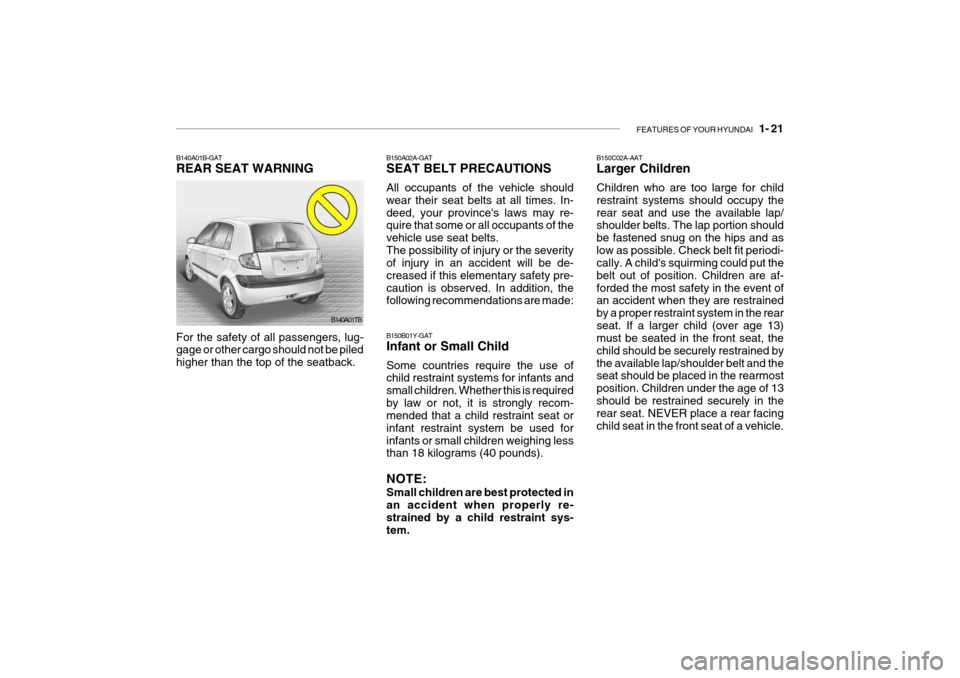
B140A01B-GAT REAR SEAT WARNING For the safety of all passengers, lug- gage or other cargo should not be piled higher than the top of the seatback.
Page 40 of 463
1- 28 FEATURES OF YOUR HYUNDAI
o Children who are too large to be in
a child restraint should sit in the rear seat and be restrained with the available lap/shoulder belts. Never allow children to ride in thefront passenger seat.
o Always make sure that the shoul- der belt portion of the outboard lap/shoulder belt is positioned midway over the shoulder, neveracross the neck or behind the back. Moving the child closer to the center of the vehicle may helpprovide a good shoulder belt fit. The lap belt portion of the lap/ shoulder belt or the center seat lap belt must always be posi- tioned as low as possible on thechild's hips and as snug as pos- sible.
o If the seat belt will not properly fit the child, Hyundai recommends the use of an approved boosterseat in the rear seat in order to raise the child's seating height so that the seat belt will properly fitthe child.B230A03A-GAT CHILD RESTRAINT SYSTEM (If Installed) Children riding in the car should sit in the rear seat and must always be properly restrained to minimize therisk of injury in an accident, sudden stop or sudden maneuver. According to accident statistics, children are saferwhen properly restrained in the rear seats than in the front seat. Larger children not in a child restraint shoulduse one of the seat belts provided. You are required by law to use safety restraints for children. If small childrenride in your vehicle you must put them in a child restraint system (safety seat). Children could be injured or killed in acrash if their restraints are not properly secured. For small children and ba- bies, a child seat or infant seat must beused. Before buying a particular child restraint system, make sure it fits your car and seat belts, and fits your child.Follow all the instructions provided by the manufacturer when installing the child restraint system. WARNING:
o A child restraint system must be placed in the rear seat. Never install a child or infant seat on the front passenger's seat.Should an accident occur and cause the passenger side airbag to deploy, it could severely in-jure or kill an infant or child seated in an infant or child seat. Thus, only use a child restraint in therear seat of your vehicle.
o Since a safety belt or child re- straint system can become very hot if it is left in a closed vehicle, be sure to check the seat coverand buckles before placing a child there.
o When the child restraint system is not in use, store it in the luggage compartment or fasten it with asafety belt so that it will not be thrown forward in the case of a sudden stop or an accident.
!
Page 41 of 463
FEATURES OF YOUR HYUNDAI 1- 29
o Never allow a child to stand up or
kneel on the seat.
o Never use an infant carrier or child safety seat that "hooks" over a seatback; it may not provide ad- equate security in an accident.
o Never allow a child to be held in a person's arms while they are in a moving vehicle, as this could re-sult in serious injury to the child in the event of an accident or a sudden stop. Holding a child in amoving vehicle does not provide the child with any means of pro- tection during an accident, even if the person holding the child is wearing a seat belt.
o If the child restaint seat is not anchored properly, the risk of achild being seriously injured or killed in a collision greatly in- creases.
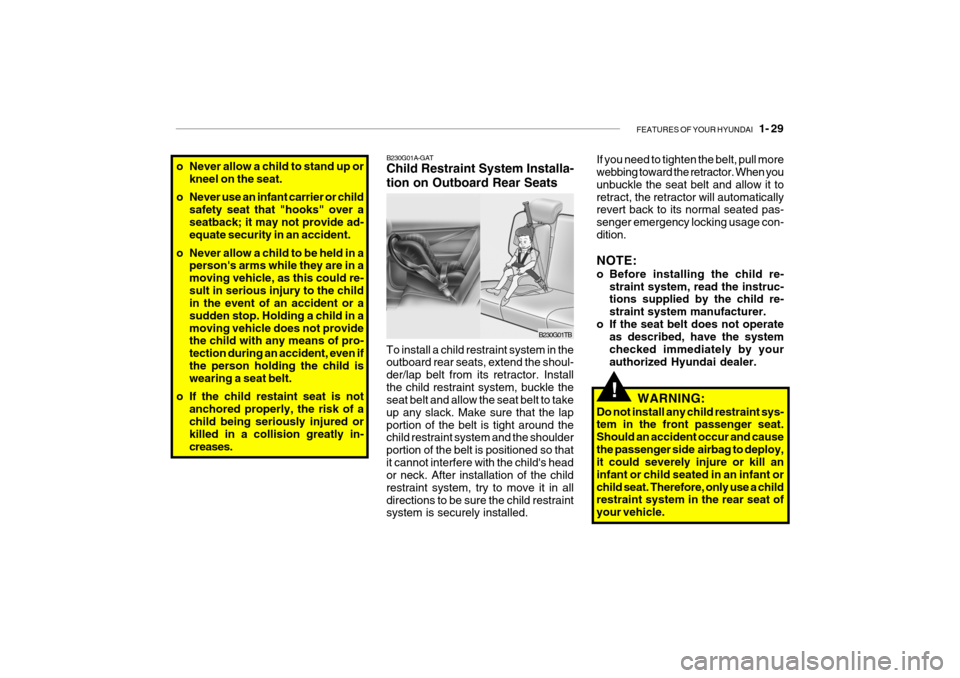
B230G01TB
To install a child restraint system in the outboard rear seats, extend the shoul- der/lap belt from its retractor. Installthe child restraint system, buckle the seat belt and allow the seat belt to take up any slack. Make sure that the lapportion of the belt is tight around the child restraint system and the shoulder portion of the belt is positioned so thatit cannot interfere with the child's head or neck. After installation of the child restraint system, try to move it in alldirections to be sure the child restraint system is securely installed. B230G01A-GAT Child Restraint System Installa- tion on Outboard Rear Seats
WARNING:
Do not install any child restraint sys- tem in the front passenger seat. Should an accident occur and causethe passenger side airbag to deploy, it could severely injure or kill an infant or child seated in an infant orchild seat. Therefore, only use a child restraint system in the rear seat of your vehicle.
If you need to tighten the belt, pull more webbing toward the retractor. When you unbuckle the seat belt and allow it toretract, the retractor will automatically revert back to its normal seated pas- senger emergency locking usage con-dition. NOTE:
o Before installing the child re-
straint system, read the instruc- tions supplied by the child re- straint system manufacturer.
o If the seat belt does not operate as described, have the systemchecked immediately by yourauthorized Hyundai dealer.!
Page 43 of 463
FEATURES OF YOUR HYUNDAI 1- 31
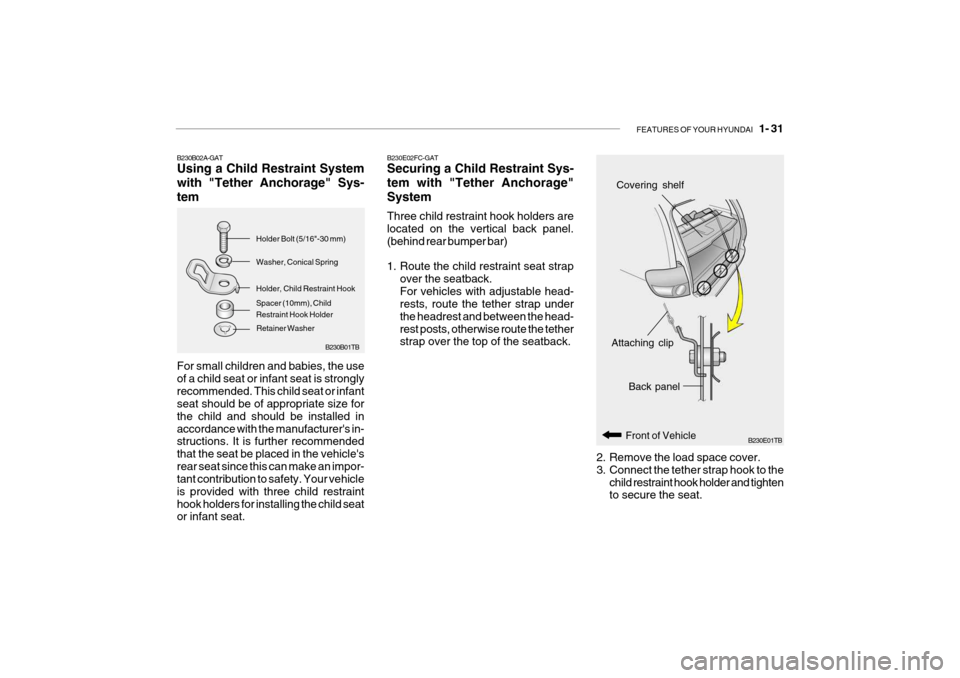
B230E01TB
Back panel
Front of Vehicle
Attaching clip
Covering shelf
2. Remove the load space cover.
3. Connect the tether strap hook to the child restraint hook holder and tighten to secure the seat.
B230B01TB
B230B02A-GAT Using a Child Restraint System with "Tether Anchorage" Sys-tem For small children and babies, the use of a child seat or infant seat is stronglyrecommended. This child seat or infant seat should be of appropriate size for the child and should be installed inaccordance with the manufacturer's in- structions. It is further recommended that the seat be placed in the vehicle'srear seat since this can make an impor- tant contribution to safety. Your vehicle is provided with three child restrainthook holders for installing the child seat or infant seat. Spacer (10mm), Child Restraint Hook Holder
Holder Bolt (5/16"-30 mm) Washer, Conical Spring Holder, Child Restraint Hook
Retainer Washer B230E02FC-GAT Securing a Child Restraint Sys- tem with "Tether Anchorage"System Three child restraint hook holders are located on the vertical back panel. (behind rear bumper bar)
1. Route the child restraint seat strap
over the seatback. For vehicles with adjustable head- rests, route the tether strap under the headrest and between the head-rest posts, otherwise route the tether strap over the top of the seatback.
Page 49 of 463

FEATURES OF YOUR HYUNDAI 1- 37
could be severely injured or killed by an airbag deployment in case of an accident.
o Do not allow children to ride in the front passenger seat. If olderchildren (teenagers and older)must ride in the front seat, make sure they are always properly belted and that the seat is movedback as far as possible.
o For maximum safety protection
in all types of crashes, all occu-pants including the driver should always wear their seat belts whether or not an airbag is alsoprovided at their seating posi- tion to minimize the risk of se- vere injury or death in the eventof a crash. Do not sit or lean unnecessarily close to the airbag while the vehicle is in motion.
o The SRS airbag system must de- ploy very rapidly to provide pro-tection in a crash. If an occupantis out of position because of not wearing a seat belt, the airbag may forcefully contact the occu-pant causing serious or fatal in- juries.
HTB203
Rear impact
Side Impact Rollover
o Front airbags are not intended to deploy in side-impact, rear-im- pact or rollover crashes. In addi-tion, airbags will not deploy in frontal crashes below the deploy- ment threshold speed.
o The SRS is designed to deploy the
airbags only when an impact issufficiently severe and when theimpact angle is less than 30° from the forward longitudinal axis of the vehicle and will not deploy inside, rear or rollover impacts. Ad- ditionally, the airbags will only deploy once. Thus, seat beltsmust be worn at all times. o The driver should sit back as far as
possible while still maintainingcontrol of the vehicle. If you aresitting too close to the airbag, it can cause death or serious injury when it inflates.
o No objects should be placed over or near the airbag modules onthe steering wheel, instrumentpanel, and the front passenger's panel above the glove box, because any such object couldcause harm if the vehicle is in a crash severe enough to cause the airbags to deploy.
o If the airbags deploy, they must be replaced by an authorizedHyundai dealer.
o Do not tamper with or discon- nect SRS wiring, or other com-ponents of the SRS system. Do-ing so could result in injury, due to accidental firing of the airbags or by rendering the SRS inopera-tive.
o Do not install a child restraint
system in the front passengerseat position. A child restraint system must never be placed in the front seat. The infant or child
Page 53 of 463
FEATURES OF YOUR HYUNDAI 1- 41
!WARNING:
o The driver is responsible for the proper position of the passenger's front airbag ON/OFF switch.
! CAUTION:
o If the passenger's front airbag ON/ OFF switch is not working prop- erly, the SRS warning light on the instrument panel will illuminate. If this occurs, have an authorizedHyundai dealer inspect the passenger's front airbag ON/OFF switch, the pre-tensioner seat beltsystem and the SRS airbag sys- tem as soon as possible.
o If the SRS airbag warning light
does not illuminate when the igni-tion key is turned to the "ON" position, or if it illuminates while the vehicle is being driven, have an authorized Hyundai dealer in-spect the passenger's front airbag ON/OFF switch, pre-tensioner seat belt and the SRS airbag system assoon as possible.o Deactivate the front passenger'sairbag only when the ignition switch is switched off, or the malfunction may occur in the SRSCM (SRSControl Module). And there may be a danger that the driver's and/or passenger's front and/or side airbagmay fail to trigger, or not trigger correctly during a collision.
o Never install a rearward facing child seat on the front passenger'sseat. The infant or child could be severely injured or killed by anairbag deployment in case of an accident.
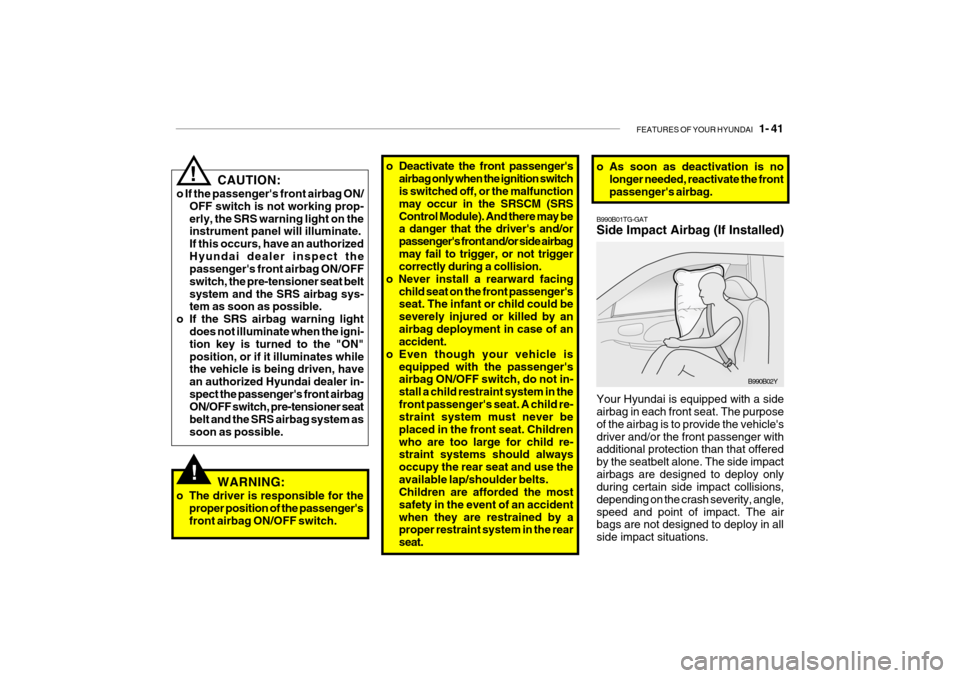
o Even though your vehicle is equipped with the passenger'sairbag ON/OFF switch, do not in- stall a child restraint system in thefront passenger's seat. A child re- straint system must never be placed in the front seat. Childrenwho are too large for child re- straint systems should always occupy the rear seat and use theavailable lap/shoulder belts. Children are afforded the most safety in the event of an accidentwhen they are restrained by a proper restraint system in the rear seat. B990B01TG-GAT Side Impact Airbag (If Installed) Your Hyundai is equipped with a side airbag in each front seat. The purpose of the airbag is to provide the vehicle'sdriver and/or the front passenger with additional protection than that offered by the seatbelt alone. The side impactairbags are designed to deploy only during certain side impact collisions, depending on the crash severity, angle,speed and point of impact. The air bags are not designed to deploy in all side impact situations.
B990B02Y
o As soon as deactivation is no
longer needed, reactivate the front passenger's airbag.
Page 55 of 463

FEATURES OF YOUR HYUNDAI 1- 43
B240C01HP
WARNING:
o Extreme Hazard! Do not use a re- ward facing restraint on a seat protected by an airbag in front ofit!
o Modification to SRS components
or wiring, including the additionof any kind of badges to the pad covers or modifications to the body structure, can adversely affect SRSperformance and lead to possible injury.
!
o For cleaning the airbag pad cov-ers, use only a soft, dry cloth or one which has been moistenedwith plain water. Solvents or clean- ers could adversely affect the airbag covers and proper deploy-ment of the system.
o No objects should be placed over
or near the airbag modules on thesteering wheel, instrument panel, and the front passenger's panel above the glove box, because anysuch object could cause harm if the vehicle is in a crash severe enough to cause the airbags toinflate.
o If the airbags inflate, they must be
replaced by an authorized Hyundaidealer.
o Do not tamper with or disconnect
SRS wiring, or other componentsof the SRS system. Doing so could result in injury, due to accidental firing of the airbags or by render-ing the SRS inoperative.o Do not install a child restraint sys-tem in the front passenger seat position.
o A child restraint system must never be placed in the front seat.The infant or child could be se-verely injured by an airbag de- ployment in case of an accident.
o If components of the airbag sys-
tem must be discarded, or if thevehicle must be scrapped, certain safety precautions must be ob-served. Your Hyundai dealer knows these precautions and can give you the necessary informa-tion. Failure to follow these pre- cautions and procedures could increase the risk of personal in-jury.
o If you sell your vehicle, make cer-
tain that this manual is transferredto the new owner.
o If your car was flooded and has
soaked carpeting or water on floor-ing, you shouldn't try to start en- gine; have the car towed to autho- rized Hyundai dealer.
Page 98 of 463
1- 86 FEATURES OF YOUR HYUNDAI
B710A01TB-GAT
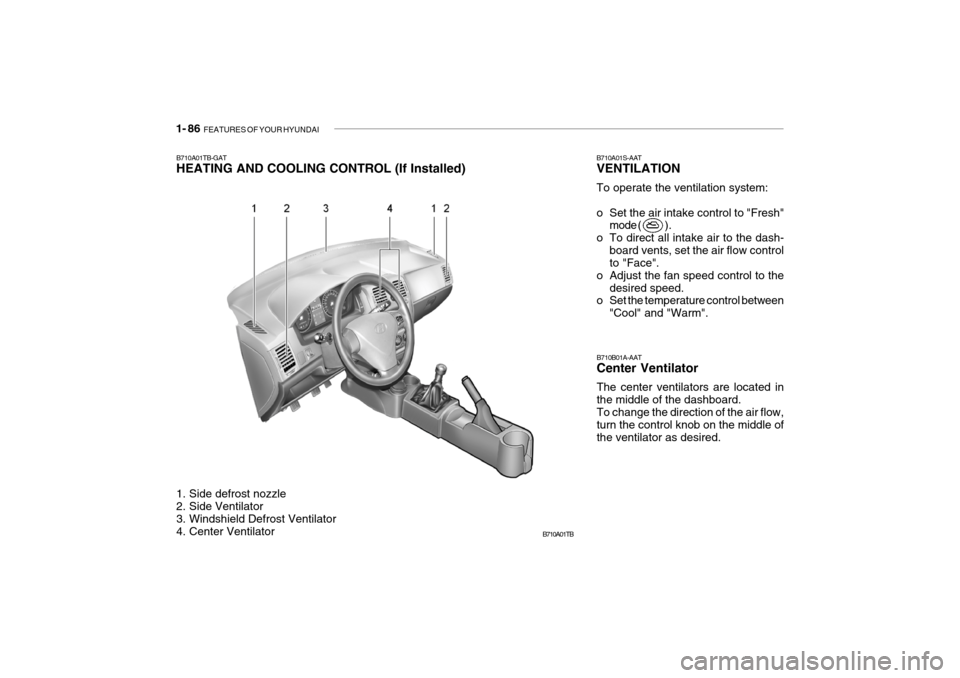
HEATING AND COOLING CONTROL (If Installed)
B710A01TB
1. Side defrost nozzle
2. Side Ventilator
3. Windshield Defrost Ventilator
4. Center Ventilator B710B01A-AAT Center Ventilator The center ventilators are located in the middle of the dashboard. To change the direction of the air flow, turn the control knob on the middle ofthe ventilator as desired.
B710A01S-AAT VENTILATION To operate the ventilation system:
o Set the air intake control to "Fresh"
mode( ).
o To direct all intake air to the dash-
board vents, set the air flow control to "Face".
o Adjust the fan speed control to the
desired speed.
o Set the temperature control between
"Cool" and "Warm".
Page 99 of 463
FEATURES OF YOUR HYUNDAI 1- 87
HTB033
1
2 3
4 HTB034
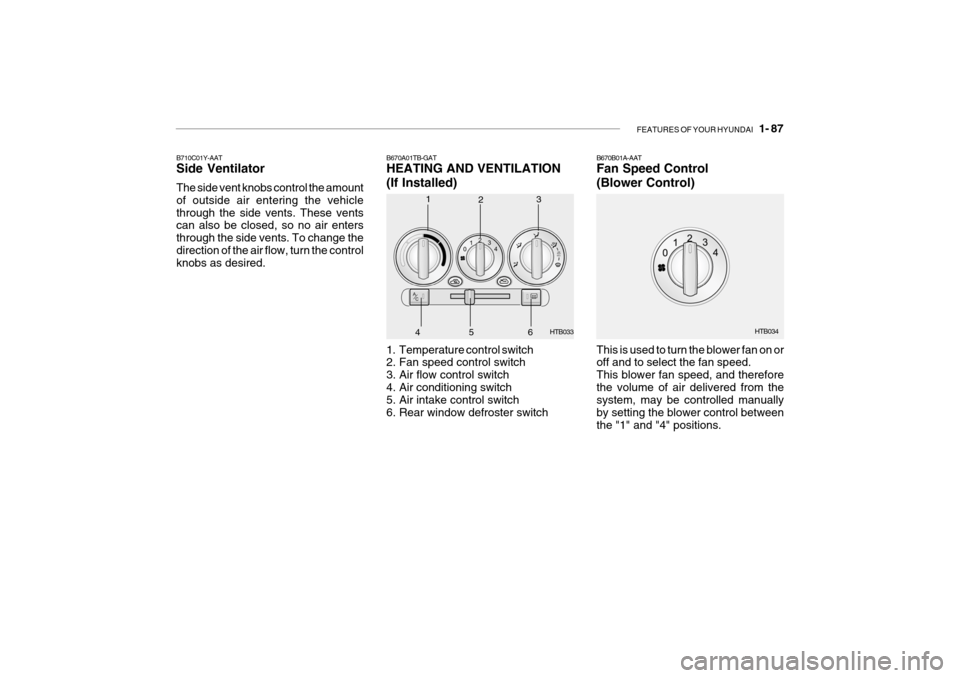
B670A01TB-GAT HEATING AND VENTILATION (If Installed)
1. Temperature control switch
2. Fan speed control switch
3. Air flow control switch
4. Air conditioning switch
5. Air intake control switch
6. Rear window defroster switch B670B01A-AAT Fan Speed Control (Blower Control) This is used to turn the blower fan on or off and to select the fan speed. This blower fan speed, and thereforethe volume of air delivered from the system, may be controlled manually by setting the blower control betweenthe "1" and "4" positions.
B710C01Y-AAT Side Ventilator The side vent knobs control the amount of outside air entering the vehiclethrough the side vents. These vents can also be closed, so no air enters through the side vents. To change thedirection of the air flow, turn the control knobs as desired.
56