rail Hyundai Getz 2008 User Guide
[x] Cancel search | Manufacturer: HYUNDAI, Model Year: 2008, Model line: Getz, Model: Hyundai Getz 2008Pages: 383, PDF Size: 9.23 MB
Page 192 of 383
5- 8 VEHICLE MAINTENANCE REQUIREMENTS
F060A01A-AAT EXPLANATION OF SCHED- ULED MAINTENANCE ITEMS F060M01A-AAT
o Engine Oil and Filter The engine oil and filter should be changed at the intervals specified in the maintenance schedule. If the car is being driven in severe conditions,more frequent oil and filter changes are required. F060B01A-AAT
o Drive Belts Inspect all drive belts for evidence of cuts, cracks, excessive wear or oil and replace if necessary. Drive beltsshould be checked periodically for proper tension and adjusted as nec- essary. After installing a new filter, run the
engine for several minutes, and checkfor leaks at the connections. Fuel fil-ters should be installed by trained technicians.
F060D01TB-AAT
o Fuel Lines, Fuel Hoses and
Connections
Check the fuel lines, fuel hoses and
connections for leakage and damage. Have a trained technician replace anydamaged or leaking parts immedi- ately. F060E01A-AAT
o Timing Belt
Inspect all parts related to the timingbelt for damage and deformation. Replace any damaged parts immedi-ately. F060G01A-AAT
o Vapor Hose and Fuel Filler Cap
The vapor hose and fuel filler cap should be inspected at those intervals specified in the maintenance sched-ule. Make sure that a new vapor hose or fuel filler cap is correctly replaced.
F060C01A-AAT
o Fuel Filter A clogged filter can limit the speed at which the vehicle may be driven, dam- age the emission system and cause hard starting. If an excessive amountof foreign matter accumulates in the fuel tank, the filter may require re- placement more frequently.
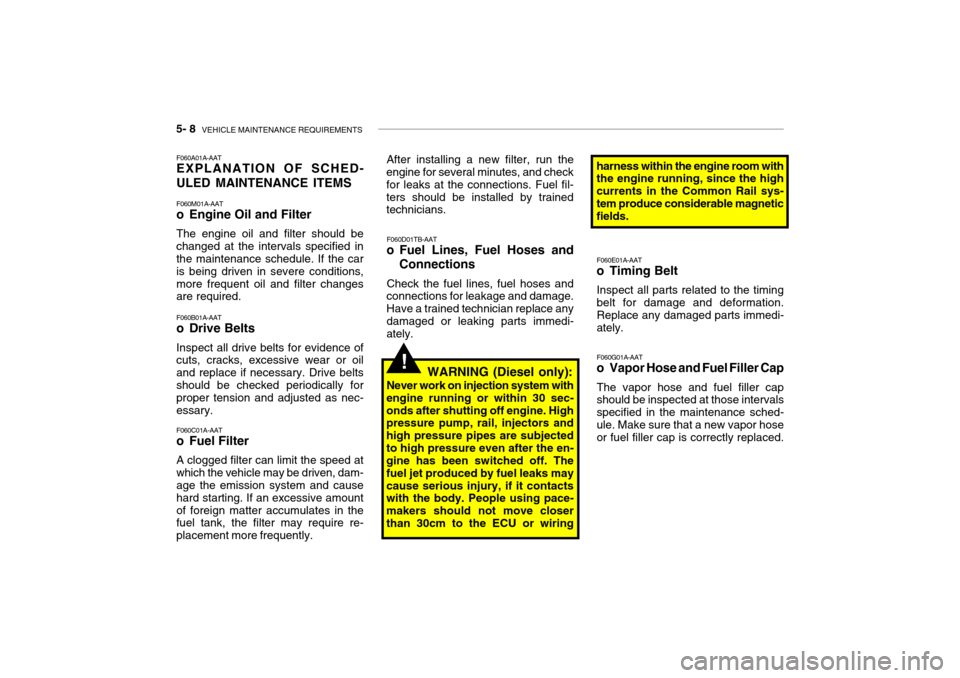
!WARNING (Diesel only):
Never work on injection system with
engine running or within 30 sec- onds after shutting off engine. High pressure pump, rail, injectors and high pressure pipes are subjectedto high pressure even after the en- gine has been switched off. The fuel jet produced by fuel leaks maycause serious injury, if it contacts with the body. People using pace- makers should not move closerthan 30cm to the ECU or wiring harness within the engine room with the engine running, since the high currents in the Common Rail sys-tem produce considerable magnetic fields.
Page 212 of 383
DO-IT-YOURSELF MAINTENANCE 6- 17
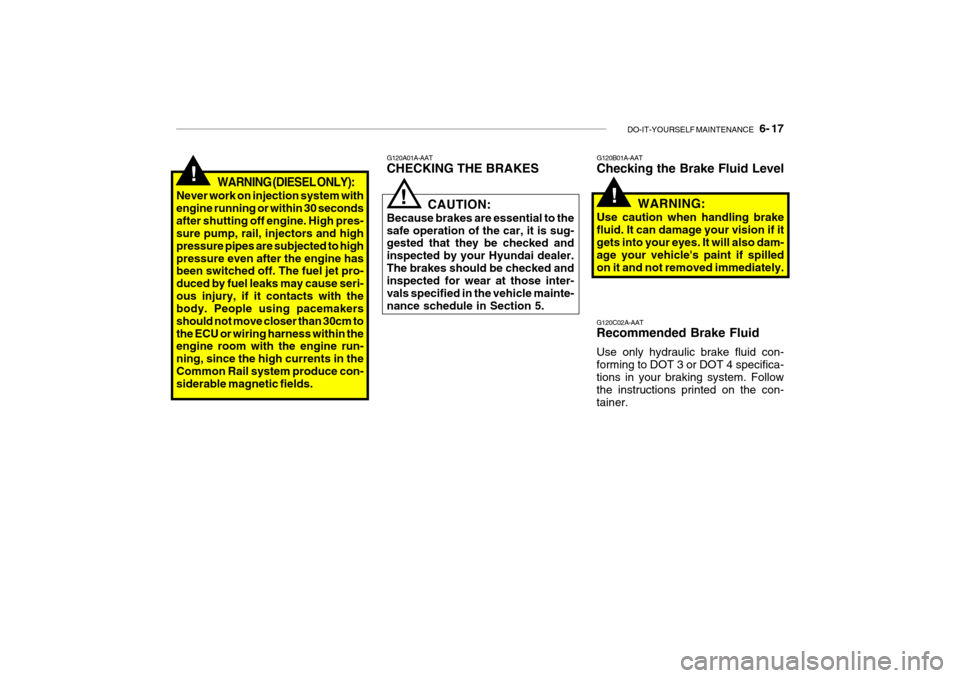
WARNING (DIESEL ONLY):
Never work on injection system with engine running or within 30 secondsafter shutting off engine. High pres- sure pump, rail, injectors and high pressure pipes are subjected to highpressure even after the engine has been switched off. The fuel jet pro- duced by fuel leaks may cause seri-ous injury, if it contacts with the body. People using pacemakers should not move closer than 30cm tothe ECU or wiring harness within the engine room with the engine run- ning, since the high currents in the Common Rail system produce con- siderable magnetic fields.
!
G120A01A-AAT CHECKING THE BRAKES G120B01A-AATChecking the Brake Fluid Level
!
CAUTION:
Because brakes are essential to the safe operation of the car, it is sug- gested that they be checked and inspected by your Hyundai dealer.The brakes should be checked and inspected for wear at those inter- vals specified in the vehicle mainte-nance schedule in Section 5. WARNING:
Use caution when handling brakefluid. It can damage your vision if it gets into your eyes. It will also dam- age your vehicle's paint if spilledon it and not removed immediately.!
G120C02A-AAT Recommended Brake Fluid Use only hydraulic brake fluid con- forming to DOT 3 or DOT 4 specifica- tions in your braking system. Follow the instructions printed on the con-tainer.
Page 254 of 383
10- 6 INDEX
Towing
A trailer (or vehicle) ................................................. 2-19
Emergency .............................................................. 3-13
If your vehicle must be towed ................................. 3-11
Trailer or Vehicl e towing ............................................. 2-19
Transaxle
Automa tic ................................................................. 2-9
Automatic transaxle fluid checking .......................... 6-15
Manual ...................................................................... 2-7
Manual transaxle Oil checking ................................ 6-14
Trip Computer ............................................................. 1-57
Trip Odometer ............................................................. 1-56
Turn signal operation .................................................. 1-59
V Vehicle Identifi cation Number ...................................... 8-2
Ventilation ................................................................... 1-86
Ventilator
Center ventilator ...................................................... 1-86
Side ventilator .......................................................... 1-87
W Warning Lights ............................................................ 1-48
Window glass ............................................................. 1-12
Windshield washer operation ......................................1-62
Windshield Wiper and Washer sw itch .........................1-61
Windshield Wiper Blades ............................................ 6-12
Winter Driving ............................................................. 2-16
Page 279 of 383
2. DRIVING YOUR HYUNDAI
Before starting the engine .............................................................. 2-3
Key positions .................................................................................... 2-4Starting ............................................................................................. 2-5
Operating the manual transaxle ....................................................... 2-8
Automatic transaxle ......................................................................... 2-9Effective Braking ............................................................................ 2-13
Anti-Lock brake system (ABS) ...................................................... 2-14
Electronic Stability Program (ESP) ................................................ 2-14
Driving for economy ....................................................................... 2-15
Winter Driving ................................................................................. 2-17
Trailer and Caravan Towing........................................................... 2-19
2
Page 291 of 383
DRIVING YOUR HYUNDAI 2- 13
HTB217-D
SC130A1-E OVERDRIVE SWITCH
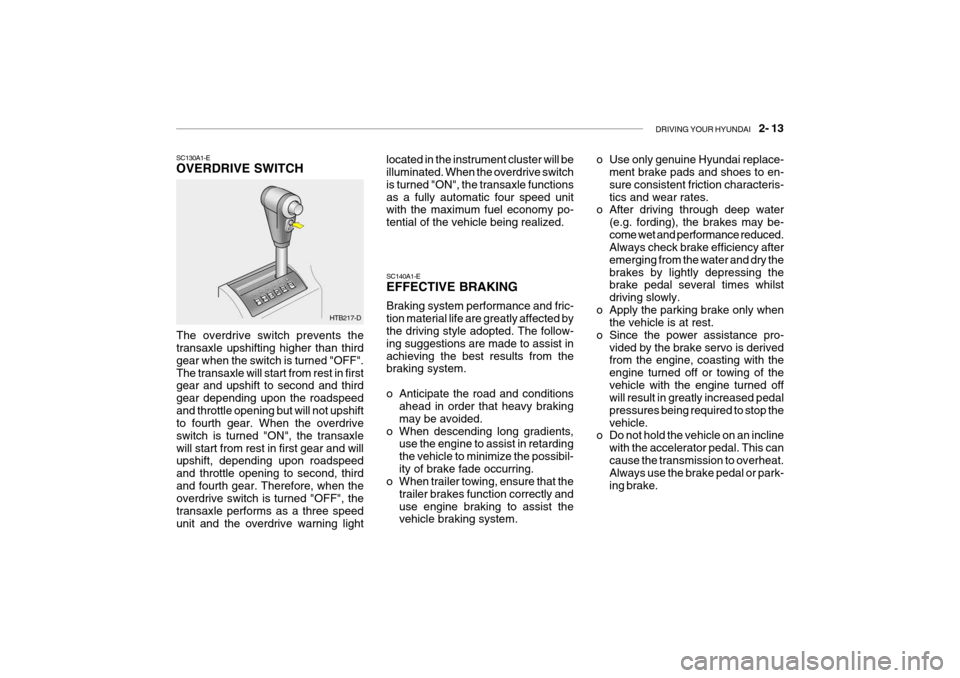
The overdrive switch prevents the transaxle upshifting higher than third gear when the switch is turned "OFF".The transaxle will start from rest in first gear and upshift to second and third gear depending upon the roadspeedand throttle opening but will not upshift to fourth gear. When the overdrive switch is turned "ON", the transaxlewill start from rest in first gear and will upshift, depending upon roadspeed and throttle opening to second, thirdand fourth gear. Therefore, when the overdrive switch is turned "OFF", the transaxle performs as a three speedunit and the overdrive warning light located in the instrument cluster will be illuminated. When the overdrive switch is turned "ON", the transaxle functionsas a fully automatic four speed unit with the maximum fuel economy po- tential of the vehicle being realized. SC140A1-E EFFECTIVE BRAKING Braking system performance and fric- tion material life are greatly affected by the driving style adopted. The follow- ing suggestions are made to assist inachieving the best results from the braking system.
o Anticipate the road and conditions
ahead in order that heavy braking may be avoided.
o When descending long gradients, use the engine to assist in retardingthe vehicle to minimize the possibil-ity of brake fade occurring.
o When trailer towing, ensure that the
trailer brakes function correctly anduse engine braking to assist the vehicle braking system. o Use only genuine Hyundai replace-
ment brake pads and shoes to en- sure consistent friction characteris-tics and wear rates.
o After driving through deep water
(e.g. fording), the brakes may be-come wet and performance reduced. Always check brake efficiency after emerging from the water and dry thebrakes by lightly depressing the brake pedal several times whilst driving slowly.
o Apply the parking brake only when the vehicle is at rest.
o Since the power assistance pro- vided by the brake servo is derived from the engine, coasting with the engine turned off or towing of thevehicle with the engine turned off will result in greatly increased pedal pressures being required to stop thevehicle.
o Do not hold the vehicle on an incline
with the accelerator pedal. This cancause the transmission to overheat. Always use the brake pedal or park- ing brake.
Page 297 of 383
DRIVING YOUR HYUNDAI 2- 19
The use of a proprietary stabiliser will assist in achieving an inherently stable outfit but whilst the use of such equip-ment will improve the characteristics of a balanced outfit, it will not compen- sate for a badly loaded and thereforeunstable outfit. The tyres and braking equipment fitted to the trailer or caravan must be main- tained in accordance with the recom- mendations of the manufacturer. Spe-cial attention should be paid to tyres which deteriorate through time and exposure rather than as a result of thedistances towed. The inside walls of the tyres should be inspected along with the outside walls for cracking anddamage. The trailer wheel nut torque must be checked on a regular basis, preferably before each towing ses-sion.
!
Nose weight
Total trailer weight
C190E01L C195F02TB-EAT TOWING ATTACHMENTS It is strongly recommended that only an Hyundai Approved towing attach-ment is used to ensure that the loads placed upon the body structure are correctly distributed. The use of a nonapproved attachment will result in the invalidation of the vehicle warranty. Hyundai towing attachments are de-signed and constructed to ensure maximum towing performance and ease of fitment. A range of accesso-ries including electrical kits are avail- able through the Hyundai authorised repairer network. It is of the utmost importance that those areas of the vehicle which aresubjected to greater stress during tow- ing are maintained in accordance with the recommendations given at the endof this book. In addition, the daily oper- ating checks relating to engine oil, transmission oil and tyres must beperformed at each refuelling to ensure maximum reliability and safety.
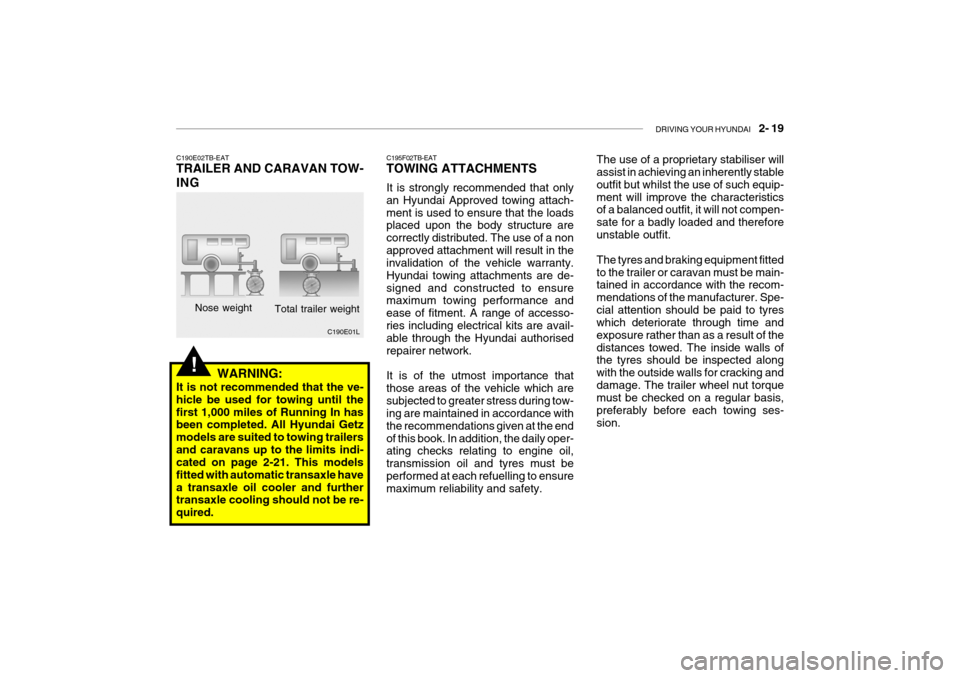
C190E02TB-EAT TRAILER AND CARAVAN TOW- ING
WARNING:
It is not recommended that the ve- hicle be used for towing until thefirst 1,000 miles of Running In has been completed. All Hyundai Getz models are suited to towing trailersand caravans up to the limits indi- cated on page 2-21. This models fitted with automatic transaxle havea transaxle oil cooler and further transaxle cooling should not be re- quired.
Page 298 of 383
2- 20 DRIVING YOUR HYUNDAI
C190E02L
Gross Axle Weight
Gross Vehicle
Weight
The trailer hitch and the safety catch mechanism must be maintained in good working order. The trailer break awaycable or chain should be inspected for damage and should be attached to the vehicle towing attachment each andevery time the trailer is hitched to the vehicle. Whilst towing, the performance of the vehicle will be reduced in terms of acceleration, braking and handling dueto the increased loads placed upon the vehicle. The driver should anticipate the change in characteristics and ad-just the driving style in keeping with these changes. Care should be exer- cised when cornering and braking toprevent the outfit becoming uncontrol- lable by reducing cornering speeds and allowing increased braking dis-tances. The driver should exercise care to en- sure that when pulling away from rest particularly on uphill gradients the clutchunit is not subjected to excessive slip- page which will reduce the useful life of this component. Use of the "OverdriveOff" "2" and "L" positions when driving vehicles with automatic transmission will assist with braking performancewhen long down hill gradients are en- countered. Improved acceleration per- formance will be available by selecting"Overdrive Off","2", or "1" depending upon road speed if it is found that the transmission unit makes an undesir-able upshift whilst hill climbing or over- taking. The transmission unit should be operated in "D" with the Overdrive "On"under normal circumstances to enhance fuel economy and reduce noise and engine wear.
CAUTION:
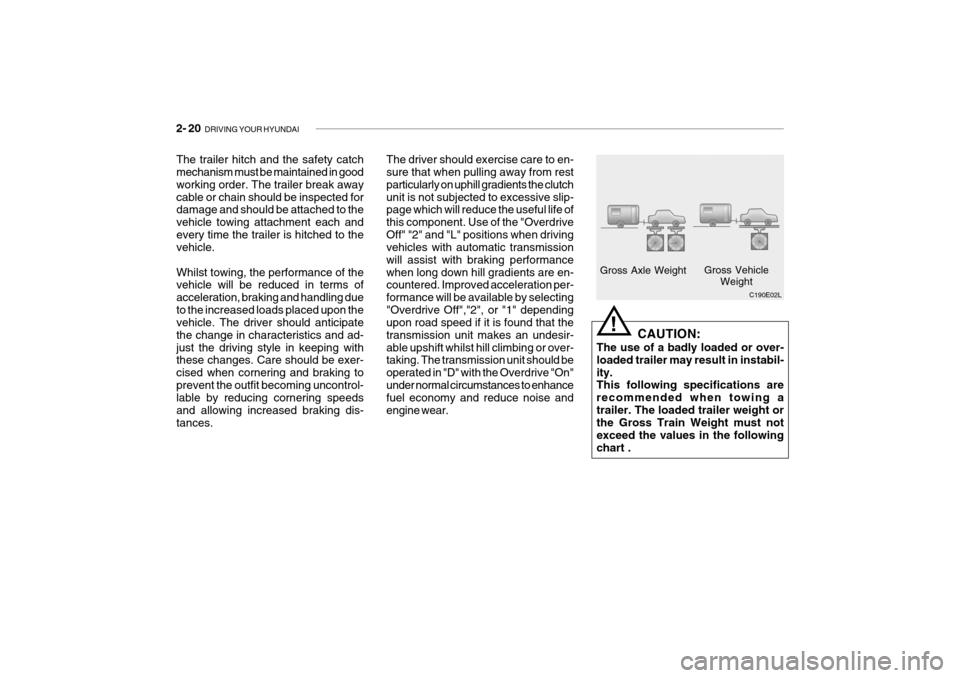
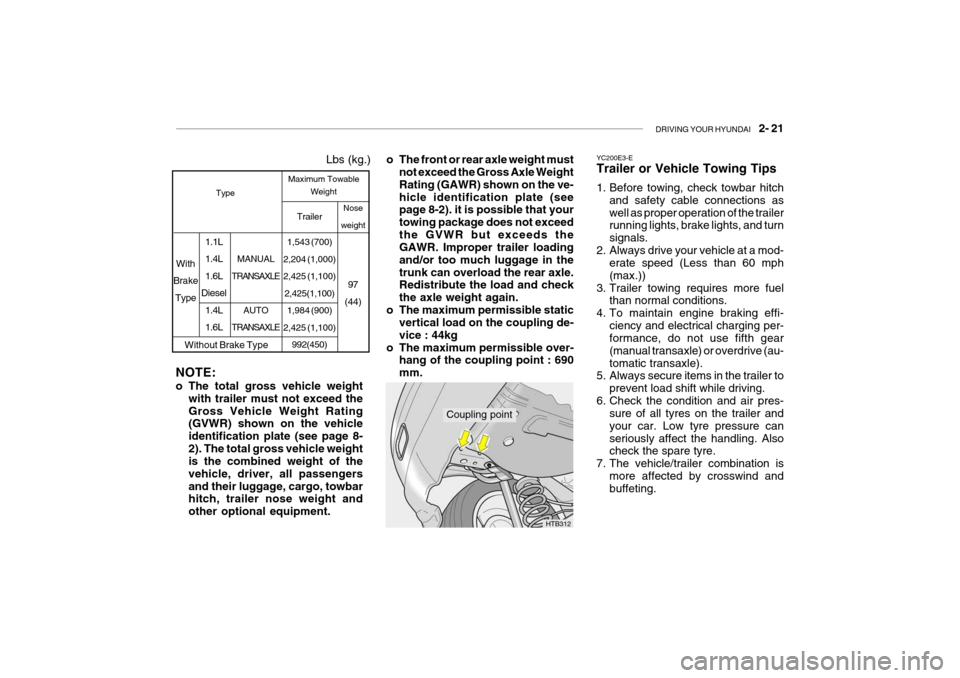
The use of a badly loaded or over-loaded trailer may result in instabil-ity. This following specifications are recommended when towing atrailer. The loaded trailer weight or the Gross Train Weight must not exceed the values in the followingchart .
!
Page 299 of 383
DRIVING YOUR HYUNDAI 2- 21
Coupling point
Nose
weight
97
(44)
Without Brake Type Trailer
1,543 (700)
2,204 (1,000) 2,425 (1,100) 2,425(1,100) 1,984 (900)
2,425 (1,100) 992(450)
MANUAL
TRANSAXLE
AUTO
TRANSAXLE
1.1L 1.4L1.6L
Diesel 1.4L1.6L
With
Brake Type Lbs (kg.)
Maximum Towable
Weight
Type
NOTE:
o The total gross vehicle weight with trailer must not exceed the Gross Vehicle Weight Rating (GVWR) shown on the vehicle identification plate (see page 8-2). The total gross vehicle weight is the combined weight of the vehicle, driver, all passengersand their luggage, cargo, towbar hitch, trailer nose weight and other optional equipment. o The front or rear axle weight must
not exceed the Gross Axle WeightRating (GAWR) shown on the ve-hicle identification plate (see page 8-2). it is possible that your towing package does not exceedthe GVWR but exceeds the GAWR. Improper trailer loading and/or too much luggage in thetrunk can overload the rear axle. Redistribute the load and check the axle weight again.
o The maximum permissible static vertical load on the coupling de-vice : 44kg
o The maximum permissible over- hang of the coupling point : 690mm. YC200E3-E Trailer or Vehicle Towing Tips
1. Before towing, check towbar hitch
and safety cable connections as well as proper operation of the trailer running lights, brake lights, and turn signals.
2. Always drive your vehicle at a mod- erate speed (Less than 60 mph(max.))
3. Trailer towing requires more fuel than normal conditions.
4. To maintain engine braking effi- ciency and electrical charging per- formance, do not use fifth gear (manual transaxle) or overdrive (au-tomatic transaxle).
5. Always secure items in the trailer to
prevent load shift while driving.
6. Check the condition and air pres- sure of all tyres on the trailer andyour car. Low tyre pressure canseriously affect the handling. Also check the spare tyre.
7. The vehicle/trailer combination is more affected by crosswind andbuffeting.
HTB312
Page 300 of 383
2- 22 DRIVING YOUR HYUNDAI
When being passed by a large ve- hicle, keep a constant speed and steer straight ahead. If there is toomuch wind buffeting slow down to get out of the other vehicle's air turbulence.
8. When parking your car and trailer, especially on a hill, be sure to followall the normal precautions. Turn yourfront wheel into the curb, set the parking brake firmly, and put the transaxle in 1st or Reverse (manual)or Park (automatic). In addition, we advise the use of wheel chocks at each of the trailer's tyres.
9. If the trailer has electric brakes, start your vehicle and trailer mov-ing, and then apply the trailer brakecontroller by hand to be sure the brakes are working. This lets you check your electrical connection atthe same time.
10. During your trip, check occasion-
ally to be sure that the load issecure, and that the lights and any trailer brakes are still working.
11. Avoid jerky starts, sudden accel- eration or sudden stops.
12. Avoid sharp turns and rapid lane
changes. 13. Avoid holding the brake pedal down
too long or too frequently. This could cause the brakes to over-heat, resulting in reduced braking efficiency.
14. When going down a hill, shift into a lower gear and use the enginebraking effect.When climbing a long grade, down-
shift the transaxle to a lower gearand reduce speed to reduce chances of engine overloading and/or overheating.
15. If you have to stop while going
uphill, do not hold the vehicle inplace by pressing on the accelera- tor. This can cause the automatic transaxle to overheat. Use the park-ing brake or footbrake.
NOTE: When towing check transaxle fluid more frequently. CAUTION:
If overheating should occur when towing, (temperature gauge reads near red zone), taking the followingaction may reduce or eliminate the problem.
1. Turn off the air conditioner.
2. Reduce highway speed.
3. Select a lower gear when going uphill.
4. While in stop and go traffic, place
the gear selection in park or neu- tral and idle the engine at a higher speed.
!
Page 305 of 383
WHAT TO DO IN AN EMERGENCY 3- 5
!
!
!
D040A01TB-EAT TEMPORARY SPARE TYRE (Not all models) The following instructions for the tem- porary spare tyre should be observed:
1. Check inflation pressure as soon as
practical after installing the spare tyre, and adjust to the specified pressure. The tyre pressure shouldbe periodically checked and main- tained at the specified pressure while the tyre is stored.
WARNING:
Whilst the engine is running, keep hands and clothing away from mov- ing parts such as the fan and drivebelts to prevent injury.
6. If the cause of the overheating can-not be found, wait until the enginetemperature has returned to normal. Then, if coolant has been lost, care- fully remove the radiator cap and addwater to bring the fluid level in the reservoir up to the base of the radia- tor fill opening. Fill the coolant ex-pansion tank to the halfway mark. To ensure the correct water to cool- ant mix is obtained after top up,testing by an authorised repairer is required. WARNING:
Do not remove the radiator cap whenthe engine is hot since steam and boiling water may be ejected fromthe radiator resulting in burns or scalding.
WARNING (Diesel only):
Never work on injection system withengine running or within 30 sec- onds after shutting off engine. Highpressure pump, rail, injectors and high pressure pipes are subject to high pressure even after the enginestopped. The fuel jet produced by fuel leaks may cause serious in- jury, if it touches the body. Peopleusing pacemakers should not move closer than 30cm etc. to the ECU or wiring harness within the engineroom while engine is running, since the high currents in the Common Rail system produce considerablemagnetic fields. 5. If the water pump drive belt is broken
or coolant is leaking out, stop theengine immediately and call the near-est Hyundai authorised repairer for assistance.
! CAUTION:
Serious loss of coolant indicates there is a leak in the cooling system and this should be checked as soonas possible by a Hyundai authorised repairer.
7. Proceed with caution until it is estab-
lished that the engine is operating normally. If the engine overheatsrepeatedly, the advice of a Hyundai authorised repairer should be sought.