Trip Hyundai Getz 2008 Owner's Manual
[x] Cancel search | Manufacturer: HYUNDAI, Model Year: 2008, Model line: Getz, Model: Hyundai Getz 2008Pages: 383, PDF Size: 9.23 MB
Page 13 of 383

1. FEATURES OF YOUR HYUNDAI
Fuel Recommendations ................................................................... 1-2
Breaking in Your New Hyundai ........................................................ 1-4
key (Immobilizer system) ................................................................. 1-5
Door locks (Theft-alarm system) ..................................................... 1-9Power windows.............................................................................. 1-13
Seat ................................................................................................ 1-13
Seat Belt ......................................................................................... 1-21
Child restraint system .................................................................... 1-28
Supplemental restraint (AIRBAG) system .....................................1-36
Instrument cluster and indicator lights ............................................1-44
Warning Light and Indicator ............................................................ 1-48
Trip computer ................................................................................. 1-57
Multi-Function Light Switch............................................................ 1-59
Windshield wiper/Washer Switch ...................................................1-61
Sunroof ........................................................................................... 1-69
Mirror ......... ..................................................................................... 1-73
Hood R elease ................................................................................ 1-77
How to use luggage Room ............................................................. 1-80
Heating and cooling control ............................................................ 1-86
Stereo sound system ..................................................................... 1-95
Audio system ................................................................................. 1-97
Antenna ........................................................................................ 1-128
1
Page 56 of 383
1- 44 FEATURES OF YOUR HYUNDAI
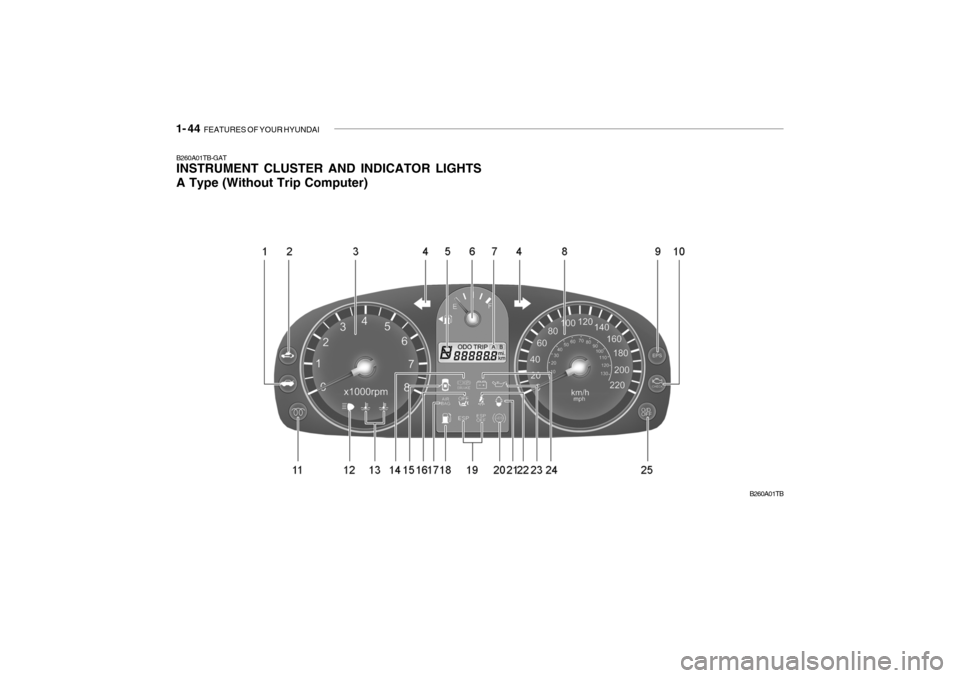
B260A01TB-GAT INSTRUMENT CLUSTER AND INDICATOR LIGHTS A Type (Without Trip Computer)
B260A01TB
Page 57 of 383

FEATURES OF YOUR HYUNDAI 1- 45
1. Tail Gate Open Warning Light
2. Immobilizer Warning Indicator Light (If installed)
3. Tachometer
4. Turn Signal Indicator Light
5. Automatic Transaxle Position Indicator Light
(If installed)
6. Fuel Gauge
7. Odometer/Trip Odometer
8. Speedometer
9. Electric Power Steering Warning Light (If installed)
10. Malfunction Indicator Light (MIL) (If installed)
11. Diesel Pre-heat Indicator Light (Diesel only)
12. High Beam Indicator Light
13. Engine Coolant Temperature Indicator Light
(If installed) 14. Parking Brake/Brake Fluid Level Warning Light
15. Door Ajar Warning Light
16. Passenger's Front Airbag OFF Indicator Light
(If installed)
17. SRS (Airbag) Warning Light
(If installed)
18. Low Fuel Warning Light
19. Electronic Stability Program (ESP) Indicator Light
(If installed)
20. ABS Warning Light (If installed)
21. Fuel Filter Warning Light (Diesel only)
22. Seat Belt Warning Light
23. Oil Pressure Warning Light
24. Charging System Warning Light
25. Overdrive off Indicator Light (Auto T/A only)
Page 58 of 383
1- 46 FEATURES OF YOUR HYUNDAI
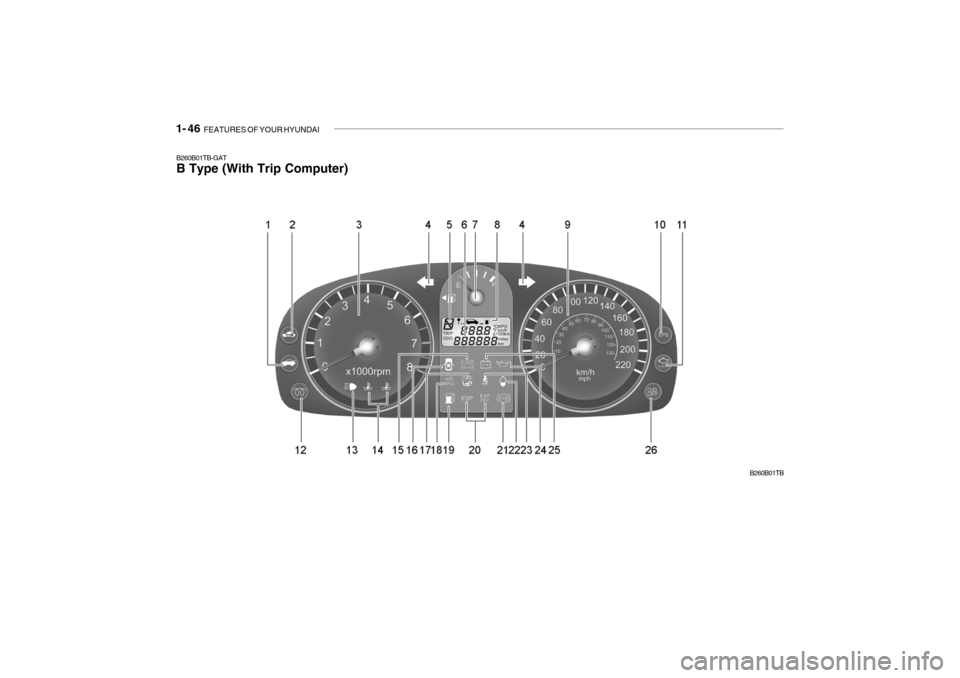
B260B01TB-GAT B Type (With Trip Computer)
B260B01TB
Page 59 of 383

FEATURES OF YOUR HYUNDAI 1- 47
1. Tail Gate Open Warning Light
2. Immobilizer Warning Indicator Light (If installed)
3. Tachometer
4. Turn Signal Indicator Light
5. Automatic Transaxle Position Indicator Light
(If installed)
6. Odometer/Trip Odometer
7. Fuel Gauge
8. Trip Computer (If installed)
9. Speedometer
10. Electric Power Steering Warning Light (If installed)
11. Malfunction Indicator Light (MIL) (If installed)
12. Diesel Pre-heat Indicator Light (Diesel only)
13. High Beam Indicator Light
14. Engine Coolant Temperature Indicator Light (If installed) 15. Parking Brake/Brake Fluid Level Warning Light
16. Door Ajar Warning Light
17. Passenger's Front Airbag OFF Indicator Light
(If installed)
18. SRS (Airbag) Warning Light (If installed)
19. Low Fuel Warning Light
20. Electronic Stability Program (ESP) Indicator Light (If installed)
21. ABS Warning Light (If installed)
22. Fuel Filter Warning Light (Diesel only)
23. Seat Belt Warning Light
24. Oil Pressure Warning Light
25. Charging System Warning Light
26. Overdrive Off Indcator Light (Auto T/A only)
Page 68 of 383
1- 56 FEATURES OF YOUR HYUNDAI
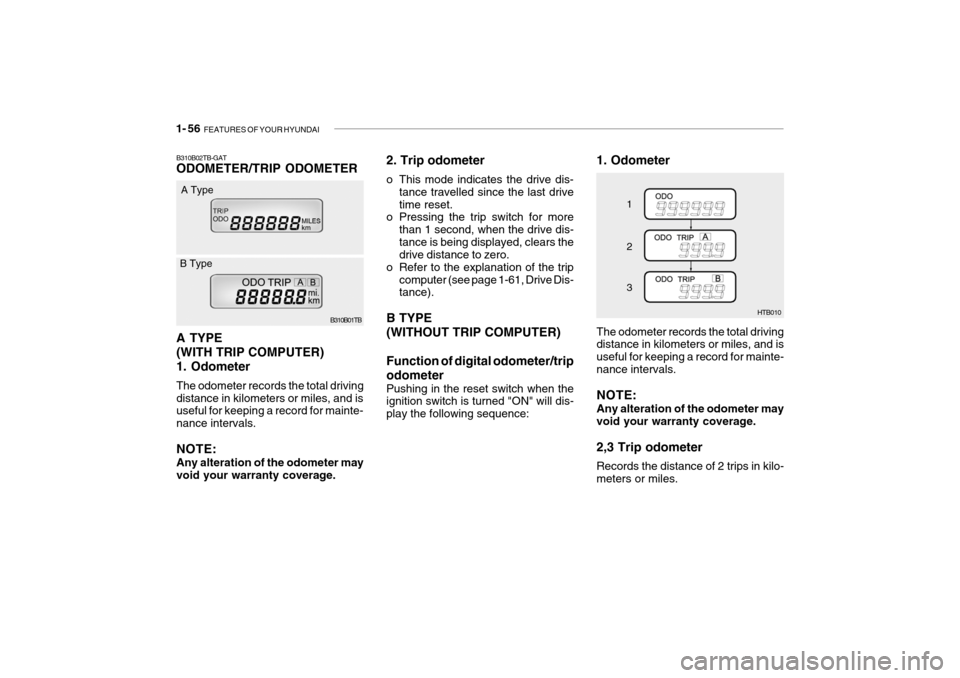
1. Odometer
HTB010
1 2 3
The odometer records the total driving distance in kilometers or miles, and is useful for keeping a record for mainte-nance intervals. NOTE: Any alteration of the odometer may void your warranty coverage. 2,3 Trip odometer Records the distance of 2 trips in kilo- meters or miles.B310B02TB-GAT ODOMETER/TRIP ODOMETER A TYPE (WITH TRIP COMPUTER)1. Odometer The odometer records the total driving distance in kilometers or miles, and is useful for keeping a record for mainte- nance intervals. NOTE: Any alteration of the odometer may void your warranty coverage. B310B01TB
A Type
B Type 2. Trip odometer
o This mode indicates the drive dis-
tance travelled since the last drive time reset.
o Pressing the trip switch for more
than 1 second, when the drive dis-tance is being displayed, clears the drive distance to zero.
o Refer to the explanation of the trip computer (see page 1-61, Drive Dis-tance).
B TYPE (WITHOUT TRIP COMPUTER) Function of digital odometer/trip odometer
Pushing in the reset switch when the ignition switch is turned "ON" will dis- play the following sequence:
Page 69 of 383
FEATURES OF YOUR HYUNDAI 1- 57
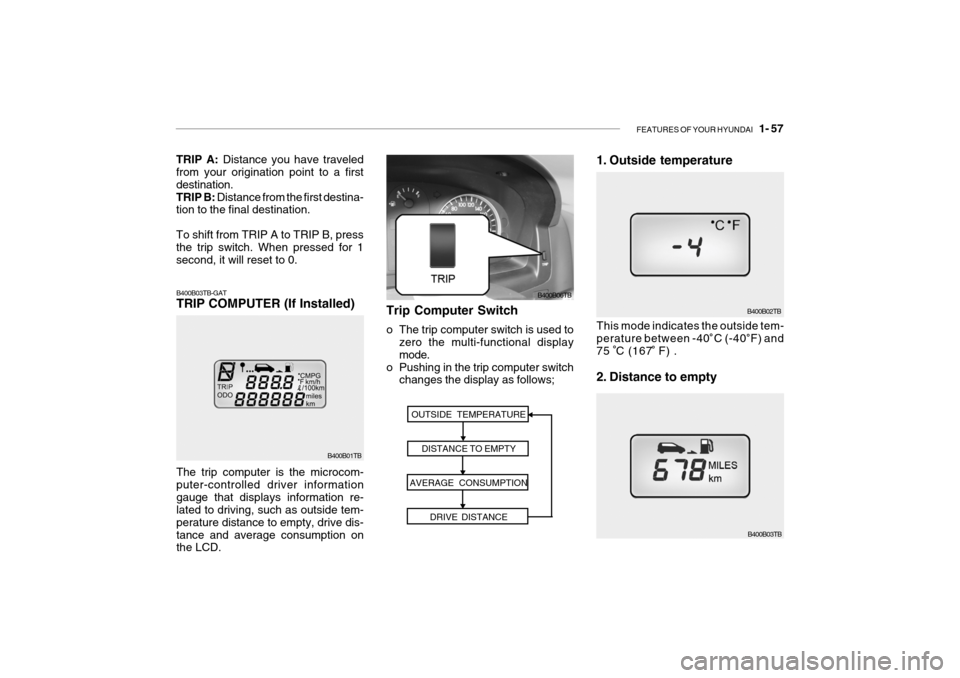
The trip computer is the microcom- puter-controlled driver informationgauge that displays information re- lated to driving, such as outside tem- perature distance to empty, drive dis-tance and average consumption on the LCD.
B400B01TB
B400B03TB-GAT TRIP COMPUTER (If Installed)
TRIP A:
Distance you have traveled
from your origination point to a first destination.TRIP B: Distance from the first destina-
tion to the final destination. To shift from TRIP A to TRIP B, press the trip switch. When pressed for 1 second, it will reset to 0.
OUTSIDE TEMPERATUREDISTANCE TO EMPTY
AVERAGE CONSUMPTION DRIVE DISTANCE
Trip Computer Switch
o The trip computer switch is used tozero the multi-functional display mode.
o Pushing in the trip computer switch changes the display as follows;
B400B06TB
B400B03TB
1. Outside temperature This mode indicates the outside tem- perature between -40 C (-40 F) and
75 C (167 F) .
2. Distance to empty
B400B02TB
Page 70 of 383
1- 58 FEATURES OF YOUR HYUNDAI
B400B04TB
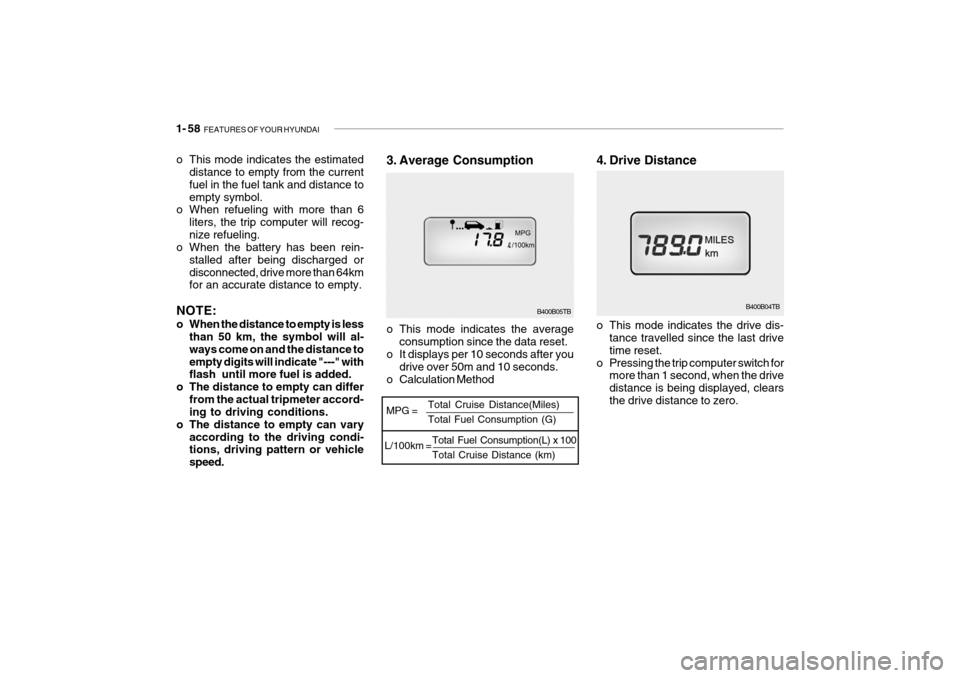
4. Drive Distance
o This mode indicates the drive dis-
tance travelled since the last drive time reset.
o Pressing the trip computer switch for more than 1 second, when the drivedistance is being displayed, clearsthe drive distance to zero.
Total Fuel Consumption(L) x 100 Total Cruise Distance (km)B400B05TB
MPG =
L/100km = Total Cruise Distance(Miles) Total Fuel Consumption (G)
o This mode indicates the estimated
distance to empty from the current fuel in the fuel tank and distance toempty symbol.
o When refueling with more than 6
liters, the trip computer will recog-nize refueling.
o When the battery has been rein-
stalled after being discharged ordisconnected, drive more than 64km for an accurate distance to empty.
NOTE:
o When the distance to empty is less than 50 km, the symbol will al- ways come on and the distance toempty digits will indicate "---" with flash until more fuel is added.
o The distance to empty can differ
from the actual tripmeter accord-ing to driving conditions.
o The distance to empty can vary
according to the driving condi-tions, driving pattern or vehicle speed. 3. Average Consumption
o This mode indicates the average
consumption since the data reset.
o It displays per 10 seconds after you
drive over 50m and 10 seconds.
o Calculation Method
Page 159 of 383

DRIVING YOUR HYUNDAI 2- 19
C170A01A-AAT HIGHER SPEED MOTORING Pre-Trip Inspections 1. Tires: Adjust the tire inflation pressures to specification. Low tire inflation pres- sures will result in overheating andpossible failure of the tires. Avoid using worn or damaged tires which may result in reduced traction ortire failure. NOTE: Never exceed the maximum tire in- flation pressure shown on the tires. 2. Fuel, engine coolant and en- gine oil: High speed travel consumes 1.5 times more fuel than urban motoring. Do not forget to check both engine coolantand engine oil. 3. Drive belt: A loose or damaged drive belt may result in overheating of the engine. C180A01A-AAT USE OF LIGHTS Check your lights regularly for correct operation and always keep them clean. When driving during the day in condi- tions of poor visibility, it is helpful todrive with headlights on low beam. This enables you to be seen as well as to see. C190A02A-GAT TRAILER OR VEHICLE TOWING If you are considering towing with your car, you should first check with your Province Department of Motor Vehiclesto determine their legal requirements. Since laws vary from province to prov- ince, the requirements for towing trail-ers, cars, other types of vehicles, or apparatus may differ. Ask your Hyundai dealer for further details before towing.
C190B01S-AAT Trailer Hitches Select the proper hitch and ball combi- nation, making sure that it's location is compatible with that of the trailer or vehicle being towed.Use a quality non-equalizing hitch which distributes the tongue load uniformly throughout the chassis. The hitch should be bolted securely to the car and installed by a qualifiedtechnician. DO NOT USE A HITCH DESIGNED FOR TEMPORARY IN- STALLATION AND NEVER USE ONETHAT ATTACHES ONLY TO THE BUMPER.
!
CAUTION
Do not do any towing with your car during its first 2,000 km (1,200 miles) in order to allow the engine to prop-erly break in. Failure to heed this caution may result in serious en- gine or transaxle damage.
Page 162 of 383
2- 22 DRIVING YOUR HYUNDAI
6. Check the condition and air pres-
sure of all tires on the trailer and your car. Low tire pressure canseriously affect the handling. Also check the spare tire.
7. The vehicle/trailer combination is more affected by crosswind andbuffeting. When being passed by a largevehicle, keep a constant speed and steer straight ahead. If there is too much wind buffeting slow downto get out of the other vehicle's air turbulence.
8. When parking your car and trailer, especially on a hill, be sure to fol-low all the normal precautions. Turn your front wheel into the curb, setthe parking brake firmly, and put the transaxle in 1st or Reverse (manual) or Park (automatic). Inaddition, place wheel chocks at each of the trailer's tires.
9. If the trailer has electric brakes, start your vehicle and trailer mov-ing, and then apply the trailer brake controller by hand to be sure thebrakes are working. This lets you check your electrical connection at the same time. 10. During your trip, check occasion-
ally to be sure that the load issecure, and that the lights andany trailer brakes are still working.
11. Avoid jerky starts, sudden accel-
eration or sudden stops.
12. Avoid sharp turns and rapid lane changes.
13. Avoid holding the brake pedal down
too long or too frequently. This could cause the brakes to over- heat, resulting in reduced brakingefficiency.
14. When going down a hill, shift into a
lower gear and use the engine brak-ing effect. When ascending a long grade, downshift the transaxle to a lowergear and reduce speed to reduce chances of engine overloading and/ or overheating.
15. If you have to stop while going uphill, do not hold the vehicle inplace by pressing on the accelera-tor. This can cause the automatic transaxle to overheat. Use the park- ing brake or footbrake.
C190F02A-GAT Trailer or Vehicle Towing Tips
1. Before towing, check hitch and
safety chain connections as well as proper operation of the trailerrunning lights, brake lights, and turn signals.
2. Always drive your vehicle at a mod- erate speed (Less than 100 km/h).
3. Trailer towing requires more fuel
than normal conditions.
4. To maintain engine braking effi- ciency and electrical charging per- formance, do not use fifth gear(manual transaxle) or overdrive (au- tomatic transaxle).
5. Always secure items in the trailer to prevent load shift while driving.
!WARNING:
Improperly loading your car and trailer can serious affect its steering and braking performance causing a crash in which could cause seriousinjury or death.