how to start Hyundai Getz 2009 Owner's Manual - RHD (UK, Australia)
[x] Cancel search | Manufacturer: HYUNDAI, Model Year: 2009, Model line: Getz, Model: Hyundai Getz 2009Pages: 191, PDF Size: 6.3 MB
Page 14 of 191

FEATURES OF YOUR HYUNDAI 1- 3
B020A01S-DAT RUNNING IN YOUR NEW HYUNDAIDuring the First 2,000 km No formal running in period is required with your new Hyundai. However, you can contribute to the economical op-eration and durability of your Hyundai by observing the following recommen- dations during the first 2,000 km.
o Don't drive faster than 88 km/h.
o While driving, keep your engine
speed or revolutions per minute between 2,000 and 4,000 rpm.
o Use moderate acceleration. Don't use full-throttle starts.
o For the first 300 km, try to avoid
hard braking.
o Don't labour the engine (in other words, don't drive so slowly in too high a gear that the engine jumps:shift to a lower gear).
o Whether going fast or slow, vary
your speed from time to time.
o Don't let the engine idle longer than 3 minutes.
o Do not tow a trailer during the first 2,000 km of operation. B880A01A-DAT IMMOBILISER SYSTEM The immobiliser system is an anti-theft device, designed to deter automobile theft. B880B07A-GAT Keys
!
CAUTION:
o When starting the engine, do not use the key with other immobi- lizer keys in close proximity. Oth- erwise, the engine may not start or may stop soon after it starts.Keep each key separately not to have any malfunction after you receive your new vehicle.
o Do not put metal accessories near the key or ignition switch.The engine may not start for themetal accessories may interrupt the transponder signal from nor- mally transmitting.
OTB028002
All of the locks fitted to the vehicle are operated by the same key. However,since it is possible to lock the doors without the use of the key, care should be exercised to ensure that the keydoes not become locked inside the vehicle by mistake.
!WARNING:
In order to prevent theft of your ve- hicle, do not leave spare keys any- where in your vehicle.
NOTE: If you make your own duplicate key, you will not be able to cancel the system or start the engine.
Page 42 of 191

FEATURES OF YOUR HYUNDAI 1- 31
!
B240B05L-D o The SRS can function only when
the ignition key is in the "ON" position. If the SRS SRI does not come on, or continuously re-mains on, after flashing for about 6 seconds when the ignition key is turned to the "ON" position, orafter the engine is started, or comes on while driving, the SRS is not working properly. If thisoccurs, have your vehicle imme- diately inspected by your Hyundai dealer.
o Before you replace a fuse or dis- connect a battery terminal, turnthe ignition key to the "LOCK"position or remove the ignition key. Never remove or replace the air bag related fuse(s) when theignition key is in the "ON" posi- tion. Failure to heed this warning will cause the SRS SRI to illumi-nate.
CAUTION:
When installing a container of liq- uid air freshener inside a vehicle, do not place it near the instrumentcluster nor on the instrument panel pad surface. If there is any leakage from the air freshener onto theseareas (instrument cluster, instru- ment panel pad or air ventilator), it may damage these parts. If the liq-uid from the air freshener does leak onto these areas, wash them with water immediately.
!
WARNING:
o When the SRS is activated, there may be a loud noise and fine dust will be released throughout thevehicle. These conditions are normal and are not hazardous. However, the fine dust generatedduring airbag deployment may cause skin irritation. Be sure to wash your hands and face thor-oughly with lukewarm water and a mild soap after an accident in which the airbags were deployed.
After complete inflation, the airbag im-mediately starts deflating, enabling thedriver to maintain forward visibility. Passenger's Airbag!
CAUTION:
Do not install or place any accesso- ries (drink holder, cassette holder,sticker, etc) on the front passenger's panel above the glove box in a ve- hicle with passenger's air bag. Suchobjects may become dangerous projectiles and cause injury if the passenger's air bag inflates.
Page 48 of 191
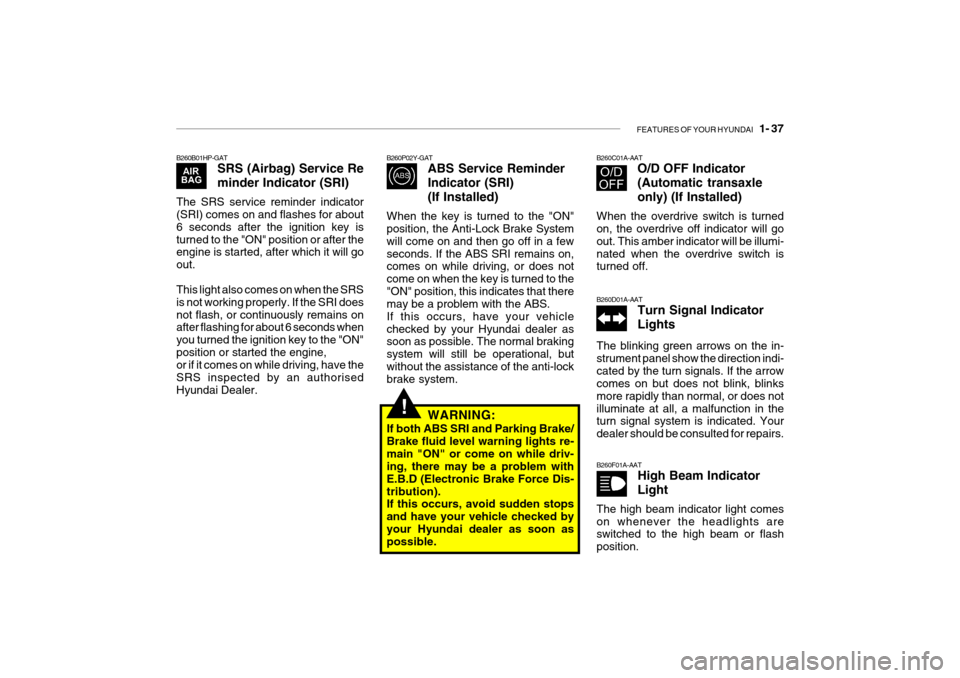
FEATURES OF YOUR HYUNDAI 1- 37
!
B260B01HP-GAT
SRS (Airbag) Service Re
minder Indicator (SRI)
The SRS service reminder indicator (SRI) comes on and flashes for about 6 seconds after the ignition key isturned to the "ON" position or after the engine is started, after which it will go out. This light also comes on when the SRS is not working properly. If the SRI doesnot flash, or continuously remains on after flashing for about 6 seconds when you turned the ignition key to the "ON"position or started the engine, or if it comes on while driving, have the SRS inspected by an authorisedHyundai Dealer. B260C01A-AAT
O/D OFF Indicator (Automatic transaxle
only) (If Installed)
When the overdrive switch is turned on, the overdrive off indicator will go out. This amber indicator will be illumi-nated when the overdrive switch is turned off. B260D01A-AAT Turn Signal Indicator Lights
The blinking green arrows on the in- strument panel show the direction indi-cated by the turn signals. If the arrow comes on but does not blink, blinks more rapidly than normal, or does notilluminate at all, a malfunction in the turn signal system is indicated. Your dealer should be consulted for repairs.B260P02Y-GAT ABS Service Reminder Indicator (SRI)(If Installed)
When the key is turned to the "ON" position, the Anti-Lock Brake System will come on and then go off in a fewseconds. If the ABS SRI remains on, comes on while driving, or does not come on when the key is turned to the"ON" position, this indicates that there may be a problem with the ABS. If this occurs, have your vehiclechecked by your Hyundai dealer as soon as possible. The normal braking system will still be operational, butwithout the assistance of the anti-lock brake system.
WARNING:
If both ABS SRI and Parking Brake/ Brake fluid level warning lights re-main "ON" or come on while driv- ing, there may be a problem with E.B.D (Electronic Brake Force Dis-tribution). If this occurs, avoid sudden stops and have your vehicle checked byyour Hyundai dealer as soon as possible.
B260F01A-AAT High Beam Indicator Light
The high beam indicator light comes on whenever the headlights are switched to the high beam or flash position.
Page 101 of 191

2- 6 DRIVING YOUR HYUNDAI
C070E03A-DAT RECOMMENDED SHIFT POINTS
1-2 2-33-4 4-5
Shift
from-to Recommended
20 km/h 40 km/h 55 km/h 75 km/h
The shift points as shown above are recommended for optimum fuel economy and performance.
NOTE:
o To shift into reverse, rest the lever
in neutral for at least 3 seconds after your car is completelystopped. Then move the lever into the reverse position.
o During cold weather, shifting may
be difficult until the transaxle lu-bricant has warmed up. This is normal and not harmful to thetransaxle.
o If you've come to a complete stop
and it's hard to shift into 1 st
or
R(Reverse), put the shift lever in N(Neutral) position and release the clutch. Press the clutch pedalback down, and then shift into 1 st
or R(Reverse) gear position.
o Do not use the shift lever as a
handrest during driving, as this can result in premature wear of the transaxle shift forks. CAUTION:
When downshifting from fifth gearto fourth gear, caution should be taken not to inadvertently press the gear lever sideways in such a man-ner that second gear is engaged. Such a drastic downshift may cause the engine speed to increase to thepoint that the tachometer will enter the red-zone. Such over-revving of the engine may possibly cause en-gine damage.
! C070B01A-DAT Using the Clutch The clutch should be pressed all the way to the floor before shifting, thenreleased slowly. The clutch pedal should fully return to the original posi- tion. Do not rest your foot on the clutchpedal while driving. This can cause unnecessary wear. Do not partially engage the clutch to hold the car on anincline. This causes unnecessary wear. Use the parking brake to hold the car on an incline. Do not operate the clutchpedal rapidly and repeatedly.
!WARNING:
If your vehicle has a manual transaxle not equipped with a ignition lockswitch, it may move and cause a serious accident when starting the engine without depressing the clutchpedal while the parking brake is re- leased and the shift never not in the N(Neutral) position.
Page 110 of 191

DRIVING YOUR HYUNDAI 2- 15
C150A01A-AAT SMOOTH CORNERING Avoid braking or gear changing in cor- ners, especially when roads are wet. Ideally, corners should always be takenunder gentle acceleration. If you follow these suggestions, tire wear will be held to a minimum.
o Use your air conditioning sparingly.
The air conditioning system is oper-ated by engine power so your fueleconomy is reduced when you use it.
C160A01A-DAT WINTER DRIVING The more severe weather conditions of winter result in greater wear and other problems. To minimise the prob-lems of winter driving, you should fol- low these suggestions: C160B01A-DAT Snowy or Icy Conditions To drive your vehicle in deep snow, it may be necessary to use snow tyres orto install tyre chains on your tyres. If snow tyre are needed, it is necessary to select tyres equivalent in size andtype to the original equipment tires. Failure to do so may adversely affect the safety and handling of your car.Furthermore, speeding, rapid accel- eration, sudden brake applications, and sharp turns are potentially very haz-ardous practices. During deceleration, use engine brak- ing to the fullest extent. Sudden brakeapplications on snowy or icy roads may cause skids to occur. You need to keep sufficient distance between thevehicle in operation in front and your vehicle. Also, apply the brake gently. It should be noted that installing tyrechains on the tyre will provide a greater driving force, but will not prevent side skids. NOTE: Tyre chains are not legal in all states. Check state laws before fitting tyre chains.
o Keep your car clean all over. For
maximum service, your Hyundai should be kept clean and free of corrosive materials. It is especially important that mud, dirt, ice, etc. not be allowed to accumulate on the underside of the car. This extra weight can result in increased fuel con- sumption and also contribute to cor- rosion.
o Travel lightly. Don't carry unneces- sary weight in your car. Weight is an enemy of good fuel economy.
o Don't let the engine idle longer than
necessary. If you are waiting (and not in traffic), turn off your engine and restart only when you're ready to go.
o Remember, your Hyundai does not require extended warm-up. As soon as the engine is running smoothly, you can drive away. In very cold weather, however, give your engine a slightly longer warm-up period.
o Don't "labour" or "over-rev" the en- gine. Labouring is driving too slowly in too high a gear resulting in the engine bucking. If this happens to you, shift to a lower gear. Over- revving is racing the engine beyond its safe limit. This can be avoided by shifting at the recommended speeds.
Page 119 of 191

WHAT TO DO IN AN EMERGENCY 3- 3
!
HTB218
Discharged battery
Booster battery
WARNING:
The gas produced by the battery during the jump-start operation is highly explosive. If these instruc- tions are not followed exactly, seri-ous personal injury and damage to the vehicle may occur! If you are not sure how to follow this proce-dure, seek qualified assistance. Automobile batteries contain sul- furic acid. This is poisonous andhighly corrosive. When jump start- ing, wear protective glasses and be careful not to get acid on yourself,your clothing or on the car. 3. Attach the clamps of the jumper
cable in the exact order shown in theillustration. That is, first, attach oneclamp of the jumper cable to the positive (+) post or cable of the discharged battery. Then attach theother end of the same cable to the positive (+) post or cable of the booster battery. Next, using theother cable, attach one clamp to the negative (-) post or cable of the booster battery. Then attach theother end of that cable to a solid metal part of the engine away from the battery. Do not connect the cableto any moving part.
4. Start the engine in the car with the
booster battery and let it run for afew minutes. This will help to as- sure that the booster battery is fully charged. During the jumping opera-tion, run the engine in this vehicle at about 2,000 rpm.
5. Start your engine using the normal starting procedure. After the enginestarts, leave the jumper cables con- nected and let the engine run at fastidle or about 2,000 rpm for several minutes.
D020A02A-AAT JUMP STARTING
o If you should accidentally get acid on
your skin or in your eyes, immedi- ately remove any contaminated cloth-ing and flush the area with clear water for at least 15 minutes. Then promptly obtain medical attention. Ifyou must be transported to an emer- gency facility, continue to apply water to the affected area with a spongeor cloth.
o The gas produced by the battery
during the jump-start operation ishighly explosive. Do not smoke or allow a spark or open flame in the vicinity.
o The battery being used to provide the jump start must be 12-volt. If youcannot determine that it is a 12-voltbattery, do not attempt to use it for the jump start.
o To jump start a car with a discharged battery, follow this procedure ex-actly:
1. If the booster battery is installed in another vehicle, be sure the two vehicles are not touching.
2. Turn off all unnecessary lights and accessories in both vehicles.
Page 124 of 191

3- 8 WHAT TO DO IN AN EMERGENCY
11. Refit the wheel trim.
12.Return the jack, tool roll and spare
wheel to the luggage compartment.
13.As soon as possible, check the wheel nut torque and adjust to the specification listed below:
Wheel nut tightening torque Steel wheel & aluminium alloy wheel: 900 ~ 1,100 kg.cm D080A01O-GAT IF YOUR VEHICLE MUST BE TOWED If your vehicle has to be towed, it should be done by your Hyundai dealer or a commercial tow truck service.This will help assure that your vehicle is not damaged in towing. Also, profes- sionals are generally aware of locallaws governing towing. In any case, rather than risk damage to your car, it is suggested that you show this infor-mation to the tow truck operator. Be sure that a safety chain system is used and that all local laws are observed.It is recommended that your vehicle be towed with a wheel lift and dollies or flatbed equipment with all the wheelsoff the ground.
!
CAUTION:
o Your vehicle can be damaged if towed incorrectly!
o Be sure the transaxle is in neu- tral.
o When the engine will not start, be sure the steering is unlocked by placing the key in the "ACC" po- sition. D080B01O-DAT Towing the Vehicle
HTB208
Your vehicle can be towed by wheel lift type truck (1), (2) or flatbed equipment(3). 1)
2)
3)
dolly
Page 128 of 191

4- 2 CORROSION PREVENTION AND APPEARANCE CARE
E010A01A-AAT CORROSION PROTECTION Protecting Your Hyundai fromCorrosion: By using the most advanced design and construction practices to combat corrosion, Hyundai produces cars ofthe highest quality. However, this is only part of the job. To achieve long- term corrosion resistance your Hyun-dai can deliver, the owner's coopera- tion and assistance is also required. E010C01A-AAT High-Corrosion Areas If you live in an area where your car is regularly exposed to corrosive materi-als, corrosion protection is particularly important. Some of the common causes of accelerated corrosion areroad salts, dust control chemicals, ocean air and industrial pollution.
E010B01A-AAT Common Causes of Corrosion The most common causes of corro- sion on your car are:
o Road salt, dirt and moisture that is allowed to accumulate underneath the car.
o Removal of paint or protective coat- ings by stones, gravel, abrasion orminor scrapes and dents which leaveunprotected metal exposed to cor- rosion. E010D01A-AAT Moisture Breeds Corrosion Moisture creates the conditions in which corrosion is most likely to occur. For example, corrosion is accelerated by high humidity, particularly when tem-peratures are just above freezing. In such conditions, the corrosive mate- rial is kept in contact with the carsurfaces by moisture that is slow to evaporate. Mud is particularly corrosive becauseit is slow to dry and holds moisture in contact with the vehicle. Although themud appears to be dry, it can still retain the moisture and promote corrosion. High temperatures can also acceler-ate corrosion of parts that are not properly ventilated so the moisture can be dispersed. For all these rea-sons, it is particularly important to keep your car clean and free of mud or accumulations of other materials. Thisapplies not only to the visible surfaces but particularly to the underside of the car. E020A01A-AAT TO HELP PREVENT CORRO- SION You can help prevent corrosion from starting by observing the following:
Page 135 of 191

5- 2 VEHICLE MAINTENANCE REQUIREMENTS
F010C01A-DAT
Specified Scheduled Proce- dures
These are the procedures such as
inspections, adjustments and replace- ments that are listed in the mainte- nance charts starting on page 5-4. These procedures must be performedat the intervals shown in the mainte- nance schedule to assure that your warranty remains in effect. Althoughit is strongly recommended that they be performed by the factory-trained or distributor-trained technicians atyour Hyundai dealer, these proce- dures may be performed at any quali- fied service facility. It is suggestedthat genuine Hyundai service parts be used for any required repairs or replacements. Other parts of equiva-lent quality such as engine oil, engine coolant, manual or auto transaxle oil, brake fluid and so on which are notsupplied by Hyundai Motor Company or its distributor may be used without affecting your warranty coverage butyou should always be sure these are equivalent
F010A01A-DAT
MAINTENANCE INTERVALS Service requirements
To ensure that you receive satisfying
operation from your Hyundai, certain maintenance procedures must be per- formed. Although careful design and engineering have reduced these to aminimum, those that are required are of the utmost importance.
It is your responsibility to have these
maintenance procedures performed to comply with the terms of the war-ranties covering your new Hyundai. The Service Passport supplied with your new vehicle provides further in-formation about these warranties. F010E02S-DAT
Do-It-Yourself Maintenance
See page (6-1 ~ 6-31).
F010D01A-DAT
General Checks
These are the regular checks youshould perform each time you drive your Hyundai or you fill the fuel tank. A list of these items will be found onpage 6-4. F010F02A-DAT
A Few Tips
Whenever you have your Hyundai serviced, keep copies of the servicerecords in your glovebox. This will help ensure that you have documen- tation when required. This is espe-cially important when an emergency service is not performed at an authorised Hyundai dealer.
F010B01A-AAT Maintenance Requirements The maintenance required for your Hyundai can be divided into three main areas:
o Specified scheduled procedures
o General checks
o Do-it-yourself maintenance to the quality of the original Hyundai
parts. Your Service Passport providesfurther information about your war-ranty coverage.
Page 190 of 191

10- 4 INDEX
High-Mounted Rear Stop Light.................................... 1-62
How to use luggage Room ......................................... 1-66
Horn ............................................................................ 1-69
I Ignition Switch ............................................................. 2-3
Immobilizer System ..................................................... 1-3
Instrument Cluster and Indicator Lights ...................... 1-35
Instrument Panel Light Control (Rheostat) .................. 1-52
Interior Light ................................................................ 1-57
Intermittent Wiper ....................................................... 1-49
JJump Starting .............................................................. 3-3
KKey If you lose y our keys .............................................. 3-10
Positions ................................................................... 2-3
L
Lubrication Chart .......................................................... 9-4
Luggage Board ............................................................ 1-67
Luggage Net ............................................................... 1-67
Luggage side trim ....................................................... 1-66M Maintenance Intervals
Explanation of scheduled maintenance items........................................................................ 5-7 ~ 5-9
Maintenance under severe usage conditions ............ 5-6
Scheduled maintenance ................................... 5-4 ~ 5-5
Service requirements ................................................ 5-2
Mirrors Outside rearview mirror heater .................................1-60
O
Odometer .................................................................... 1-41
Outside rearview Mirror............................................... 1-59
Outside rearview Mirror Heater................................... 1-60
P
Power Steering Fluid Level ......................................... 6-22
Power windows ........................................................... 1-11
RRear seat .................................................................... 1-15
Rear Seat F old Down ................................................. 1-16
Rear Window Demister Switch ................................... 1-50
Running in your New Hyundai ..................................... 1-3