warning Hyundai Getz 2009 Owner's Guide
[x] Cancel search | Manufacturer: HYUNDAI, Model Year: 2009, Model line: Getz, Model: Hyundai Getz 2009Pages: 254, PDF Size: 7.8 MB
Page 40 of 254
1- 28 FEATURES OF YOUR HYUNDAI
o Children who are too large to be in
a child restraint should sit in the rear seat and be restrained with the available lap/shoulder belts. Never allow children to ride in thefront passenger seat.
o Always make sure that the shoul- der belt portion of the outboard lap/shoulder belt is positioned midway over the shoulder, neveracross the neck or behind the back. Moving the child closer to the center of the vehicle may helpprovide a good shoulder belt fit. The lap belt portion of the lap/ shoulder belt or the center seat lap belt must always be posi- tioned as low as possible on thechild's hips and as snug as pos- sible.
o If the seat belt will not properly fit the child, Hyundai recommends the use of an approved boosterseat in the rear seat in order to raise the child's seating height so that the seat belt will properly fitthe child.B230A04A-GAT CHILD RESTRAINT SYSTEM (If Installed) Children riding in the car should sit in the rear seat and must always be properly restrained to minimize therisk of injury in an accident, sudden stop or sudden maneuver. According to accident statistics, children are saferwhen properly restrained in the rear seats than in the front seat. Larger children not in a child restraint shoulduse one of the seat belts provided. You are required by law to use safety restraints for children. If small childrenride in your vehicle you must put them in a child restraint system (safety seat). Child restraint systems are designed tobe secured in vehicle seats by lap belts or the lap belt portion of a lap/shoulder belt, or by a tether anchor and/or ISOFIXanchors (if installed). Children could be injured or killed in a crash if their restraints are not properlysecured. For small children and babies, a child seat or infant seat must be used. Before buying a particular child restraintsystem, make sure it fits your car and seat belts, and fits your child. Follow all the instructions provided by the manu-facturer when installing the child re- straint system. WARNING:
o A child restraint system must be placed in the rear seat. Neverinstall a child or infant seat on the front passenger's seat.Should an accident occur and cause the passenger side airbag to deploy, it could severely in-jure or kill an infant or child seated in an infant or child seat. Thus, only use a child restraint in therear seat of your vehicle.
o Since a safety belt or child re- straint system can become very hot if it is left in a closed vehicle, be sure to check the seat coverand buckles before placing a child there.
o When the child restraint system is not in use, store it in the luggage compartment or fasten it with asafety belt so that it will not be thrown forward in the case of a sudden stop or an accident.
!
Page 41 of 254
FEATURES OF YOUR HYUNDAI 1- 29
o Never allow a child to stand up or
kneel on the seat.
o Never use an infant carrier or child safety seat that "hooks" over a seatback; it may not provide ad- equate security in an accident.
o Never allow a child to be held in a person's arms while they are in a moving vehicle, as this could re-sult in serious injury to the child in the event of an accident or a sudden stop. Holding a child in amoving vehicle does not provide the child with any means of pro- tection during an accident, even if the person holding the child is wearing a seat belt.
o If the child restaint seat is not anchored properly, the risk of achild being seriously injured or killed in a collision greatly in- creases.
OTB039101
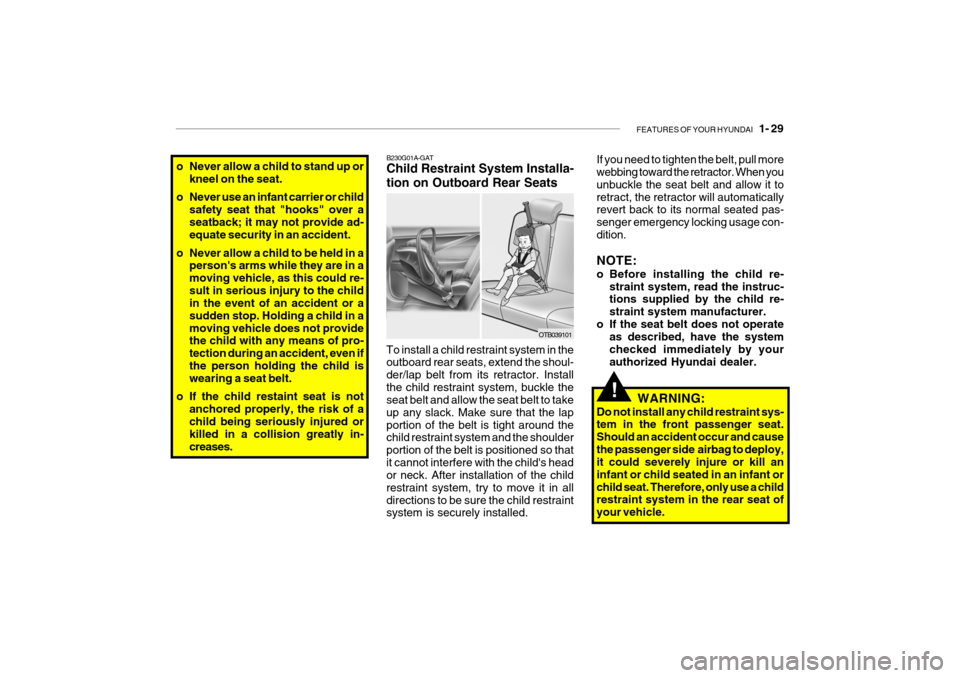
To install a child restraint system in the outboard rear seats, extend the shoul- der/lap belt from its retractor. Installthe child restraint system, buckle the seat belt and allow the seat belt to take up any slack. Make sure that the lapportion of the belt is tight around the child restraint system and the shoulder portion of the belt is positioned so thatit cannot interfere with the child's head or neck. After installation of the child restraint system, try to move it in alldirections to be sure the child restraint system is securely installed. B230G01A-GAT Child Restraint System Installa- tion on Outboard Rear Seats
WARNING:
Do not install any child restraint sys- tem in the front passenger seat. Should an accident occur and causethe passenger side airbag to deploy, it could severely injure or kill an infant or child seated in an infant orchild seat. Therefore, only use a child restraint system in the rear seat of your vehicle.
If you need to tighten the belt, pull more webbing toward the retractor. When you unbuckle the seat belt and allow it toretract, the retractor will automatically revert back to its normal seated pas- senger emergency locking usage con-dition. NOTE:
o Before installing the child re-
straint system, read the instruc- tions supplied by the child re- straint system manufacturer.
o If the seat belt does not operate as described, have the systemchecked immediately by yourauthorized Hyundai dealer.!
Page 43 of 254
FEATURES OF YOUR HYUNDAI 1- 31
B230E01TB
Back panel
Front of Vehicle
Attaching clip
Covering shelf
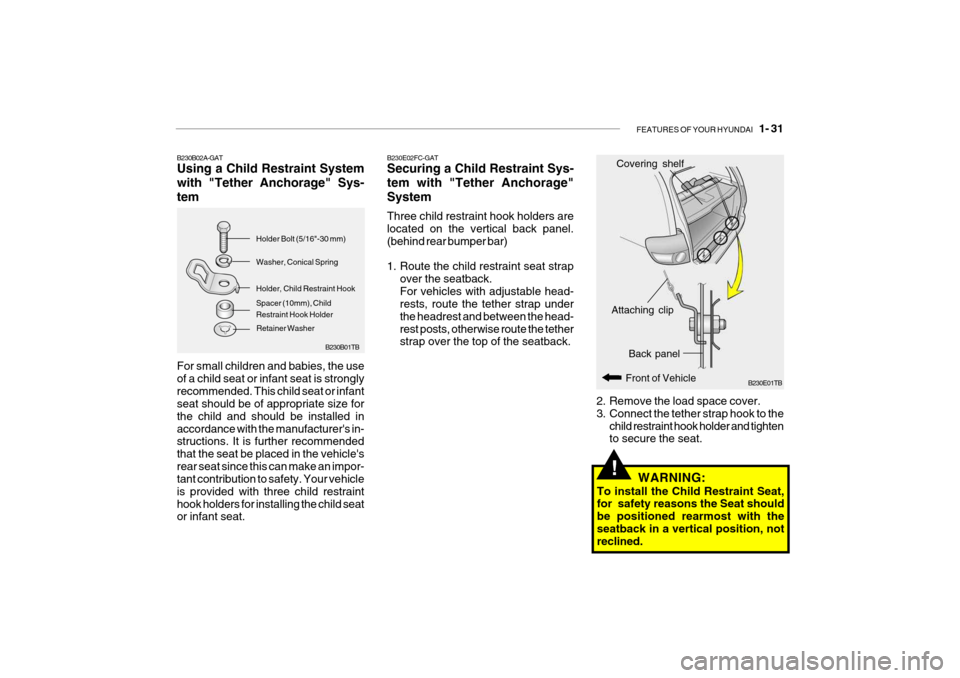
2. Remove the load space cover.
3. Connect the tether strap hook to the child restraint hook holder and tighten to secure the seat.
B230B01TB
B230B02A-GAT Using a Child Restraint System with "Tether Anchorage" Sys-tem For small children and babies, the use of a child seat or infant seat is stronglyrecommended. This child seat or infant seat should be of appropriate size for the child and should be installed inaccordance with the manufacturer's in- structions. It is further recommended that the seat be placed in the vehicle'srear seat since this can make an impor- tant contribution to safety. Your vehicle is provided with three child restrainthook holders for installing the child seat or infant seat. Spacer (10mm), Child Restraint Hook Holder
Holder Bolt (5/16"-30 mm) Washer, Conical Spring Holder, Child Restraint Hook
Retainer Washer B230E02FC-GAT Securing a Child Restraint Sys- tem with "Tether Anchorage"System Three child restraint hook holders are located on the vertical back panel. (behind rear bumper bar)
1. Route the child restraint seat strap
over the seatback. For vehicles with adjustable head- rests, route the tether strap under the headrest and between the head-rest posts, otherwise route the tether strap over the top of the seatback.
!WARNING:
To install the Child Restraint Seat, for safety reasons the Seat should be positioned rearmost with theseatback in a vertical position, not reclined.
Page 45 of 254
FEATURES OF YOUR HYUNDAI 1- 33
WARNING:
o Do not install a child restraint seat at the center of the rear seat using the vehicle's outboard rear seat ISOFIX anchors. The ISOFIX an-chors are only provided for the left and right outboard rear seating positions. Do not misuse theISOFIX anchors by attempting to attach a child restraint seat in the middle of the rear seat to the ISOFIXanchors. In a crash, the child re- straint seat ISOFIX attachments may not be strong enough to se-cure the child restraint seat prop- erly in the center of the rear seat and may break, causing seriousinjury or death.!
B230C02TB
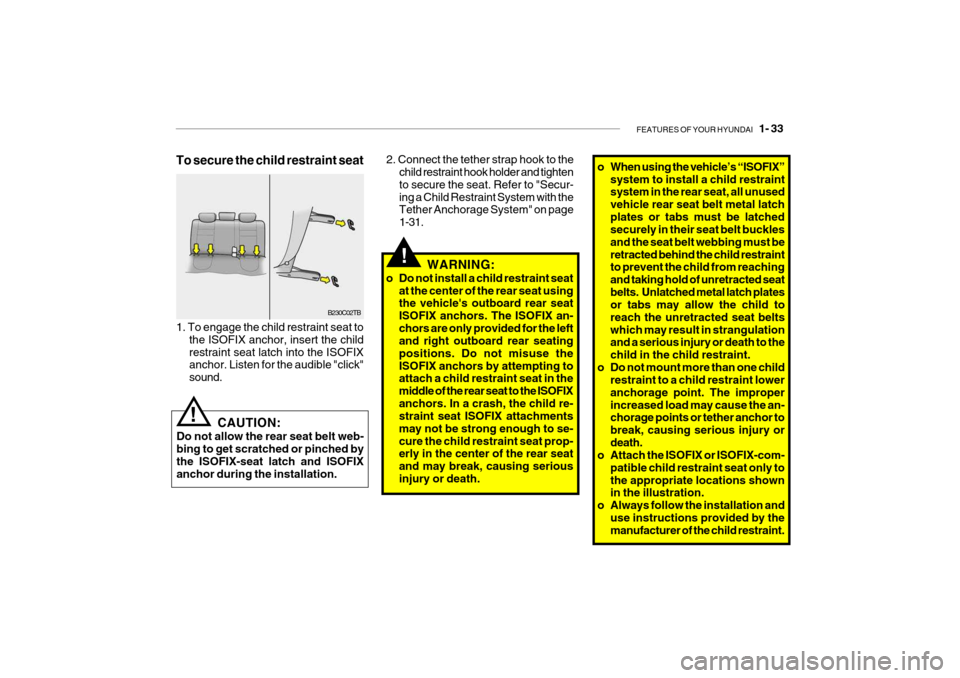
1. To engage the child restraint seat to the ISOFIX anchor, insert the child restraint seat latch into the ISOFIX anchor. Listen for the audible "click" sound.
To secure the child restraint seat
2. Connect the tether strap hook to the
child restraint hook holder and tighten to secure the seat. Refer to "Secur-ing a Child Restraint System with the Tether Anchorage System" on page 1-31.
! CAUTION:
Do not allow the rear seat belt web- bing to get scratched or pinched by the ISOFIX-seat latch and ISOFIX anchor during the installation.
o When using the vehicle’s “ISOFIX” system to install a child restraint system in the rear seat, all unused vehicle rear seat belt metal latchplates or tabs must be latched securely in their seat belt buckles and the seat belt webbing must beretracted behind the child restraint to prevent the child from reaching and taking hold of unretracted seat
belts. Unlatched metal latch plates or tabs may allow the child to reach the unretracted seat beltswhich may result in strangulation and a serious injury or death to the child in the child restraint.
o Do not mount more than one child restraint to a child restraint loweranchorage point. The improperincreased load may cause the an- chorage points or tether anchor to break, causing serious injury ordeath.
o Attach the ISOFIX or ISOFIX-com-
patible child restraint seat only tothe appropriate locations shown in the illustration.
o Always follow the installation and use instructions provided by themanufacturer of the child restraint.
Page 46 of 254
1- 34 FEATURES OF YOUR HYUNDAI
WARNING:
To obtain maximum benefit from a pre-tensioner seat belt:
1. The seat belt must be worn cor- rectly.
2. The seat belt must be adjusted to
the correct position.!
NOTE:
o Both the driver's and frontpassenger's pre-tensioner seat belts will be activated in certain frontal collisions. The pre- tensioner seat belts can be acti-vated with the airbags. The pre- tensioners will be activated un- der these conditions even if theseat belts are not being worn at the time of the collision.
o When the pre-tensioner seat belts are activated, a loud noise maybe heard and fine dust, which may appear to be smoke, may bevisible in the passenger com- partment. These are normal op- erating conditions and are nothazardous.
The pre-tensioner seat belt operates in the same way as an Emergency Lock- ing Retractor (ELR) type of seat belt.
HXG229
B180B01A-GAT Pre-tensioner Seat Belt (With A/BAG) (If Installed) Your Hyundai vehicle is equipped with driver's and front passenger's pre- tensioner seat belts. The purpose ofthe pre-tensioner is to make sure that the seat belts fit tightly against the occupant's body in certain frontal col-lisions. The pre-tensioner seat belts can be activated with the airbags.
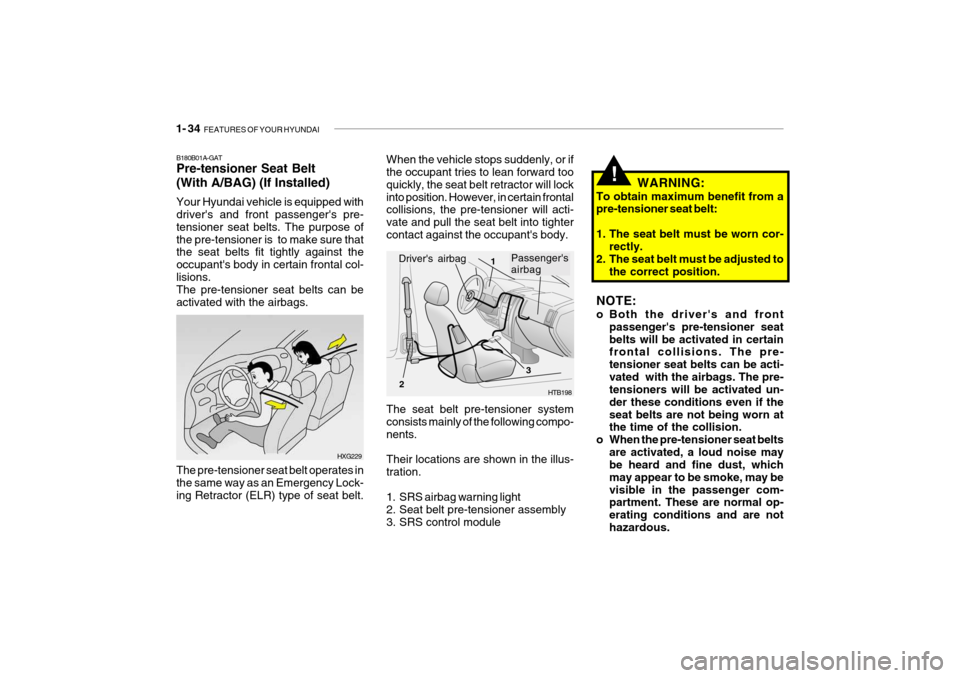
When the vehicle stops suddenly, or if the occupant tries to lean forward too quickly, the seat belt retractor will lockinto position. However, in certain frontal collisions, the pre-tensioner will acti- vate and pull the seat belt into tightercontact against the occupant's body.
The seat belt pre-tensioner system consists mainly of the following compo- nents. Their locations are shown in the illus- tration.
1. SRS airbag warning light
2. Seat belt pre-tensioner assembly
3. SRS control module
HTB198
Driver's airbag1
2 3Passenger's airbag
Page 47 of 254
FEATURES OF YOUR HYUNDAI 1- 35
illuminates while the vehicle is being driven, please have an au- thorized Hyundai dealer inspectthe pre-tensioner seat belt or SRS airbag system as soon as pos- sible.
WARNING:
o Pre-tensioners are designed to operate only one time. After acti- vation, pre-tensioner seat belts must be replaced. All seat belts, of any type, should always bereplaced after they have been worn during a collision.
o The pre-tensioner seat belt as- sembly mechanisms become hotduring activation. Do not touch the pre-tensioner seat belt as-semblies for several minutes af- ter they have been activated.
o Do not attempt to inspect or re-
place the pre-tensioner seat beltsyourself. This must be done by an authorized Hyundai dealer.
o Do not strike the pre-tensioner seat belt assemblies.!
o Although it is harmless, the finedust may cause skin irritation and should not be breathed for pro-longed periods. Wash your hands and face thoroughly after an acci- dent in which the pre-tensionerseat belts were activated.
! CAUTION:
o Because the sensor that activates the SRS airbag is connected with the pre-tensioner seat belt, the SRSairbag warning light on the instrument panel will blink for ap- proximately 6 seconds after theignition key has been turned to the "ON" position, and then it should turn off.
o If the pre-tensioner seat belt is not working properly, this warn-ing light will illuminate even ifthere is no malfunction of the SRS airbag system . If the SRS airbag warning light does notilluminate when the ignition key is turned to "ON", or if it remains illuminated after blinking for ap-proximately 6 seconds, or if it
o Do not attempt to service or repair the pre-tensioner seat belt system in any manner.
o Improper handling of the pre- tensioner seat belt assemblies,and failure to heed the warningsto not strike, modify, inspect, re- place, service or repair the pre- tensioner seat belt assembliesmay lead to improper operation or inadvertent activation and se- rious injury.
o Always wear the seat belts when driving or riding in a motor ve-hicle.
Page 48 of 254
1- 36 FEATURES OF YOUR HYUNDAI
HTB203
Rear impact
Side Impact Rollover
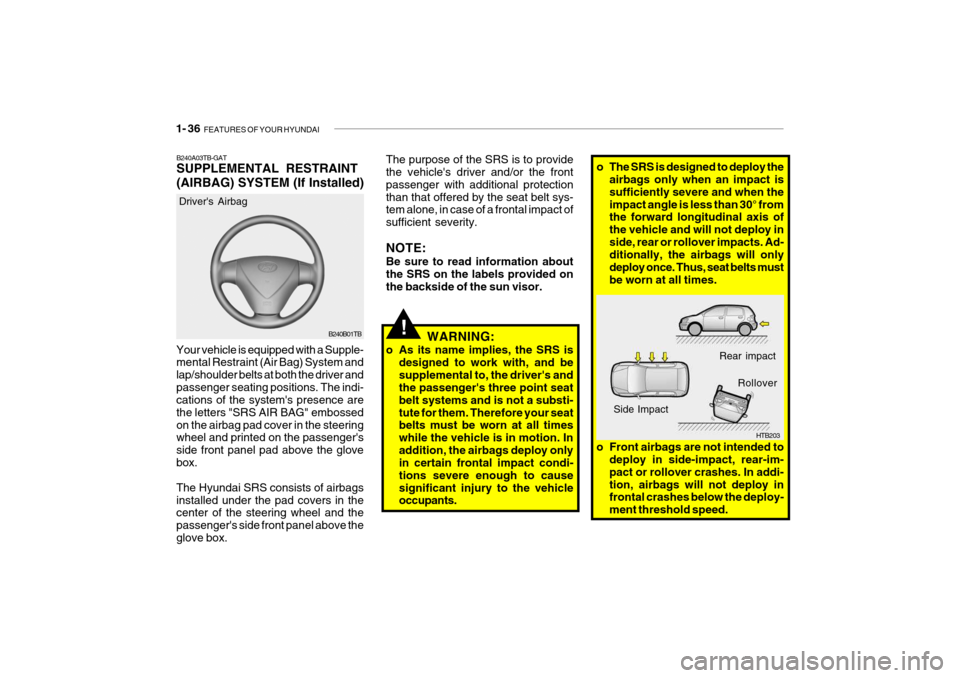
o Front airbags are not intended to deploy in side-impact, rear-im- pact or rollover crashes. In addi-tion, airbags will not deploy in frontal crashes below the deploy- ment threshold speed.
o The SRS is designed to deploy the
airbags only when an impact issufficiently severe and when theimpact angle is less than 30° from the forward longitudinal axis of the vehicle and will not deploy inside, rear or rollover impacts. Ad- ditionally, the airbags will only deploy once. Thus, seat belts mustbe worn at all times.
B240B01TB
Driver's Airbag
Your vehicle is equipped with a Supple- mental Restraint (Air Bag) System and lap/shoulder belts at both the driver andpassenger seating positions. The indi- cations of the system's presence are the letters "SRS AIR BAG" embossedon the airbag pad cover in the steering wheel and printed on the passenger's side front panel pad above the glovebox. The Hyundai SRS consists of airbags installed under the pad covers in the center of the steering wheel and the passenger's side front panel above theglove box. B240A03TB-GAT SUPPLEMENTAL RESTRAINT (AIRBAG) SYSTEM (If Installed)
The purpose of the SRS is to provide the vehicle's driver and/or the front passenger with additional protectionthan that offered by the seat belt sys- tem alone, in case of a frontal impact of sufficient severity. NOTE: Be sure to read information about the SRS on the labels provided onthe backside of the sun visor.
WARNING:
o As its name implies, the SRS is designed to work with, and besupplemental to, the driver's and the passenger's three point seat belt systems and is not a substi-tute for them. Therefore your seat belts must be worn at all times while the vehicle is in motion. Inaddition, the airbags deploy only in certain frontal impact condi- tions severe enough to causesignificant injury to the vehicle occupants.
!
Page 51 of 254
FEATURES OF YOUR HYUNDAI 1- 39
CAUTION:
When installing a container of liq- uid air freshener inside a vehicle, do not place it near the instrumentcluster nor on the instrument panel pad surface. If there is any leakage from the air freshener onto theseareas (instrument cluster, instru- ment panel pad or air ventilator), it may damage these parts. If the liq-uid from the air freshener does leak onto these areas, wash them with water immediately.
!
!
WARNING:
o When the SRS is activated, there may be a loud noise and fine dust will be released throughout thevehicle. These conditions are normal and are not hazardous. However, the fine dust generatedduring airbag deployment may cause skin irritation. Be sure to wash your hands and face thor-oughly with lukewarm water and a mild soap after an accident in which the airbags were deployed.
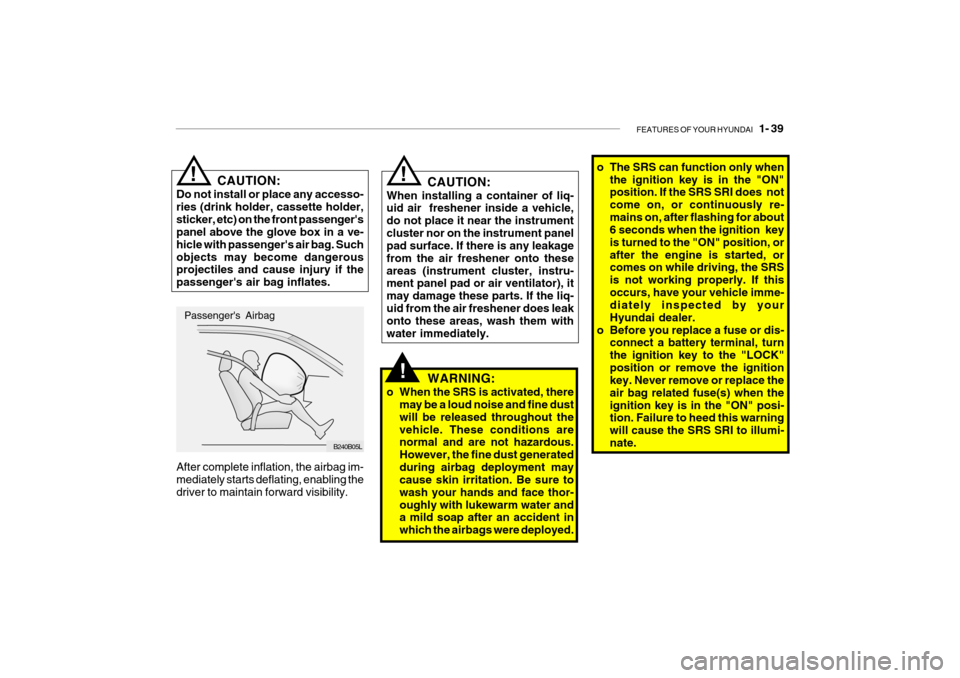
After complete inflation, the airbag im- mediately starts deflating, enabling thedriver to maintain forward visibility.Passenger's Airbag
B240B05L
!CAUTION:
Do not install or place any accesso- ries (drink holder, cassette holder,sticker, etc) on the front passenger's panel above the glove box in a ve- hicle with passenger's air bag. Suchobjects may become dangerous projectiles and cause injury if the passenger's air bag inflates.o The SRS can function only when the ignition key is in the "ON" position. If the SRS SRI does not come on, or continuously re-mains on, after flashing for about 6 seconds when the ignition key is turned to the "ON" position, orafter the engine is started, or comes on while driving, the SRS is not working properly. If thisoccurs, have your vehicle imme- diately inspected by your Hyundai dealer.
o Before you replace a fuse or dis- connect a battery terminal, turnthe ignition key to the "LOCK"position or remove the ignition key. Never remove or replace the air bag related fuse(s) when theignition key is in the "ON" posi- tion. Failure to heed this warning will cause the SRS SRI to illumi-nate.
Page 52 of 254
1- 40 FEATURES OF YOUR HYUNDAI
!
CAUTION:
o If the passenger's front airbag ON/ OFF switch is not working prop- erly, the SRS warning light on the instrument panel will illuminate. If this occurs, have an authorizedHyundai dealer inspect the passenger's front airbag ON/OFF switch, the pre-tensioner seat beltsystem and the SRS airbag sys- tem as soon as possible.
B240C01NF
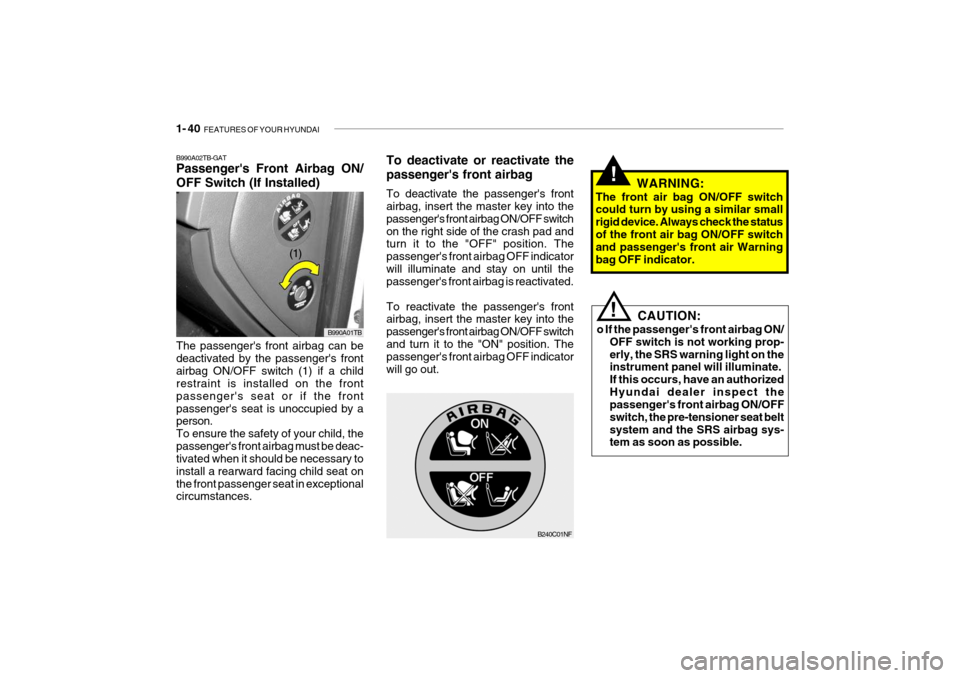
B990A02TB-GAT Passenger's Front Airbag ON/ OFF Switch (If Installed)
B990A01TB
The passenger's front airbag can be deactivated by the passenger's frontairbag ON/OFF switch (1) if a child restraint is installed on the front passenger's seat or if the frontpassenger's seat is unoccupied by a person. To ensure the safety of your child, thepassenger's front airbag must be deac- tivated when it should be necessary to install a rearward facing child seat onthe front passenger seat in exceptional circumstances. (1)
To deactivate or reactivate the passenger's front airbag To deactivate the passenger's front airbag, insert the master key into the passenger's front airbag ON/OFF switchon the right side of the crash pad and
turn it to the "OFF" position. The passenger's front airbag OFF indicatorwill illuminate and stay on until the passenger's front airbag is reactivated. To reactivate the passenger's front airbag, insert the master key into the passenger's front airbag ON/OFF switchand turn it to the "ON" position. The passenger's front airbag OFF indicator will go out.
!WARNING:
The front air bag ON/OFF switch could turn by using a similar small rigid device. Always check the statusof the front air bag ON/OFF switch and passenger's front air Warning bag OFF indicator.
Page 53 of 254
FEATURES OF YOUR HYUNDAI 1- 41
!WARNING:
o The driver is responsible for the proper position of the passenger's front airbag ON/OFF switch.
o Deactivate the front passenger's airbag only when the ignition switchis switched off, or the malfunction may occur in the SRSCM (SRSControl Module). And there may be a danger that the driver's and/or passenger's front and/or side airbagmay fail to trigger, or not trigger correctly during a collision.
o Never install a rearward facing child seat on the front passenger'sseat. The infant or child could be severely injured or killed by anairbag deployment in case of an accident.
o Even though your vehicle isequipped with the passenger's airbag ON/OFF switch, do not in- stall a child restraint system in thefront passenger's seat. A child re- straint system must never be placed in the front seat. Childrenwho are too large for child re- straint systems should always occupy the rear seat and use theavailable lap/shoulder belts. Children are afforded the most safety in the event of an accidentwhen they are restrained by a proper restraint system in the rear seat.
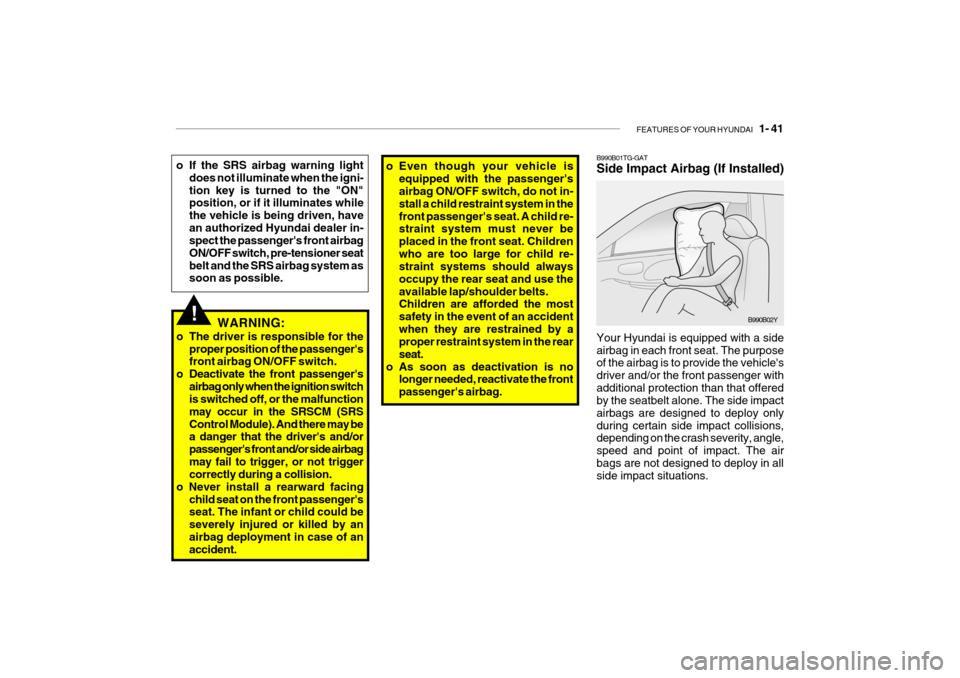
o As soon as deactivation is no longer needed, reactivate the frontpassenger's airbag. B990B01TG-GAT Side Impact Airbag (If Installed) Your Hyundai is equipped with a side airbag in each front seat. The purpose of the airbag is to provide the vehicle's driver and/or the front passenger withadditional protection than that offered by the seatbelt alone. The side impact airbags are designed to deploy onlyduring certain side impact collisions, depending on the crash severity, angle, speed and point of impact. The airbags are not designed to deploy in all side impact situations.
B990B02Y
o If the SRS airbag warning light
does not illuminate when the igni- tion key is turned to the "ON" position, or if it illuminates while the vehicle is being driven, havean authorized Hyundai dealer in- spect the passenger's front airbag ON/OFF switch, pre-tensioner seatbelt and the SRS airbag system as soon as possible.