handle Hyundai Grand i10 2015 User Guide
[x] Cancel search | Manufacturer: HYUNDAI, Model Year: 2015, Model line: Grand i10, Model: Hyundai Grand i10 2015Pages: 343, PDF Size: 29.47 MB
Page 137 of 343
481
Features of your vehicle
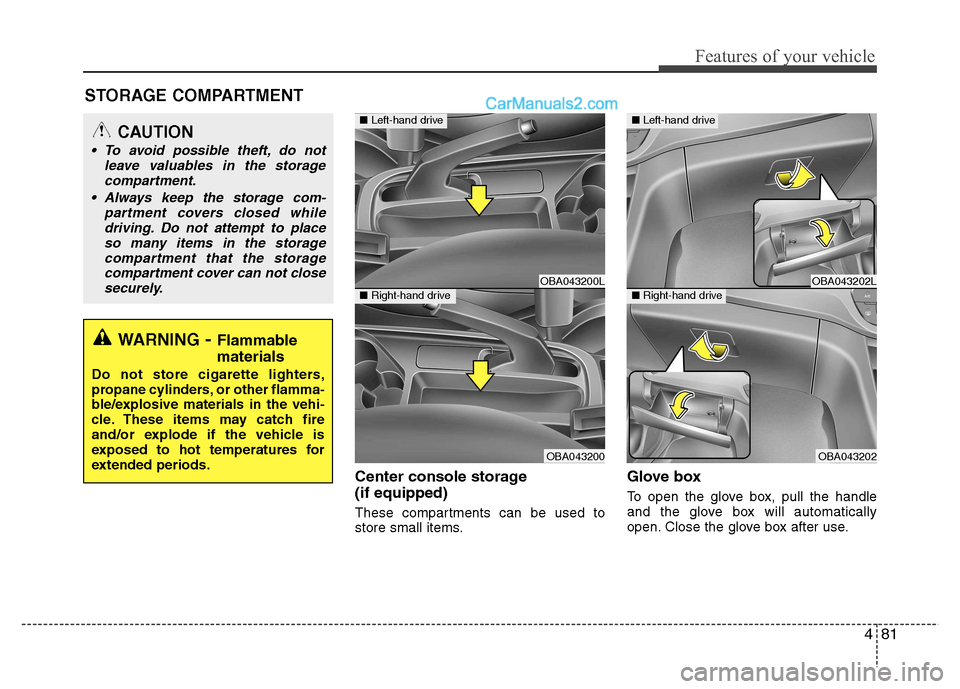
Center console storage (if equipped)
These compartments can be used to
store small items.Glove box
To open the glove box, pull the handle
and the glove box will automatically
open. Close the glove box after use.
STORAGE COMPARTMENT
WARNING
- Flammable
materials
Do not store cigarette lighters,
propane cylinders, or other flamma-
ble/explosive materials in the vehi-
cle. These items may catch fire
and/or explode if the vehicle is
exposed to hot temperatures for
extended periods.
CAUTION
To avoid possible theft, do not leave valuables in the storage
compartment.
Always keep the storage com- partment covers closed whiledriving. Do not attempt to place
so many items in the storage compartment that the storagecompartment cover can not close securely.
OBA043200L
OBA043200
■ Left-hand drive
■Right-hand driveOBA043202L
OBA043202
■Left-hand drive
■Right-hand drive
Page 236 of 343
What to do in an emergency
8
6
IF YOU HAVE A FLAT TIRE
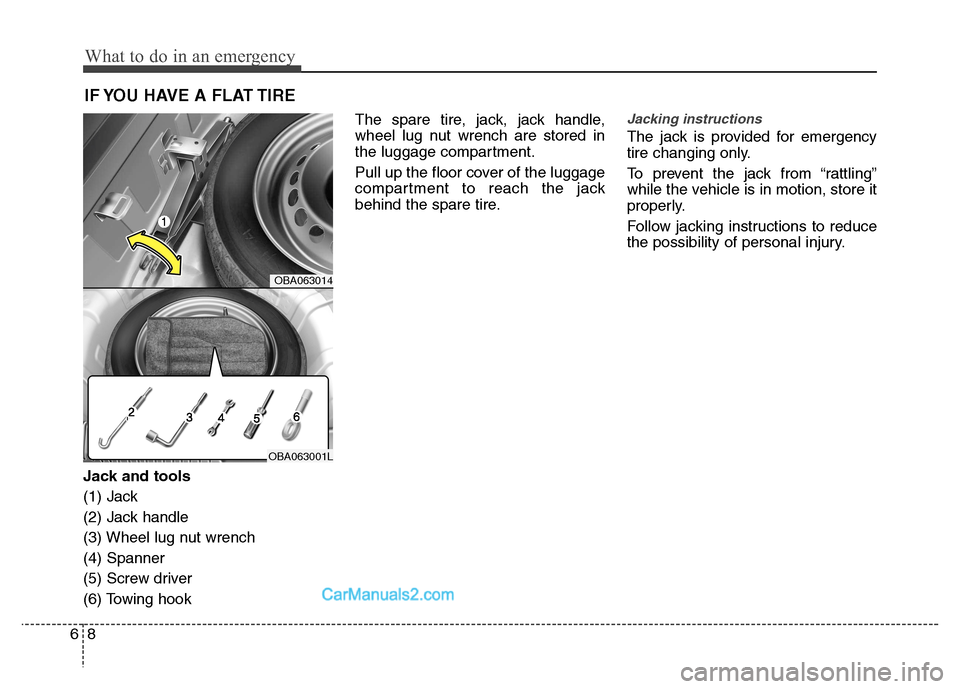
Jack and tools
(1) Jack
(2) Jack handle
(3) Wheel lug nut wrench(4) Spanner
(5) Screw driver
(6) Towing hook The spare tire, jack, jack handle,
wheel lug nut wrench are stored in
the luggage compartment.
Pull up the floor cover of the luggage
compartment to reach the jack
behind the spare tire.
Jacking instructions
The jack is provided for emergency
tire changing only.
To prevent the jack from “rattling”
while the vehicle is in motion, store it
properly.
Follow jacking instructions to reduce
the possibility of personal injury.
OBA063014
OBA063001L
Page 238 of 343
What to do in an emergency
10
6
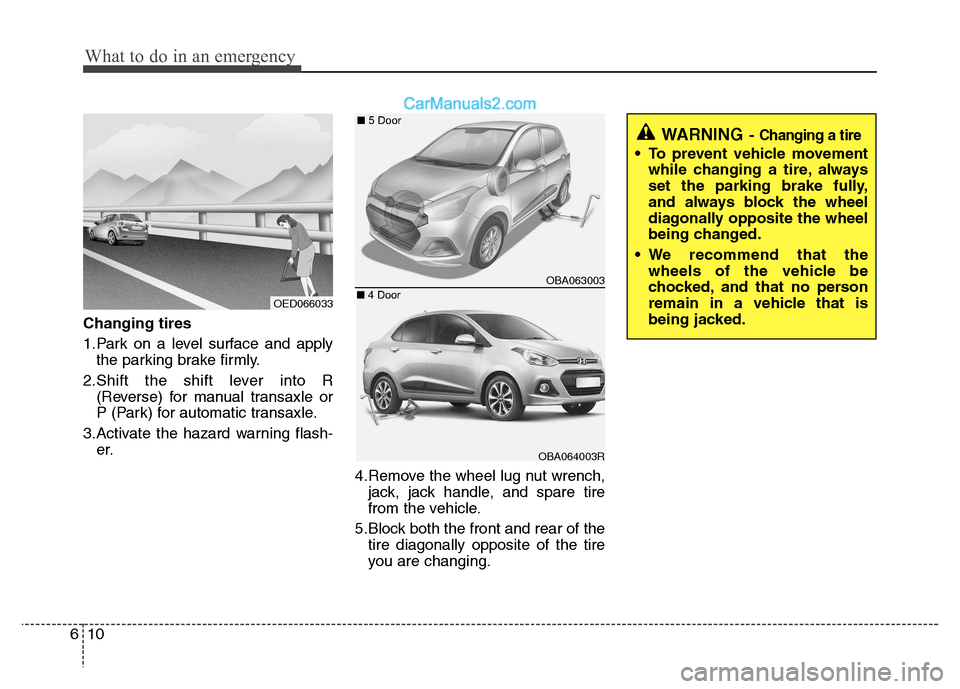
Changing tires
1.Park on a level surface and apply
the parking brake firmly.
2.Shift the shift lever into R (Reverse) for manual transaxle or
P (Park) for automatic transaxle.
3.Activate the hazard warning flash- er.
4.Remove the wheel lug nut wrench,jack, jack handle, and spare tire
from the vehicle.
5.Block both the front and rear of the tire diagonally opposite of the tire
you are changing.
OBA063003
OBA064003R
WARNING - Changing a tire
To prevent vehicle movement
while changing a tire, always
set the parking brake fully,
and always block the wheel
diagonally opposite the wheel
being changed.
We recommend that the wheels of the vehicle be
chocked, and that no person
remain in a vehicle that is
being jacked.
OED066033 ■
5 Door
■ 4 Door
Page 239 of 343
611
What to do in an emergency
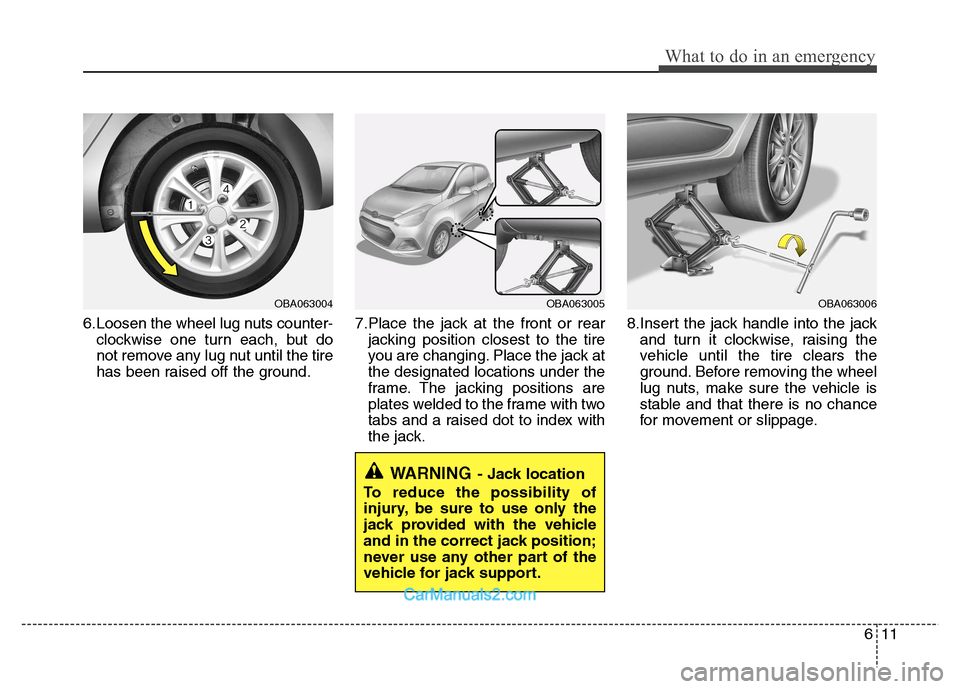
6.Loosen the wheel lug nuts counter-clockwise one turn each, but do
not remove any lug nut until the tire
has been raised off the ground. 7.Place the jack at the front or rear
jacking position closest to the tire
you are changing. Place the jack atthe designated locations under the
frame. The jacking positions are
plates welded to the frame with two
tabs and a raised dot to index with
the jack. 8.Insert the jack handle into the jack
and turn it clockwise, raising the
vehicle until the tire clears the
ground. Before removing the wheel
lug nuts, make sure the vehicle is
stable and that there is no chance
for movement or slippage.
WARNING - Jack location
To reduce the possibility of
injury, be sure to use only the
jack provided with the vehicle
and in the correct jack position;
never use any other part of the
vehicle for jack support.
OBA063005OBA063006OBA063004
Page 240 of 343
What to do in an emergency
12
6
9.Loosen the wheel lug nuts and
remove them with your fingers. Slide the wheel off the studs and
lay it flat so it cannot roll away. To
put the wheel on the hub, pick up
the spare tire, line up the holeswith the studs and slide the wheel
onto them. If this is difficult, tip thewheel slightly and get the top holein the wheel lined up with the top
stud. Then jiggle the wheel back
and forth until the wheel can be slid
over the other studs. 10. To install the wheel, hold it on the
studs, put the wheel nuts on thestuds and tighten them finger
tight. Jiggle the tire to be sure it iscompletely seated, then tighten
the nuts as much as possible
with your fingers again.
11. Lower the vehicle to the ground by turning the wheel nut wrench
counterclockwise.
WARNING
Wheels and wheel covers may have sharp edges. Handle
them carefully to avoid possi-
ble severe injury.
Before putting the wheel into place, be sure that there isnothing on the hub or wheel
(such as mud, tar, gravel, etc.)
that interferes with the wheel
from fitting solidly against the
hub. If there is, remove it. Ifthe contact of the mountingsurface between the wheel
and hub is not good, the
wheel nuts could come looseand cause the loss of a wheel.
Loss of a wheel may result in
loss of control of the vehicle.
This may cause serious injuryor death.
Page 241 of 343
613
What to do in an emergency
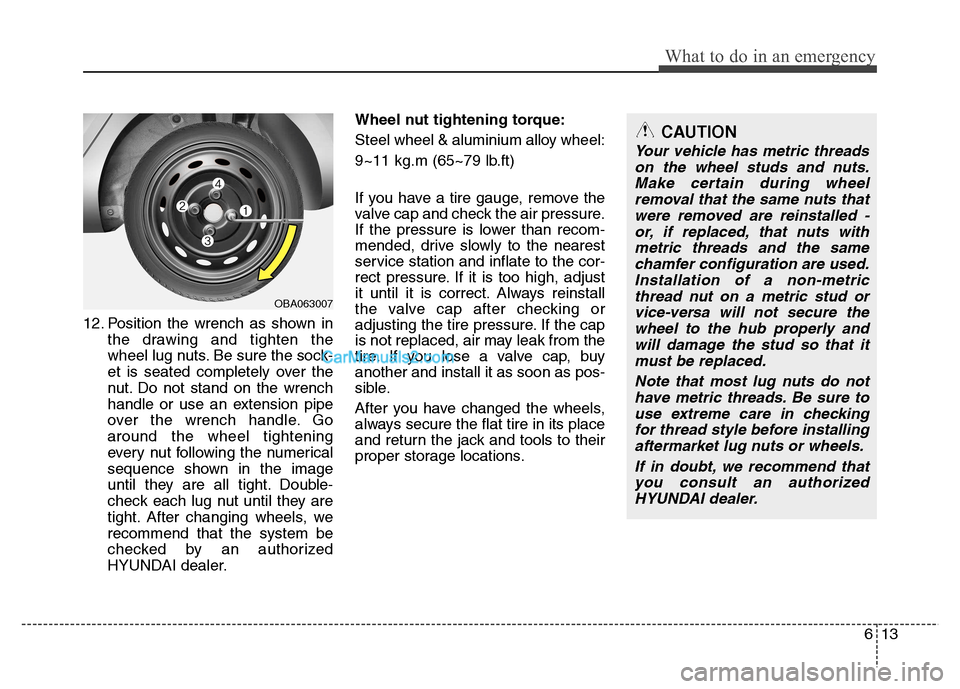
12. Position the wrench as shown inthe drawing and tighten the
wheel lug nuts. Be sure the sock-
et is seated completely over the
nut. Do not stand on the wrench
handle or use an extension pipe
over the wrench handle. Goaround the wheel tightening
every nut following the numerical
sequence shown in the image
until they are all tight. Double-
check each lug nut until they are
tight. After changing wheels, werecommend that the system be
checked by an authorized
HYUNDAI dealer. Wheel nut tightening torque:
Steel wheel & aluminium alloy wheel:
9~11 kg.m (65~79 lb.ft)
If you have a tire gauge, remove the
valve cap and check the air pressure.
If the pressure is lower than recom-
mended, drive slowly to the nearest
service station and inflate to the cor-
rect pressure. If it is too high, adjust
it until it is correct. Always reinstall
the valve cap after checking or
adjusting the tire pressure. If the cap
is not replaced, air may leak from the
tire. If you lose a valve cap, buyanother and install it as soon as pos-
sible.
After you have changed the wheels,
always secure the flat tire in its place
and return the jack and tools to their
proper storage locations.
CAUTION
Your vehicle has metric threads
on the wheel studs and nuts.Make certain during wheel removal that the same nuts thatwere removed are reinstalled -or, if replaced, that nuts withmetric threads and the same chamfer configuration are used.Installation of a non-metricthread nut on a metric stud or vice-versa will not secure thewheel to the hub properly andwill damage the stud so that it must be replaced.
Note that most lug nuts do nothave metric threads. Be sure touse extreme care in checkingfor thread style before installing aftermarket lug nuts or wheels.
If in doubt, we recommend thatyou consult an authorizedHYUNDAI dealer.
OBA063007
Page 273 of 343
Maintenance
26
7
BRAKES/CLUTCH(IF EQUIPPED) FLUID
Checking the brake/clutch fluid
level
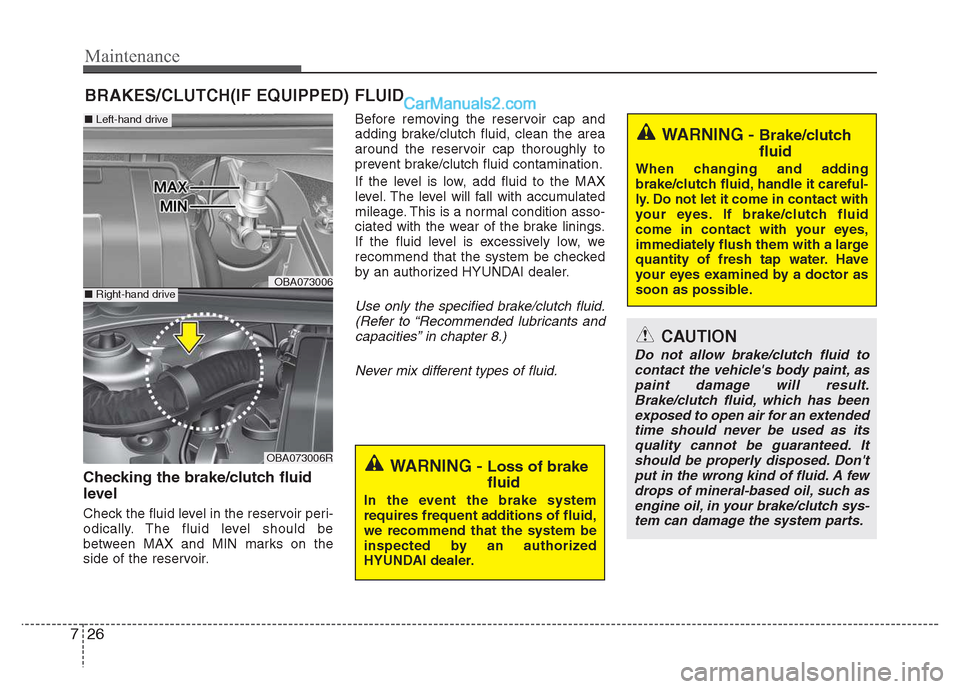
Check the fluid level in the reservoir peri-
odically. The fluid level should be
between MAX and MIN marks on the
side of the reservoir. Before removing the reservoir cap and
adding brake/clutch fluid, clean the area
around the reservoir cap thoroughly to
prevent brake/clutch fluid contamination.
If the level is low, add fluid to the MAX
level. The level will fall with accumulated
mileage. This is a normal condition asso-
ciated with the wear of the brake linings.
If the fluid level is excessively low, we
recommend that the system be checked
by an authorized HYUNDAI dealer.
Use only the specified brake/clutch fluid.
(Refer to “Recommended lubricants and capacities” in chapter 8.)
Never mix different types of fluid.
WARNING - Brake/clutch fluid
When changing and adding
brake/clutch fluid, handle it careful-
ly. Do not let it come in contact with
your eyes. If brake/clutch fluid
come in contact with your eyes,
immediately flush them with a large
quantity of fresh tap water. Have
your eyes examined by a doctor as
soon as possible.
WARNING - Loss of brake fluid
In the event the brake system
requires frequent additions of fluid,we recommend that the system be
inspected by an authorized
HYUNDAI dealer.
CAUTION
Do not allow brake/clutch fluid to contact the vehicle's body paint, aspaint damage will result.Brake/clutch fluid, which has been
exposed to open air for an extended time should never be used as itsquality cannot be guaranteed. It should be properly disposed. Don't
put in the wrong kind of fluid. A few drops of mineral-based oil, such asengine oil, in your brake/clutch sys-tem can damage the system parts.
OBA073006
OBA073006R
■ Left-hand drive
■Right-hand drive
Page 317 of 343

Maintenance
70
7
Headlight, position light, turn sig-
nal light, and front fog light bulbreplacement
(1) Headlight (Low/High)
(2) Parking(Position) light
(3) Front turn signal light
(4) Front fog light / Daytime running light
(if equipped)
✽✽NOTICE
If the headlight aiming adjustment is
necessary after the headlight assembly is
reinstalled, consult an authorized
HYUNDAI dealer.
OBA073018OHD076046
WARNING - Halogen bulbs
Halogen bulbs contain pressur-
ized gas that will produce flying
pieces of glass if broken.
Always handle them carefully, and avoid scratches and abra-
sions. If the bulbs are lit, avoid
contact with liquids. Never touchthe glass with bare hands.
Residual oil may cause the bulb
to overheat and burst when lit. A
bulb should be operated onlywhen installed in a headlight.
(Continued)
(Continued)
If a bulb becomes damaged orcracked, replace it immediately
and carefully dispose of it.
Wear eye protection when chang- ing a bulb. Allow the bulb to cool
down before handling it.