Start Hyundai Grand i10 2015 Service Manual
[x] Cancel search | Manufacturer: HYUNDAI, Model Year: 2015, Model line: Grand i10, Model: Hyundai Grand i10 2015Pages: 343, PDF Size: 29.47 MB
Page 204 of 343
Driving your vehicle
16
5
N (Neutral)
The wheels and transaxle are not engaged.
Use N (Neutral) if you need to restart a
stalled engine, or if it is necessary to stop
with the engine ON. Shift into P (Park) if
you need to leave your vehicle for anyreason.
Always depress the brake pedal when
you are shifting from N (Neutral) to
another gear.
D (Drive)
This is the normal driving position. The
transaxle will automatically shift through
a 4-gear sequence, providing the best
fuel economy and power.
For extra power when passing another
vehicle or driving uphill, depress the
accelerator fully. The transaxle will auto-
matically downshift to the next lower gear
(or gears, as appropriate).
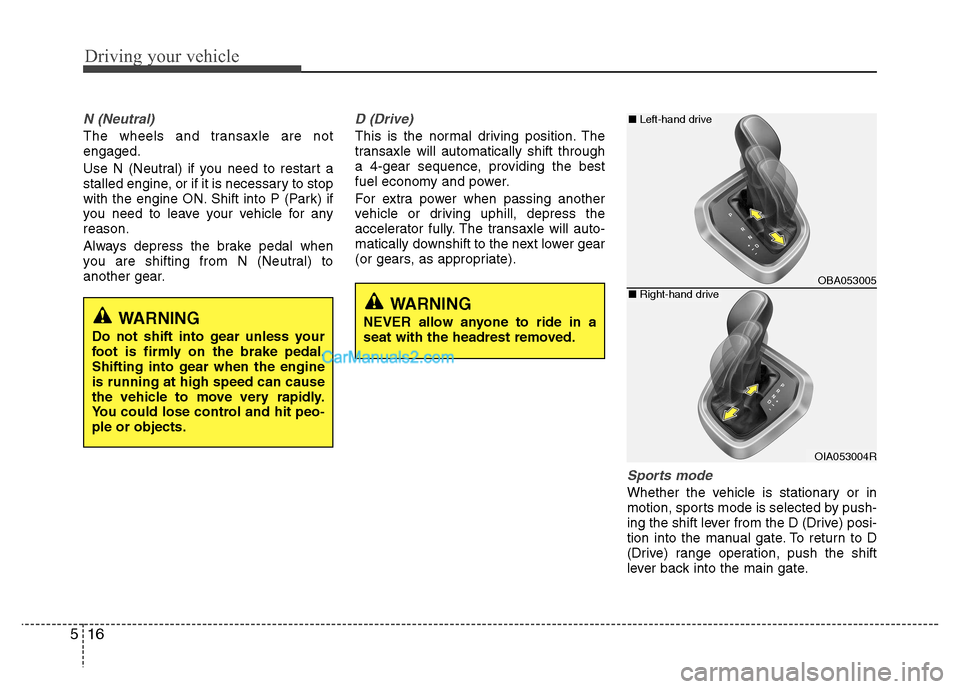
Sports mode
Whether the vehicle is stationary or in
motion, sports mode is selected by push-
ing the shift lever from the D (Drive) posi-
tion into the manual gate. To return to D
(Drive) range operation, push the shift
lever back into the main gate.
WARNING
Do not shift into gear unless your
foot is firmly on the brake pedal.
Shifting into gear when the engineis running at high speed can cause
the vehicle to move very rapidly.
You could lose control and hit peo-ple or objects.WARNING
NEVER allow anyone to ride in a
seat with the headrest removed.
OBA053005
OIA053004R
■ Left-hand drive
■Right-hand drive
Page 206 of 343
Driving your vehicle
18
5
Parking
Always come to a complete stop and
continue to depress the brake pedal.
Move the shift lever into the P (Park)
position, apply the parking brake, and
place the ignition switch in the
LOCK/OFF position. Take the Key with
you when exiting the vehicle. Good driving practices
Never move the shift lever from P
(Park) or N (Neutral) to any other posi-
tion with the accelerator pedaldepressed.
Never move the shift lever into P (Park) when the vehicle is in motion.
Be sure the vehicle is completely stopped before you attempt to shift into
R (Reverse) or D (Drive).
Do not move the shift lever to N (Neutral) when driving. Doing so mayresult in an accident because of a loss
of engine braking and the transaxlecould be damaged.
Do not drive with your foot resting on the brake pedal. Even light, but consis-tent pedal pressure can result in the
brakes overheating, brake wear and
possibly even brake failure.
When driving in sports mode, slow down before shifting to a lower gear.
Otherwise, the lower gear may not be
engaged if the engine rpms are out-
side of the allowable range.
Always apply the parking brake when leaving the vehicle. Do not depend on
placing the transmission in P (Park) to
keep the vehicle from moving. Exercise extreme caution when driving
on a slippery surface. Be especially
careful when braking, accelerating or
shifting gears. On a slippery surface,
an abrupt change in vehicle speed can
cause the drive wheels to lose traction
and may cause loss of vehicle controlresulting in an accident
Optimum vehicle performance and economy is obtained by smoothly
depressing and releasing the accelera-
tor.
WARNING
When you stay in the vehicle with
the engine running, be careful not
to depress the accelerator pedal for
a long period of time. The engine or
exhaust system may overheat and
start a fire.
The exhaust gas and the exhaust
system are very hot. Keep away
from the exhaust system compo-nents.
Do not stop or park over flammable
materials, such as dry grass, paper
or leaves. They may ignite and
cause a fire.
Page 211 of 343
523
Driving your vehicle
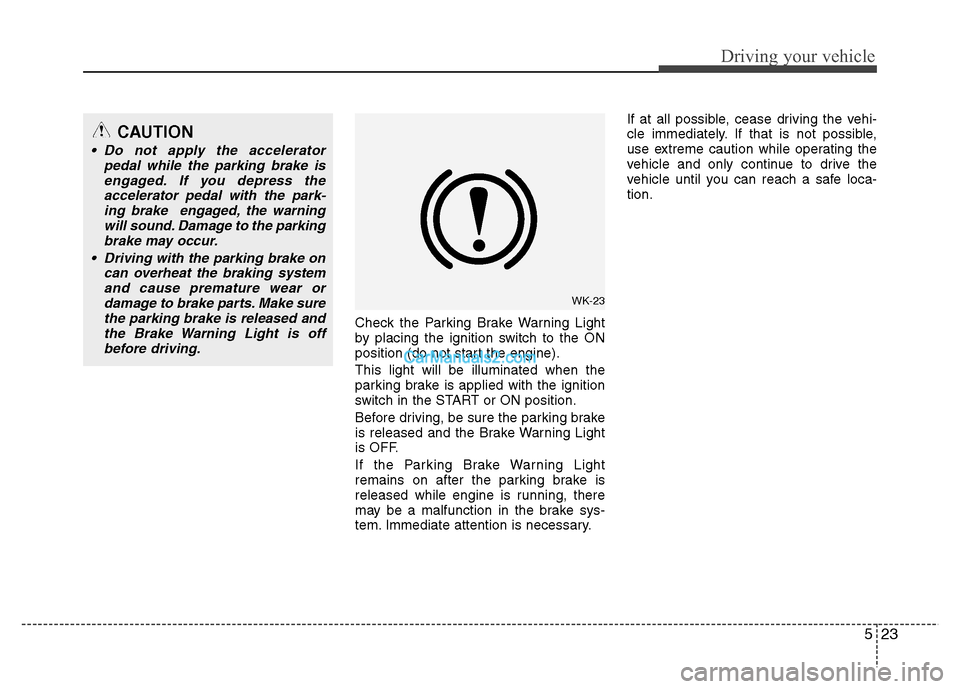
Check the Parking Brake Warning Light
by placing the ignition switch to the ON
position (do not start the engine). This light will be illuminated when the
parking brake is applied with the ignition
switch in the START or ON position.
Before driving, be sure the parking brake
is released and the Brake Warning Light
is OFF.
If the Parking Brake Warning Light
remains on after the parking brake is
released while engine is running, there
may be a malfunction in the brake sys-
tem. Immediate attention is necessary.If at all possible, cease driving the vehi-
cle immediately. If that is not possible,
use extreme caution while operating the
vehicle and only continue to drive the
vehicle until you can reach a safe loca-tion.
WK-23
CAUTION
Do not apply the accelerator
pedal while the parking brake is
engaged. If you depress theaccelerator pedal with the park-ing brake engaged, the warning will sound. Damage to the parking
brake may occur.
Driving with the parking brake on can overheat the braking systemand cause premature wear or
damage to brake parts. Make surethe parking brake is released andthe Brake Warning Light is offbefore driving.
Page 213 of 343

525
Driving your vehicle
On loose or uneven road surfaces, oper-
ation of the anti-lock brake system mayresult in a longer stopping distance than
for vehicles equipped with a conventional
brake system.
The ABS warning light ( ) will stay on
for several seconds after the ignition
switch is in the ON position. During that
time, the ABS will go through self-diag-
nosis and the light will go off if everything
is normal. If the light stays on, you may
have a problem with your ABS. We rec-
ommend that you contact an authorized
HYUNDAI dealer as soon as possible✽✽NOTICE
When you jump start your vehicle
because of a drained battery, the engine
may not run as smoothly and the ABS
warning light ( ) may turn on at the
same time. This happens because of the
low battery voltage. It does not mean
your ABS is malfunctioning. Have the
battery recharged before driving the
vehicle.WARNING
If the ABS warning light ( ) is on
and stays on, you may have a prob-
lem with the ABS. Your power
brakes will work normally. To
reduce the risk of serious injury or
death, we recommend that you con-
tact your HYUNDAI dealer as soon
as possible.
CAUTION
When you drive on a road having poor traction, such as an icy road,
and apply your brakes continuous-ly, the ABS will be active continu-ously and the ABS warning light ( ) may illuminate. Pull your car
over to a safe place and turn the engine off.
Restart the engine. If the ABS warn-ing light is off, then your ABS sys-
tem is normal. Otherwise, you mayhave a problem with your ABS sys- tem. We recommend that you con-tact an authorized HYUNDAI dealer
as soon as possible.
Page 215 of 343
527
Driving your vehicle
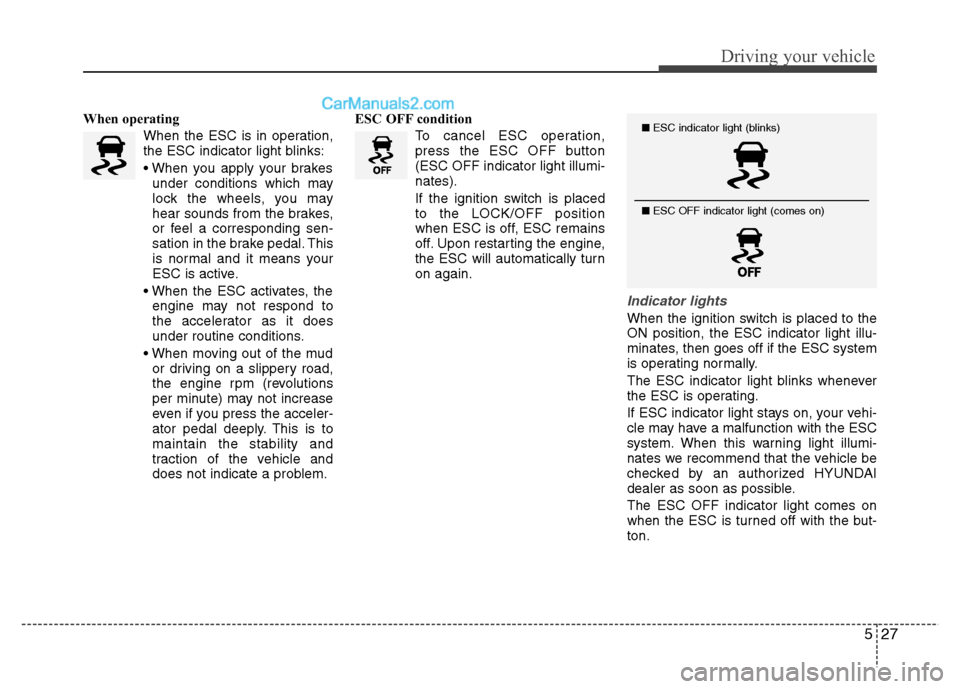
When operatingWhen the ESC is in operation,
the ESC indicator light blinks:
under conditions which may
lock the wheels, you may
hear sounds from the brakes,
or feel a corresponding sen-
sation in the brake pedal. This
is normal and it means your
ESC is active.
engine may not respond to
the accelerator as it does
under routine conditions.
or driving on a slippery road,
the engine rpm (revolutions
per minute) may not increase
even if you press the acceler-
ator pedal deeply. This is tomaintain the stability and
traction of the vehicle and
does not indicate a problem. ESC OFF condition
To cancel ESC operation,
press the ESC OFF button(ESC OFF indicator light illumi-nates).
If the ignition switch is placed to the LOCK/OFF position
when ESC is off, ESC remains
off. Upon restarting the engine,
the ESC will automatically turnon again.
Indicator lights
When the ignition switch is placed to the ON position, the ESC indicator light illu-
minates, then goes off if the ESC system
is operating normally.
The ESC indicator light blinks whenever
the ESC is operating.
If ESC indicator light stays on, your vehi-
cle may have a malfunction with the ESC
system. When this warning light illumi-
nates we recommend that the vehicle be
checked by an authorized HYUNDAI
dealer as soon as possible. The ESC OFF indicator light comes on
when the ESC is turned off with the but-ton.
■ESC indicator light (blinks)
■ ESC OFF indicator light (comes on)
Page 218 of 343
Driving your vehicle
30
5
VSM OFF condition
To cancel VSM operation, press the ESC
OFF button. ESC OFF indicator light
( ) will illuminate.
To turn on VSM, press the ESC OFF but-
ton again. The ESC OFF indicator lightwill go out. Hill-Start Assist Control (HAC) (if equipped)
The Hill-Start Assist Control (HAC) pre-
vents the vehicle from rolling backwards
when starting a vehicle from a stop on a
hill. The system operates the brakes
automatically for approximately 1.5 sec-
onds and releases the brake when the
accelerator pedal is depressed or after
1.5 seconds.✽✽
NOTICE
The HAC does not operate when the shift lever is in P (Park) or N (Neutral)
(for automatic transaxle vehicle.)
The HAC operates when: - the shift lever is in N (Neutral) or D
(Drive) on up hill.
- the shift lever is in R (Reverses) on
down hill.
(for manual transaxle vehicle)
The HAC activates even though the ESC (Electronic Stability Control) is
off but does not activate when the
ESC has malfunctioned.
WARNING
If ESC indicator light ( ) or EPS
warning light ( ) stays on, your
vehicle may have a malfunction
with the VSM system. When thewarning light illuminates we recom-
mend that the vehicle be checked
by an authorized HYUNDAI dealer
as soon as possible.
WARNING
Always be ready to depress the
accelerator pedal when starting off
on a incline. The HAC activates only
for approximately 1.5 seconds.
CAUTION
Driving with varying tire or wheel sizes may cause the ESC system tomalfunction. When replacing tires,make sure they are the same size asyour original tires for this vehicle.
Page 229 of 343
What to do in an emergency
ROAD WARNING . . . . . . . . . . . . . . . . . . . . . . . . . . 6-2 Hazard warning flasher . . . . . . . . . . . . . . . . . . . . . . . 6-2
IN CASE OF AN EMERGENCY WHILE
DRIVING . . . . . . . . . . . . . . . . . . . . . . . . . . . . . . . . . 6-2 If the engine stalls at a crossroad or crossing. . . . . . . 6-2
If you have a flat tire while driving . . . . . . . . . . . . . . . 6-2
If the engine stalls while driving . . . . . . . . . . . . . . . . . 6-3
IF THE ENGINE DOES NOT START . . . . . . . . . 6-3 If the engine doesn't turn over or turns over slowly. . 6-3
If the engine turns over normally but does not start . . 6-3
JUMP STARTING . . . . . . . . . . . . . . . . . . . . . . . . . 6-4
IF THE ENGINE OVERHEATS . . . . . . . . . . . . . . 6-7
IF YOU HAVE A FLAT TIRE . . . . . . . . . . . . . . . . 6-8 Jack and tools . . . . . . . . . . . . . . . . . . . . . . . . . . . . . . . . 6-8
Removing and storing the spare tire . . . . . . . . . . . . . 6-9
Changing tires . . . . . . . . . . . . . . . . . . . . . . . . . . . . . . . 6-10
TOWING . . . . . . . . . . . . . . . . . . . . . . . . . . . . . . . . . 6-15 Towing service . . . . . . . . . . . . . . . . . . . . . . . . . . . . . . . 6-15
Removable towing hook (front) . . . . . . . . . . . . . . . . . 6-16
Emergency towing . . . . . . . . . . . . . . . . . . . . . . . . . . . . 6-17
6
Page 230 of 343
What to do in an emergency
2
6
ROAD WARNING
Hazard warning flasher
The hazard warning flasher serves as a
warning to other drivers to exercise
extreme caution when approaching,
overtaking, or passing your vehicle. It should be used whenever emergency
repairs are being made or when the vehi-cle is stopped near the edge of a road-
way.
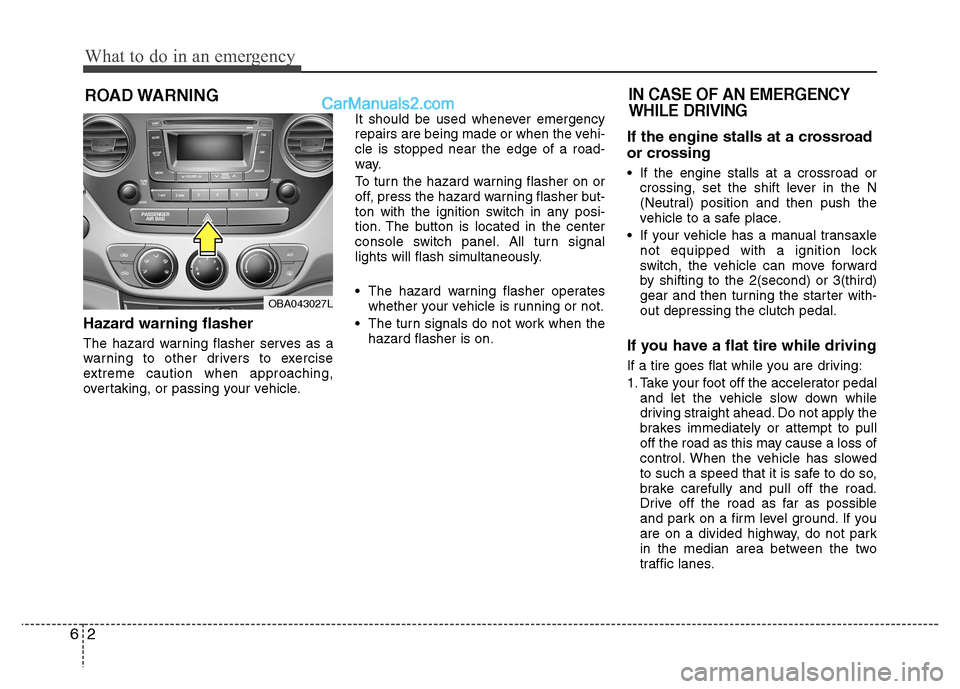
To turn the hazard warning flasher on or
off, press the hazard warning flasher but-
ton with the ignition switch in any posi-
tion. The button is located in the center
console switch panel. All turn signal
lights will flash simultaneously.
• The hazard warning flasher operates
whether your vehicle is running or not.
The turn signals do not work when the hazard flasher is on. If the engine stalls at a crossroad
or crossing
If the engine stalls at a crossroad or
crossing, set the shift lever in the N
(Neutral) position and then push the
vehicle to a safe place.
If your vehicle has a manual transaxle not equipped with a ignition lock
switch, the vehicle can move forward
by shifting to the 2(second) or 3(third)
gear and then turning the starter with-out depressing the clutch pedal.
If you have a flat tire while driving
If a tire goes flat while you are driving:
1. Take your foot off the accelerator pedal and let the vehicle slow down while
driving straight ahead. Do not apply the
brakes immediately or attempt to pull
off the road as this may cause a loss of
control. When the vehicle has slowed
to such a speed that it is safe to do so,
brake carefully and pull off the road.
Drive off the road as far as possible
and park on a firm level ground. If you
are on a divided highway, do not park
in the median area between the two
traffic lanes.IN CASE OF AN EMERGENCY WHILE DRIVING
OBA043027L
Page 231 of 343
63
What to do in an emergency
2. When the vehicle is stopped, turn onyour hazard warning flasher, set the
parking brake and put the transaxle in
P (automatic transaxle) or reverse
(manual transaxle).
3. Have all passengers get out of the vehicle. Be sure they all get out on the
side of the vehicle that is away from
traffic.
4. When changing a flat tire, follow the instruction provided later in this chap-
ter.
If the engine stalls while driving
1. Reduce your speed gradually, keeping a straight line. Move cautiously off the
road to a safe place.
2. Turn on your hazard warning flasher.
3. Try to start the engine again. Try to start the engine again. If your vehicle
will not start, we recommend that you
consult an authorized HYUNDAI deal-
er. If the engine doesn't turn over or
turns over slowly
1. If your vehicle has an automatic
transaxle, be sure the shift lever is in N
(Neutral) or P (Park) and the emer-
gency brake is set.
2. Check the battery connections to be sure they are clean and tight.
3. Turn on the interior light. If the light dims or goes out when you operate the
starter, the battery is discharged.
4. Check the starter connections to be sure they are securely tightened.
5. Do not push or pull the vehicle to start it. See instructions for "Jump starting". If the engine turns over normally
but does not start
1. Check the fuel level.
2. With the ignition switch in the LOCK/
OFF position, check all connectors at
the ignition coils and spark plugs.
Reconnect any that may be discon-
nected or loose.
3. Check the fuel line in the engine com- partment.
4. If the engine still does not start, we rec- ommend that you call an authorized
HYUNDAI dealer.
IF THE ENGINE DOES NOT START
WARNING
If the engine will not start, do not
push or pull the vehicle to start it.This could result in a collision or
cause other damage. In addition,
push or pull starting may cause the
catalytic converter to overload and
create a fire.
Page 232 of 343
What to do in an emergency
4
6
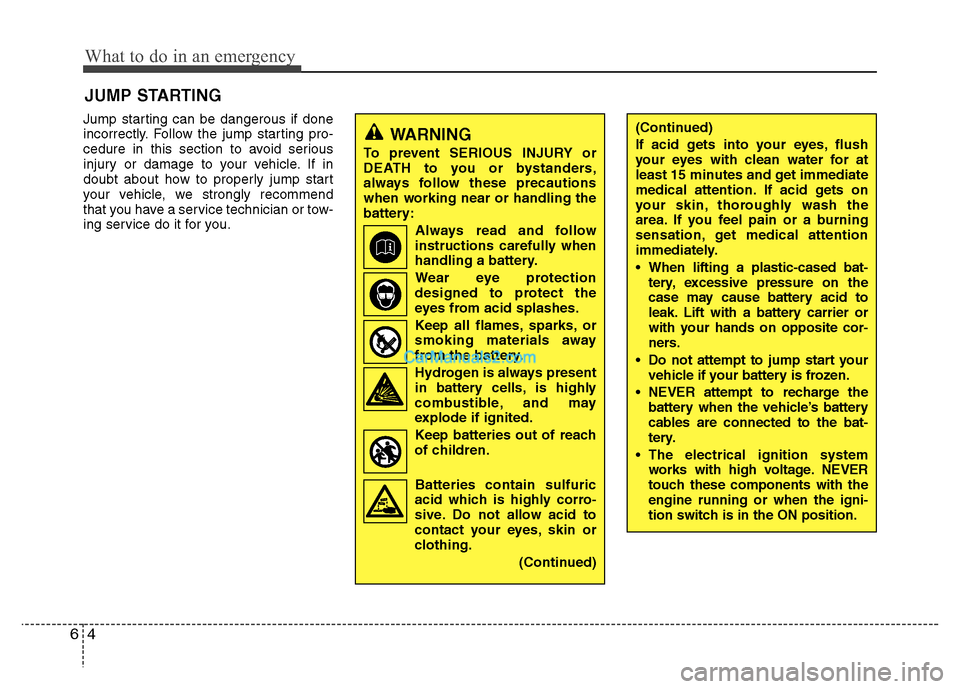
JUMP STARTING
Jump starting can be dangerous if done
incorrectly. Follow the jump starting pro-
cedure in this section to avoid serious
injury or damage to your vehicle. If in
doubt about how to properly jump start
your vehicle, we strongly recommend
that you have a service technician or tow-
ing service do it for you.
WARNING
To prevent SERIOUS INJURY or
DEATH to you or bystanders,
always follow these precautions
when working near or handling the
battery:
Always read and follow
instructions carefully when
handling a battery.
Wear eye protection
designed to protect the
eyes from acid splashes.
Keep all flames, sparks, or
smoking materials away
from the battery.
Hydrogen is always present in battery cells, is highly
combustible, and may
explode if ignited.
Keep batteries out of reach
of children.
Batteries contain sulfuric
acid which is highly corro-
sive. Do not allow acid to
contact your eyes, skin or
clothing.
(Continued)(Continued)
If acid gets into your eyes, flush
your eyes with clean water for at
least 15 minutes and get immediate
medical attention. If acid gets on
your skin, thoroughly wash the
area. If you feel pain or a burning
sensation, get medical attention
immediately.
• When lifting a plastic-cased bat-tery, excessive pressure on the
case may cause battery acid to
leak. Lift with a battery carrier or
with your hands on opposite cor-
ners.
Do not attempt to jump start your vehicle if your battery is frozen.
NEVER attempt to recharge the battery when the vehicle’s battery
cables are connected to the bat-
tery.
The electrical ignition system works with high voltage. NEVER
touch these components with theengine running or when the igni-
tion switch is in the ON position.