Start Hyundai Grand i10 2015 Repair Manual
[x] Cancel search | Manufacturer: HYUNDAI, Model Year: 2015, Model line: Grand i10, Model: Hyundai Grand i10 2015Pages: 343, PDF Size: 29.47 MB
Page 289 of 343
Maintenance
42
7
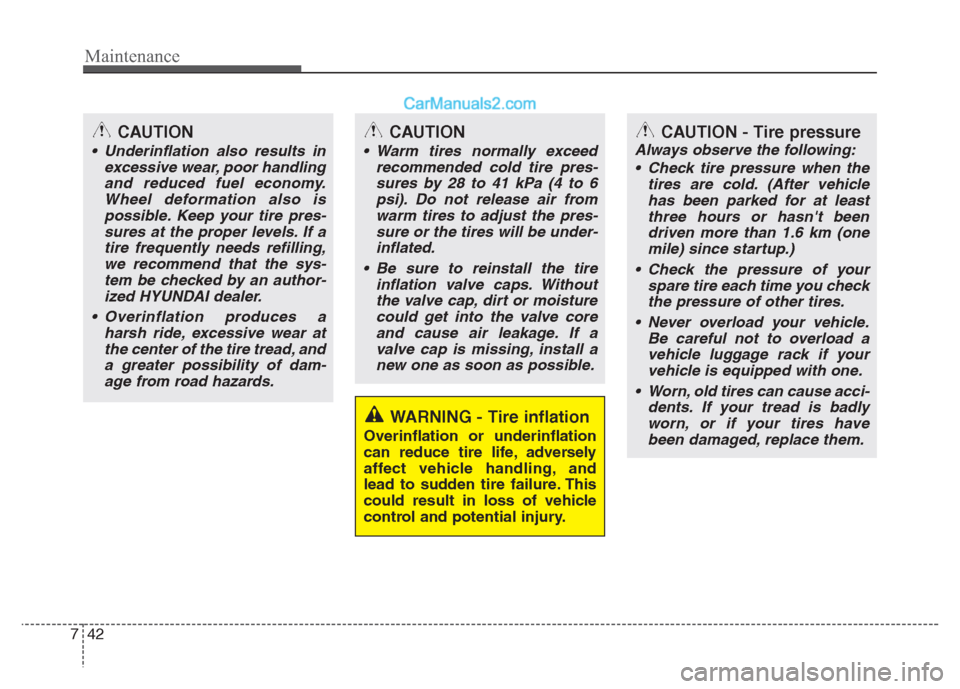
WARNING - Tire inflation
Overinflation or underinflation
can reduce tire life, adversely
affect vehicle handling, and
lead to sudden tire failure. This
could result in loss of vehicle
control and potential injury.
CAUTION - Tire pressure
Always observe the following:
Check tire pressure when the tires are cold. (After vehiclehas been parked for at leastthree hours or hasn't been driven more than 1.6 km (onemile) since startup.)
Check the pressure of your spare tire each time you checkthe pressure of other tires.
Never overload your vehicle. Be careful not to overload avehicle luggage rack if yourvehicle is equipped with one.
Worn, old tires can cause acci- dents. If your tread is badlyworn, or if your tires have been damaged, replace them.
CAUTION
Underinflation also results in excessive wear, poor handlingand reduced fuel economy.Wheel deformation also ispossible. Keep your tire pres-sures at the proper levels. If a tire frequently needs refilling,we recommend that the sys-tem be checked by an author- ized HYUNDAI dealer.
Overinflation produces a harsh ride, excessive wear atthe center of the tire tread, anda greater possibility of dam- age from road hazards.
CAUTION
Warm tires normally exceed recommended cold tire pres-sures by 28 to 41 kPa (4 to 6 psi). Do not release air fromwarm tires to adjust the pres-sure or the tires will be under- inflated.
Be sure to reinstall the tire inflation valve caps. Withoutthe valve cap, dirt or moisturecould get into the valve core and cause air leakage. If avalve cap is missing, install anew one as soon as possible.
Page 305 of 343
Maintenance
58
7
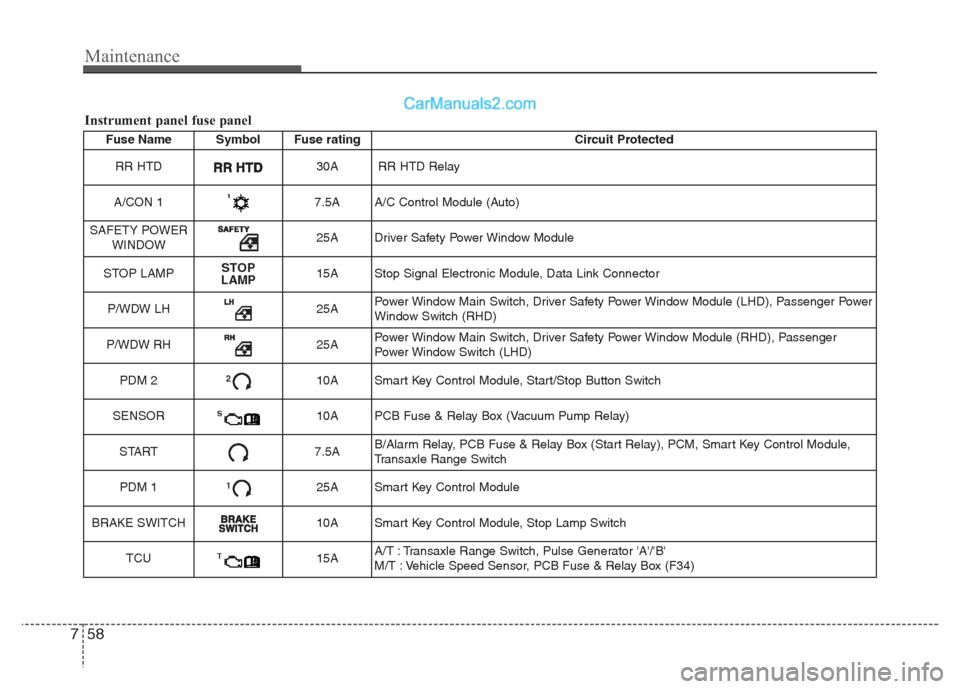
Fuse Name Symbol Fuse rating Circuit Protected
RR HTD
30A RR HTD Relay
A/CON 1
7.5A A/C Control Module (Auto)
SAFETY POWER WINDOW
25A Driver Safety Power Window Module
STOP LAMP
STOP
LAMP15A Stop Signal Electronic Module, Data Link Connector
P/WDW LH
25A Power Window Main Switch, Driver Safety Power Window Module (LHD), Passenger Power
Window Switch (RHD)
P/WDW RH
25A Power Window Main Switch, Driver Safety Power Window Module (RHD), Passenger
Power Window Switch (LHD)
PDM 2
210A Smart Key Control Module, Start/Stop Button Switch
SENSOR
S10A PCB Fuse & Relay Box (Vacuum Pump Relay)
START
7.5A B/Alarm Relay, PCB Fuse & Relay Box (Start Relay), PCM, Smart Key Control Module,
Transaxle Range Switch
PDM 1
125A Smart Key Control Module
BRAKE SWITCH
10A Smart Key Control Module, Stop Lamp Switch
TCU
T15A A/T : Transaxle Range Switch, Pulse Generator 'A'/'B'
M/T : Vehicle Speed Sensor, PCB Fuse & Relay Box (F34)
Instrument panel fuse panel
Page 309 of 343
Maintenance
62
7
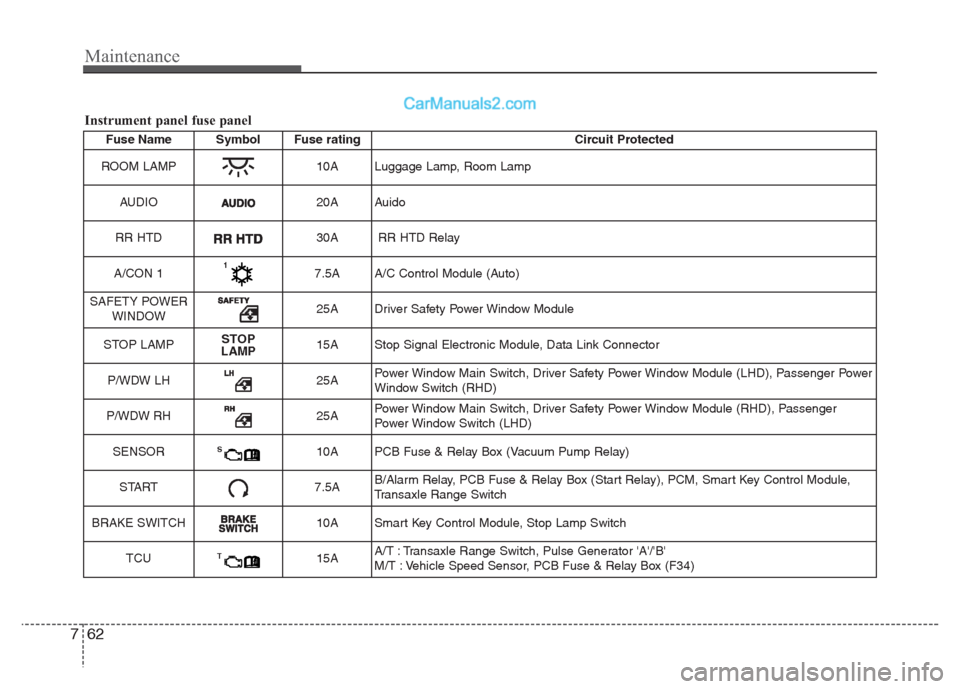
Fuse Name Symbol Fuse rating Circuit Protected
ROOM LAMP
10A Luggage Lamp, Room Lamp
AUDIO
20A Auido
RR HTD
30A RR HTD Relay
A/CON 1
7.5A A/C Control Module (Auto)
SAFETY POWER WINDOW
25A Driver Safety Power Window Module
STOP LAMP
STOP
LAMP15A Stop Signal Electronic Module, Data Link Connector
P/WDW LH
25A Power Window Main Switch, Driver Safety Power Window Module (LHD), Passenger Power
Window Switch (RHD)
P/WDW RH
25A Power Window Main Switch, Driver Safety Power Window Module (RHD), Passenger
Power Window Switch (LHD)
SENSOR
S10A PCB Fuse & Relay Box (Vacuum Pump Relay)
START
7.5A B/Alarm Relay, PCB Fuse & Relay Box (Start Relay), PCM, Smart Key Control Module,
Transaxle Range Switch
BRAKE SWITCH
10A Smart Key Control Module, Stop Lamp Switch
TCU
T15A A/T : Transaxle Range Switch, Pulse Generator 'A'/'B'
M/T : Vehicle Speed Sensor, PCB Fuse & Relay Box (F34)
Instrument panel fuse panel
Page 313 of 343
Maintenance
66
7
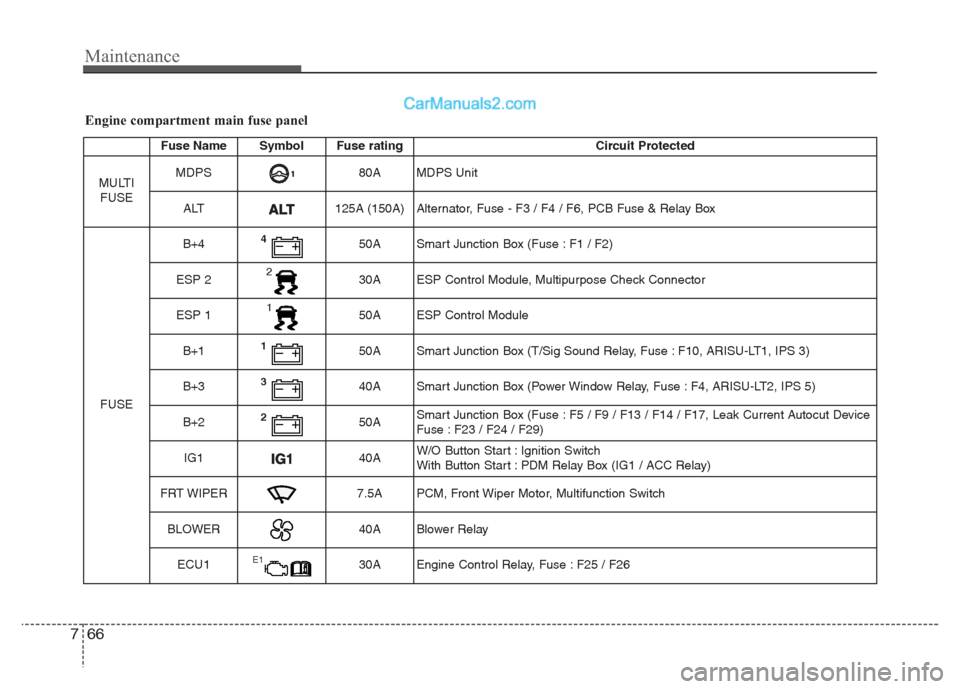
Engine compartment main fuse panel
Fuse Name Symbol Fuse rating Circuit Protected
MULTI FUSE
MDPS80A MDPS Unit
ALT125A (150A) Alternator, Fuse - F3 / F4 / F6, PCB Fuse & Relay Box
FUSE
B+4450A Smart Junction Box (Fuse : F1 / F2)
ESP 2230A ESP Control Module, Multipurpose Check Connector
ESP 1150A ESP Control Module
B+1150A Smart Junction Box (T/Sig Sound Relay, Fuse : F10, ARISU-LT1, IPS 3)
B+3340A Smart Junction Box (Power Window Relay, Fuse : F4, ARISU-LT2, IPS 5)
B+2250A Smart Junction Box (Fuse : F5 / F9 / F13 / F14 / F17, Leak Current Autocut Device
Fuse : F23 / F24 / F29)
IG140AW/O Button Start : Ignition Switch
With Button Start : PDM Relay Box (IG1 / ACC Relay)
FRT WIPER7.5A PCM, Front Wiper Motor, Multifunction Switch
BLOWER40A Blower Relay
ECU1E130A Engine Control Relay, Fuse : F25 / F26
Page 314 of 343
767
Maintenance
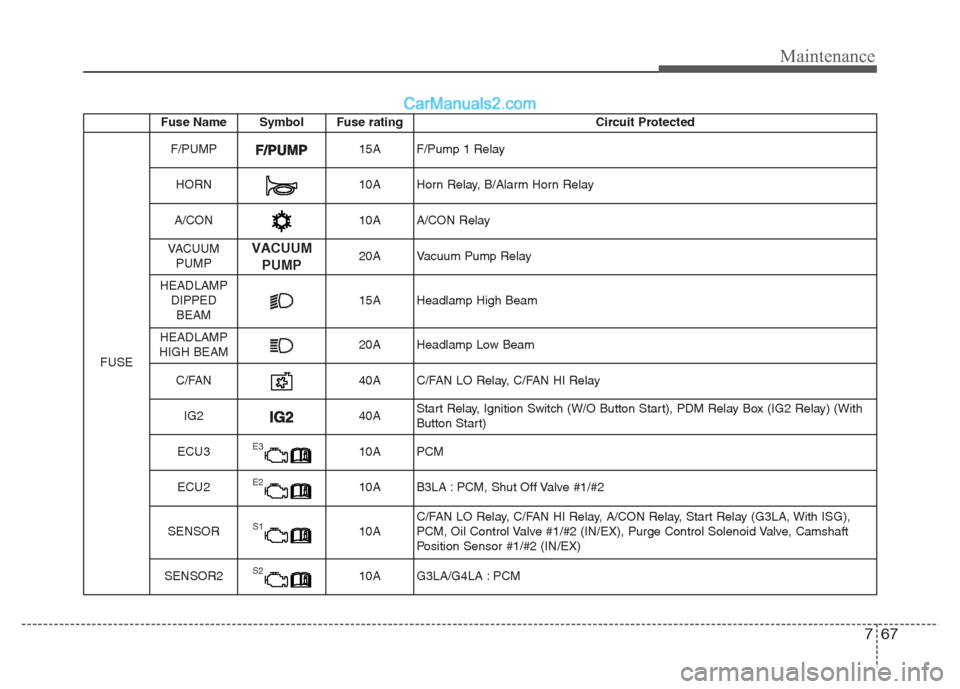
Fuse Name Symbol Fuse rating Circuit Protected
FUSE
F/PUMP15A F/Pump 1 Relay
HORN10A Horn Relay, B/Alarm Horn Relay
A/CON10A A/CON Relay
VACUUM PUMPVACUUM
PUMP20A Vacuum Pump Relay
HEADLAMP DIPPEDBEAM15A Headlamp High Beam
HEADLAMP
HIGH BEAM20A Headlamp Low Beam
C/FAN40A C/FAN LO Relay, C/FAN HI Relay
IG240A Start Relay, Ignition Switch (W/O Button Start), PDM Relay Box (IG2 Relay) (With
Button Start)
ECU3E310A PCM
ECU2E210A B3LA : PCM, Shut Off Valve #1/#2
SENSORS110AC/FAN LO Relay, C/FAN HI Relay, A/CON Relay, Start Relay (G3LA, With ISG),
PCM, Oil Control Valve #1/#2 (IN/EX), Purge Control Solenoid Valve, Camshaft
Position Sensor #1/#2 (IN/EX)
SENSOR2S210A G3LA/G4LA : PCM
Page 327 of 343
Maintenance
80
7
To help prevent corrosion
You can help prevent corrosion from get-
ting started by observing the following:
Keep your vehicle clean
The best way to prevent corrosion is to
keep your vehicle clean and free of cor-
rosive materials. Attention to the under-
side of the vehicle is particularly impor-tant.
If you live in a high-corrosion area —
where road salts are used, near the
ocean, areas with industrial pollution,
acid rain, etc.—, you should take extra
care to prevent corrosion. In winter,
hose off the underside of your vehicleat least once a month and be sure toclean the underside thoroughly when
winter is over. When cleaning underneath the vehicle,
give particular attention to the compo-
nents under the fenders and other
areas that are hidden from view. Do a
thorough job; just dampening the accu-
mulated mud rather than washing it
away will accelerate corrosion rather
than prevent it. Water under high pres-
sure and steam are particularly effec-
tive in removing accumulated mud and
corrosive materials.
rocker panels and frame members, be
sure that drain holes are kept open sothat moisture can escape and not be
trapped inside to accelerate corrosion.
Keep your garage dry
Don't park your vehicle in a damp, poorly
ventilated garage. This creates a favor-
able environment for corrosion. This is
particularly true if you wash your vehicle
in the garage or drive it into the garage
when it is still wet or covered with snow,
ice or mud. Even a heated garage can
contribute to corrosion unless it is well
ventilated so moisture is dispersed. Keep paint and trim in good condition
Scratches or chips in the finish should be
covered with "touch-up" paint as soon as
possible to reduce the possibility of cor-
rosion. If bare metal is showing through,the attention of a qualified body and paintshop is recommended.
Bird droppings : Bird droppings are high-
ly corrosive and may damage painted
surfaces in just a few hours. Always
remove bird droppings as soon as possi-
ble. Don't neglect the interior Moisture can collect under the floor mats
and carpeting and cause corrosion.
Check under the mats periodically to be
sure the carpeting is dry. Use particular
care if you carry fertilizers, cleaning
materials or chemicals in the vehicle.
These should be carried only in proper
containers and any spills or leaks should
be cleaned up, flushed with clean water
and thoroughly dried.
Page 330 of 343
783
Maintenance
3. Exhaust emission control system
The Exhaust Emission Control System is
a highly effective system which controls
exhaust emissions while maintaining
good vehicle performance.
Vehicle modifications
This vehicle should not be modified.
Modification of your vehicle could affect
its performance, safety or durability and
may even violate governmental safety
and emissions regulations.
In addition, damage or performance
problems resulting from any modification
may not be covered under warranty.
Engine exhaust gas precautions (carbon monoxide)
Carbon monoxide can be present with other exhaust fumes. Therefore, if you
smell exhaust fumes of any kind inside
your vehicle, have it inspected and
repaired immediately. If you ever sus-
pect exhaust fumes are coming into
your vehicle, drive it only with all the
windows fully open. Have your vehicle
checked and repaired immediately. Do not operate the engine in confined
or closed areas (such as garages) any
more than what is necessary to move
the vehicle in or out of the area.
When the vehicle is stopped in an open area for more than a short time
with the engine running, adjust the
ventilation system (as needed) to draw
outside air into the vehicle.
Never sit in a parked or stopped vehi- cle for any extended time with the
engine running.
When the engine stalls or fails to start, excessive attempts to restart the
engine may cause damage to theemission control system.
WARNING - Exhaust
Engine exhaust gases contain car-
bon monoxide (CO). Though color-
less and odorless, it is dangerousand could be lethal if inhaled.
Follow the instructions following to
avoid CO poisoning.
Page 336 of 343
85
Specifications & Consumer information
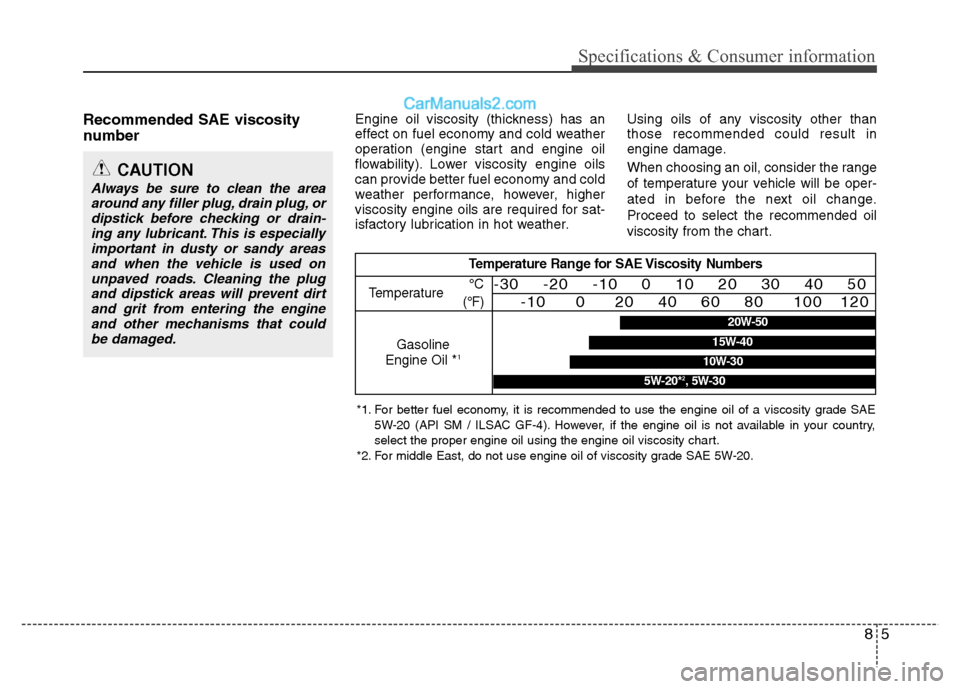
Recommended SAE viscosity
number Engine oil viscosity (thickness) has an
effect on fuel economy and cold weather
operation (engine start and engine oil
flowability). Lower viscosity engine oils
can provide better fuel economy and cold
weather performance, however, higher
viscosity engine oils are required for sat-
isfactory lubrication in hot weather.Using oils of any viscosity other thanthose recommended could result in
engine damage.
When choosing an oil, consider the range
of temperature your vehicle will be oper-
ated in before the next oil change.Proceed to select the recommended oil
viscosity from the chart.
CAUTION
Always be sure to clean the area
around any filler plug, drain plug, ordipstick before checking or drain-
ing any lubricant. This is especiallyimportant in dusty or sandy areasand when the vehicle is used on
unpaved roads. Cleaning the plugand dipstick areas will prevent dirt and grit from entering the engine and other mechanisms that could
be damaged.
Temperature Range for SAE Viscosity Numbers
Temperature °C
(°F)-30 -20 -10 0 10 20 30 40 50 -10 0 20 40 60 80 100 120
*1. For better fuel economy, it is recommended to use the engine oil of a viscosity grade SAE5W-20 (API SM / ILSAC GF-4). However, if the engine oil is not available in your country,
select the proper engine oil using the engine oil viscosity chart.
*2. For middle East, do not use engine oil of viscosity grade SAE 5W-20.
Gasoline
Engine Oil * 1
20W-50
10W-30
15W-40
5W-20*
2
, 5W-30