engine Hyundai H-1 (Grand Starex) 2003 Service Manual
[x] Cancel search | Manufacturer: HYUNDAI, Model Year: 2003, Model line: H-1 (Grand Starex), Model: Hyundai H-1 (Grand Starex) 2003Pages: 173, PDF Size: 3.68 MB
Page 112 of 173

3-15
STARTING & OPERATING
STARTING & OPERATING STARTING & OPERATING
STARTING & OPERATING
STARTING & OPERATING
D170F01P-GAT (5)(5)
(5)(5)
(5) High speed
High speed High speed
High speed
High speed The higher the vehicles speed, the more fuel consumed. Avoid driving at full speed. Evena slight release of the accelerator pedal willsave significant amount of fuel.
GS30210A
Tire pressure gauge
D170G01P-GAT
(6)(6)
(6)(6)
(6) Tire inflation pressure
Tire inflation pressure Tire inflation pressure
Tire inflation pressure
Tire inflation pressure
GS30200A
D170E01P-GAT
(4)(4)
(4)(4)
(4) Idling
Idling Idling
Idling
Idling The vehicle consumes fuel even during idling. Avoid extended idling whenever possible.
D170C01P-GAT
(2)(2)
(2)(2)
(2) Shifting
Shifting Shifting
Shifting
Shifting Shift only at an appropriate vehicle speed and engine rpm. Always use the highest gear possible.Fuel consumption depends largely on the manner in which vehicle is driven but it isalso affected by other driving conditions.
D170D01P-GAT (3)(3)
(3)(3)
(3) City traffic
City traffic City traffic
City traffic
City traffic Frequent starting and stopping increases the average fuel consumption. Use roadswith smooth traffic flow whenever possible.When driving on congested roads, avoiduse of a low gear at high engine rpm.
Check the tire inflation pressure at regularintervals. Low tire inflation pressures in-crease road resistance and fuel consump-tion. In addition, low tire pressures adverselyaffect tire wear and driving control.D170H01P-GAT
(7)(7)
(7)(7)
(7) Load
Load Load
Load
Load
GS30220A
Do not drive with unnecessary articles in the luggage compartment.Especially during city driving where frequentstarting and stopping is necessary, the in-creased weight of the vehicle will greatlyaffect fuel consumption. Also avoid driving with unnecessary lug- gage, etc., on the roof; the increased airresistance will cause more fuel consump-tion.
D170I01P-GAT (8)(8)
(8)(8)
(8) Cold engine starting
Cold engine starting Cold engine starting
Cold engine starting
Cold engine starting Starting of a cold engine consumes more fuel. Unnecessary fuel consumption is alsocaused by keeping a hot engine running.After the engine is started, begin drivingsoon.
Page 113 of 173

STARTING & OPERATING
STARTING & OPERATING STARTING & OPERATING
STARTING & OPERATING
STARTING & OPERATING
3-16 D180H01P-GAT
Parking brake
Parking brake Parking brake
Parking brake
Parking brake
If the atmospheric temperature is below freez- ing, park the vehicle with the gearshift lever in1st or reverse and do not engage the parkingbrake. If the parking brake is engaged and thereis moisture on the brake linings, the liningscould become frozen to the brake drums, mak-ing it impossible to release the parking brake.
C160G02A-AAT
To Keep Locks from Freezing
To Keep Locks from Freezing To Keep Locks from Freezing
To Keep Locks from Freezing
To Keep Locks from Freezing
To keep the locks from freezing, squirt anapproved de-icer fluid or glycerine into the keyopening. If a lock is covered with ice, squirt itwith an approved de-icing fluid to remove theice. If the lock is frozen internally, you may beable to thaw it out by using a heated key.Handle the heated key with care to avoid burn-ing your fingers.
NOTE:
NOTE: NOTE:
NOTE:
NOTE:
The proper temperature for using the immo-
The proper temperature for using the immo- The proper temperature for using the immo-
The proper temperature for using the immo-
The proper temperature for using the immo-
bilizer key is from -40°C to 80°C. If you heat
bilizer key is from -40°C to 80°C. If you heat bilizer key is from -40°C to 80°C. If you heat
bilizer key is from -40°C to 80°C. If you heat
bilizer key is from -40°C to 80°C. If you heat
the immobilizer key over 80°C to open the
the immobilizer key over 80°C to open the the immobilizer key over 80°C to open the
the immobilizer key over 80°C to open the
the immobilizer key over 80°C to open the
frozen lock, it may cause damage to the
frozen lock, it may cause damage to the frozen lock, it may cause damage to the
frozen lock, it may cause damage to the
frozen lock, it may cause damage to the
transponder in its head.
transponder in its head. transponder in its head.
transponder in its head.
transponder in its head. D180G01P-GAT
Door locks
Door locks Door locks
Door locks
Door locks
To prevent the door locks from freezing up, the lock cylinders should be masked with tape,etc., when washing the vehicle in cold weatherto prevent the entrance of water.
D180E01P-GAT
Wiper blades
Wiper blades Wiper blades
Wiper blades
Wiper blades
Before operating the wipers, check the wiperblades to confirm that they are not frozen to thewindshield or tailgate. If the blades are frozen tothe windshield or tailgate, do not operate thewipers until the ice has melted and the bladesare freed. D180F01P-GAT
Ventilation slots
Ventilation slots Ventilation slots
Ventilation slots
Ventilation slots
The ventilation slots in the headlight housing on the assistant seat side should be brushed clearafter a heavy snowfall so that the operation ofthe heating and ventilation systems will not beimpaired.
anyway, will only deliver a fraction of the startercurrent which is normally available. It is recommended that you have the battery checked by an authorized HYUNDAI dealerbefore the start of cold weather and, if neces-sary, have it charged. This not only ensures reliable starting, but a battery which is kept fully charged also has alonger life. D180D01P-GAT
Washer fluid
Washer fluid Washer fluid
Washer fluid
Washer fluid
To ensure proper operation of the windshield or rear window at low temperatures, anti-freezeshould be added to the washer fluid at a rate ofone part antifreeze to one part water.
D180A01P-GAT
DURING COLD WEATHER
DURING COLD WEATHER DURING COLD WEATHER
DURING COLD WEATHER
DURING COLD WEATHER
Engine oil
Engine oil Engine oil
Engine oil
Engine oil
The engine oil can become very thick at low
temperatures, thus making it difficult to start theengine.
Change to a thinner oil designed for winter use
before the start of cold weather; for the appro-priate oil viscosity, refer to the "Consumer Infor-mation" section.
D180B01P-GATEngine coolant
Engine coolant Engine coolant
Engine coolant
Engine coolant
If the temperature in your area drops below
freezing, there is the danger that the coolant inthe engine or radiator could freeze and causesevere damage to the engine and/or radiator. Be sure to add a sufficient amount of antifreeze
to the coolant to prevent it from freezing.
The engine coolant mixture used at the factory
is intended to be left in the cooling system andprovides protection against freezing for tem-perature as low as approximately -30°C (-20°F).The concentration should be checked beforethe start of cold weather and anti-freeze addedto the system if necessary
D180C01P-GATBattery
Battery Battery
Battery
Battery
The capacity of the battery is reduced at low
temperatutes.
This is an inevitable result of its chemical and
physical properties. This is why a very coldbattery, particularly one that is not fully charged
Page 114 of 173

3-17
STARTING & OPERATING
STARTING & OPERATING STARTING & OPERATING
STARTING & OPERATING
STARTING & OPERATING
D180L01P-GAT Tire chains
Tire chains Tire chains
Tire chains
Tire chains
If tire chains are to be used, be sure that they
are mounted on the rear wheels.
Use only tire chains which are designed for use
with the tires mounted on the vehicle; use of the incorrect size or type of chain could result indamage to the vehicle body.
Before driving over long stretches of road which
are free of snow, you should remove the chainsto avoid damage to the tires.
NOTE:
NOTE: NOTE:
NOTE:
NOTE:
The laws and regulations concerning tire
The laws and regulations concerning tire The laws and regulations concerning tire
The laws and regulations concerning tire
The laws and regulations concerning tire chains vary. Find out and follow the laws
chains vary. Find out and follow the laws chains vary. Find out and follow the laws
chains vary. Find out and follow the laws
chains vary. Find out and follow the laws
and regulations in your area.
and regulations in your area. and regulations in your area.
and regulations in your area.
and regulations in your area.
When parking on a steep slope, turn the front
wheels in towards the kerb and chock the wheels.
D180I01P-GATWashing the vehicle
Washing the vehicle Washing the vehicle
Washing the vehicle
Washing the vehicle
The salt and other chemicals spread on winter
roads in some areas can have a detrimentaleffect on a vehicle body. You should thereforewash the vehicle as often as convenient inaccordance with our care-instruction. Have apreservative applied and the underfloor protec-tion checked at an authorized HYUNDAI dealerbefore and after the cold weather season. D180M02P-GAT
ADDITIONAL EQUIPMENT
ADDITIONAL EQUIPMENT ADDITIONAL EQUIPMENT
ADDITIONAL EQUIPMENT
ADDITIONAL EQUIPMENT
It is a good idea to carry a shovel or a short-handled spade in the vehicle during the winterso that you can clear away snow if you getstuck. A small hand-brush for sweeping snowoff the windscreen and rear window is alsouseful.
HAI3001
CAUTION:(If installed)
CAUTION:(If installed) CAUTION:(If installed)
CAUTION:(If installed)
CAUTION:(If installed)
White smoke may arise from the fuel fired
White smoke may arise from the fuel fired White smoke may arise from the fuel fired
White smoke may arise from the fuel fired
White smoke may arise from the fuel fired
heater outlet in the driver's front wheel hous-
heater outlet in the driver's front wheel hous- heater outlet in the driver's front wheel hous-
heater outlet in the driver's front wheel hous-
heater outlet in the driver's front wheel hous-
ing during winter driving. This is a normal
ing during winter driving. This is a normal ing during winter driving. This is a normal
ing during winter driving. This is a normal
ing during winter driving. This is a normal
condition.
condition. condition.
condition.
condition.
But, If a black (or gray) smoke is generated
But, If a black (or gray) smoke is generated But, If a black (or gray) smoke is generated
But, If a black (or gray) smoke is generated
But, If a black (or gray) smoke is generated
heavily, have the fuel fired heater checked
heavily, have the fuel fired heater checked heavily, have the fuel fired heater checked
heavily, have the fuel fired heater checked
heavily, have the fuel fired heater checked
by your Hyundai dealer.
by your Hyundai dealer. by your Hyundai dealer.
by your Hyundai dealer.
by your Hyundai dealer.
If the engine stops while the fuel fired heater
If the engine stops while the fuel fired heater If the engine stops while the fuel fired heater
If the engine stops while the fuel fired heater
If the engine stops while the fuel fired heater
is operating, whizzing noise may be heard
is operating, whizzing noise may be heard is operating, whizzing noise may be heard
is operating, whizzing noise may be heard
is operating, whizzing noise may be heard
from the lower of the battery in the engine
from the lower of the battery in the engine from the lower of the battery in the engine
from the lower of the battery in the engine
from the lower of the battery in the engine
compartment.
compartment. compartment.
compartment.
compartment.
NOTE:
NOTE: NOTE:
NOTE:
NOTE:
The laws and regulations concerning snow
The laws and regulations concerning snow The laws and regulations concerning snow
The laws and regulations concerning snow
The laws and regulations concerning snow tires (driving speed, required use, type, etc.)
tires (driving speed, required use, type, etc.) tires (driving speed, required use, type, etc.)
tires (driving speed, required use, type, etc.)
tires (driving speed, required use, type, etc.)
vary. Find out and follow the laws and reg-
vary. Find out and follow the laws and reg- vary. Find out and follow the laws and reg-
vary. Find out and follow the laws and reg-
vary. Find out and follow the laws and reg-
ulations in your area.
ulations in your area. ulations in your area.
ulations in your area.
ulations in your area.
D180K01P-GAT Snow tires
Snow tires Snow tires
Snow tires
Snow tires
The use of snow tires is recommended for
driving in snow and ice. To preserve driving stability, mount snow tires of the same size andtread pattern on all four wheels.
Snow tires worn more than 50% are no longer
suitable for use as snow tires.
Snow tires which do not meet specifications
must not be used. D180J01P-GAT
Weather strip
Weather strip Weather strip
Weather strip
Weather strip
To prevent freezing of the weather strip on the
doors, the roof, etc., they should be treated withsilicone grease.
Page 115 of 173

STARTING & OPERATING
STARTING & OPERATING STARTING & OPERATING
STARTING & OPERATING
STARTING & OPERATING
3-18 (1) Position the vehicle so that one wheel is on
a dry paved surface and the other on ice, snow, mud, etc. Drive the vehicle, and observe the operation of the limited-slip differential. The vehicle should not become stuck if the differential is functioning properly.
(2) Depress the accelerator pedal gradually, and then when traction is good, depress itforcefully. If the vehicle accelerates well, thedifferential is functioning properly.
CAUTION:
CAUTION: CAUTION:
CAUTION:
CAUTION:
(1)(1)
(1)(1)
(1) Never start the engine while one of the
Never start the engine while one of the Never start the engine while one of the
Never start the engine while one of the
Never start the engine while one of the
rear wheels is jacked up and the other in
rear wheels is jacked up and the other in rear wheels is jacked up and the other in
rear wheels is jacked up and the other in
rear wheels is jacked up and the other in
contact with the ground; doing so may
contact with the ground; doing so may contact with the ground; doing so may
contact with the ground; doing so may
contact with the ground; doing so may
cause the vehicle to jump forward.
cause the vehicle to jump forward. cause the vehicle to jump forward.
cause the vehicle to jump forward.
cause the vehicle to jump forward.
(2)(2)
(2)(2)
(2) If one of the rear wheels begins to spin in
If one of the rear wheels begins to spin in If one of the rear wheels begins to spin in
If one of the rear wheels begins to spin in
If one of the rear wheels begins to spin in
mud, snow, etc., the vehicle can some-
mud, snow, etc., the vehicle can some- mud, snow, etc., the vehicle can some-
mud, snow, etc., the vehicle can some-
mud, snow, etc., the vehicle can some-
times be driven out by depressing the
times be driven out by depressing the times be driven out by depressing the
times be driven out by depressing the
times be driven out by depressing the
accelerator pedal further; however, avoid
accelerator pedal further; however, avoid accelerator pedal further; however, avoid
accelerator pedal further; however, avoid
accelerator pedal further; however, avoid
running the engine continuously at high
running the engine continuously at high running the engine continuously at high
running the engine continuously at high
running the engine continuously at high
rpm because doing so could damage the
rpm because doing so could damage the rpm because doing so could damage the
rpm because doing so could damage the
rpm because doing so could damage the
limited-slip differential.
limited-slip differential. limited-slip differential.
limited-slip differential.
limited-slip differential.
D190A02P-GAT
LIMITED-SLIP DIFFERENTIAL
LIMITED-SLIP DIFFERENTIAL LIMITED-SLIP DIFFERENTIAL
LIMITED-SLIP DIFFERENTIAL
LIMITED-SLIP DIFFERENTIAL
(If installed)
(If installed) (If installed)
(If installed)
(If installed) A limited-slip differential, if equipped, is for the
rear wheel differential only. The features of this limited-slip differential are described below:
Just as with a conventional differential, the
wheel on one side is allowed to turn at adifferent speed from the wheel on the other sidewhen the vehicle is cornering. The differencebetween the limited-slip differential and a con-ventional differential is that if the wheel on oneside of the vehicle loses traction, a greateramount of torque is applied to the rear wheel onthe other side to improve traction.
NOTE:
NOTE: NOTE:
NOTE:
NOTE:
In a stationary position, the L.S.D will oper-
In a stationary position, the L.S.D will oper- In a stationary position, the L.S.D will oper-
In a stationary position, the L.S.D will oper-
In a stationary position, the L.S.D will oper- ate when the torque difference between the
ate when the torque difference between the ate when the torque difference between the
ate when the torque difference between the
ate when the torque difference between the
rear right wheel and the left wheel is from
rear right wheel and the left wheel is from rear right wheel and the left wheel is from
rear right wheel and the left wheel is from
rear right wheel and the left wheel is from
5Kgf·m to 9 Kgf·m.
5Kgf·m to 9 Kgf·m. 5Kgf·m to 9 Kgf·m.
5Kgf·m to 9 Kgf·m.
5Kgf·m to 9 Kgf·m.
The following procedures can be used to con-
firm that the limited-slip differential is function- ing properly: This is due to cleaning process for fuel fired
This is due to cleaning process for fuel fired This is due to cleaning process for fuel fired
This is due to cleaning process for fuel fired
This is due to cleaning process for fuel fired
heater and a normal operation.
heater and a normal operation. heater and a normal operation.
heater and a normal operation.
heater and a normal operation.
It will takes about 1- 3 minutes according to
It will takes about 1- 3 minutes according to It will takes about 1- 3 minutes according to
It will takes about 1- 3 minutes according to
It will takes about 1- 3 minutes according to
fuel quantity in the fuel fired heater fuel line.
fuel quantity in the fuel fired heater fuel line. fuel quantity in the fuel fired heater fuel line.
fuel quantity in the fuel fired heater fuel line.
fuel quantity in the fuel fired heater fuel line.
Page 117 of 173

IN CASE OF EMERGENCY
IN CASE OF EMERGENCY IN CASE OF EMERGENCY
IN CASE OF EMERGENCY
IN CASE OF EMERGENCY
4-2 E040A02P-GAT
JACKING UP THE VEHICLE
JACKING UP THE VEHICLE JACKING UP THE VEHICLE
JACKING UP THE VEHICLE
JACKING UP THE VEHICLE
GS40050A
1. Loosen the holding nut and pull out the
handle.
GS40060A
2. Insert the opposite end of the handle, andthen tighten the holding nut.
E040A01P-1
2WD
The method for jacking up the vehicle should be remembered in order to change a tire in theevent of a puncture and in order to install tirechains.
E040A02P-GAG
4WD
After stopping the engine and applying the
parking brake on a flat level surface, also use chocks to hold the wheels.
E040A03P-GAGRR
Position the jack only at the specified points indicated in the illustration, and the use of thejack at other points could damage the vehiclebody.
GS40080A
Jack handleRelief valve
Using the jack handle, turn the relief valve clockwise until it reaches a stop.
The jack handle is stored as shown in thefigure. To assemble, follow the steps below.
Page 118 of 173

IN CASE OF EMERGENCY
IN CASE OF EMERGENCY IN CASE OF EMERGENCY
IN CASE OF EMERGENCY
IN CASE OF EMERGENCY
4-3
GS40090A
Notch of handle
Pressure piston
Then fit the handle into the pressure piston, and
align the groove of the handle with the notch of the holder.
Move the jack handle up and down to raise the
piston.
Using a jack handle, turn the relief valve coun-
terclockwise slowly to lower the piston.
Press the piston down all the way, and turn the
relief valve clockwise as far as possible.
GS40100A
CAUTION:
CAUTION: CAUTION:
CAUTION:
CAUTION:
(1)(1)
(1)(1)
(1)
Use only the jack included with the ve-
Use only the jack included with the ve- Use only the jack included with the ve-
Use only the jack included with the ve-
Use only the jack included with the ve-
hicle and use it only for changing a wheel.
hicle and use it only for changing a wheel. hicle and use it only for changing a wheel.
hicle and use it only for changing a wheel.
hicle and use it only for changing a wheel.
(2)(2)
(2)(2)
(2)
Position the jack on a hard level surface.
Position the jack on a hard level surface. Position the jack on a hard level surface.
Position the jack on a hard level surface.
Position the jack on a hard level surface.
(3)(3)
(3)(3)
(3)
If the relief valve is loosened by turning
If the relief valve is loosened by turning If the relief valve is loosened by turning
If the relief valve is loosened by turning
If the relief valve is loosened by turning
it 2 or more times in the counterclock-
it 2 or more times in the counterclock- it 2 or more times in the counterclock-
it 2 or more times in the counterclock-
it 2 or more times in the counterclock-
wise direction, the jack’s oil will leak and
wise direction, the jack’s oil will leak and wise direction, the jack’s oil will leak and
wise direction, the jack’s oil will leak and
wise direction, the jack’s oil will leak and
the jack cannot be used.
the jack cannot be used. the jack cannot be used.
the jack cannot be used.
the jack cannot be used.
(4)(4)
(4)(4)
(4)
This jack is hydraulic, and the ram is a
This jack is hydraulic, and the ram is a This jack is hydraulic, and the ram is a
This jack is hydraulic, and the ram is a
This jack is hydraulic, and the ram is a
two-stage type. When both rams are
two-stage type. When both rams are two-stage type. When both rams are
two-stage type. When both rams are
two-stage type. When both rams are
raised and the stop mark(Green paint)
raised and the stop mark(Green paint) raised and the stop mark(Green paint)
raised and the stop mark(Green paint)
raised and the stop mark(Green paint)
of the upper ram becomes visible, stop
of the upper ram becomes visible, stop of the upper ram becomes visible, stop
of the upper ram becomes visible, stop
of the upper ram becomes visible, stop
jacking immediately.
jacking immediately. jacking immediately.
jacking immediately.
jacking immediately.
Further extension of the ram may dam-
Further extension of the ram may dam- Further extension of the ram may dam-
Further extension of the ram may dam-
Further extension of the ram may dam-
age the jack.
age the jack. age the jack.
age the jack.
age the jack.
(5)(5)
(5)(5)
(5) When the jack is used, be sure that there
When the jack is used, be sure that there When the jack is used, be sure that there
When the jack is used, be sure that there
When the jack is used, be sure that there
is no one in or under the vehicle.
is no one in or under the vehicle. is no one in or under the vehicle.
is no one in or under the vehicle.
is no one in or under the vehicle. (6)(6)
(6)(6)
(6) When jacking up the vehicle, do so only
When jacking up the vehicle, do so only When jacking up the vehicle, do so only
When jacking up the vehicle, do so only
When jacking up the vehicle, do so only
until the tires are slightly lifted from the
until the tires are slightly lifted from the until the tires are slightly lifted from the
until the tires are slightly lifted from the
until the tires are slightly lifted from the
ground. It is dangerous to jack up the
ground. It is dangerous to jack up the ground. It is dangerous to jack up the
ground. It is dangerous to jack up the
ground. It is dangerous to jack up the
vehicle more than that much.
vehicle more than that much. vehicle more than that much.
vehicle more than that much.
vehicle more than that much.
(7)(7)
(7)(7)
(7) It is very dangerous if the jack somehow
It is very dangerous if the jack somehow It is very dangerous if the jack somehow
It is very dangerous if the jack somehow
It is very dangerous if the jack somehow
slips, so never leave the vehicle in the
slips, so never leave the vehicle in the slips, so never leave the vehicle in the
slips, so never leave the vehicle in the
slips, so never leave the vehicle in the
jacked-up position, and never shake the
jacked-up position, and never shake the jacked-up position, and never shake the
jacked-up position, and never shake the
jacked-up position, and never shake the
vehicle while it is raised.
vehicle while it is raised. vehicle while it is raised.
vehicle while it is raised.
vehicle while it is raised.
E040B01P-GAT To jack up vehicle on 4-wheel drive
To jack up vehicle on 4-wheel drive To jack up vehicle on 4-wheel drive
To jack up vehicle on 4-wheel drive
To jack up vehicle on 4-wheel drive
GS40110A
Do not crank the engine while jacking up the
vehicle.
The tire on the ground may turn and the vehicle
may roll off the jack.
Page 124 of 173

IN CASE OF EMERGENCY
IN CASE OF EMERGENCY IN CASE OF EMERGENCY
IN CASE OF EMERGENCY
IN CASE OF EMERGENCY
4-9
C190E04P-GAT
Trailer Weight Limit
Trailer Weight Limit Trailer Weight Limit
Trailer Weight Limit
Trailer Weight Limit
SSA2200BTongue load Total trailer weight
Tongue loads can be increased or decreased by redistributing the load in the trailer. This canbe verified by checking the total weight of theloaded trailer and then checking the load on thetongue.
SSA2200D
Gross axle weight Gross vehicle weight
C190B01S-AAT
Trailer Hitches
Trailer Hitches Trailer Hitches
Trailer Hitches
Trailer Hitches
Select the proper hitch and ball combination,
making sure that its location is compatible with that of the trailer or vehicle being towed. Use aquality non-equalizing hitch which distributesthe tongue load uniformly throughout the chas-sis.
The hitch should be bolted securely to the car
and installed by a qualified technician. DO NOTUSE A HITCH DESIGNED FOR TEMPORARYINSTALLATION AND NEVER USE ONE THATATTACHES ONLY TO THE BUMPER.
C190C01P-GATTrailer Brakes
Trailer Brakes Trailer Brakes
Trailer Brakes
Trailer Brakes
If your trailer is equipped with a braking system,make sure it conforms to federal and/or localregulations and that it is properly installed andoperating correctly.
NOTE:
NOTE: NOTE:
NOTE:
NOTE:
If you tow a trailer or vehicle, your car will
If you tow a trailer or vehicle, your car will If you tow a trailer or vehicle, your car will
If you tow a trailer or vehicle, your car will
If you tow a trailer or vehicle, your car will
require more frequent maintenance due to
require more frequent maintenance due to require more frequent maintenance due to
require more frequent maintenance due to
require more frequent maintenance due to
the additional load. See "Maintenance Un-
the additional load. See "Maintenance Un- the additional load. See "Maintenance Un-
the additional load. See "Maintenance Un-
the additional load. See "Maintenance Un-
der Severe Usage Conditions" on page 6-8.
der Severe Usage Conditions" on page 6-8. der Severe Usage Conditions" on page 6-8.
der Severe Usage Conditions" on page 6-8.
der Severe Usage Conditions" on page 6-8. C190D01A-GAT
Safety Chains
Safety Chains Safety Chains
Safety Chains
Safety Chains
Should the hitch connection between your car
and the trailer or vehicle you are towing fail, thetrailer or vehicle could wander dangerouslyacross other lanes of traffic and ultimately col-lide with another vehicle.
To eliminate this potentially dangerous situa-
tion, safety chains, attached between your carand the trailer or towed vehicle, are required inmost provinces.
CAUTION:
CAUTION: CAUTION:
CAUTION:
CAUTION:
Do not do any towing with your car during
Do not do any towing with your car during Do not do any towing with your car during
Do not do any towing with your car during
Do not do any towing with your car during its first 2,000 km (1,200 miles) in order to
its first 2,000 km (1,200 miles) in order to its first 2,000 km (1,200 miles) in order to
its first 2,000 km (1,200 miles) in order to
its first 2,000 km (1,200 miles) in order to
allow the engine to properly break in. Fail-
allow the engine to properly break in. Fail- allow the engine to properly break in. Fail-
allow the engine to properly break in. Fail-
allow the engine to properly break in. Fail-
ure to heed this caution may result in seri-
ure to heed this caution may result in seri- ure to heed this caution may result in seri-
ure to heed this caution may result in seri-
ure to heed this caution may result in seri-
ous engine or transmission damage.
ous engine or transmission damage. ous engine or transmission damage.
ous engine or transmission damage.
ous engine or transmission damage. CAUTION:
CAUTION: CAUTION:
CAUTION:
CAUTION:
oo
oo
o
Never connect a trailer brake system di-
Never connect a trailer brake system di- Never connect a trailer brake system di-
Never connect a trailer brake system di-
Never connect a trailer brake system di-
rectly to the vehicle brake system.
rectly to the vehicle brake system. rectly to the vehicle brake system.
rectly to the vehicle brake system.
rectly to the vehicle brake system.
oo
oo
o When towing a trailer on steep grades (in
When towing a trailer on steep grades (in When towing a trailer on steep grades (in
When towing a trailer on steep grades (in
When towing a trailer on steep grades (in
excess of 12%) pay close attention to the
excess of 12%) pay close attention to the excess of 12%) pay close attention to the
excess of 12%) pay close attention to the
excess of 12%) pay close attention to the
engine coolant temperature gauge to
engine coolant temperature gauge to engine coolant temperature gauge to
engine coolant temperature gauge to
engine coolant temperature gauge to
ensure the engine does not overheat. If
ensure the engine does not overheat. If ensure the engine does not overheat. If
ensure the engine does not overheat. If
ensure the engine does not overheat. If
the needle of the coolant temperature
the needle of the coolant temperature the needle of the coolant temperature
the needle of the coolant temperature
the needle of the coolant temperature
gauge moves across the dial towards
gauge moves across the dial towards gauge moves across the dial towards
gauge moves across the dial towards
gauge moves across the dial towards
"H" (HOT), pull over and stop as soon as
"H" (HOT), pull over and stop as soon as "H" (HOT), pull over and stop as soon as
"H" (HOT), pull over and stop as soon as
"H" (HOT), pull over and stop as soon as
it is safe to do so, and allow the engine to
it is safe to do so, and allow the engine to it is safe to do so, and allow the engine to
it is safe to do so, and allow the engine to
it is safe to do so, and allow the engine to
idle until it cools down. You may proceed
idle until it cools down. You may proceed idle until it cools down. You may proceed
idle until it cools down. You may proceed
idle until it cools down. You may proceed
once the engine has cooled sufficiently.
once the engine has cooled sufficiently. once the engine has cooled sufficiently.
once the engine has cooled sufficiently.
once the engine has cooled sufficiently.
Page 126 of 173

IN CASE OF EMERGENCY
IN CASE OF EMERGENCY IN CASE OF EMERGENCY
IN CASE OF EMERGENCY
IN CASE OF EMERGENCY
4-11
9. If the trailer has electric brakes, start your
vehicle and trailer moving, and then apply the trailer brake controller by hand to besure the brakes are working. This lets you
check your electrical connection at the sametime.
10. During your trip, check occasionally to be sure that the load is secure, and that thelights and any trailer brakes are still working.
11. Avoid jerky starts, sudden acceleration or sudden stops.
12. Avoid sharp turns and rapid lane changes.
13. Avoid holding the brake pedal down too long or too frequently. This could cause the brakes to overheat, resulting in reduced brakingefficiency.
14. When going down a hill, shift into a lower gear and use the engine braking effect.When ascending a long grade, downshift the
transmission to a lower gear and reducespeed to reduce chances of engine over-
loading and/or overheating.
15. If you have to stop while going uphill, do not hold the vehicle in place by pressing on theaccelerator. This can cause the automatictransmission to overheat. Use the parkingbrake or footbrake.
NOTE:
NOTE: NOTE:
NOTE:
NOTE:
When towing, check transmission fluid more
When towing, check transmission fluid more When towing, check transmission fluid more
When towing, check transmission fluid more
When towing, check transmission fluid more frequently.
frequently. frequently.
frequently.
frequently. CAUTION:
CAUTION: CAUTION:
CAUTION:
CAUTION:
If overheating should occur when towing,
If overheating should occur when towing, If overheating should occur when towing,
If overheating should occur when towing,
If overheating should occur when towing,(temperature gauge
(temperature gauge (temperature gauge
(temperature gauge
(temperature gauge
reads near red zone),
reads near red zone), reads near red zone),
reads near red zone),
reads near red zone),
taking the following action may reduce or
taking the following action may reduce or taking the following action may reduce or
taking the following action may reduce or
taking the following action may reduce or
eliminate
eliminate eliminate
eliminate
eliminate
the problem.
the problem. the problem.
the problem.
the problem.
1.1.
1.1.
1. Turn off the air conditioner.
Turn off the air conditioner. Turn off the air conditioner.
Turn off the air conditioner.
Turn off the air conditioner.
2.2.
2.2.
2. Reduce highway speed.
Reduce highway speed. Reduce highway speed.
Reduce highway speed.
Reduce highway speed.
3.3.
3.3.
3. Select a lower gear when going uphill.
Select a lower gear when going uphill. Select a lower gear when going uphill.
Select a lower gear when going uphill.
Select a lower gear when going uphill.
4.4.
4.4.
4. While in stop and go traffic, place the
While in stop and go traffic, place the While in stop and go traffic, place the
While in stop and go traffic, place the
While in stop and go traffic, place the
gear selection in park
gear selection in park gear selection in park
gear selection in park
gear selection in park or neutral and idle
or neutral and idle or neutral and idle
or neutral and idle
or neutral and idle
the engine at a higher speed.
the engine at a higher speed. the engine at a higher speed.
the engine at a higher speed.
the engine at a higher speed.
C190F01A-GAT
Trailer or Vehicle Towing Tips
Trailer or Vehicle Towing Tips Trailer or Vehicle Towing Tips
Trailer or Vehicle Towing Tips
Trailer or Vehicle Towing Tips
1. Before towing, check hitch and safety chain
connections as well as proper operation of the trailer running lights, brake lights, andturn signals.
2. Always drive your vehicle at a moderate speed (Less than 100 km/h).
3. Trailer towing requires more fuel than nor- mal conditions.
4. To maintain engine braking efficiency and electrical charging performance, do not usefifth gear (manual transmission) or overdrive(automatic transmission).
5. Always secure items in the trailer to prevent load shift while driving.
6. Check the condition and air pressure of all tires on the trailer and your car. Low tirepressure can seriously affect the handling.
Also check the spare tire.
7. The vehicle/trailer combination is more af- fected by crosswind and buffeting. Whenbeing passed by a large vehicle, keep aconstant speed and steer straight ahead. Ifthere is too much wind buffeting slow downto get out of the other vehicle’s air turbu-lence.
8. When parking your car and trailer, especial- ly on a hill, be sure to follow all the normalprecautions. Turn your front wheel into the
curb, set the parking brake firmly, and putthe transmission in 1st or Reverse (manual)or Park (automatic). In addition, place wheel
chocks at each of the trailer’s tires. D030A01A-AAT
IF THE ENGINE OVERHEATS
IF THE ENGINE OVERHEATS IF THE ENGINE OVERHEATS
IF THE ENGINE OVERHEATS
IF THE ENGINE OVERHEATS
GT40260A
If your temperature gauge indicates overheat-
ing, you experience a loss of power, or hear loud pinging or knocking and the engine isprobably too hot. If this happens to you, youshould:
Page 127 of 173

IN CASE OF EMERGENCY
IN CASE OF EMERGENCY IN CASE OF EMERGENCY
IN CASE OF EMERGENCY
IN CASE OF EMERGENCY
4-12 normal for cold water to be draining from it when you stop).
WARNING:
WARNING: WARNING:
WARNING:
WARNING:
While the engine is running, keep hair, hands,
While the engine is running, keep hair, hands, While the engine is running, keep hair, hands,
While the engine is running, keep hair, hands,
While the engine is running, keep hair, hands,
long hair and
long hair and long hair and
long hair and
long hair and clothing away from moving
clothing away from moving clothing away from moving
clothing away from moving
clothing away from moving
parts such as the fan and drive belts to
parts such as the fan and drive belts to parts such as the fan and drive belts to
parts such as the fan and drive belts to
parts such as the fan and drive belts to
prevent
prevent prevent
prevent
prevent injury.
injury. injury.
injury.
injury.
5. If the water pump drive belt is broken or engine coolant is leaking out, stop the en-gine immediately and call the nearestHyundai dealer for assistance.
WARNING:
WARNING: WARNING:
WARNING:
WARNING:
Do not remove the radiator cap when the
Do not remove the radiator cap when the Do not remove the radiator cap when the
Do not remove the radiator cap when the
Do not remove the radiator cap when the
engine is hot. This
engine is hot. This engine is hot. This
engine is hot. This
engine is hot. This can allow coolant to be
can allow coolant to be can allow coolant to be
can allow coolant to be
can allow coolant to be
blown out of the opening and cause serious
blown out of the opening and cause serious blown out of the opening and cause serious
blown out of the opening and cause serious
blown out of the opening and cause serious
burns.
burns. burns.
burns.
burns.
GS40280A
6. If you cannot find the cause of the overheat-
ing, wait until the engine temperature has returned to normal. Then, if engine coolant
has been lost, carefully remove the radiator
cap and add engine coolant to bring the fluidlevel in the reservoir up to the halfway mark.
7. Proceed with caution, keeping alert for fur- ther signs of overheating. If overheating hap-pens again, call a Hyundai dealer for assis-tance.
CAUTION:
CAUTION: CAUTION:
CAUTION:
CAUTION:
Serious loss of engine coolant indicates
Serious loss of engine coolant indicates Serious loss of engine coolant indicates
Serious loss of engine coolant indicates
Serious loss of engine coolant indicates
there is a leak in
there is a leak in there is a leak in
there is a leak in
there is a leak in the cooling system and this
the cooling system and this the cooling system and this
the cooling system and this
the cooling system and this
should be checked as soon as possible by a
should be checked as soon as possible by a should be checked as soon as possible by a
should be checked as soon as possible by a
should be checked as soon as possible by a
Hyundai
Hyundai Hyundai
Hyundai
Hyundai dealer.
dealer. dealer.
dealer.
dealer.
GS40270A
3. If engine coolant is running out under the car
or steam is coming out from the hood, stop the engine. Do not open the hood until theengine coolant has stopped running or thesteaming has stopped. If there is no visibleloss of engine coolant and no steam, leavethe engine running and check to be sure theengine cooling fan is operating. If the fan isnot running, turn the engine off.
4. Check to see if the water pump drive belt is missing. If it is not missing, check to seethat it is tight. If the drive belt seems to besatisfactory, check for engine coolant leak-ing from the radiator, hoses or under the car.(If the air conditioning had been in use, it is
1. Pull off the road and stop as soon as it is
safe to do so.
2. Place the gear selector lever in "P" (auto- matic), or neutral (manual transmission) andset the parking brake. If the air conditioning
is on, turn it off.
Page 129 of 173
IN CASE OF EMERGENCY
IN CASE OF EMERGENCY IN CASE OF EMERGENCY
IN CASE OF EMERGENCY
IN CASE OF EMERGENCY
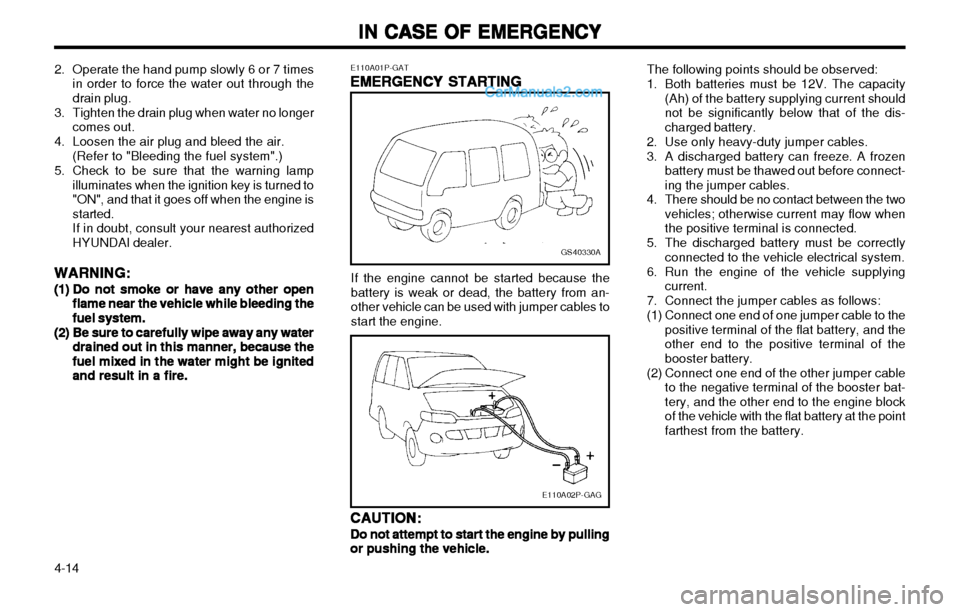
4-14 The following points should be observed:
1. Both batteries must be 12V. The capacity
(Ah) of the battery supplying current should not be significantly below that of the dis-charged battery.
2. Use only heavy-duty jumper cables.
3. A discharged battery can freeze. A frozen battery must be thawed out before connect- ing the jumper cables.
4. There should be no contact between the two vehicles; otherwise current may flow whenthe positive terminal is connected.
5. The discharged battery must be correctly connected to the vehicle electrical system.
6. Run the engine of the vehicle supplying current.
7. Connect the jumper cables as follows:
(1) Connect one end of one jumper cable to the positive terminal of the flat battery, and the other end to the positive terminal of thebooster battery.
(2) Connect one end of the other jumper cable to the negative terminal of the booster bat-tery, and the other end to the engine blockof the vehicle with the flat battery at the pointfarthest from the battery.
GS40330A
E110A02P-GAG
If the engine cannot be started because the battery is weak or dead, the battery from an-other vehicle can be used with jumper cables tostart the engine.
E110A01P-GAT
EMERGENCY STARTING
EMERGENCY STARTING EMERGENCY STARTING
EMERGENCY STARTING
EMERGENCY STARTING
CAUTION:
CAUTION: CAUTION:
CAUTION:
CAUTION:
Do not attempt to start the engine by pulling
Do not attempt to start the engine by pulling Do not attempt to start the engine by pulling
Do not attempt to start the engine by pulling
Do not attempt to start the engine by pulling
or pushing the vehicle.
or pushing the vehicle. or pushing the vehicle.
or pushing the vehicle.
or pushing the vehicle.
2. Operate the hand pump slowly 6 or 7 times
in order to force the water out through thedrain plug.
3. Tighten the drain plug when water no longer comes out.
4. Loosen the air plug and bleed the air. (Refer to "Bleeding the fuel system".)
5. Check to be sure that the warning lamp illuminates when the ignition key is turned to"ON", and that it goes off when the engine isstarted.If in doubt, consult your nearest authorizedHYUNDAI dealer.
WARNING:
WARNING: WARNING:
WARNING:
WARNING:
(1)(1)
(1)(1)
(1) Do not smoke or have any other open
Do not smoke or have any other open Do not smoke or have any other open
Do not smoke or have any other open
Do not smoke or have any other open
flame near the vehicle while bleeding the
flame near the vehicle while bleeding the flame near the vehicle while bleeding the
flame near the vehicle while bleeding the
flame near the vehicle while bleeding the
fuel system.
fuel system. fuel system.
fuel system.
fuel system.
(2)(2)
(2)(2)
(2) Be sure to carefully wipe away any water
Be sure to carefully wipe away any water Be sure to carefully wipe away any water
Be sure to carefully wipe away any water
Be sure to carefully wipe away any water
drained out in this manner, because the
drained out in this manner, because the drained out in this manner, because the
drained out in this manner, because the
drained out in this manner, because the
fuel mixed in the water might be ignited
fuel mixed in the water might be ignited fuel mixed in the water might be ignited
fuel mixed in the water might be ignited
fuel mixed in the water might be ignited
and result in a fire.
and result in a fire. and result in a fire.
and result in a fire.
and result in a fire.