air condition Hyundai H-1 (Grand Starex) 2011 Service Manual
[x] Cancel search | Manufacturer: HYUNDAI, Model Year: 2011, Model line: H-1 (Grand Starex), Model: Hyundai H-1 (Grand Starex) 2011Pages: 338, PDF Size: 8.16 MB
Page 328 of 338
Maintenance
74 7
G270303CEN
Operating precautions for catalytic
converters (if equipped)Your vehicle is equipped with a catalytic
converter emission control device.
Therefore, the following precautions
must be observed:
• Use only UNLEADED FUEL for gaso-
line engines.
• Do not operate the vehicle when there
are signs of engine malfunction, such
as misfire or a noticeable loss of per-
formance.
• Do not misuse or abuse the engine.
Examples of misuse are coasting with
the ignition off and descending steep
grades in gear with the ignition off.
• Do not operate the engine at high idle
speed for extended periods (5 minutes
or more).
• Do not modify or tamper with any part
of the engine or emission control sys-
tem. All inspections and adjustments
must be made by an authorized
HYUNDAI dealer.
• Avoid driving with a very low fuel level.
If you run out of gasoline, it could
cause the engine to misfire and result
in excessive loading of the catalytic
converter.
Failure to observe these precautions
could result in damage to the catalytic
converter and to your vehicle.
Additionally, such actions could void your
warranties.Diesel Particulate Filter (if equipped)
The Diesel Particulate Filter (DPF) sys-
tem removes the soot emitted from the
vehicle.
Unlike a disposable air filter, the DPF
system automatically burns (oxidizes)
and removes the accumulated soot
according to the driving condition. In
other words, the active burning by engine
control system and high exhaust gas
temperature caused by normal/high driv-
ing condition burns and removes the
accumulated soot.
However, if the vehicle continues to be
driven at low speed for long time, the
accumulated soot may not be automati-
cally removed because of low exhaust
gas temperature. In this particular case,
the amount of soot is out of detection
limit, the soot oxidation process by
engine control system may not happen
and the malfunction indicator light may
blink.
When the malfunction indicator light
blinks, it may stop blinking by driving the
vehicle at more than 60km/h (37 mph) or
at more than second gear with 1500 ~
2000 engine rpm for a certain time (for
about 25 minutes).
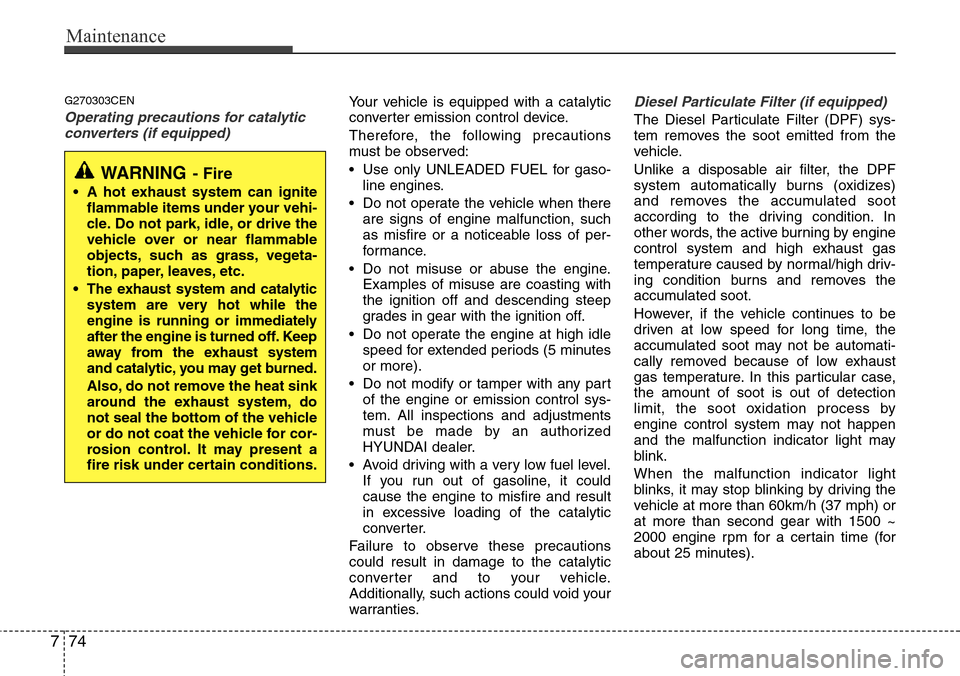
WARNING- Fire
• A hot exhaust system can ignite
flammable items under your vehi-
cle. Do not park, idle, or drive the
vehicle over or near flammable
objects, such as grass, vegeta-
tion, paper, leaves, etc.
• The exhaust system and catalytic
system are very hot while the
engine is running or immediately
after the engine is turned off. Keep
away from the exhaust system
and catalytic, you may get burned.
Also, do not remove the heat sink
around the exhaust system, do
not seal the bottom of the vehicle
or do not coat the vehicle for cor-
rosion control. It may present a
fire risk under certain conditions.
Page 330 of 338
8
Vehicle identification number (VIN) / 8-2
Vehicle certification label / 8-2
Tire specification and pressure label / 8-3
Engine number / 8-3
Air conditioner compressor label / 8-3
Consumer information
Page 332 of 338
83
Consumer information
H030000AUN
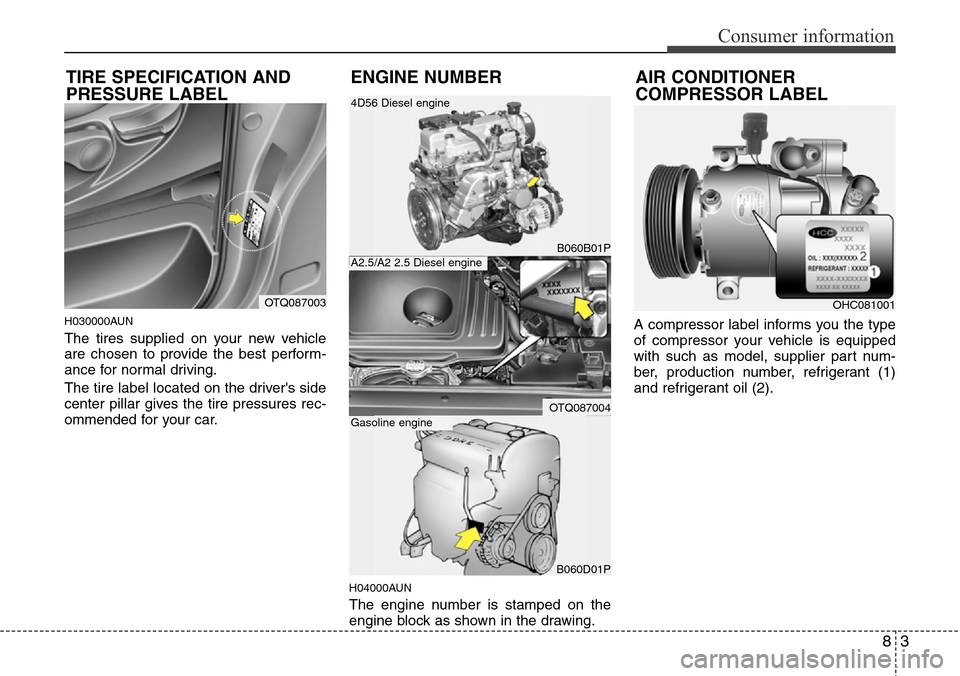
The tires supplied on your new vehicle
are chosen to provide the best perform-
ance for normal driving.
The tire label located on the driver's side
center pillar gives the tire pressures rec-
ommended for your car.
H04000AUN
The engine number is stamped on the
engine block as shown in the drawing.A compressor label informs you the type
of compressor your vehicle is equipped
with such as model, supplier part num-
ber, production number, refrigerant (1)
and refrigerant oil (2).
OTQ087003
B060B01P
OTQ087004
B060D01P
4D56 Diesel engine
A2.5/A2 2.5 Diesel engine
Gasoline engine
TIRE SPECIFICATION AND
PRESSURE LABELENGINE NUMBER
OHC081001
AIR CONDITIONER
COMPRESSOR LABEL