engine Hyundai H350 2016 User Guide
[x] Cancel search | Manufacturer: HYUNDAI, Model Year: 2016, Model line: H350, Model: Hyundai H350 2016Pages: 473, PDF Size: 26.4 MB
Page 68 of 473
3-6Information
When starting the engine, do not use
the key with other immobilizer keys
around. Otherwise the engine may not
start or may stop soon after it starts.
Keep each key separately not to have
any malfunction after you receive
your new vehicle.
Information
If you need additional keys or lose
your keys, we recommend that you
consult an authorized HYUNDAI
dealer. The transponder in your ignition
key is an important part of the
immobilizer system. It is designed
to give years of trouble-free serv-
ice, however you should avoid
exposure to moisture, static elec-
tricity and rough handling.
Immobilizer system malfunction
could occur.
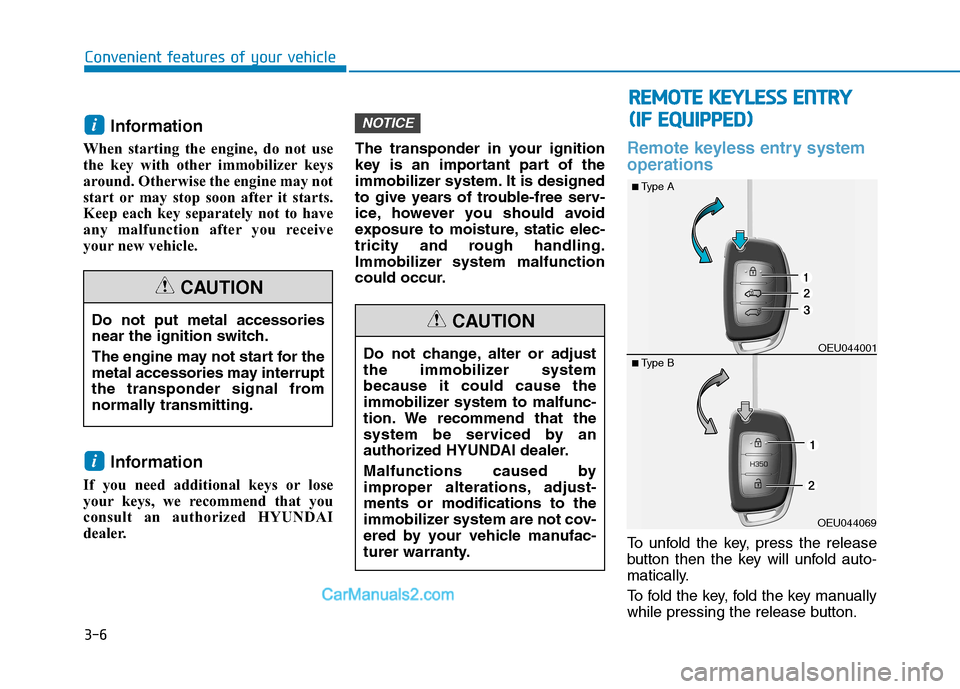
Remote keyless entry system operations
To unfold the key, press the release
button then the key will unfold auto-
matically.
To fold the key, fold the key manually
while pressing the release button.
NOTICE
i
i
Convenient features of your vehicle
Do not put metal accessories
near the ignition switch.
The engine may not start for the
metal accessories may interrupt
the transponder signal from
normally transmitting.
CAUTION
Do not change, alter or adjust
the immobilizer systembecause it could cause the
immobilizer system to malfunc-
tion. We recommend that the
system be serviced by an
authorized HYUNDAI dealer.
Malfunctions caused by
improper alterations, adjust-ments or modifications to the
immobilizer system are not cov-
ered by your vehicle manufac-
turer warranty.
CAUTION
RR
EEMM OOTTEE KK EEYY LLEE SSSS EE NN TTRR YY
(
( IIFF EE QQ UUIIPP PPEEDD ))
OEU044069OEU044001
■
Type A
■ Type B
Page 72 of 473
3-10
Convenient features of your vehicle
Armed stage
Park the vehicle and stop the engine.
Arm the system as described below.
1.Remove the ignition key from theignition switch or turn off the
engine.
2.Make sure that all doors (and rear door) and the engine hood areclosed and latched.
3.Lock the doors by depressing the door lock button on the transmitter.After completion of the steps
above, the hazard warning lights
will blink once to indicate that the
system is armed.
If any door, rear door remains
open, the hazard warning lights
won't operate and theft-alarm will
not arm. Close the door and try
again to lock the doors. If any door (and rear door) remains
open, the hazard warning lights
won't operate and theft-alarm will
not arm. Close the door and try
again to lock the doors. If engine hood remains open, the
hazard warning lights won't oper-
ate and theft-alarm will not arm.
Close the engine hood. The hazard
warning lights blink once and theft-
alarm arms.
Do not arm the system until all passengers have left the vehi-
cle. If the system is armed while
a passenger(s) remains in the
vehicle, the alarm may be acti-
vated when the remaining pas-
senger(s) leave the vehicle. If
any door, rear door or enginehood is opened within 30 sec-onds after entering the armed
stage, the system is disarmed to
prevent unnecessary alarm.
Theft-alarm stage
The alarm will be activated if any of
the following occurs while the system
is armed.
A front or rear door is opened with-out using transmitter.
The rear door is opened without using transmitter.
The engine hood is opened.The siren will sound and the hazard
warning lights will blink continuously
for 27 seconds, unless the system is
disarmed. To turn off the system,
unlock the doors with the transmitter.
Page 73 of 473
3-11
Convenient features of your vehicle
3
Disarmed stage
The system will be disarmed when:
Transmitter
- The door unlock button is pressed.
- The engine is started.
- The ignition switch is in the "ON"position. (Armed stage status)
- The ignition switch is in the "ACC" position for 27 seconds or more.
(Theft-alarm stage status)
After the doors are unlocked, the
hazard warning lights will blink twiceto indicate that the system is dis-
armed.
After pressing the unlock button, if
any door (or rear door) is not opened
within 30 seconds, the system will be
rearmed. Information
Burglar alarm system
If the system is not disarmed with the transmitter, insert the key into
the ignition switch and start the
engine. Then the system will be dis-
armed.
If you lose your keys, we recom- mend that you consult an author-
ized HYUNDAI dealer.
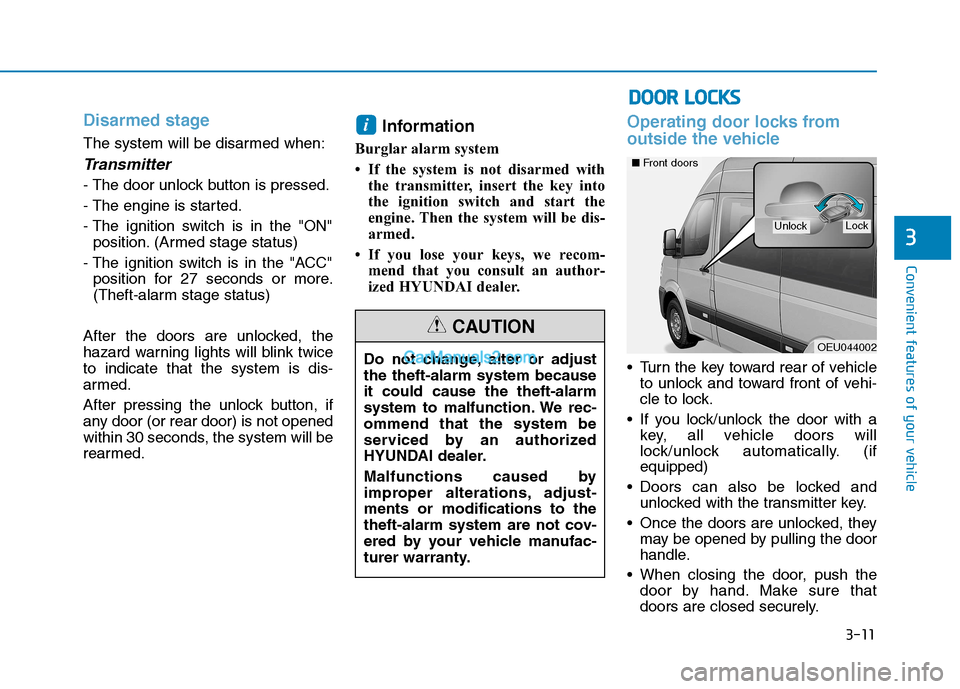
Operating door locks from
outside the vehicle
Turn the key toward rear of vehicleto unlock and toward front of vehi-
cle to lock.
If you lock/unlock the door with a key, all vehicle doors will
lock/unlock automatically. (ifequipped)
Doors can also be locked and unlocked with the transmitter key.
Once the doors are unlocked, they may be opened by pulling the door
handle.
When closing the door, push the door by hand. Make sure that
doors are closed securely.
i
Do not change, alter or adjust the theft-alarm system becauseit could cause the theft-alarm
system to malfunction. We rec-ommend that the system be
serviced by an authorized
HYUNDAI dealer.
Malfunctions caused by
improper alterations, adjust-ments or modifications to the
theft-alarm system are not cov-
ered by your vehicle manufac-
turer warranty.
CAUTION
DDOO OORR LL OO CCKK SS
OEU044002
LockUnlock
■Front doors
Page 76 of 473
3-14
Deadlocks (if equipped)
Some vehicles are equipped with a
deadlocking system. Deadlocks pre-
vent opening of a door from either
inside or outside the vehicle once the
deadlocks have been activated pro-
viding an additional measure of vehi-
cle security.
To lock the vehicle using the dead-
lock function, the doors must be
locked using the Remote keyless
entry transmitter. To unlock the vehi-
cle, the transmitter must again beused.
Speed sensing door lock sys- tem (if equipped)
All doors will be automatically locked
after the vehicle speed exceeds 15
km/h. And all doors will be automati-
cally unlocked when you turn the
engine off or when you remove the
ignition key. (if equipped)
Convenient features of your vehicle
Unattended children
An enclosed vehicle can
become extremely hot, causing
death or severe injury to unat-
tended children or animals who
cannot escape the vehicle.
Furthermore, children might
operate features of the vehicle
that could injure them, or theycould encounter other harm,
possibly from someone gaining
entry to the vehicle. Never leave
children or animals unattended
in your vehicle.
WARNING
Do not lock the doors with the
transmitter with anybody left in
the vehicle. The passenger in
the vehicle cannot unlock the
doors with the door lock button.
For example, if the door is
locked with the transmitter, the
passenger in the vehicle cannot
unlock the door without the
transmitter.
WARNING
Page 92 of 473
3-30
Convenient features of your vehicle
Opening the hood
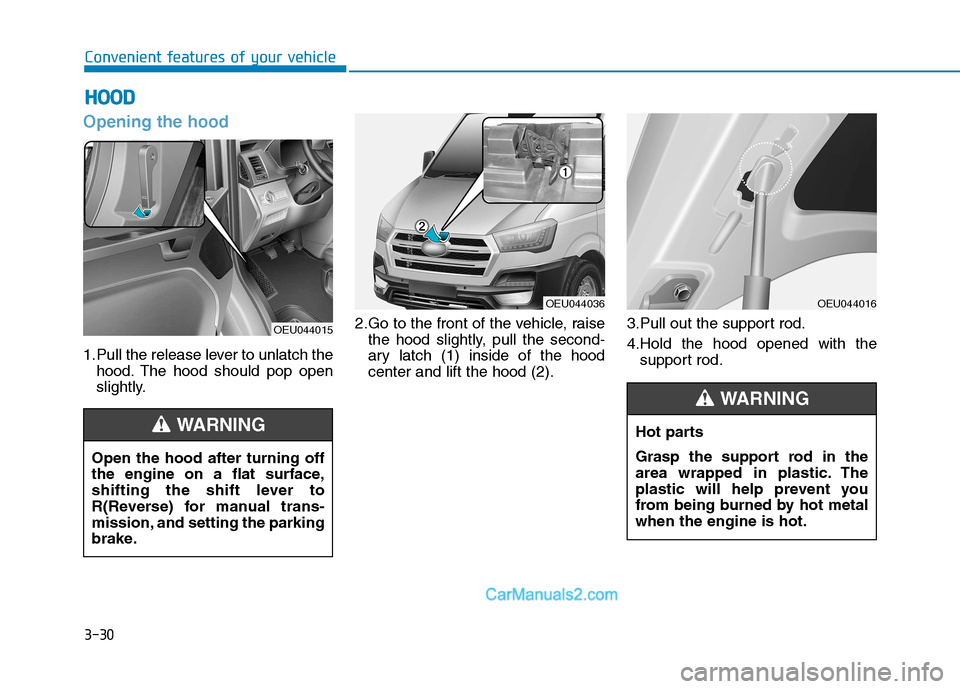
1.Pull the release lever to unlatch thehood. The hood should pop open
slightly. 2.Go to the front of the vehicle, raise
the hood slightly, pull the second-
ary latch (1) inside of the hoodcenter and lift the hood (2). 3.Pull out the support rod.
4.Hold the hood opened with the
support rod.
Open the hood after turning off
the engine on a flat surface,
shifting the shift lever to
R(Reverse) for manual trans-
mission, and setting the parking
brake.
WARNING
HH OO OO DD
OEU044015
Hot parts
Grasp the support rod in the
area wrapped in plastic. The
plastic will help prevent you
from being burned by hot metalwhen the engine is hot.
WARNING
OEU044036OEU044016
Page 93 of 473
3-31
Convenient features of your vehicle
3
Closing the hood
1.Before closing the hood, check thefollowing:
ment must be correctly installed.
bustible material must be
removed from the engine com-
partment.
2.Return the support rod to its clip to prevent it from rattling.
3.Lower the hood until it is about 30 cm (1 ft.) above the closed position
and let it drop. Make sure that it
locks into place. Hood
Before closing the hood, ensure that all obstructions
are removed from the hood
opening. Closing the hoodwith an obstruction present in
the hood opening may result
in property damage or severe
personal injury.
Do not leave gloves, rags or
any other combustible materi-
al in the engine compartment.
Doing so may cause a heat-
induced fire.
WARNING
Always double check to be
sure that the hood is firmly
latched before driving away. If
it is not latched, the hood
could fly open while the vehi-
cle is being driven, causing a
total loss of visibility, whichmight result in an accident.
The support rod must be
inserted completely into the
hole whenever you inspect
the engine compartment. This
will prevent the hood from
falling and possibly injuring
you.
Do not move the vehicle with
the hood raised. The view will
be blocked and the hood
could fall or be damaged.
WARNING
Page 94 of 473
3-32
Convenient features of your vehicle
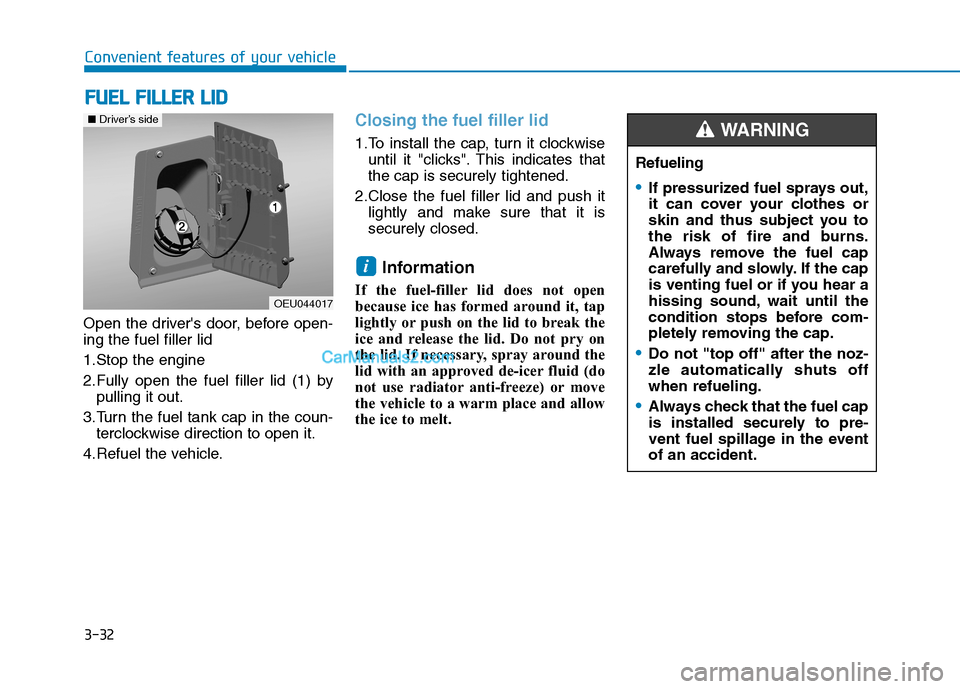
Open the driver's door, before open- ing the fuel filler lid
1.Stop the engine
2.Fully open the fuel filler lid (1) bypulling it out.
3.Turn the fuel tank cap in the coun- terclockwise direction to open it.
4.Refuel the vehicle.
Closing the fuel filler lid
1.To install the cap, turn it clockwise until it "clicks". This indicates that the cap is securely tightened.
2.Close the fuel filler lid and push it lightly and make sure that it issecurely closed.
Information
If the fuel-filler lid does not open
because ice has formed around it, tap
lightly or push on the lid to break the
ice and release the lid. Do not pry on
the lid. If necessary, spray around the
lid with an approved de-icer fluid (do
not use radiator anti-freeze) or move
the vehicle to a warm place and allow
the ice to melt.
i
FF UU EELL FF IILL LLEE RR LL IIDD
OEU044017
■Driver’s side
Refueling
If pressurized fuel sprays out,
it can cover your clothes or
skin and thus subject you to
the risk of fire and burns.
Always remove the fuel cap
carefully and slowly. If the cap
is venting fuel or if you hear a
hissing sound, wait until the
condition stops before com-
pletely removing the cap.
Do not "top off" after the noz-
zle automatically shuts offwhen refueling.
Always check that the fuel cap
is installed securely to pre-
vent fuel spillage in the eventof an accident.
WARNING
Page 95 of 473
3-33
Convenient features of your vehicle
3
Refueling dangers
Automotive fuels are flammable
materials. When refueling,
please note the following guide-
lines carefully. Failure to follow
these guidelines may result in
severe personal injury, severe
burns or death by fire or explo-sion.
Read and follow all warning posted at the gas station facil-
ity.
Before touching the fuel noz-
zle, you should eliminate
potentially dangerous static
electricity discharge by touch-
ing another metal part of the
vehicle, a safe distance away
from the fuel filler neck, noz-
zle, or other gas source.(Continued)
WARNING (Continued)
Do not get back into a vehicle
once you have begun refuel-
ing since you can generate
static electricity by touching,
rubbing or sliding against any
item or fabric (polyester, satin,
nylon, etc.) capable of produc-
ing static electricity. Static
electricity discharge can
ignite fuel vapors resulting in
rapid burning. If you must re-
enter the vehicle, you should
once again eliminate poten-
tially dangerous static elec-
tricity discharge by touching a
metal part of the vehicle, away
from the fuel filler neck, noz-
zle or other diesel source.
When using an approved
portable fuel container, besure to place the container on
the ground prior to refueling.(Continued)
(Continued)
Static electricity discharge
from the container can ignite
fuel vapors causing a fire.Once refueling has begun,
contact with the vehicleshould be maintained until the
filling is complete.
Use only portable plastic fuel
containers designed to carryand store diesel.
Do not use cellular phones
while refueling. Electric cur-
rent and/or electronic interfer-
ence from cellular phones can
potentially ignite fuel vapors
causing a fire.
When refueling, always shut
the engine off. Sparks pro-
duced by electrical compo-nents related to the engine
can ignite fuel vapors causing
a fire. Once refueling is com-
plete, check to make sure thefiller cap and filler door are
securely closed, before start-
ing the engine. (Continued)
Page 97 of 473
3-35
Convenient features of your vehicle
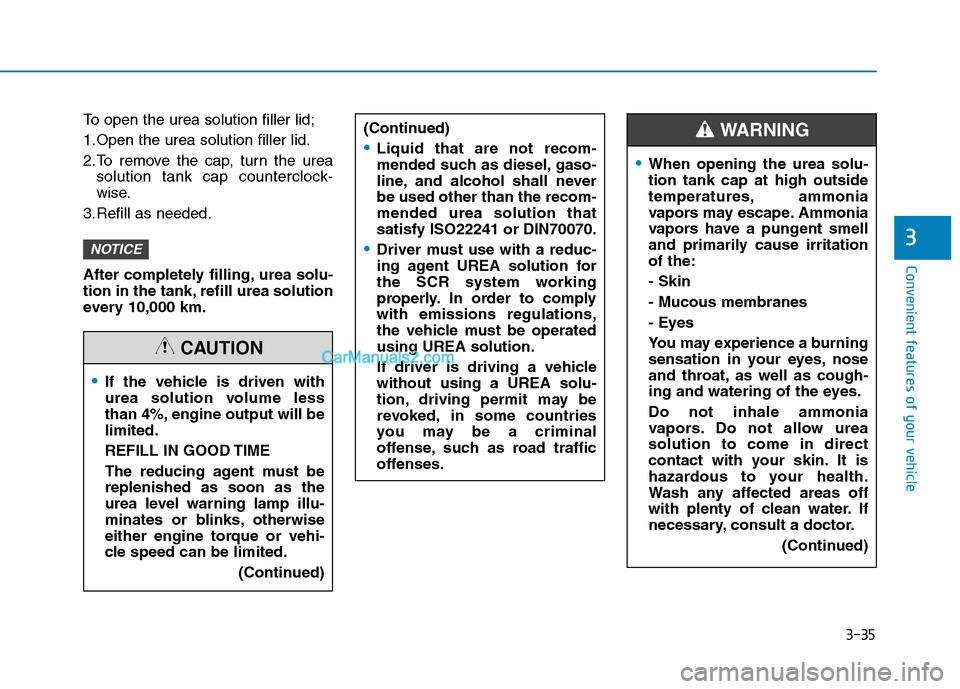
To open the urea solution filler lid;
1.Open the urea solution filler lid.
2.To remove the cap, turn the ureasolution tank cap counterclock-
wise.
3.Refill as needed.
After completely filling, urea solu-
tion in the tank, refill urea solution
every 10,000 km.
NOTICE3
If the vehicle is driven with
urea solution volume less
than 4%, engine output will belimited.
REFILL IN GOOD TIME
The reducing agent must be replenished as soon as the
urea level warning lamp illu-
minates or blinks, otherwise
either engine torque or vehi-
cle speed can be limited. (Continued)
CAUTION
When opening the urea solu- tion tank cap at high outside
temperatures, ammonia
vapors may escape. Ammonia
vapors have a pungent smell
and primarily cause irritationof the: - Skin- Mucous membranes
- Eyes
You may experience a burning
sensation in your eyes, nose
and throat, as well as cough-
ing and watering of the eyes. Do not inhale ammonia
vapors. Do not allow ureasolution to come in direct
contact with your skin. It is
hazardous to your health.
Wash any affected areas off
with plenty of clean water. If
necessary, consult a doctor.
(Continued)
WARNING(Continued)
Liquid that are not recom-
mended such as diesel, gaso-
line, and alcohol shall neverbe used other than the recom-mended urea solution thatsatisfy ISO22241 or DIN70070.
Driver must use with a reduc-
ing agent UREA solution for
the SCR system working
properly. In order to complywith emissions regulations,
the vehicle must be operatedusing UREA solution.
If driver is driving a vehicle without using a UREA solu-
tion, driving permit may be
revoked, in some countries
you may be a criminal
offense, such as road traffic
offenses.
Page 99 of 473
3-37
Convenient features of your vehicle
3
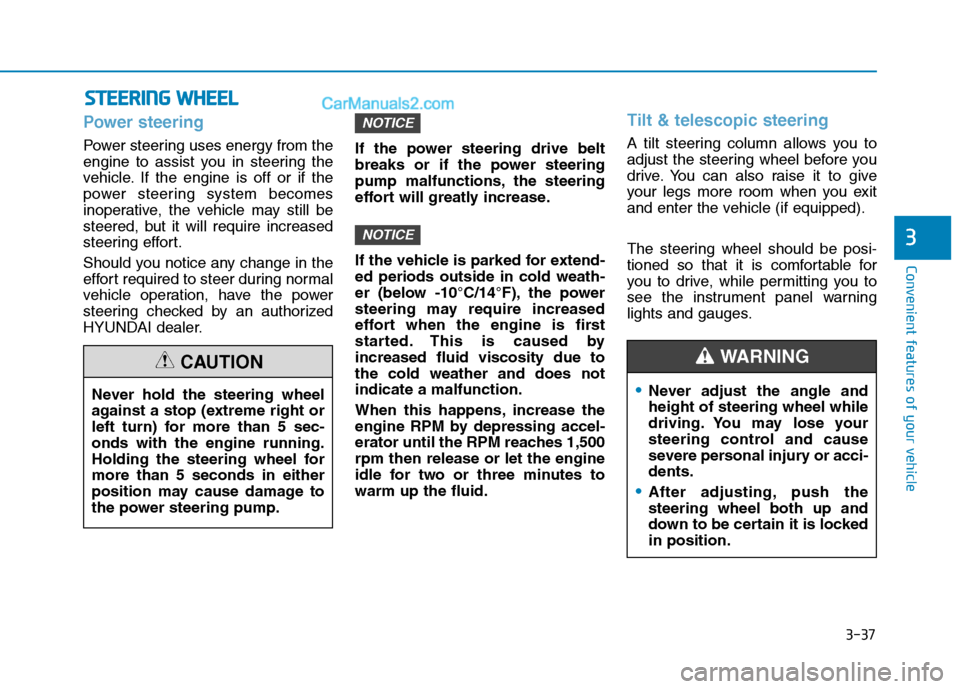
Power steering
Power steering uses energy from the
engine to assist you in steering the
vehicle. If the engine is off or if the
power steering system becomes
inoperative, the vehicle may still be
steered, but it will require increased
steering effort.
Should you notice any change in the
effort required to steer during normal
vehicle operation, have the power
steering checked by an authorized
HYUNDAI dealer.If the power steering drive belt
breaks or if the power steering
pump malfunctions, the steering
effort will greatly increase.
If the vehicle is parked for extend- ed periods outside in cold weath-
er (below -10°C/14°F), the power
steering may require increased
effort when the engine is first
started. This is caused byincreased fluid viscosity due tothe cold weather and does notindicate a malfunction.
When this happens, increase the
engine RPM by depressing accel-
erator until the RPM reaches 1,500rpm then release or let the engine
idle for two or three minutes towarm up the fluid.
Tilt & telescopic steering
A tilt steering column allows you to
adjust the steering wheel before you
drive. You can also raise it to give
your legs more room when you exit
and enter the vehicle (if equipped).
The steering wheel should be posi-
tioned so that it is comfortable for
you to drive, while permitting you to
see the instrument panel warning
lights and gauges.
NOTICE
NOTICE
SS
TT EEEERR IINN GG WW HHEEEELL
Never hold the steering wheel
against a stop (extreme right or
left turn) for more than 5 sec-onds with the engine running.
Holding the steering wheel formore than 5 seconds in either
position may cause damage to
the power steering pump.
CAUTION
Never adjust the angle and height of steering wheel while
driving. You may lose your
steering control and cause
severe personal injury or acci-dents.
After adjusting, push the steering wheel both up and
down to be certain it is lockedin position.
WARNING