pressure HYUNDAI I20 2020 Workshop Manual
[x] Cancel search | Manufacturer: HYUNDAI, Model Year: 2020, Model line: I20, Model: HYUNDAI I20 2020Pages: 444, PDF Size: 8.93 MB
Page 395 of 444
10-56
Maintenance
Tire replacement
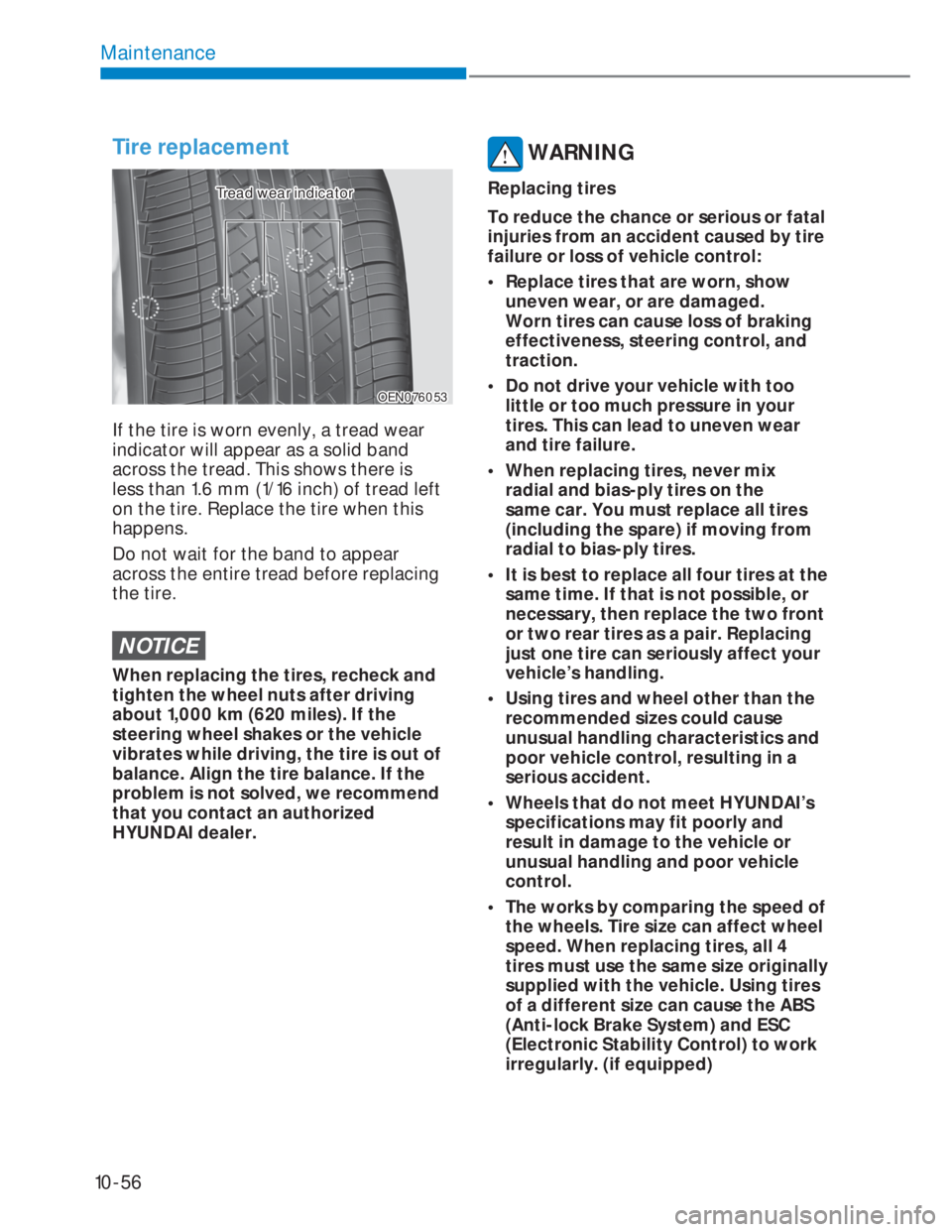
OEN076053OEN076053
Tread wear indicatorTread wear indicator
If the tire is worn evenly, a tread wear
indicator will appear as a solid band
across the tread. This shows there is
less than 1.6 mm (1/16 inch) of tread left
on the tire. Replace the tire when this
happens.
Do not wait for the band to appear
across the entire tread before replacing
the tire.
NOTICE
When replacing the tires, recheck and
tighten the wheel nuts after driving
about 1,000 km (620 miles). If the
steering wheel shakes or the vehicle
vibrates while driving, the tire is out of
balance. Align the tire balance. If the
problem is not solved, we recommend
that you contact an authorized
HYUNDAI dealer.
WARNING
Replacing tires
To reduce the chance or serious or fatal
injuries from an accident caused by tire
failure or loss of vehicle control:
• Replace tires that are worn, show
uneven wear, or are damaged.
Worn tires can cause loss of braking
effectiveness, steering control, and
traction.
• Do not drive your vehicle with too
little or too much pressure in your
tires. This can lead to uneven wear
and tire failure.
• When replacing tires, never mix
radial and bias-ply tires on the
same car. You must replace all tires
(including the spare) if moving from
radial to bias-ply tires.
• It is best to replace all four tires at the
same time. If that is not possible, or
necessary, then replace the two front
or two rear tires as a pair. Replacing
just one tire can seriously affect your
vehicle’s handling.
• Using tires and wheel other than the
recommended sizes could cause
unusual handling characteristics and
poor vehicle control, resulting in a
serious accident.
• Wheels that do not meet HYUNDAI’s
specifications may fit poorly and
result in damage to the vehicle or
unusual handling and poor vehicle
control.
• The works by comparing the speed of
the wheels. Tire size can affect wheel
speed. When replacing tires, all 4
tires must use the same size originally
supplied with the vehicle. Using tires
of a different size can cause the ABS
(Anti-lock Brake System) and ESC
(Electronic Stability Control) to work
irregularly. (if equipped)
Page 399 of 444
10-60
Maintenance
4. Tire ply composition and material
The number of layers or plies of
rubber-coated fabric in the tire. Tire
manufacturers also must indicate the
materials in the tire, which include steel,
nylon, polyester, and others. The letter
“R” means radial ply construction; the
letter “D” means diagonal or bias ply
construction; and the letter “B” means
belted-bias ply construction.
5. Maximum permissible inflation
pressure
This number is the greatest amount
of air pressure that should be put in
the tire. Do not exceed the maximum
permissible inflation pressure. Refer to
the Tire and Loading Information label
for recommended inflation pressure.
6. Maximum load rating
This number indicates the maximum
load in kilograms and pounds that can
be carried by the tire. When replacing
the tires on the vehicle, always use a
tire that has the same load rating as the
factory installed tire.
7. Uniform tire quality grading
Quality grades can be found where
applicable on the tire sidewall between
tread shoulder and maximum chapter
width.
For example:
TREAD wear 200
TRACTION AA
TEMPERATURE A
Tread wear
The tread wear grade is a comparative
rating based on the wear rate of the tire
when tested under controlled conditions
on a specified government test course.
For example, a tire graded 150 would
wear one-and-a-half times (1½) as well
on the government course as a tire
graded 100.
The relative performance of tires
depends upon the actual conditions
of their use, however, and may depart
significantly from the norm due to
variations in driving habits, service
practices and differences in road
characteristics and climate.
These grades are molded on the side-
walls of passenger vehicle tires. The
tires available as standard or optional
equipment on your vehicle may vary
with respect to grade.
Page 401 of 444
10-62
Maintenance
NOTICE
Because the sidewall of the low aspect
ratio tire is shorter than the normal, the
wheel and tire of the low aspect ratio
tire is easier to be damaged. So, follow
the instructions below.
- When driving on a rough road or
off road, drive cautiously because
tires and wheels may be damaged.
And after driving, inspect tires and
wheels.
- When passing over a pothole, speed
bump, manhole, or curb stone, drive
slowly so that the tires and wheels
are not damaged.
- If the tire is impacted, we
recommend that you inspect the tire
condition or contact an authorized
HYUNDAI dealer.
- To prevent damage to the tire,
inspect the tire condition and
pressure every 3,000km.
NOTICE
• It is not easy to recognize the tire
damage with your own eyes. But
if there is the slightest hint of tire
damage, even though you cannot see
the tire damage with your own eyes,
have the tire checked or replaced
because the tire damage may cause
air leakage from the tire.
• If the tire is damaged by driving
on a rough road, off road, pothole,
manhole, or curb stone, it will not be
covered by the warranty.
• You can find out the tire information
on the tire sidewall.
Page 428 of 444
10-89
10
NOTICE
If you park your vehicle near a stainless
steel sign or glass facade building, the
vehicle’s exterior plastic parts such
as a bumper, spoiler, garnish, lamp
or outside rearview mirror might be
damaged due to sunlight reflected
from the sign or building. To prevent
damage of the exterior plastic parts,
you should avoid parking in areas
where light may be reflected or use a
car cover. (The exterior plastic parts
applied to your vehicle may vary.)
Exterior care
Exterior general caution
It is very important to follow the label
directions when using any chemical
cleaner or polish. Read all warning and
caution statements that appear on the
label.
High-pressure washing
• When using high-pressure washers,
make sure to maintain sufficient
distance from the vehicle.
Insufficient clearance or excessive
pressure can lead to component
damage or water penetration.
• Do not spray the camera, sensors or
its surrounding area directly with a
high pressure washer. Shock applied
from high pressure water may cause
the device to not operate normally.
• Do not bring the nozzle tip close to
boots (rubber or plastic covers) or
connectors as they may be damaged
if they come into contact with high
pressure water.
Finish maintenance
Washing
To help protect your vehicle’s finish
from rust and deterioration, wash it
thoroughly and frequently at least once
a month with lukewarm or cold water.
If you use your vehicle for off-road
driving, you should wash it after each
off-road trip. Pay special attention to the
removal of any accumulation of salt, dirt,
mud, and other foreign materials. Make
sure the drain holes in the lower edges
of the doors and rocker panels are kept
clear and clean.
Insects, tar, tree sap, bird droppings,
industrial pollution and similar deposits
can damage your vehicle’s finish if not
removed immediately.
Even prompt washing with plain water
may not completely remove all these
deposits. A mild soap, safe for use on
painted surfaces, may be used.
After washing, rinse the vehicle
thoroughly with lukewarm or cold water.
Do not allow soap to dry on the finish.
NOTICE
• Do not use strong soap, chemical
detergents or hot water, and do not
wash the vehicle in direct sunlight
or when the body of the vehicle is
warm.
• Be careful when washing the side
windows of your vehicle.
Especially, with high-pressure water,
water may leak through the windows
and wet the interior.
• To prevent damage to the plastic
parts and lamps, do not clean
with chemical solvents or strong
detergents.
APPEARANCE CARE
Page 429 of 444
10-90
Maintenance
WARNING
Wet brakes
After washing the vehicle, test the
brakes while driving slowly to see if
they have been affected by water. If
braking performance is impaired, dry
the brakes by applying them lightly
while maintaining a slow forward
speed.
OBI3090045LOBI3090045L
NOTICE
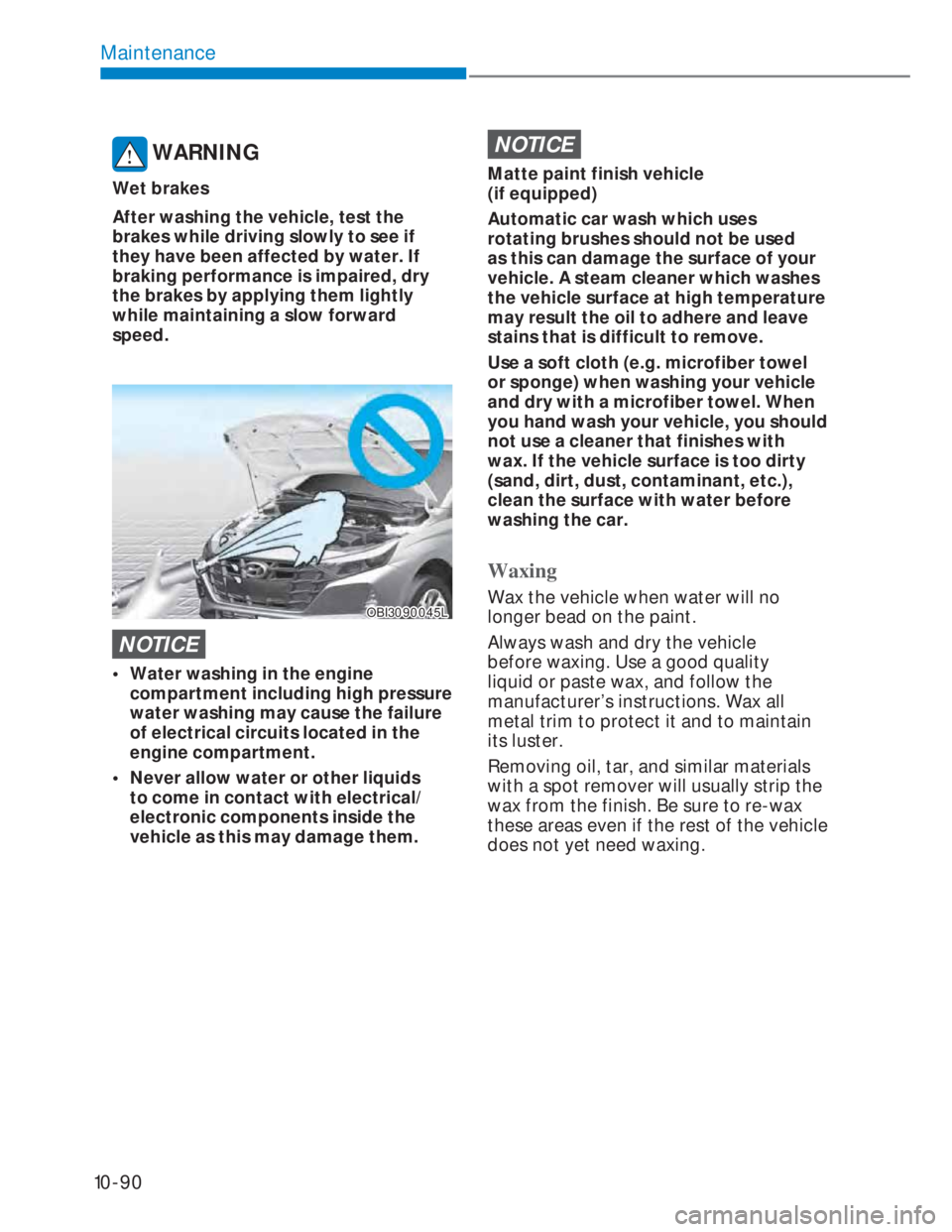
• Water washing in the engine
compartment including high pressure
water washing may cause the failure
of electrical circuits located in the
engine compartment.
• Never allow water or other liquids
to come in contact with electrical/
electronic components inside the
vehicle as this may damage them.
NOTICE
Matte paint finish vehicle
(if equipped)
Automatic car wash which uses
rotating brushes should not be used
as this can damage the surface of your
vehicle. A steam cleaner which washes
the vehicle surface at high temperature
may result the oil to adhere and leave
stains that is difficult to remove.
Use a soft cloth (e.g. microfiber towel
or sponge) when washing your vehicle
and dry with a microfiber towel. When
you hand wash your vehicle, you should
not use a cleaner that finishes with
wax. If the vehicle surface is too dirty
(sand, dirt, dust, contaminant, etc.),
clean the surface with water before
washing the car.
Waxing
Wax the vehicle when water will no
longer bead on the paint.
Always wash and dry the vehicle
before waxing. Use a good quality
liquid or paste wax, and follow the
manufacturer’s instructions. Wax all
metal trim to protect it and to maintain
its luster.
Removing oil, tar, and similar materials
with a spot remover will usually strip the
wax from the finish. Be sure to re-wax
these areas even if the rest of the vehicle
does not yet need waxing.
Page 430 of 444
10-91
10
NOTICE
• Wiping dust or dirt off the body with
a dry cloth will scratch the finish.
• Do not use steel wool, abrasive
cleaners, or strong detergents
containing highly alkaline or caustic
agents on chrome-plated or anodized
aluminum parts. This may result in
damage to the protective coating
and cause discoloration or paint
deterioration.
NOTICE
Matte paint finish vehicle
(if equipped)
Do not use any polish protector such as
a detergent, an abrasive and a polish.
In case wax is applied, remove the wax
immediately using a silicon remover
and if any tar or tar contaminant is on
the surface use a tar remover to clean.
However, be careful not to apply too
much pressure on the painted area.
Finish damage repair
Deep scratches or stone chips in the
painted surface must be repaired
promptly. Exposed metal will quickly
rust and may develop into a major repair
expense.
i Information
If your vehicle is damaged and requires
any metal repair or replacement, be sure
the body shop applies anti-corrosion
materials to the parts repaired or
replaced.
NOTICE
Matte paint finish vehicle
(if equipped)
In case of matte paint finish vehicles,
it is impossible to modify only the
damaged area and repair of the whole
part is necessary. If the vehicle is
damaged and painting is required,
we recommend that you have your
vehicle maintained and repaired by
an authorized HYUNDAI dealer. Take
extreme care, as it is difficult to restore
the quality after the repair.
Page 433 of 444
10-94
Maintenance
Keep your vehicle clean
The best way to prevent corrosion is
to keep your vehicle clean and free of
corrosive materials. Attention to the
underside of the vehicle is particularly
important.
• If you live in a high-corrosion area —
where road salts are used, near the
ocean, areas with industrial pollution,
acid rain, etc.—, you should take extra
care to prevent corrosion. In winter,
hose off the underside of your vehicle
at least once a month and be sure to
clean the underside thoroughly when
winter is over.
• When cleaning underneath the
vehicle, give particular attention to the
components under the fenders and
other areas that are hidden from view.
Do a thorough job; just dampening the
accumulated mud rather than washing
it away will accelerate corrosion rather
than prevent it. Water under high
pressure and steam are particularly
effective in removing accumulated
mud and corrosive materials.
• When cleaning lower door panels,
rocker panels and frame members, be
sure that drain holes are kept open so
that moisture can escape and not be
trapped inside to accelerate corrosion.Keep your garage dry
Don’t park your vehicle in a damp,
poorly ventilated garage. This creates
a favorable environment for corrosion.
This is particularly true if you wash your
vehicle in the garage or drive it into the
garage when it is still wet or covered
with snow, ice or mud. Even a heated
garage can contribute to corrosion
unless it is well ventilated so moisture is
dispersed.
Keep paint and trim in good condition
Scratches or chips in the finish should
be covered with “touch-up” paint as
soon as possible to reduce the possibility
of corrosion. If bare metal is showing
through, the attention of a qualified
body and paint shop is recommended.
Bird droppings : Bird droppings are
highly corrosive and may damage
painted surfaces in just a few hours.
Always remove bird droppings as soon
as possible.
Don’t neglect the interior
Moisture can collect under the floor
mats and carpeting and cause corrosion.
Check under the mats periodically to be
sure the carpeting is dry. Use particular
care if you carry fertilizers, cleaning
materials or chemicals in the vehicle.
These should be carried only in proper
containers and any spills or leaks should
be cleaned up, flushed with clean water
and thoroughly dried.