temperature HYUNDAI I30 2011 Workshop Manual
[x] Cancel search | Manufacturer: HYUNDAI, Model Year: 2011, Model line: I30, Model: HYUNDAI I30 2011Pages: 635, PDF Size: 40.66 MB
Page 393 of 635

Maintenance
76
7
Do not modify or tamper with any part
of the engine or emission control sys-
tem. All inspections and adjustments
must be made by an authorized
HYUNDAI dealer.
Avoid driving with a very low fuel level. If you run out of gasoline, it couldcause the engine to misfire and result
in excessive loading of the catalytic
converter.
Failure to observe these precautionscould result in damage to the catalytic
converter and to your vehicle.
Additionally, such actions could void your
warranties.Diesel Particulate Filter (if equipped)
The Diesel Particulate Filter (DPF) sys-
tem removes the soot emitted from the
vehicle.
Unlike a disposable air filter, the DPF
system automatically burns (oxidizes)
and removes the accumulated soot
according to the driving condition. In
other words, the active burning by engine
control system and high exhaust gas
temperature caused by normal/high driv-
ing condition burns and removes the
accumulated soot.
However, if the vehicle continues to be
driven at low speed for long time, the
accumulated soot may not be automati-
cally removed because of low exhaust
gas temperature. In this particular case,the amount of soot is out of detection
limit, the soot oxidation process by
engine control system may not happen
and the malfunction indicator light may
blink.When the malfunction indicator light
blinks, it may stop blinking by driving the
vehicle at more than 60km/h (37 mph) orat more than second gear with 1500 ~
2000 engine rpm for a certain time (for
about 25 minutes). If the malfunction indicator light contin-
ues to be blinked in spite of the proce-
dure, please visit an authorized
HYUNDAI dealer and then check theDPF system.
If you continue to drive with the malfunc-
tion indicator light blinking for a long
time, the DPF system can be damaged
and fuel consumption can be worsen.
CAUTION -
Diesel Fuel
(if equipped with DPF)
It is recommended to use the regu- lated automotive diesel fuel for
diesel vehicle equipped with the DPF system.
If you use diesel fuel including highsulfur (more than 50 ppm sulfur) and unspecified additives, it can
cause the DPF system to be dam-aged and white smoke can be emit- ted.
Page 403 of 635

Specifications
6
9
I040100BFD Recommended SAE viscosity
number
Engine oil viscosity (thickness) has an
effect on fuel economy and cold weather
operation (engine start and engine oil
flowability). Lower viscosity engine oils
can provide better fuel economy and cold
weather performance, however, higher
viscosity engine oils are required for sat-
isfactory lubrication in hot weather. Using
oils of any viscosity other than those rec-ommended could result in engine dam-
age. When choosing an oil, consider the range
of temperature your vehicle will be oper-
ated in before the next oil change.Proceed to select the recommended oil
viscosity from the chart.
CAUTION
Always be sure to clean the area
around any filler plug, drain plug, ordipstick before checking or drain-ing any lubricant. This is especially
important in dusty or sandy areasand when the vehicle is used onunpaved roads. Cleaning the plug and dipstick areas will prevent dirt
and grit from entering the engineand other mechanisms that could be damaged.
Temperature Range for SAE Viscosity Numbers
Temperature
Gasoline
Engine Oil * 1
(For Europe) °C
(°F)-30 -20 -10 0 10 20 30 40 50 -10 0 20 40 60 80 100 120
Diesel
Engine Oil
5W-30
15W-40
10W-30
0W-30* 4
*1. For better fuel economy, it is recommended to use the engine oil of a viscosity grade SAE
0W-40, 5W-30, 5W-40 (API Service SL or SM, ACEA A3 or above).
*2. For better fuel economy, it is recommended to use the engine oil of a viscosity grade SAE 5W-20* 3
(API SM / ILSAC GF-4). However, if the engine oil is not available in your country,
select the proper engine oil using the engine oil viscosity chart.
*3. In Middle East, do not use the engine oil of viscosity grade SAE 5W-20.
*4. It is only for extreme cold area and to be restricted by driving condition and area. (Especially, not recommended for sustained high loaded and high speed operation.)
0W-40, 5W-30, 5W-40
Gasoline
Engine Oil * 2
(Except Europe)20W-50
10W-30
15W-40
5W-20* 3
, 5W-30
Page 407 of 635

Index
4
I
Display illumination, see instrument
panel illumination ·······················································4-36
Door locks ·········································································4-8 Central door lock switch ············································4-9
Child-protector rear door lock ·································4-11
Deadlocks ··································································4-10
Drinks holders, see cup holders ·····································4-93
Driver's air bag ·······························································3-40
Driving at night ······························································5-34
Driving in flooded areas ················································5-35
Driving in the rain ··························································5-35
Economical operation ····················································5-31
Electric chromic mirror (ECM) ·····································4-31
Electric power steering ··················································4-28
Emergency starting ··························································6-4 Jump starting ······························································6-4
Push starting ·······························································6-5
Emergency tailgate safety release ··································4-13
Emergency towing ·························································6-22
Emergency while driving ·················································6-2
Emergency commodity ··················································6-25
Emission control system ················································7-74 Crankcase emission control system ·························7-74
Evaporative emission control system ·······················7-74 Exhaust emission control system ·····························7-75
Engine compartment ························································7-2
Engine coolant ·······························································7-25
Engine number ·································································8-4
Engine oil ·······································································7-24
Engine overheats ······························································6-6
Engine temperature gauge ·············································4-37
Engine will not start ·························································6-3
Evaporative emission control system ····························7-74
Exhaust emission control system ···································7-75Explanation of scheduled maintenance items ················7-21
Exterior care ···································································7-68
Exterior features ···························································4-101 Mounting bracket for roof carrier ··························4-101
Roof rack ································································4-102
Flat tire ···········································································6-12 Changing tires ··························································6-13
Compact spare tire ···················································6-18
Jack and tools ···························································6-12
Removing and storing the spare tire ························6-13
Floor mat anchor(s) ·······················································4-96Fluid Automatic transaxle ··················································7-29
Brakes/clutch fluid ···················································7-28
Washer fluid ·····························································7-31
E
F
Page 408 of 635

I5
Index
Folding the rear seat ······················································3-10
Front fog light bulb replacement ···································7-64
Front seat adjustment ························································3-4
Fuel filler lid ···································································4-21
Fuel filter (for diesel) ······················································7-32
Fuel gauge ·······································································4-38
Fuel requirements ·····························································1-2
Fuses ···············································································7-53
Fuse/relay panel description······································7-57
Main fuse···································································7-56
Memory fuse ·····························································7-55
Gauge Engine temperature gauge ·········································4-37
Fuel gauge ·································································4-38
Glassroof, see sunroof ····················································4-24
Glove box ········································································4-88
Hazard warning flasher ···················································4-53
Hazardous driving conditions ·········································5-33
Headlight bulb replacement ············································7-63
Headlight escort function················································4-54
Headlight welcome function ··········································4-55
Headlight leveling device················································4-59 Headrest ·····································································3-5, 3-9
Heating and air conditioning ··········································4-69
High mounted stop light replacement·····························7-66
Highway driving ·····························································5-35
Hood················································································4-19
Horn ················································································4-29
How to use this manual ····················································1-2
Ignition key interlock system··········································5-15
Immobilizer system···························································4-3
Indicators and warnings ··················································4-41
Indicator symbols on the instrument cluster·····················1-7
Inside rearview mirror ····················································4-31
Instrument cluster ···························································4-35
Engine temperature gauge ·········································4-37
Fuel gauge ·································································4-38
Instrument panel illumination ···································4-36
Odometer/Tripmeter ··················································4-38
Speedometer ······························································4-36
Tachometer ································································4-37
Trip computer ····························································4-39
Warning and indicators ·············································4-41
Instrument panel illumination ·········································4-36
Instrument panel overview················································2-4
Interior care ·····································································7-73
Interior features ·······························································4-92
G
H
I
Page 420 of 635
37
Safety system of your vehicle
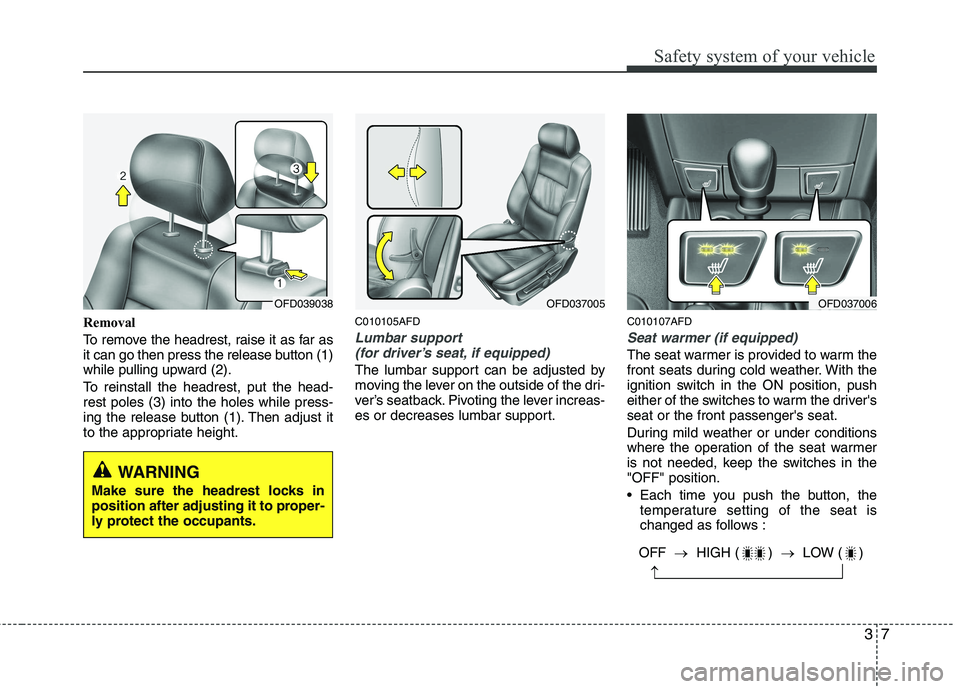
Removal
To remove the headrest, raise it as far as
it can go then press the release button (1)
while pulling upward (2).
To reinstall the headrest, put the head- rest poles (3) into the holes while press-
ing the release button (1). Then adjust it
to the appropriate height.C010105AFD
Lumbar support
(for driver’s seat, if equipped)
The lumbar support can be adjusted by
moving the lever on the outside of the dri-
ver’s seatback. Pivoting the lever increas-
es or decreases lumbar support. C010107AFD
Seat warmer (if equipped)
The seat warmer is provided to warm the
front seats during cold weather. With the
ignition switch in the ON position, push
either of the switches to warm the driver'sseat or the front passenger's seat.
During mild weather or under conditions
where the operation of the seat warmer
is not needed, keep the switches in the"OFF" position.
Each time you push the button, the
temperature setting of the seat is
changed as follows :
OFD037005OFD039038OFD037006
OFF HIGH ( ) LOW ( )
WARNING
Make sure the headrest locks in
position after adjusting it to proper-
ly protect the occupants.
Page 421 of 635

Safety system of your vehicle
8
3
The seat warmer defaults to the OFF
position whenever the ignition switch is
turned on.
✽✽ NOTICE
With the seat warmer switch in ON
position, the heating system in the seat
turns off or on automatically depending
on the seat temperature.
C010108AUN
Seatback pocket (if equipped)
The seatback pocket is provided on the
back of the front passenger’s and driver’s
seatbacks.
WARNING - Seat warmer
burns
Passengers should use extreme
caution when using seat warmers
due to the possibility of excess
heating or burns. In particular, the
driver must exercise extreme care
for the following types of passen-
gers:
1. Infants, children, elderly or hand- icapped persons, or hospital out- patients
2. Persons with sensitive skin or those that burn easily
3. Fatigued individuals
4. Intoxicated individuals
5. Individuals taking medication that can cause drowsiness or
sleepiness (sleeping pills, cold
tablets, etc.)
WARNING - Seatback
pockets
Do not put heavy or sharp objects
in the seatback pockets. In an acci-
dent they could come loose from
the pocket and injure vehicle occu-pants.
OFD037040
CAUTION
When cleaning the seats, do not use an organic solvent such as
thinner, benzene, alcohol andgasoline. Doing so may damagethe surface of the heater or seats.
To prevent overheating the seat warmer, do not place blankets,
cushions or seat covers on theseats while the seat warmer is inoperation.
Do not place heavy or sharp objects on seats equipped with
seat warmers. Damage to the seatwarming components could occur.
Page 498 of 635
Features of your vehicle
26
4
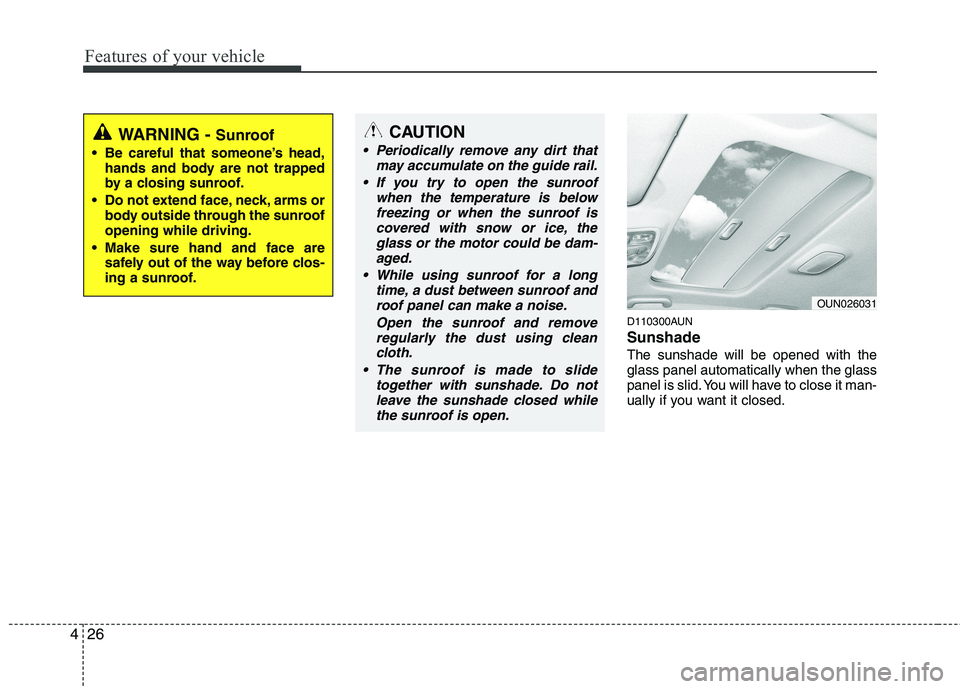
D110300AUN Sunshade The sunshade will be opened with the glass panel automatically when the glass
panel is slid. You will have to close it man-
ually if you want it closed.
OUN026031
WARNING - Sunroof
Be careful that someone’s head, hands and body are not trapped
by a closing sunroof.
Do not extend face, neck, arms or body outside through the sunroofopening while driving.
Make sure hand and face are safely out of the way before clos-
ing a sunroof.CAUTION
Periodically remove any dirt that
may accumulate on the guide rail.
If you try to open the sunroof when the temperature is belowfreezing or when the sunroof iscovered with snow or ice, the
glass or the motor could be dam- aged.
While using sunroof for a long time, a dust between sunroof androof panel can make a noise.
Open the sunroof and removeregularly the dust using cleancloth.
The sunroof is made to slide together with sunshade. Do notleave the sunshade closed while
the sunroof is open.
Page 500 of 635

Features of your vehicle
28
4
D130200AFD
Electric power steering
Power steering uses the motor to assist
you in steering the vehicle. If the engine
is off or if the power steering system
becomes inoperative, the vehicle may
still be steered, but it will require
increased steering effort.
The motor driven power steering is con-
trolled by power steering control unit
which sense the steering wheel torque,
steering wheel position and vehicle
speed to command the motor.
The steering wheel becomes heavier as
the vehicle’s speed increases and
becomes lighter as the vehicle’s speed
decreases for the better control of the
steering wheel.
Should you notice any change in the
effort required to steer during normal
vehicle operation, have the power steer-
ing checked by an authorized HYUNDAI
dealer.✽✽
NOTICE
The following symptoms may occur dur-
ing normal vehicle operation:
The EPS warning light does not illu- minate.
The steering wheel becomes heavier after turning the ignition switch on.
This happens as the system performs
the EPS system diagnostics. When the
diagnostics is completed, the steering
wheel will return to its normal condi-
tion.
Click noise may be heard from the
EPS relay after the ignition switch is
turned to the ON or LOCK position.
Motor noise may be heard when the vehicle is at a stop or at a low driving
speed.
If the Electric Power Steering System
does not operate normally, the warn-
ing light will illuminate on the instru-
ment cluster. The steering wheel may
become difficult to control or operate
abnormally. Take your vehicle to an
authorized HYUNDAI dealer and
have the vehicle checked as soon as
possible.
When you operate the steering wheel
in low temperature, abnormal noise
could occur. If temperature rises, the
noise will disappear. This is a normal
condition. D130300AFD Tilt steering
A tilt steering wheel allows you to adjust
the steering wheel before you drive. You
can also raise it to give your legs more
room when you exit and enter the vehicle(if equipped).
The steering wheel should be positioned
so that it is comfortable for you to drive,
while permitting you to see the instru-
ment panel warning lights and gauges.
STEERING WHEEL
Page 507 of 635

435
Features of your vehicle
D150000AFDINSTRUMENT CLUSTER
1. Tachometer
2. Engine temperature gauge
3. Fuel gauge
4. Speedometer
5. Turn signal indicators
6. Warning and indicator lights (if equipped)
7. Odometer/Trip computer (if equipped)
OFD049034L
* The actual cluster in the vehicle may differ from the illustration.For more details refer to the "Gauges" in the next pages.
Page 509 of 635

437
Features of your vehicle
D150202AFD
Tachometer
The tachometer indicates the approxi-
mate number of engine revolutions per
minute (rpm). Use the tachometer to select the correct
shift points and to prevent lugging and/or
over-revving the engine.
The tachometer pointer may move slight-
ly when the ignition switch is in ACC or
ON position with the engine OFF. This
movement is normal and will not affect
the accuracy of the tachometer once the
engine is running.D150203AUN
Engine temperature gauge
This gauge shows the temperature of the
engine coolant when the ignition switchis ON.
Do not continue driving with an overheat-
ed engine. If your vehicle overheats, refer
to “If the engine overheats” in section 6.
OFD047041R
CAUTION
If the gauge pointer moves beyond
the normal range area toward the “130/H” position, it indicates over-
heating that may damage theengine.
WARNING
Never remove the radiator cap
when the engine is hot. The enginecoolant is under pressure and
could cause severe burns. Wait
until the engine is cool before
adding coolant to the reservoir.
OFD047039/OFD047040
Gasoline
Type A Type B
Diesel
CAUTION
Do not operate the engine within
the tachometer's RED ZONE. This may cause severe engine damage.