Acc HYUNDAI I30 2020 User Guide
[x] Cancel search | Manufacturer: HYUNDAI, Model Year: 2020, Model line: I30, Model: HYUNDAI I30 2020Pages: 659, PDF Size: 17.14 MB
Page 31 of 659
2-11
Safety system of your vehicle
2
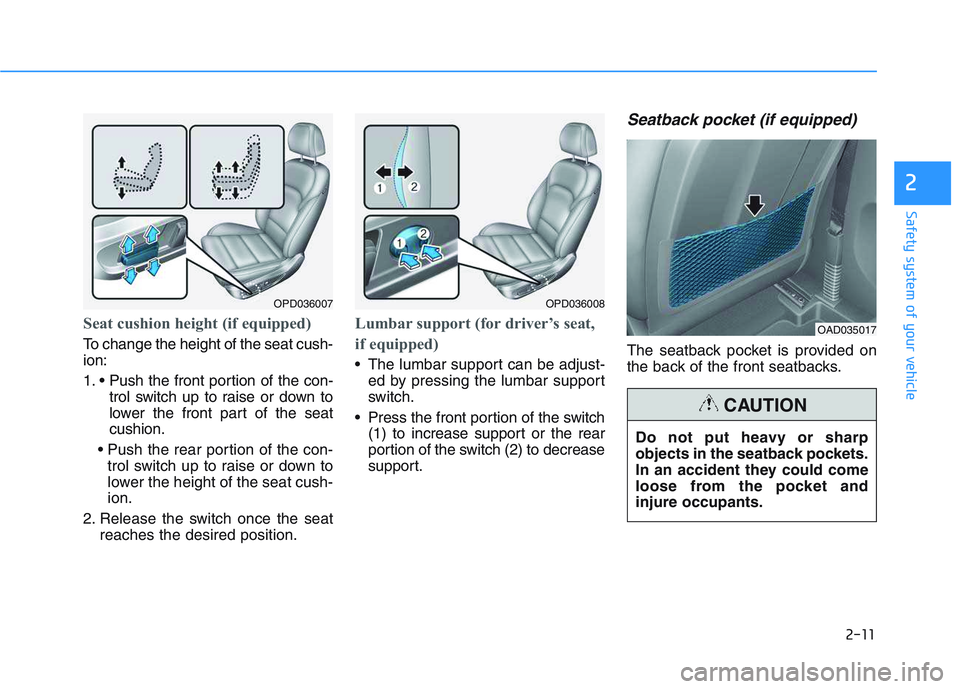
Seat cushion height (if equipped)
To change the height of the seat cush-
ion:
1. trol switch up to raise or down to
lower the front part of the seat
cushion.
trol switch up to raise or down to
lower the height of the seat cush-
ion.
2. Release the switch once the seat reaches the desired position.
Lumbar support (for driver’s seat,
if equipped)
The lumbar support can be adjust-ed by pressing the lumbar support
switch.
Press the front portion of the switch (1) to increase support or the rear
portion of the switch (2) to decrease
support.
Seatback pocket (if equipped)
The seatback pocket is provided on
the back of the front seatbacks.
OPD036007OPD036008
OAD035017
Do not put heavy or sharp
objects in the seatback pockets.
In an accident they could come
loose from the pocket and
injure occupants.
CAUTION
Page 32 of 659
2-12
Safety system of your vehicle
Rear seats
Folding the rear seat
The rear seatbacks can be folded to
facilitate carrying long items or to
increase the luggage capacity of the
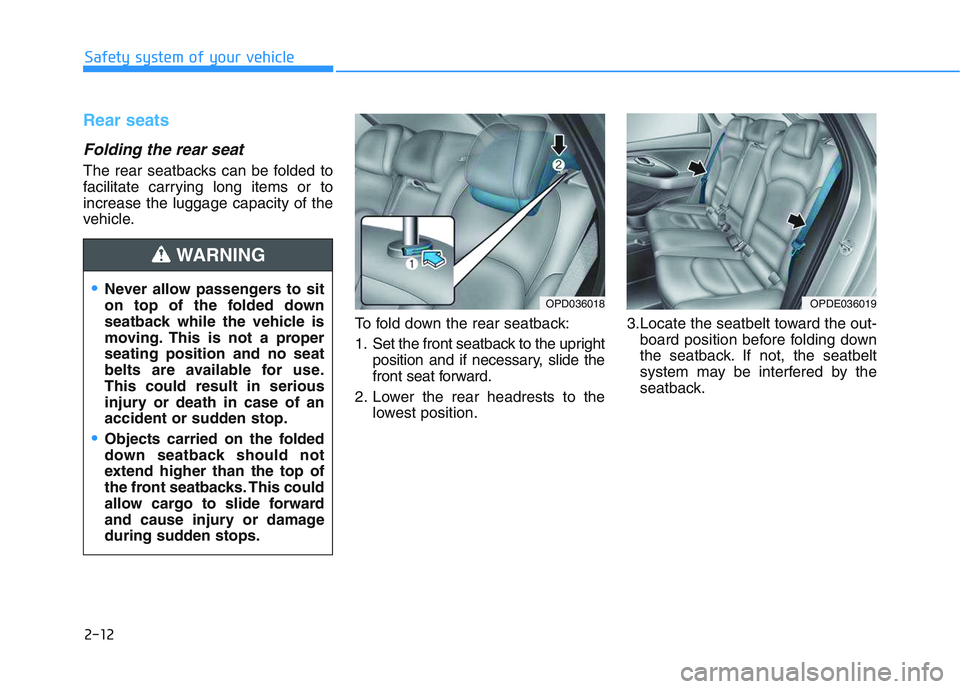
vehicle.To fold down the rear seatback:
1. Set the front seatback to the uprightposition and if necessary, slide the
front seat forward.
2. Lower the rear headrests to the lowest position. 3.Locate the seatbelt toward the out-
board position before folding down
the seatback. If not, the seatbelt
system may be interfered by the
seatback.
Never allow passengers to sit
on top of the folded down
seatback while the vehicle is
moving. This is not a proper
seating position and no seat
belts are available for use.
This could result in serious
injury or death in case of an
accident or sudden stop.
Objects carried on the folded
down seatback should not
extend higher than the top of
the front seatbacks. This could
allow cargo to slide forward
and cause injury or damage
during sudden stops.
WARNING
OPD036018OPDE036019
Page 33 of 659
2-13
Safety system of your vehicle
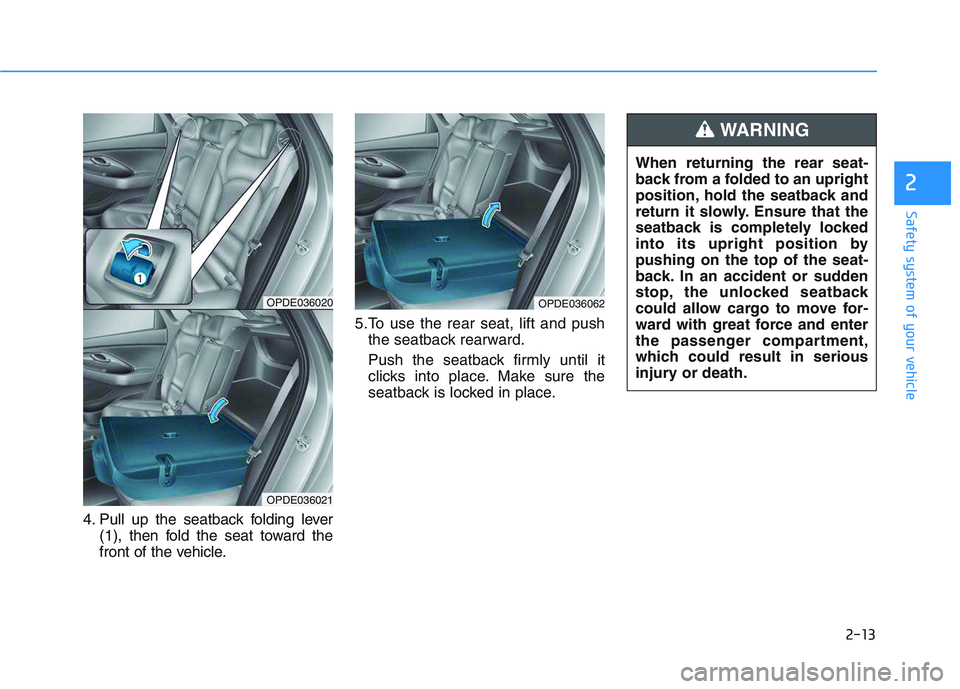
4. Pull up the seatback folding lever(1), then fold the seat toward the
front of the vehicle. 5.To use the rear seat, lift and push
the seatback rearward.
Push the seatback firmly until it
clicks into place. Make sure the
seatback is locked in place.
2
OPDE036062OPDE036020
OPDE036021
When returning the rear seat-
back from a folded to an upright
position, hold the seatback and
return it slowly. Ensure that the
seatback is completely locked
into its upright position by
pushing on the top of the seat-
back. In an accident or sudden
stop, the unlocked seatback
could allow cargo to move for-
ward with great force and enter
the passenger compartment,
which could result in serious
injury or death.
WARNING
Page 34 of 659
2-14
Armrest (if equipped)
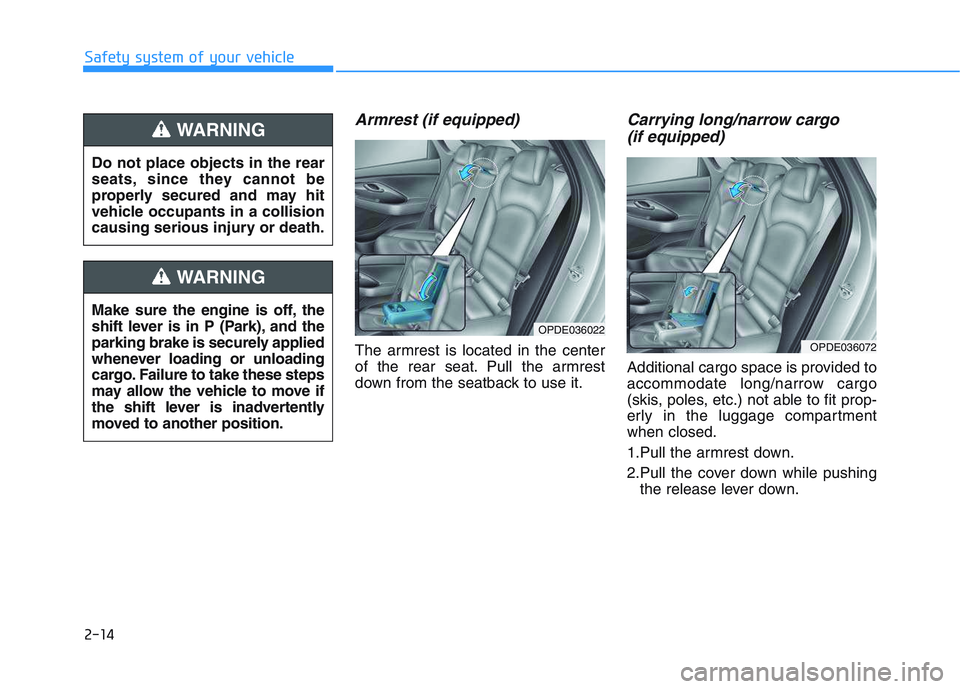
The armrest is located in the center
of the rear seat. Pull the armrest
down from the seatback to use it.
Carrying long/narrow cargo (if equipped)
Additional cargo space is provided to
accommodate long/narrow cargo
(skis, poles, etc.) not able to fit prop-
erly in the luggage compartment
when closed.
1.Pull the armrest down.
2.Pull the cover down while pushing
the release lever down.
Safety system of your vehicle
Do not place objects in the rear
seats, since they cannot be
properly secured and may hit
vehicle occupants in a collision
causing serious injury or death.
WARNING
Make sure the engine is off, the
shift lever is in P (Park), and the
parking brake is securely applied
whenever loading or unloading
cargo. Failure to take these steps
may allow the vehicle to move if
the shift lever is inadvertently
moved to another position.
WARNING
OPDE036022
OPDE036072
Page 35 of 659
2-15
Safety system of your vehicle
2
Headrest
The vehicle’s front and rear seats have
adjustable headrests. The headrests
provide comfort for passengers, but
more importantly they are designed to
help protect passengers from whiplash
and other neck and spinal injuries dur-
ing an accident, especially in a rear
impact collision.To reduce the risk of serious
injury or death in an accident,
take the following precautions
when adjusting your headrests:
Always properly adjust the
headrests for all passengers
BEFORE starting the vehicle.
NEVER let anyone ride in a seat
with the headrest removed. (Continued)
(Continued)
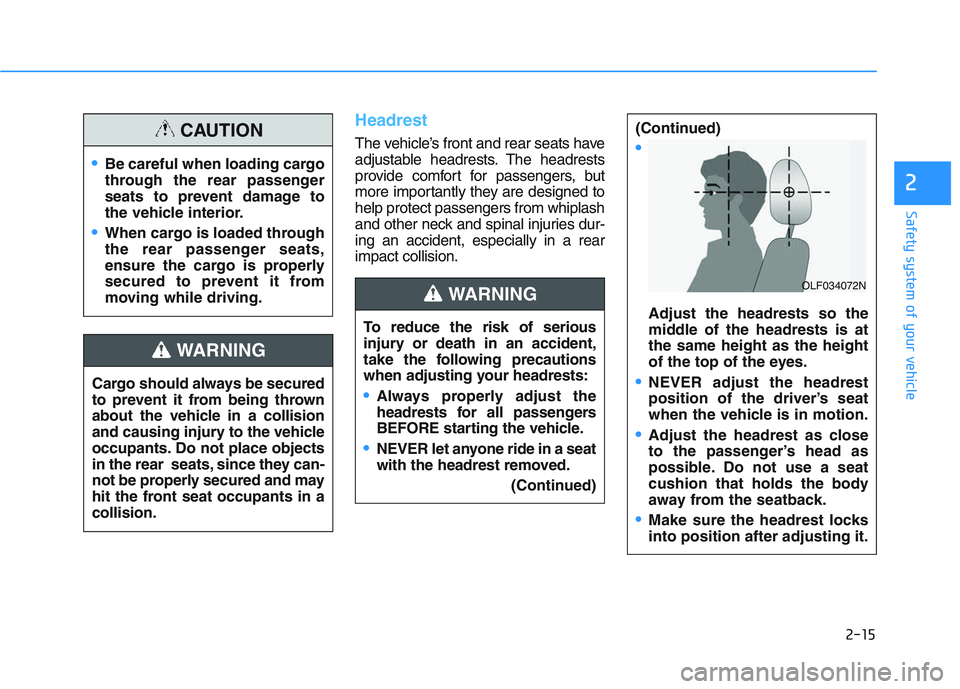
Adjust the headrests so the
middle of the headrests is at
the same height as the height
of the top of the eyes.
NEVER adjust the headrest
position of the driver’s seat
when the vehicle is in motion.
Adjust the headrest as close
to the passenger’s head as
possible. Do not use a seat
cushion that holds the body
away from the seatback.
Make sure the headrest locks
into position after adjusting it.
WARNING OLF034072N
Cargo should always be secured
to prevent it from being thrown
about the vehicle in a collision
and causing injury to the vehicle
occupants. Do not place objects
in the rear seats, since they can-
not be properly secured and may
hit the front seat occupants in a
collision.
WARNING
Be careful when loading cargo
through the rear passenger
seats to prevent damage to
the vehicle interior.
When cargo is loaded through
the rear passenger seats,
ensure the cargo is properly
secured to prevent it from
moving while driving.
CAUTION
Page 42 of 659
2-22
Safety system of your vehicle
This section describes how to use the
seat belts properly. It also describes
some of the things not to do when
using seat belts.
Seat belt safety precautions
Always fasten your seat belt and
make sure all passengers have fas-
tened their seat belts before starting
any trip. Air bags are designed to
supplement the seat belt as an addi-
tional safety device, but they are not a
substitute. Most countries require all
occupants of a vehicle to wear seat
belts.
S
S E
E A
A T
T
B
B E
E L
L T
T S
S
Seat belts must be used by ALL
passengers whenever the vehi-
cle is moving. Take the following
precautions when adjusting and
wearing seat belts:
Children under the age of 13
should be properly restrained
in the rear seats.
Never allow children to ride in
the front passenger seat, unless
the air bag is deactivated. If a
child is seated in the front pas-
senger seat, move the seat as
far back as possible and prop-
erly restrain them in the seat.
NEVER allow an infant or child
to be carried on an occupant’s
lap.
NEVER ride with the seatback
reclined when the vehicle is
moving.
Do not allow children to share
a seat or seat belt.
(Continued)
WARNING (Continued)
Do not wear the shoulder belt
under your arm or behind your
back.
Never wear a seat belt over
fragile objects. If there is a sud-
den stop or impact, the seat
belt can damage it.
Do not use the seat belt if it is
twisted. A twisted seat belt
will not protect you properly
in an accident.
Do not use a seat belt if the
webbing or hardware is dam-
aged.
Do not latch the seat belt into
the buckles of other seats.
NEVER unfasten the seat belt
while driving. This may cause
loss of vehicle control result-
ing in an accident.
Make sure there is nothing in
the buckle interfering with the
seat belt latch mechanism.
This may prevent the seat belt
from fastening securely.(Continued)
Page 43 of 659
2-23
Safety system of your vehicle
2
Seat belt warning light
Seat belt warning
Driver’s seat belt warning
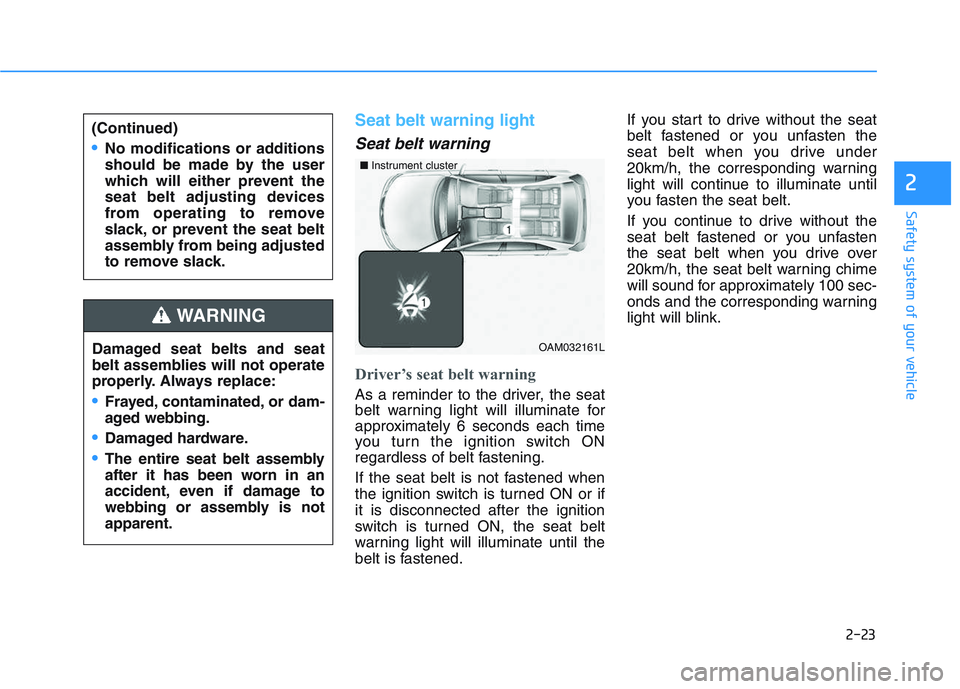
As a reminder to the driver, the seat
belt warning light will illuminate for
approximately 6 seconds each time
you turn the ignition switch ON
regardless of belt fastening.
If the seat belt is not fastened when
the ignition switch is turned ON or if
it is disconnected after the ignition
switch is turned ON, the seat belt
warning light will illuminate until the
belt is fastened.If you start to drive without the seat
belt fastened or you unfasten the
seat belt when you drive under
20km/h, the corresponding warning
light will continue to illuminate until
you fasten the seat belt.
If you continue to drive without the
seat belt fastened or you unfasten
the seat belt when you drive over
20km/h, the seat belt warning chime
will sound for approximately 100 sec-
onds and the corresponding warning
light will blink.
Damaged seat belts and seat
belt assemblies will not operate
properly. Always replace:Frayed, contaminated, or dam-
aged webbing.
Damaged hardware.
The entire seat belt assembly
after it has been worn in an
accident, even if damage to
webbing or assembly is not
apparent.
WARNING
(Continued)
No modifications or additions
should be made by the user
which will either prevent the
seat belt adjusting devices
from operating to remove
slack, or prevent the seat belt
assembly from being adjusted
to remove slack.
OAM032161L
■
Instrument cluster
Page 46 of 659
2-26
Safety system of your vehicle
If you are not able to smoothly pull
enough of the seat belt out from
the retractor, firmly pull the seat
belt out and release it. After
release, you will be able to pull the
belt out smoothly.
Height adjustment
You can adjust the height of the
shoulder belt anchor to one of the
four different positions for maximum
comfort and safety.
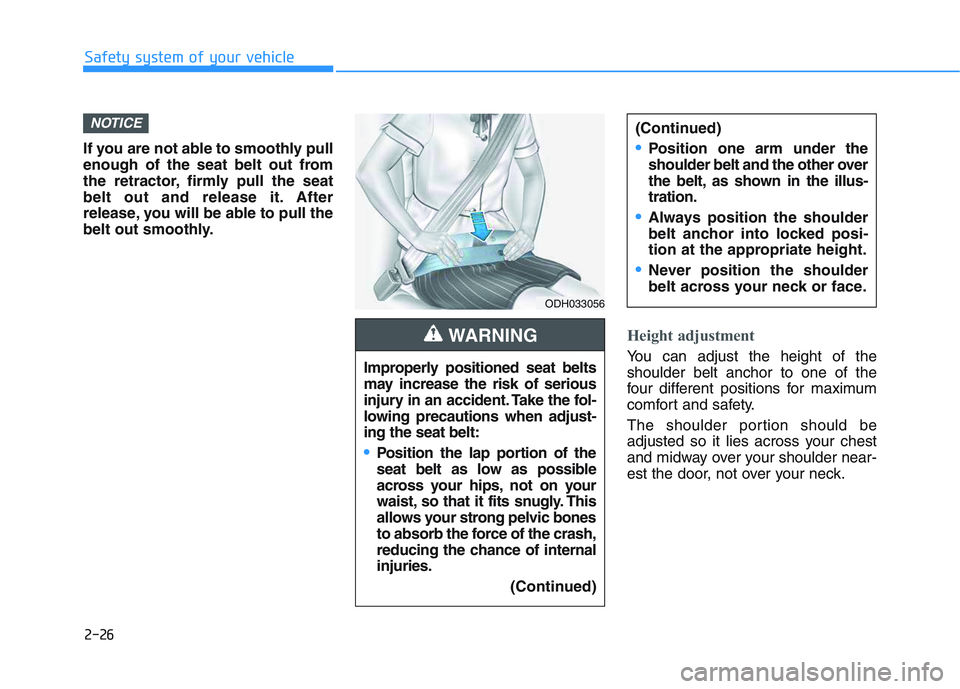
The shoulder portion should be
adjusted so it lies across your chest
and midway over your shoulder near-
est the door, not over your neck.
NOTICE
ODH033056
Improperly positioned seat belts
may increase the risk of serious
injury in an accident. Take the fol-
lowing precautions when adjust-
ing the seat belt:
Position the lap portion of the
seat belt as low as possible
across your hips, not on your
waist, so that it fits snugly. This
allows your strong pelvic bones
to absorb the force of the crash,
reducing the chance of internal
injuries. (Continued)
WARNING
(Continued)
Position one arm under the
shoulder belt and the other over
the belt, as shown in the illus-
tration.
Always position the shoulder
belt anchor into locked posi-
tion at the appropriate height.
Never position the shoulder
belt across your neck or face.
Page 49 of 659
2-29
Safety system of your vehicle
2
When the vehicle stops suddenly, or
if the occupant tries to lean forward
too quickly, the seat belt retractor will
lock into position. In certain frontal
collisions, the pre-tensioner will acti-
vate and pull the seat belt into tighter
contact against the occupant's body.
If the system senses excessive tension
on the driver or passenger's seat belt
when the pre-tensioner system acti-
vates, the load limiter inside the retrac-
tor pre-tensioner will release some of
the pressure on the affected seat belt.Do not touch the pre-tensioner
seat belt assemblies for several
minutes after they have been
activated. When the pre-ten-
sioner seat belt mechanism
deploys during a collision, the
pre-tensioner can become hot
and can burn you.WARNING
Body work on the front area of
the vehicle may damage the
pre-tensioner seat belt system.
Therefore, we recommend the
system to be serviced by an
authorized HYUNDAI dealer.
CAUTION
Always wear your seat belt and
sit properly in your seat.
Do not use the seat belt if it is
loose or twisted. A loose or
twisted seat belt will not pro-
tect you properly in an acci-
dent.
Do not place anything near the
buckle. This may adversely
affect the buckle and cause it
to function improperly.
Always replace your pre-ten-
sioners after activation or an
accident.
NEVER inspect, service, repair
or replace the pre-tensioners
yourself. This must be done by
an authorized HYUNDAI dealer.
Do not hit the seat belt assem-
blies.
WARNING
Page 50 of 659
2-30
Safety system of your vehicle
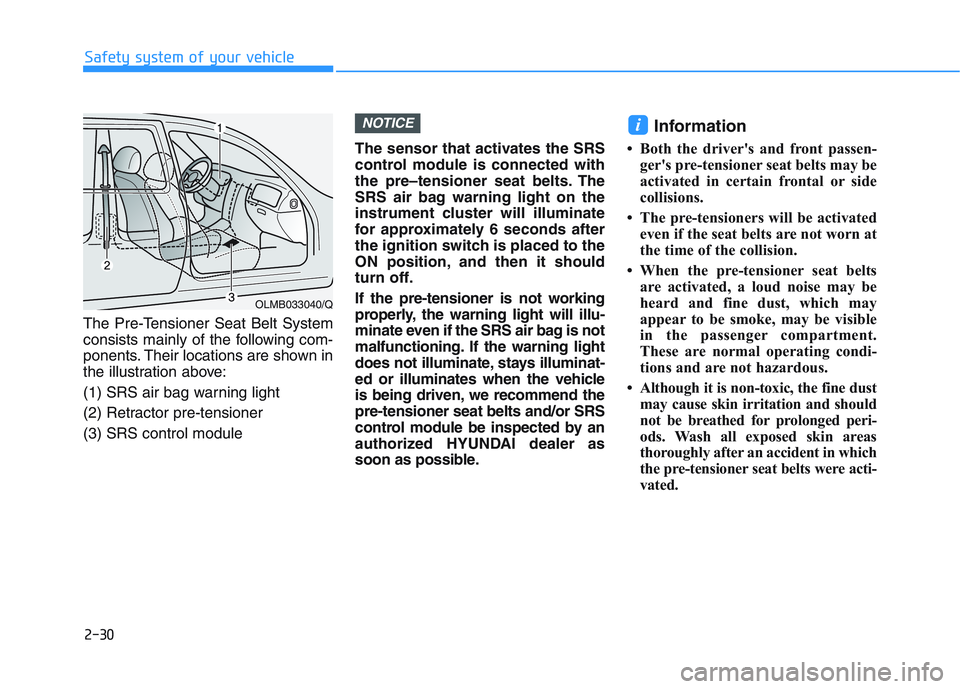
The Pre-Tensioner Seat Belt System
consists mainly of the following com-
ponents. Their locations are shown in
the illustration above:
(1) SRS air bag warning light
(2) Retractor pre-tensioner
(3) SRS control module The sensor that activates the SRS
control module is connected with
the pre–tensioner seat belts. The
SRS air bag warning light on the
instrument cluster will illuminate
for approximately 6 seconds after
the ignition switch is placed to the
ON position, and then it should
turn off.
If the pre-tensioner is not working
properly, the warning light will illu-
minate even if the SRS air bag is not
malfunctioning. If the warning light
does not illuminate, stays illuminat-
ed or illuminates when the vehicle
is being driven, we recommend the
pre-tensioner seat belts and/or SRS
control module be inspected by an
authorized HYUNDAI dealer as
soon as possible.
Information
• Both the driver's and front passen-
ger's pre-tensioner seat belts may be
activated in certain frontal or side
collisions.
• The pre-tensioners will be activated even if the seat belts are not worn at
the time of the collision.
• When the pre-tensioner seat belts are activated, a loud noise may be
heard and fine dust, which may
appear to be smoke, may be visible
in the passenger compartment.
These are normal operating condi-
tions and are not hazardous.
• Although it is non-toxic, the fine dust may cause skin irritation and should
not be breathed for prolonged peri-
ods. Wash all exposed skin areas
thoroughly after an accident in which
the pre-tensioner seat belts were acti-
vated.
iNOTICE
OLMB033040/Q