Drive HYUNDAI I30 2023 User Guide
[x] Cancel search | Manufacturer: HYUNDAI, Model Year: 2023, Model line: I30, Model: HYUNDAI I30 2023Pages: 533, PDF Size: 59.13 MB
Page 29 of 533
2-8
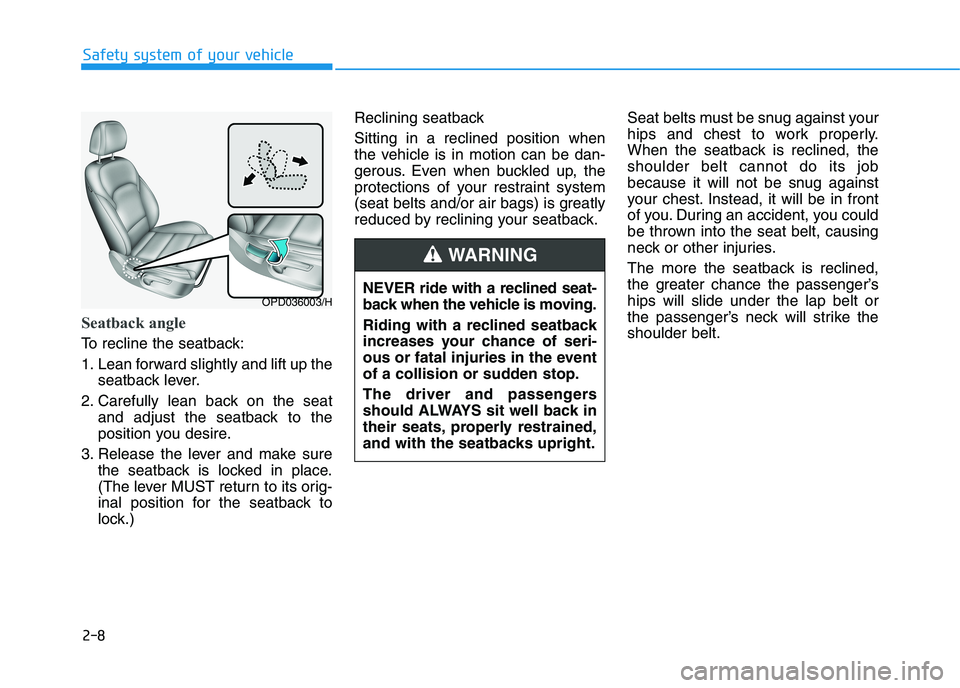
Seatback angle
To recline the seatback:
1. Lean forward slightly and lift up the
seatback lever.
2. Carefully lean back on the seat
and adjust the seatback to the
position you desire.
3. Release the lever and make sure
the seatback is locked in place.
(The lever MUST return to its orig-
inal position for the seatback to
lock.)Reclining seatback
Sitting in a reclined position when
the vehicle is in motion can be dan-
gerous. Even when buckled up, the
protections of your restraint system
(seat belts and/or air bags) is greatly
reduced by reclining your seatback.Seat belts must be snug against your
hips and chest to work properly.
When the seatback is reclined, the
shoulder belt cannot do its job
because it will not be snug against
your chest. Instead, it will be in front
of you. During an accident, you could
be thrown into the seat belt, causing
neck or other injuries.
The more the seatback is reclined,
the greater chance the passenger’s
hips will slide under the lap belt or
the passenger’s neck will strike the
shoulder belt.
Safety system of your vehicle
OPD036003/HNEVER ride with a reclined seat-
back when the vehicle is moving.
Riding with a reclined seatback
increases your chance of seri-
ous or fatal injuries in the event
of a collision or sudden stop.
The driver and passengers
should ALWAYS sit well back in
their seats, properly restrained,
and with the seatbacks upright.
WARNING
Page 30 of 533
2-9
Safety system of your vehicle
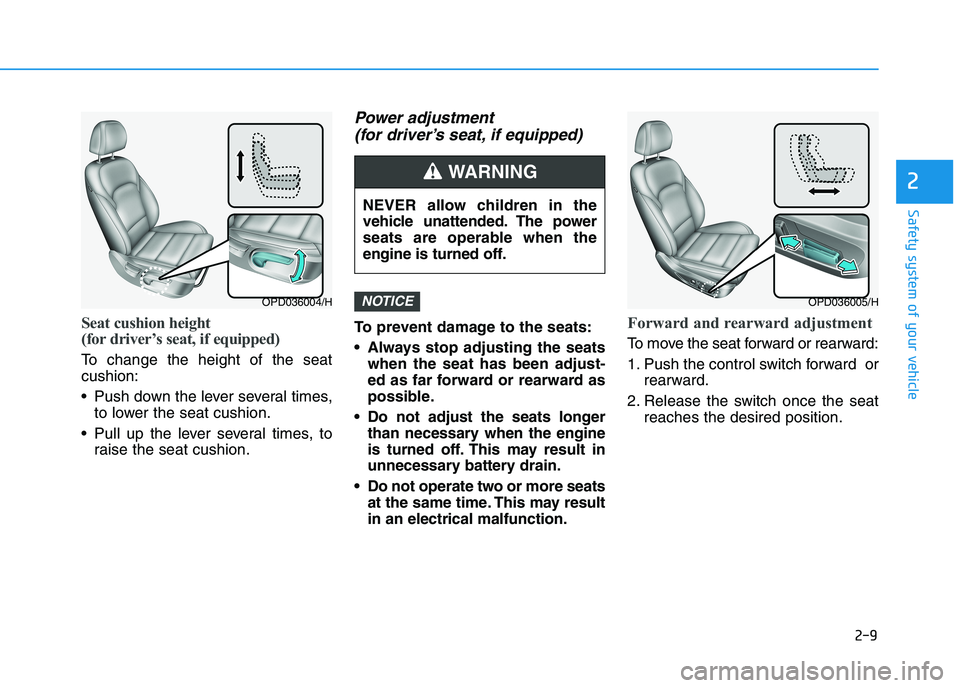
Seat cushion height
(for driver’s seat, if equipped)
To change the height of the seat
cushion:
Push down the lever several times,
to lower the seat cushion.
Pull up the lever several times, to
raise the seat cushion.
Power adjustment
(for driver’s seat, if equipped)
To prevent damage to the seats:
Always stop adjusting the seats
when the seat has been adjust-
ed as far forward or rearward as
possible.
Do not adjust the seats longer
than necessary when the engine
is turned off. This may result in
unnecessary battery drain.
Do not operate two or more seats
at the same time. This may result
in an electrical malfunction.Forward and rearward adjustment
To move the seat forward or rearward:
1. Push the control switch forward or
rearward.
2. Release the switch once the seat
reaches the desired position.
NOTICE
2
OPD036004/H
NEVER allow children in the
vehicle unattended. The power
seats are operable when the
engine is turned off.
WARNING
OPD036005/H
Page 31 of 533
2-10
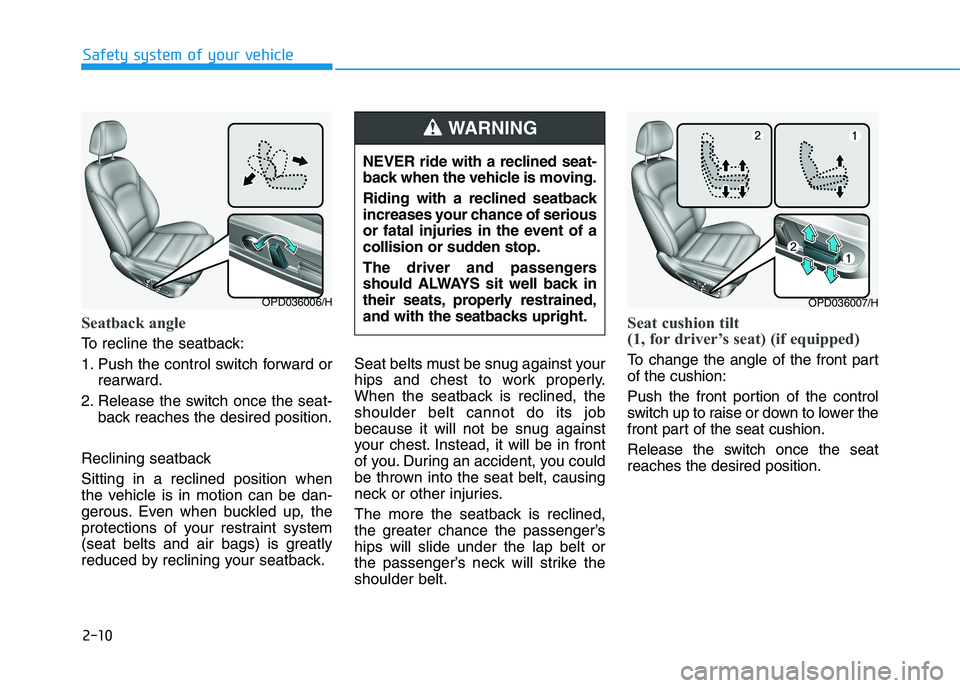
Seatback angle
To recline the seatback:
1. Push the control switch forward or
rearward.
2. Release the switch once the seat-
back reaches the desired position.
Reclining seatback
Sitting in a reclined position when
the vehicle is in motion can be dan-
gerous. Even when buckled up, the
protections of your restraint system
(seat belts and air bags) is greatly
reduced by reclining your seatback.Seat belts must be snug against your
hips and chest to work properly.
When the seatback is reclined, the
shoulder belt cannot do its job
because it will not be snug against
your chest. Instead, it will be in front
of you. During an accident, you could
be thrown into the seat belt, causing
neck or other injuries.
The more the seatback is reclined,
the greater chance the passenger’s
hips will slide under the lap belt or
the passenger’s neck will strike the
shoulder belt.
Seat cushion tilt
(1, for driver’s seat) (if equipped)
To change the angle of the front part
of the cushion:
Push the front portion of the control
switch up to raise or down to lower the
front part of the seat cushion.
Release the switch once the seat
reaches the desired position.
Safety system of your vehicle
NEVER ride with a reclined seat-
back when the vehicle is moving.
Riding with a reclined seatback
increases your chance of serious
or fatal injuries in the event of a
collision or sudden stop.
The driver and passengers
should ALWAYS sit well back in
their seats, properly restrained,
and with the seatbacks upright.
WARNING
OPD036006/HOPD036007/H
Page 32 of 533
2-11
Safety system of your vehicle
2
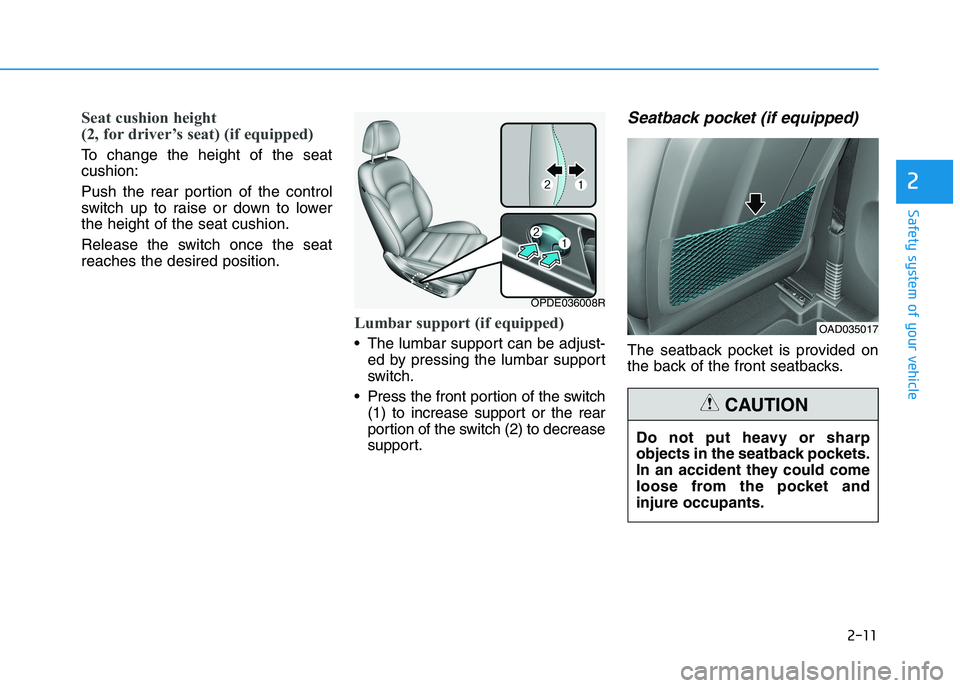
Seat cushion height
(2, for driver’s seat) (if equipped)
To change the height of the seat
cushion:
Push the rear portion of the control
switch up to raise or down to lower
the height of the seat cushion.
Release the switch once the seat
reaches the desired position.
Lumbar support (if equipped)
The lumbar support can be adjust-
ed by pressing the lumbar support
switch.
Press the front portion of the switch
(1) to increase support or the rear
portion of the switch (2) to decrease
support.
Seatback pocket (if equipped)
The seatback pocket is provided on
the back of the front seatbacks.
OPDE036008R
OAD035017
Do not put heavy or sharp
objects in the seatback pockets.
In an accident they could come
loose from the pocket and
injure occupants.
CAUTION
Page 36 of 533
2-15
Safety system of your vehicle
2
Armrest (if equipped)
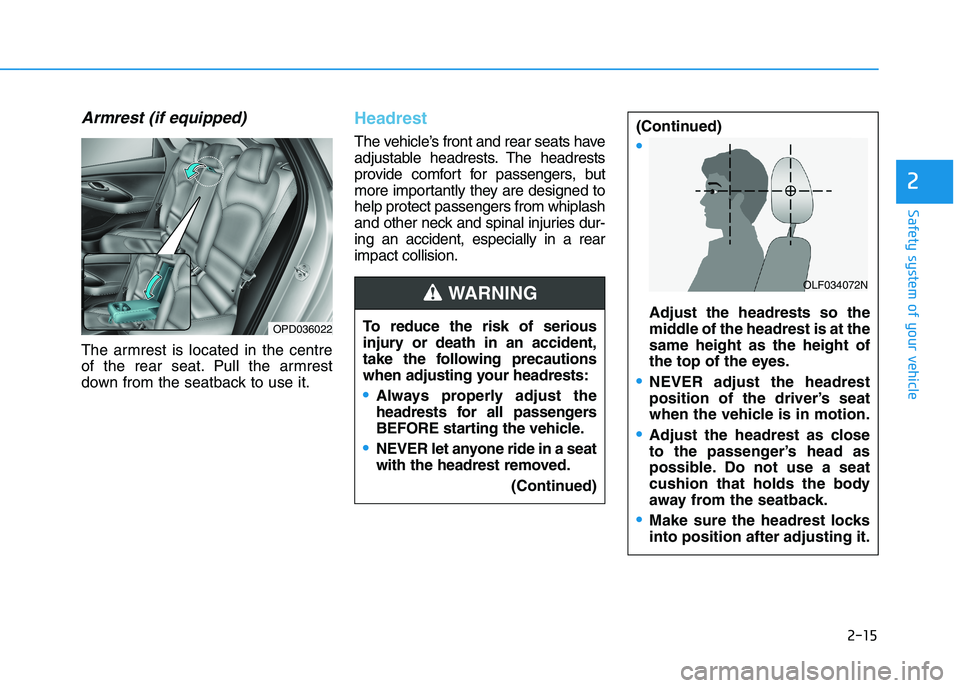
The armrest is located in the centre
of the rear seat. Pull the armrest
down from the seatback to use it.
Headrest
The vehicle’s front and rear seats have
adjustable headrests. The headrests
provide comfort for passengers, but
more importantly they are designed to
help protect passengers from whiplash
and other neck and spinal injuries dur-
ing an accident, especially in a rear
impact collision.
To reduce the risk of serious
injury or death in an accident,
take the following precautions
when adjusting your headrests:
Always properly adjust the
headrests for all passengers
BEFORE starting the vehicle.
NEVER let anyone ride in a seat
with the headrest removed.
(Continued)
(Continued)
Adjust the headrests so the
middle of the headrest is at the
same height as the height of
the top of the eyes.
NEVER adjust the headrest
position of the driver’s seat
when the vehicle is in motion.
Adjust the headrest as close
to the passenger’s head as
possible. Do not use a seat
cushion that holds the body
away from the seatback.
Make sure the headrest locks
into position after adjusting it.
WARNING OLF034072N
OPD036022
Page 37 of 533
2-16
Safety system of your vehicle
To prevent damage, NEVER hit or
pull on the headrests.
Front seat headrests
The driver’s and front passenger’s
seats are equipped with adjustable
headrests for the passengers safety
and comfort.
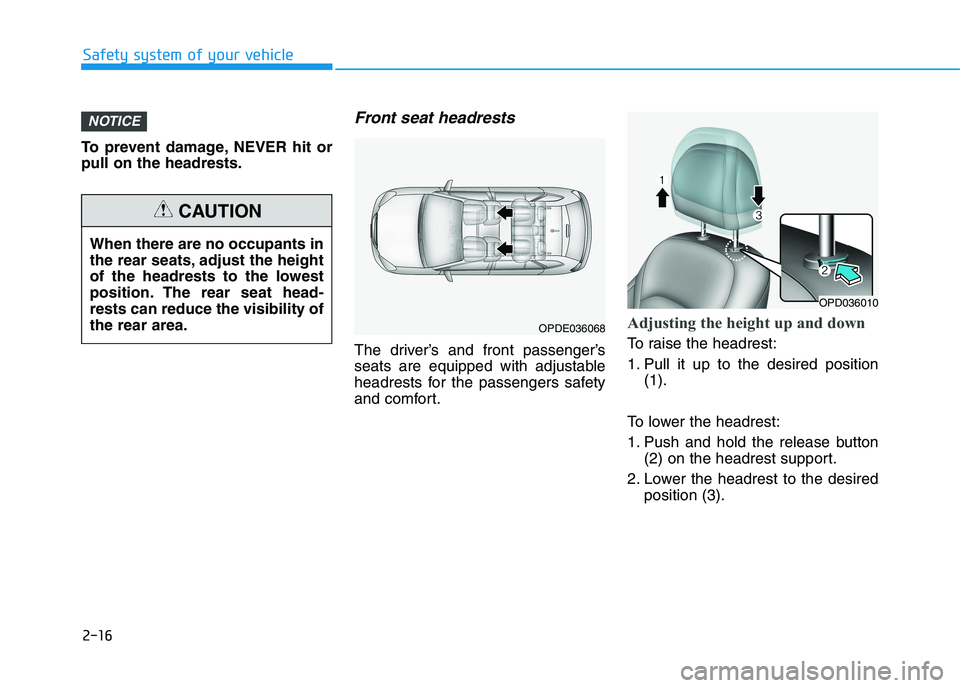
Adjusting the height up and down
To raise the headrest:
1. Pull it up to the desired position
(1).
To lower the headrest:
1. Push and hold the release button
(2) on the headrest support.
2. Lower the headrest to the desired
position (3).
NOTICE
OPDE036068
OPD036010
When there are no occupants in
the rear seats, adjust the height
of the headrests to the lowest
position. The rear seat head-
rests can reduce the visibility of
the rear area.
CAUTION
Page 42 of 533

2-21
Safety system of your vehicle
2
Front air ventilation seat
(if equipped)
The air ventilation seats are provided
to cool the front seats by blowing air
through small vent holes on the sur-
face of the seat cushions and seat-
backs.
When the operation of the air ventila-
tion seat is not needed, keep the
switches in the OFF position.
Whilst the engine is running, push
the switch to cool the driver's seat or
the front passenger's seat. Each time you push the switch, the
airflow changes as follows:
When pressing the switch for more
than 1.5 seconds with the air venti-
lation seat operating, the operation
will turn OFF.
The air ventilation seats default to
the OFF position whenever the
ignition switch is placed in the ON
position.
To prevent damage to the air ven-
tilation seat:
Use the air ventilation seat ONLY
when the climate control system
is on. Using the air ventilation
seat for prolonged periods of
time with the climate control sys-
tem off could cause the air venti-
lation seat to malfunction.
(Continued)(Continued)
Never use a solvent such as paint
thinner, benzene, alcohol or
petrol to clean the seats.
Avoid spilling liquids on the sur-
face of the front seats and seat-
backs; this may cause the air vent
holes to become blocked and not
work properly.
Do not place materials such as
plastic bags or newspapers under
the seats. They may block the air
intake causing the air vents to not
work properly.
Do not change the seat covers. It
may damage the air ventilation
seat.
If the air vents do not operate,
restart the vehicle. If there is no
change, we recommend that you
have your vehicle inspected by
an authorisedHYUNDAI dealer.NOTICE
OFF HIGH ( )
LOW ( ) MIDDLE ( )
→→
→
→
OPDE036016R
Page 45 of 533
2-24
Safety system of your vehicle
Seat belt warning light
Seat belt warning
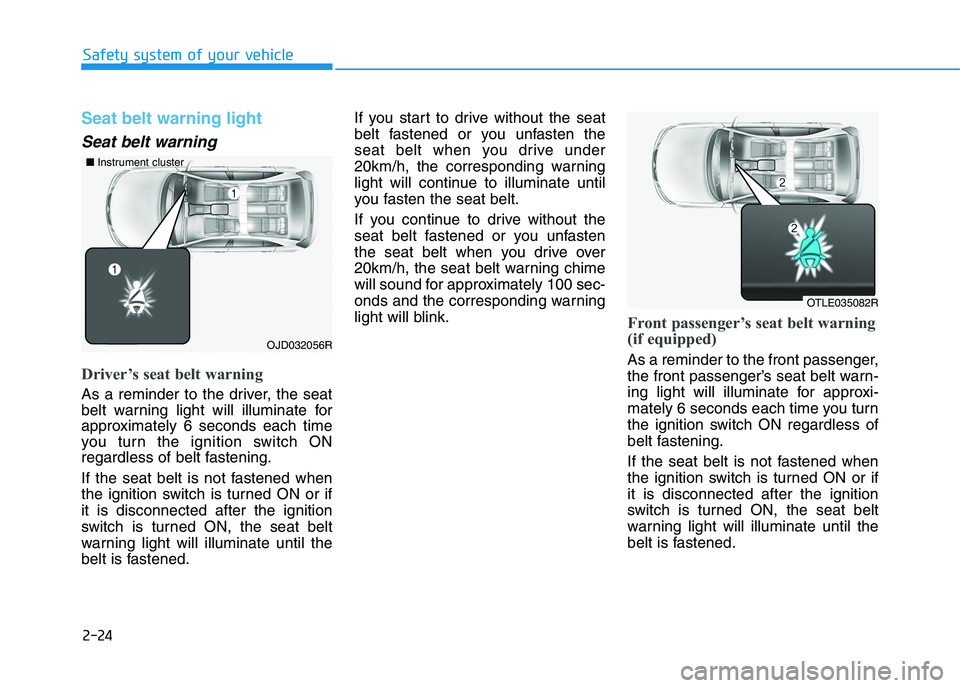
Driver’s seat belt warning
As a reminder to the driver, the seat
belt warning light will illuminate for
approximately 6 seconds each time
you turn the ignition switch ON
regardless of belt fastening.
If the seat belt is not fastened when
the ignition switch is turned ON or if
it is disconnected after the ignition
switch is turned ON, the seat belt
warning light will illuminate until the
belt is fastened.If you start to drive without the seat
belt fastened or you unfasten the
seat belt when you drive under
20km/h, the corresponding warning
light will continue to illuminate until
you fasten the seat belt.
If you continue to drive without the
seat belt fastened or you unfasten
the seat belt when you drive over
20km/h, the seat belt warning chime
will sound for approximately 100 sec-
onds and the corresponding warning
light will blink.
Front passenger’s seat belt warning
(if equipped)
As a reminder to the front passenger,
the front passenger’s seat belt warn-
ing light will illuminate for approxi-
mately 6 seconds each time you turn
the ignition switch ON regardless of
belt fastening.
If the seat belt is not fastened when
the ignition switch is turned ON or if
it is disconnected after the ignition
switch is turned ON, the seat belt
warning light will illuminate until the
belt is fastened.
OTLE035082R
OJD032056R ■Instrument cluster
Page 46 of 533
2-25
Safety system of your vehicle
2
If you start to drive without the seat
belt fastened or you unfasten the
seat belt when you drive under
20km/h, the corresponding warning
light will continue to illuminate until
you fasten the seat belt.
If you continue to drive without the
seat belt fastened or you unfasten
the seat belt when you drive over
20km/h, the seat belt warning chime
will sound for approximately 100 sec-
onds and the corresponding warning
light will blink.Information
• You can find the front passenger’s
seat belt warning light on the centre
fascia panel.
• Even if the front passenger seat is
not occupied, the seat belt warning
light will blink or illuminate for 6
seconds.
• The front passenger's seat belt
warning may operate when luggage
is placed on the front passenger seat.
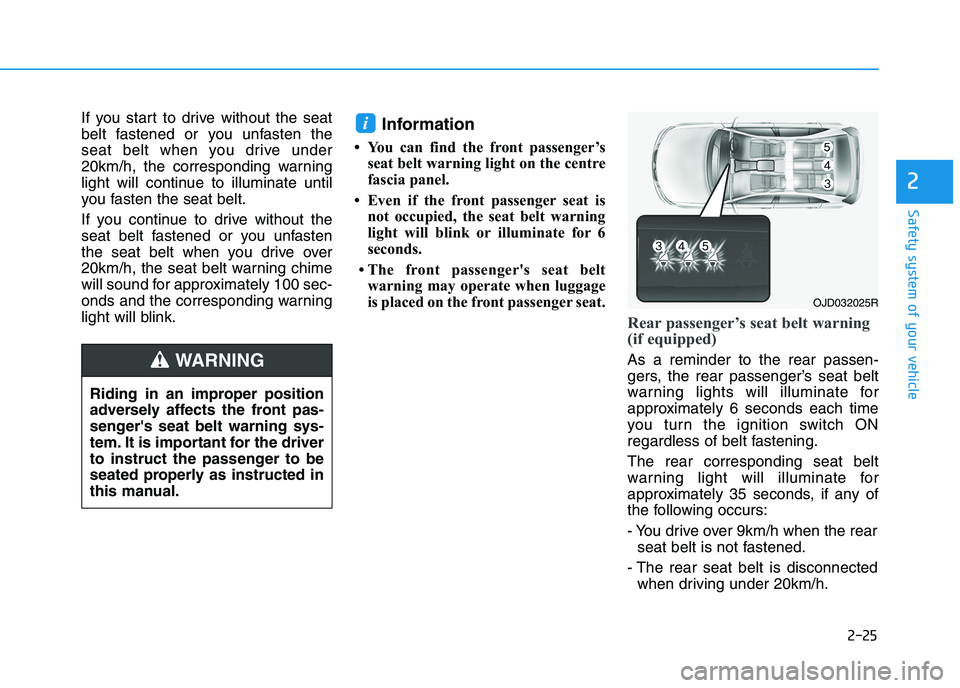
Rear passenger’s seat belt warning
(if equipped)
As a reminder to the rear passen-
gers, the rear passenger’s seat belt
warning lights will illuminate for
approximately 6 seconds each time
you turn the ignition switch ON
regardless of belt fastening.
The rear corresponding seat belt
warning light will illuminate for
approximately 35 seconds, if any of
the following occurs:
- You drive over 9km/h when the rear
seat belt is not fastened.
- The rear seat belt is disconnected
when driving under 20km/h.
i
OJD032025R
Riding in an improper position
adversely affects the front pas-
senger's seat belt warning sys-
tem. It is important for the driver
to instruct the passenger to be
seated properly as instructed in
this manual.
WARNING
Page 47 of 533
2-26
Safety system of your vehicle
If the rear seat belt is fastened, the
warning light will turn off immediately.
If the rear seat belt is disconnected
when you drive over the 20km/h, the
corresponding seat belt warning light
will blink and a warning chime will
sound for 35 seconds.
But, if the rear passenger's lap/shoul-
der belt is/are connected and discon-
nected twice within 9 seconds after
the belt is fastened, the corresponding
seat belt warning light will not operate.
Seat belt restraint system
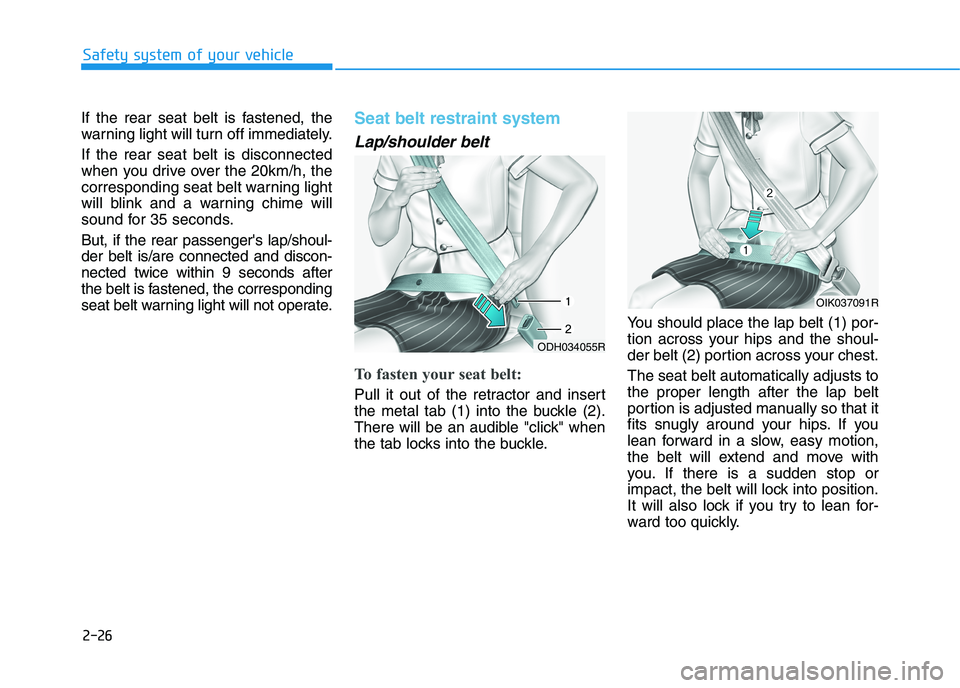
Lap/shoulder belt
To fasten your seat belt:
Pull it out of the retractor and insert
the metal tab (1) into the buckle (2).
There will be an audible "click" when
the tab locks into the buckle.You should place the lap belt (1) por-
tion across your hips and the shoul-
der belt (2) portion across your chest.
The seat belt automatically adjusts to
the proper length after the lap belt
portion is adjusted manually so that it
fits snugly around your hips. If you
lean forward in a slow, easy motion,
the belt will extend and move with
you. If there is a sudden stop or
impact, the belt will lock into position.
It will also lock if you try to lean for-
ward too quickly.
ODH034055R
OIK037091R