Drive HYUNDAI I30 2023 Owners Manual
[x] Cancel search | Manufacturer: HYUNDAI, Model Year: 2023, Model line: I30, Model: HYUNDAI I30 2023Pages: 533, PDF Size: 59.13 MB
Page 520 of 533
7-89
7
Maintenance
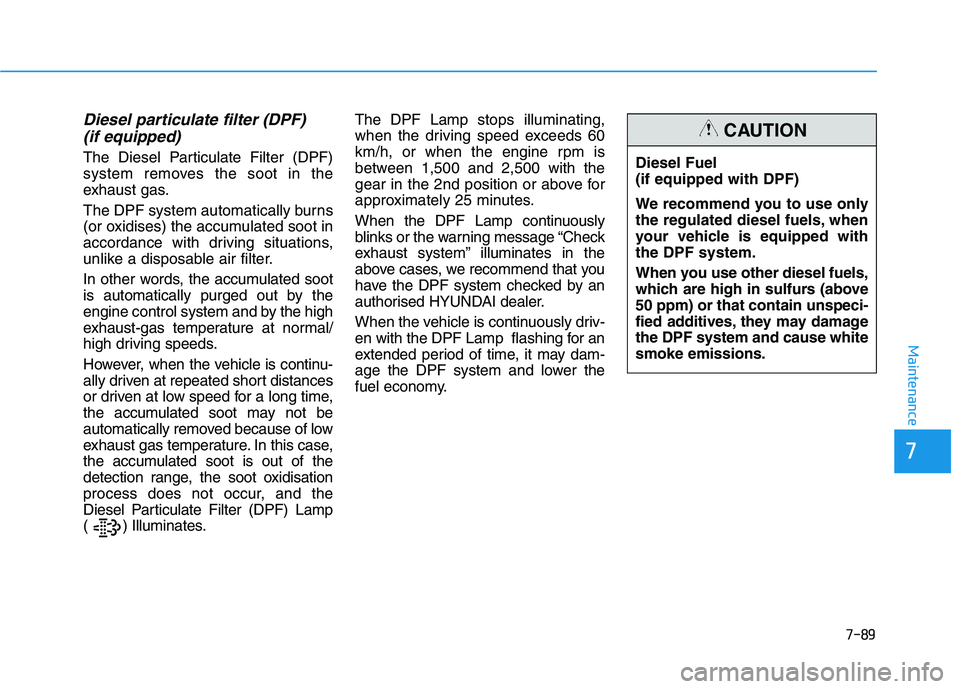
Diesel particulate filter (DPF)
(if equipped)
The Diesel Particulate Filter (DPF)
system removes the soot in the
exhaust gas.
The DPF system automatically burns
(or oxidises) the accumulated soot in
accordance with driving situations,
unlike a disposable air filter.
In other words, the accumulated soot
is automatically purged out by the
engine control system and by the high
exhaust-gas temperature at normal/
high driving speeds.
However, when the vehicle is continu-
ally driven at repeated short distances
or driven at low speed for a long time,
the accumulated soot may not be
automatically removed because of low
exhaust gas temperature. In this case,
the accumulated soot is out of the
detection range, the soot oxidisation
process does not occur, and the
Diesel Particulate Filter (DPF) Lamp
( ) Illuminates.The DPF Lamp stops illuminating,
when the driving speed exceeds 60
km/h, or when the engine rpm is
between 1,500 and 2,500 with the
gear in the 2nd position or above for
approximately 25 minutes.
When the DPF Lamp continuously
blinks or the warning message “Check
exhaust system” illuminates in the
above cases, we recommend that you
have the DPF system checked by an
authorised HYUNDAI dealer.
When the vehicle is continuously driv-
en with the DPF Lamp flashing for an
extended period of time, it may dam-
age the DPF system and lower the
fuel economy.Diesel Fuel
(if equipped with DPF)
We recommend you to use only
the regulated diesel fuels, when
your vehicle is equipped with
the DPF system.
When you use other diesel fuels,
which are high in sulfurs (above
50 ppm) or that contain unspeci-
fied additives, they may damage
the DPF system and cause white
smoke emissions.
CAUTION
Page 525 of 533
8-4
Specifications & Consumer information
T TY
YR
RE
ES
S
A
AN
ND
D
W
WH
HE
EE
EL
LS
S
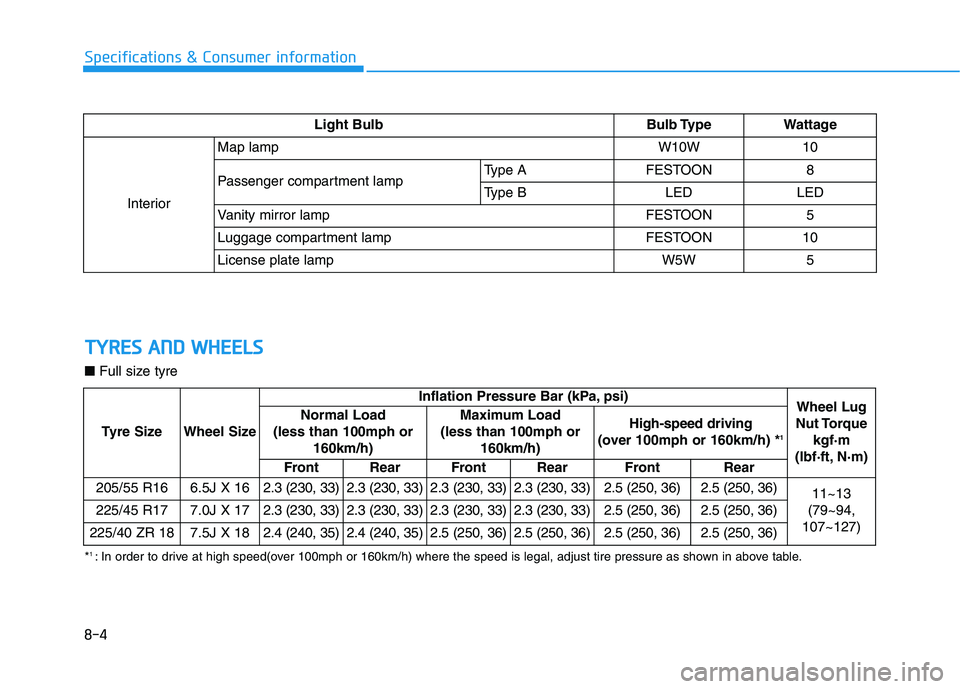
Light BulbBulb TypeWattage
Interior
Map lampW10W10
Passenger compartment lampType AFESTOON8
Type BLEDLED
Vanity mirror lampFESTOON5
Luggage compartment lampFESTOON10
License plate lampW5W5
Tyre Size Wheel SizeInflation Pressure Bar (kPa, psi)
Wheel Lug
Nut Torque
kgf·m
(lbf·ft, N·m) Normal Load
(less than 100mph or
160km/h)Maximum Load
(less than 100mph or
160km/h)High-speed driving
(over 100mph or 160km/h) *1
Front Rear Front Rear Front Rear
205/55 R16 6.5J X 162.3 (230, 33) 2.3 (230, 33) 2.3 (230, 33) 2.3 (230, 33) 2.5 (250, 36) 2.5 (250, 36)
11~13
(79~94,
107~127) 225/45 R17 7.0J X 172.3 (230, 33) 2.3 (230, 33) 2.3 (230, 33) 2.3 (230, 33) 2.5 (250, 36) 2.5 (250, 36)
225/40 ZR 18 7.5J X 182.4 (240, 35) 2.4 (240, 35) 2.5 (250, 36) 2.5 (250, 36) 2.5 (250, 36) 2.5 (250, 36)
■Full size tyre
*1 : In order to drive at high speed(over 100mph or 160km/h) where the speed is legal, adjust tire pressure as shown in above table.
Page 526 of 533
8-5
8
Specifications & Consumer information
When replacing tyres, use the same size originally supplied with the vehicle.
Using tyres of a different size can seriously affect your vehicle's handling.
CAUTION
It is permissible to add 20 kPa (3 psi) to the standard tyre pressure specification if colder temperatures are
expected soon. Tyres typically lose 7 kPa (1 psi) for every 7°C (12°F) temperature drop. If extreme tempera-
ture variations are expected, recheck your tyre pressure as necessary to keep them properly inflated.
An air pressure generally decreases, as you drive up to a high-altitude area above sea level. Thus, if you plan
to drive a high-altitude area, check the tyre pressures in advance. If necessary, inflate them to a proper level
(Air inflation per altitude: +10 kPa/1 km (+2.4 psi/1 mile)).
NOTICE
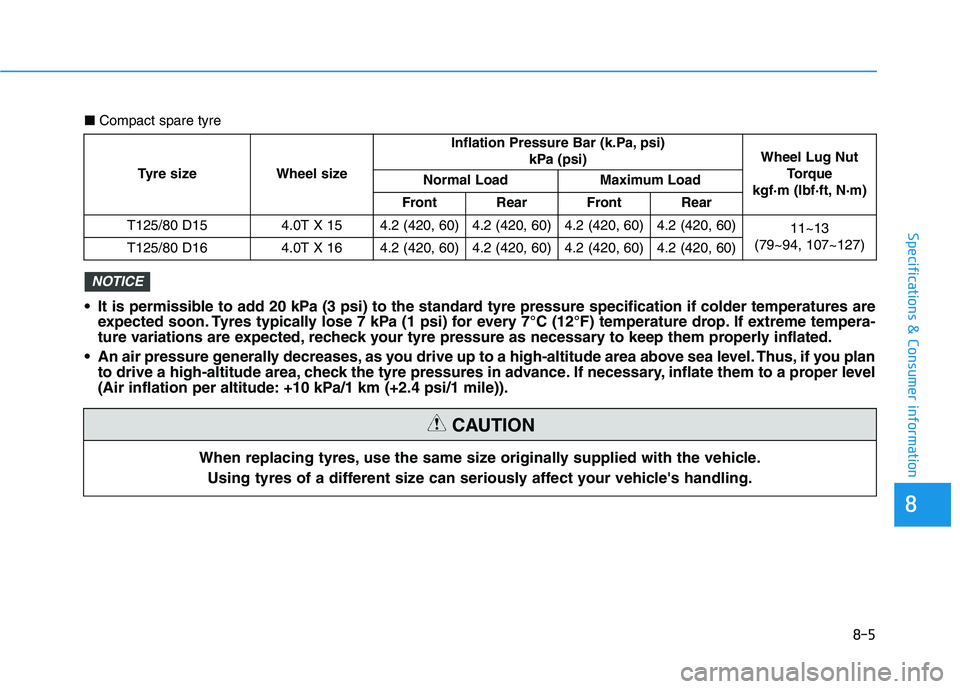
■Compact spare tyre
Tyre size Wheel sizeInflation Pressure Bar (k.Pa, psi)
kPa (psi)Wheel Lug Nut
Torque
kgf·m (lbf·ft, N·m) Normal Load Maximum Load
Front Rear Front Rear
T125/80 D15 4.0T X 15 4.2 (420, 60) 4.2 (420, 60) 4.2 (420, 60) 4.2 (420, 60)
11~13
(79~94, 107~127)
T125/80 D16 4.0T X 16 4.2 (420, 60) 4.2 (420, 60) 4.2 (420, 60) 4.2 (420, 60)
Page 531 of 533
8-10
Specifications & Consumer information
V VE
EH
HI
IC
CL
LE
E
C
CE
ER
RT
TI
IF
FI
IC
CA
AT
TI
IO
ON
N
L LA
AB
BE
EL
L
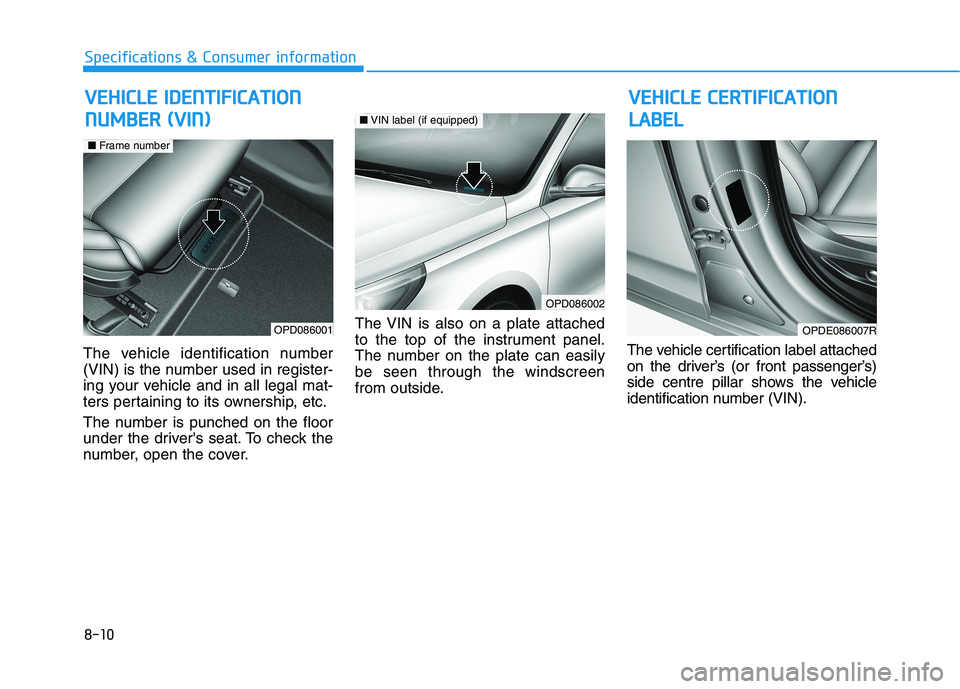
The vehicle identification number
(VIN) is the number used in register-
ing your vehicle and in all legal mat-
ters pertaining to its ownership, etc.
The number is punched on the floor
under the driver's seat. To check the
number, open the cover.The VIN is also on a plate attached
to the top of the instrument panel.
The number on the plate can easily
be seen through the windscreen
from outside.The vehicle certification label attached
on the driver’s (or front passenger’s)
side centre pillar shows the vehicle
identification number (VIN).
OPDE086007ROPD086001
■Frame number
V
VE
EH
HI
IC
CL
LE
E
I
ID
DE
EN
NT
TI
IF
FI
IC
CA
AT
TI
IO
ON
N
N NU
UM
MB
BE
ER
R
(
(V
VI
IN
N)
)
OPD086002
■VIN label (if equipped)
Page 532 of 533
8-11
8
Specifications & Consumer information
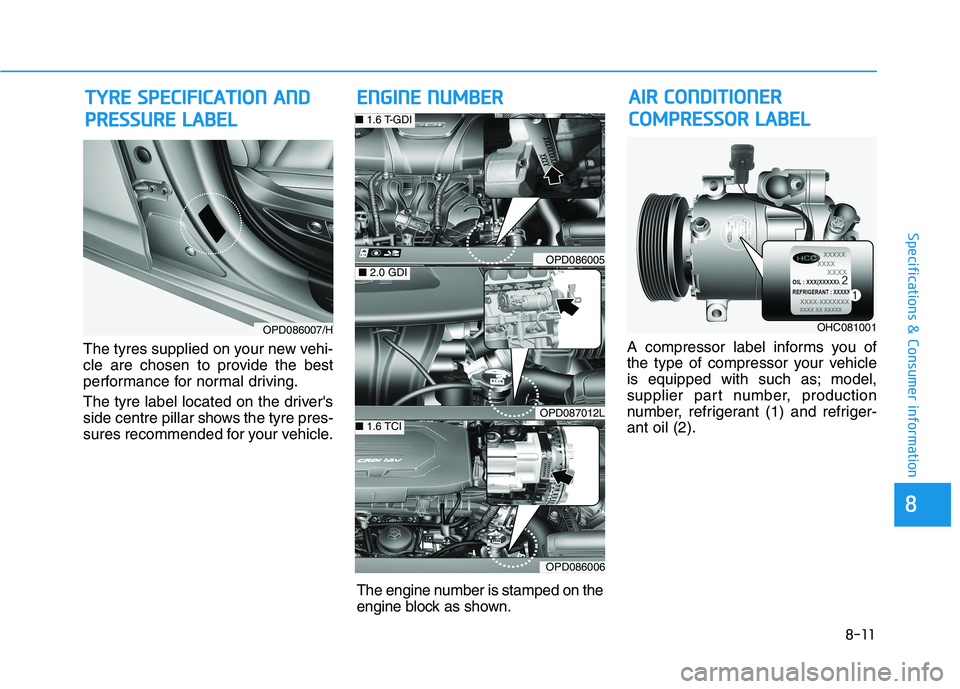
The tyres supplied on your new vehi-
cle are chosen to provide the best
performance for normal driving.
The tyre label located on the driver's
side centre pillar shows the tyre pres-
sures recommended for your vehicle.A compressor label informs you of
the type of compressor your vehicle
is equipped with such as; model,
supplier part number, production
number, refrigerant (1) and refriger-
ant oil (2).
T TY
YR
RE
E
S
SP
PE
EC
CI
IF
FI
IC
CA
AT
TI
IO
ON
N
A
AN
ND
D
P PR
RE
ES
SS
SU
UR
RE
E
L
LA
AB
BE
EL
L
OPD086007/H
E EN
NG
GI
IN
NE
E
N
NU
UM
MB
BE
ER
RA AI
IR
R
C
CO
ON
ND
DI
IT
TI
IO
ON
NE
ER
R
C CO
OM
MP
PR
RE
ES
SS
SO
OR
R
L
LA
AB
BE
EL
L
OPD086005
OPD087012L
OPD086006
■2.0 GDI
■ 1.6 T-GDI
■ 1.6 TCI
OHC081001
The engine number is stamped on the
engine block as shown.