coolant level HYUNDAI I30 2023 User Guide
[x] Cancel search | Manufacturer: HYUNDAI, Model Year: 2023, Model line: I30, Model: HYUNDAI I30 2023Pages: 533, PDF Size: 59.13 MB
Page 451 of 533
Maintenance
7-20
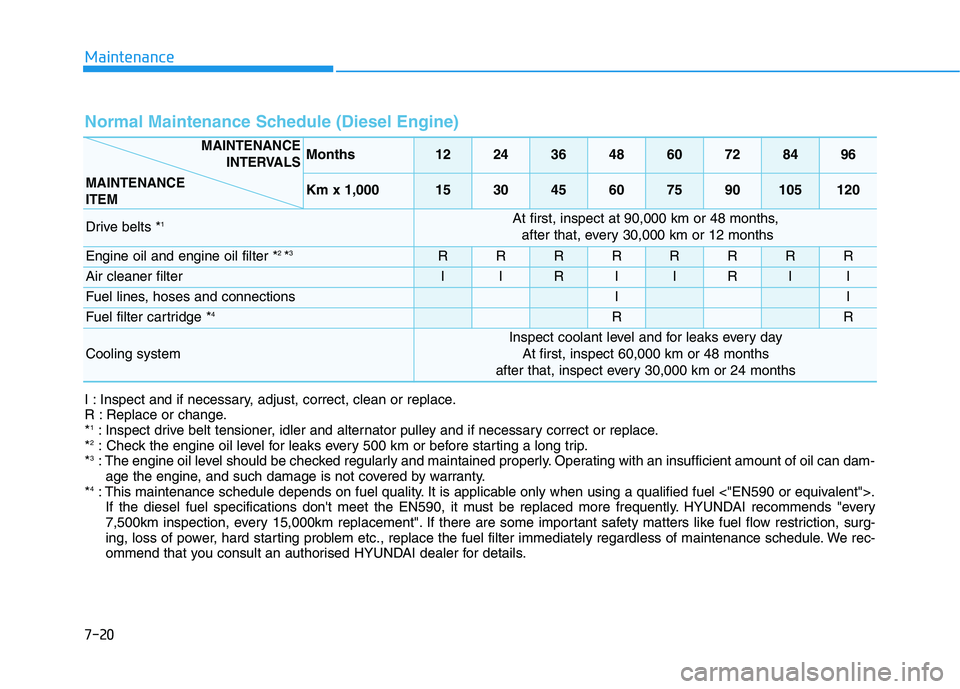
Normal Maintenance Schedule (Diesel Engine)
Months1224364860728496
Km x 1,000153045607590105120
Drive belts *1At first, inspect at 90,000 km or 48 months,
after that, every 30,000 km or 12 months
Engine oil and engine oil filter *2 *3RRRRRRRR
Air cleaner filter IIRIIRII
Fuel lines, hoses and connectionsII
Fuel filter cartridge *4RR
Cooling system
Inspect coolant level and for leaks every day
At first, inspect 60,000 km or 48 months
after that, inspect every 30,000 km or 24 months
I : Inspect and if necessary, adjust, correct, clean or replace.
R : Replace or change.
*
1: Inspect drive belt tensioner, idler and alternator pulley and if necessary correct or replace.
*2: Check the engine oil level for leaks every 500 km or before starting a long trip.
*3 : The engine oil level should be checked regularly and maintained properly. Operating with an insufficient amount of oil can dam-
age the engine, and such damage is not covered by warranty.
*
4: This maintenance schedule depends on fuel quality. It is applicable only when using a qualified fuel <"EN590 or equivalent">.
If the diesel fuel specifications don't meet the EN590, it must be replaced more frequently. HYUNDAI recommends "every
7,500km inspection, every 15,000km replacement". If there are some important safety matters like fuel flow restriction, surg-
ing, loss of power, hard starting problem etc., replace the fuel filter immediately regardless of maintenance schedule. We rec-
ommend that you consult an authorised HYUNDAI dealer for details.
MAINTENANCE
INTERVALS
MAINTENANCE
ITEM
Page 462 of 533
7-31
7
Maintenance
E EN
NG
GI
IN
NE
E
C
CO
OO
OL
LA
AN
NT
T
The high-pressure cooling system
has a reservoir filled with year-round
antifreeze coolant. The reservoir is
filled at the factory.
Check the antifreeze protection and
coolant concentration level at least
once a year, at the beginning of the
winter season, and before travelling
to a colder climate.
When the engine overheats from
low engine coolant, suddenly
adding engine coolant may cause
cracks in the engine. To prevent
damage, add engine coolant
slowly in small quantities.
Do not drive with no engine
coolant. It may cause water pump
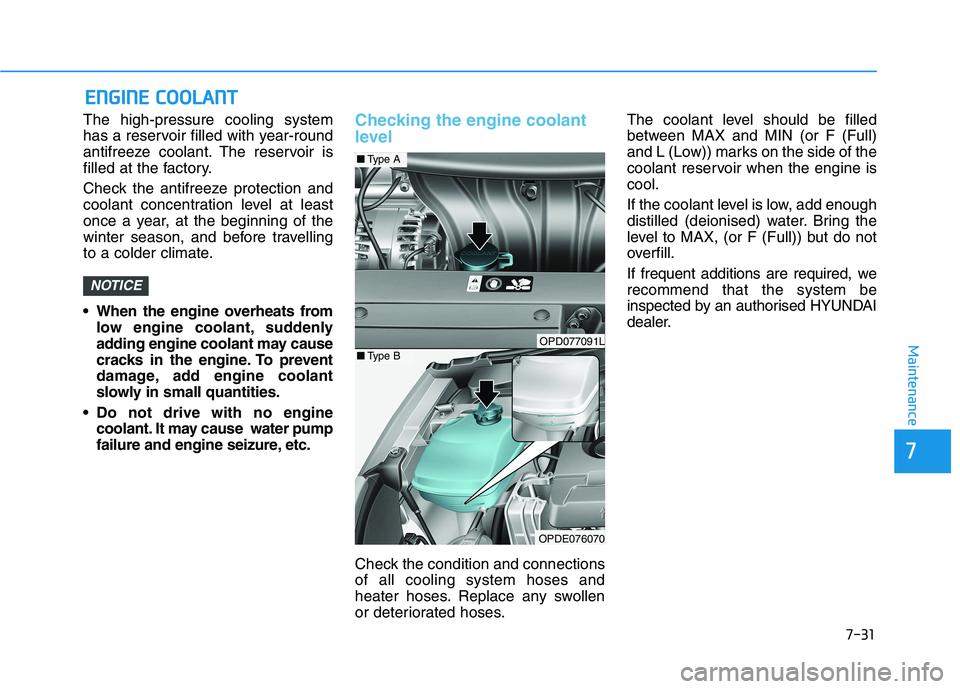
failure and engine seizure, etc.Checking the engine coolant
level
Check the condition and connections
of all cooling system hoses and
heater hoses. Replace any swollen
or deteriorated hoses.The coolant level should be filled
between MAX and MIN (or F (Full)
and L (Low)) marks on the side of the
coolant reservoir when the engine is
cool.
If the coolant level is low, add enough
distilled (deionised) water. Bring the
level to MAX, (or F (Full)) but do not
overfill.
If frequent additions are required, we
recommend that the system be
inspected by an authorised HYUNDAI
dealer.NOTICE
OPD077091L
OPDE076070
■Type A
■Type B
Page 466 of 533
7-35
7
Maintenance
W WA
AS
SH
HE
ER
R
F
FL
LU
UI
ID
D
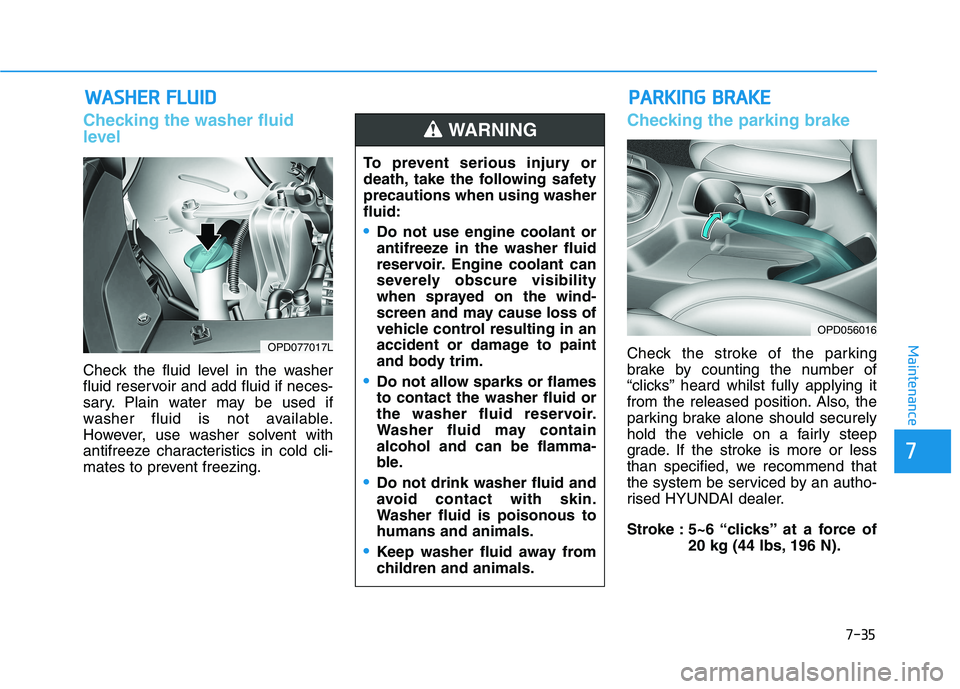
Checking the washer fluid
level
Check the fluid level in the washer
fluid reservoir and add fluid if neces-
sary. Plain water may be used if
washer fluid is not available.
However, use washer solvent with
antifreeze characteristics in cold cli-
mates to prevent freezing.
Checking the parking brake
Check the stroke of the parking
brake by counting the number of
“clicks’’ heard whilst fully applying it
from the released position. Also, the
parking brake alone should securely
hold the vehicle on a fairly steep
grade. If the stroke is more or less
than specified, we recommend that
the system be serviced by an autho-
rised HYUNDAI dealer.
Stroke : 5~6 “clicks’’ at a force of
20 kg (44 lbs, 196 N).OPD077017L
P PA
AR
RK
KI
IN
NG
G
B
BR
RA
AK
KE
E
OPD056016
To prevent serious injury or
death, take the following safety
precautions when using washer
fluid:
Do not use engine coolant or
antifreeze in the washer fluid
reservoir. Engine coolant can
severely obscure visibility
when sprayed on the wind-
screen and may cause loss of
vehicle control resulting in an
accident or damage to paint
and body trim.
Do not allow sparks or flames
to contact the washer fluid or
the washer fluid reservoir.
Washer fluid may contain
alcohol and can be flamma-
ble.
Do not drink washer fluid and
avoid contact with skin.
Washer fluid is poisonous to
humans and animals.
Keep washer fluid away from
children and animals.
WARNING