wheel size HYUNDAI I30 2023 User Guide
[x] Cancel search | Manufacturer: HYUNDAI, Model Year: 2023, Model line: I30, Model: HYUNDAI I30 2023Pages: 533, PDF Size: 59.13 MB
Page 484 of 533
7-53
7
Maintenance
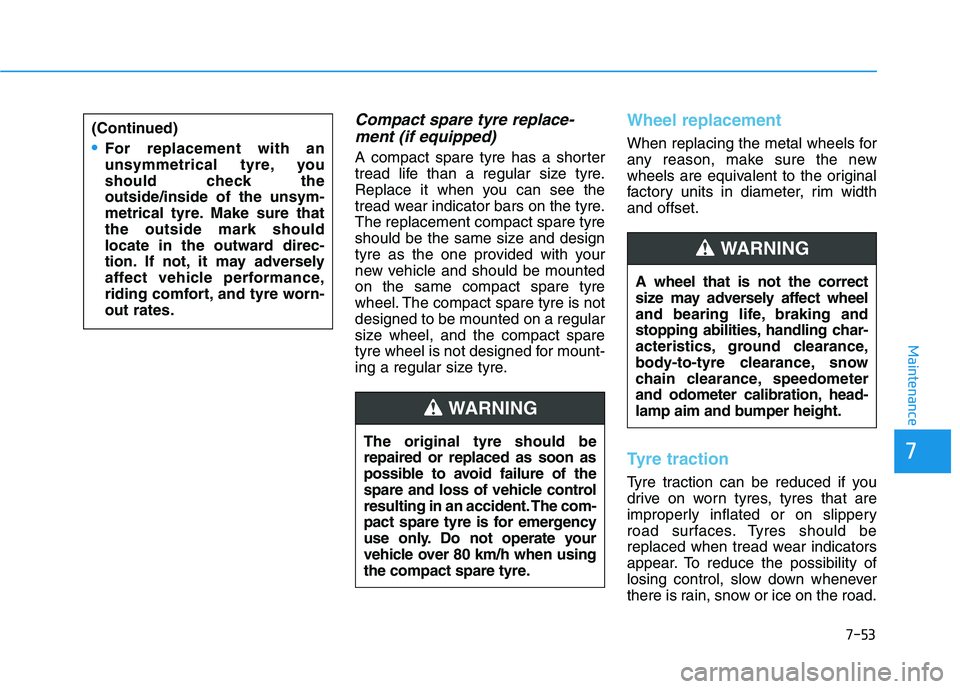
Compact spare tyre replace-
ment (if equipped)
A compact spare tyre has a shorter
tread life than a regular size tyre.
Replace it when you can see the
tread wear indicator bars on the tyre.
The replacement compact spare tyre
should be the same size and design
tyre as the one provided with your
new vehicle and should be mounted
on the same compact spare tyre
wheel. The compact spare tyre is not
designed to be mounted on a regular
size wheel, and the compact spare
tyre wheel is not designed for mount-
ing a regular size tyre.
Wheel replacement
When replacing the metal wheels for
any reason, make sure the new
wheels are equivalent to the original
factory units in diameter, rim width
and offset.
Tyre traction
Tyre traction can be reduced if you
drive on worn tyres, tyres that are
improperly inflated or on slippery
road surfaces. Tyres should be
replaced when tread wear indicators
appear. To reduce the possibility of
losing control, slow down whenever
there is rain, snow or ice on the road. The original tyre should be
repaired or replaced as soon as
possible to avoid failure of the
spare and loss of vehicle control
resulting in an accident. The com-
pact spare tyre is for emergency
use only. Do not operate your
vehicle over 80 km/h when using
the compact spare tyre.
WARNING
(Continued)
For replacement with an
unsymmetrical tyre, you
should check the
outside/inside of the unsym-
metrical tyre. Make sure that
the outside mark should
locate in the outward direc-
tion. If not, it may adversely
affect vehicle performance,
riding comfort, and tyre worn-
out rates.
A wheel that is not the correct
size may adversely affect wheel
and bearing life, braking and
stopping abilities, handling char-
acteristics, ground clearance,
body-to-tyre clearance, snow
chain clearance, speedometer
and odometer calibration, head-
lamp aim and bumper height.
WARNING
Page 485 of 533

7-54
Maintenance
Tyre maintenance
In addition to proper inflation, correct
wheel alignment helps to decrease
tyre wear. If you find a tyre is worn
unevenly, have your dealer check the
wheel alignment.
When you have new tyres installed,
make sure they are balanced. This
will increase vehicle ride comfort and
tyre life. Additionally, a tyre should
always be rebalanced if it is removed
from the wheel.
Tyre sidewall labelling
This information identifies and
describes the fundamental charac-
teristics of the tyre and also provides
the tyre identification number (TIN)
for safety standard certification. The
TIN can be used to identify the tyre in
case of a recall.
1. Manufacturer or brand name
Manufacturer or brand name is
shown.
2. Tyre size designation
A tyre’s sidewall is marked with a tyre
size designation. You will need this
information when selecting replace-
ment tyres for your vehicle. The fol-
lowing explains what the letters and
numbers in the tyre size designation
mean.Example tyre size designation:
(These numbers are provided as an
example only; your tyre size designa-
tor could vary depending on your
vehicle.)
205/55R16 91H
205 - Tyre width in millimetres.
55 - Aspect ratio. The tyre’s section
height as a percentage of its
width.
R - Tyre construction code (Radial).
16 - Rim diameter in inches.
91 - Load Index, a numerical code
associated with the maximum
load the tyre can carry.
H - Speed Rating Symbol. See the
speed rating chart in this section
for additional information.
OLMB073028 1
1 2
34 5,6
7
Page 486 of 533

7-55
7
Maintenance
Wheel size designation
Wheels are also marked with impor-
tant information that you need if you
ever have to replace one. The follow-
ing explains what the letters and
numbers in the wheel size designa-
tion mean.
Example wheel size designation:
6.5JX16
6.5 - Rim width in inches.
J - Rim contour designation.
16 - Rim diameter in inches.
Tyre speed ratings
The chart below lists many of the dif-
ferent speed ratings currently being
used for passenger vehicle tyres.
The speed rating is part of the tyre
size designation on the sidewall of
the tyre. This symbol corresponds to
that tyre’s designed maximum safe
operating speed.
3. Checking tyre life (TIN : Tyre
Identification Number)
Any tyres that are over six years old,
based on the manufacturing date,
(including the spare tyre) should be
replaced by new ones. You can find
the manufacturing date on the tyre
sidewall (possibly on the inside of the
wheel), displaying the DOT Code.
The DOT Code is a series of num-
bers on a tyre consisting of numbers
and English letters. The manufactur-
ing date is designated by the last four
digits (characters) of the DOT code.
DOT : XXXX XXXX OOOO
The front part of the DOT shows a
plant code number, tyre size and
tread pattern and the last four num-
bers indicate week and year manu-
factured.
For example:
DOT XXXX XXXX 1519 represents
that the tyre was produced in the
15th week of 2019.
Speed
Rating
SymbolMaximum Speed
S 180 km/h
T 190 km/h
H 210 km/h
V 240 km/h
W 270km/h
Y 300km/h
Page 525 of 533
8-4
Specifications & Consumer information
T TY
YR
RE
ES
S
A
AN
ND
D
W
WH
HE
EE
EL
LS
S
Light BulbBulb TypeWattage
Interior
Map lampW10W10
Passenger compartment lampType AFESTOON8
Type BLEDLED
Vanity mirror lampFESTOON5
Luggage compartment lampFESTOON10
License plate lampW5W5
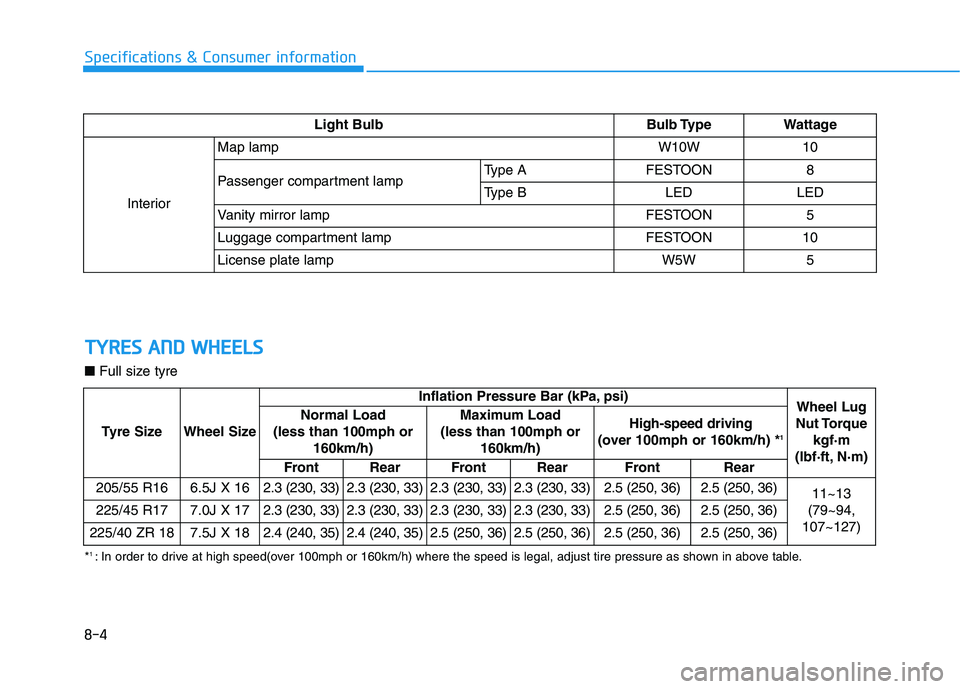
Tyre Size Wheel SizeInflation Pressure Bar (kPa, psi)
Wheel Lug
Nut Torque
kgf·m
(lbf·ft, N·m) Normal Load
(less than 100mph or
160km/h)Maximum Load
(less than 100mph or
160km/h)High-speed driving
(over 100mph or 160km/h) *1
Front Rear Front Rear Front Rear
205/55 R16 6.5J X 162.3 (230, 33) 2.3 (230, 33) 2.3 (230, 33) 2.3 (230, 33) 2.5 (250, 36) 2.5 (250, 36)
11~13
(79~94,
107~127) 225/45 R17 7.0J X 172.3 (230, 33) 2.3 (230, 33) 2.3 (230, 33) 2.3 (230, 33) 2.5 (250, 36) 2.5 (250, 36)
225/40 ZR 18 7.5J X 182.4 (240, 35) 2.4 (240, 35) 2.5 (250, 36) 2.5 (250, 36) 2.5 (250, 36) 2.5 (250, 36)
■Full size tyre
*1 : In order to drive at high speed(over 100mph or 160km/h) where the speed is legal, adjust tire pressure as shown in above table.
Page 526 of 533
8-5
8
Specifications & Consumer information
When replacing tyres, use the same size originally supplied with the vehicle.
Using tyres of a different size can seriously affect your vehicle's handling.
CAUTION
It is permissible to add 20 kPa (3 psi) to the standard tyre pressure specification if colder temperatures are
expected soon. Tyres typically lose 7 kPa (1 psi) for every 7°C (12°F) temperature drop. If extreme tempera-
ture variations are expected, recheck your tyre pressure as necessary to keep them properly inflated.
An air pressure generally decreases, as you drive up to a high-altitude area above sea level. Thus, if you plan
to drive a high-altitude area, check the tyre pressures in advance. If necessary, inflate them to a proper level
(Air inflation per altitude: +10 kPa/1 km (+2.4 psi/1 mile)).
NOTICE
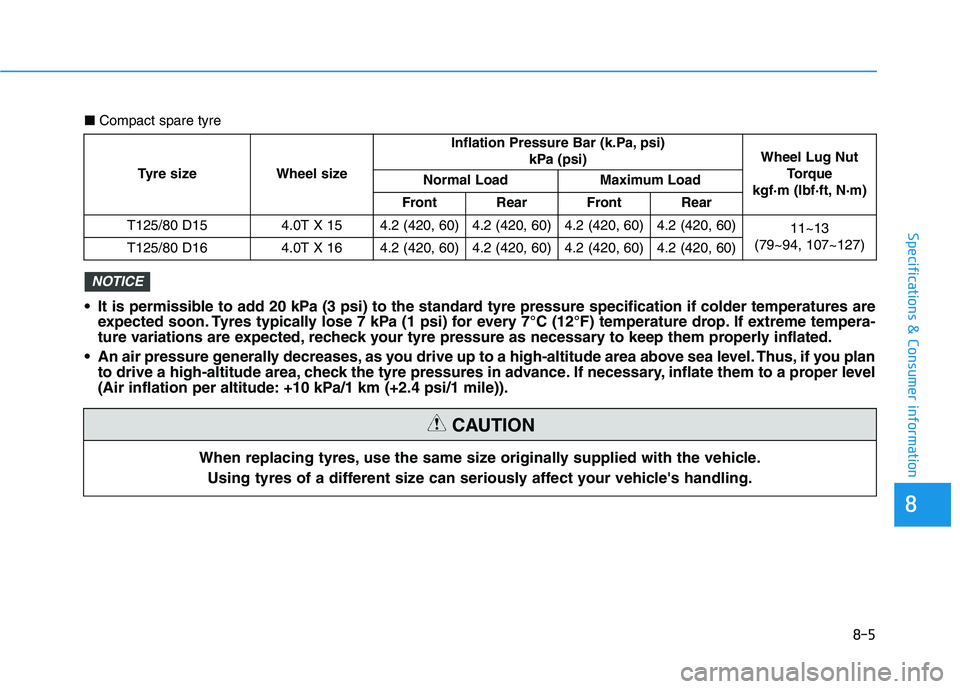
■Compact spare tyre
Tyre size Wheel sizeInflation Pressure Bar (k.Pa, psi)
kPa (psi)Wheel Lug Nut
Torque
kgf·m (lbf·ft, N·m) Normal Load Maximum Load
Front Rear Front Rear
T125/80 D15 4.0T X 15 4.2 (420, 60) 4.2 (420, 60) 4.2 (420, 60) 4.2 (420, 60)
11~13
(79~94, 107~127)
T125/80 D16 4.0T X 16 4.2 (420, 60) 4.2 (420, 60) 4.2 (420, 60) 4.2 (420, 60)