Drive HYUNDAI I30 2023 Owners Manual
[x] Cancel search | Manufacturer: HYUNDAI, Model Year: 2023, Model line: I30, Model: HYUNDAI I30 2023Pages: 533, PDF Size: 59.13 MB
Page 456 of 533
7-25
7
Maintenance
E EX
XP
PL
LA
AN
NA
AT
TI
IO
ON
N
O
OF
F
S
SC
CH
HE
ED
DU
UL
LE
ED
D
M
MA
AI
IN
NT
TE
EN
NA
AN
NC
CE
E
I
IT
TE
EM
MS
S
Engine oil and filter
The engine oil and filter should be
changed at the intervals specified in
the maintenance schedule. If the
vehicle is being driven in severe con-
ditions, more frequent oil and filter
changes are required.
Drive belts
Inspect all drive belts for evidence of
cuts, cracks, excessive wear or oil
saturation and replace if necessary.
Drive belts should be checked peri-
odically for proper tension and
adjusted as necessary.
Fuel filter (cartridge)
A clogged filter can limit the speed at
which the vehicle may be driven,
damage the emission system and
cause multiple issues such as hard
starting.
If an excessive amount of foreign
matter accumulates in the fuel tank,
the filter may require replacement
more frequently.
After installing a new filter, run the
engine for several minutes, and
check for leaks at the connections.
We recommend that the fuel filter be
replaced by an authorised HYUNDAI
dealer.
Fuel lines, fuel hoses and con-
nections
Check the fuel lines, fuel hoses and
connections for leakage and dam-
age. We recommend that the fuel
lines, fuel hoses and connections be
replaced by an authorised HYUNDAI
dealer.
Vapour hose and fuel filler cap
The vapour hose and fuel filler cap
should be inspected at those inter-
vals specified in the maintenance
schedule. Make sure that a new
vapour hose or fuel filler cap is cor-
rectly replaced.
Vacuum crankcase ventilation
hoses (if equipped)
Inspect the surface of hoses for evi-
dence of heat and/or mechanical
damage. Hard and brittle rubber,
cracking, tears, cuts, abrasions, and
excessive swelling indicate deterio-
ration. Particular attention should be
paid to examine those hose surfaces
nearest to high heat sources, such
as the exhaust manifold.
Inspect the hose routing to ensure
that the hoses do not come in con-
tact with any heat source, sharp
edges or moving component which
might cause heat damage or
mechanical wear. Inspect all hose
connections, such as clamps and
couplings, to make sure they are
secure, and that no leaks are pres-
ent. Hoses should be replaced
immediately if there is any evidence
of deterioration or damage. When you are inspecting the belt,
place the ignition switch to the
LOCK/OFF or ACC position.
CAUTION
Page 457 of 533
7-26
Maintenance
Air cleaner filter
We recommend that the air cleaner
filter be replaced by an authorised
HYUNDAI dealer.
Spark plugs
(for Petrol Engine)
Make sure to install new spark plugs
of the correct heat range.
Valve clearance
(for Petrol Engine)
Inspect excessive valve noise and/or
engine vibration and adjust if neces-
sary. We recommend that the system
be serviced by an authorised HYUNDAI
dealer.
Cooling system
Check the cooling system parts,
such as radiator, coolant reservoir,
hoses and connections for leakage
and damage. Replace any damaged
parts.
Engine coolant
The coolant should be changed at
the intervals specified in the mainte-
nance schedule.
Automatic transmission fluid
(if equipped)
Automatic transmission fluid should
not be checked under normal usage
conditions.
We recommend that the automatic
transmission fluid is changed by an
authorised HYUNDAI dealer accord-
ing to the maintenance schedule.
Information
Automatic transmission fluid colour is
red when new.
As the vehicle is driven, the automatic
transmission fluid will begin to look
darker.
This is a normal condition. It does not
need to be replaced based on the colour
change.
The use of a non-specified fluid
could result in transmission mal-
function and failure.
Use only specified automatic
transmission fluid.
(Refer to “Recommended lubri-
cants and capacities” in chapter 8.)
Manual transmission fluid
(if equipped)
Inspect the manual transmission
fluid according to the maintenance
schedule.
NOTICE
i
Do not disconnect and inspect
spark plugs when the engine is
hot. You may burn yourself.
WARNING
Page 458 of 533
7-27
7
Maintenance
Dual clutch transmission fluid
(if equipped)
Inspect the dual clutch transmission
fluid according to the maintenance
schedule.
Brake hoses and lines
Visually check for proper installation,
chafing, cracks, deterioration and
any leakage. Replace any deteriorat-
ed or damaged parts immediately.
Brake/Clutch fluid
(if equipped)
Check the brake/clutch fluid level in
the brake/clutch fluid reservoir. The
level should be between “MIN” and
“MAX” marks on the side of the
reservoir. Use only hydraulic
brake/clutch fluid conforming to DOT
4 specification.
Parking brake
Inspect the parking brake system
including the parking brake lever (or
pedal) and cables.
Brake pads, calipers and
rotors
Check the pads for excessive wear,
discs for run out and wear, and
calipers for fluid leakage.
Suspension mounting bolts
Check the suspension connections
for looseness or damage. Retighten
to the specified torque.
Steering gear rack, linkage &
boots/lower arm ball joint
With the vehicle stopped and engine
off, check for excessive free-play in
the steering wheel.
Check the linkage for bends or dam-
age. Check the dust boots and ball
joints for deterioration, cracks, or
damage. Replace any damaged
parts.
Drive shafts and boots
Check the drive shafts, boots and
clamps for cracks, deterioration, or
damage. Replace any damaged
parts and, if necessary, repack the
grease.
Air conditioning refrigerant/
compressor
Check the air conditioning lines and
connections for leakage and dam-
age.
Page 462 of 533
7-31
7
Maintenance
E EN
NG
GI
IN
NE
E
C
CO
OO
OL
LA
AN
NT
T
The high-pressure cooling system
has a reservoir filled with year-round
antifreeze coolant. The reservoir is
filled at the factory.
Check the antifreeze protection and
coolant concentration level at least
once a year, at the beginning of the
winter season, and before travelling
to a colder climate.
When the engine overheats from
low engine coolant, suddenly
adding engine coolant may cause
cracks in the engine. To prevent
damage, add engine coolant
slowly in small quantities.
Do not drive with no engine
coolant. It may cause water pump
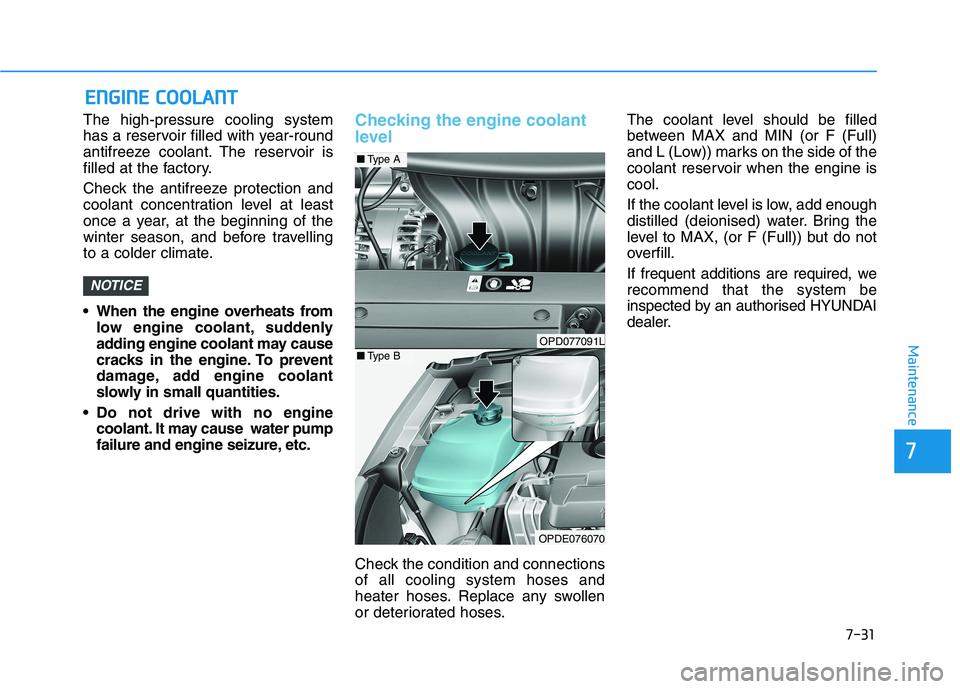
failure and engine seizure, etc.Checking the engine coolant
level
Check the condition and connections
of all cooling system hoses and
heater hoses. Replace any swollen
or deteriorated hoses.The coolant level should be filled
between MAX and MIN (or F (Full)
and L (Low)) marks on the side of the
coolant reservoir when the engine is
cool.
If the coolant level is low, add enough
distilled (deionised) water. Bring the
level to MAX, (or F (Full)) but do not
overfill.
If frequent additions are required, we
recommend that the system be
inspected by an authorised HYUNDAI
dealer.NOTICE
OPD077091L
OPDE076070
■Type A
■Type B
Page 468 of 533
7-37
7
Maintenance
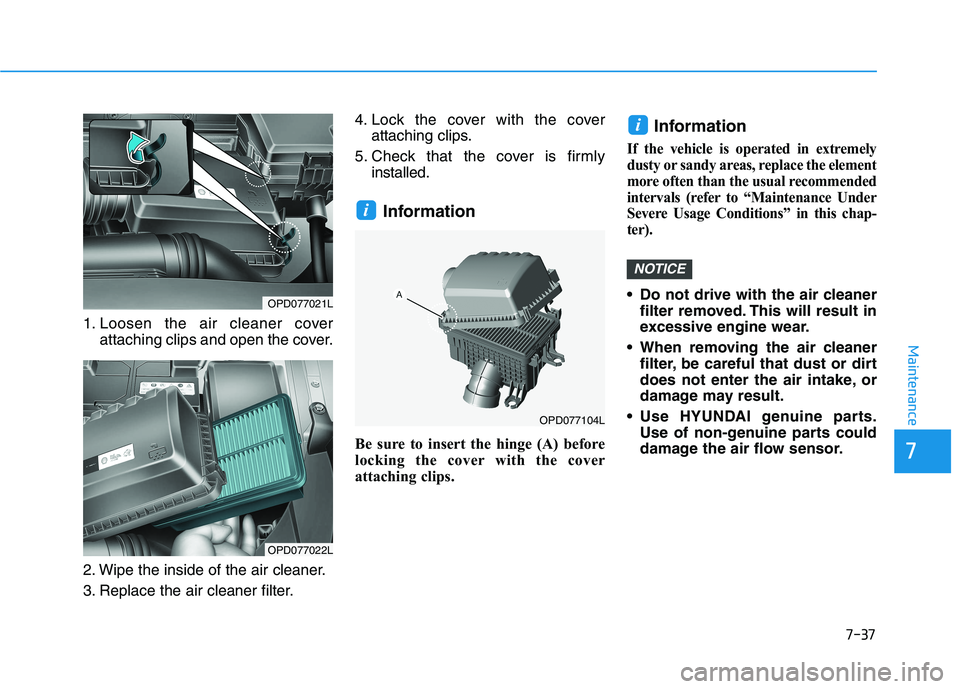
1. Loosen the air cleaner cover
attaching clips and open the cover.
2. Wipe the inside of the air cleaner.
3. Replace the air cleaner filter.4. Lock the cover with the cover
attaching clips.
5. Check that the cover is firmly
installed.
Information
Be sure to insert the hinge (A) before
locking the cover with the cover
attaching clips.
Information
If the vehicle is operated in extremely
dusty or sandy areas, replace the element
more often than the usual recommended
intervals (refer to “Maintenance Under
Severe Usage Conditions” in this chap-
ter).
Do not drive with the air cleaner
filter removed. This will result in
excessive engine wear.
When removing the air cleaner
filter, be careful that dust or dirt
does not enter the air intake, or
damage may result.
Use HYUNDAI genuine parts.
Use of non-genuine parts could
damage the air flow sensor.
NOTICE
i
i
OPD077021L
OPD077022L
OPD077104L
Page 477 of 533
7-46
Maintenance
By jump starting
After a jump start from a good bat-
tery, drive the vehicle for 20-30 min-
utes before it is shutoff. The vehicle
may not restart if you shut it off
before the battery had a chance to
adequately recharge. See “Jump
Starting” in chapter 6 for more infor-
mation on jump starting procedures.
Information
An inappropriately disposed
battery can be harmful to
the environment and human
health. Dispose of the bat-
tery according to your local
law(s) or regulation.
Reset items
The following items may need to be
reset after the battery has been dis-
charged or the battery has been dis-
connected.
Auto up/down window
Sunroof
Trip computer
Climate control system
Clock
Audio system
i
Page 478 of 533
7-47
7
Maintenance
T TY
YR
RE
ES
S
A
AN
ND
D
W
WH
HE
EE
EL
LS
S
Tyre care
For proper maintenance, safety, and
maximum fuel economy, you must
always maintain recommended tyre
inflation pressures and stay within the
load limits and weight distribution rec-
ommended for your vehicle.
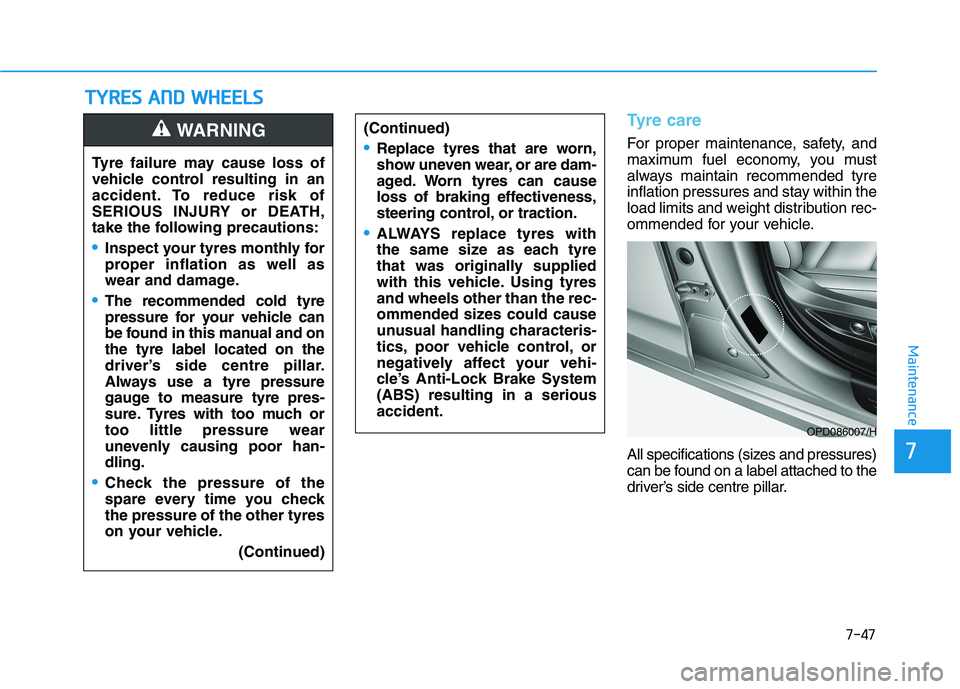
All specifications (sizes and pressures)
can be found on a label attached to the
driver’s side centre pillar. (Continued)Replace tyres that are worn,
show uneven wear, or are dam-
aged. Worn tyres can cause
loss of braking effectiveness,
steering control, or traction.
ALWAYS replace tyres with
the same size as each tyre
that was originally supplied
with this vehicle. Using tyres
and wheels other than the rec-
ommended sizes could cause
unusual handling characteris-
tics, poor vehicle control, or
negatively affect your vehi-
cle’s Anti-Lock Brake System
(ABS) resulting in a serious
accident.
Tyre failure may cause loss of
vehicle control resulting in an
accident. To reduce risk of
SERIOUS INJURY or DEATH,
take the following precautions:
Inspect your tyres monthly for
proper inflation as well as
wear and damage.
The recommended cold tyre
pressure for your vehicle can
be found in this manual and on
the tyre label located on the
driver’s side centre pillar.
Always use a tyre pressure
gauge to measure tyre pres-
sure. Tyres with too much or
too little pressure wear
unevenly causing poor han-
dling.
Check the pressure of the
spare every time you check
the pressure of the other tyres
on your vehicle.
(Continued)
WARNING
OPD086007/H
Page 479 of 533

7-48
Maintenance
Recommended cold tyre infla-
tion pressures
All tyre pressures (including the
spare) should be checked when the
tyres are cold. “Cold tyres” means
the vehicle has not been driven for at
least three hours or driven less than
1.6 km.
Warm tyres normally exceed recom-
mended cold tyre pressures by 28 to
41 kPa (4 to 6 psi). Do not release air
from warm tyres to adjust the pres-
sure or the tyres will be under-inflat-
ed. For recommended inflation pres-
sure, refer to “Tyre and Wheels” in
chapter 8.Recommended pressures must
be maintained for the best ride,
vehicle handling, and minimum
tyre wear.
Over-inflation or under-inflation
can reduce tyre life, adversely
affect vehicle handling, and
lead to sudden tyre failure that
could result in loss of vehicle
control resulting in an accident.
Severe under-inflation can lead
to severe heat build-up, causing
blowouts, tread separation and
other tyre failures that can
result in the loss of vehicle con-
trol resulting in an accident.
This risk is much higher on hot
days and when driving for long
periods at high speeds.
WARNING
Under-inflation results in
excessive wear, poor handling
and reduced fuel economy.
Wheel deformation is also
possible. Keep your tyre pres-
sures at the proper levels. If a
tyre frequently needs refilling,
we recommend it be checked
by an authorised HYUNDAI
dealer.
Over-inflation produces a
harsh ride, excessive wear at
the centre of the tyre tread,
and a greater possibility of
damage from road hazards.
CAUTION
Page 484 of 533
7-53
7
Maintenance
Compact spare tyre replace-
ment (if equipped)
A compact spare tyre has a shorter
tread life than a regular size tyre.
Replace it when you can see the
tread wear indicator bars on the tyre.
The replacement compact spare tyre
should be the same size and design
tyre as the one provided with your
new vehicle and should be mounted
on the same compact spare tyre
wheel. The compact spare tyre is not
designed to be mounted on a regular
size wheel, and the compact spare
tyre wheel is not designed for mount-
ing a regular size tyre.
Wheel replacement
When replacing the metal wheels for
any reason, make sure the new
wheels are equivalent to the original
factory units in diameter, rim width
and offset.
Tyre traction
Tyre traction can be reduced if you
drive on worn tyres, tyres that are
improperly inflated or on slippery
road surfaces. Tyres should be
replaced when tread wear indicators
appear. To reduce the possibility of
losing control, slow down whenever
there is rain, snow or ice on the road. The original tyre should be
repaired or replaced as soon as
possible to avoid failure of the
spare and loss of vehicle control
resulting in an accident. The com-
pact spare tyre is for emergency
use only. Do not operate your
vehicle over 80 km/h when using
the compact spare tyre.
WARNING
(Continued)
For replacement with an
unsymmetrical tyre, you
should check the
outside/inside of the unsym-
metrical tyre. Make sure that
the outside mark should
locate in the outward direc-
tion. If not, it may adversely
affect vehicle performance,
riding comfort, and tyre worn-
out rates.
A wheel that is not the correct
size may adversely affect wheel
and bearing life, braking and
stopping abilities, handling char-
acteristics, ground clearance,
body-to-tyre clearance, snow
chain clearance, speedometer
and odometer calibration, head-
lamp aim and bumper height.
WARNING
Page 489 of 533

7-58
Maintenance
Because the sidewall of a low
aspect ratio tyre is shorter than
a standard tyre, the rim of the
wheel and the tyre itself is more
easily susceptible to damage.
Use caution when driving and
follow the guidelines below to
help minimise damage to the
wheel and tyre:
When driving on a rough road
or driving off a road, be careful
not to damage the tyres and
wheels. After driving, inspect
the tyres and wheels.
When passing over a pothole,
speed bump, manhole, or curb
stone, drive the vehicle slowly
so as not to damage the tyres
and wheels.
(Continued)
CAUTION(Continued)
If the tyre is subjected to a
severe impact, we recom-
mend you have the tyre and
wheel inspected by an autho-
rised HYUNDAI dealer.
Inspect the tyre condition and
pressure every 3,000 km to
prevent tyre damage.
It is not easy to recognise tyre
damage with your own eyes.
But if there is the slightest hint
of tyre damage, have the tyre
checked or replaced because
the tyre damage may cause air
leakage from the tyre.
If the tyre is damaged by driv-
ing on a rough road, off road,
pothole, manhole, or curb
stone, it will not be covered by
the warranty.