warning HYUNDAI I30 2023 Owners Manual
[x] Cancel search | Manufacturer: HYUNDAI, Model Year: 2023, Model line: I30, Model: HYUNDAI I30 2023Pages: 533, PDF Size: 59.13 MB
Page 459 of 533
7-28
Maintenance
E EN
NG
GI
IN
NE
E
O
OI
IL
L
Checking the engine oil level
(Petrol engine)
1. Follow all of the oil manufacturer’s
precautions.
2. Be sure the vehicle is on the level
ground in P (Park) with the parking
brake set. If possible, block the
wheels.
3. Turn the engine on and allow the
engine to reach normal operating
temperatures.
4. Turn the engine off and wait for a
few minutes (about 5 minutes) for
the oil to return to the oil pan.
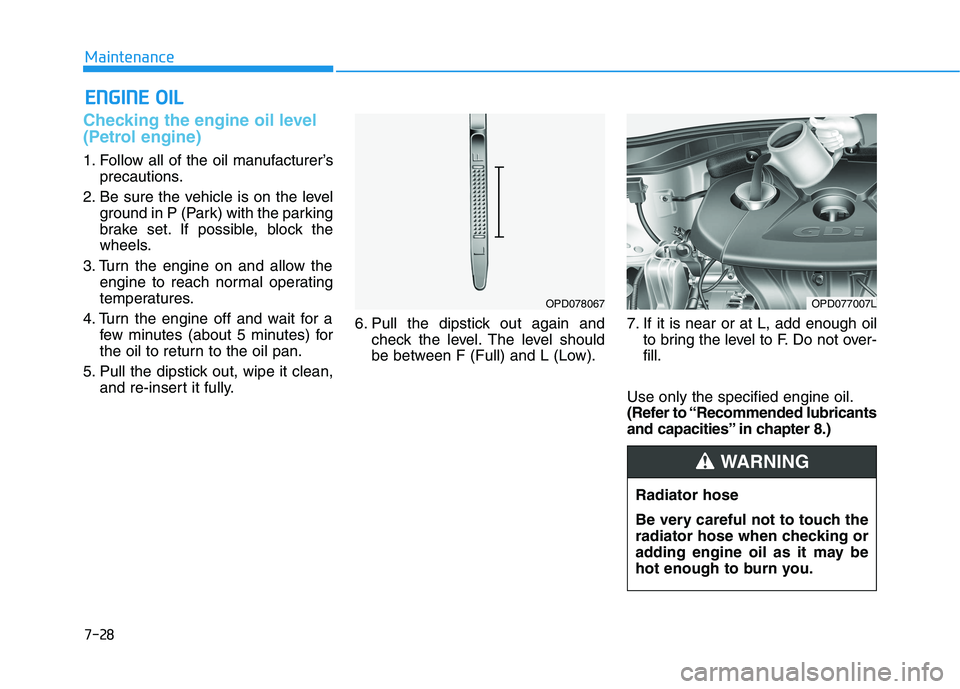
5. Pull the dipstick out, wipe it clean,
and re-insert it fully.6. Pull the dipstick out again and
check the level. The level should
be between F (Full) and L (Low).7. If it is near or at L, add enough oil
to bring the level to F. Do not over-
fill.
Use only the specified engine oil.
(Refer to “Recommended lubricants
and capacities” in chapter 8.)
OPD077007L
Radiator hose
Be very careful not to touch the
radiator hose when checking or
adding engine oil as it may be
hot enough to burn you.
WARNING
OPD078067
Page 461 of 533

7-30
Maintenance
8. If it is near or at L, add enough oil
to bring the level to F. Do not over-
fill.
Use only the specified engine oil.
(Refer to “Recommended lubricants
and capacities” in chapter 8.)
Checking the engine oil and filter
We recommend that the engine oil
and filter be replaced by an authorised
HYUNDAI dealer.
Used engine oil may cause irri-
tation or cancer of the skin if
left in contact with the skin for
prolonged periods of time. Used
engine oil contains chemicals
that have caused cancer in lab-
oratory animals. Always protect
your skin by washing your
hands thoroughly with soap
and warm water as soon as pos-
sible after handling used oil.
WARNING
OPD076009
Radiator hose
Be very careful not to touch the
radiator hose when checking or
adding engine oil as it may be
hot enough to burn you.
WARNING
Page 463 of 533
7-32
Maintenance
The electric motor for the cooling fan
is controlled by engine coolant tem-
perature, refrigerant pressure and
vehicle speed. As the engine coolant
temperature decreases, the electric
motor will automatically shut off. This
is a normal condition. If your vehicle
is equipped with GDI, the electric
motor for the cooling fan may begin
to operate at any time and continue
to operate until you disconnect the
negative battery cable.The electric motor for
the cooling fan may
continue to operate
or start up when the
engine is not running
and can cause serious injury.
Keep hands, clothing and tools
away from the rotating fan blades
of the cooling fan.
WARNING
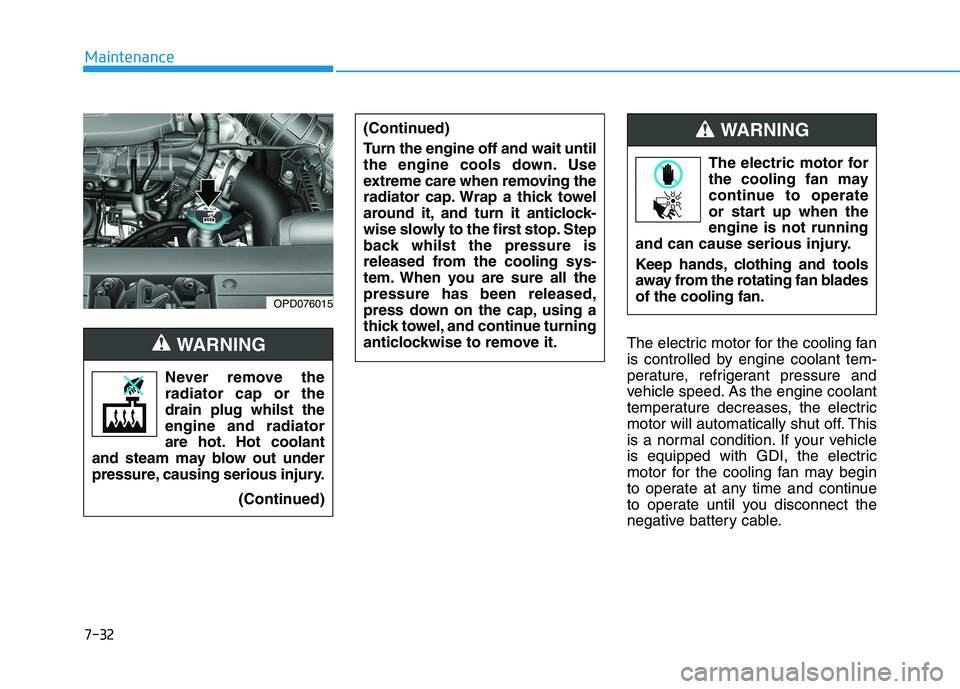
Never remove the
radiator cap or the
drain plug whilst the
engine and radiator
are hot. Hot coolant
and steam may blow out under
pressure, causing serious injury.
(Continued)
WARNING
OPD076015
(Continued)
Turn the engine off and wait until
the engine cools down. Use
extreme care when removing the
radiator cap. Wrap a thick towel
around it, and turn it anticlock-
wise slowly to the first stop. Step
back whilst the pressure is
released from the cooling sys-
tem. When you are sure all the
pressure has been released,
press down on the cap, using a
thick towel, and continue turning
anticlockwise to remove it.
Page 464 of 533

7-33
7
Maintenance
Recommended engine coolant
When adding coolant, use only dis-
tilled (deionised) water for your
vehicle and never mix hard water in
the coolant filled at the factory. An
incorrect coolant mixture can result
in serious malfunction or engine
damage.
The engine in your vehicle has alu-
minium engine parts and must be
protected by an ethylene-glycol
with phosphate based coolant to
prevent corrosion and freezing.
DO NOT USE alcohol or methanol
coolant or mix them with the spec-
ified coolant.
Do not use a solution that contains
more than 60% antifreeze or less
than 35% antifreeze, which would
reduce the effectiveness of the solu-
tion.For mixture percentage, refer to the
following table.
Information
If in doubt about the mix ratio, a 50%
water and 50% antifreeze mix is the
easiest to mix together as it will be the
same quantity of each. It is suitable to
use for most temperature ranges of
-35°C (-31°F) and higher.
Changing the engine coolant
We recommend that the coolant is
changed by an authorised HYUNDAI
dealer according to the Maintenance
Schedule at the beginning of this
chapter.
To prevent damage to engine parts,
put a thick towel around the radia-
tor cap before refilling the coolant
to prevent the coolant from over-
flowing into engine parts, such as
the alternator.
NOTICE
i
Ambient
TemperatureMixture Percentage
(volume)
Antifreeze Water
-15°C (5°F) 35 65
-25°C (-13°F) 40 60
-35°C (-31°F) 50 50
-45°C (-49°F) 60 40
Do not use engine coolant or
antifreeze in the washer fluid
reservoir.
Engine coolant can severely
obscure visibility when sprayed
on the windscreen and may
cause loss of vehicle control
resulting in an accident.
Engine coolant may also cause
damage to paint and body trim.
WARNING
Page 465 of 533
7-34
Maintenance
B BR
RA
AK
KE
E/
/C
CL
LU
UT
TC
CH
H
F
FL
LU
UI
ID
D
(
(I
IF
F
E
EQ
QU
UI
IP
PP
PE
ED
D)
)
Checking the brake/clutch
fluid level
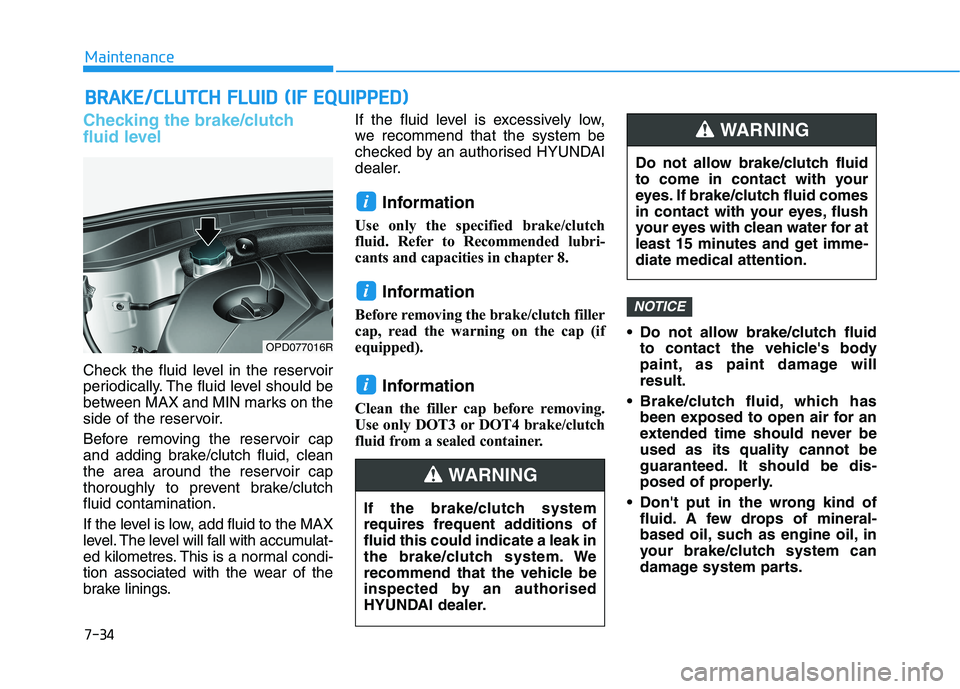
Check the fluid level in the reservoir
periodically. The fluid level should be
between MAX and MIN marks on the
side of the reservoir.
Before removing the reservoir cap
and adding brake/clutch fluid, clean
the area around the reservoir cap
thoroughly to prevent brake/clutch
fluid contamination.
If the level is low, add fluid to the MAX
level. The level will fall with accumulat-
ed kilometres. This is a normal condi-
tion associated with the wear of the
brake linings.If the fluid level is excessively low,
we recommend that the system be
checked by an authorised HYUNDAI
dealer.
Information
Use only the specified brake/clutch
fluid. Refer to Recommended lubri-
cants and capacities in chapter 8.
Information
Before removing the brake/clutch filler
cap, read the warning on the cap (if
equipped).
Information
Clean the filler cap before removing.
Use only DOT3 or DOT4 brake/clutch
fluid from a sealed container. Do not allow brake/clutch fluid
to contact the vehicle's body
paint, as paint damage will
result.
Brake/clutch fluid, which has
been exposed to open air for an
extended time should never be
used as its quality cannot be
guaranteed. It should be dis-
posed of properly.
Don't put in the wrong kind of
fluid. A few drops of mineral-
based oil, such as engine oil, in
your brake/clutch system can
damage system parts.
NOTICE
i
i
i
OPD077016R
If the brake/clutch system
requires frequent additions of
fluid this could indicate a leak in
the brake/clutch system. We
recommend that the vehicle be
inspected by an authorised
HYUNDAI dealer.
WARNING
Do not allow brake/clutch fluid
to come in contact with your
eyes. If brake/clutch fluid comes
in contact with your eyes, flush
your eyes with clean water for at
least 15 minutes and get imme-
diate medical attention.
WARNING
Page 466 of 533
7-35
7
Maintenance
W WA
AS
SH
HE
ER
R
F
FL
LU
UI
ID
D
Checking the washer fluid
level
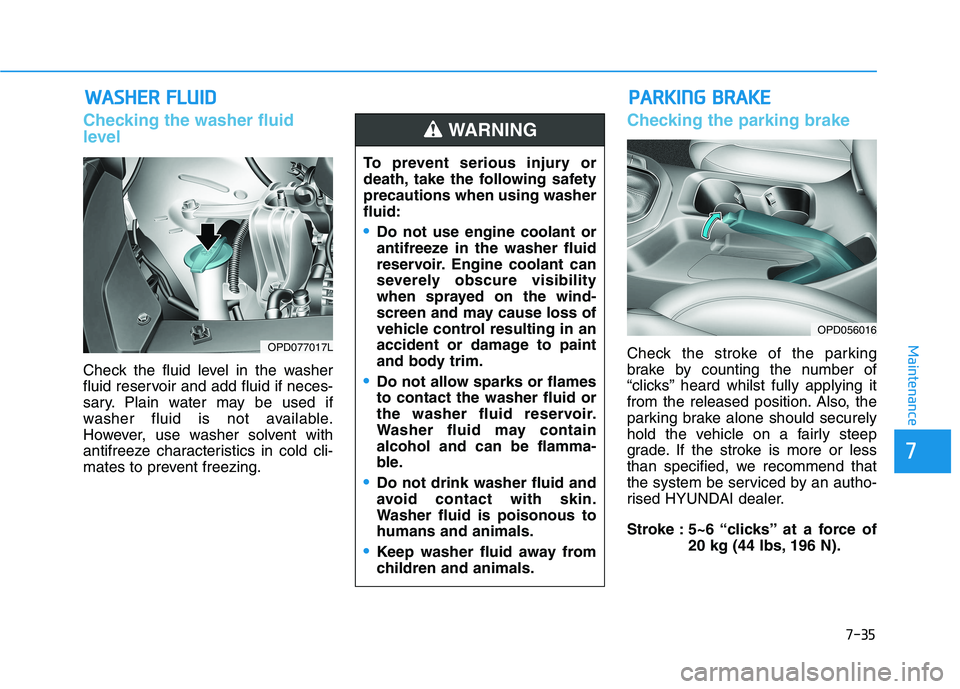
Check the fluid level in the washer
fluid reservoir and add fluid if neces-
sary. Plain water may be used if
washer fluid is not available.
However, use washer solvent with
antifreeze characteristics in cold cli-
mates to prevent freezing.
Checking the parking brake
Check the stroke of the parking
brake by counting the number of
“clicks’’ heard whilst fully applying it
from the released position. Also, the
parking brake alone should securely
hold the vehicle on a fairly steep
grade. If the stroke is more or less
than specified, we recommend that
the system be serviced by an autho-
rised HYUNDAI dealer.
Stroke : 5~6 “clicks’’ at a force of
20 kg (44 lbs, 196 N).OPD077017L
P PA
AR
RK
KI
IN
NG
G
B
BR
RA
AK
KE
E
OPD056016
To prevent serious injury or
death, take the following safety
precautions when using washer
fluid:
Do not use engine coolant or
antifreeze in the washer fluid
reservoir. Engine coolant can
severely obscure visibility
when sprayed on the wind-
screen and may cause loss of
vehicle control resulting in an
accident or damage to paint
and body trim.
Do not allow sparks or flames
to contact the washer fluid or
the washer fluid reservoir.
Washer fluid may contain
alcohol and can be flamma-
ble.
Do not drink washer fluid and
avoid contact with skin.
Washer fluid is poisonous to
humans and animals.
Keep washer fluid away from
children and animals.
WARNING
Page 467 of 533
7-36
Maintenance
A AI
IR
R
C
CL
LE
EA
AN
NE
ER
R F
FU
UE
EL
L
F
FI
IL
LT
TE
ER
R
(
(F
FO
OR
R
D
DI
IE
ES
SE
EL
L)
)
Draining water from fuel filter
The fuel filter in the diesel engine
operates the critical function of sepa-
rating water from the fuels and pre-
venting accumulating of water in the
base.
When enough water has accumulat-
ed inside the fuel filter, the warning
light ( ) illuminates with the igni-
tion switch in the ON position.
In this case, we recommend you to
have the system checked by an
authorised HYUNDAI dealer.
When the accumulated water is not
drained at the proper timing, water
may permeate in the fuel filter,
damaging the major vehicle com-
ponents, such as the fuel system.
Fuel filter cartridge replace-
ment
We recommend the fuel filter car-
tridge be replaced by an authorised
HYUNDAI dealer according to the
Maintenance Schedule at the begin-
ning of this chapter.
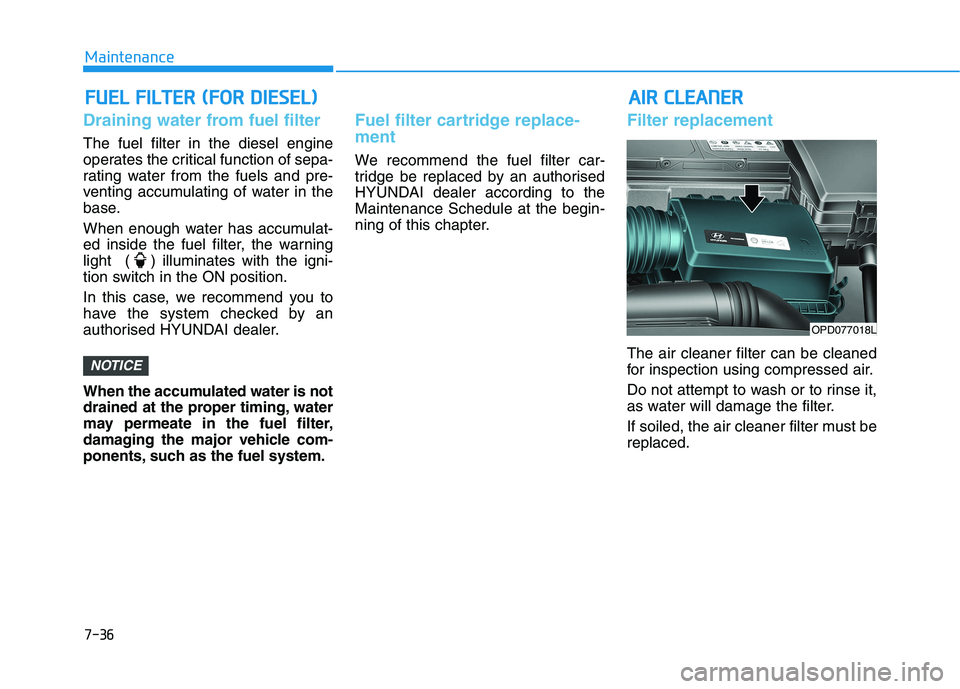
Filter replacement
The air cleaner filter can be cleaned
for inspection using compressed air.
Do not attempt to wash or to rinse it,
as water will damage the filter.
If soiled, the air cleaner filter must be
replaced.NOTICE
OPD077018L
Page 474 of 533

7-43
7
Maintenance
B BA
AT
TT
TE
ER
RY
Y
When you do not use the vehicle
for a long time in a low tempera-
ture area, disconnect the battery
and keep it indoors.
Always charge the battery fully
to prevent battery case damage
in low temperature areas.
If you connect unauthorised elec-
tronic devices to the battery, the
battery may be discharged. Never
use unauthorised devices.
NOTICE
NOTICE
(Continued)
NEVER attempt to recharge
the battery when the vehicle’s
battery cables are connected
to the battery.
The electrical ignition system
works with high voltage.
NEVER touch these compo-
nents with the engine running
or when the ignition switch is
in the ON position.
To prevent SERIOUS INJURY or
DEATH to you or bystanders,
always follow these precautions
when working near or handling
the battery:
Always read and follow
instructions carefully
when handling a battery.
Wear eye protection
designed to protect the
eyes from acid splashes.
Keep all flames, sparks,
or smoking materials
away from the battery.
Hydrogen is always
present in battery cells,
is highly combustible,
and may explode if ignit-
ed.
Keep batteries out of
reach of children.
(Continued)
WARNING (Continued)
Batteries contain sul-
phuric acid which is
highly corrosive. Do not
allow acid to contact your
eyes, skin or clothing.
If acid gets into your eyes, flush
your eyes with clean water for at
least 15 minutes and get imme-
diate medical attention. If acid
gets on your skin, thoroughly
wash the area. If you feel pain or
a burning sensation, get med-
ical attention immediately.
When lifting a plastic-cased
battery, excessive pressure
on the case may cause battery
acid to leak. Lift with a battery
carrier or with your hands on
opposite corners.
Do not attempt to jump start
your vehicle if your battery is
frozen.
(Continued)
Page 476 of 533
7-45
7
Maintenance
AGM battery (if equipped)
Absorbent Glass Matt (AGM)
batteries are maintenance-
free and we recommend that
the AGM battery be serviced
by an authorised HYUNDAI
dealer. For charging your
AGM battery, use only fully
automatic battery chargers
that are specially developed
for AGM batteries.
When replacing the AGM bat-
tery, we recommend that you
use parts for replacement
from an authorised HYUNDAI
dealer.
Do not open or remove the
cap on top of the battery. This
may cause leaks of internal
electrolyte that could result in
severe injury.
CAUTION
Always follow these instructions
when recharging your vehicle’s
battery to avoid the risk of SERI-
OUS INJURY or DEATH from
explosions or acid burns:
Before performing mainte-
nance or recharging the bat-
tery, turn off all accessories
and stop the engine.
Keep all flames, sparks, or
smoking materials away from
the battery.
Always work outdoors or in an
area with plenty of ventilation.
Wear eye protection when
checking the battery during
charging.
The battery must be removed
from the vehicle and placed in
a well ventilated area.
(Continued)
WARNING (Continued)
Watch the battery during
charging, and stop or reduce
the charging rate if the battery
cells begin boiling violently.
The negative battery cable
must be removed first and
installed last when the battery
is disconnected. Disconnect
the battery charger in the fol-
lowing order:
(1) Turn off the battery charger
main switch.
(2) Unhook the negative
clamp from the negative
battery terminal.
(3) Unhook the positive clamp
from the positive battery
terminal.
Always use a genuine HYUNDAI
approved battery when you
replace the battery.
Page 478 of 533
7-47
7
Maintenance
T TY
YR
RE
ES
S
A
AN
ND
D
W
WH
HE
EE
EL
LS
S
Tyre care
For proper maintenance, safety, and
maximum fuel economy, you must
always maintain recommended tyre
inflation pressures and stay within the
load limits and weight distribution rec-
ommended for your vehicle.
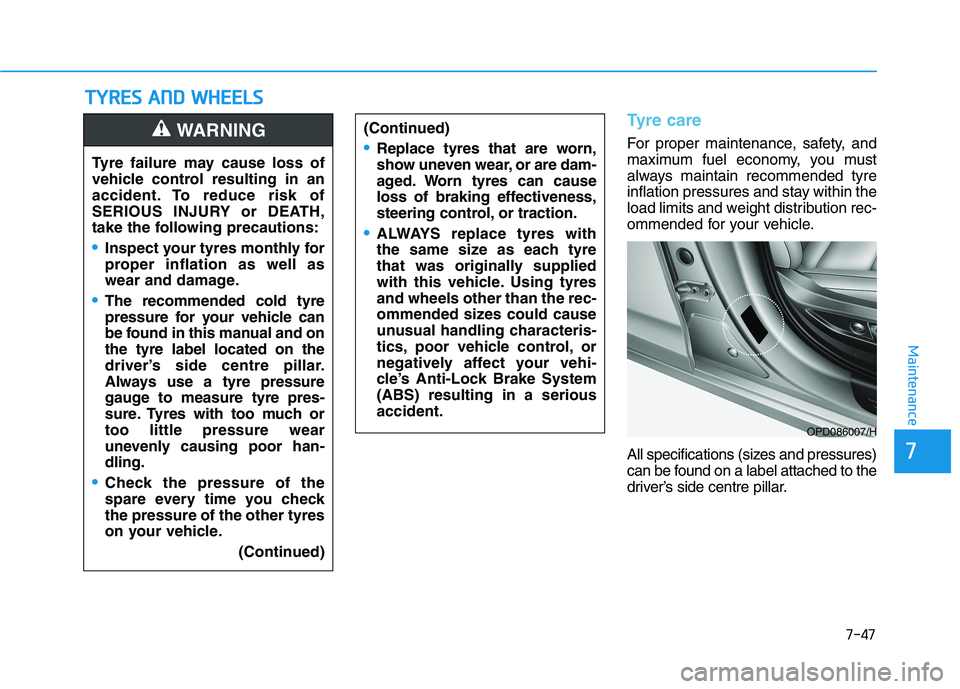
All specifications (sizes and pressures)
can be found on a label attached to the
driver’s side centre pillar. (Continued)Replace tyres that are worn,
show uneven wear, or are dam-
aged. Worn tyres can cause
loss of braking effectiveness,
steering control, or traction.
ALWAYS replace tyres with
the same size as each tyre
that was originally supplied
with this vehicle. Using tyres
and wheels other than the rec-
ommended sizes could cause
unusual handling characteris-
tics, poor vehicle control, or
negatively affect your vehi-
cle’s Anti-Lock Brake System
(ABS) resulting in a serious
accident.
Tyre failure may cause loss of
vehicle control resulting in an
accident. To reduce risk of
SERIOUS INJURY or DEATH,
take the following precautions:
Inspect your tyres monthly for
proper inflation as well as
wear and damage.
The recommended cold tyre
pressure for your vehicle can
be found in this manual and on
the tyre label located on the
driver’s side centre pillar.
Always use a tyre pressure
gauge to measure tyre pres-
sure. Tyres with too much or
too little pressure wear
unevenly causing poor han-
dling.
Check the pressure of the
spare every time you check
the pressure of the other tyres
on your vehicle.
(Continued)
WARNING
OPD086007/H