warning HYUNDAI I30 2023 Owners Manual
[x] Cancel search | Manufacturer: HYUNDAI, Model Year: 2023, Model line: I30, Model: HYUNDAI I30 2023Pages: 533, PDF Size: 59.13 MB
Page 479 of 533

7-48
Maintenance
Recommended cold tyre infla-
tion pressures
All tyre pressures (including the
spare) should be checked when the
tyres are cold. “Cold tyres” means
the vehicle has not been driven for at
least three hours or driven less than
1.6 km.
Warm tyres normally exceed recom-
mended cold tyre pressures by 28 to
41 kPa (4 to 6 psi). Do not release air
from warm tyres to adjust the pres-
sure or the tyres will be under-inflat-
ed. For recommended inflation pres-
sure, refer to “Tyre and Wheels” in
chapter 8.Recommended pressures must
be maintained for the best ride,
vehicle handling, and minimum
tyre wear.
Over-inflation or under-inflation
can reduce tyre life, adversely
affect vehicle handling, and
lead to sudden tyre failure that
could result in loss of vehicle
control resulting in an accident.
Severe under-inflation can lead
to severe heat build-up, causing
blowouts, tread separation and
other tyre failures that can
result in the loss of vehicle con-
trol resulting in an accident.
This risk is much higher on hot
days and when driving for long
periods at high speeds.
WARNING
Under-inflation results in
excessive wear, poor handling
and reduced fuel economy.
Wheel deformation is also
possible. Keep your tyre pres-
sures at the proper levels. If a
tyre frequently needs refilling,
we recommend it be checked
by an authorised HYUNDAI
dealer.
Over-inflation produces a
harsh ride, excessive wear at
the centre of the tyre tread,
and a greater possibility of
damage from road hazards.
CAUTION
Page 481 of 533

7-50
Maintenance
Disc brake pads should be inspected
for wear whenever tyres are rotated.
Information
The outside and inside of an unsym-
metrical tyre is distinguishable. When
installing an unsymmetrical tyre, be
sure to install the side marked "out-
side" facing the outside. If the side
marked "inside" is installed on the
outside, it will have a negative effect
on vehicle performance.
Wheel alignment and tyre bal-
ance
The wheels on your vehicle were
aligned and balanced carefully at the
factory to give you the longest tyre
life and best overall performance.
In most cases, you will not need to
have your wheels aligned again.
However, if you notice unusual tyre
wear or your vehicle pulling one way
or the other, the alignment may need
to be reset.
If you notice your vehicle vibrating
when driving on a smooth road, your
wheels may need to be rebalanced.
Incorrect wheel weights can dam-
age your vehicle’s aluminium
wheels. Use only approved wheel
weights.
NOTICE
i
CBGQ0706
ODH073802
■ With a full-size spare tyre (if equipped)
■Without a spare tyre
Do not use the compact spare
tyre for tyre rotation.
Do not mix bias ply and radial
ply tyres under any circum-
stances. This may cause
unusual handling characteris-
tics that may cause loss of
vehicle control resulting in an
accident.
WARNING
Page 482 of 533

7-51
7
Maintenance
Tyre replacement
If the tyre is worn evenly, a tread
wear indicator will appear as a solid
band across the tread. This shows
there is less than 1.6 mm of tread left
on the tyre. Replace the tyre when
this happens.
Do not wait for the band to appear
across the entire tread before replac-
ing the tyre.When replacing the tyres, recheck
and tighten the wheel nuts after
driving about 620 mile. If the steer-
ing wheel shakes or the vehicle
vibrates while driving, the tyre is
out of balance. Align the tyre bal-
ance. If the problem is not solved,
we recommend that you contact
an authorised HYUNDAI dealer.
NOTICE
OLMB073027
Tread wear indicatorTo reduce the risk of DEATH or
SERIOUS INJURY:
Replace tyres that are worn,
show uneven wear, or are
damaged. Worn tyres can
cause loss of braking effec-
tiveness, steering control, and
traction.
Always replace tyres with the
same size as each tyre that
was originally supplied with
this vehicle. Using tyres and
wheels other than the recom-
mended sizes could cause
unusual handling characteris-
tics, poor vehicle control, or
negatively affect your vehi-
cle’s Anti-Lock Brake System
(ABS) resulting in a serious
accident.
(Continued)
WARNING
Page 483 of 533

7-52
Maintenance
(Continued)
When replacing tyres (or
wheels), it is recommended to
replace the two front or two
rear tyres (or wheels) as a
pair. Replacing just one tyre
can seriously affect your vehi-
cle’s handling.
Tyres degrade over time, even
when they are not being used.
Regardless of the remaining
tread, HYUNDAI recommends
that tyres be replaced after six
(6) years of normal service.
Heat caused by hot climates or
frequent high loading condi-
tions can accelerate the aging
process. Failure to follow this
warning may cause sudden
tyre failure, which could lead
to a loss of vehicle control
resulting in an accident.
Replacing tyres
Driving on worn-out tyres is
very hazardous and will
reduce braking effectiveness,
steering accuracy, and trac-
tion.
Your vehicle is equipped with
tyres designed to provide for
safe ride and handling capa-
bility. Do not use a size and
type of tyre and wheel that is
different form the one that is
originally installed on your
vehicle. It can affect the safety
and performance of your vehi-
cle, which could lead to han-
dling failure or rollover and
serious injury. When replacing
the tires, be sure to equipped
all four tires with the tire and
wheel of the same size, type,
tread, brand and load-carrying
capability.
(Continued)
(Continued)
The use of any other tyre size
or type may seriously affect
ride, handling, ground clear-
ance, stopping distance, body
to tyre clearance, snow tyre
clearance, and speedometer
reliability.
It is best to replace all four
tyres at the same time. If that
is not possible, or necessary,
then replace the two front or
two rear tyres as a pair.
Replacing just one tire can
seriously affect your vehicle’s
handling.
The ABS works by comparing
the speed of the wheels. Tyre
size can affect wheel speed.
When replacing tyres, all 4
tyres must use the same size
originally supplied with the
vehicle. Using tyres of a dif-
ferent size can cause the
ABS(Anti-lock Brake System)
and ESC(Electronic Stability
Control)(if equipped) to work
irregularly.
(Continued)
WARNING
Page 484 of 533
7-53
7
Maintenance
Compact spare tyre replace-
ment (if equipped)
A compact spare tyre has a shorter
tread life than a regular size tyre.
Replace it when you can see the
tread wear indicator bars on the tyre.
The replacement compact spare tyre
should be the same size and design
tyre as the one provided with your
new vehicle and should be mounted
on the same compact spare tyre
wheel. The compact spare tyre is not
designed to be mounted on a regular
size wheel, and the compact spare
tyre wheel is not designed for mount-
ing a regular size tyre.
Wheel replacement
When replacing the metal wheels for
any reason, make sure the new
wheels are equivalent to the original
factory units in diameter, rim width
and offset.
Tyre traction
Tyre traction can be reduced if you
drive on worn tyres, tyres that are
improperly inflated or on slippery
road surfaces. Tyres should be
replaced when tread wear indicators
appear. To reduce the possibility of
losing control, slow down whenever
there is rain, snow or ice on the road. The original tyre should be
repaired or replaced as soon as
possible to avoid failure of the
spare and loss of vehicle control
resulting in an accident. The com-
pact spare tyre is for emergency
use only. Do not operate your
vehicle over 80 km/h when using
the compact spare tyre.
WARNING
(Continued)
For replacement with an
unsymmetrical tyre, you
should check the
outside/inside of the unsym-
metrical tyre. Make sure that
the outside mark should
locate in the outward direc-
tion. If not, it may adversely
affect vehicle performance,
riding comfort, and tyre worn-
out rates.
A wheel that is not the correct
size may adversely affect wheel
and bearing life, braking and
stopping abilities, handling char-
acteristics, ground clearance,
body-to-tyre clearance, snow
chain clearance, speedometer
and odometer calibration, head-
lamp aim and bumper height.
WARNING
Page 488 of 533

Temperature - A, B & C
The temperature grades are A (the
highest), then B and C representing
the tyre’s resistance to the genera-
tion of heat and its ability to dissipate
heat when tested under controlled
conditions on a specified indoor lab-
oratory test wheel.
Sustained high temperature can
cause the material of the tyre to
degenerate and reduce tyre life, and
excessive temperature can lead to
sudden tyre failure. Grades B and A
represent higher levels of perform-
ance on the laboratory test wheel
than the minimum required by law.
Low aspect ratio tyres
Low aspect ratio tyres, the aspect
ratio is lower than 50, are provided
for sporty looks.
Because low aspect ratio tyres are
optimized for handling and braking,
their sidewall is a little stiffer than a
standard tyre. Also low aspect ratio
tyres tend to be wider and conse-
quently have a greater contact patch
with the road surface. In some
instances they may generate more
road noise compared with standard
tyres.
7-57
7
Maintenance
The temperature grade for this
tyre is established for a tyre that
is properly inflated and not
overloaded. Excessive speed,
under-inflation, over-inflation,
or excessive loading, either
separately or in combination,
can cause heat build-up and
possible sudden tyre failure.
This may cause loss of vehicle
control resulting in an accident.
WARNING
The traction grade assigned to
this tyre is based on straight-
ahead braking traction tests,
and does not include accelera-
tion, cornering, hydroplaning,
or peak traction characteristics.
WARNING
Page 490 of 533
7-59
7
Maintenance
F FU
US
SE
ES
S
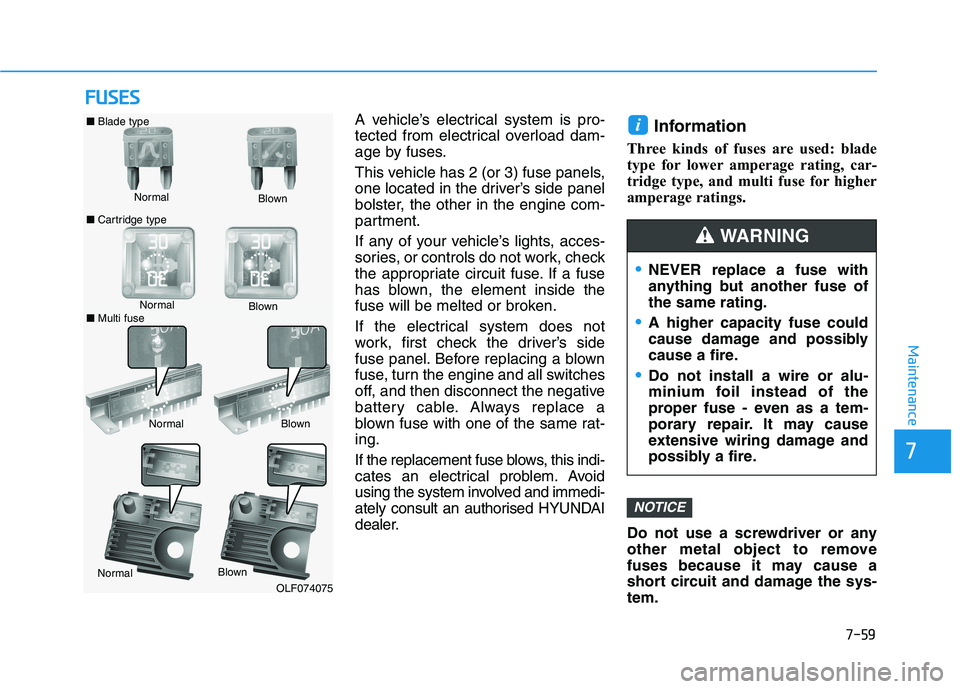
A vehicle’s electrical system is pro-
tected from electrical overload dam-
age by fuses.
This vehicle has 2 (or 3) fuse panels,
one located in the driver’s side panel
bolster, the other in the engine com-
partment.
If any of your vehicle’s lights, acces-
sories, or controls do not work, check
the appropriate circuit fuse. If a fuse
has blown, the element inside the
fuse will be melted or broken.
If the electrical system does not
work, first check the driver’s side
fuse panel. Before replacing a blown
fuse, turn the engine and all switches
off, and then disconnect the negative
battery cable. Always replace a
blown fuse with one of the same rat-
ing.
If the replacement fuse blows, this indi-
cates an electrical problem. Avoid
using the system involved and immedi-
ately consult an authorised HYUNDAI
dealer.Information
Three kinds of fuses are used: blade
type for lower amperage rating, car-
tridge type, and multi fuse for higher
amperage ratings.
Do not use a screwdriver or any
other metal object to remove
fuses because it may cause a
short circuit and damage the sys-
tem.
NOTICE
i
Normal ■Blade type
■Cartridge typeBlown
NormalBlown
NormalBlown
OLF074075
NEVER replace a fuse with
anything but another fuse of
the same rating.
A higher capacity fuse could
cause damage and possibly
cause a fire.
Do not install a wire or alu-
minium foil instead of the
proper fuse - even as a tem-
porary repair. It may cause
extensive wiring damage and
possibly a fire.
WARNING
Normal
Blown
■Multi fuse
Page 497 of 533
7-66
Maintenance
L LI
IG
GH
HT
T
B
BU
UL
LB
BS
S
Consult an authorised HYUNDAI
dealer to replace most vehicle light
bulbs. It is difficult to replace vehicle
light bulbs because other parts of the
vehicle must be removed before you
can get to the bulb. This is especially
true for removing the headlamp
assembly to get to the bulb(s).
Removing/installing the headlamp
assembly can result in damage to
the vehicle.Be sure to replace the burned-out
bulb with one of the same wattage
rating. Otherwise, it may cause
damage to the fuse or electrical
wiring system.
Information
The headlamp and tail lamp lenses
could appear frosty if the vehicle is
washed after driving or the vehicle is
driven at night in wet weather. This
condition is caused by temperature dif-
ference between the lamp inside and
outside and, it does not indicate a prob-
lem with your vehicle. When moisture
condenses in the lamp, it will be
removed after driving with the head-
lamp on. The removable level may dif-
fer depending on lamp size, lamp posi-
tion and environmental condition.
However, if moisture is not removed,
we recommend that your vehicle is
inspected by an authorised HYUNDAI
dealer.
Information
The headlamp aiming should be adjust-
ed after an accident or after the head-
lamp assembly is reinstalled, at an
authorised HYUNDAI dealer.
i
i
NOTICE
Prior to working on a light, firmly
apply the parking brake, ensure
that the ignition switch is in the
LOCK/OFF position and turn off
the lights to avoid sudden move-
ment of the vehicle and burning
your fingers or receiving an elec-
tric shock.
WARNING
Page 498 of 533
7-67
7
Maintenance
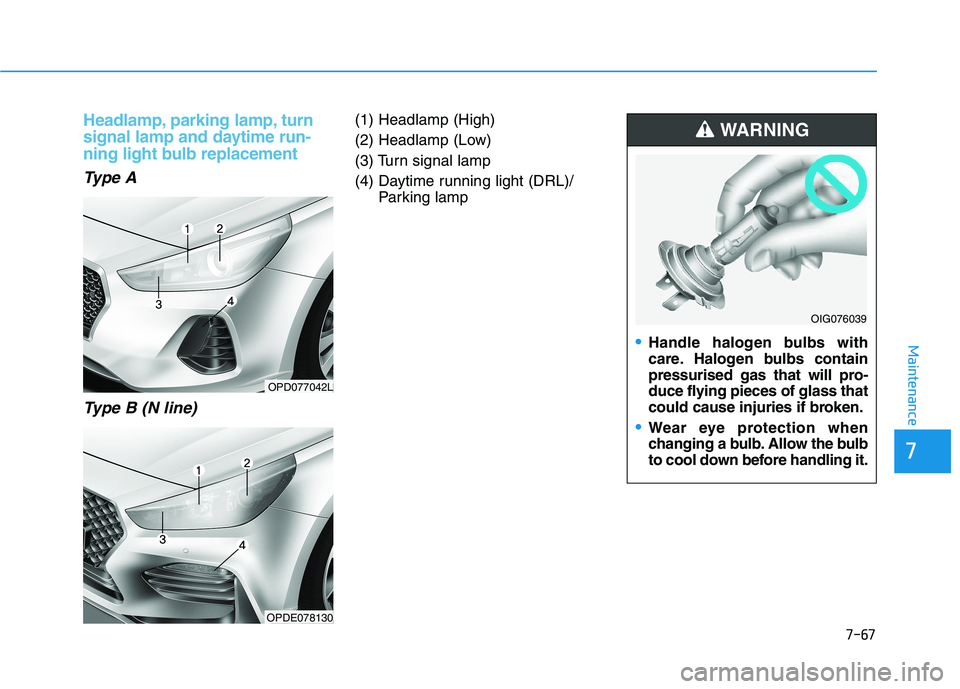
Headlamp, parking lamp, turn
signal lamp and daytime run-
ning light bulb replacement
Type A
Type B (N line)
(1) Headlamp (High)
(2) Headlamp (Low)
(3) Turn signal lamp
(4) Daytime running light (DRL)/
Parking lamp
Handle halogen bulbs with
care. Halogen bulbs contain
pressurised gas that will pro-
duce flying pieces of glass that
could cause injuries if broken.
Wear eye protection when
changing a bulb. Allow the bulb
to cool down before handling it.
WARNING
OIG076039
OPD077042L
OPDE078130
Page 508 of 533
7-77
7
Maintenance
A AP
PP
PE
EA
AR
RA
AN
NC
CE
E
C
CA
AR
RE
E
Exterior care
Exterior general caution
It is very important to follow the label
directions when using any chemical
cleaner or polish. Read all warning
and caution statements that appear
on the label.
Finish maintenance
Washing
To help protect your vehicle’s finish
from rust and deterioration, wash it
thoroughly and frequently at least
once a month with lukewarm or cold
water.
If you use your vehicle for off-road
driving, you should wash it after each
off-road trip. Pay special attention to
the removal of any accumulation of
salt, dirt, mud, and other foreign
materials. Make sure the drain holes
in the lower edges of the doors and
rocker panels are kept clear and
clean.
Insects, tar, tree sap, bird droppings,
industrial pollution and similar deposits
can damage your vehicle’s finish if not
removed immediately.
Even prompt washing with plain water
may not completely remove all these
deposits.
A mild soap, safe for use on painted
surfaces, may be used.
After washing, rinse the vehicle thor-
oughly with lukewarm or cold water.
Do not allow soap to dry on the finish. Do not use strong soap, chemi-
cal detergents or hot water, and
do not wash the vehicle in direct
sunlight or when the body of the
vehicle is warm.
Be careful when washing the
side windows of your vehicle.
Especially, with high-pressure
water, water may leak through
the windows and wet the interior.
To prevent damage to the plastic
parts and lamps, do not clean
with chemical solvents or strong
detergents.
NOTICE
Wet brakes
After washing the vehicle, test
the brakes whilst driving slowly
to see if they have been affected
by water. If braking performance
is impaired, dry the brakes by
applying them lightly whilst
maintaining a slow forward
speed.
WARNING