height HYUNDAI I30 2023 Owner's Manual
[x] Cancel search | Manufacturer: HYUNDAI, Model Year: 2023, Model line: I30, Model: HYUNDAI I30 2023Pages: 533, PDF Size: 59.13 MB
Page 336 of 533
5-71
Driving your vehicle
5
Limitations of the system
The driver must be cautious in the
below situations, because the sys-
tem may not detect other vehicles or
objects in certain circumstances.
The vehicle drives on a bend or
through a tollgate.
The vehicle is turning left or right at
a crossroads.
The sensor is polluted with rain,
snow, mud, etc.
The rear bumper where the sensor
is located is covered with a foreign
object such as a bumper sticker, a
bumper guard, a bike rack, etc.
The rear bumper is damaged, or
the sensor is out of the original
default position.
The vehicle height gets lower or
higher due to heavy loading in the
luggage compartment, abnormal
tyre pressure, etc.
The vehicle drives in inclement
weather such as heavy rain or
snow. There is a fixed object near the
vehicle, such as a guardrail, per-
son, animal, etc.
The vehicle is driven near areas
containing metal substances such
as a construction zone, railway,
etc.
A big vehicle is near such as a bus
or truck.
A motorcycle or bicycle is near.
A flat trailer is near.
If the vehicle has started at the
same time as the vehicle next to
you and has accelerated.
When the other vehicle passes at a
very fast speed.
Whilst changing lanes.
Whilst going down or up a steep
road where the height of the lane is
different.
When the other vehicle approach-
es very close.
When a trailer or carrier is
installed.
When the temperature near the
rear bumper area is high or low. When the sensors are blocked by
other vehicles, walls or parking-lot
pillars.
When the detected vehicle revers-
es, as your vehicle reverses.
If there are small objects in the
detecting area such as a shopping
trolley or a baby stroller.
If there is a low height vehicle such
as a sports car.
When other vehicles are close to
your vehicle.
When the vehicle in the next lane
moves two lanes away from you
OR when the vehicle two lanes
away moves to the next lane to
you.
When driving through a narrow
road with many trees or bushes.
When driving through a large area
with few vehicles or structures
around, such as a desert, rural
area, etc.
When driving on wet surfaces.
Page 338 of 533
5-73
Driving your vehicle
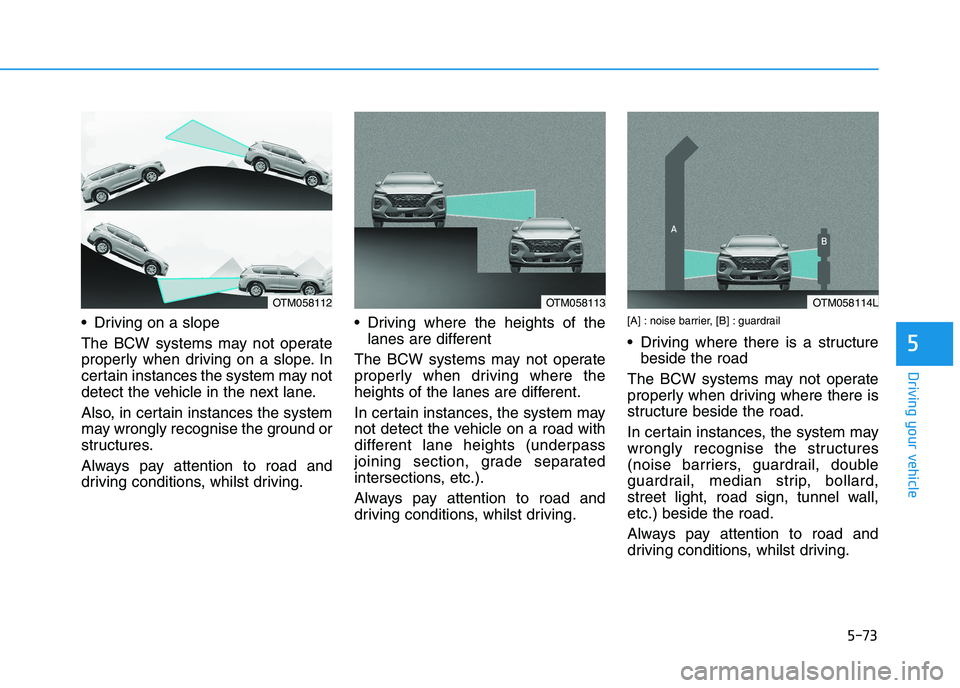
Driving on a slope
The BCW systems may not operate
properly when driving on a slope. In
certain instances the system may not
detect the vehicle in the next lane.
Also, in certain instances the system
may wrongly recognise the ground or
structures.
Always pay attention to road and
driving conditions, whilst driving. Driving where the heights of the
lanes are different
The BCW systems may not operate
properly when driving where the
heights of the lanes are different.
In certain instances, the system may
not detect the vehicle on a road with
different lane heights (underpass
joining section, grade separated
intersections, etc.).
Always pay attention to road and
driving conditions, whilst driving.[A] : noise barrier, [B] : guardrail
Driving where there is a structure
beside the road
The BCW systems may not operate
properly when driving where there is
structure beside the road.
In certain instances, the system may
wrongly recognise the structures
(noise barriers, guardrail, double
guardrail, median strip, bollard,
street light, road sign, tunnel wall,
etc.) beside the road.
Always pay attention to road and
driving conditions, whilst driving.5
OTM058112OTM058113OTM058114L
Page 484 of 533
7-53
7
Maintenance
Compact spare tyre replace-
ment (if equipped)
A compact spare tyre has a shorter
tread life than a regular size tyre.
Replace it when you can see the
tread wear indicator bars on the tyre.
The replacement compact spare tyre
should be the same size and design
tyre as the one provided with your
new vehicle and should be mounted
on the same compact spare tyre
wheel. The compact spare tyre is not
designed to be mounted on a regular
size wheel, and the compact spare
tyre wheel is not designed for mount-
ing a regular size tyre.
Wheel replacement
When replacing the metal wheels for
any reason, make sure the new
wheels are equivalent to the original
factory units in diameter, rim width
and offset.
Tyre traction
Tyre traction can be reduced if you
drive on worn tyres, tyres that are
improperly inflated or on slippery
road surfaces. Tyres should be
replaced when tread wear indicators
appear. To reduce the possibility of
losing control, slow down whenever
there is rain, snow or ice on the road. The original tyre should be
repaired or replaced as soon as
possible to avoid failure of the
spare and loss of vehicle control
resulting in an accident. The com-
pact spare tyre is for emergency
use only. Do not operate your
vehicle over 80 km/h when using
the compact spare tyre.
WARNING
(Continued)
For replacement with an
unsymmetrical tyre, you
should check the
outside/inside of the unsym-
metrical tyre. Make sure that
the outside mark should
locate in the outward direc-
tion. If not, it may adversely
affect vehicle performance,
riding comfort, and tyre worn-
out rates.
A wheel that is not the correct
size may adversely affect wheel
and bearing life, braking and
stopping abilities, handling char-
acteristics, ground clearance,
body-to-tyre clearance, snow
chain clearance, speedometer
and odometer calibration, head-
lamp aim and bumper height.
WARNING
Page 485 of 533

7-54
Maintenance
Tyre maintenance
In addition to proper inflation, correct
wheel alignment helps to decrease
tyre wear. If you find a tyre is worn
unevenly, have your dealer check the
wheel alignment.
When you have new tyres installed,
make sure they are balanced. This
will increase vehicle ride comfort and
tyre life. Additionally, a tyre should
always be rebalanced if it is removed
from the wheel.
Tyre sidewall labelling
This information identifies and
describes the fundamental charac-
teristics of the tyre and also provides
the tyre identification number (TIN)
for safety standard certification. The
TIN can be used to identify the tyre in
case of a recall.
1. Manufacturer or brand name
Manufacturer or brand name is
shown.
2. Tyre size designation
A tyre’s sidewall is marked with a tyre
size designation. You will need this
information when selecting replace-
ment tyres for your vehicle. The fol-
lowing explains what the letters and
numbers in the tyre size designation
mean.Example tyre size designation:
(These numbers are provided as an
example only; your tyre size designa-
tor could vary depending on your
vehicle.)
205/55R16 91H
205 - Tyre width in millimetres.
55 - Aspect ratio. The tyre’s section
height as a percentage of its
width.
R - Tyre construction code (Radial).
16 - Rim diameter in inches.
91 - Load Index, a numerical code
associated with the maximum
load the tyre can carry.
H - Speed Rating Symbol. See the
speed rating chart in this section
for additional information.
OLMB073028 1
1 2
34 5,6
7
Page 523 of 533
8-2
Specifications & Consumer information
D DI
IM
ME
EN
NS
SI
IO
ON
NS
S
E EN
NG
GI
IN
NE
E
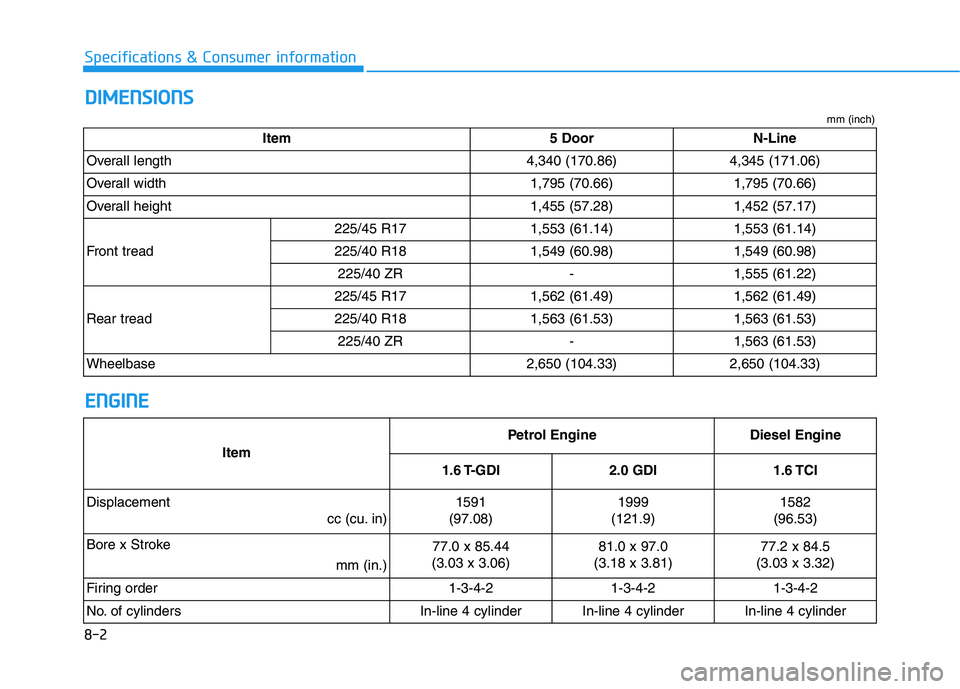
Item 5 Door N-Line
Overall length 4,340 (170.86) 4,345 (171.06)
Overall width 1,795 (70.66) 1,795 (70.66)
Overall height 1,455 (57.28) 1,452 (57.17)
Front tread225/45 R17 1,553 (61.14) 1,553 (61.14)
225/40 R18 1,549 (60.98) 1,549 (60.98)
225/40 ZR - 1,555 (61.22)
Rear tread225/45 R17 1,562 (61.49) 1,562 (61.49)
225/40 R18 1,563 (61.53) 1,563 (61.53)
225/40 ZR - 1,563 (61.53)
Wheelbase 2,650 (104.33) 2,650 (104.33)
Item
Petrol EngineDiesel Engine
1.6 T-GDI2.0 GDI1.6 TCI
Displacement
cc (cu. in)
1591
(97.08)1999
(121.9)1582
(96.53)
Bore x Stroke
mm (in.)
77.0 x 85.44
(3.03 x 3.06)81.0 x 97.0
(3.18 x 3.81)77.2 x 84.5
(3.03 x 3.32)
Firing order
1-3-4-21-3-4-21-3-4-2
No. of cylinders
In-line 4 cylinderIn-line 4 cylinderIn-line 4 cylinder
mm (inch)