height HYUNDAI I30 2023 User Guide
[x] Cancel search | Manufacturer: HYUNDAI, Model Year: 2023, Model line: I30, Model: HYUNDAI I30 2023Pages: 533, PDF Size: 59.13 MB
Page 56 of 533
2-35
Safety system of your vehicle
Our recommendation:
Children always in the rear
seat
Children under age 13 should always
ride in the rear seats and must
always be properly restrained to min-
imise the risk of injury in an accident,
sudden stop or sudden manoeuvre.
According to accident statistics, chil-
dren are safer when properly
restrained in the rear seats than in
the front seat. Children too large for a
Child Restraint System must use the
seat belts provided.Most countries have regulations
which require children to travel in
approved Child Restraint Systems.
The laws governing the age or
height/weight restrictions at which
seat belts can be used instead of
Child Restraint System differs
between countries, so you should be
aware of the specific requirements in
your country, and where you are trav-
elling.
Child Restraint Systems must be
properly installed in the vehicle seat.
Always use a commercially available
Child Restraint System that meets the
requirements of the Australian/New
Zealand standards.
Child Restraint System (CRS)
Infants and younger children must be
restrained in an appropriate rear-
ward-facing or forward-facing CRS
that has first been properly secured
to the seat of the vehicle. Read and
comply with the instructions for
installation and use provided by the
manufacturer of the Child Restraint
System.
C CH
HI
IL
LD
D
R
RE
ES
ST
TR
RA
AI
IN
NT
T
S
SY
YS
ST
TE
EM
M
(
(C
CR
RS
S)
)
2
Always properly restrain chil-
dren in the vehicle. Children of
all ages are safer when riding in
the rear seats. Never place a
rearward-facing Child Restraint
System on the front passenger
seat.
WARNING
Page 57 of 533
2-36
Safety system of your vehicle
Selecting a Child Restraint
System (CRS)
When selecting a Child Restraint
System for your child, always:
Make sure the CRS has a label
certifying that it meets the require-
ments of the Australian/New
Zealand standards.
Select a Child Restraint System
based on your child’s height and
weight. The required label or the
instructions for use typically pro-
vide this information.
Select a Child Restraint System
that fits the vehicle seating position
where it will be used.
Read and comply with the warn-
ings and instructions for installation
and use provided with the Child
Restraint System.
Child Restraint System types
There are three main types of Child
Restraint Systems: rearward-facing,
forward-facing and booster Child
Restraint Systems.
They are classified according to the
child’s age, height and weight.
Always follow the Child
Restraint System manufactur-
er’s instructions for installation
and use.
Always properly restrain your
child in the Child Restraint
System.
Do not use an infant carrier or
a child safety seat that
“hooks” over a seatback, it
may not provide adequate
protection in an accident.
After an accident, we recom-
mend a HYUNDAI dealer to
check the Child Restraint
System, seat belts, ISOFIX
anchorages and top-tether
anchorages.
WARNING
Page 58 of 533
2-37
Safety system of your vehicle
2
Rearward-facing Child Restraint
System
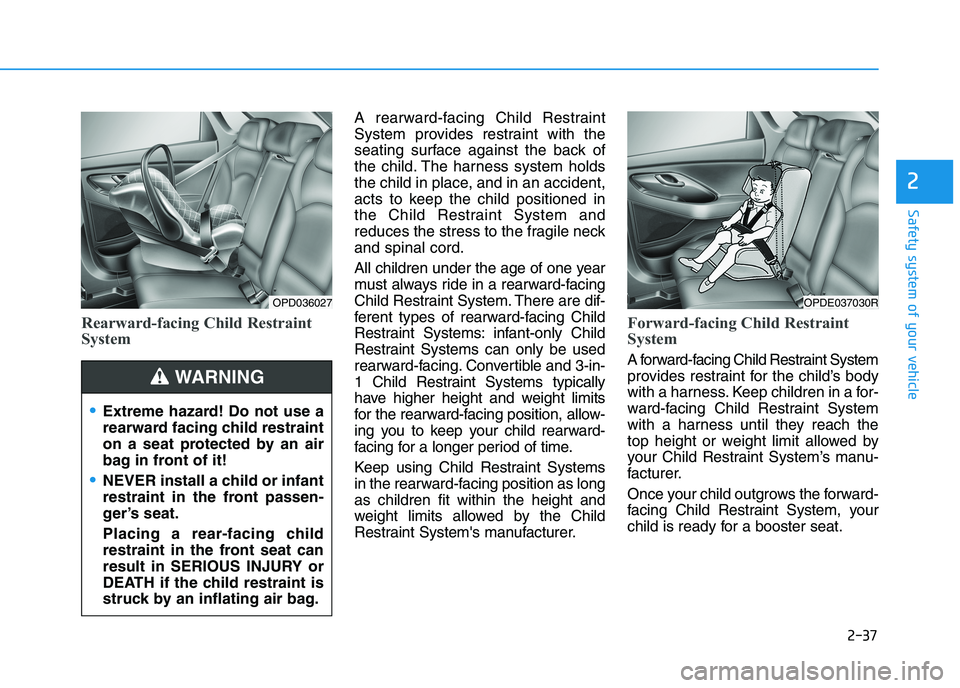
A rearward-facing Child Restraint
System provides restraint with the
seating surface against the back of
the child. The harness system holds
the child in place, and in an accident,
acts to keep the child positioned in
the Child Restraint System and
reduces the stress to the fragile neck
and spinal cord.
All children under the age of one year
must always ride in a rearward-facing
Child Restraint System. There are dif-
ferent types of rearward-facing Child
Restraint Systems: infant-only Child
Restraint Systems can only be used
rearward-facing. Convertible and 3-in-
1 Child Restraint Systems typically
have higher height and weight limits
for the rearward-facing position, allow-
ing you to keep your child rearward-
facing for a longer period of time.
Keep using Child Restraint Systems
in the rearward-facing position as long
as children fit within the height and
weight limits allowed by the Child
Restraint System's manufacturer.
Forward-facing Child Restraint
System
A forward-facing Child Restraint System
provides restraint for the child’s body
with a harness. Keep children in a for-
ward-facing Child Restraint System
with a harness until they reach the
top height or weight limit allowed by
your Child Restraint System’s manu-
facturer.
Once your child outgrows the forward-
facing Child Restraint System, your
child is ready for a booster seat.
OPD036027
Extreme hazard! Do not use a
rearward facing child restraint
on a seat protected by an air
bag in front of it!
NEVER install a child or infant
restraint in the front passen-
ger’s seat.
Placing a rear-facing child
restraint in the front seat can
result in SERIOUS INJURY or
DEATH if the child restraint is
struck by an inflating air bag.
WARNING
OPDE037030R
Page 83 of 533
2-62
Safety system of your vehicle
Additional safety precautions
Passengers should not move out of
or change seats whilst the vehicle
is moving.A passenger who is not
wearing a seat belt during a crash or
emergency stop can be thrown
against the inside of the vehicle,
against other occupants, or be ejected
from the vehicle.
Do not use any accessories on seat
belts.Devices claiming to improve
occupant comfort or reposition the
seat belt can reduce the protection
provided by the seat belt and increase
the chance of serious injury in a crash.
Do not modify the front seats.
Modification of the front seats could
interfere with the operation of the sup-
plemental restraint system sensing
components or side air bags.
Do not place items under the front
seats.Placing items under the front
seats could interfere with the opera-
tion of the supplemental restraint sys-
tem sensing components and wiring
harnesses.
Do not cause impact to the doors.
Impact to the doors when the ignition
switch is in the ON position may cause
the air bags to inflate.
Adding equipment to or modify-
ing your air bag equipped vehicle
If you modify your vehicle by changing
your vehicle's frame, bumper system,
front end or side sheet metal or ride
height, this may affect the operation of
your vehicle's air bag system.
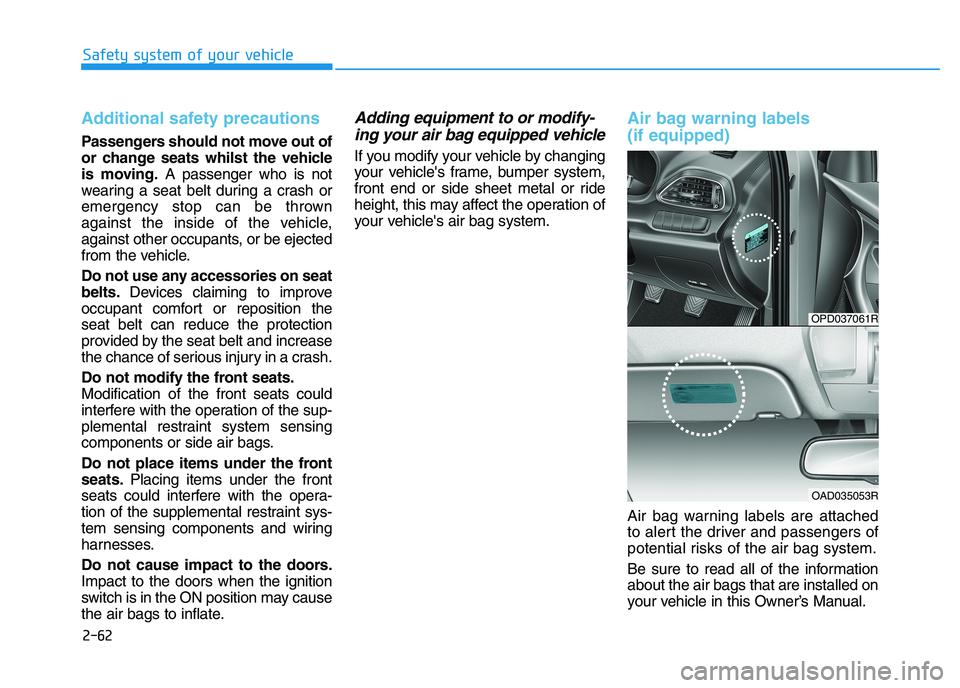
Air bag warning labels
(if equipped)
Air bag warning labels are attached
to alert the driver and passengers of
potential risks of the air bag system.
Be sure to read all of the information
about the air bags that are installed on
your vehicle in this Owner’s Manual.
OPD037061R
OAD035053R
Page 101 of 533
3-18
Convenient features of your vehicle
(Continued)
• When the vehicle is stationary, if
you turn the steering wheel all the
way to the left or right continuously,
the steering wheel effort increases.
This is not a system malfunction. As
time passes, the steering wheel
effort will return to its normal con-
dition.
Tilt steering / Telescopic steer-
ing
Information
After adjustment, sometimes the lock-
release lever may not lock the steering
wheel.
It is not a malfunction. This occurs
when two gears are not engaged cor-
rectly. In this case, adjust the steering
wheel again and then lock the steering
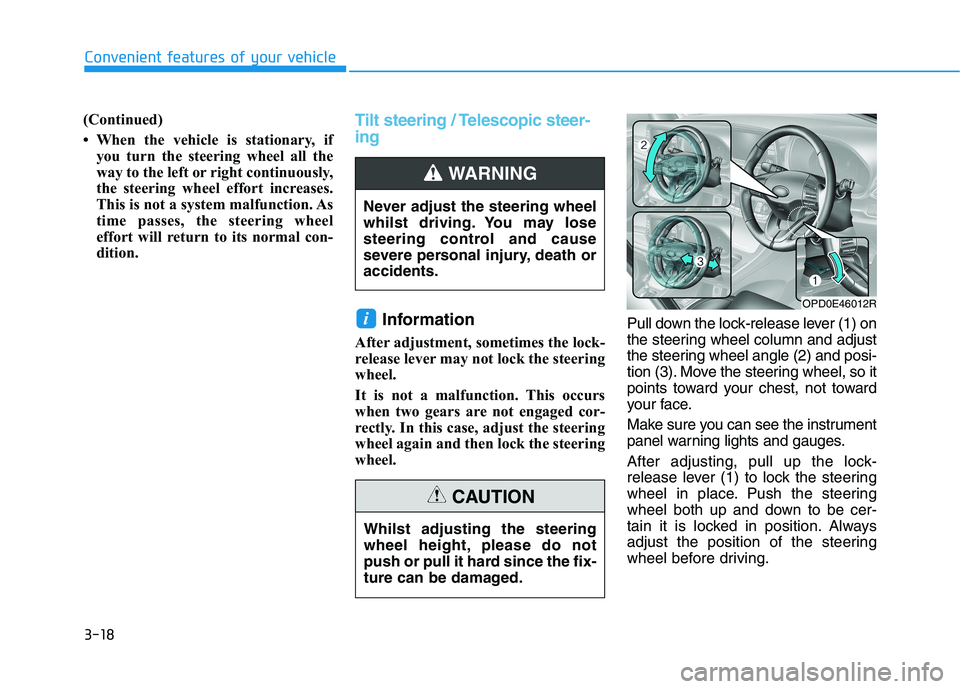
wheel.Pull down the lock-release lever (1) on
the steering wheel column and adjust
the steering wheel angle (2) and posi-
tion (3). Move the steering wheel, so it
points toward your chest, not toward
your face.
Make sure you can see the instrument
panel warning lights and gauges.
After adjusting, pull up the lock-
release lever (1) to lock the steering
wheel in place. Push the steering
wheel both up and down to be cer-
tain it is locked in position. Always
adjust the position of the steering
wheel before driving.
i
Never adjust the steering wheel
whilst driving. You may lose
steering control and cause
severe personal injury, death or
accidents.
WARNING
OPD0E46012R
Whilst adjusting the steering
wheel height, please do not
push or pull it hard since the fix-
ture can be damaged.
CAUTION
Page 182 of 533
3-99
Convenient features of your vehicle
3
Non-operational conditions of
Parking Distance Warning
(Reverse) system
The Parking Distance Warning
(Reverse) system may not operate
normally when:
Moisture is frozen to the sensor.
Sensor is covered with foreign mat-
ter, such as snow or water, or the
sensor cover is blocked.
There is a possibility of Parking
Distance Warning (Reverse) system
malfunction when:
Driving on uneven road surfaces
such as unpaved roads, gravel,
bumps, or gradients.
Objects generating excessive noise
such as vehicle horns, loud motor-
cycle engines, or truck air brakes
can interfere with the sensor.
Heavy rain or water spray is present. Wireless transmitters or mobile
phones are present near the sensor.
The sensor is covered with snow.
Any non-factory equipment or acces-
sories have been installed, or if the
vehicle bumper height or sensor
installation has been modified.
Detecting range may decrease when:
Outside air temperature is extreme-
ly hot or cold.
Undetectable objects smaller than
1 m and narrower than 14 cm in
diameter.
The following objects may not be
recognised by the sensor:
Sharp or slim objects such as
ropes, chains or small poles.
Objects, which tend to absorb sen-
sor frequency such as clothes,
spongy material or snow.
Your new vehicle warranty does
not cover any accidents or dam-
age to the vehicle or injuries to
its occupants related to a
Parking Distance Warning
(Reverse) system. Always drive
safely and cautiously.
WARNING
Page 183 of 533
3-100
Convenient features of your vehicle
Parking Distance Warning
(Reverse) system precautions
The Parking Distance Warning
(Reverse) system may not sound
consistently depending on the speed
and shapes of the objects detected.
The Parking Distance Warning
(Reverse) system may malfunction if
the vehicle bumper height or sensor
installation has been modified or
damaged. Any non-factory installed
equipment or accessories may also
interfere with the sensor perform-
ance.
The sensor may not recognise
objects less than 30 cm from the
sensor, or it may sense an incorrect
distance. Use caution.
When the sensor is frozen or stained
with snow, dirt, or water, the sensor
may be inoperative until the stains
are removed using a soft cloth.
Do not push, scratch or strike the
sensor with any hard objects that
could damage the surface of the
sensor. Sensor damage could occur. Do not spray the sensors or its sur-
rounding area directly with a high
pressure washer. Shock applied
from high pressure water may cause
the device to not operate normally.
Parking Distance Warning
(Reverse/Forward) system
(if equipped)
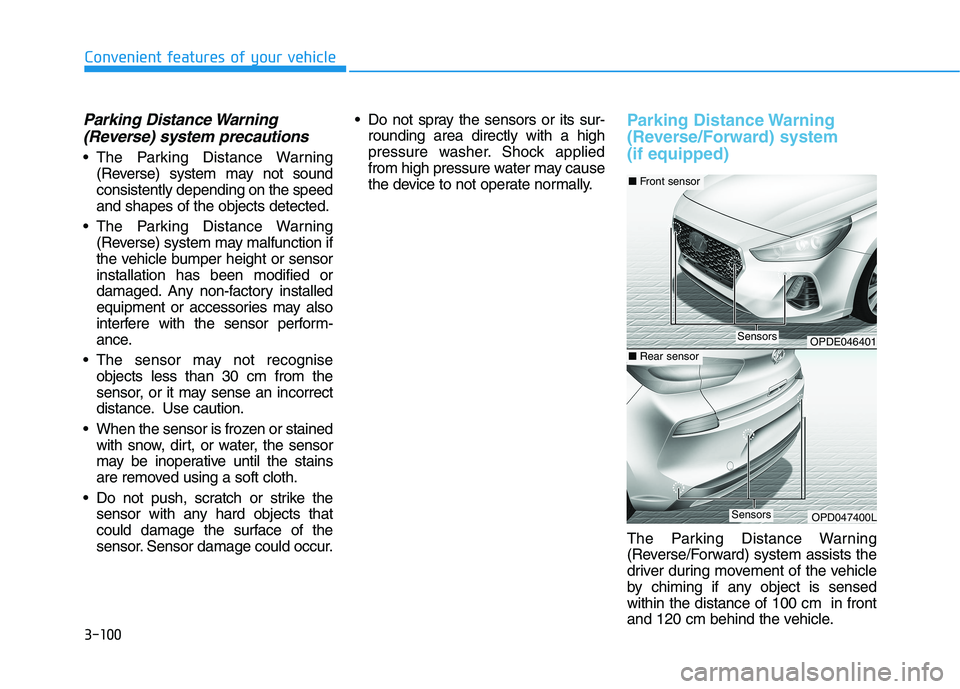
The Parking Distance Warning
(Reverse/Forward) system assists the
driver during movement of the vehicle
by chiming if any object is sensed
within the distance of 100 cm in front
and 120 cm behind the vehicle.
OPDE046401
OPD047400L
■Front sensor
■Rear sensor
Sensors
Sensors
Page 186 of 533
3-103
Convenient features of your vehicle
3
Any non-factory equipment or
accessories have been installed, or
if the vehicle bumper height or sen-
sor installation has been modified.
Detecting range may decrease when:
Outside air temperature is
extremely hot or cold.
Undetectable objects smaller than
1 m and narrower than 14 cm in
diameter.
The following objects may not be
recognised by the sensor:
Sharp or slim objects such as
ropes, chains or small poles.
Objects, which tend to absorb sen-
sor frequency such as clothes,
spongy material or snow.
Parking Distance Warning
(Reverse/Forward) system pre-
cautions
The Parking Distance Warning
(Reverse/Forward) system may not
sound consistently depending on
the speed and shapes of the
objects detected.
The Parking Distance Warning
(Reverse/Forward) system may
malfunction if the vehicle bumper
height or sensor installation has
been modified or damaged. Any
non-factory installed equipment or
accessories may also interfere with
the sensor performance. The sensor may not recognise
objects less than 30 cm from the
sensor, or it may sense an incor-
rect distance. Use caution.
When the sensor is frozen or
stained with snow, dirt, or water,
the sensor may be inoperative until
the stains are removed using a soft
cloth.
Do not push, scratch or strike the
sensor. Sensor damage could
occur.
Do not spray the sensors or its sur-
rounding area directly with a high
pressure washer. Shock applied
from high pressure water may
cause the device to not operate
normally. Your new vehicle warranty does
not cover any accidents or dam-
age to the vehicle or injuries to
its occupants related to a
Parking Distance Warning
(Reverse/Forward) system.
Always drive safely and cau-
tiously.
WARNING
Page 228 of 533
4-3
Multimedia System
4
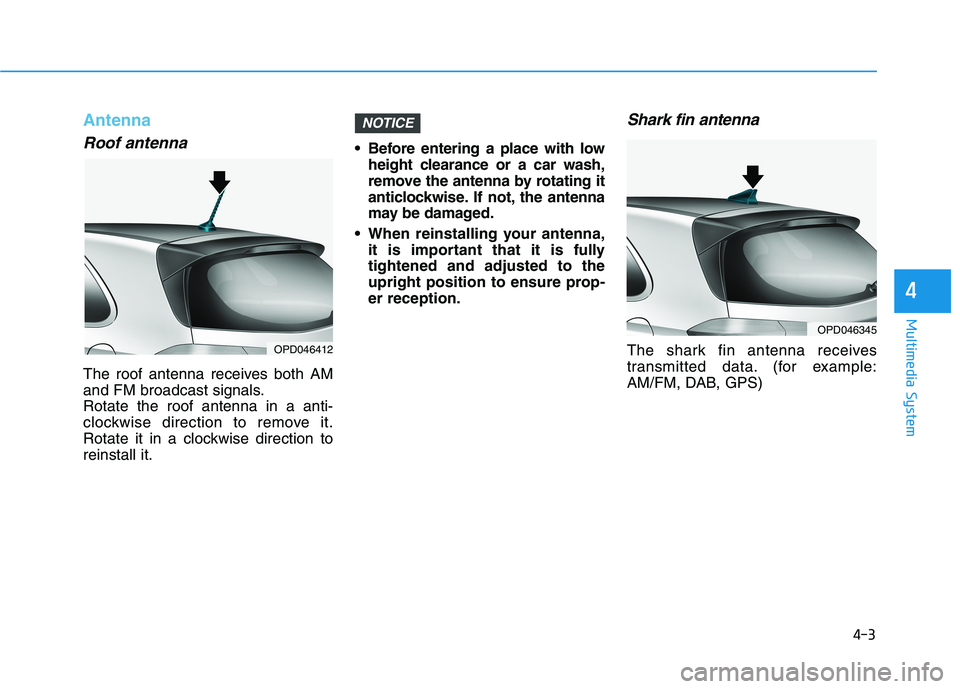
Antenna
Roof antenna
The roof antenna receives both AM
and FM broadcast signals.
Rotate the roof antenna in a anti-
clockwise direction to remove it.
Rotate it in a clockwise direction to
reinstall it. Before entering a place with low
height clearance or a car wash,
remove the antenna by rotating it
anticlockwise. If not, the antenna
may be damaged.
When reinstalling your antenna,
it is important that it is fully
tightened and adjusted to the
upright position to ensure prop-
er reception.
Shark fin antenna
The shark fin antenna receives
transmitted data. (for example:
AM/FM, DAB, GPS)
NOTICE
OPD046412
OPD046345
Page 318 of 533
![HYUNDAI I30 2023 User Guide 5-53
Driving your vehicle
5
AUTO HOLD conditions not met.
Close door, bonnet and tailgate
When you press the [AUTO HOLD]
switch, if the drivers door and bonnet
are not closed, a warning will sound
an](/img/35/56144/w960_56144-317.png "HYUNDAI I30 2023 User Guide 5-53
Driving your vehicle
5
AUTO HOLD conditions not met.
Close door, bonnet and tailgate
When you press the [AUTO HOLD]
switch, if the drivers door and bonnet
are not closed, a warning will sound
an")
5-53
Driving your vehicle
5
AUTO HOLD conditions not met.
Close door, bonnet and tailgate
When you press the [AUTO HOLD]
switch, if the driver's door and bonnet
are not closed, a warning will sound
and a message will appear on the
LCD display. At this moment, press
the [AUTO HOLD] button after clos-
ing the driver's door and bonnet.
Anti-lock Brake System (ABS)
ABS is an electronic braking system
that helps prevent a braking skid.
ABS allows the driver to steer and
brake at the same time. An Anti-Lock Braking System
(ABS) or an Electronic Stability
Control (ESC) system will not
prevent accidents due to
improper or dangerous driving
manoeuvres. Even though vehi-
cle control is improved during
emergency braking, always
maintain a safe distance
between you and objects ahead
of you. Vehicle speeds should
always be reduced during
extreme road conditions. The
braking distance for vehicles
equipped with ABS or ESC may
be longer than for those without
these systems in the following
road conditions.
Drive your vehicle at reduced
speeds during the following
conditions:
Rough, gravel or snow-cov-
ered roads.
(Continued)
WARNING
OPD058108R
(Continued)
On roads where the road sur-
face is pitted or has different
surface height.
Tyre chains are installed on
your vehicle.
The safety features of an ABS
or ESC equipped vehicle should
not be tested by high speed
driving or cornering. This could
endanger the safety of yourself
or others.