tyres HYUNDAI I30 2023 Service Manual
[x] Cancel search | Manufacturer: HYUNDAI, Model Year: 2023, Model line: I30, Model: HYUNDAI I30 2023Pages: 533, PDF Size: 59.13 MB
Page 486 of 533

7-55
7
Maintenance
Wheel size designation
Wheels are also marked with impor-
tant information that you need if you
ever have to replace one. The follow-
ing explains what the letters and
numbers in the wheel size designa-
tion mean.
Example wheel size designation:
6.5JX16
6.5 - Rim width in inches.
J - Rim contour designation.
16 - Rim diameter in inches.
Tyre speed ratings
The chart below lists many of the dif-
ferent speed ratings currently being
used for passenger vehicle tyres.
The speed rating is part of the tyre
size designation on the sidewall of
the tyre. This symbol corresponds to
that tyre’s designed maximum safe
operating speed.
3. Checking tyre life (TIN : Tyre
Identification Number)
Any tyres that are over six years old,
based on the manufacturing date,
(including the spare tyre) should be
replaced by new ones. You can find
the manufacturing date on the tyre
sidewall (possibly on the inside of the
wheel), displaying the DOT Code.
The DOT Code is a series of num-
bers on a tyre consisting of numbers
and English letters. The manufactur-
ing date is designated by the last four
digits (characters) of the DOT code.
DOT : XXXX XXXX OOOO
The front part of the DOT shows a
plant code number, tyre size and
tread pattern and the last four num-
bers indicate week and year manu-
factured.
For example:
DOT XXXX XXXX 1519 represents
that the tyre was produced in the
15th week of 2019.
Speed
Rating
SymbolMaximum Speed
S 180 km/h
T 190 km/h
H 210 km/h
V 240 km/h
W 270km/h
Y 300km/h
Page 487 of 533

7-56
Maintenance
4. Tyre ply composition and
material
The number of layers or plies of rub-
ber-coated fabric in the tyre. Tyre
manufacturers also must indicate the
materials in the tyre, which include
steel, nylon, polyester, and others.
The letter "R" means radial ply con-
struction; the letter "D“ means diago-
nal or bias ply construction; and the
letter "B" means restrained-bias ply
construction.
5. Maximum permissible infla-
tion pressure
This number is the greatest amount
of air pressure that should be put in
the tyre. Do not exceed the maximum
permissible inflation pressure. Refer
to the Tyre and Loading Information
label for recommended inflation
pressure.
6. Maximum load rating
This number indicates the maximum
load in kilograms and pounds that
can be carried by the tyre. When
replacing the tyres on the vehicle,
always use a tyre that has the same
load rating as the factory installed
tyre.
7. Uniform tyre quality grading
Quality grades can be found where
applicable on the tyre sidewall
between tread shoulder and maxi-
mum section width.
For example:
TREAD WEAR 200
TRACTION AA
TEMPERATURE A
Tread wear
The tread wear grade is a compara-
tive rating based on the wear rate of
the tyre when tested under controlled
conditions on a specified government
test course. For example, a tyre grad-
ed 150 would wear one-and-a-half
times (1½) as well on the government
course as a tyre graded 100.The relative performance of tyres
depends upon the actual conditions
of their use, however, and may
depart significantly from the norm
due to variations in driving habits,
service practices and differences in
road characteristics and climate.
These grades are molded on the
sidewalls of passenger vehicle tyres.
The tyres available as standard or
optional equipment on your vehicle
may vary with respect to grade.
Traction - AA, A, B & C
The traction grades, from highest to
lowest, are AA, A, B and C. Those
grades represent the tyre’s ability to
stop on wet pavement as measured
under controlled conditions on speci-
fied government test surfaces of
asphalt and concrete. A tyre marked C
may have poor traction performance.
Page 488 of 533

Temperature - A, B & C
The temperature grades are A (the
highest), then B and C representing
the tyre’s resistance to the genera-
tion of heat and its ability to dissipate
heat when tested under controlled
conditions on a specified indoor lab-
oratory test wheel.
Sustained high temperature can
cause the material of the tyre to
degenerate and reduce tyre life, and
excessive temperature can lead to
sudden tyre failure. Grades B and A
represent higher levels of perform-
ance on the laboratory test wheel
than the minimum required by law.
Low aspect ratio tyres
Low aspect ratio tyres, the aspect
ratio is lower than 50, are provided
for sporty looks.
Because low aspect ratio tyres are
optimized for handling and braking,
their sidewall is a little stiffer than a
standard tyre. Also low aspect ratio
tyres tend to be wider and conse-
quently have a greater contact patch
with the road surface. In some
instances they may generate more
road noise compared with standard
tyres.
7-57
7
Maintenance
The temperature grade for this
tyre is established for a tyre that
is properly inflated and not
overloaded. Excessive speed,
under-inflation, over-inflation,
or excessive loading, either
separately or in combination,
can cause heat build-up and
possible sudden tyre failure.
This may cause loss of vehicle
control resulting in an accident.
WARNING
The traction grade assigned to
this tyre is based on straight-
ahead braking traction tests,
and does not include accelera-
tion, cornering, hydroplaning,
or peak traction characteristics.
WARNING
Page 489 of 533

7-58
Maintenance
Because the sidewall of a low
aspect ratio tyre is shorter than
a standard tyre, the rim of the
wheel and the tyre itself is more
easily susceptible to damage.
Use caution when driving and
follow the guidelines below to
help minimise damage to the
wheel and tyre:
When driving on a rough road
or driving off a road, be careful
not to damage the tyres and
wheels. After driving, inspect
the tyres and wheels.
When passing over a pothole,
speed bump, manhole, or curb
stone, drive the vehicle slowly
so as not to damage the tyres
and wheels.
(Continued)
CAUTION(Continued)
If the tyre is subjected to a
severe impact, we recom-
mend you have the tyre and
wheel inspected by an autho-
rised HYUNDAI dealer.
Inspect the tyre condition and
pressure every 3,000 km to
prevent tyre damage.
It is not easy to recognise tyre
damage with your own eyes.
But if there is the slightest hint
of tyre damage, have the tyre
checked or replaced because
the tyre damage may cause air
leakage from the tyre.
If the tyre is damaged by driv-
ing on a rough road, off road,
pothole, manhole, or curb
stone, it will not be covered by
the warranty.
Page 522 of 533
8
Specifications & Consumer information
8
Specifications & Consumer information
8
Dimensions ..............................................................8-2
Engine ......................................................................8-2
Bulb wattage ...........................................................8-3
Tyres and wheels ...................................................8-4
Air conditioning system ........................................8-6
Vehicle weight and luggage volume ....................8-6
Recommended lubricants and capacities ...........8-7
Recommended SAE viscosity number ..........................8-8
Vehicle identification number (VIN) ..................8-10
Vehicle certification label ...................................8-10
Tyre specification and pressure label ..............8-11
Engine number .....................................................8-11
Air conditioner compressor label ......................8-11
Fuel label ...............................................................8-12
Petrol engine ....................................................................8-12
Diesel engine ....................................................................8-12
Page 526 of 533
8-5
8
Specifications & Consumer information
When replacing tyres, use the same size originally supplied with the vehicle.
Using tyres of a different size can seriously affect your vehicle's handling.
CAUTION
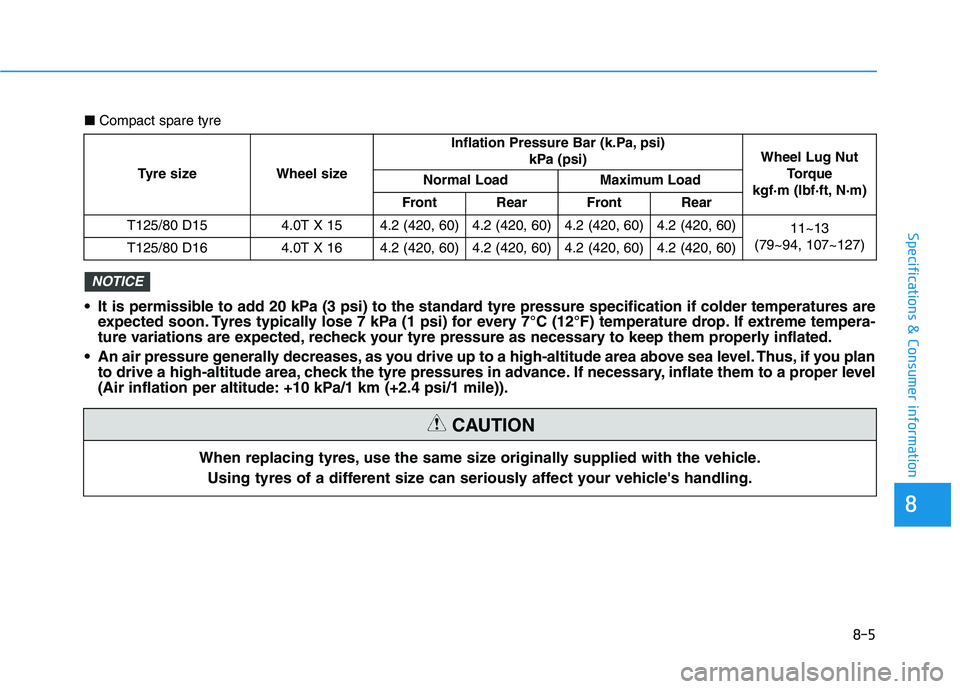
It is permissible to add 20 kPa (3 psi) to the standard tyre pressure specification if colder temperatures are
expected soon. Tyres typically lose 7 kPa (1 psi) for every 7°C (12°F) temperature drop. If extreme tempera-
ture variations are expected, recheck your tyre pressure as necessary to keep them properly inflated.
An air pressure generally decreases, as you drive up to a high-altitude area above sea level. Thus, if you plan
to drive a high-altitude area, check the tyre pressures in advance. If necessary, inflate them to a proper level
(Air inflation per altitude: +10 kPa/1 km (+2.4 psi/1 mile)).
NOTICE
■Compact spare tyre
Tyre size Wheel sizeInflation Pressure Bar (k.Pa, psi)
kPa (psi)Wheel Lug Nut
Torque
kgf·m (lbf·ft, N·m) Normal Load Maximum Load
Front Rear Front Rear
T125/80 D15 4.0T X 15 4.2 (420, 60) 4.2 (420, 60) 4.2 (420, 60) 4.2 (420, 60)
11~13
(79~94, 107~127)
T125/80 D16 4.0T X 16 4.2 (420, 60) 4.2 (420, 60) 4.2 (420, 60) 4.2 (420, 60)
Page 532 of 533
8-11
8
Specifications & Consumer information
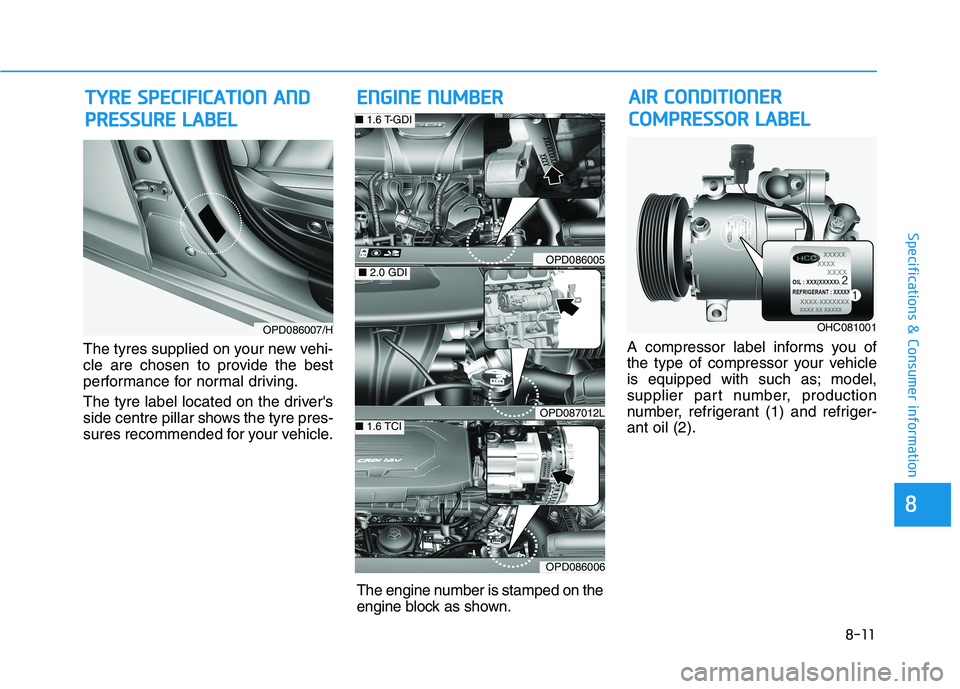
The tyres supplied on your new vehi-
cle are chosen to provide the best
performance for normal driving.
The tyre label located on the driver's
side centre pillar shows the tyre pres-
sures recommended for your vehicle.A compressor label informs you of
the type of compressor your vehicle
is equipped with such as; model,
supplier part number, production
number, refrigerant (1) and refriger-
ant oil (2).
T TY
YR
RE
E
S
SP
PE
EC
CI
IF
FI
IC
CA
AT
TI
IO
ON
N
A
AN
ND
D
P PR
RE
ES
SS
SU
UR
RE
E
L
LA
AB
BE
EL
L
OPD086007/H
E EN
NG
GI
IN
NE
E
N
NU
UM
MB
BE
ER
RA AI
IR
R
C
CO
ON
ND
DI
IT
TI
IO
ON
NE
ER
R
C CO
OM
MP
PR
RE
ES
SS
SO
OR
R
L
LA
AB
BE
EL
L
OPD086005
OPD087012L
OPD086006
■2.0 GDI
■ 1.6 T-GDI
■ 1.6 TCI
OHC081001
The engine number is stamped on the
engine block as shown.