clutch HYUNDAI I30 2023 Repair Manual
[x] Cancel search | Manufacturer: HYUNDAI, Model Year: 2023, Model line: I30, Model: HYUNDAI I30 2023Pages: 533, PDF Size: 59.13 MB
Page 465 of 533
7-34
Maintenance
B BR
RA
AK
KE
E/
/C
CL
LU
UT
TC
CH
H
F
FL
LU
UI
ID
D
(
(I
IF
F
E
EQ
QU
UI
IP
PP
PE
ED
D)
)
Checking the brake/clutch
fluid level
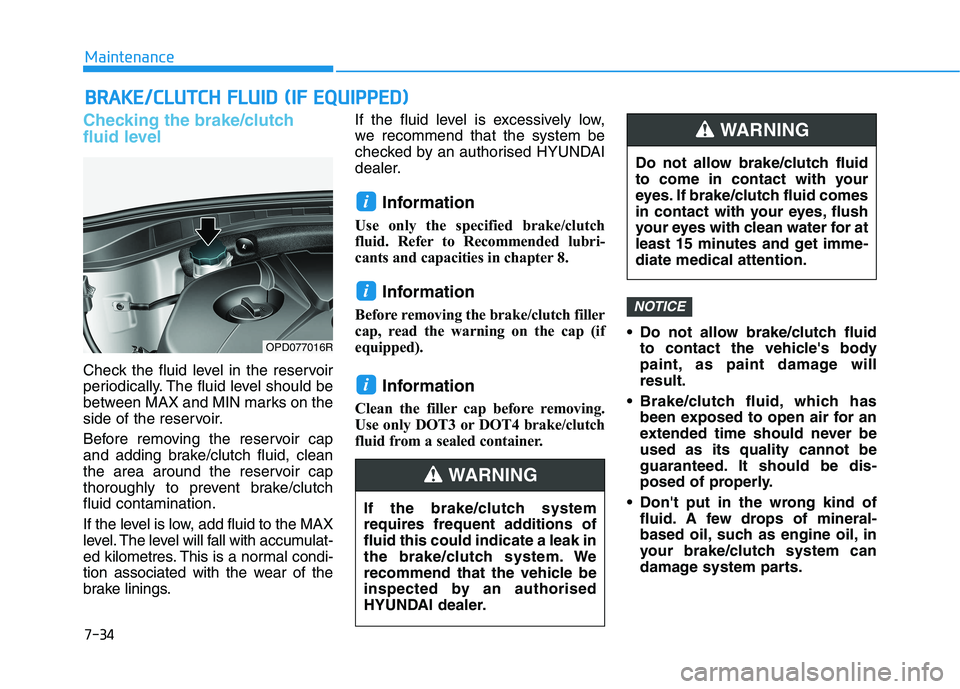
Check the fluid level in the reservoir
periodically. The fluid level should be
between MAX and MIN marks on the
side of the reservoir.
Before removing the reservoir cap
and adding brake/clutch fluid, clean
the area around the reservoir cap
thoroughly to prevent brake/clutch
fluid contamination.
If the level is low, add fluid to the MAX
level. The level will fall with accumulat-
ed kilometres. This is a normal condi-
tion associated with the wear of the
brake linings.If the fluid level is excessively low,
we recommend that the system be
checked by an authorised HYUNDAI
dealer.
Information
Use only the specified brake/clutch
fluid. Refer to Recommended lubri-
cants and capacities in chapter 8.
Information
Before removing the brake/clutch filler
cap, read the warning on the cap (if
equipped).
Information
Clean the filler cap before removing.
Use only DOT3 or DOT4 brake/clutch
fluid from a sealed container. Do not allow brake/clutch fluid
to contact the vehicle's body
paint, as paint damage will
result.
Brake/clutch fluid, which has
been exposed to open air for an
extended time should never be
used as its quality cannot be
guaranteed. It should be dis-
posed of properly.
Don't put in the wrong kind of
fluid. A few drops of mineral-
based oil, such as engine oil, in
your brake/clutch system can
damage system parts.
NOTICE
i
i
i
OPD077016R
If the brake/clutch system
requires frequent additions of
fluid this could indicate a leak in
the brake/clutch system. We
recommend that the vehicle be
inspected by an authorised
HYUNDAI dealer.
WARNING
Do not allow brake/clutch fluid
to come in contact with your
eyes. If brake/clutch fluid comes
in contact with your eyes, flush
your eyes with clean water for at
least 15 minutes and get imme-
diate medical attention.
WARNING
Page 527 of 533
8-6
Specifications & Consumer information
A AI
IR
R
C
CO
ON
ND
DI
IT
TI
IO
ON
NI
IN
NG
G
S
SY
YS
ST
TE
EM
M
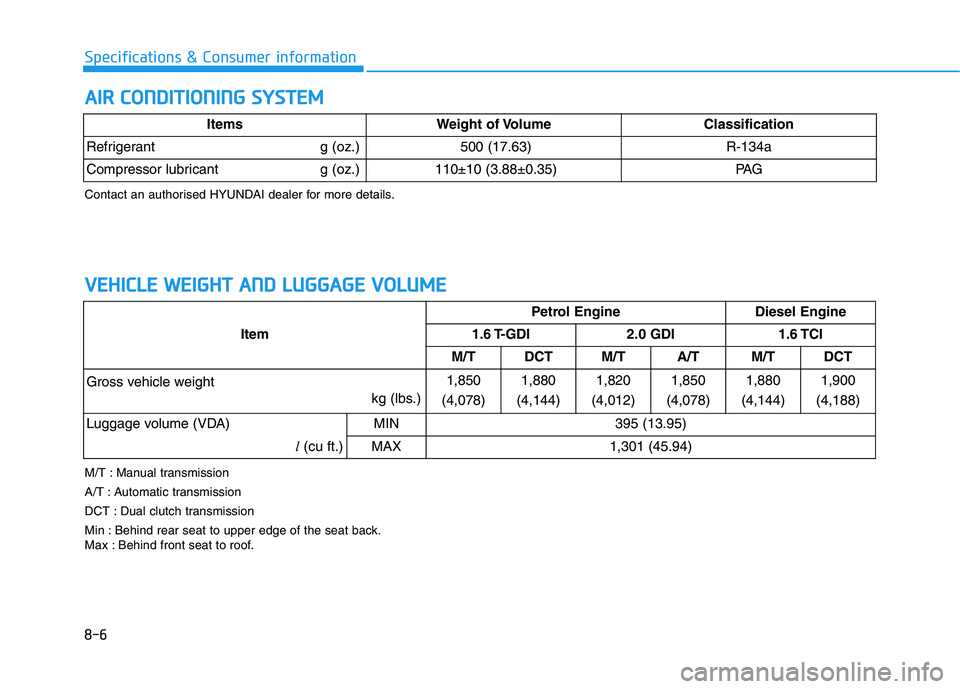
ItemPetrol Engine Diesel Engine
1.6 T-GDI 2.0 GDI 1.6 TCI
M/T DCT M/T A/T M/T DCT
Gross vehicle weight
kg (lbs.)1,850
(4,078)1,880
(4,144)1,820
(4,012)1,850
(4,078)1,880
(4,144)1,900
(4,188)
Luggage volume (VDA)
l(cu ft.)MIN 395 (13.95)
MAX 1,301 (45.94)
V VE
EH
HI
IC
CL
LE
E
W
WE
EI
IG
GH
HT
T
A
AN
ND
D
L
LU
UG
GG
GA
AG
GE
E
V
VO
OL
LU
UM
ME
E
ItemsWeight of Volume Classification
Refrigerant g (oz.)500 (17.63)R-134a
Compressor lubricant g (oz.)110±10 (3.88±0.35)PA G
Contact an authorised HYUNDAI dealer for more details.
M/T : Manual transmission
A/T : Automatic transmission
DCT : Dual clutch transmission
Min : Behind rear seat to upper edge of the seat back.
Max : Behind front seat to roof.
Page 529 of 533
8-8
Specifications & Consumer information
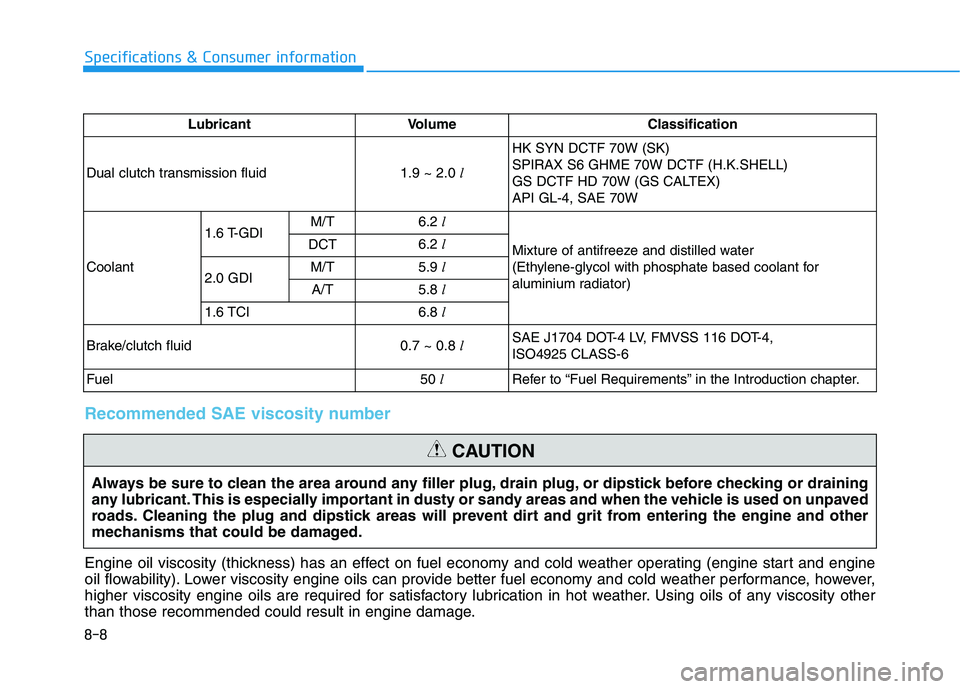
Lubricant Volume Classification
Dual clutch transmission fluid1.9 ~ 2.0 lHK SYN DCTF 70W (SK)
SPIRAX S6 GHME 70W DCTF (H.K.SHELL)
GS DCTF HD 70W (GS CALTEX)
API GL-4, SAE 70W
Coolant1.6 T-GDIM/T6.2 l
Mixture of antifreeze and distilled water
(Ethylene-glycol with phosphate based coolant for
aluminium radiator) DCT6.2 l
2.0 GDIM/T5.9 l
A/T5.8 l
1.6 TCI6.8 l
Brake/clutch fluid0.7 ~ 0.8 lSAE J1704 DOT-4 LV, FMVSS 116 DOT-4,
ISO4925 CLASS-6
Fuel50 l
Refer to “Fuel Requirements” in the Introduction chapter.
Always be sure to clean the area around any filler plug, drain plug, or dipstick before checking or draining
any lubricant. This is especially important in dusty or sandy areas and when the vehicle is used on unpaved
roads. Cleaning the plug and dipstick areas will prevent dirt and grit from entering the engine and other
mechanisms that could be damaged.
CAUTION
Recommended SAE viscosity number
Engine oil viscosity (thickness) has an effect on fuel economy and cold weather operating (engine start and engine
oil flowability). Lower viscosity engine oils can provide better fuel economy and cold weather performance, however,
higher viscosity engine oils are required for satisfactory lubrication in hot weather. Using oils of any viscosity other
than those recommended could result in engine damage.