Drive train HYUNDAI I30 2023 Owners Manual
[x] Cancel search | Manufacturer: HYUNDAI, Model Year: 2023, Model line: I30, Model: HYUNDAI I30 2023Pages: 533, PDF Size: 59.13 MB
Page 8 of 533
![HYUNDAI I30 2023 Owners Manual F8
Introduction
Petrol containing ethanol
Ethanol [E-10], a mixture of petrol
and ethanol (also known as grain
alcohol), is marketed along with or
instead of leaded or unleaded petrol.
Do not use petr](/img/35/56144/w960_56144-7.png "HYUNDAI I30 2023 Owners Manual F8
Introduction
Petrol containing ethanol
Ethanol [E-10], a mixture of petrol
and ethanol (also known as grain
alcohol), is marketed along with or
instead of leaded or unleaded petrol.
Do not use petr")
F8
Introduction
Petrol containing ethanol
Ethanol [E-10], a mixture of petrol
and ethanol (also known as grain
alcohol), is marketed along with or
instead of leaded or unleaded petrol.
Do not use petrol containing more
than 10% ethanol, and do not use
petrol or ethanol containing any
methanol. Either of these fuels may
cause drivability problems and dam-
age to the fuel system, engine con-
trol system and emission control sys-
tem.
Discontinue using ethanol of any
kind if driveability problems occur.
Vehicle damage or driveability prob-
lems may not be covered by the
manufacturer’s warranty if they result
from the use of:
1. Petrol containing more than 10%
ethanol.
2. Petrol or ethanol containing
methanol.
3. Leaded fuel or leaded ethanol.Never use fuel which contains
methanol. Discontinue use of any
petrol product which impairs dri-
vability.
Other fuels
Using fuel additives such as:
- Silicone fuel additive
- MMT (Magnanese, Mn) fuel additive
- Ferrocene (iron-based) fuel additive
- Other metallic-based fuel additives
may result in cylinder misfire, poor
acceleration, engine stalling, dam-
age to the catalytic converter, or
abnormal corrosion, and may cause
damage to the engine resulting in a
reduction in the overall life of the
powertrain.
Damage to the fuel system or per-
formance problems caused by the
use of these fuels may not be cov-
ered by your New Vehicle Limited
Warranty.
NOTICE
NOTICE
Page 22 of 533
Safety system of your vehicle
2
Important safety precautions...............................2-2
Always wear your seat belt............................................2-2
Restrain all children ..........................................................2-2
Air bag hazards..................................................................2-2
Driver distraction ...............................................................2-2
Control your speed ...........................................................2-3
Keep your vehicle in a safe condition .........................2-3
Seats ........................................................................2-4
Safety precautions............................................................2-5
Front seats ..........................................................................2-6
Rear seats .........................................................................2-12
Headrest ............................................................................2-15
Seat warmers and air ventilation seats.....................2-19
Seat belts ..............................................................2-22
Seat belt safety precautions ........................................2-22
Seat belt warning light ..................................................2-24
Seat belt restraint system ............................................2-26
Additional seat belt safety precautions ....................2-31
Care of seat belts ...........................................................2-34
Child restraint system (CRS) ..............................2-35
Children always in the rear seat .................................2-35
Selecting a Child Restraint System (CRS) .................2-36
Installing a Child Restraint System (CRS)..................2-38
Air bag - supplemental restraint system .........2-45
Where are the air bags? ...............................................2-47
How does the air bag system operate? ....................2-50
What to expect after an air bag inflates..................2-54
Why didn't my air bag go off in a collision? ...........2-56
SRS care ............................................................................2-61
Additional safety precautions ......................................2-62
Air bag warning labels ...................................................2-62
This chapter provides you with important information about how to protect yourself and your passengers.
It explains how to properly use your seats and seat belts, and how your air bags work.
Additionally, this chapter explains how to properly restrain infants and children in your vehicle.
Page 23 of 533
2-2
You will find many safety precautions
and recommendations throughout
this section, and throughout this man-
ual. The safety precautions in this sec-
tion are among the most important.
Always wear your seat belt
A seat belt is your best protection in
all types of accidents. Air bags are
designed to supplement seat belts,
not replace them. So even though
your vehicle is equipped with air bags,
ALWAYS make sure you and your
passengers wear your seat belts, and
wear them properly.
Restrain all children
All children under age 13 should ride
in your vehicle properly restrained in
a rear seat, not the front seat. Infants
and small children should be
restrained in an appropriate child
restraint. Larger children should use
a booster seat with the lap/shoulder
belt until they can use the seat belt
properly without a booster seat.
Air bag hazards
Whilst air bags can save lives, they
can also cause serious or fatal
injuries to occupants who sit too
close to them, or who are not prop-
erly restrained. Infants, young chil-
dren, and short adults are at the
greatest risk of being injured by an
inflating air bag. Follow all instruc-
tions and warnings in this manual.
Driver distraction
Driver distraction presents a serious
and potentially deadly danger, espe-
cially for inexperienced drivers. Safety
should be the first concern when
behind the wheel and drivers need to
be aware of the wide array of potential
distractions, such as drowsiness,
reaching for objects, eating, personal
grooming, other passengers, and
using mobile phones.
Drivers can become distracted when
they take their eyes and attention off
the road or their hands off the wheel
to focus on activities other than driv-
ing. To reduce your risk of distraction
and an accident:
• ALWAYS set up your mobile devices
(i.e., MP3 players, phones, naviga-
tion units, etc.) when your vehicle is
parked or safely stopped.
ONLY use your mobile device when
allowed by laws and conditions per-
mit safe use. NEVER text or email
whilst driving. Most countries have
laws prohibiting drivers from texting.
Some countries and cities also pro-
hibit drivers from using handheld
phones.
I IM
MP
PO
OR
RT
TA
AN
NT
T
S
SA
AF
FE
ET
TY
Y
P
PR
RE
EC
CA
AU
UT
TI
IO
ON
NS
S
Safety system of your vehicle
Page 27 of 533
2-6
Safety system of your vehicle
Seat belts
Always fasten your seat belt before
starting any trip.
At all times, passengers should sit
upright and be properly restrained.
Infants and small children must be
restrained in appropriate Child
Restraint Systems. Children who
have outgrown a booster seat as well
as adults, must be restrained using
the seat belts.
Front seats
The front seat can be adjusted by
using the control lever or switches
located on the outside of the seat
cushion. Before driving, adjust the
seat to the proper position so that you
can easily control the steering wheel,
foot pedals and controls on the instru-
ment panel.
Take the following precautions
when adjusting your seat belt:
NEVER use one seat belt for
more than one occupant.
Always position the seatback
upright with the lap portion of
the seat belt snug and low
across the hips.
NEVER allow children or small
infants to ride on a passenger’s
lap.
(Continued)
(Continued)
Do not route the seat belt
across your neck, across sharp
edges, or reroute the shoulder
strap away from your body.
Do not allow the seat belt to
become caught or jammed.
WARNING Take the following precautions
when adjusting your seat:
NEVER attempt to adjust the
seat whilst the vehicle is mov-
ing. The seat could respond
with unexpected movement
and may cause loss of vehicle
control resulting in an acci-
dent.
Do not place anything under
the front seats. Loose objects
in the driver’s foot area could
interfere with the operation of
the foot pedals, causing an
accident.
(Continued)
WARNING
Page 29 of 533
2-8
Seatback angle
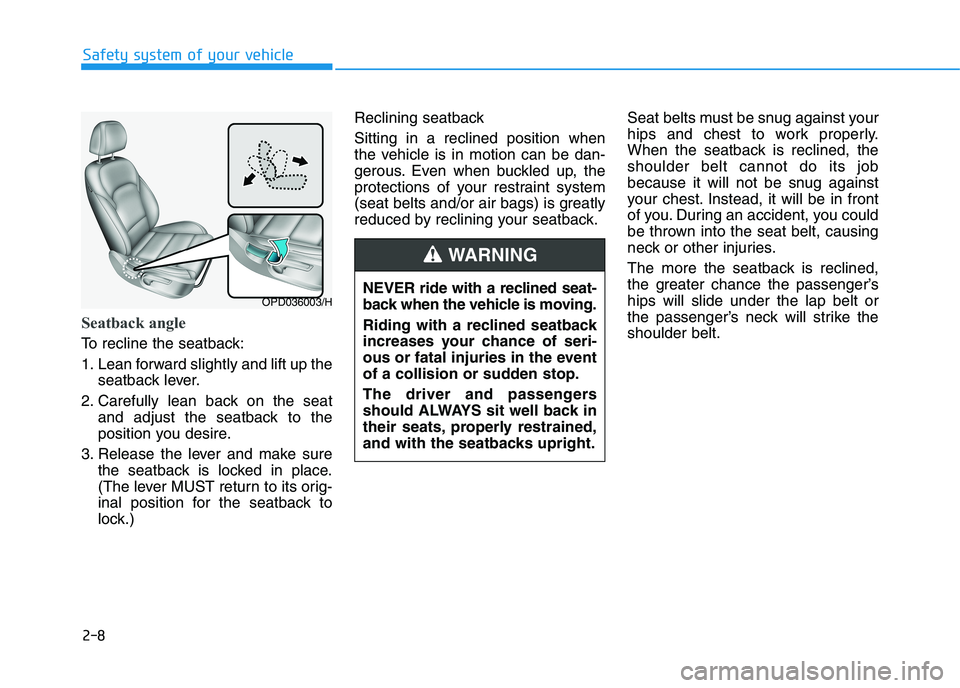
To recline the seatback:
1. Lean forward slightly and lift up the
seatback lever.
2. Carefully lean back on the seat
and adjust the seatback to the
position you desire.
3. Release the lever and make sure
the seatback is locked in place.
(The lever MUST return to its orig-
inal position for the seatback to
lock.)Reclining seatback
Sitting in a reclined position when
the vehicle is in motion can be dan-
gerous. Even when buckled up, the
protections of your restraint system
(seat belts and/or air bags) is greatly
reduced by reclining your seatback.Seat belts must be snug against your
hips and chest to work properly.
When the seatback is reclined, the
shoulder belt cannot do its job
because it will not be snug against
your chest. Instead, it will be in front
of you. During an accident, you could
be thrown into the seat belt, causing
neck or other injuries.
The more the seatback is reclined,
the greater chance the passenger’s
hips will slide under the lap belt or
the passenger’s neck will strike the
shoulder belt.
Safety system of your vehicle
OPD036003/HNEVER ride with a reclined seat-
back when the vehicle is moving.
Riding with a reclined seatback
increases your chance of seri-
ous or fatal injuries in the event
of a collision or sudden stop.
The driver and passengers
should ALWAYS sit well back in
their seats, properly restrained,
and with the seatbacks upright.
WARNING
Page 31 of 533
2-10
Seatback angle
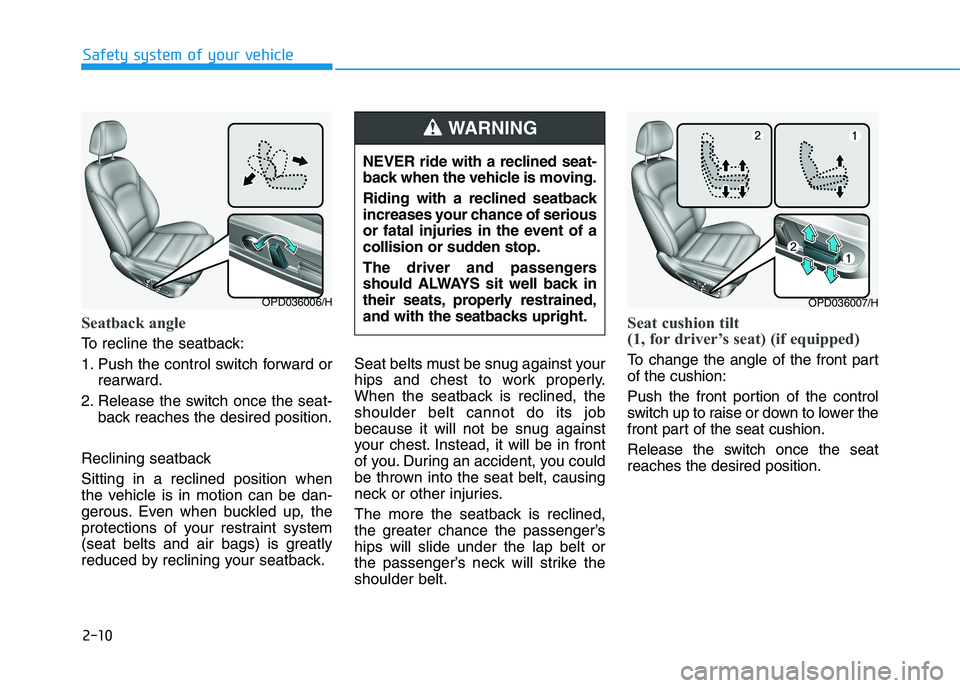
To recline the seatback:
1. Push the control switch forward or
rearward.
2. Release the switch once the seat-
back reaches the desired position.
Reclining seatback
Sitting in a reclined position when
the vehicle is in motion can be dan-
gerous. Even when buckled up, the
protections of your restraint system
(seat belts and air bags) is greatly
reduced by reclining your seatback.Seat belts must be snug against your
hips and chest to work properly.
When the seatback is reclined, the
shoulder belt cannot do its job
because it will not be snug against
your chest. Instead, it will be in front
of you. During an accident, you could
be thrown into the seat belt, causing
neck or other injuries.
The more the seatback is reclined,
the greater chance the passenger’s
hips will slide under the lap belt or
the passenger’s neck will strike the
shoulder belt.
Seat cushion tilt
(1, for driver’s seat) (if equipped)
To change the angle of the front part
of the cushion:
Push the front portion of the control
switch up to raise or down to lower the
front part of the seat cushion.
Release the switch once the seat
reaches the desired position.
Safety system of your vehicle
NEVER ride with a reclined seat-
back when the vehicle is moving.
Riding with a reclined seatback
increases your chance of serious
or fatal injuries in the event of a
collision or sudden stop.
The driver and passengers
should ALWAYS sit well back in
their seats, properly restrained,
and with the seatbacks upright.
WARNING
OPD036006/HOPD036007/H
Page 47 of 533
2-26
Safety system of your vehicle
If the rear seat belt is fastened, the
warning light will turn off immediately.
If the rear seat belt is disconnected
when you drive over the 20km/h, the
corresponding seat belt warning light
will blink and a warning chime will
sound for 35 seconds.
But, if the rear passenger's lap/shoul-
der belt is/are connected and discon-
nected twice within 9 seconds after
the belt is fastened, the corresponding
seat belt warning light will not operate.
Seat belt restraint system
Lap/shoulder belt
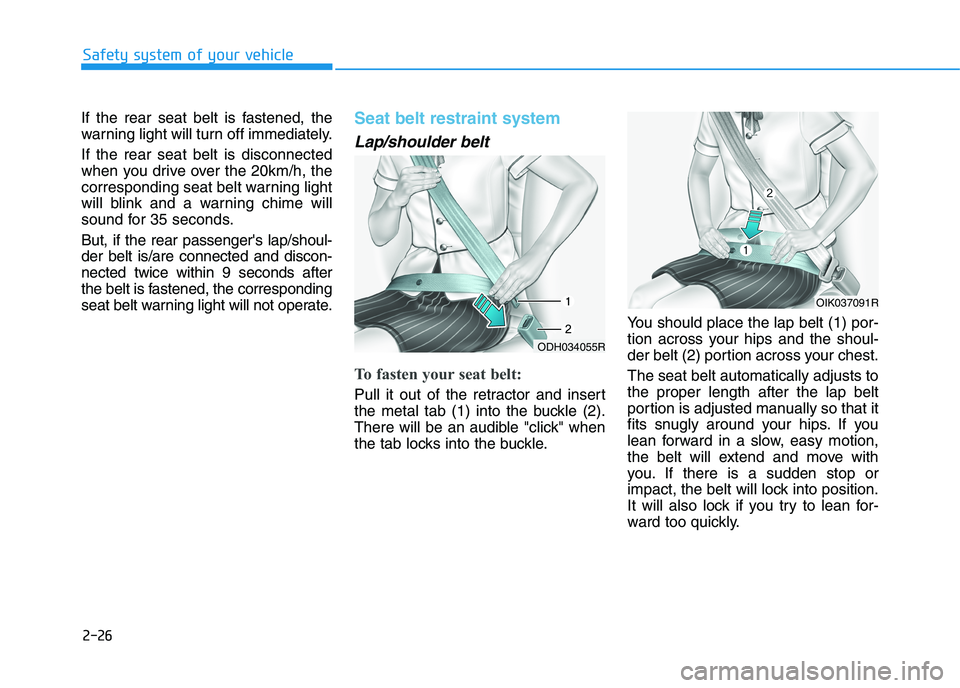
To fasten your seat belt:
Pull it out of the retractor and insert
the metal tab (1) into the buckle (2).
There will be an audible "click" when
the tab locks into the buckle.You should place the lap belt (1) por-
tion across your hips and the shoul-
der belt (2) portion across your chest.
The seat belt automatically adjusts to
the proper length after the lap belt
portion is adjusted manually so that it
fits snugly around your hips. If you
lean forward in a slow, easy motion,
the belt will extend and move with
you. If there is a sudden stop or
impact, the belt will lock into position.
It will also lock if you try to lean for-
ward too quickly.
ODH034055R
OIK037091R
Page 54 of 533
2-33
Safety system of your vehicle
2
Seat belt use and injured people
A seat belt should be used when an
injured person is being transported.
Consult a doctor for specific recom-
mendations.
One person per belt
Two people (including children) should
never attempt to use a single seat belt.
This could increase the severity of
injuries in case of an accident.
Do not lie down
Sitting in a reclined position when
the vehicle is in motion can be dan-
gerous. Even when buckled up, the
protections of your restraint system
(seat belts and/or air bags) is greatly
reduced by reclining your seatback.
Seat belts must be snug against your
hips and chest to work properly.
During an accident, you could be
thrown into the seat belt, causing
neck or other injuries.The more the seat back is reclined,
the greater the chance for the pas-
senger's hips to slide under the lap
belt or the passenger's neck to strike
the shoulder belt.
NEVER ride with a reclined
seatback when the vehicle is
moving.
Riding with a reclined seat-
back increases your chance
of serious or fatal injuries in
the event of a collision or sud-
den stop.
The driver and passengers
should always sit well back in
their seats, properly
restrained, and with the seat-
backs upright.
WARNING
Always make sure larger chil-
dren’s seat belts are worn and
properly adjusted.
NEVER allow the shoulder
belt to contact the child’s
neck or face.
Do not allow more than one
child to use a single seat belt.
WARNING
Page 67 of 533

2-46
Safety system of your vehicle
The vehicles are equipped with a
Supplemental Air Bag System for the
driver’s seat and front passenger’s
seats.
The front air bags are designed to
supplement the three-point seat
belts. For these air bags to provide
protection, the seat belts must be
worn at all times when driving.
You can be severely injured or killed
in an accident if you are not wearing
a seat belt. Air bags are designed to
supplement seat belts, but do not
replace them. Also, air bags are not
designed to deploy in every collision.
In some accidents, the seat belts are
the only restraint protecting you.AIR BAG SAFETY PRECAUTIONS
ALWAYS use seat belts Child Restraint Systems - every trip, every
time, everyone! Even with air bags, you can be seriously injured or
killed in a collision if you are improperly restrained or not wearing
your seat.
NEVER place a child in any Child Restraint System or booster seat in
the front passenger seat.
An inflating air bag could forcefully strike the infant or child causing
serious or fatal injuries.
ABC - Always Buckle Children under age 13 in the back seat. It is the
safest place for children of any age to ride. If a child age 13 or older
must be seated in the front seat, he or she must be properly belted
and the seat should be moved as far back as possible.
All occupants should sit upright with the seatback in an upright posi-
tion, centred on the seat cushion with their seat belt on, legs com-
fortably extended and their feet on the floor until the vehicle is parked
and the engine is turned off. If an occupant is out of position during
an accident, the rapidly deploying air bag may forcefully contact the
occupant causing serious or fatal injuries.
You and your passengers should never sit or lean unnecessarily
close to the air bags or lean against the door or centre console.
Move your seat as far back as possible from front air bags, whilst still
maintaining control of the vehicle.
WARNING
Page 68 of 533
2-47
Safety system of your vehicle
2
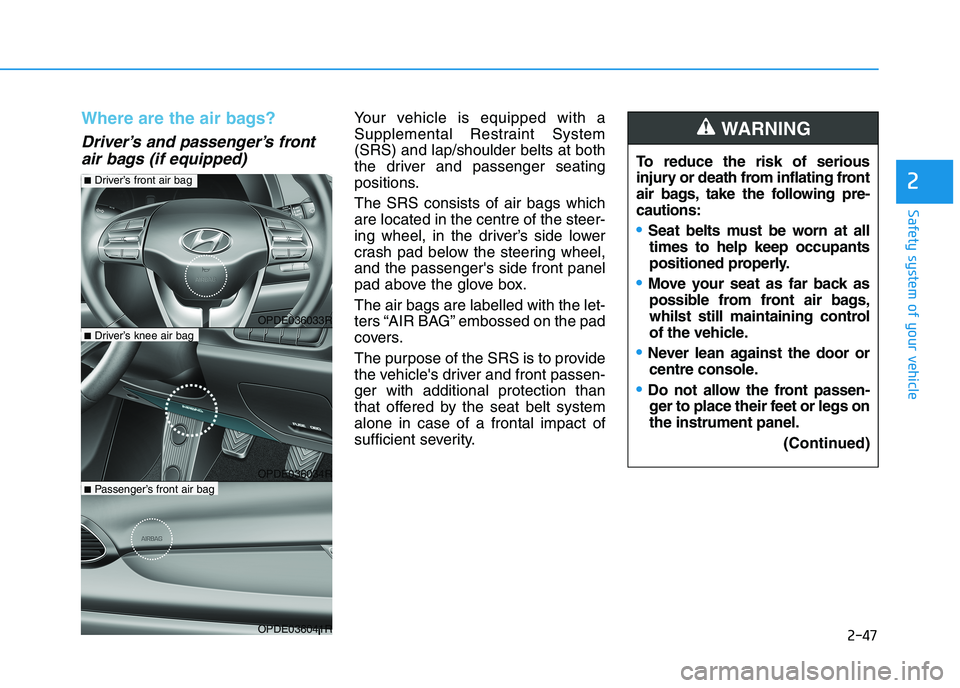
Where are the air bags?
Driver’s and passenger’s front
air bags (if equipped)
Your vehicle is equipped with a
Supplemental Restraint System
(SRS) and lap/shoulder belts at both
the driver and passenger seating
positions.
The SRS consists of air bags which
are located in the centre of the steer-
ing wheel, in the driver’s side lower
crash pad below the steering wheel,
and the passenger's side front panel
pad above the glove box.
The air bags are labelled with the let-
ters “AIR BAG” embossed on the pad
covers.
The purpose of the SRS is to provide
the vehicle's driver and front passen-
ger with additional protection than
that offered by the seat belt system
alone in case of a frontal impact of
sufficient severity.To reduce the risk of serious
injury or death from inflating front
air bags, take the following pre-
cautions:
Seat belts must be worn at all
times to help keep occupants
positioned properly.
Move your seat as far back as
possible from front air bags,
whilst still maintaining control
of the vehicle.
Never lean against the door or
centre console.
Do not allow the front passen-
ger to place their feet or legs on
the instrument panel.
(Continued)
WARNING
OPDE036033R
OPDE036034R
OPDE036041R
■Driver’s knee air bag
■Driver’s front air bag
■Passenger’s front air bag