wheel base HYUNDAI I30 2023 Owners Manual
[x] Cancel search | Manufacturer: HYUNDAI, Model Year: 2023, Model line: I30, Model: HYUNDAI I30 2023Pages: 533, PDF Size: 59.13 MB
Page 73 of 533
2-52
Safety system of your vehicle
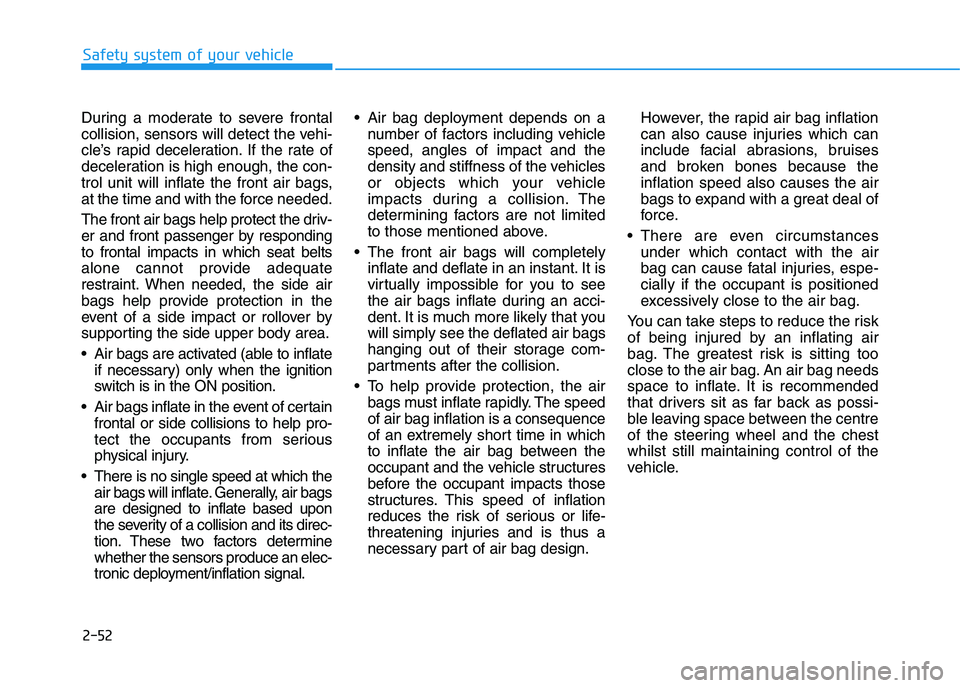
During a moderate to severe frontal
collision, sensors will detect the vehi-
cle’s rapid deceleration. If the rate of
deceleration is high enough, the con-
trol unit will inflate the front air bags,
at the time and with the force needed.
The front air bags help protect the driv-
er and front passenger by responding
to frontal impacts in which seat belts
alone cannot provide adequate
restraint. When needed, the side air
bags help provide protection in the
event of a side impact or rollover by
supporting the side upper body area.
Air bags are activated (able to inflate
if necessary) only when the ignition
switch is in the ON position.
Air bags inflate in the event of certain
frontal or side collisions to help pro-
tect the occupants from serious
physical injury.
There is no single speed at which the
air bags will inflate. Generally, air bags
are designed to inflate based upon
the severity of a collision and its direc-
tion. These two factors determine
whether the sensors produce an elec-
tronic deployment/inflation signal. Air bag deployment depends on a
number of factors including vehicle
speed, angles of impact and the
density and stiffness of the vehicles
or objects which your vehicle
impacts during a collision. The
determining factors are not limited
to those mentioned above.
The front air bags will completely
inflate and deflate in an instant. It is
virtually impossible for you to see
the air bags inflate during an acci-
dent. It is much more likely that you
will simply see the deflated air bags
hanging out of their storage com-
partments after the collision.
To help provide protection, the air
bags must inflate rapidly. The speed
of air bag inflation is a consequence
of an extremely short time in which
to inflate the air bag between the
occupant and the vehicle structures
before the occupant impacts those
structures. This speed of inflation
reduces the risk of serious or life-
threatening injuries and is thus a
necessary part of air bag design.However, the rapid air bag inflation
can also cause injuries which can
include facial abrasions, bruises
and broken bones because the
inflation speed also causes the air
bags to expand with a great deal of
force.
There are even circumstances
under which contact with the air
bag can cause fatal injuries, espe-
cially if the occupant is positioned
excessively close to the air bag.
You can take steps to reduce the risk
of being injured by an inflating air
bag. The greatest risk is sitting too
close to the air bag. An air bag needs
space to inflate. It is recommended
that drivers sit as far back as possi-
ble leaving space between the centre
of the steering wheel and the chest
whilst still maintaining control of the
vehicle.
Page 486 of 533

7-55
7
Maintenance
Wheel size designation
Wheels are also marked with impor-
tant information that you need if you
ever have to replace one. The follow-
ing explains what the letters and
numbers in the wheel size designa-
tion mean.
Example wheel size designation:
6.5JX16
6.5 - Rim width in inches.
J - Rim contour designation.
16 - Rim diameter in inches.
Tyre speed ratings
The chart below lists many of the dif-
ferent speed ratings currently being
used for passenger vehicle tyres.
The speed rating is part of the tyre
size designation on the sidewall of
the tyre. This symbol corresponds to
that tyre’s designed maximum safe
operating speed.
3. Checking tyre life (TIN : Tyre
Identification Number)
Any tyres that are over six years old,
based on the manufacturing date,
(including the spare tyre) should be
replaced by new ones. You can find
the manufacturing date on the tyre
sidewall (possibly on the inside of the
wheel), displaying the DOT Code.
The DOT Code is a series of num-
bers on a tyre consisting of numbers
and English letters. The manufactur-
ing date is designated by the last four
digits (characters) of the DOT code.
DOT : XXXX XXXX OOOO
The front part of the DOT shows a
plant code number, tyre size and
tread pattern and the last four num-
bers indicate week and year manu-
factured.
For example:
DOT XXXX XXXX 1519 represents
that the tyre was produced in the
15th week of 2019.
Speed
Rating
SymbolMaximum Speed
S 180 km/h
T 190 km/h
H 210 km/h
V 240 km/h
W 270km/h
Y 300km/h
Page 488 of 533

Temperature - A, B & C
The temperature grades are A (the
highest), then B and C representing
the tyre’s resistance to the genera-
tion of heat and its ability to dissipate
heat when tested under controlled
conditions on a specified indoor lab-
oratory test wheel.
Sustained high temperature can
cause the material of the tyre to
degenerate and reduce tyre life, and
excessive temperature can lead to
sudden tyre failure. Grades B and A
represent higher levels of perform-
ance on the laboratory test wheel
than the minimum required by law.
Low aspect ratio tyres
Low aspect ratio tyres, the aspect
ratio is lower than 50, are provided
for sporty looks.
Because low aspect ratio tyres are
optimized for handling and braking,
their sidewall is a little stiffer than a
standard tyre. Also low aspect ratio
tyres tend to be wider and conse-
quently have a greater contact patch
with the road surface. In some
instances they may generate more
road noise compared with standard
tyres.
7-57
7
Maintenance
The temperature grade for this
tyre is established for a tyre that
is properly inflated and not
overloaded. Excessive speed,
under-inflation, over-inflation,
or excessive loading, either
separately or in combination,
can cause heat build-up and
possible sudden tyre failure.
This may cause loss of vehicle
control resulting in an accident.
WARNING
The traction grade assigned to
this tyre is based on straight-
ahead braking traction tests,
and does not include accelera-
tion, cornering, hydroplaning,
or peak traction characteristics.
WARNING
Page 523 of 533
8-2
Specifications & Consumer information
D DI
IM
ME
EN
NS
SI
IO
ON
NS
S
E EN
NG
GI
IN
NE
E
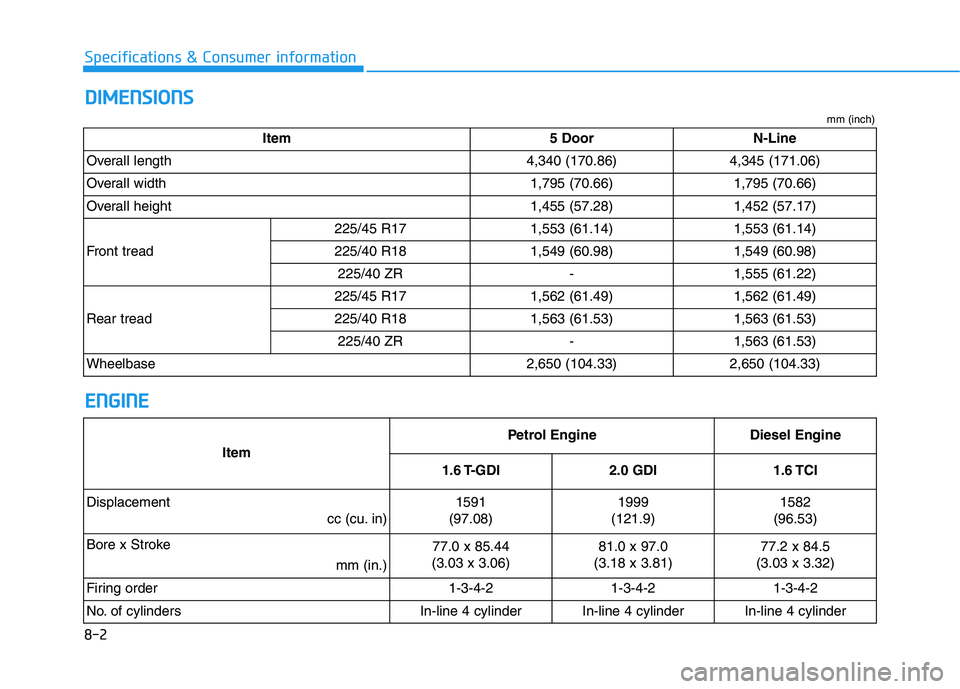
Item 5 Door N-Line
Overall length 4,340 (170.86) 4,345 (171.06)
Overall width 1,795 (70.66) 1,795 (70.66)
Overall height 1,455 (57.28) 1,452 (57.17)
Front tread225/45 R17 1,553 (61.14) 1,553 (61.14)
225/40 R18 1,549 (60.98) 1,549 (60.98)
225/40 ZR - 1,555 (61.22)
Rear tread225/45 R17 1,562 (61.49) 1,562 (61.49)
225/40 R18 1,563 (61.53) 1,563 (61.53)
225/40 ZR - 1,563 (61.53)
Wheelbase 2,650 (104.33) 2,650 (104.33)
Item
Petrol EngineDiesel Engine
1.6 T-GDI2.0 GDI1.6 TCI
Displacement
cc (cu. in)
1591
(97.08)1999
(121.9)1582
(96.53)
Bore x Stroke
mm (in.)
77.0 x 85.44
(3.03 x 3.06)81.0 x 97.0
(3.18 x 3.81)77.2 x 84.5
(3.03 x 3.32)
Firing order
1-3-4-21-3-4-21-3-4-2
No. of cylinders
In-line 4 cylinderIn-line 4 cylinderIn-line 4 cylinder
mm (inch)