warning light HYUNDAI I800 2016 User Guide
[x] Cancel search | Manufacturer: HYUNDAI, Model Year: 2016, Model line: I800, Model: HYUNDAI I800 2016Pages: 419, PDF Size: 9.23 MB
Page 62 of 419
347
Safety features of your vehicle
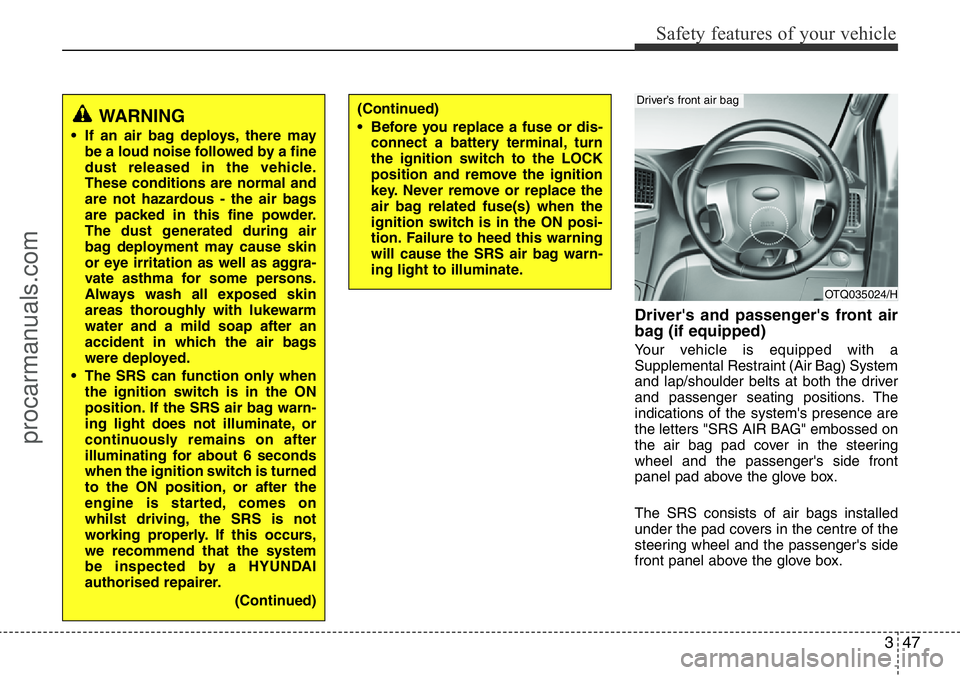
Driver's and passenger's front air
bag (if equipped)
Your vehicle is equipped with a
Supplemental Restraint (Air Bag) System
and lap/shoulder belts at both the driver
and passenger seating positions. The
indications of the system's presence are
the letters "SRS AIR BAG" embossed on
the air bag pad cover in the steering
wheel and the passenger's side front
panel pad above the glove box.
The SRS consists of air bags installed
under the pad covers in the centre of the
steering wheel and the passenger's side
front panel above the glove box.
WARNING
• If an air bag deploys, there may
be a loud noise followed by a fine
dust released in the vehicle.
These conditions are normal and
are not hazardous - the air bags
are packed in this fine powder.
The dust generated during air
bag deployment may cause skin
or eye irritation as well as aggra-
vate asthma for some persons.
Always wash all exposed skin
areas thoroughly with lukewarm
water and a mild soap after an
accident in which the air bags
were deployed.
• The SRS can function only when
the ignition switch is in the ON
position. If the SRS air bag warn-
ing light does not illuminate, or
continuously remains on after
illuminating for about 6 seconds
when the ignition switch is turned
to the ON position, or after the
engine is started, comes on
whilst driving, the SRS is not
working properly. If this occurs,
we recommend that the system
be inspected by a HYUNDAI
authorised repairer.
(Continued)
(Continued)
• Before you replace a fuse or dis-
connect a battery terminal, turn
the ignition switch to the LOCK
position and remove the ignition
key. Never remove or replace the
air bag related fuse(s) when the
ignition switch is in the ON posi-
tion. Failure to heed this warning
will cause the SRS air bag warn-
ing light to illuminate.
OTQ035024/H
Driver’s front air bag
procarmanuals.com
Page 64 of 419
349
Safety features of your vehicle
(Continued)
• No objects should be placed over
or near the air bag modules on
the steering wheel, instrument
panel, and the front passenger's
panel above the glove box,
because any such object could
cause harm if the vehicle is in a
crash severe enough to cause
the air bags to deploy.
• Do not tamper with or disconnect
SRS wiring or other components
of the SRS system. Doing so
could result in injury, due to acci-
dental deployment of the air bags
or by rendering the SRS inopera-
tive.
• If the SRS air bag warning light
( ) remains illuminated whilst
the vehicle is being driven, we
recommend that the system be
inspected by a HYUNDAI autho-
rised repairer.
(Continued)(Continued)
• Air bags can only be used once –
we recommend that the system
be replaced by a HYUNDAI autho-
rised repairer.
• The SRS is designed to deploy
the front air bags only when an
impact is sufficiently severe and
when the impact angle is less
than 30° from the forward longitu-
dinal axis of the vehicle.
Additionally, the air bags will only
deploy once. Seat belts must be
worn at all times.
• Front air bags are not intended to
deploy in side-impact, rear-
impact or rollover crashes. In
addition, front air bags will not
deploy in frontal crashes below
the deployment threshold.
(Continued)(Continued)
• A child restraint system must
never be placed in the front seat.
The infant or child could be
severely injured or killed by an air
bag deployment in case of an
accident.
• Children age 12 and under must
always be properly restrained in
the rear seat. Never allow chil-
dren to ride in the front passen-
ger seat. If a child over 12 must
be seated in the front seat, he or
she must be properly belted and
the seat should be moved as far
back as possible.
• For maximum safety protection in
all types of crashes, all occu-
pants including the driver should
always wear their seat belts
whether or not an air bag is also
provided at their seating position
to minimise the risk of severe
injury or death in the event of a
crash. Do not sit or lean unneces-
sarily close to the air bag whilst
the vehicle is in motion.
(Continued)
procarmanuals.com
Page 71 of 419
Safety features of your vehicle
56 3
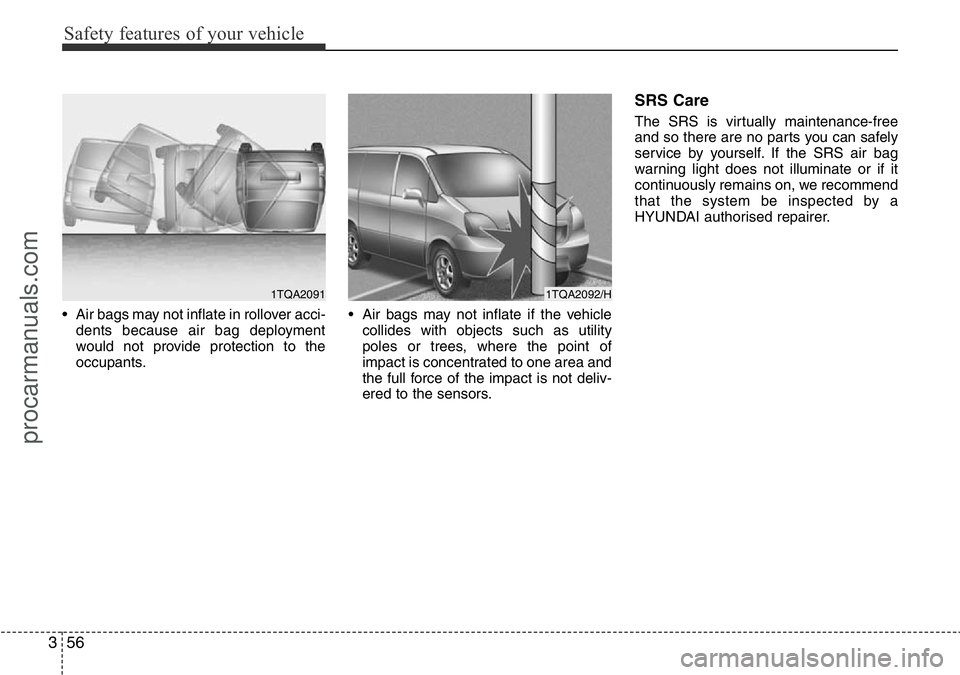
• Air bags may not inflate in rollover acci-
dents because air bag deployment
would not provide protection to the
occupants.• Air bags may not inflate if the vehicle
collides with objects such as utility
poles or trees, where the point of
impact is concentrated to one area and
the full force of the impact is not deliv-
ered to the sensors.
SRS Care
The SRS is virtually maintenance-free
and so there are no parts you can safely
service by yourself. If the SRS air bag
warning light does not illuminate or if it
continuously remains on, we recommend
that the system be inspected by a
HYUNDAI authorised repairer.
1TQA20911TQA2092/H
procarmanuals.com
Page 75 of 419
4
Keys / 4-2
Remote keyless entry / 4-4
Theft-alarm system / 4-7
Door locks / 4-9
Tailgate / 4-14
Windows / 4-17
Bonnet / 4-22
Fuel filler lid / 4-24
Sunroof / 4-27
Steering wheel / 4-32
Mirrors / 4-35
Instrument cluster / 4-39
Rear parking assist system / 4-60
Hazard warning flasher / 4-63
Rearview camera / 4-63
Lighting / 4-64
Wipers and washers / 4-69
Interior light / 4-72
Defroster / 4-74
Manual climate control system / 4-75
Automatic climate control system / 4-88
Windscreen defrosting and defogging / 4-100
Storage compartment / 4-104
Interior features / 4-107
Audio system / 4-131
Features of your vehicle
procarmanuals.com
Page 78 of 419
Features of your vehicle
4 4
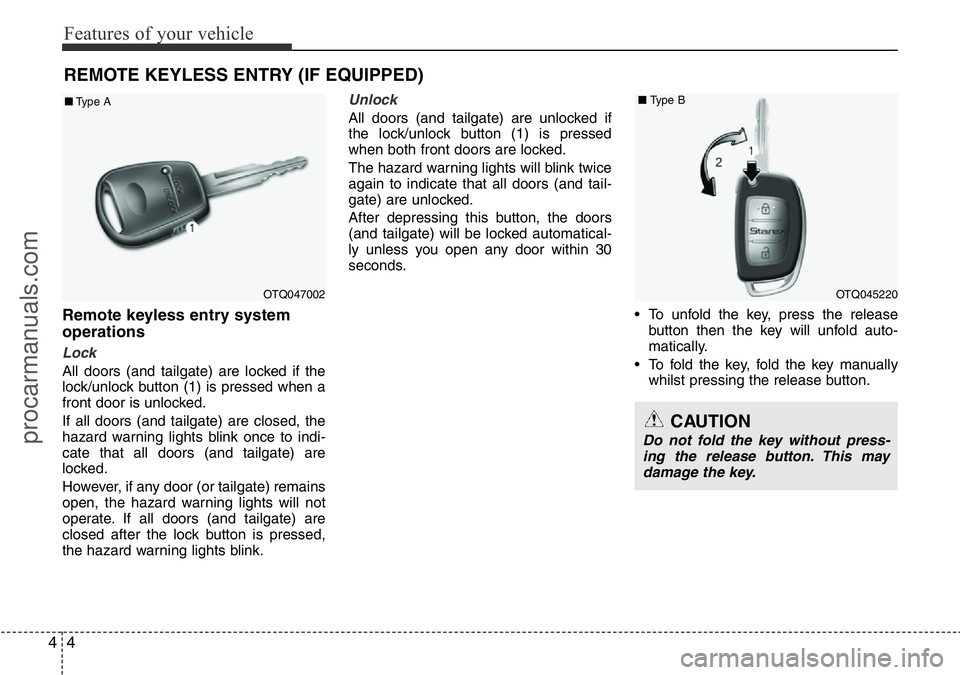
Remote keyless entry system
operations
Lock
All doors (and tailgate) are locked if the
lock/unlock button (1) is pressed when a
front door is unlocked.
If all doors (and tailgate) are closed, the
hazard warning lights blink once to indi-
cate that all doors (and tailgate) are
locked.
However, if any door (or tailgate) remains
open, the hazard warning lights will not
operate. If all doors (and tailgate) are
closed after the lock button is pressed,
the hazard warning lights blink.
Unlock
All doors (and tailgate) are unlocked if
the lock/unlock button (1) is pressed
when both front doors are locked.
The hazard warning lights will blink twice
again to indicate that all doors (and tail-
gate) are unlocked.
After depressing this button, the doors
(and tailgate) will be locked automatical-
ly unless you open any door within 30
seconds.
• To unfold the key, press the release
button then the key will unfold auto-
matically.
• To fold the key, fold the key manually
whilst pressing the release button.
REMOTE KEYLESS ENTRY (IF EQUIPPED)
OTQ047002
■Type A
OTQ045220
■ Type B
CAUTION
Do not fold the key without press-
ing the release button. This may
damage the key.
procarmanuals.com
Page 81 of 419
47
Features of your vehicle
THEFT-ALARM SYSTEM (IF EQUIPPED)
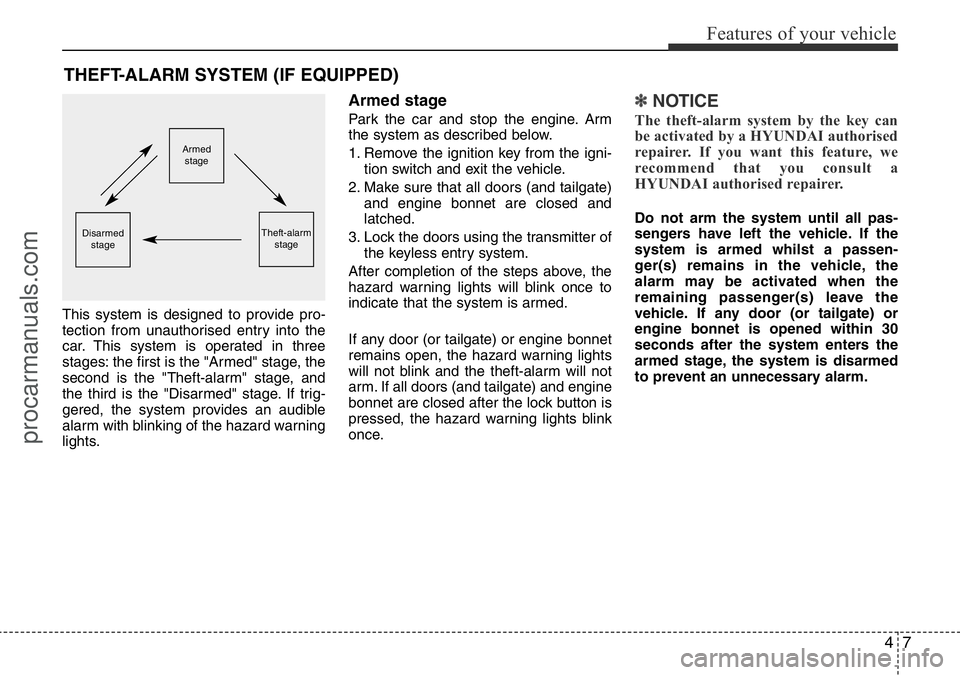
This system is designed to provide pro-
tection from unauthorised entry into the
car. This system is operated in three
stages: the first is the "Armed" stage, the
second is the "Theft-alarm" stage, and
the third is the "Disarmed" stage. If trig-
gered, the system provides an audible
alarm with blinking of the hazard warning
lights.
Armed stage
Park the car and stop the engine. Arm
the system as described below.
1. Remove the ignition key from the igni-
tion switch and exit the vehicle.
2. Make sure that all doors (and tailgate)
and engine bonnet are closed and
latched.
3. Lock the doors using the transmitter of
the keyless entry system.
After completion of the steps above, the
hazard warning lights will blink once to
indicate that the system is armed.
If any door (or tailgate) or engine bonnet
remains open, the hazard warning lights
will not blink and the theft-alarm will not
arm. If all doors (and tailgate) and engine
bonnet are closed after the lock button is
pressed, the hazard warning lights blink
once.
✽NOTICE
The theft-alarm system by the key can
be activated by a HYUNDAI authorised
repairer. If you want this feature, we
recommend that you consult a
HYUNDAI authorised repairer.
Do not arm the system until all pas-
sengers have left the vehicle. If the
system is armed whilst a passen-
ger(s) remains in the vehicle, the
alarm may be activated when the
remaining passenger(s) leave the
vehicle. If any door (or tailgate) or
engine bonnet is opened within 30
seconds after the system enters the
armed stage, the system is disarmed
to prevent an unnecessary alarm.
Armed
stage
Theft-alarm
stageDisarmed
stage
procarmanuals.com
Page 82 of 419
Features of your vehicle
8 4
Theft-alarm stage
The alarm will be activated if any of the
following occurs whilst the system is
armed.
• A front or rear door is opened without
using the transmitter.
• The tailgate is opened without using
the transmitter.
• The engine bonnet is opened.
The horn will sound and the hazard
warning lights will blink continuously for
approximately 30 seconds. To turn off the
system, unlock the doors with the trans-
mitter.
Disarmed stage
The system will be disarmed when the
doors (and tailgate) are unlocked with the
transmitter.
After depressing the unlock button, the
hazard warning lights will blink twice to
indicate that the system is disarmed.
After depressing the unlock button, if any
door (or tailgate) is not opened within 30
seconds, the system will be rearmed.
✽NOTICE
• If the system is not disarmed with the
transmitter, insert the key into the
ignition switch and start the engine.
Then the system will be disarmed.
• If you lose your keys, we recommend
that you consult a HYUNDAI autho-
rised repairer.
CAUTION
Do not change, alter or adjust the
theft-alarm system because it could
cause the theft-alarm system to
malfunction. We recommend that
the system be serviced by a
HYUNDAI authorised repairer.
Malfunctions caused by improper
alterations, adjustments or modifi-
cations to the theft-alarm system
are not covered by your vehicle
manufacturer warranty.
procarmanuals.com
Page 84 of 419
Features of your vehicle
10 4
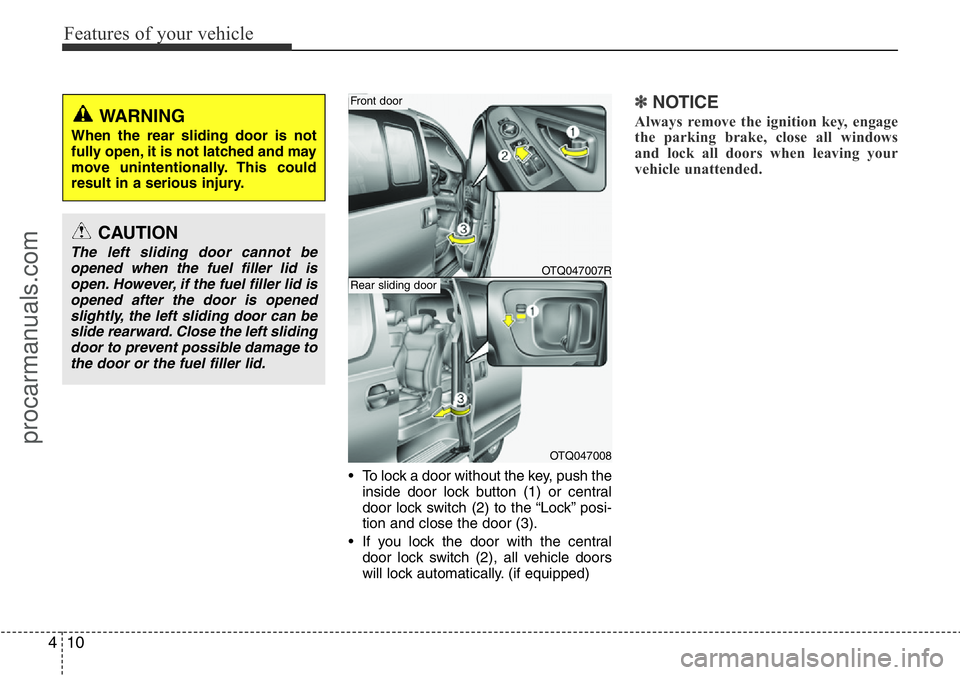
• To lock a door without the key, push the
inside door lock button (1) or central
door lock switch (2
) to the “Lock” posi-
tion and close the door (3).
• If you lock the door with the central
door lock switch (2), all vehicle doors
will lock automatically. (if equipped)
✽NOTICE
Always remove the ignition key, engage
the parking brake, close all windows
and lock all doors when leaving your
vehicle unattended. WARNING
When the rear sliding door is not
fully open, it is not latched and may
move unintentionally. This could
result in a serious injury.
CAUTION
The left sliding door cannot be
opened when the fuel filler lid is
open. However, if the fuel filler lid is
opened after the door is opened
slightly, the left sliding door can be
slide rearward. Close the left sliding
door to prevent possible damage to
the door or the fuel filler lid.
OTQ047007R
Front door
OTQ047008
Rear sliding door
procarmanuals.com
Page 96 of 419
Features of your vehicle
22 4
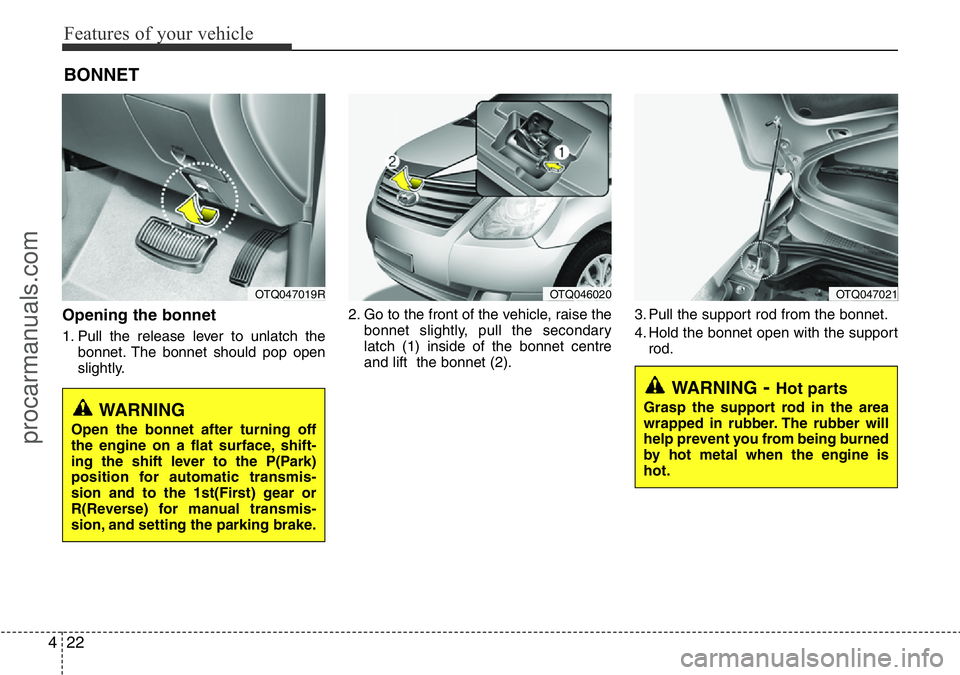
Opening the bonnet
1. Pull the release lever to unlatch the
bonnet. The bonnet should pop open
slightly.2. Go to the front of the vehicle, raise the
bonnet slightly, pull the secondary
latch (1) inside of the bonnet centre
and lift the bonnet (2).3. Pull the support rod from the bonnet.
4. Hold the bonnet open with the support
rod.
BONNET
OTQ047019ROTQ047021
WARNING- Hot parts
Grasp the support rod in the area
wrapped in rubber. The rubber will
help prevent you from being burned
by hot metal when the engine is
hot.WARNING
Open the bonnet after turning off
the engine on a flat surface, shift-
ing the shift lever to the P(Park)
position for automatic transmis-
sion and to the 1st(First) gear or
R(Reverse) for manual transmis-
sion, and setting the parking brake.
OTQ046020
procarmanuals.com
Page 99 of 419
425
Features of your vehicle
Closing the fuel filler lid
1. To install the cap, turn it clockwise until
it “clicks”. This indicates that the cap is
securely tightened.
2. Close the fuel filler lid and push it light-
ly and make sure that it is securely
closed.
WARNING - Refuelling
• If pressurised fuel sprays out, it
can cover your clothes or skin
and thus subject you to the risk
of fire and burns. Always remove
the fuel cap carefully and slowly.
If the cap is venting fuel or if you
hear a hissing sound, wait until
the condition stops before com-
pletely removing the cap.
• Do not "top off" after the nozzle
automatically shuts off when
refuelling.
• Always check that the fuel cap is
installed securely to prevent fuel
spillage in the event of an acci-
dent.
(Continued)
• Do not get back into a vehicle
once you have begun refuelling
since you can generate static
electricity by touching, rubbing
or sliding against any item or fab-
ric (polyester, satin, nylon, etc.)
capable of producing static elec-
tricity. Static electricity discharge
can ignite fuel vapours resulting
in rapid burning. If you must re-
enter the vehicle, you should
once again eliminate potentially
dangerous static electricity dis-
charge by touching a metal part
of the vehicle, away from the fuel
filler neck, nozzle or other petrol
source.
• When using an approved
portable fuel container, be sure to
place the container on the
ground prior to refuelling. Static
electricity discharge from the
container can ignite fuel vapours
causing a fire. Once refuelling
has begun, contact with the vehi-
cle should be maintained until
the filling is complete. Use only
approved portable plastic fuel
containers designed to carry and
store fuel.
(Continued)WARNING - Refuelling
dangers
Automotive fuels are flammable
materials. When refuelling, please
note the following guidelines care-
fully. Failure to follow these guide-
lines may result in severe personal
injury, severe burns or death by fire
or explosion.
• Read and follow all warning at the
fuel station facility.
• Before refuelling note the loca-
tion of the Emergency Fuel Shut-
Off, if available, at the fuel station
facility.
• Before touching the fuel nozzle,
you should eliminate potentially
dangerous static electricity dis-
charge by touching another metal
part of the vehicle, a safe dis-
tance away from the fuel filler
neck, nozzle, or other gas source.
(Continued)
procarmanuals.com