wheel HYUNDAI I800 2016 User Guide
[x] Cancel search | Manufacturer: HYUNDAI, Model Year: 2016, Model line: I800, Model: HYUNDAI I800 2016Pages: 419, PDF Size: 9.23 MB
Page 75 of 419
4
Keys / 4-2
Remote keyless entry / 4-4
Theft-alarm system / 4-7
Door locks / 4-9
Tailgate / 4-14
Windows / 4-17
Bonnet / 4-22
Fuel filler lid / 4-24
Sunroof / 4-27
Steering wheel / 4-32
Mirrors / 4-35
Instrument cluster / 4-39
Rear parking assist system / 4-60
Hazard warning flasher / 4-63
Rearview camera / 4-63
Lighting / 4-64
Wipers and washers / 4-69
Interior light / 4-72
Defroster / 4-74
Manual climate control system / 4-75
Automatic climate control system / 4-88
Windscreen defrosting and defogging / 4-100
Storage compartment / 4-104
Interior features / 4-107
Audio system / 4-131
Features of your vehicle
procarmanuals.com
Page 106 of 419
Features of your vehicle
32 4
WARNING
• Never adjust the angle of the
steering wheel whilst driving. You
may lose steering control and
cause severe personal injury,
death or accidents.
• After adjusting, push the steering
wheel both up and down to be
certain it is locked in position.
Power steering
Power steering uses energy from the
engine to assist you in steering the vehi-
cle. If the engine is off or if the power
steering system becomes inoperative,
the vehicle may still be steered, but it will
require increased steering effort.
Should you notice any change in the
effort required to steer during normal
vehicle operation, we recommend that
the system be checked by a HYUNDAI
authorised repairer.
✽NOTICE
If the power steering drive belt breaks
or if the power steering pump malfunc-
tions, the steering effort will greatly
increase.
✽NOTICE
If the vehicle is parked for extended
periods outside in cold weather (below
-10°C/14°F), the power steering may
require increased effort when the engine
is first started. This is caused by
increased fluid viscosity due to the cold
weather and does not indicate a mal-
function.
When this happens, increase the engine
RPM by depressing accelerator until the
RPM reaches 1,500 rpm then release or
let the engine idle for two or three min-
utes to warm up the fluid.
Adjustable steering column
The adjustable steering column permits
adjustment of the rake of the steering
wheel for the convenience of the driver.
The position of the steering wheel should
be adjusted for maximum comfort and
control whilst permitting a clear view of
the instrument panel.
STEERING WHEEL
CAUTION
Never hold the steering wheel
against a stop (extreme right or left
turn) for more than 5 seconds with
the engine running. Holding the
steering wheel for more than 5 sec-
onds in either position may cause
damage to the power steering
pump.
procarmanuals.com
Page 107 of 419
433
Features of your vehicle
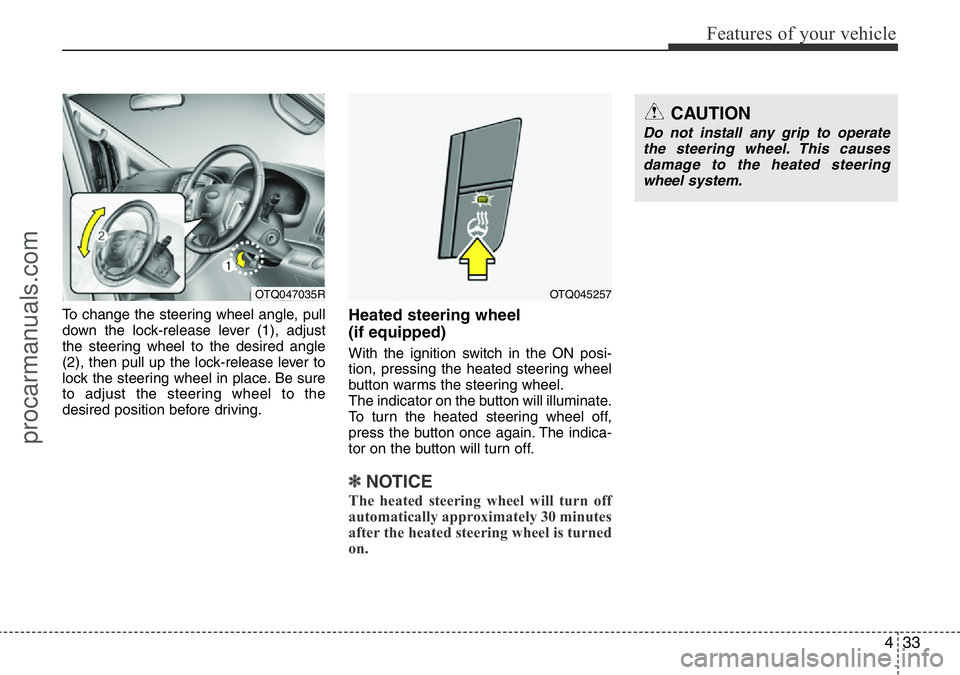
To change the steering wheel angle, pull
down the lock-release lever (1), adjust
the steering wheel to the desired angle
(2), then pull up the lock-release lever to
lock the steering wheel in place. Be sure
to adjust the steering wheel to the
desired position before driving.Heated steering wheel
(if equipped)
With the ignition switch in the ON posi-
tion, pressing the heated steering wheel
button warms the steering wheel.
The indicator on the button will illuminate.
To turn the heated steering wheel off,
press the button once again. The indica-
tor on the button will turn off.
✽NOTICE
The heated steering wheel will turn off
automatically approximately 30 minutes
after the heated steering wheel is turned
on.
OTQ047035ROTQ045257
CAUTION
Do not install any grip to operate
the steering wheel. This causes
damage to the heated steering
wheel system.
procarmanuals.com
Page 108 of 419
Features of your vehicle
34 4
Horn
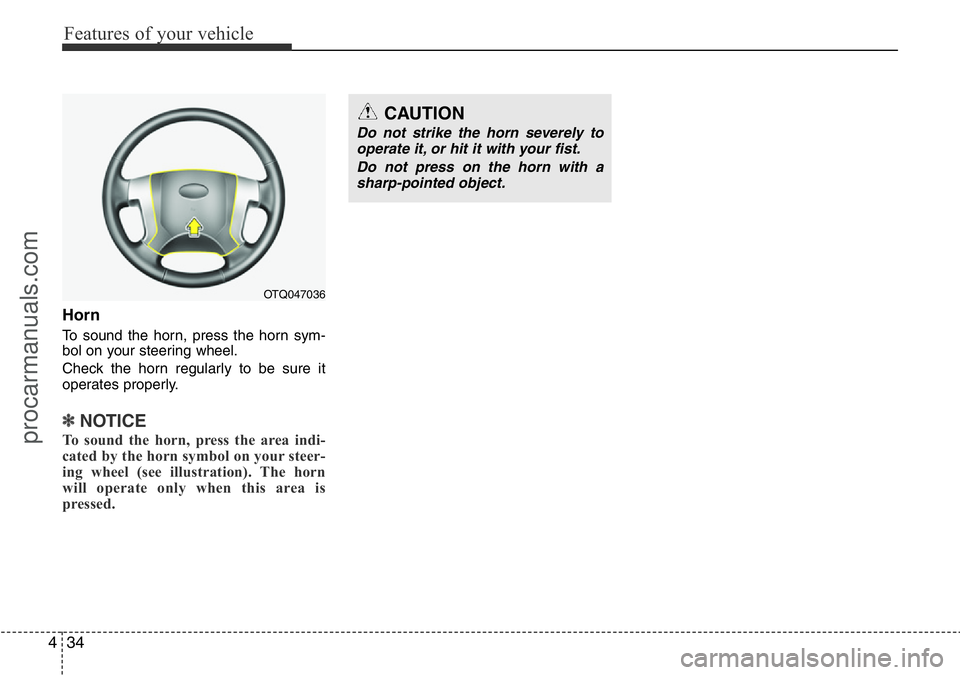
To sound the horn, press the horn sym-
bol on your steering wheel.
Check the horn regularly to be sure it
operates properly.
✽NOTICE
To sound the horn, press the area indi-
cated by the horn symbol on your steer-
ing wheel (see illustration). The horn
will operate only when this area is
pressed.
CAUTION
Do not strike the horn severely to
operate it, or hit it with your fist.
Do not press on the horn with a
sharp-pointed object.
OTQ047036
procarmanuals.com
Page 125 of 419
451
Features of your vehicle
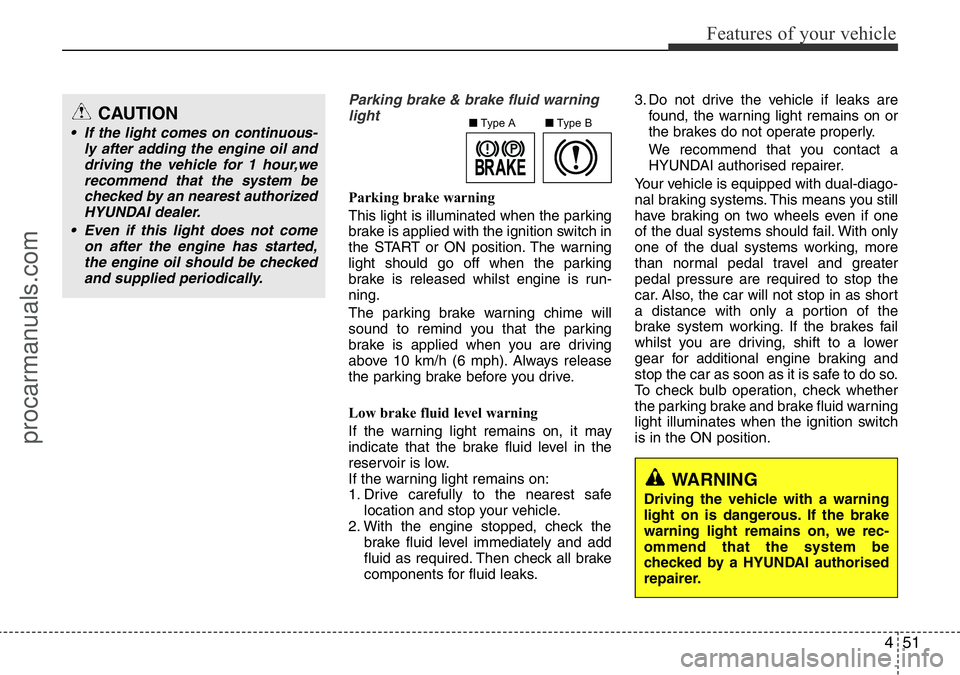
Parking brake & brake fluid warning
light
Parking brake warning
This light is illuminated when the parking
brake is applied with the ignition switch in
the START or ON position. The warning
light should go off when the parking
brake is released whilst engine is run-
ning.
The parking brake warning chime will
sound to remind you that the parking
brake is applied when you are driving
above 10 km/h (6 mph). Always release
the parking brake before you drive.
Low brake fluid level warning
If the warning light remains on, it may
indicate that the brake fluid level in the
reservoir is low.
If the warning light remains on:
1. Drive carefully to the nearest safe
location and stop your vehicle.
2. With the engine stopped, check the
brake fluid level immediately and add
fluid as required. Then check all brake
components for fluid leaks.3. Do not drive the vehicle if leaks are
found, the warning light remains on or
the brakes do not operate properly.
We recommend that you contact a
HYUNDAI authorised repairer.
Your vehicle is equipped with dual-diago-
nal braking systems. This means you still
have braking on two wheels even if one
of the dual systems should fail. With only
one of the dual systems working, more
than normal pedal travel and greater
pedal pressure are required to stop the
car. Also, the car will not stop in as short
a distance with only a portion of the
brake system working. If the brakes fail
whilst you are driving, shift to a lower
gear for additional engine braking and
stop the car as soon as it is safe to do so.
To check bulb operation, check whether
the parking brake and brake fluid warning
light illuminates when the ignition switch
is in the ON position.
CAUTION
• If the light comes on continuous-
ly after adding the engine oil and
driving the vehicle for 1 hour,we
recommend that the system be
checked by an nearest authorized
HYUNDAI dealer.
• Even if this light does not come
on after the engine has started,
the engine oil should be checked
and supplied periodically.■Type A■Type B
WARNING
Driving the vehicle with a warning
light on is dangerous. If the brake
warning light remains on, we rec-
ommend that the system be
checked by a HYUNDAI authorised
repairer.
procarmanuals.com
Page 130 of 419
Features of your vehicle
56 4
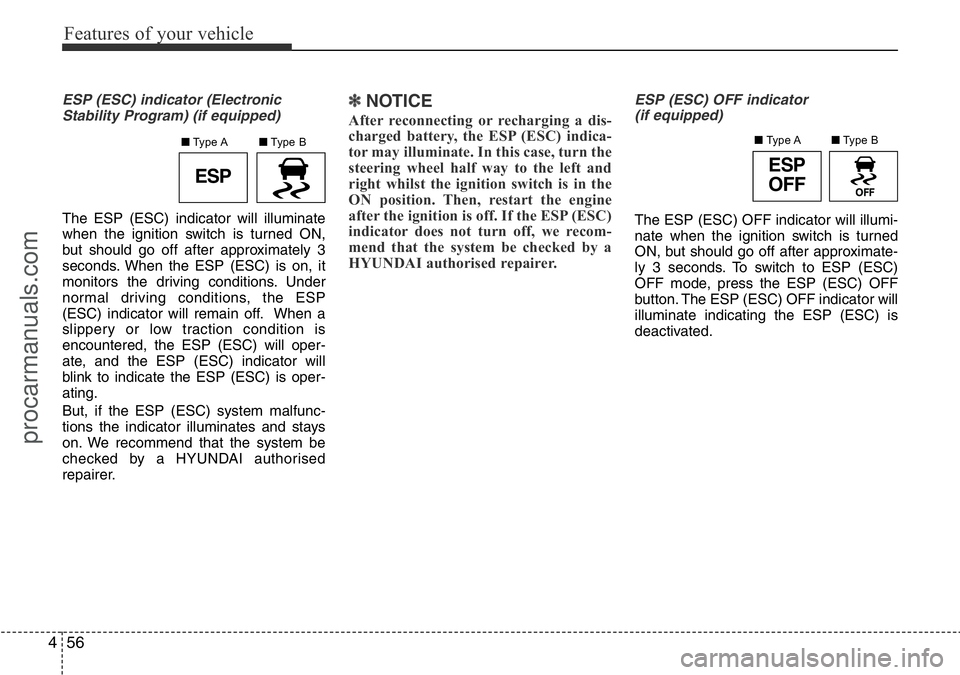
ESP (ESC) indicator (Electronic
Stability Program) (if equipped)
The ESP (ESC) indicator will illuminate
when the ignition switch is turned ON,
but should go off after approximately 3
seconds. When the ESP (ESC) is on, it
monitors the driving conditions. Under
normal driving conditions, the ESP
(ESC) indicator will remain off. When a
slippery or low traction condition is
encountered, the ESP (ESC) will oper-
ate, and the ESP (ESC) indicator will
blink to indicate the ESP (ESC) is oper-
ating.
But, if the ESP (ESC) system malfunc-
tions the indicator illuminates and stays
on. We recommend that the system be
checked by a HYUNDAI authorised
repairer.
✽NOTICE
After reconnecting or recharging a dis-
charged battery, the ESP (ESC) indica-
tor may illuminate. In this case, turn the
steering wheel half way to the left and
right whilst the ignition switch is in the
ON position. Then, restart the engine
after the ignition is off. If the ESP (ESC)
indicator does not turn off, we recom-
mend that the system be checked by a
HYUNDAI authorised repairer.
ESP (ESC) OFF indicator
(if equipped)
The ESP (ESC) OFF indicator will illumi-
nate when the ignition switch is turned
ON, but should go off after approximate-
ly 3 seconds. To switch to ESP (ESC)
OFF mode, press the ESP (ESC) OFF
button. The ESP (ESC) OFF indicator will
illuminate indicating the ESP (ESC) is
deactivated.
ESPESP
OFF
■Type B ■Type A■Type B ■Type A
procarmanuals.com
Page 152 of 419
Features of your vehicle
78 4
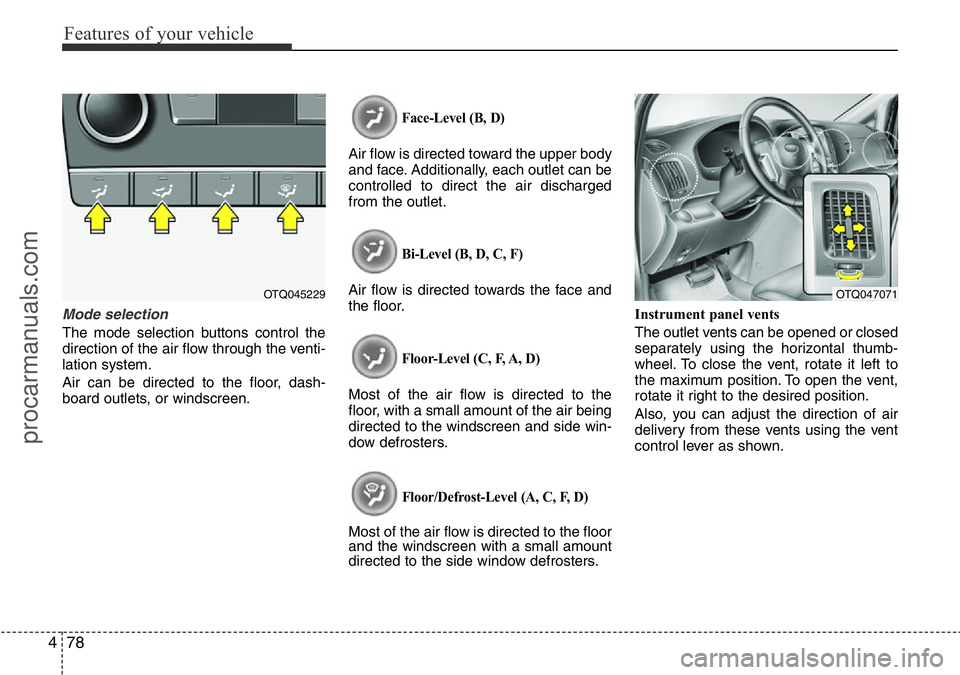
Mode selection
The mode selection buttons control the
direction of the air flow through the venti-
lation system.
Air can be directed to the floor, dash-
board outlets, or windscreen.
Face-Level (B, D)
Air flow is directed toward the upper body
and face. Additionally, each outlet can be
controlled to direct the air discharged
from the outlet.
Bi-Level (B, D, C, F)
Air flow is directed towards the face and
the floor.
Floor-Level (C, F, A, D)
Most of the air flow is directed to the
floor, with a small amount of the air being
directed to the windscreen and side win-
dow defrosters.
Floor/Defrost-Level (A, C, F, D)
Most of the air flow is directed to the floor
and the windscreen with a small amount
directed to the side window defrosters.Instrument panel vents
The outlet vents can be opened or closed
separately using the horizontal thumb-
wheel. To close the vent, rotate it left to
the maximum position. To open the vent,
rotate it right to the desired position.
Also, you can adjust the direction of air
delivery from these vents using the vent
control lever as shown.
OTQ045229OTQ047071
procarmanuals.com
Page 156 of 419
Features of your vehicle
82 4
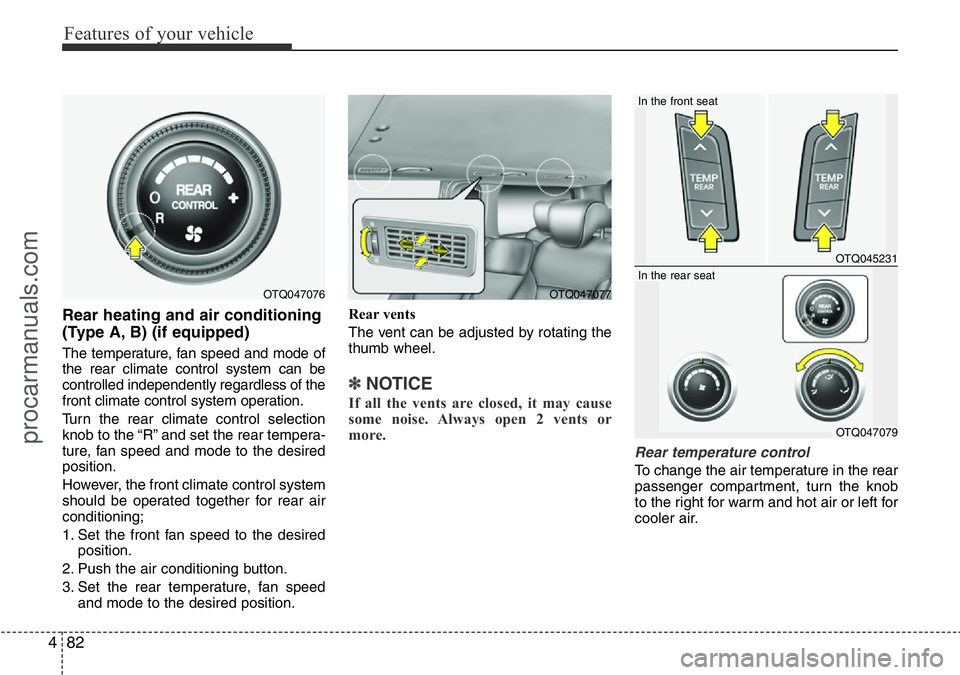
Rear heating and air conditioning
(Type A, B) (if equipped)
The temperature, fan speed and mode of
the rear climate control system can be
controlled independently regardless of the
front climate control system operation.
Turn the rear climate control selection
knob to the “R” and set the rear tempera-
ture, fan speed and mode to the desired
position.
However, the front climate control system
should be operated together for rear air
conditioning;
1. Set the front fan speed to the desired
position.
2. Push the air conditioning button.
3. Set the rear temperature, fan speed
and mode to the desired position.Rear vents
The vent can be adjusted by rotating the
thumb wheel.
✽NOTICE
If all the vents are closed, it may cause
some noise. Always open 2 vents or
more.
Rear temperature control
To change the air temperature in the rear
passenger compartment, turn the knob
to the right for warm and hot air or left for
cooler air.
OTQ047076OTQ047077
OTQ045231
In the front seat
OTQ047079
In the rear seat
procarmanuals.com
Page 165 of 419
491
Features of your vehicle
Face-Level
Air flow is directed toward the upper body
and face. Additionally, each outlet can be
controlled to direct the air discharged
from the outlet.
Bi-Level
Air flow is directed towards the face and
the floor.Floor-Level
Most of the air flow is directed to the
floor, with a small amount of the air being
directed to the windscreen and side win-
dow defrosters.
Floor/Defrost-Level
Most of the air flow is directed to the floor
and the windscreen with a small amount
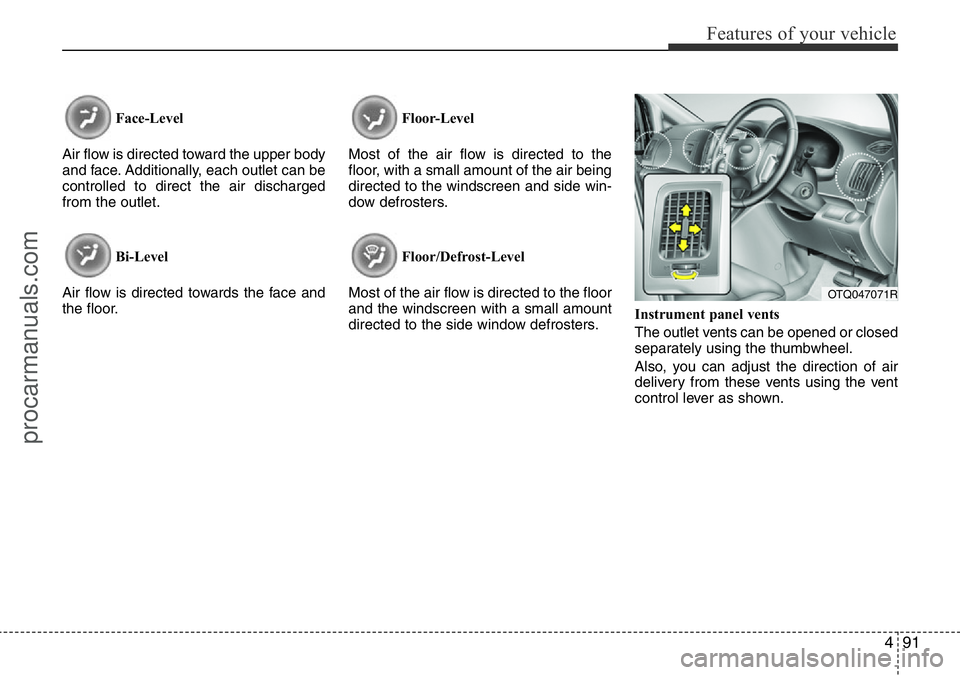
directed to the side window defrosters.Instrument panel vents
The outlet vents can be opened or closed
separately using the thumbwheel.
Also, you can adjust the direction of air
delivery from these vents using the vent
control lever as shown.
OTQ047071R
procarmanuals.com
Page 169 of 419
495
Features of your vehicle
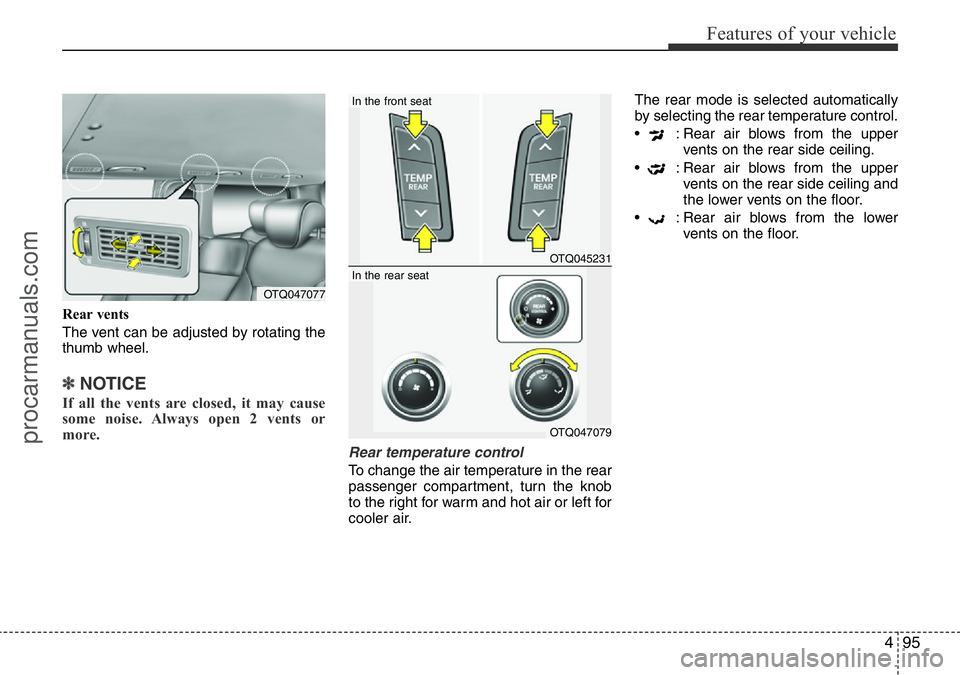
Rear vents
The vent can be adjusted by rotating the
thumb wheel.
✽NOTICE
If all the vents are closed, it may cause
some noise. Always open 2 vents or
more.
Rear temperature control
To change the air temperature in the rear
passenger compartment, turn the knob
to the right for warm and hot air or left for
cooler air.The rear mode is selected automatically
by selecting the rear temperature control.
• : Rear air blows from the upper
vents on the rear side ceiling.
• : Rear air blows from the upper
vents on the rear side ceiling and
the lower vents on the floor.
• : Rear air blows from the lower
vents on the floor.
OTQ047077
OTQ045231
In the front seat
OTQ047079
In the rear seat
procarmanuals.com