fuel type Hyundai Ioniq Hybrid 2017 User Guide
[x] Cancel search | Manufacturer: HYUNDAI, Model Year: 2017, Model line: Ioniq Hybrid, Model: Hyundai Ioniq Hybrid 2017Pages: 553, PDF Size: 59.51 MB
Page 191 of 553
3-89
Convenient features of your vehicle
3
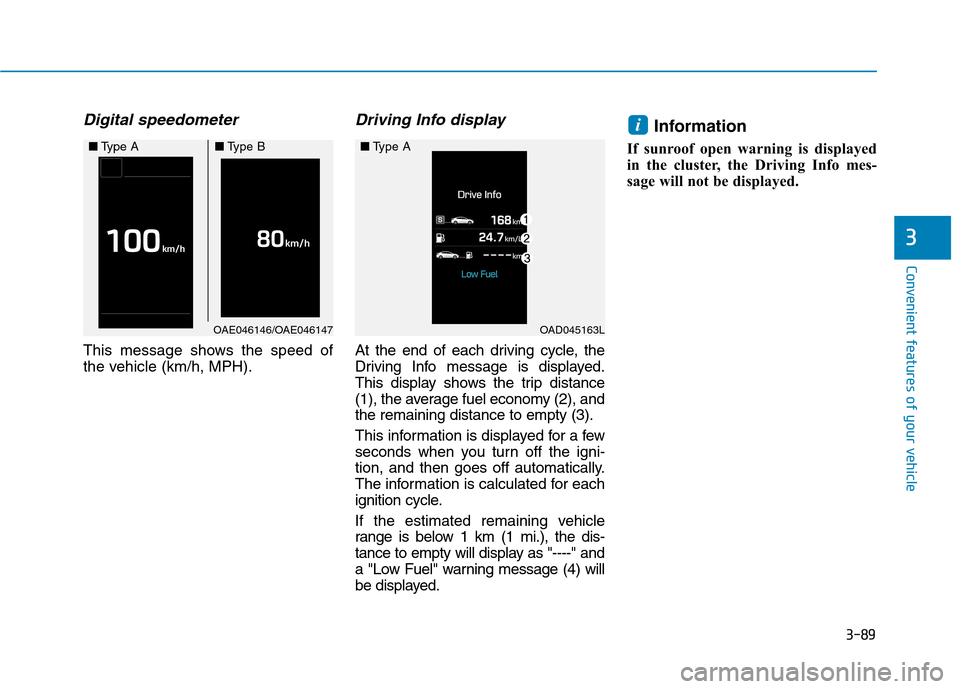
Digital speedometer
This message shows the speed of
the vehicle (km/h, MPH).
Driving Info display
At the end of each driving cycle, the
Driving Info message is displayed.
This display shows the trip distance
(1), the average fuel economy (2), andthe remaining distance to empty (3).
This information is displayed for a few
seconds when you turn off the igni-
tion, and then goes off automatically.
The information is calculated for each
ignition cycle.
If the estimated remaining vehicle
range is below 1 km (1 mi.), the dis-
tance to empty will display as "----" and
a "Low Fuel" warning message (4) will
be displayed.Information
If sunroof open warning is displayed
in the cluster, the Driving Info mes-
sage will not be displayed.
i
OAE046146/OAE046147
■ Type A■Type B
OAD045163L
■Type A
Page 300 of 553
5-16
Driving your vehicle
The dual clutch transmission givesthe driving feel of a manual trans-
mission, yet provides the ease of a
fully automatic transmission. Unlike
a traditional automatic transmis-sion, the gear shifting can some-
times be felt and heard on the dual
clutch transmission, as the actua-tors engage the clutch and thegear is selected.
The dual clutch transmission can be thought of as an automatically
shifting manual transmission.
When D (Drive) is selected, the
transmission will automatically shiftthrough the gears similar to a con-
ventional automatic transmission. The dual clutch transmission incor-
porates a dry-type dual clutch
mechanism, which allows for better
acceleration performance and
increased fuel efficiency while driv-
ing. But it differs from a conven-
tional automatic transmission in
that it does not incorporate a
torque converter. Instead, the tran-
sition from one gear to the next is
managed by clutch slip, especially
at lower speeds. As a result, shifts
are sometimes more noticeable,
and a light vibration can be felt as
the transmission shaft speed ismatched with the engine shaft
speed. This is a normal condition of
the dual clutch transmission.
The dry-type clutch transfers torque more directly and provides
a direct-drive feeling which may
feel different from a conventional
automatic transmission. This may
be more noticeable when launch-
ing the vehicle from a stop or when
traveling at low, stop-and-go vehi-
cle speeds.
To reduce the risk of serious
injury or death:
ALWAYS check the surround-
ing areas near your vehicle for
people, especially children,
before shifting a vehicle into
D (Drive) or R (Reverse).
Before leaving the driver's
seat, always make sure the
shift lever is in the P (Park)
position, then set the parking
brake, and place the ignition
switch in the LOCK/OFF posi-
tion. Unexpected and sudden
vehicle movement can occurif these precautions are not
followed.
(Continued)
(Continued)
Do not use the engine brake
(shifting from a high gear to
lower gear) rapidly on slip-
pery roads. The vehicle mayslip causing an accident.
WARNING
Page 486 of 553
7-65
7
Maintenance
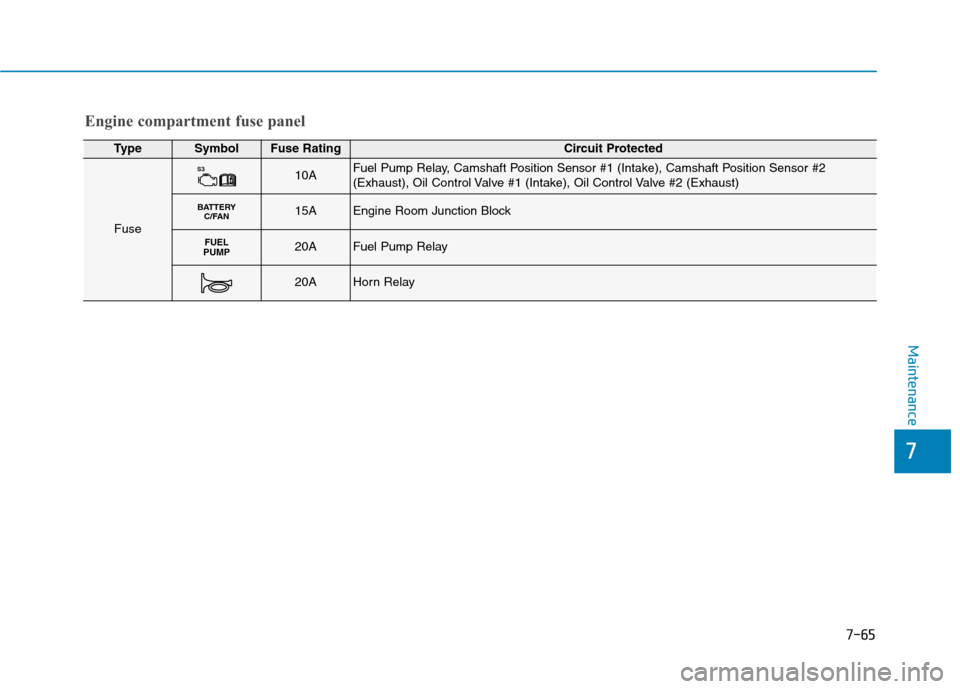
TypeSymbolFuse RatingCircuit Protected
Fuse
S310AFuel Pump Relay, Camshaft Position Sensor #1 (Intake), Camshaft Position Sensor #2
(Exhaust), Oil Control Valve #1 (Intake), Oil Control Valve #2 (Exhaust)
BATTERYC/FAN15AEngine Room Junction Block
FUEL
PUMP20AFuel Pump Relay
20AHorn Relay
Engine compartment fuse panel
Page 552 of 553
I-11
Sunroof .........................................................................3-33
Automatic reversal .....................................................3-34
Resetting the sunroof .................................................3-35
Sliding the sunroof.....................................................3-33
Sunroof opening and closing .....................................3-33
Sunshade ....................................................................3-35
Tilting the sunroof .....................................................3-34
Sunroof inside air recirculation ..................................3-129
Sunvisor ......................................................................3-133
Tachometer ...................................................................3-44
Tailgate .........................................................................3-38
Tailgate room lamp .......................................................3-99
Theft-alarm system .......................................................3-17
Tilt steering / Telescope steering ..................................3-21
Tire chains ....................................................................5-96
Tire load and speed capacity ..........................................8-5
Tire Mobility Kit (TMK) ..............................................6-24
Tire pressure monitoring system (TPMS) ....................6-10
Tire rotation ..................................................................7-44
Tire specification and pressure label ..............................8-9
Tires and wheels ...........................................................7-41 Checking tire inflation pressure.................................7-43
Compact spare tire replacement ................................7-46
Low aspect ratio tires.................................................7-51
Recommended cold tire inflation pressures ..............7-42 Tire care .....................................................................7-41
Tire maintenance........................................................7-47
Tire replacement ........................................................7-45
Tire rotation ...............................................................7-44
Tire sidewall labeling.................................................7-47
Tire traction................................................................7-46
Wheel alignment and tire balance .............................7-45
Wheel replacement .............................................7-46, 8-4
Towing ..........................................................................6-32
Traffic change .............................................................3-124
Trip computer ...............................................................3-86
Average fuel economy ...............................................3-87
Average vehicle speed ...............................................3-88
Digital speedometer ...................................................3-89
Distance to empty (for cluster type A) ......................3-87
Driving Info display...................................................3-89
Driving style ..............................................................3-90
Elapsed time...............................................................3-88
Energy flow................................................................3-90
Engine coolant temperature .......................................3-90
Instant fuel economy .................................................3-87
Tripmeter....................................................................3-88
Turn signals ..................................................................3-93
I
Index
T