load capacity Hyundai Ioniq Hybrid 2017 Owner's Manual
[x] Cancel search | Manufacturer: HYUNDAI, Model Year: 2017, Model line: Ioniq Hybrid, Model: Hyundai Ioniq Hybrid 2017Pages: 553, PDF Size: 59.51 MB
Page 264 of 553
4-23
Multimedia System
4
(Continued)
Some USB devices are not recog-nized due to compatibility issues.
Do not touch the USB connections.
Connecting and disconnecting USB devices rapidly over a short period
of time can cause equipment failure.
Abnormal sounds may be audible when the USB device is disconnected.
Turn the audio off before connecting or disconnecting external USB
devices.
Recognition may take longer depending on the type, capacity or
file format of the external USB
device. This is not a product mal-
function.
Use of USB devices for purposes other than playing music files is pro-
hibited.
Image display and video playback are not supported.
(Continued)(Continued)
Use of USB accessories, including
charge and heat though the USB I/F,
can lead to reduced product per-
formance or malfunctions. Do not
use USB devices or accessories for
these purposes.
Use of aftermarket USB hubs and extension cables can result in the
vehicle’s audio system failing to rec-
ognize your USB device. Connect
the USB device directly to the multi-
media port of your vehicle.
When using high-capacity USB devices with logical drive divisions,
only files saved on the highest level
logical drive can be played.
If applications are loaded on a USB
drive, file playback may fail.
Some MP3 players, cell phones, dig- ital cameras, etc. (USB devices that
are not recognized as mobile stor-
age) may not operate normally
when connected.
USB charging may not be supported by some mobile devices.
(Continued)(Continued)
Operation is guaranteed only for
standard (Metal Cover Type) USB
Memory drives.
Operation of HDD, CF, SD and memory stick devices is not guaran-
teed.
DRM (Digital Rights Management) files cannot be played.
SD-type USB memory, CF-type USB memory, and other USB mem-
ory devices that require adapters
for connection are not supported.
Proper operation of USB HDDs or USB drives with connectors that
loosen due to vehicle vibrations is
not guaranteed. (iStick, etc.)
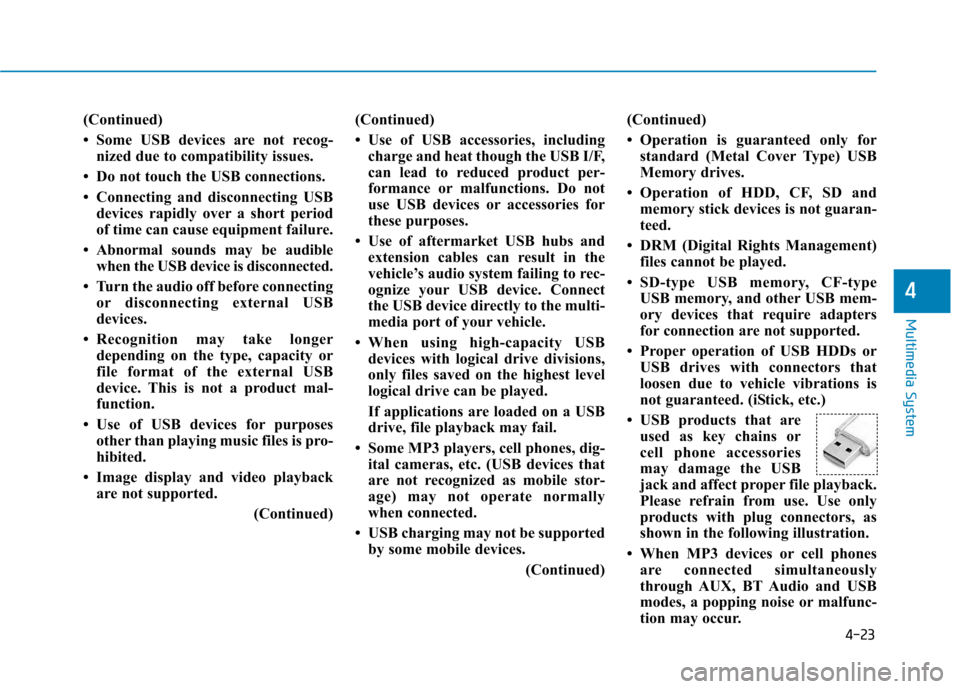
USB products that are used as key chains or
cell phone accessories
may damage the USB
jack and affect proper file playback.
Please refrain from use. Use only
products with plug connectors, as
shown in the following illustration.
When MP3 devices or cell phones are connected simultaneously
through AUX, BT Audio and USB
modes, a popping noise or malfunc-
tion may occur.
Page 405 of 553
6-20
What to do in an emergency
To prevent compact spare tire
failure and loss of control pos-
sibly resulting in an accident:
Use the compact spare tire
only in an emergency.
NEVER operate your vehicle
over 80 km/h (50 mph).
Do not exceed the vehicle’s
maximum load rating or the
load carrying capacity shown
on the sidewall of the com-
pact spare tire.
Do not use the compact spare
tire continuously. Repair orreplace the original tire as
soon as possible to avoid fail-
ure of the compact spare tire.
WARNING
If you have a tire gauge, check the tire pressure (see "Tires and
Wheels" in chapter 8 for tire pressure
instructions.). If the pressure is lower
or higher than recommended, drive
slowly to the nearest service stationand adjust it to the recommended
pressure. Always reinstall the valve
cap after checking or adjusting tire
pressure. If the cap is not replaced,
air may leak from the tire. If you lose
a valve cap, buy another and install it
as soon as possible. After changing
tires, secure the flat tire and return
the jack and tools to their proper stor-
age locations.
Check the tire pressure as soon
as possible after installing a spare
tire. Adjust it to the recommended
pressure.If any of the equipment such as the
jack, lug nuts, studs, or other equip-ment is damaged or in poor condi-tion, do not attempt to change the
tire and call for assistance.
Check and tighten the tire wheel lug
nuts after driving over 50km if tires
are replaced. Re-check the tire
wheel lug nuts after driving over1,000km.Use of compact spare tires
(if equipped)
Compact spare tires are designed for
emergency use only. Drive carefullyon the compact spare tire and
always follow the safety precautions.
NOTICE
Your vehicle has metric threads
on the studs and lug nuts. Make
certain during tire changing
that the same nuts that were
removed are reinstalled. If you
have to replace your lug nuts
make sure they have metric
threads to avoid damaging thestuds and ensure the wheel is
properly secured to the hub. We
recommend that you consult an
authorized HYUNDAI dealer for
assistance.
CAUTION
Page 473 of 553
7-52
MaintenanceF
F UU SSEE SS
A vehicle’s electrical system is pro-
tected from electrical overload dam-
age by fuses.
This vehicle has 2 (or 3) fuse panels,
one located in the driver’s side panel
bolster, the other in the engine com-
partment.
If any of your vehicle’s lights, acces-
sories, or controls do not work, check
the appropriate circuit fuse. If a fuse
has blown, the element inside the
fuse will be melted or broken.
If the electrical system does not
work, first check the driver’s side
fuse panel. Before replacing a blown
fuse, turn the engine and all switches
off, and then disconnect the negative
battery cable. Always replace a
blown fuse with one of the same rat-ing.
If the replacement fuse blows, this indi-
cates an electrical problem. Avoid
using the system involved and immedi-
ately consult an authorized HYUNDAI
dealer. Information
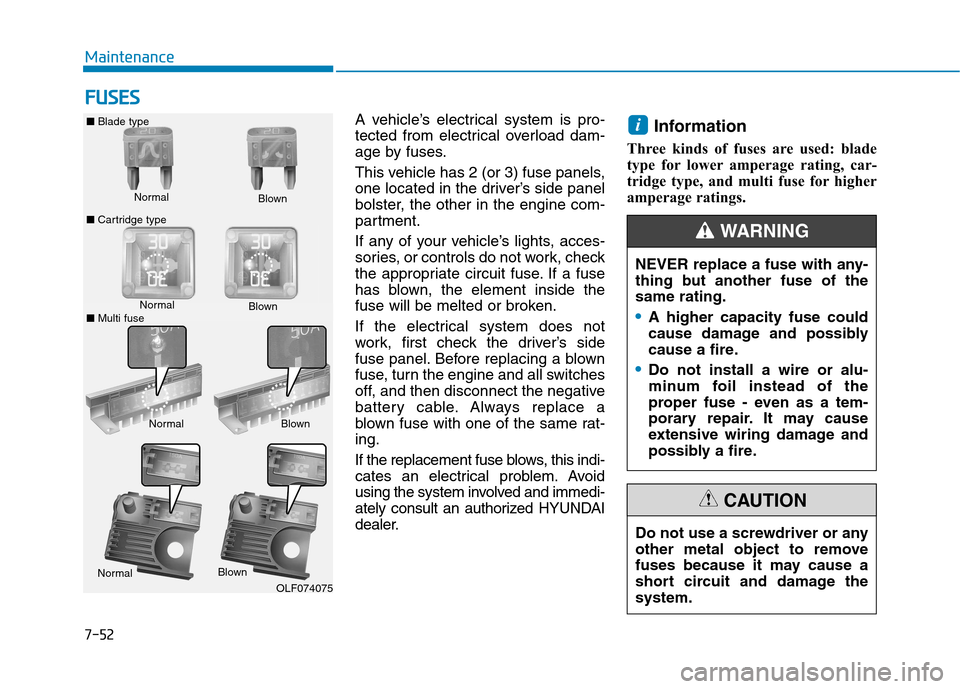
Three kinds of fuses are used: blade
type for lower amperage rating, car-
tridge type, and multi fuse for higher
amperage ratings.i
Normal
■
Blade type
■ Cartridge type Blown
Normal Blown
Normal Blown
OLF074075 Do not use a screwdriver or any
other metal object to remove
fuses because it may cause a
short circuit and damage thesystem.
CAUTION
NEVER replace a fuse with any-
thing but another fuse of thesame rating.
A higher capacity fuse could
cause damage and possibly
cause a fire.
Do not install a wire or alu-
minum foil instead of the
proper fuse - even as a tem-
porary repair. It may cause
extensive wiring damage and
possibly a fire.
WARNING
Normal
Blown
■ Multi fuse
Page 515 of 553
8
Specifications & Consumer information
8
Specifications & Consumer information
8
Dimensions ..............................................................8-2
Engine ......................................................................8-2
Bulb wattage ...........................................................8-3
Tires and wheels ....................................................8-4
Tire load and speed capacity ...............................8-5
Air conditioning system ........................................8-5
Volume and weight ................................................8-5
Recommended lubricants and capacities ...........8-6Recommended SAE viscosity number ..........................8-7
Vehicle identification number (VIN) ....................8-8
Vehicle certification label .....................................8-8
Tire specification and pressure label .................8-9
Engine number .......................................................8-9
Air conditioner compressor label ........................8-9
Declaration of conformity ..................................8-10
Page 519 of 553
8-5
8
Specifications & Consumer information
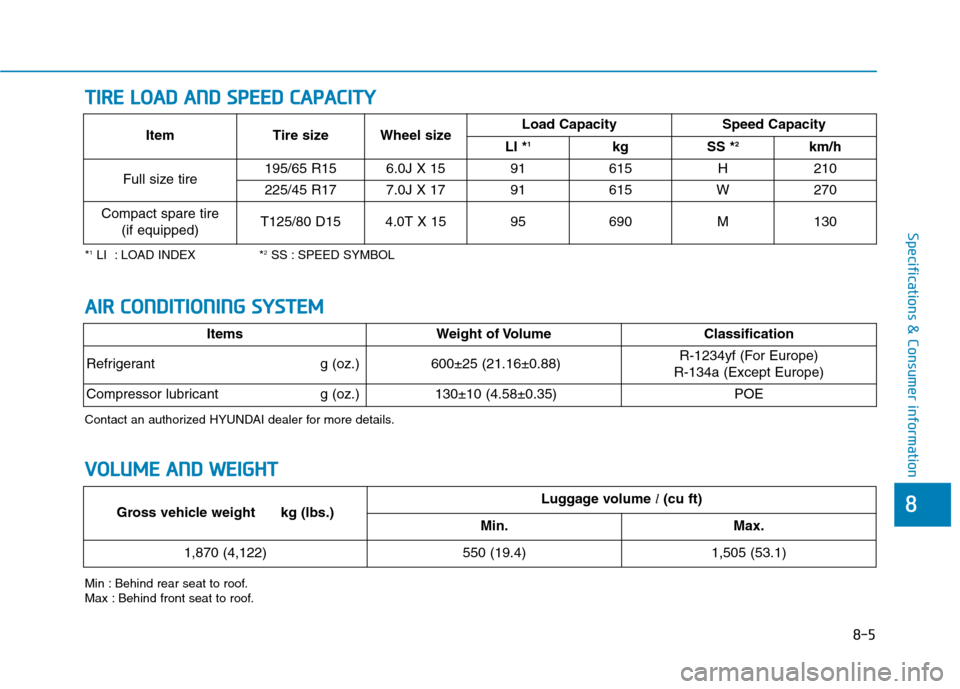
TTIIRR EE LL OO AADD AA NN DD SS PP EEEE DD CC AA PPAA CCIITT YY
*1
LI : LOAD INDEX * 2
SS : SPEED SYMBOL
Min : Behind rear seat to roof.
Max : Behind front seat to roof. Item Tire size Wheel size
Load Capacity Speed Capacity
LI * 1
kg SS * 2
km/h
Full size tire 195/65 R15 6.0J X 15 91 615 H 210
225/45 R17 7.0J X 17 91 615 W 270
Compact spare tire
(if equipped)T125/80 D154.0T X 1595690M130
VVOO LLUU MM EE AA NN DD WW EEIIGG HH TT
Gross vehicle weight kg (lbs.)Luggage volume l(cu ft)
Min.Max.
1,870 (4,122)550 (19.4)1,505 (53.1)
AA IIRR CC OO NNDDIITT IIOO NNIINN GG SS YY SSTT EEMM
ItemsWeight of Volume Classification
Refrigerant g (oz.)600±25 (21.16±0.88)R-1234yf (For Europe)
R-134a (Except Europe)
Compressor lubricant g (oz.)130±10 (4.58±0.35)POE
Contact an authorized HYUNDAI dealer for more details.
Page 552 of 553
I-11
Sunroof .........................................................................3-33
Automatic reversal .....................................................3-34
Resetting the sunroof .................................................3-35
Sliding the sunroof.....................................................3-33
Sunroof opening and closing .....................................3-33
Sunshade ....................................................................3-35
Tilting the sunroof .....................................................3-34
Sunroof inside air recirculation ..................................3-129
Sunvisor ......................................................................3-133
Tachometer ...................................................................3-44
Tailgate .........................................................................3-38
Tailgate room lamp .......................................................3-99
Theft-alarm system .......................................................3-17
Tilt steering / Telescope steering ..................................3-21
Tire chains ....................................................................5-96
Tire load and speed capacity ..........................................8-5
Tire Mobility Kit (TMK) ..............................................6-24
Tire pressure monitoring system (TPMS) ....................6-10
Tire rotation ..................................................................7-44
Tire specification and pressure label ..............................8-9
Tires and wheels ...........................................................7-41 Checking tire inflation pressure.................................7-43
Compact spare tire replacement ................................7-46
Low aspect ratio tires.................................................7-51
Recommended cold tire inflation pressures ..............7-42 Tire care .....................................................................7-41
Tire maintenance........................................................7-47
Tire replacement ........................................................7-45
Tire rotation ...............................................................7-44
Tire sidewall labeling.................................................7-47
Tire traction................................................................7-46
Wheel alignment and tire balance .............................7-45
Wheel replacement .............................................7-46, 8-4
Towing ..........................................................................6-32
Traffic change .............................................................3-124
Trip computer ...............................................................3-86
Average fuel economy ...............................................3-87
Average vehicle speed ...............................................3-88
Digital speedometer ...................................................3-89
Distance to empty (for cluster type A) ......................3-87
Driving Info display...................................................3-89
Driving style ..............................................................3-90
Elapsed time...............................................................3-88
Energy flow................................................................3-90
Engine coolant temperature .......................................3-90
Instant fuel economy .................................................3-87
Tripmeter....................................................................3-88
Turn signals ..................................................................3-93
I
Index
T