refill Hyundai Ioniq Hybrid 2017 Owner's Manual
[x] Cancel search | Manufacturer: HYUNDAI, Model Year: 2017, Model line: Ioniq Hybrid, Model: Hyundai Ioniq Hybrid 2017Pages: 553, PDF Size: 59.51 MB
Page 167 of 553
3-65
Convenient features of your vehicle
3
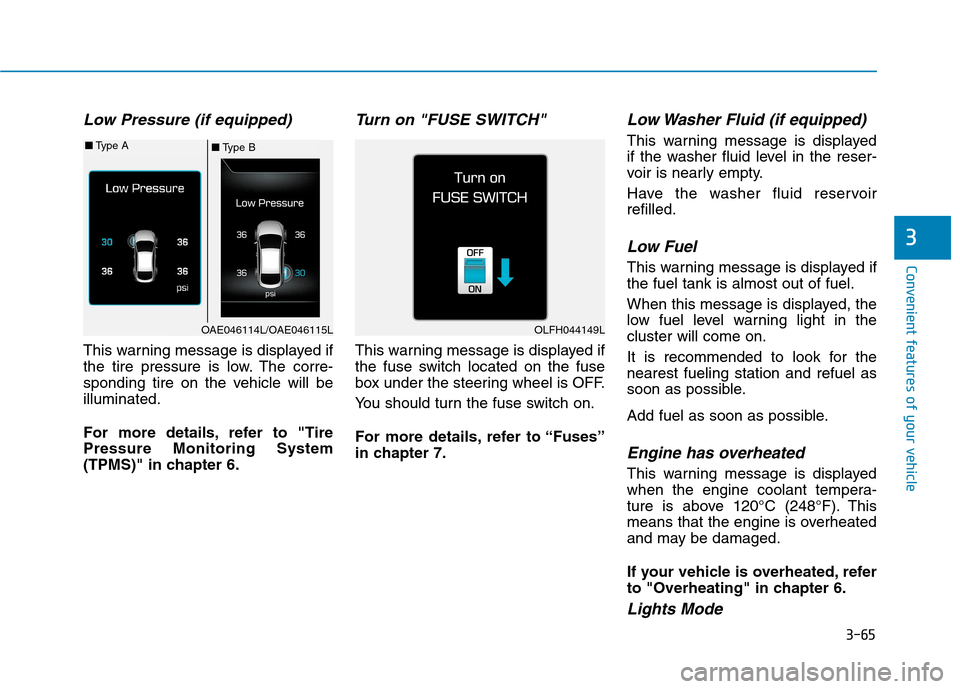
Low Pressure (if equipped)
This warning message is displayed if
the tire pressure is low. The corre-
sponding tire on the vehicle will beilluminated.
For more details, refer to "Tire Pressure Monitoring System
(TPMS)" in chapter 6.
Turn on "FUSE SWITCH"
This warning message is displayed if
the fuse switch located on the fuse
box under the steering wheel is OFF.
You should turn the fuse switch on.
For more details, refer to “Fuses”
in chapter 7.
Low Washer Fluid (if equipped)
This warning message is displayed
if the washer fluid level in the reser-
voir is nearly empty.
Have the washer fluid reservoir refilled.
Low Fuel
This warning message is displayed ifthe fuel tank is almost out of fuel.
When this message is displayed, the
low fuel level warning light in thecluster will come on.
It is recommended to look for the nearest fueling station and refuel as
soon as possible.
Add fuel as soon as possible.
Engine has overheated
This warning message is displayed
when the engine coolant tempera-
ture is above 120°C (248°F). This
means that the engine is overheated
and may be damaged.
If your vehicle is overheated, refer
to "Overheating" in chapter 6.
Lights Mode
■Type B
■
Type A
OAE046114L/OAE046115LOLFH044149L
Page 171 of 553
3-69
Convenient features of your vehicle
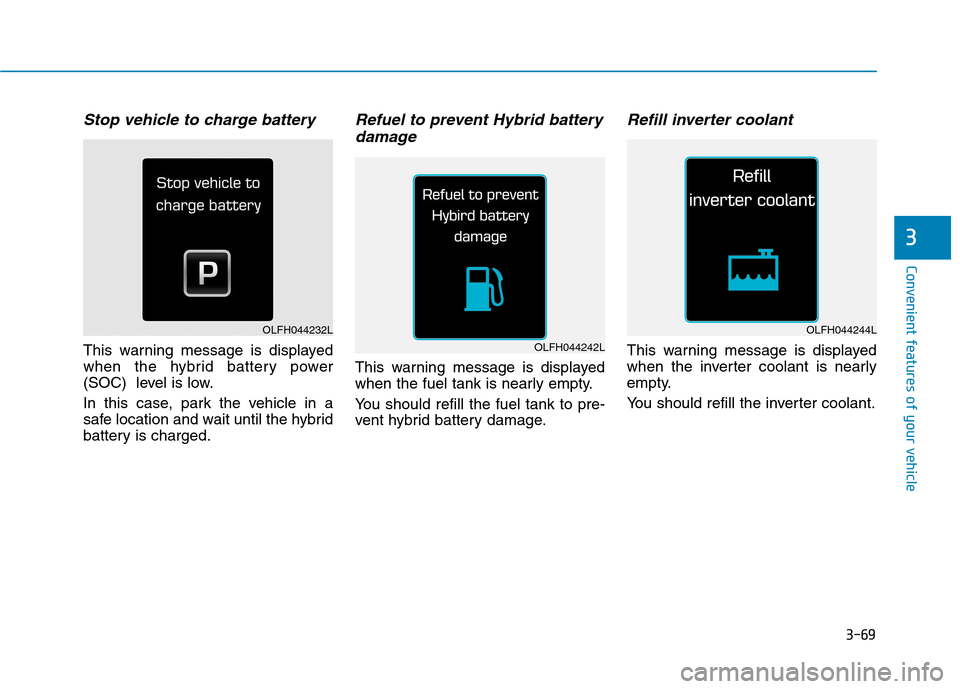
Stop vehicle to charge battery
This warning message is displayed
when the hybrid battery power
(SOC) level is low.
In this case, park the vehicle in a
safe location and wait until the hybrid
battery is charged.
Refuel to prevent Hybrid batterydamage
This warning message is displayed
when the fuel tank is nearly empty.
You should refill the fuel tank to pre-
vent hybrid battery damage.
Refill inverter coolant
This warning message is displayed
when the inverter coolant is nearly
empty.
You should refill the inverter coolant.
3
OLFH044232L
OLFH044242L
OLFH044244L
Page 428 of 553
SSCC HH EEDD UU LLEE DD MM AAIINN TTEENN AANN CCEE SS EE RR VV IICC EE SS
7-7
7
Maintenance
Follow Normal Maintenance Schedule if the vehicle is usually operated where none of the following conditions apply. If any
of the following conditions apply, you must follow the Maintenance Under Severe Usage Conditions.
Repeated driving short distance of less than 8 km (5 miles) in normal temperature or less than 16 km (10miles) in
freezing temperature
Extensive engine idling or low speed driving for long distances
Driving on rough, dusty, muddy, unpaved, graveled or salt-spread roads
Driving in areas using salt or other corrosive materials or in very cold weather
Driving in heavy dust condition
Driving in heavy traffic area
Driving on uphill, downhill, or mountain road repeatedly
Towing a trailer or using a camper, or roof rack
Driving as a patrol car, taxi, other commercial use of vehicle towing
Driving over 170 km/h (106 miles/h)
Frequently driving in stop-and-go condition
If your vehicle is operated under the above conditions, you should inspect, replace or refill more frequently than the following Normal Maintenance Schedule. After the periods or distance shown in the chart, continue to follow the pre-scribed maintenance intervals.
Page 446 of 553
7-25
7
Maintenance
Information
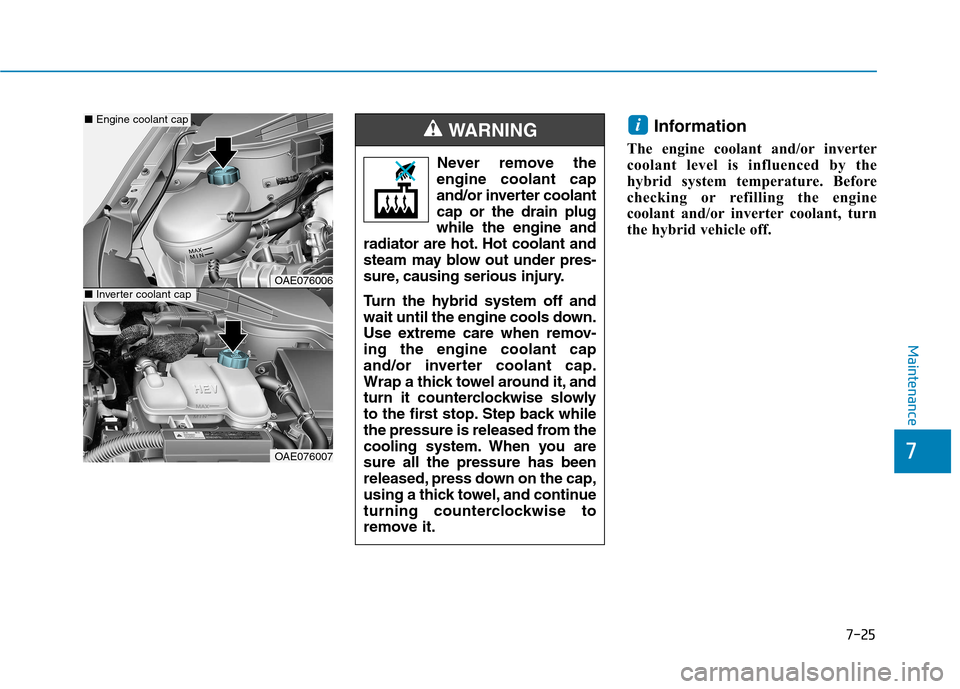
The engine coolant and/or inverter
coolant level is influenced by the
hybrid system temperature. Before
checking or refilling the engine
coolant and/or inverter coolant, turn
the hybrid vehicle off. i
Never remove the
engine coolant cap
and/or inverter coolantcap or the drain plugwhile the engine and
radiator are hot. Hot coolant and
steam may blow out under pres-
sure, causing serious injury.
Turn the hybrid system off and
wait until the engine cools down.
Use extreme care when remov-ing the engine coolant cap
and/or inverter coolant cap.
Wrap a thick towel around it, and
turn it counterclockwise slowly
to the first stop. Step back while
the pressure is released from the
cooling system. When you aresure all the pressure has been
released, press down on the cap,
using a thick towel, and continue
turning counterclockwise to
remove it.
WARNING
OAE076006
OAE076007
■ Engine coolant cap
■Inverter coolant cap
Page 447 of 553
7-26
Maintenance
The electric motor for the cooling fan
is controlled by engine coolant tem-
perature, refrigerant pressure and
vehicle speed. As the engine coolant
temperature decreases, the electric
motor will automatically shut off. This
is a normal condition. If your vehicle
is equipped with GDI, the electric
motor for the cooling fan may begin
to operate at any time and continue
to operate until you disconnect the
negative battery cable.The electric motor for
the cooling fan may
continue to operate
or start up when theengine is not running
and can cause serious injury.
Keep hands, clothing and tools
away from the rotating fan bladesof the cooling fan.
WARNING
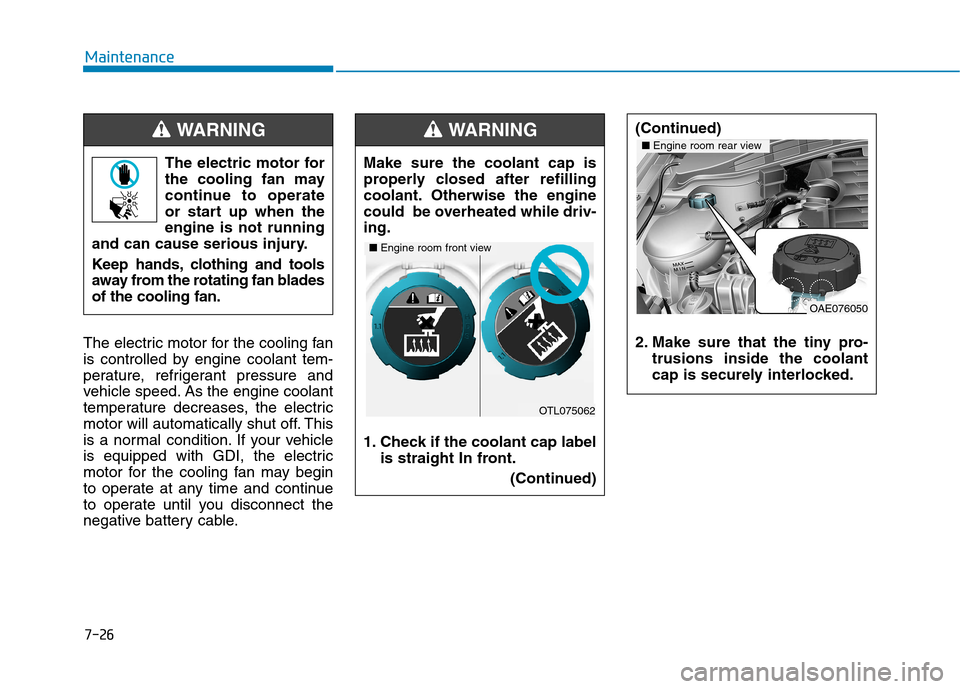
Make sure the coolant cap is
properly closed after refilling
coolant. Otherwise the engine
could be overheated while driv-ing.
1. Check if the coolant cap label is straight In front.
(Continued)
WARNING
OTL075062
■Engine room front view (Continued)
2. Make sure that the tiny pro-
trusions inside the coolant
cap is securely interlocked.
OAE076050
■Engine room rear view
Page 448 of 553
7-27
7
Maintenance
Recommended coolant
When adding coolant, use onlydeionized water, distilled water or
soft water for your vehicle and
never mix hard water in the coolant
filled at the factory.
An improper coolant mixture can result in severe malfunction or
engine/hybrid system damage.
The engine in your vehicle has alu- minum engine parts and must be
protected by an phosphate-based
ethylene glycol coolant to preventcorrosion and freezing.
Do not use alcohol or methanol coolant or mix them with the spec-ified coolant.
Do not use a solution that contains more than 60% antifreeze or less
than 35% antifreeze, which would
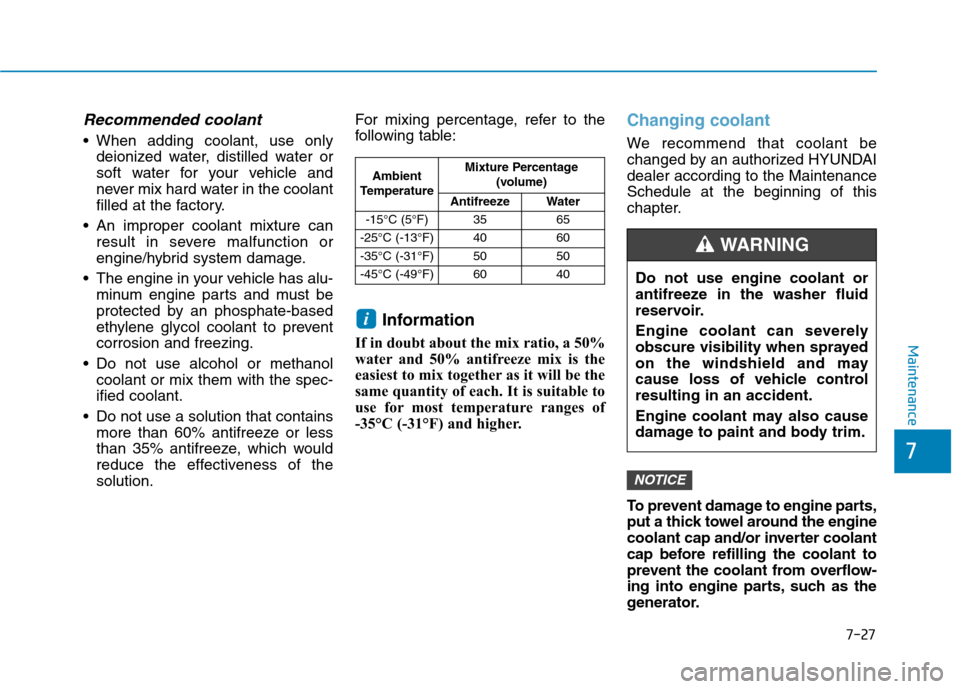
reduce the effectiveness of thesolution. For mixing percentage, refer to the
following table:
Information
If in doubt about the mix ratio, a 50%
water and 50% antifreeze mix is the
easiest to mix together as it will be the
same quantity of each. It is suitable to
use for most temperature ranges of
-35°C (-31°F) and higher.
Changing coolant
We recommend that coolant be
changed by an authorized HYUNDAIdealer according to the MaintenanceSchedule at the beginning of this
chapter.
To prevent damage to engine parts,
put a thick towel around the engine
coolant cap and/or inverter coolant
cap before refilling the coolant to
prevent the coolant from overflow-
ing into engine parts, such as the
generator.
NOTICE
i
Ambient
Temperature Mixture Percentage
(volume)
Antifreeze Water
-15°C (5°F) 35 65
-25°C (-13°F) 40 60
-35°C (-31°F) 50 50
-45°C (-49°F) 60 40
Do not use engine coolant or
antifreeze in the washer fluid
reservoir.
Engine coolant can severely
obscure visibility when sprayed
on the windshield and may
cause loss of vehicle controlresulting in an accident.
Engine coolant may also cause
damage to paint and body trim.
WARNING
Page 464 of 553
7-43
7
Maintenance
Check tire inflation pressure
Check your tires, including the spare
tire, once a month or more.
How to check
Use a good quality tire pressure
gauge to check tire pressure. You
can not tell if your tires are properly
inflated simply by looking at them.
Radial tires may look properly inflat-
ed when they are under-inflated.
Remove the valve cap from the tire
valve stem. Press the tire gauge firm-
ly onto the valve to get a pressure
measurement. If the cold tire inflationpressure matches the recommendedpressure on the tire and loading
information label, no further adjust-
ment is necessary. If the pressure is
low, add air until you reach the rec-
ommended pressure. Make sure to
put the valve caps back on the valve
stems. Without the valve cap, dirt or
moisture could get into the valve
core and cause air leakage. If a valve
cap is missing, install a new one as
soon as possible.If you overfill the tire, release air bypushing on the metal stem in the
center of the tire valve. Recheck the
tire pressure with the tire gauge. Be
sure to put the valve caps back on
the valve stems. Without the valve
cap, dirt or moisture could get into
the valve core and cause air leakage.
If a valve cap is missing, install a new
one as soon as possible.
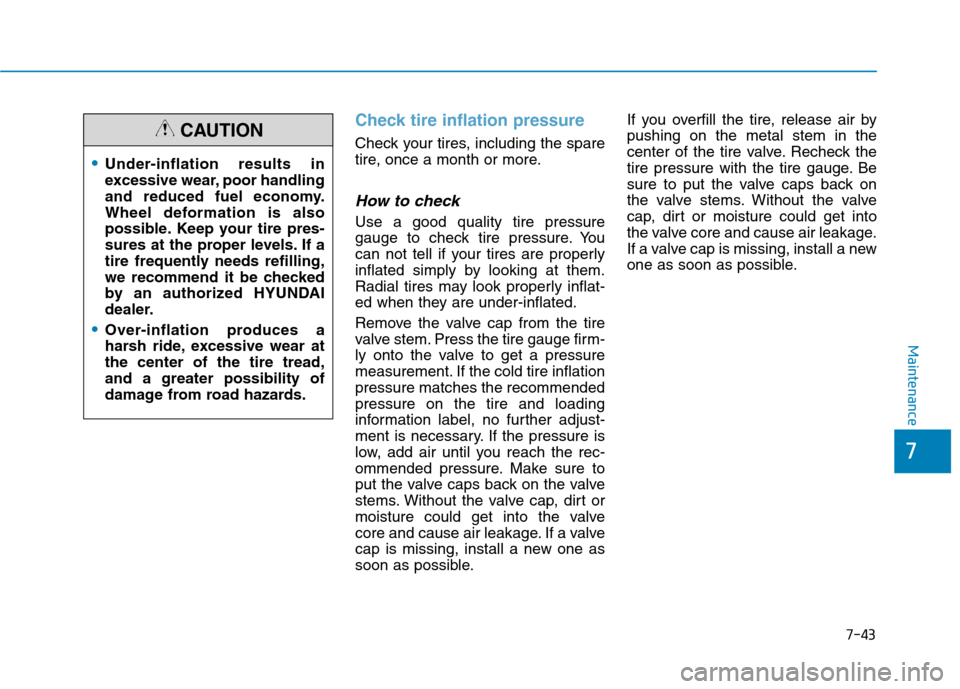
Under-inflation results in
excessive wear, poor handling
and reduced fuel economy.
Wheel deformation is also
possible. Keep your tire pres-
sures at the proper levels. If a
tire frequently needs refilling,
we recommend it be checked
by an authorized HYUNDAI
dealer.
Over-inflation produces a
harsh ride, excessive wear atthe center of the tire tread,and a greater possibility of
damage from road hazards.
CAUTION
Page 520 of 553
8-6
Specifications & Consumer informationR
R EECCOO MM MMEENN DDEEDD LL UU BBRRIICC AA NN TTSS AA NN DD CC AA PPAA CCIITT IIEE SS
To help achieve proper engine and powertrain performance and durability, use only lubricants of the proper quality.
The correct lubricants also help promote engine efficiency that results in improved fuel economy.
These lubricants and fluids are recommended for use in your vehicle.
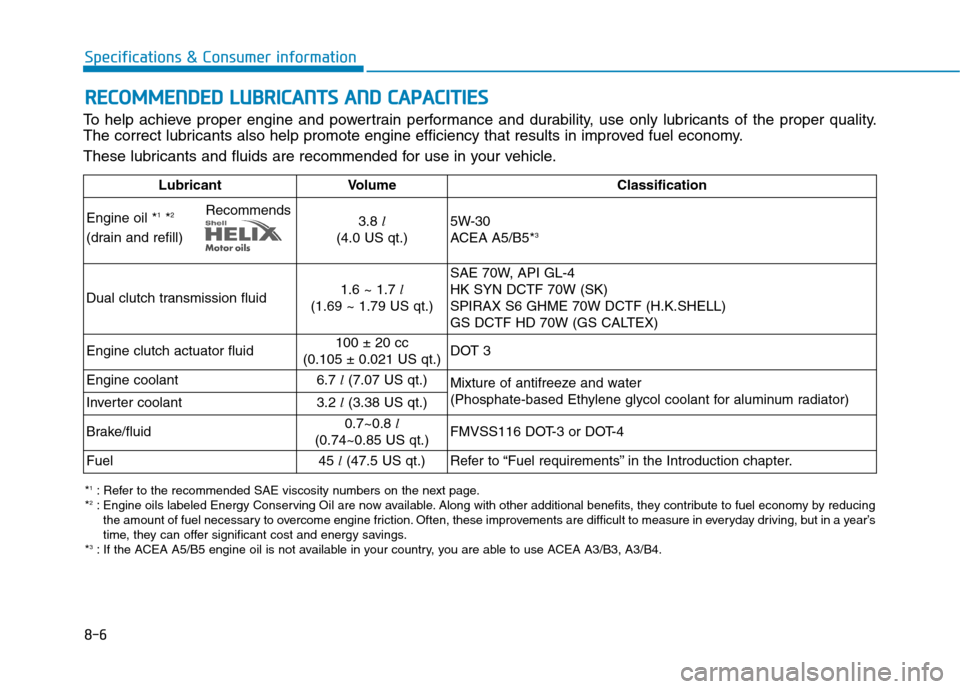
Lubricant Volume Classification
Engine oil * 1
*2
Recommends
(drain and refill) 3.8
l
(4.0 US qt.) 5W-30
ACEA A5/B5*
3
Dual clutch transmission fluid 1.6 ~ 1.7
l
(1.69 ~ 1.79 US qt.) SAE 70W, API GL-4HK SYN DCTF 70W (SK)SPIRAX S6 GHME 70W DCTF (H.K.SHELL)
GS DCTF HD 70W (GS CALTEX)
Engine clutch actuator fluid 100 ± 20 cc
(0.105 ± 0.021 US qt.) DOT 3
Engine coolant 6.7
l(7.07 US qt.)
Mixture of antifreeze and water
(Phosphate-based Ethylene glycol coolant for aluminum radiator)
Inverter coolant 3.2
l(3.38 US qt.)
Brake/fluid 0.7~0.8
l
(0.74~0.85 US qt.) FMVSS116 DOT-3 or DOT-4
Fuel 45
l(47.5 US qt.)
Refer to “Fuel requirements” in the Introduction chapter.
*1
: Refer to the recommended SAE viscosity numbers on the next page.
* 2
: Engine oils labeled Energy Conserving Oil are now available. Along with other additional benefits, they contribute to fuel economy by reducing
the amount of fuel necessary to overcome engine friction. Often, these improvements are difficult to measure in everyday driving, but in a year’s
time, they can offer significant cost and energy savings.
* 3
: If the ACEA A5/B5 engine oil is not available in your country, you are able to use ACEA A3/B3, A3/B4.