fuel cap HYUNDAI IX35 2014 Owner's Manual
[x] Cancel search | Manufacturer: HYUNDAI, Model Year: 2014, Model line: IX35, Model: HYUNDAI IX35 2014Pages: 1534, PDF Size: 39.76 MB
Page 519 of 1534
429
Features of your vehicle
(Continued)Use only portable plastic fuel
containers designed to carry and
store gasoline.
Do not use cellular phones while refueling. Electric current and/or
electronic interference from cel-
lular phones can potentially
ignite fuel vapors causing a fire.
When refueling, always shut the engine off. Sparks produced byelectrical components related to
the engine can ignite fuel vapors
causing a fire. Once refueling is
complete, check to make sure thefiller cap and filler door are
securely closed, before starting
the engine.
DO NOT use matches or a lighter and DO NOT SMOKE or leave a lit
cigarette in your vehicle while at
a gas station especially during
refueling. Automotive fuel is
highly flammable and can, when
ignited, result in fire.
(Continued)(Continued)
If a fire breaks out during refuel-ing, leave the vicinity of the vehi-
cle, and immediately contact the
manager of the gas station and
then contact the local fire depart-
ment. Follow any safety instruc-
tions they provide.CAUTION
Make sure to refuel your vehicle
according to the "Fuel require-
ments" suggested in section 1.
If the fuel filler cap requires replacement, we recommend thatyou use parts for replacement
from an authorized HYUNDAIdealer. An incorrect fuel filler cap can result in a serious malfunc-tion of the fuel system or emis-
sion control system.
Do not spill fuel on the exterior surfaces of the vehicle. Any typeof fuel spilled on painted surfaces
may damage the paint.
After refueling, make sure the fuel cap is installed securely to pre-vent fuel spillage in the event ofan accident.
EL(FL) Eng 4A.QXP 7/11/2013 11:31 AM Page 29
Page 540 of 1534
Features of your vehicle
50
4
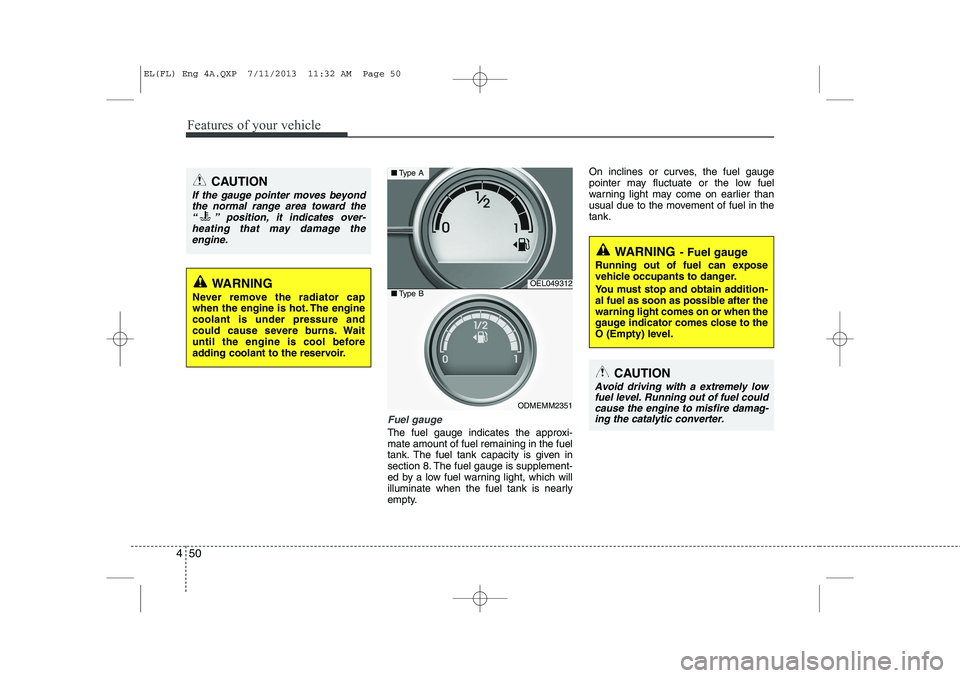
Fuel gauge
The fuel gauge indicates the approxi- mate amount of fuel remaining in the fuel
tank. The fuel tank capacity is given in
section 8. The fuel gauge is supplement-
ed by a low fuel warning light, which will
illuminate when the fuel tank is nearly
empty. On inclines or curves, the fuel gauge
pointer may fluctuate or the low fuel
warning light may come on earlier than
usual due to the movement of fuel in thetank.
CAUTION
If the gauge pointer moves beyond
the normal range area toward the
“ ” position, it indicates over-heating that may damage theengine.
WARNING
Never remove the radiator cap
when the engine is hot. The enginecoolant is under pressure and
could cause severe burns. Wait
until the engine is cool before
adding coolant to the reservoir.OEL049312
ODMEMM2351
■ Type A
■Type B
WARNING - Fuel gauge
Running out of fuel can expose
vehicle occupants to danger.
You must stop and obtain addition-
al fuel as soon as possible after thewarning light comes on or when the
gauge indicator comes close to the
O (Empty) level.
CAUTION
Avoid driving with a extremely low fuel level. Running out of fuel could cause the engine to misfire damag-ing the catalytic converter.
EL(FL) Eng 4A.QXP 7/11/2013 11:32 AM Page 50
Page 828 of 1534
This section will guide you in the proper
loading of your vehicle and/or trailer, to
keep your loaded vehicle weight within its
design rating capability, with or without a
trailer. Properly loading your vehicle will
provide maximum return of the vehicle
design performance. Before loading your
vehicle, familiarize yourself with the fol-
lowing terms for determining your vehi-
cle's weight ratings, with or without a
trailer, from the vehicle's specifications
and the certification label: Base curb weight
This is the weight of the vehicle including a full tank of fuel and all standard equip-
ment. It does not include passengers,
cargo, or optional equipment.
Vehicle curb weight
This is the weight of your new vehicle
when you picked it up from your dealer
plus any aftermarket equipment.
Cargo weight
This figure includes all weight added to
the Base Curb Weight, including cargoand optional equipment.GAW (Gross axle weight)
This is the total weight placed on each
axle (front and rear) - including vehicle
curb weight and all payload.
GAWR (Gross axle weight rating)
This is the maximum allowable weight
that can be carried by a single axle (front
or rear). These numbers are shown on
the certification label.
The total load on each axle must never
exceed its GAWR.
GVW (Gross vehicle weight)
This is the Base Curb Weight plus actual
Cargo Weight plus passengers.
GVWR (Gross vehicle weight rat- ing)
This is the maximum allowable weight of
the fully loaded vehicle (including all
options, equipment, passengers and
cargo). The GVWR is shown on the cer-tification label.
Overloading
VEHICLE WEIGHT
WARNING -
Vehicle weight
The gross axle weight rating
(GAWR) and the gross vehicle
weight rating (GVWR) for your vehi-
cle are on the certification label
attached to the driver's (or front
passenger’s) door. Exceedingthese ratings can cause an acci-
dent or vehicle damage. You can
calculate the weight of your load byweighing the items (and people)
before putting them in the vehicle.
Be careful not to overload your
vehicle.
574
Driving your vehicle
EL(FL) Eng 5.QXP 7/11/2013 11:05 AM Page 74
Page 870 of 1534
75
Maintenance
OEL070302
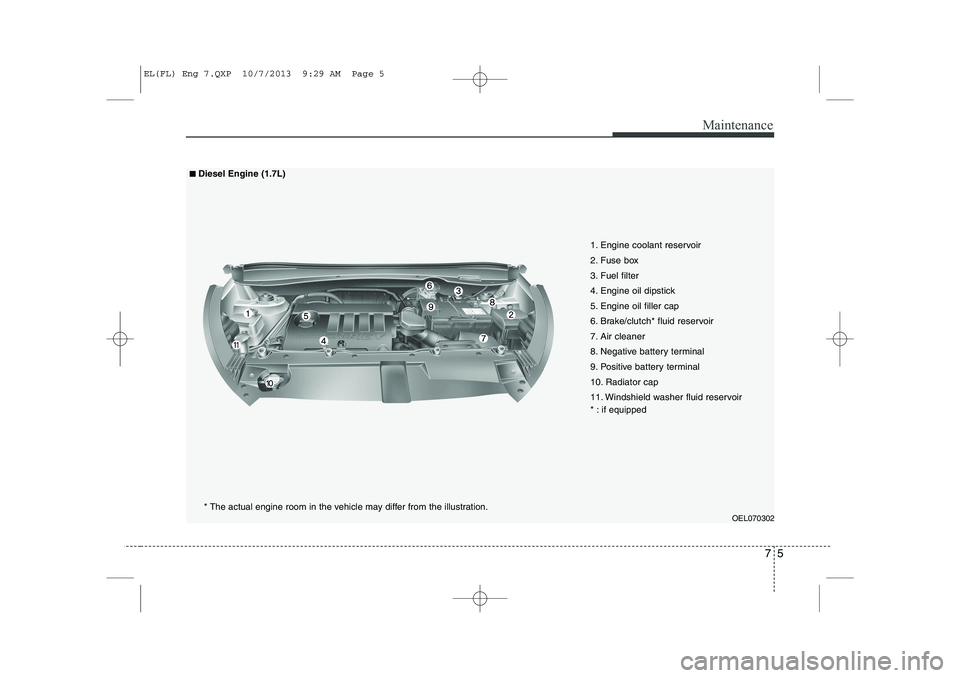
1. Engine coolant reservoir
2. Fuse box
3. Fuel filter
4. Engine oil dipstick
5. Engine oil filler cap
6. Brake/clutch* fluid reservoir
7. Air cleaner
8. Negative battery terminal
9. Positive battery terminal
10. Radiator cap
11. Windshield washer fluid reservoir
* : if equipped
■■Diesel Engine (1.7L)
* The actual engine room in the vehicle may differ from the illustration.
EL(FL) Eng 7.QXP 10/7/2013 9:29 AM Page 5
Page 871 of 1534
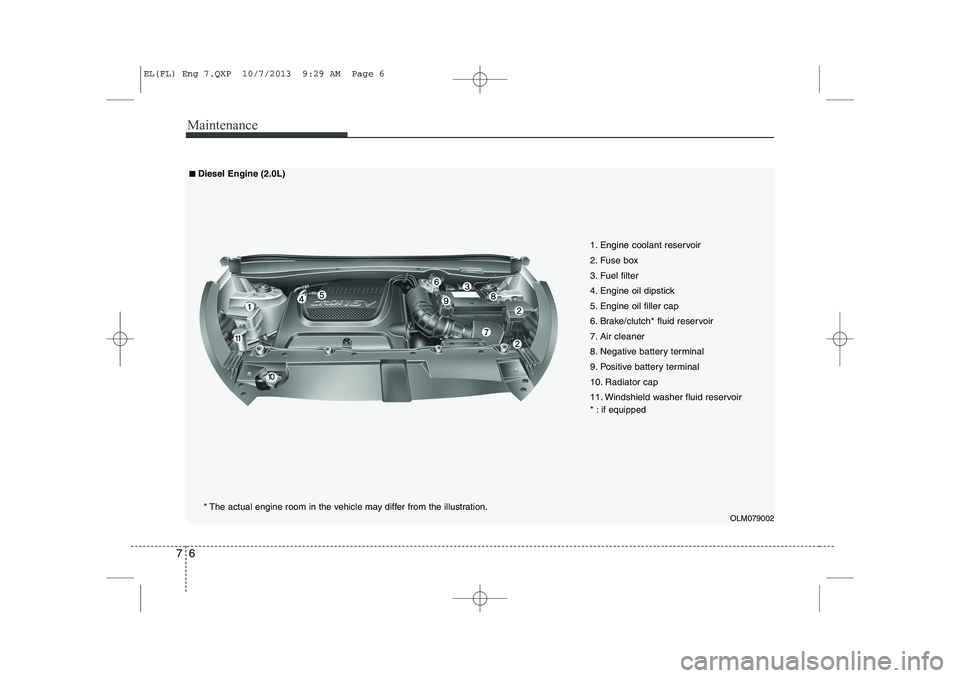
Maintenance
6
7
OLM079002
1. Engine coolant reservoir
2. Fuse box
3. Fuel filter
4. Engine oil dipstick
5. Engine oil filler cap
6. Brake/clutch* fluid reservoir
7. Air cleaner
8. Negative battery terminal
9. Positive battery terminal
10. Radiator cap
11. Windshield washer fluid reservoir
* : if equipped
■■
Diesel Engine (2.0L)
* The actual engine room in the vehicle may differ from the illustration.
EL(FL) Eng 7.QXP 10/7/2013 9:29 AM Page 6
Page 878 of 1534
713
Maintenance
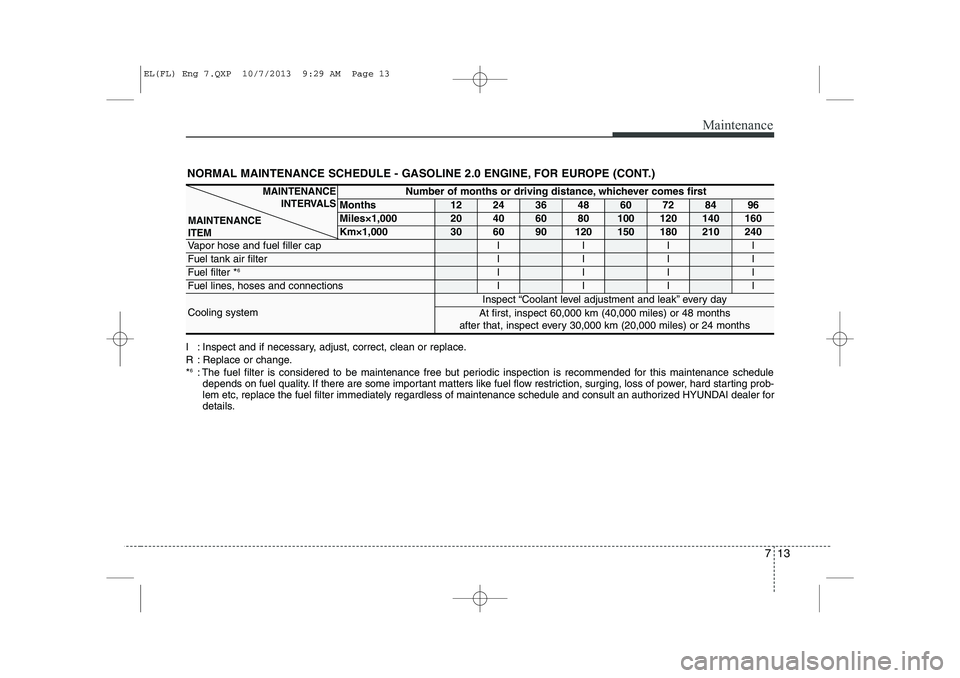
NORMAL MAINTENANCE SCHEDULE - GASOLINE 2.0 ENGINE, FOR EUROPE (CONT.)
I : Inspect and if necessary, adjust, correct, clean or replace.
R : Replace or change.* 6
: The fuel filter is considered to be maintenance free but periodic inspection is recommended for this maintenance schedule
depends on fuel quality. If there are some important matters like fuel flow restriction, surging, loss of power, hard starting p rob-
lem etc, replace the fuel filter immediately regardless of maintenance schedule and consult an authorized HYUNDAI dealer for
details.
Number of months or driving distance, whichever comes first
Months1224364860728496
Miles×1,00020406080100120140160
Km×1,000306090120150180210240
Vapor hose and fuel filler capIIII
Fuel tank air filterIIII
Fuel filter * 6IIII
Fuel lines, hoses and connectionsIIII
Cooling system
Inspect “Coolant level adjustment and leak” every day
At first, inspect 60,000 km (40,000 miles) or 48 months
after that, inspect every 30,000 km (20,000 miles) or 24 months
MAINTENANCE INTERVALS
MAINTENANCE ITEM
EL(FL) Eng 7.QXP 10/7/2013 9:29 AM Page 13
Page 885 of 1534
Maintenance
20
7
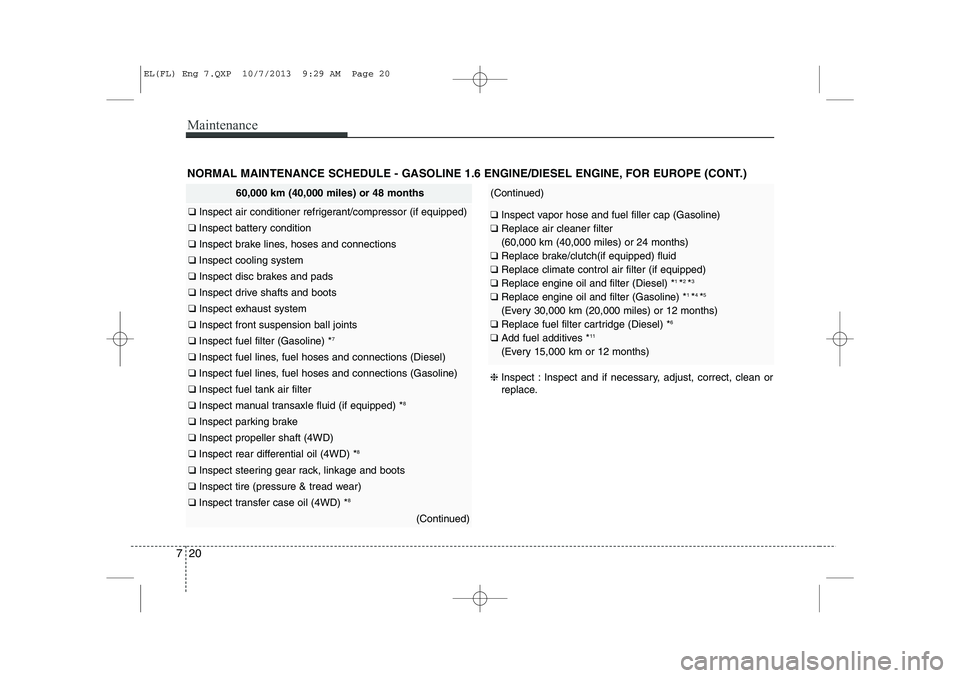
NORMAL MAINTENANCE SCHEDULE - GASOLINE 1.6 ENGINE/DIESEL ENGINE, FOR EUROPE (CONT.)
❈Inspect : Inspect and if necessary, adjust, correct, clean or
replace.
60,000 km (40,000 miles) or 48 months
❑ Inspect air conditioner refrigerant/compressor (if equipped)
❑ Inspect battery condition
❑ Inspect brake lines, hoses and connections
❑ Inspect cooling system
❑ Inspect disc brakes and pads
❑ Inspect drive shafts and boots
❑ Inspect exhaust system
❑ Inspect front suspension ball joints
❑ Inspect fuel filter (Gasoline) * 7
❑
Inspect fuel lines, fuel hoses and connections (Diesel)
❑ Inspect fuel lines, fuel hoses and connections (Gasoline)
❑ Inspect fuel tank air filter
❑ Inspect manual transaxle fluid (if equipped) * 8
❑
Inspect parking brake
❑ Inspect propeller shaft (4WD)
❑ Inspect rear differential oil (4WD) * 8
❑
Inspect steering gear rack, linkage and boots
❑ Inspect tire (pressure & tread wear)
❑ Inspect transfer case oil (4WD) * 8
(Continued)
(Continued)
❑
Inspect vapor hose and fuel filler cap (Gasoline)
❑ Replace air cleaner filter (60,000 km (40,000 miles) or 24 months)
❑ Replace brake/clutch(if equipped) fluid
❑ Replace climate control air filter (if equipped)
❑ Replace engine oil and filter (Diesel) * 1
*2
*3
❑ Replace engine oil and filter (Gasoline) * 1
*4
*5
(Every 30,000 km (20,000 miles) or 12 months)
❑ Replace fuel filter cartridge (Diesel) * 6
❑ Add fuel additives * 11
(Every 15,000 km or 12 months)
EL(FL) Eng 7.QXP 10/7/2013 9:29 AM Page 20
Page 887 of 1534
Maintenance
22
7
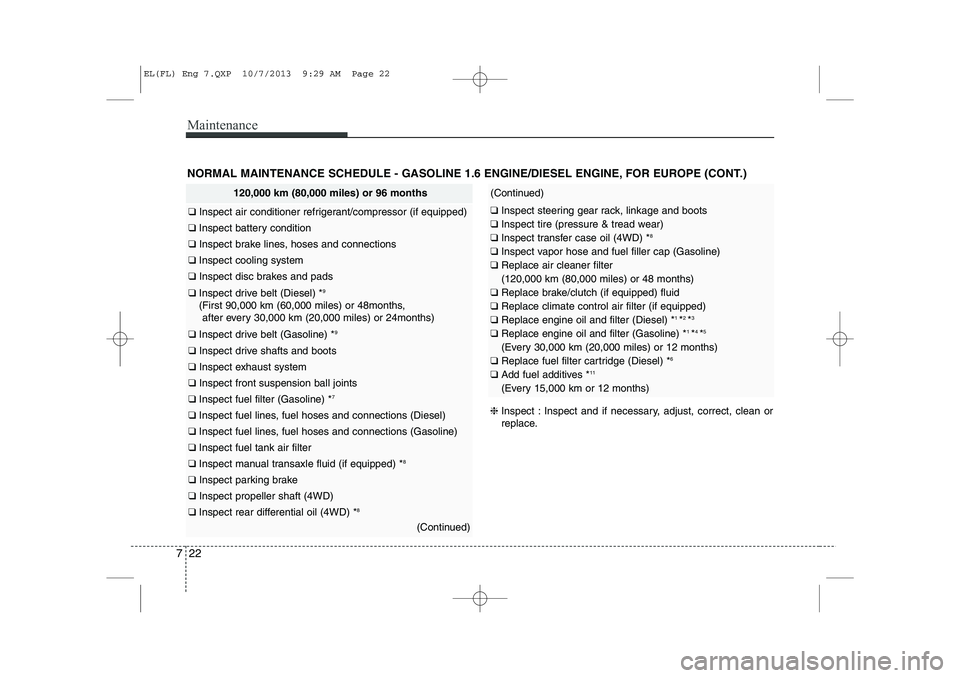
NORMAL MAINTENANCE SCHEDULE - GASOLINE 1.6 ENGINE/DIESEL ENGINE, FOR EUROPE (CONT.)
❈Inspect : Inspect and if necessary, adjust, correct, clean or
replace.
120,000 km (80,000 miles) or 96 months
❑ Inspect air conditioner refrigerant/compressor (if equipped)
❑ Inspect battery condition
❑ Inspect brake lines, hoses and connections
❑ Inspect cooling system
❑ Inspect disc brakes and pads
❑ Inspect drive belt (Diesel) * 9
(First 90,000 km (60,000 miles) or 48months, after every 30,000 km (20,000 miles) or 24months)
❑ Inspect drive belt (Gasoline) * 9
❑
Inspect drive shafts and boots
❑ Inspect exhaust system
❑ Inspect front suspension ball joints
❑ Inspect fuel filter (Gasoline) * 7
❑
Inspect fuel lines, fuel hoses and connections (Diesel)
❑ Inspect fuel lines, fuel hoses and connections (Gasoline)
❑ Inspect fuel tank air filter
❑ Inspect manual transaxle fluid (if equipped) * 8
❑
Inspect parking brake
❑ Inspect propeller shaft (4WD)
❑ Inspect rear differential oil (4WD) * 8
(Continued)
(Continued)
❑
Inspect steering gear rack, linkage and boots
❑ Inspect tire (pressure & tread wear)
❑ Inspect transfer case oil (4WD) * 8
❑ Inspect vapor hose and fuel filler cap (Gasoline)
❑ Replace air cleaner filter (120,000 km (80,000 miles) or 48 months)
❑ Replace brake/clutch (if equipped) fluid
❑ Replace climate control air filter (if equipped)
❑ Replace engine oil and filter (Diesel) * 1
*2
*3
❑ Replace engine oil and filter (Gasoline) * 1
*4
*5
(Every 30,000 km (20,000 miles) or 12 months)
❑ Replace fuel filter cartridge (Diesel) * 6
❑ Add fuel additives * 11
(Every 15,000 km or 12 months)
EL(FL) Eng 7.QXP 10/7/2013 9:29 AM Page 22
Page 889 of 1534
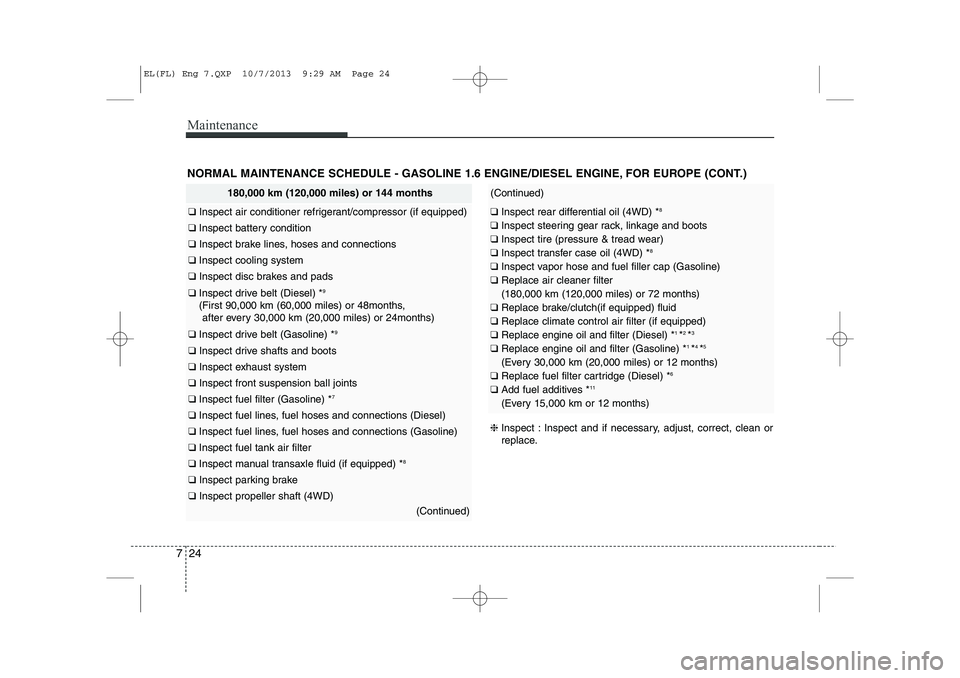
Maintenance
24
7
NORMAL MAINTENANCE SCHEDULE - GASOLINE 1.6 ENGINE/DIESEL ENGINE, FOR EUROPE (CONT.)
❈Inspect : Inspect and if necessary, adjust, correct, clean or
replace.
180,000 km (120,000 miles) or 144 months
❑ Inspect air conditioner refrigerant/compressor (if equipped)
❑ Inspect battery condition
❑ Inspect brake lines, hoses and connections
❑ Inspect cooling system
❑ Inspect disc brakes and pads
❑ Inspect drive belt (Diesel) * 9
(First 90,000 km (60,000 miles) or 48months, after every 30,000 km (20,000 miles) or 24months)
❑ Inspect drive belt (Gasoline) * 9
❑
Inspect drive shafts and boots
❑ Inspect exhaust system
❑ Inspect front suspension ball joints
❑ Inspect fuel filter (Gasoline) * 7
❑
Inspect fuel lines, fuel hoses and connections (Diesel)
❑ Inspect fuel lines, fuel hoses and connections (Gasoline)
❑ Inspect fuel tank air filter
❑ Inspect manual transaxle fluid (if equipped) * 8
❑
Inspect parking brake
❑ Inspect propeller shaft (4WD)
(Continued)
(Continued)
❑ Inspect rear differential oil (4WD) * 8
❑ Inspect steering gear rack, linkage and boots
❑ Inspect tire (pressure & tread wear)
❑ Inspect transfer case oil (4WD) * 8
❑ Inspect vapor hose and fuel filler cap (Gasoline)
❑ Replace air cleaner filter (180,000 km (120,000 miles) or 72 months)
❑ Replace brake/clutch(if equipped) fluid
❑ Replace climate control air filter (if equipped)
❑ Replace engine oil and filter (Diesel) * 1
*2
*3
❑ Replace engine oil and filter (Gasoline) * 1
*4
*5
(Every 30,000 km (20,000 miles) or 12 months)
❑ Replace fuel filter cartridge (Diesel) * 6
❑ Add fuel additives * 11
(Every 15,000 km or 12 months)
EL(FL) Eng 7.QXP 10/7/2013 9:29 AM Page 24
Page 891 of 1534

Maintenance
26
7
NORMAL MAINTENANCE SCHEDULE - GASOLINE 1.6 ENGINE/DIESEL ENGINE, FOR EUROPE (CONT.)
❈Inspect : Inspect and if necessary, adjust, correct, clean or
replace.
240,000 km (160,000 miles) or 192 months
❑ Inspect air conditioner refrigerant/compressor (if equipped)
❑ Inspect battery condition
❑ Inspect brake lines, hoses and connections
❑ Inspect cooling system
❑ Inspect disc brakes and pads
❑ Inspect drive belt (Diesel) * 9
(First 90,000 km (60,000 miles) or 48months, after every 30,000 km (20,000 miles) or 24months)
❑ Inspect drive belt (Gasoline) * 9
❑
Inspect drive shafts and boots
❑ Inspect exhaust system
❑ Inspect front suspension ball joints
❑ Inspect fuel filter (Gasoline) * 7
❑
Inspect fuel lines, fuel hoses and connections (Diesel)
❑ Inspect fuel lines, fuel hoses and connections (Gasoline)
❑ Inspect fuel tank air filter
❑ Inspect manual transaxle fluid (if equipped) * 8
❑
Inspect parking brake
❑ Inspect propeller shaft (4WD)
❑ Inspect rear differential oil (4WD) * 8
(Continued)
(Continued)
❑
Inspect steering gear rack, linkage and boots
❑ Inspect tire (pressure & tread wear)
❑ Inspect transfer case oil (4WD) * 8
❑ Inspect vapor hose and fuel filler cap (Gasoline)
❑ Replace air cleaner filter (240,000 km (160,000 miles) or 96 months)
❑ Replace brake/clutch(if equipped) fluid
❑ Replace climate control air filter (if equipped)
❑ Replace engine coolant * 10
(First 210,000 km (120,000 miles) or 120months, after every 30,000 km (20,000 miles) or 24months)
❑ Replace engine oil and filter (Diesel) * 1
*2
*3
❑ Replace engine oil and filter (Gasoline) * 1
*4
*5
(Every 30,000 km (20,000 miles) or 12 months)
❑ Replace fuel filter cartridge (Diesel) * 6
❑ Add fuel additives * 11
(Every 15,000 km or 12 months)
EL(FL) Eng 7.QXP 10/7/2013 9:29 AM Page 26