fuel cap HYUNDAI IX35 2014 Owner's Guide
[x] Cancel search | Manufacturer: HYUNDAI, Model Year: 2014, Model line: IX35, Model: HYUNDAI IX35 2014Pages: 1534, PDF Size: 39.76 MB
Page 897 of 1534

Maintenance
32
7
NORMAL MAINTENANCE SCHEDULE - EXCEPT EUROPE (CONT.)
60,000 km (40,000 miles) or 48 months
❑ Inspect air cleaner filter - Except Middle East
❑ Inspect air conditioner refrigerant/compressor (if equipped)
❑ Inspect battery condition
❑ Inspect brake/clutch(if equipped) fluid
❑ Inspect brake lines, hoses and connections
❑ Inspect cooling system
(At first, inspect 60,000 km (40,000 miles) or 48 months
after that, inspect every 30,000 km
(20,000 miles) or 24
months)
❑ Inspect disc brakes and pads
❑ Inspect drive belt * 3
❑
Inspect drive shafts and boots
❑ Inspect exhaust system
❑ Inspect front suspension ball joints
❑ Inspect fuel lines, fuel hoses and connections (Diesel)
❑ Inspect fuel lines, fuel hoses and connections (Gasoline)
❑ Inspect manual transaxle fluid (if equipped) * 6
❑
Inspect parking brake
❑ Inspect propeller shaft (4WD) (if equipped)
❑ Inspect rear differential oil (4WD) * 6
(Continued)
(Continued)
❑
Inspect steering gear rack, linkage and boots
❑ Inspect tire (pressure & tread wear)
❑ Inspect transfer case oil (4WD) * 6
❑ Inspect vapor hose and fuel filler cap
❑ Replace air cleaner filter - For Middle East
❑ Replace climate control air filter (if equipped)
❑ Replace engine oil and filter (Diesel) * 1
(Every 10,000 km (6,500 miles) or 12 months)
❑ Replace engine oil and filter (Gasoline) * 1
- Except Middle East
❑ Replace engine oil and filter (Gasoline) * 1
- For Middle East
(Every 10,000 km (6,500 miles) or 12 months) * 2
❑ Replace fuel filter (Gasoline) * 4
❑ Replace fuel filter cartridge (Diesel) * 5
❑ Replace fuel tank air filter (Gasoline)
❑ Add fuel additives * 9
(Every 5,000 km or 6 months)
❈ Inspect : Inspect and if necessary, adjust, correct, clean or
replace.
EL(FL) Eng 7.QXP 10/7/2013 9:29 AM Page 32
Page 900 of 1534

735
Maintenance
NORMAL MAINTENANCE SCHEDULE - EXCEPT EUROPE (CONT.)
120,000 km (80,000 miles) or 96 months
❑ Inspect air cleaner filter - Except Middle East
❑ Inspect air conditioner refrigerant/compressor (if equipped)
❑ Inspect battery condition
❑ Inspect brake/clutch (if equipped) fluid
❑ Inspect brake lines, hoses and connections
❑ Inspect cooling system
(At first, inspect 60,000 km (40,000 miles) or 48 months
after that, inspect every 30,000 km
(20,000 miles)or 24
months)
❑ Inspect disc brakes and pads
❑ Inspect drive belt * 3
❑
Inspect drive shafts and boots
❑ Inspect exhaust system
❑ Inspect front suspension ball joints
❑ Inspect fuel lines, fuel hoses and connections (Diesel)
❑ Inspect fuel lines, fuel hoses and connections (Gasoline)
❑ Inspect manual transaxle fluid (if equipped) * 6
(Continued)
(Continued)
❑
Inspect parking brake
❑ Inspect propeller shaft (4WD) (if equipped)
❑ Inspect rear differential oil (4WD) * 6
❑
Inspect steering gear rack, linkage and boots
❑ Inspect tire (pressure & tread wear)
❑ Inspect transfer case oil (4WD) * 6
❑
Inspect vapor hose and fuel filler cap
❑ Replace air cleaner filter - For Middle East
❑ Replace climate control air filter (if equipped)
❑ Replace coolant * 7
(At first 200,000 km (120,000 miles) or 120 months,
after every 40,000 km (25,000 miles) or 24 months) * 8
❑
Replace engine oil and filter (Diesel) * 1
(Every 10,000 km (6,500 miles) or 12 months)
❑ Replace engine oil and filter (Gasoline) * 1
- Except Middle East
❑ Replace engine oil and filter (Gasoline) * 1
- For Middle East
(Every 10,000 km (6,500 miles) or 12 months) * 2
(Continued)
EL(FL) Eng 7.QXP 10/7/2013 9:29 AM Page 35
Page 907 of 1534
Maintenance
42
7
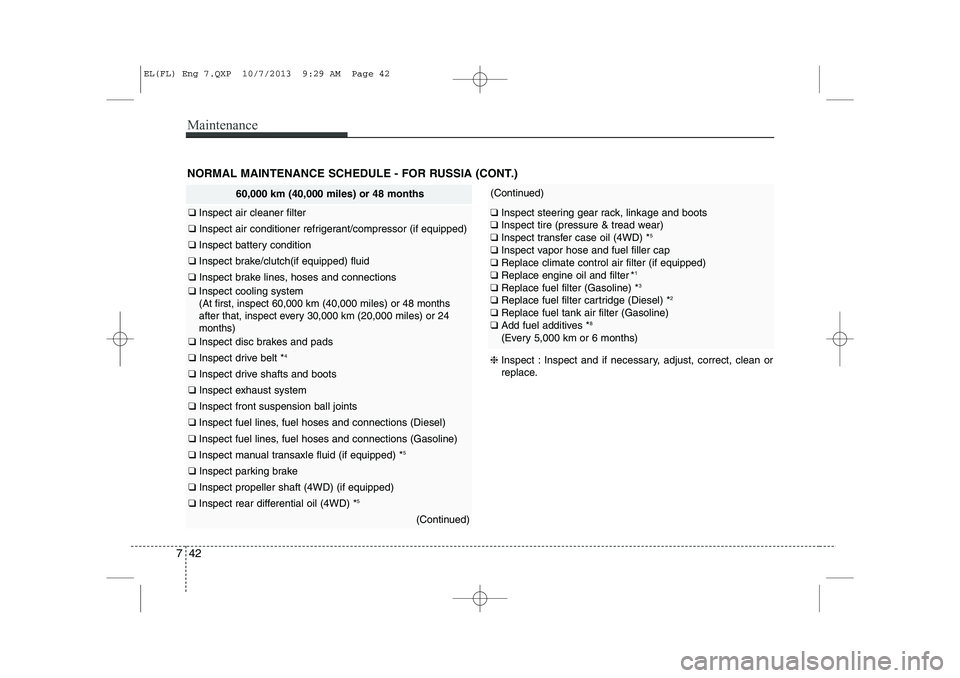
NORMAL MAINTENANCE SCHEDULE - FOR RUSSIA (CONT.)
60,000 km (40,000 miles) or 48 months
❑ Inspect air cleaner filter
❑ Inspect air conditioner refrigerant/compressor (if equipped)
❑ Inspect battery condition
❑ Inspect brake/clutch(if equipped) fluid
❑ Inspect brake lines, hoses and connections
❑ Inspect cooling system
(At first, inspect 60,000 km (40,000 miles) or 48 months
after that, inspect every 30,000 km
(20,000 miles) or 24
months)
❑ Inspect disc brakes and pads
❑ Inspect drive belt * 4
❑
Inspect drive shafts and boots
❑ Inspect exhaust system
❑ Inspect front suspension ball joints
❑ Inspect fuel lines, fuel hoses and connections (Diesel)
❑ Inspect fuel lines, fuel hoses and connections (Gasoline)
❑ Inspect manual transaxle fluid (if equipped) * 5
❑
Inspect parking brake
❑ Inspect propeller shaft (4WD) (if equipped)
❑ Inspect rear differential oil (4WD) * 5
(Continued)
(Continued)
❑
Inspect steering gear rack, linkage and boots
❑ Inspect tire (pressure & tread wear)
❑ Inspect transfer case oil (4WD) * 5
❑ Inspect vapor hose and fuel filler cap
❑ Replace climate control air filter (if equipped)
❑ Replace engine oil and filter * 1
❑ Replace fuel filter (Gasoline) * 3
❑ Replace fuel filter cartridge (Diesel) * 2
❑ Replace fuel tank air filter (Gasoline)
❑ Add fuel additives * 8
(Every 5,000 km or 6 months)
❈ Inspect : Inspect and if necessary, adjust, correct, clean or
replace.
EL(FL) Eng 7.QXP 10/7/2013 9:29 AM Page 42
Page 910 of 1534
745
Maintenance
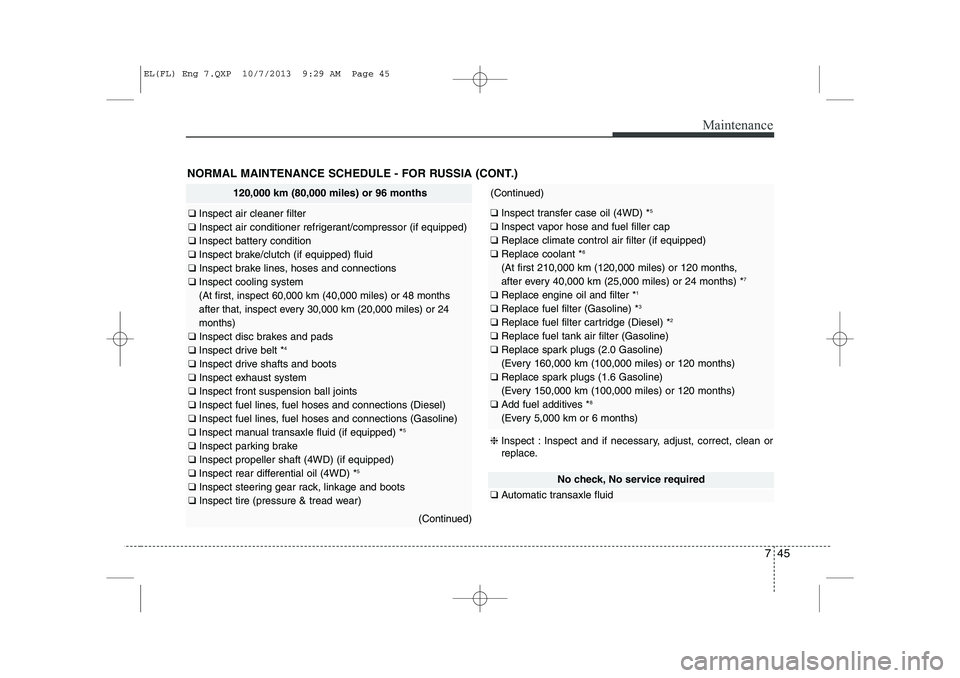
NORMAL MAINTENANCE SCHEDULE - FOR RUSSIA (CONT.)
No check, No service required
❑Automatic transaxle fluid
❈ Inspect : Inspect and if necessary, adjust, correct, clean or
replace.
120,000 km (80,000 miles) or 96 months
❑ Inspect air cleaner filter
❑ Inspect air conditioner refrigerant/compressor (if equipped)
❑ Inspect battery condition
❑ Inspect brake/clutch (if equipped) fluid
❑ Inspect brake lines, hoses and connections
❑ Inspect cooling system
(At first, inspect 60,000 km (40,000 miles) or 48 months
after that, inspect every 30,000 km
(20,000 miles)or 24
months)
❑ Inspect disc brakes and pads
❑ Inspect drive belt * 4
❑ Inspect drive shafts and boots
❑ Inspect exhaust system
❑ Inspect front suspension ball joints
❑ Inspect fuel lines, fuel hoses and connections (Diesel)
❑ Inspect fuel lines, fuel hoses and connections (Gasoline)
❑ Inspect manual transaxle fluid (if equipped) * 5
❑ Inspect parking brake
❑ Inspect propeller shaft (4WD) (if equipped)
❑ Inspect rear differential oil (4WD) * 5
❑ Inspect steering gear rack, linkage and boots
❑ Inspect tire (pressure & tread wear)
(Continued)
(Continued)
❑ Inspect transfer case oil (4WD) * 5
❑ Inspect vapor hose and fuel filler cap
❑ Replace climate control air filter (if equipped)
❑ Replace coolant * 6
(At first 210,000 km (120,000 miles) or 120 months,
after every 40,000 km (25,000 miles) or 24 months) * 7
❑ Replace engine oil and filter * 1
❑ Replace fuel filter (Gasoline) * 3
❑ Replace fuel filter cartridge (Diesel) * 2
❑ Replace fuel tank air filter (Gasoline)
❑ Replace spark plugs (2.0 Gasoline)
(Every 160,000 km (100,000 miles) or 120 months)
❑ Replace spark plugs (1.6 Gasoline)
(Every 150,000 km (100,000 miles) or 120 months)
❑ Add fuel additives * 8
(Every 5,000 km or 6 months)
EL(FL) Eng 7.QXP 10/7/2013 9:29 AM Page 45
Page 914 of 1534
749
Maintenance
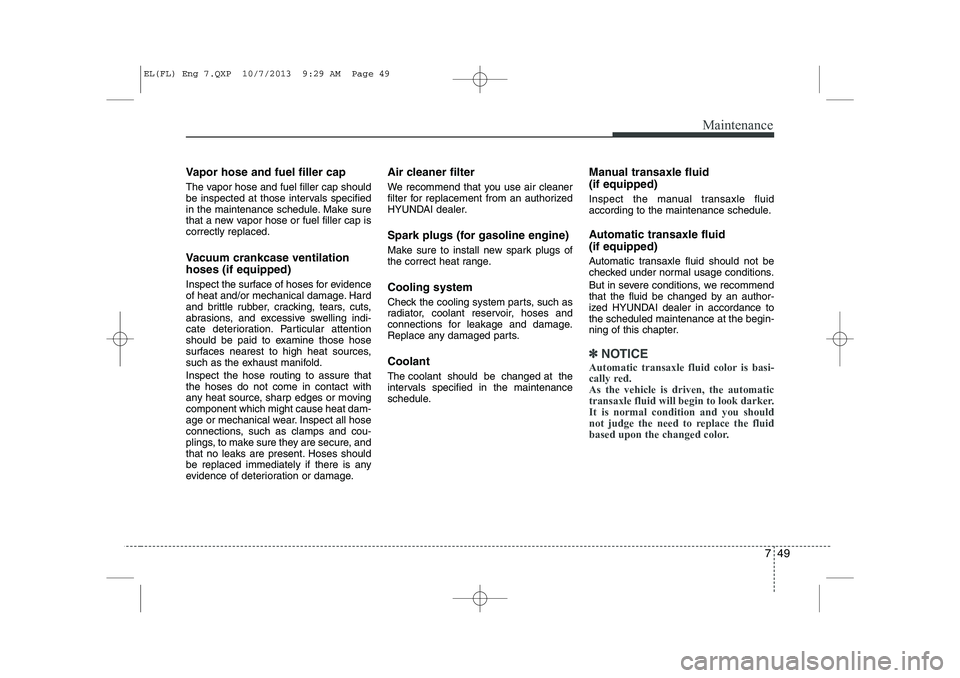
Vapor hose and fuel filler cap
The vapor hose and fuel filler cap should
be inspected at those intervals specified
in the maintenance schedule. Make sure
that a new vapor hose or fuel filler cap iscorrectly replaced.
Vacuum crankcase ventilation hoses (if equipped)
Inspect the surface of hoses for evidence
of heat and/or mechanical damage. Hard
and brittle rubber, cracking, tears, cuts,
abrasions, and excessive swelling indi-
cate deterioration. Particular attention
should be paid to examine those hose
surfaces nearest to high heat sources,
such as the exhaust manifold. Inspect the hose routing to assure that the hoses do not come in contact with
any heat source, sharp edges or movingcomponent which might cause heat dam-
age or mechanical wear. Inspect all hose
connections, such as clamps and cou-
plings, to make sure they are secure, and
that no leaks are present. Hoses should
be replaced immediately if there is any
evidence of deterioration or damage.Air cleaner filter
We recommend that you use air cleaner
filter for replacement from an authorized
HYUNDAI dealer.
Spark plugs (for gasoline engine)
Make sure to install new spark plugs of
the correct heat range. Cooling system
Check the cooling system parts, such as
radiator, coolant reservoir, hoses and
connections for leakage and damage.
Replace any damaged parts. Coolant The coolant should be changed at the
intervals specified in the maintenance
schedule.
Manual transaxle fluid (if equipped)
Inspect the manual transaxle fluid
according to the maintenance schedule.
Automatic transaxle fluid (if equipped)
Automatic transaxle fluid should not be
checked under normal usage conditions.
But in severe conditions, we recommend
that the fluid be changed by an author-
ized HYUNDAI dealer in accordance tothe scheduled maintenance at the begin-
ning of this chapter.
✽✽
NOTICE
Automatic transaxle fluid color is basi-
cally red. As the vehicle is driven, the automatic
transaxle fluid will begin to look darker.It is normal condition and you should
not judge the need to replace the fluid
based upon the changed color.
EL(FL) Eng 7.QXP 10/7/2013 9:29 AM Page 49
Page 935 of 1534

Maintenance
70
7
WARNING - Tire inflation
Overinflation or underinflation
can reduce tire life, adversely
affect vehicle handling, and
lead to sudden tire failure. This
could result in loss of vehicle
control and potential injury.
CAUTION - Tire pressure
Always observe the following:
Check tire pressure when the tires are cold. (After vehiclehas been parked for at leastthree hours or hasn't been driven more than 1.6 km (1mile) since startup.)
Check the pressure of your spare tire each time you checkthe pressure of other tires.
Never overload your vehicle. Be careful not to overload avehicle luggage rack if yourvehicle is equipped with one.
Worn, old tires can cause acci- dents. If your tread is badlyworn, or if your tires have been damaged, replace them.
CAUTION
Underinflation also results in excessive wear, poor handlingand reduced fuel economy.Wheel deformation also ispossible. Keep your tire pres- sures at the proper levels. If atire frequently needs refilling,we recommend that the sys- tem be checked by an author-ized HYUNDAI dealer.
Overinflation produces a harsh ride, excessive wear atthe center of the tire tread, and a greater possibility of dam-age from road hazards.
CAUTION
Warm tires normally exceed recommended cold tire pres-sures by 28 to 41 kPa (4 to 6 psi). Do not release air fromwarm tires to adjust the pres-sure or the tires will be under- inflated.
Be sure to reinstall the tire inflation valve caps. Withoutthe valve cap, dirt or moisturecould get into the valve core and cause air leakage. If avalve cap is missing, install anew one as soon as possible.
EL(FL) Eng 7.QXP 10/7/2013 9:31 AM Page 70
Page 978 of 1534
7 113
Maintenance
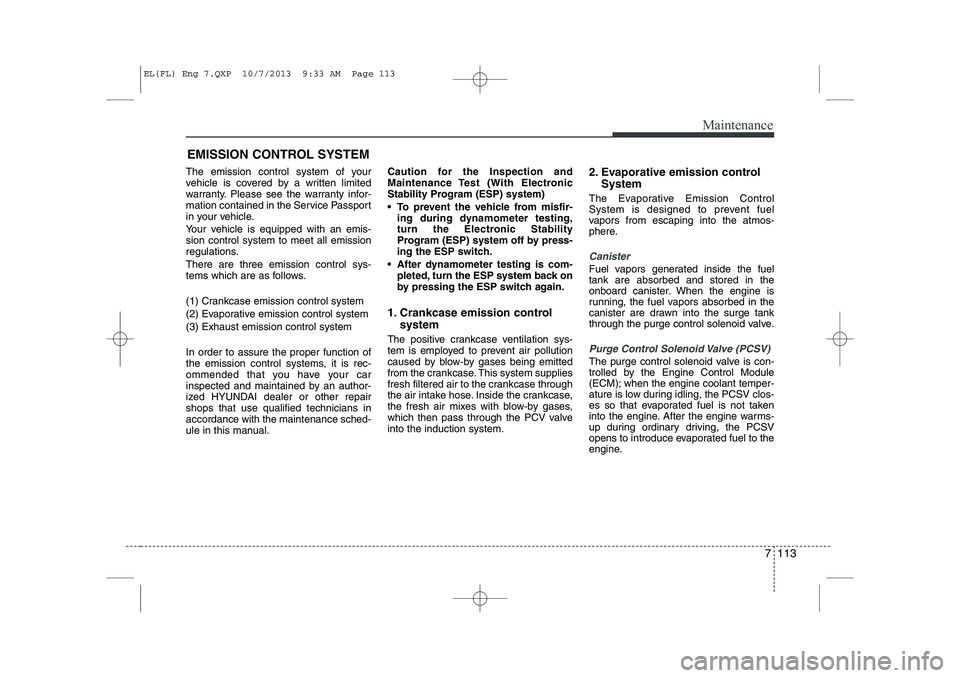
EMISSION CONTROL SYSTEM
The emission control system of your
vehicle is covered by a written limited
warranty. Please see the warranty infor-
mation contained in the Service Passport
in your vehicle.
Your vehicle is equipped with an emis- sion control system to meet all emission
regulations. There are three emission control sys-
tems which are as follows.
(1) Crankcase emission control system
(2) Evaporative emission control system(3) Exhaust emission control system In order to assure the proper function of
the emission control systems, it is rec-
ommended that you have your car
inspected and maintained by an author-
ized HYUNDAI dealer or other repairshops that use qualified technicians inaccordance with the maintenance sched-
ule in this manual. Caution for the Inspection and
Maintenance Test (With Electronic
Stability Program (ESP) system)
To prevent the vehicle from misfir-
ing during dynamometer testing,
turn the Electronic Stability
Program (ESP) system off by press-
ing the ESP switch.
After dynamometer testing is com- pleted, turn the ESP system back on
by pressing the ESP switch again.
1. Crankcase emission control system
The positive crankcase ventilation sys-
tem is employed to prevent air pollution
caused by blow-by gases being emitted
from the crankcase. This system supplies
fresh filtered air to the crankcase through
the air intake hose. Inside the crankcase,
the fresh air mixes with blow-by gases,
which then pass through the PCV valveinto the induction system. 2. Evaporative emission control
System
The Evaporative Emission Control
System is designed to prevent fuel
vapors from escaping into the atmos-
phere.
Canister
Fuel vapors generated inside the fuel tank are absorbed and stored in the
onboard canister. When the engine is
running, the fuel vapors absorbed in the
canister are drawn into the surge tank
through the purge control solenoid valve.
Purge Control Solenoid Valve (PCSV)
The purge control solenoid valve is con-
trolled by the Engine Control Module
(ECM); when the engine coolant temper-
ature is low during idling, the PCSV clos-
es so that evaporated fuel is not taken
into the engine. After the engine warms-
up during ordinary driving, the PCSV
opens to introduce evaporated fuel to the
engine.
EL(FL) Eng 7.QXP 10/7/2013 9:33 AM Page 113
Page 987 of 1534
Specifications & Consumer information
6
8
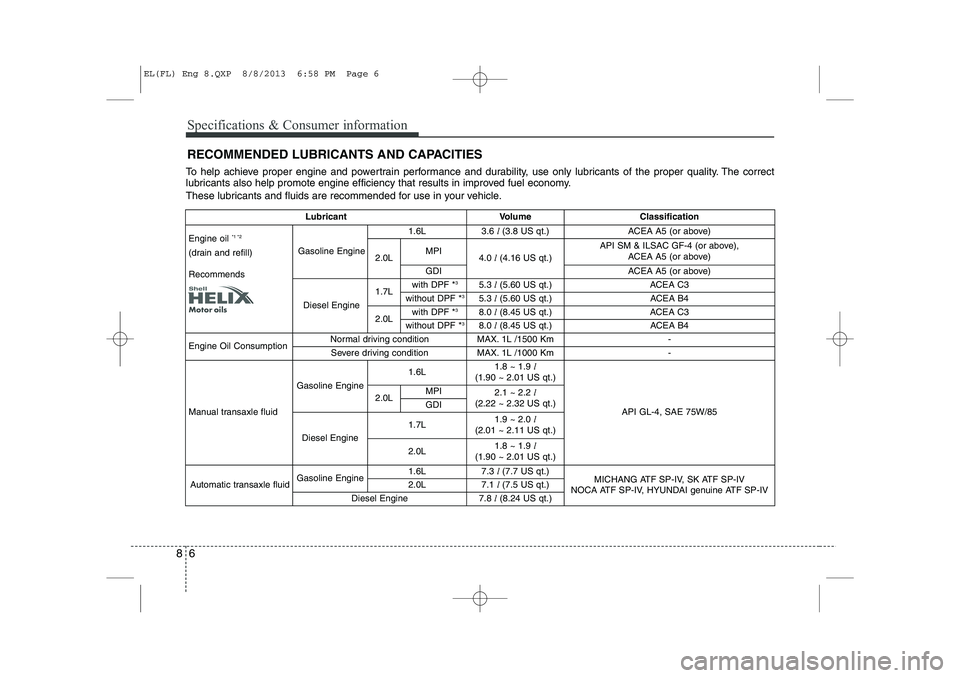
To help achieve proper engine and powertrain performance and durability, use only lubricants of the proper quality. The correct
lubricants also help promote engine efficiency that results in improved fuel economy.
These lubricants and fluids are recommended for use in your vehicle. RECOMMENDED LUBRICANTS AND CAPACITIES
LubricantVolume Classification
Engine oil
*1 *2
(drain and refill) Recommends
Gasoline Engine
1.6L3.6 l(3.8 US qt.)ACEA A5 (or above)
2.0LMPI4.0 l(4.16 US qt.)
API SM & ILSAC GF-4 (or above),
ACEA A5 (or above)
GDIACEA A5 (or above)
Diesel Engine
1.7Lwith DPF * 35.3
l(5.60 US qt.)ACEA C3
without DPF * 35.3
l(5.60 US qt.)ACEA B4
2.0Lwith DPF * 38.0
l(8.45 US qt.)ACEA C3
without DPF * 38.0
l(8.45 US qt.)ACEA B4
Engine Oil ConsumptionNormal driving conditionMAX. 1L /1500 Km-
Severe driving conditionMAX. 1L /1000 Km-
Manual transaxle fluid
Gasoline Engine
1.6L1.8 ~ 1.9 l
(1.90 ~ 2.01 US qt.)
API GL-4, SAE 75W/85
2.0LMPI2.1 ~ 2.2 l
(2.22 ~ 2.32 US qt.)
GDI
Diesel Engine
1.7L1.9 ~ 2.0 l
(2.01 ~ 2.11 US qt.)
2.0L1.8 ~ 1.9 l
(1.90 ~ 2.01 US qt.)
Automatic transaxle fluidGasoline Engine1.6L7.3 l(7.7 US qt.)MICHANG ATF SP-IV, SK ATF SP-IV
NOCA ATF SP-IV, HYUNDAI genuine ATF SP-IV2.0L7.1 l(7.5 US qt.)
Diesel Engine7.8 l(8.24 US qt.)
EL(FL) Eng 8.QXP 8/8/2013 6:58 PM Page 6
Page 995 of 1534
13
Introduction
Petrol containing alcohol andmethanol
Gasohol, a mixture of petrol and ethanol
(also known as grain alcohol), and petrolor gasohol containing methanol (also
known as wood alcohol) are being mar-
keted along with or instead of leaded orunleaded petrol. Do not use gasohol containing more than 10% ethanol, and do not use petrol or
gasohol containing any methanol. Either
of these fuels may cause drivability prob-lems and damage to the fuel system.
Discontinue using gasohol of any kind if
drivability problems occur.
Vehicle damage or driveability problems
may not be covered by the manufactur-
er’s warranty if they result from the useof:
1. Gasohol containing more than 10% ethanol.
2. Petrol or gasohol containing methanol.
3. Leaded fuel or leaded gasohol.
Use of MTBE
HYUNDAI recommends avoiding fuels
containing MTBE (Methyl Tertiary Butyl
Ether) over 15.0% vol. (Oxygen Content
2.7% weight) in your vehicle.
Fuel containing MTBE over 15.0% vol.
(Oxygen Content 2.7% weight) may
reduce vehicle performance and produce
vapour lock or hard starting.
Do not use methanol
Fuels containing methanol (wood alco-
hol) should not be used in your vehicle.
This type of fuel can reduce vehicle per-
formance and damage components ofthe fuel system.
WARNING
Do not "top off" after the nozzle automatically shuts off when refuelling.
Always check that the fuel cap is installed securely to prevent fuel
spillage in the event of an acci-dent.
CAUTION
Never use gasohol which contains
methanol. Discontinue use of any gasohol product which impairs dri-
vability.
CAUTION
Your New Vehicle Limited Warranty may not cover damage to the fuel
system and any performance prob- lems that are caused by the use offuels containing methanol or fuels
containing MTBE (Methyl TertiaryButyl Ether) over 15.0% vol. (Oxygen Content 2.7% weight.)
EL(FL) UK 1.QXP 8/5/2013 6:21 PM Page 3
Page 1005 of 1534
26
Your vehicle at a glance
OEL070302R
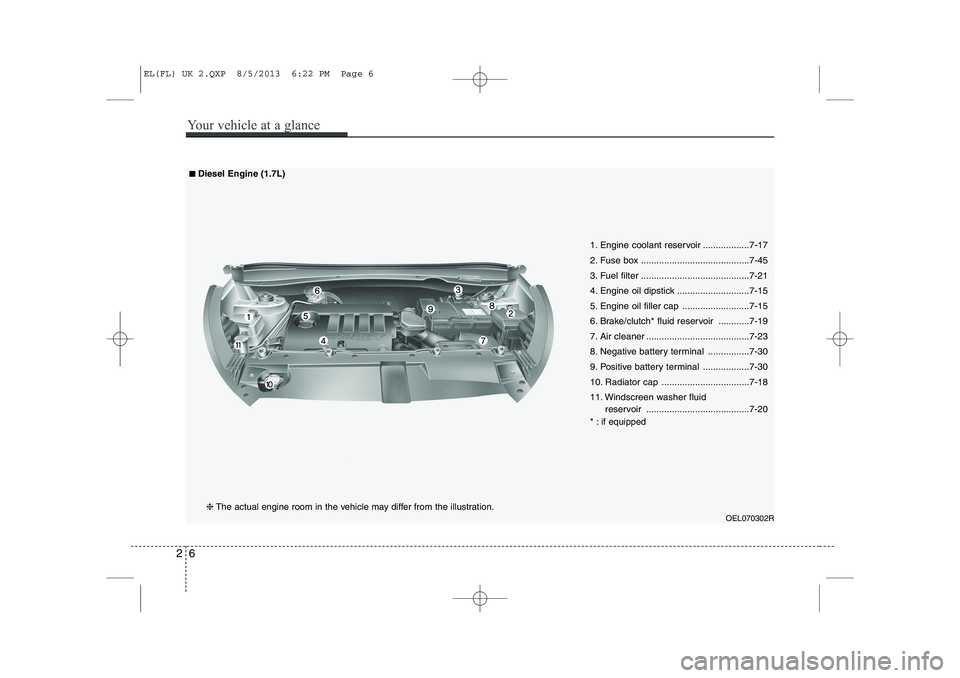
1. Engine coolant reservoir ..................7-17
2. Fuse box ..........................................7-45
3. Fuel filter ..........................................7-21
4. Engine oil dipstick ............................7-15
5. Engine oil filler cap ..........................7-15
6. Brake/clutch* fluid reservoir ............7-19
7. Air cleaner ........................................7-23
8. Negative battery terminal ................7-30
9. Positive battery terminal ..................7-30
10. Radiator cap ..................................7-18
11. Windscreen washer fluidreservoir ........................................7-20
* : if equipped
■■Diesel Engine (1.7L)
❈ The actual engine room in the vehicle may differ from the illustration.
EL(FL) UK 2.QXP 8/5/2013 6:22 PM Page 6