service HYUNDAI IX35 2014 Owner's Guide
[x] Cancel search | Manufacturer: HYUNDAI, Model Year: 2014, Model line: IX35, Model: HYUNDAI IX35 2014Pages: 1534, PDF Size: 39.76 MB
Page 331 of 1534
737
Maintenance
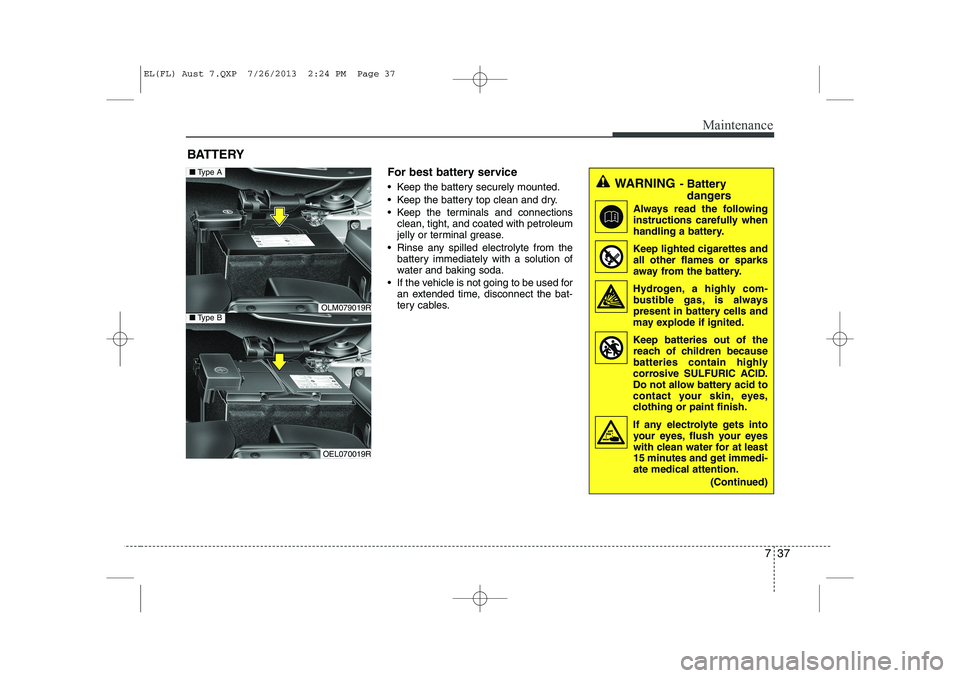
BATTERYFor best battery service
Keep the battery securely mounted.
Keep the battery top clean and dry.
Keep the terminals and connectionsclean, tight, and coated with petroleum
jelly or terminal grease.
Rinse any spilled electrolyte from the battery immediately with a solution of
water and baking soda.
If the vehicle is not going to be used for an extended time, disconnect the bat-
tery cables.
WARNING - Battery
dangers
Always read the following
instructions carefully when
handling a battery.
Keep lighted cigarettes and all other flames or sparks
away from the battery.
Hydrogen, a highly com- bustible gas, is always
present in battery cells and
may explode if ignited.
Keep batteries out of the reach of children because
batteries contain highly
corrosive SULFURIC ACID.
Do not allow battery acid to
contact your skin, eyes,
clothing or paint finish.
If any electrolyte gets into your eyes, flush your eyes
with clean water for at least
15 minutes and get immedi-ate medical attention.
(Continued)
OLM079019R
OEL070019R
■Type A
■Type B
EL(FL) Aust 7.QXP 7/26/2013 2:24 PM Page 37
Page 342 of 1534
Maintenance
48
7
4. Tyre ply composition and material
The number of layers or plies of rub-
ber-coated fabric are in the tyre. Tyre
manufacturers also must indicate the
materials in the tyre, which include
steel, nylon, polyester, and others.
The letter "R" means radial ply con-
struction; the letter "D" means diago-
nal or bias ply construction; and theletter "B" means belted-bias ply con-
struction.
5. Maximum permissible inflation
pressure
This number is the greatest amount of air pressure that should be put in
the tyre. Do not exceed the maximum
permissible inflation pressure. Refer
to the Tyre and Loading Information
label for recommended inflation
pressure.
6. Maximum load rating
This number indicates the maximum
load in kilograms and pounds that
can be carried by the tyre. When
replacing the tyres on the vehicle,
always use a tyre that has the same
load rating as the factory installed
tyre.
7. Uniform tyre quality grading
Quality grades can be found where
applicable on the tyre sidewall
between tread shoulder and maxi-
mum section width.
For example:
TREADWEAR 200
TRACTION AA
TEMPERATURE A Tread wear
The tread wear grade is a compara-
tive rating based on the wear rate ofthe tyre when tested under controlled
conditions on a specified govern-
ment test course. For example, a tyre
graded 150 would wear one-and-a-
half times (1½) as well on the gov-
ernment course as a tyre graded100.
The relative performance of tyres depends upon the actual conditions
of their use, however, and may
depart significantly from the norm
because of variations in driving
habits, service practices and differ-
ences in road characteristics and cli-
mate.
These grades are molded on the
side-walls of passenger vehicle
tyres. The tyres available as standard
or optional equipment on your vehi-
cles may vary with respect to grade.
WARNING - Tyre age
Tyres degrade over time, even
when they are not being used.
Regardless of the remaining
tread, it is recommended that
tyres generally be replaced
after six (6) years of normal
service. Heat caused by hot cli-mates or frequent high loadingconditions can accelerate the
aging process. Failure to follow
this Warning can result in sud-
den tyre failure, which could
lead to a loss of control and an
accident involving serious
injury or death.
EL(FL) Aust 7.QXP 7/26/2013 2:24 PM Page 48
Page 367 of 1534
773
Maintenance
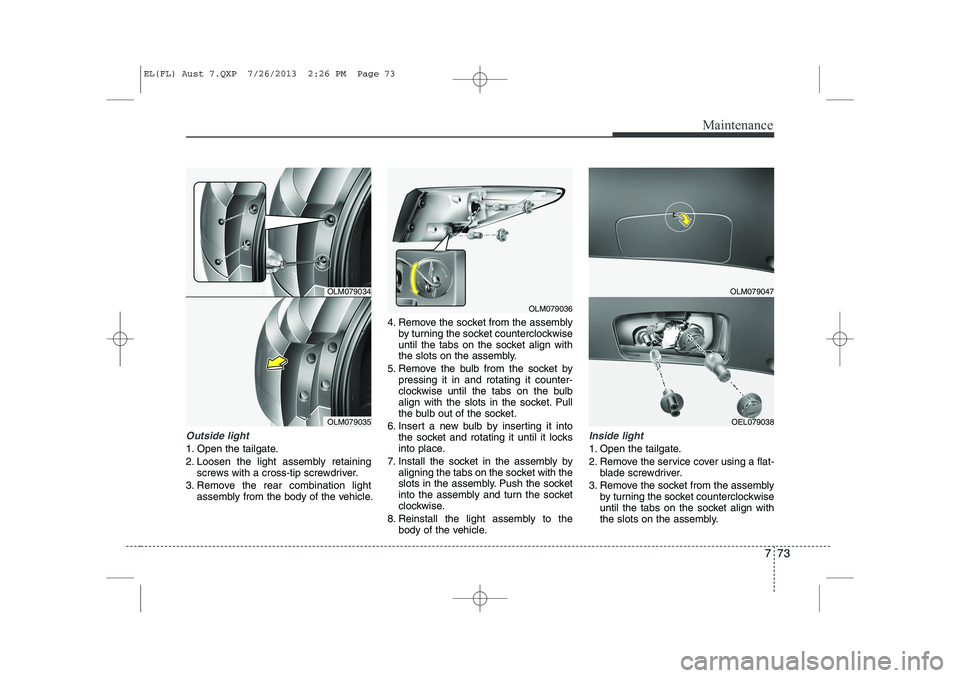
Outside light
1. Open the tailgate.
2. Loosen the light assembly retainingscrews with a cross-tip screwdriver.
3. Remove the rear combination light assembly from the body of the vehicle. 4. Remove the socket from the assembly
by turning the socket counterclockwise
until the tabs on the socket align with
the slots on the assembly.
5. Remove the bulb from the socket by pressing it in and rotating it counter-
clockwise until the tabs on the bulb
align with the slots in the socket. Pull
the bulb out of the socket.
6. Insert a new bulb by inserting it into the socket and rotating it until it locks
into place.
7. Install the socket in the assembly by aligning the tabs on the socket with the
slots in the assembly. Push the socket
into the assembly and turn the socket
clockwise.
8. Reinstall the light assembly to the body of the vehicle.
Inside light
1. Open the tailgate.
2. Remove the service cover using a flat- blade screwdriver.
3. Remove the socket from the assembly by turning the socket counterclockwise
until the tabs on the socket align with
the slots on the assembly.
OLM079034
OLM079035
OLM079036
OLM079047
OEL079038
EL(FL) Aust 7.QXP 7/26/2013 2:26 PM Page 73
Page 368 of 1534
Maintenance
74
7
4. Remove the bulb from the socket by
pressing it in and rotating it counter-
clockwise until the tabs on the bulb
align with the slots in the socket. Pull
the bulb out of the socket.
5. Insert a new bulb by inserting it into the socket and rotating it until it locks
into place.
6. Install the socket in the assembly by aligning the tabs on the socket with the
slots in the assembly. Push the socket
into the assembly and turn the socket
clockwise.
7. Install the service cover by putting it into the service hole.
Stop and tail light (LED type)
If the light does not operate, we recom-
mend that the system be checked by an
authorised HYUNDAI dealer. Rear fog light (if equipped)
1. Remove the socket from the assembly
by turning the socket counterclockwise
until the tabs on the socket align with
the slots on the assembly.
2. Remove the bulb from the socket by pressing it in and rotating it counter-
clockwise until the tabs on the bulb
align with the slots in the socket. Pull
the bulb out of the socket.
3. Insert a new bulb in the socket.
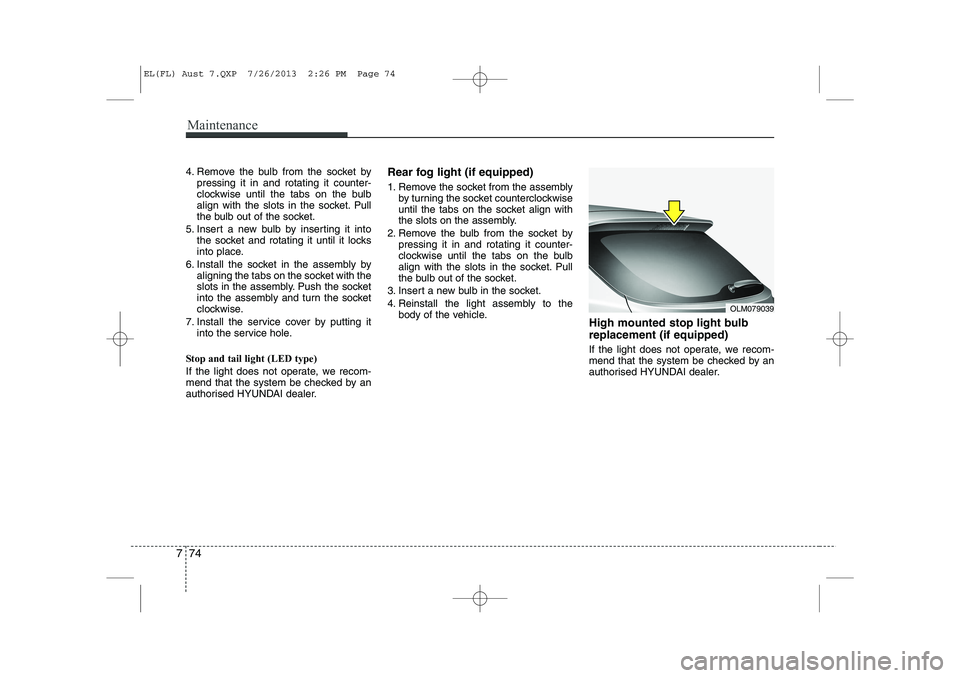
4. Reinstall the light assembly to the body of the vehicle. High mounted stop light bulb replacement (if equipped)
If the light does not operate, we recom-
mend that the system be checked by an
authorised HYUNDAI dealer.
OLM079039
EL(FL) Aust 7.QXP 7/26/2013 2:26 PM Page 74
Page 377 of 1534
783
Maintenance
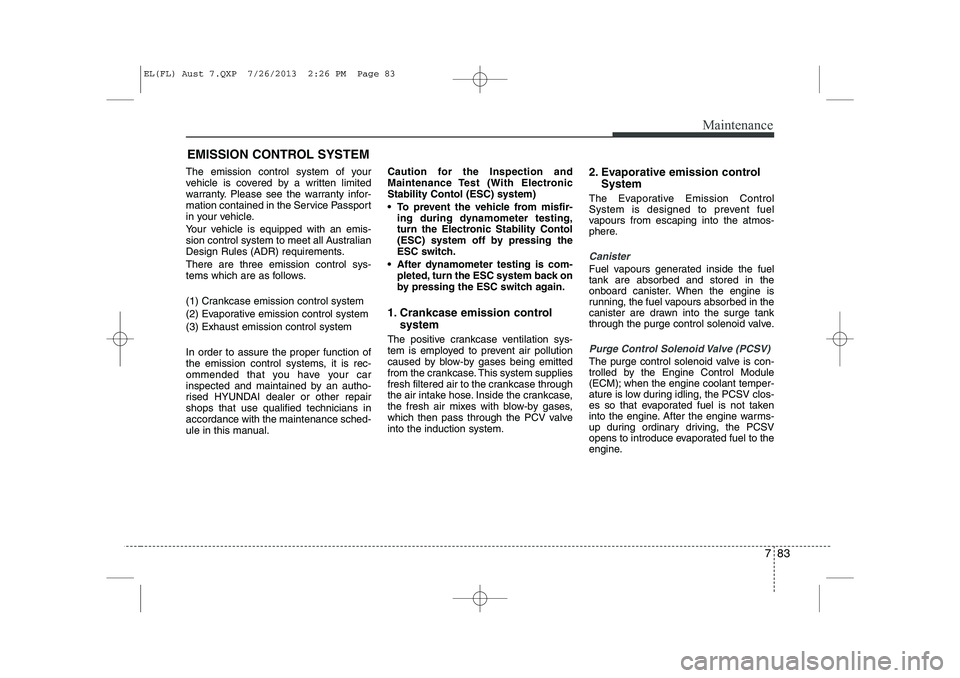
EMISSION CONTROL SYSTEM
The emission control system of your
vehicle is covered by a written limited
warranty. Please see the warranty infor-
mation contained in the Service Passport
in your vehicle.
Your vehicle is equipped with an emis-
sion control system to meet all Australian
Design Rules (ADR) requirements. There are three emission control sys-
tems which are as follows.
(1) Crankcase emission control system
(2) Evaporative emission control system(3) Exhaust emission control system In order to assure the proper function of
the emission control systems, it is rec-
ommended that you have your car
inspected and maintained by an autho-
rised HYUNDAI dealer or other repairshops that use qualified technicians inaccordance with the maintenance sched-
ule in this manual. Caution for the Inspection and
Maintenance Test (With ElectronicStability Contol (ESC) system)
To prevent the vehicle from misfir-
ing during dynamometer testing,
turn the Electronic Stability Contol
(ESC) system off by pressing the
ESC switch.
After dynamometer testing is com- pleted, turn the ESC system back on
by pressing the ESC switch again.
1. Crankcase emission control system
The positive crankcase ventilation sys-
tem is employed to prevent air pollution
caused by blow-by gases being emitted
from the crankcase. This system supplies
fresh filtered air to the crankcase through
the air intake hose. Inside the crankcase,
the fresh air mixes with blow-by gases,
which then pass through the PCV valveinto the induction system. 2. Evaporative emission control
System
The Evaporative Emission Control
System is designed to prevent fuel
vapours from escaping into the atmos-
phere.
Canister
Fuel vapours generated inside the fuel tank are absorbed and stored in the
onboard canister. When the engine is
running, the fuel vapours absorbed in the
canister are drawn into the surge tank
through the purge control solenoid valve.
Purge Control Solenoid Valve (PCSV)
The purge control solenoid valve is con-
trolled by the Engine Control Module
(ECM); when the engine coolant temper-
ature is low during idling, the PCSV clos-
es so that evaporated fuel is not taken
into the engine. After the engine warms-
up during ordinary driving, the PCSV
opens to introduce evaporated fuel to the
engine.
EL(FL) Aust 7.QXP 7/26/2013 2:26 PM Page 83
Page 394 of 1534
F4FOREWORD
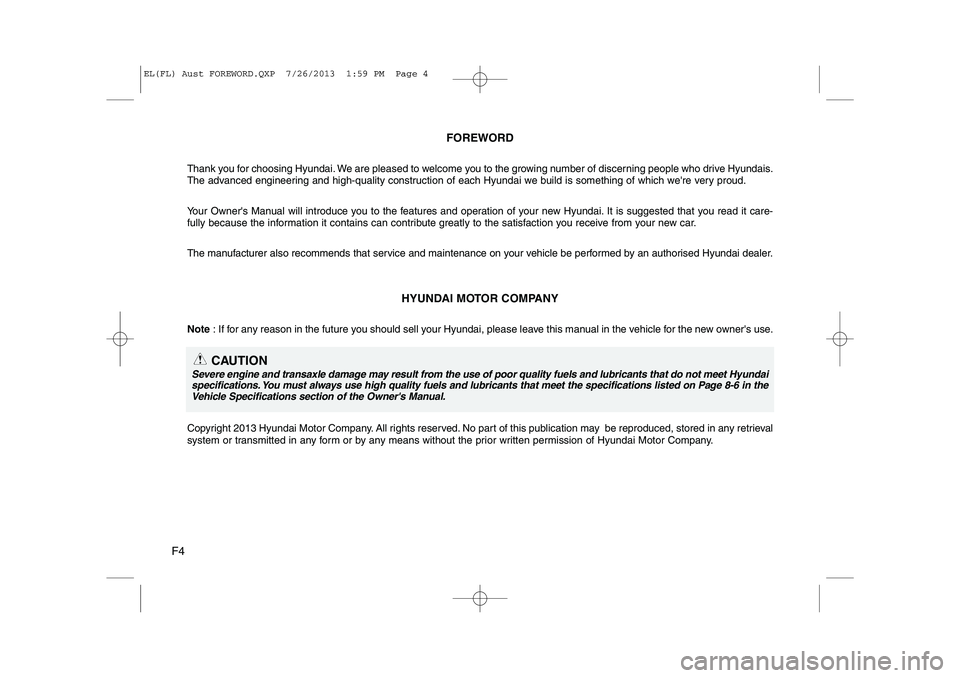
Thank you for choosing Hyundai. We are pleased to welcome you to the growing number of discerning people who drive Hyundais.
The advanced engineering and high-quality construction of each Hyundai we build is something of which we're very proud.
Your Owner's Manual will introduce you to the features and operation of your new Hyundai. It is suggested that you read it care-
fully because the information it contains can contribute greatly to the satisfaction you receive from your new car.
The manufacturer also recommends that service and maintenance on your vehicle be performed by an authorised Hyundai dealer.
HYUNDAI MOTOR COMPANY
Note : If for any reason in the future you should sell your Hyundai, please leave this manual in the vehicle for the new owner's use.
Copyright 2013 Hyundai Motor Company. All rights reserved. No part of this publication may be reproduced, stored in any retrieva l
system or transmitted in any form or by any means without the prior written permission of Hyundai Motor Company.
CAUTION
Severe engine and transaxle damage may result from the use of poor quality fuels and lubricants that do not meet Hyundai specifications. You must always use high quality fuels and lubricants that meet the specifications listed on Page 8-6 in theVehicle Specifications section of the Owner's Manual.
EL(FL) Aust FOREWORD.QXP 7/26/2013 1:59 PM Page 4
Page 404 of 1534
I7
Index
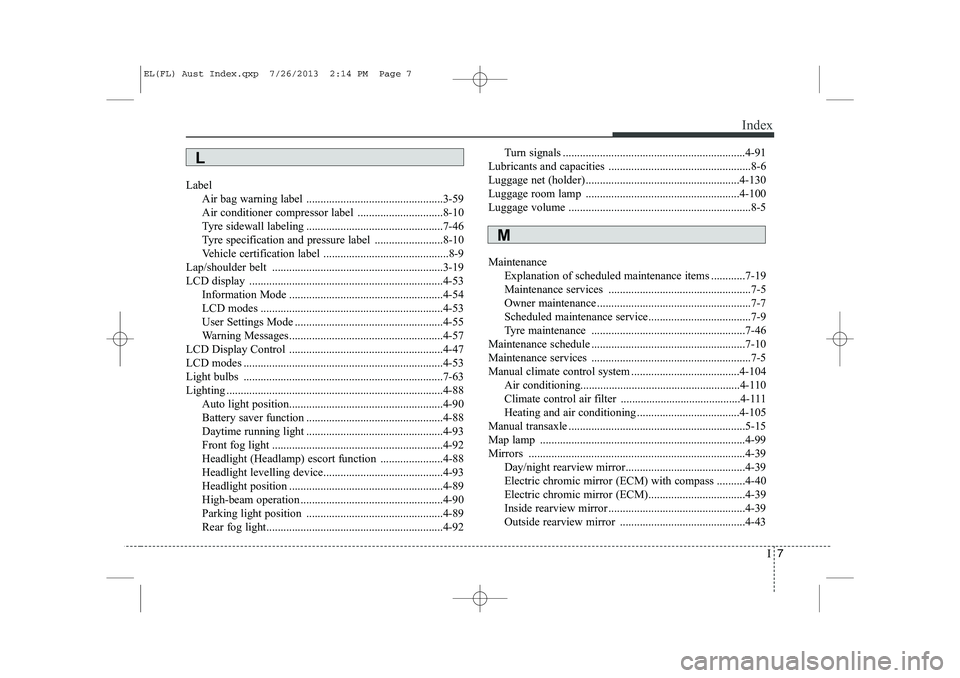
Label
Air bag warning label ................................................3-59
Air conditioner compressor label ..............................8-10
Tyre sidewall labeling ................................................7-46
Tyre specification and pressure label ........................8-10
Vehicle certification label ............................................8-9
Lap/shoulder belt ............................................................3-19
LCD display ....................................................................4-53 Information Mode ......................................................4-54
LCD modes ................................................................4-53
User Settings Mode ....................................................4-55
Warning Messages......................................................4-57
LCD Display Control ......................................................4-47
LCD modes ......................................................................4-53
Light bulbs ......................................................................7-63
Lighting ............................................................................4-88 Auto light position......................................................4-90
Battery saver function ................................................4-88
Daytime running light ................................................4-93
Front fog light ............................................................4-92
Headlight (Headlamp) escort function ......................4-88
Headlight levelling device..........................................4-93
Headlight position ......................................................4-89
High-beam operation ..................................................4-90
Parking light position ................................................4-89
Rear fog light..............................................................4-92 Turn signals ................................................................4-91
Lubricants and capacities ..................................................8-6
Luggage net (holder) ......................................................4-130
Luggage room lamp ......................................................4-100
Luggage volume ................................................................8-5 Maintenance Explanation of scheduled maintenance items ............7-19
Maintenance services ..................................................7-5
Owner maintenance ......................................................7-7
Scheduled maintenance service....................................7-9
Tyre maintenance ......................................................7-46
Maintenance schedule ......................................................7-10
Maintenance services ........................................................7-5
Manual climate control system ......................................4-104 Air conditioning........................................................4-110
Climate control air filter ..........................................4-111
Heating and air conditioning ....................................4-105
Manual transaxle ..............................................................5-15
Map lamp ........................................................................4-99
Mirrors ............................................................................4-39 Day/night rearview mirror..........................................4-39
Electric chromic mirror (ECM) with compass ..........4-40
Electric chromic mirror (ECM)..................................4-39
Inside rearview mirror ................................................4-39
Outside rearview mirror ............................................4-43
M
L
EL(FL) Aust Index.qxp 7/26/2013 2:14 PM Page 7
Page 406 of 1534
I9
Index
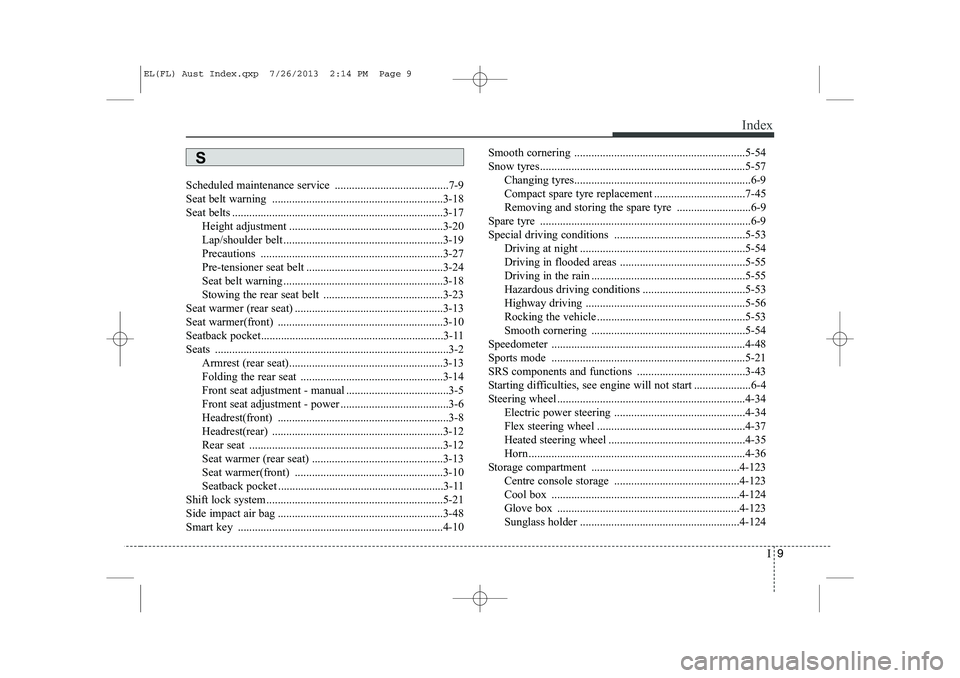
Scheduled maintenance service ........................................7-9
Seat belt warning ............................................................3-18
Seat belts ..........................................................................3-17
Height adjustment ......................................................3-20
Lap/shoulder belt ........................................................3-19
Precautions ................................................................3-27
Pre-tensioner seat belt ................................................3-24
Seat belt warning ........................................................3-18
Stowing the rear seat belt ..........................................3-23
Seat warmer (rear seat) ....................................................3-13
Seat warmer(front) ..........................................................3-10
Seatback pocket................................................................3-11
Seats ..................................................................................3-2 Armrest (rear seat)......................................................3-13
Folding the rear seat ..................................................3-14
Front seat adjustment - manual ....................................3-5
Front seat adjustment - power ......................................3-6
Headrest(front) ............................................................3-8
Headrest(rear) ............................................................3-12
Rear seat ....................................................................3-12
Seat warmer (rear seat) ..............................................3-13
Seat warmer(front) ....................................................3-10
Seatback pocket ..........................................................3-11
Shift lock system ..............................................................5-21
Side impact air bag ..........................................................3-48
Smart key ........................................................................4-10 Smooth cornering ............................................................5-54
Snow tyres........................................................................5-57
Changing tyres..............................................................6-9
Compact spare tyre replacement ................................7-45
Removing and storing the spare tyre ..........................6-9
Spare tyre ..........................................................................6-9
Special driving conditions ..............................................5-53 Driving at night ..........................................................5-54
Driving in flooded areas ............................................5-55
Driving in the rain ......................................................5-55
Hazardous driving conditions ....................................5-53
Highway driving ........................................................5-56
Rocking the vehicle ....................................................5-53
Smooth cornering ......................................................5-54
Speedometer ....................................................................4-48
Sports mode ....................................................................5-21
SRS components and functions ......................................3-43
Starting difficulties, see engine will not start ....................6-4
Steering wheel ..................................................................4-34 Electric power steering ..............................................4-34
Flex steering wheel ....................................................4-37
Heated steering wheel ................................................4-35
Horn ............................................................................4-36
Storage compartment ....................................................4-123 Centre console storage ............................................4-123
Cool box ..................................................................4-124
Glove box ................................................................4-123
Sunglass holder ........................................................4-124
S
EL(FL) Aust Index.qxp 7/26/2013 2:14 PM Page 9
Page 451 of 1534
Safety features of your vehicle
26
3
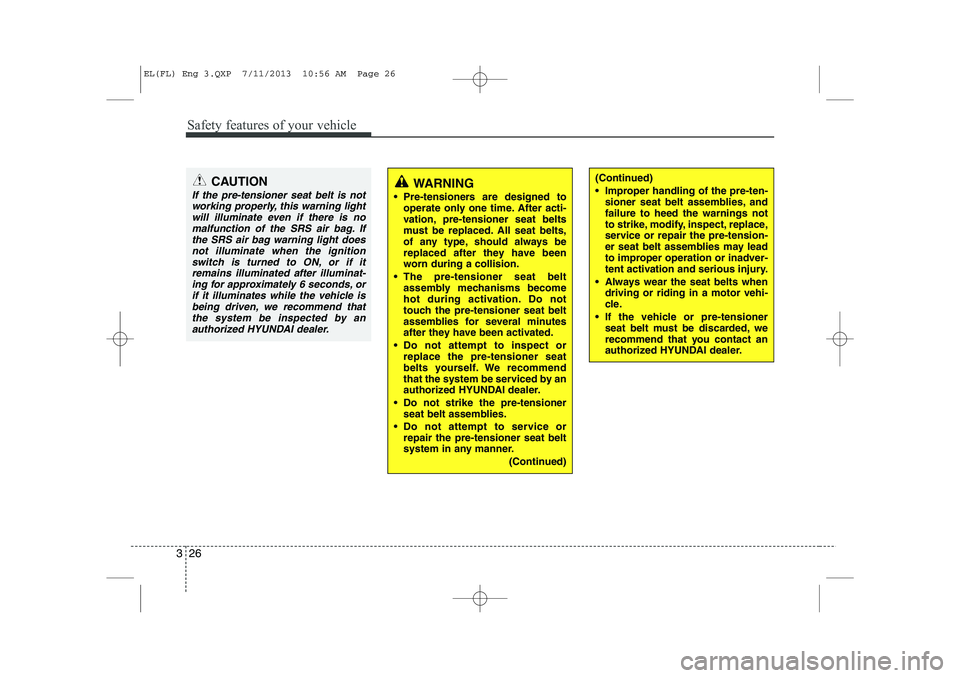
WARNING
Pre-tensioners are designed to operate only one time. After acti-
vation, pre-tensioner seat belts
must be replaced. All seat belts,
of any type, should always be
replaced after they have been
worn during a collision.
The pre-tensioner seat belt assembly mechanisms become
hot during activation. Do not
touch the pre-tensioner seat belt
assemblies for several minutes
after they have been activated.
Do not attempt to inspect or replace the pre-tensioner seat
belts yourself. We recommend
that the system be serviced by an
authorized HYUNDAI dealer.
Do not strike the pre-tensioner seat belt assemblies.
Do not attempt to service or repair the pre-tensioner seat belt
system in any manner.
(Continued)CAUTION
If the pre-tensioner seat belt is notworking properly, this warning light
will illuminate even if there is nomalfunction of the SRS air bag. Ifthe SRS air bag warning light does not illuminate when the ignition
switch is turned to ON, or if itremains illuminated after illuminat-ing for approximately 6 seconds, or
if it illuminates while the vehicle isbeing driven, we recommend thatthe system be inspected by anauthorized HYUNDAI dealer.
(Continued)
Improper handling of the pre-ten- sioner seat belt assemblies, and failure to heed the warnings not
to strike, modify, inspect, replace,
service or repair the pre-tension-
er seat belt assemblies may lead
to improper operation or inadver-
tent activation and serious injury.
Always wear the seat belts when driving or riding in a motor vehi-
cle.
If the vehicle or pre-tensioner seat belt must be discarded, we
recommend that you contact an
authorized HYUNDAI dealer.
EL(FL) Eng 3.QXP 7/11/2013 10:56 AM Page 26
Page 480 of 1534
355
Safety features of your vehicle
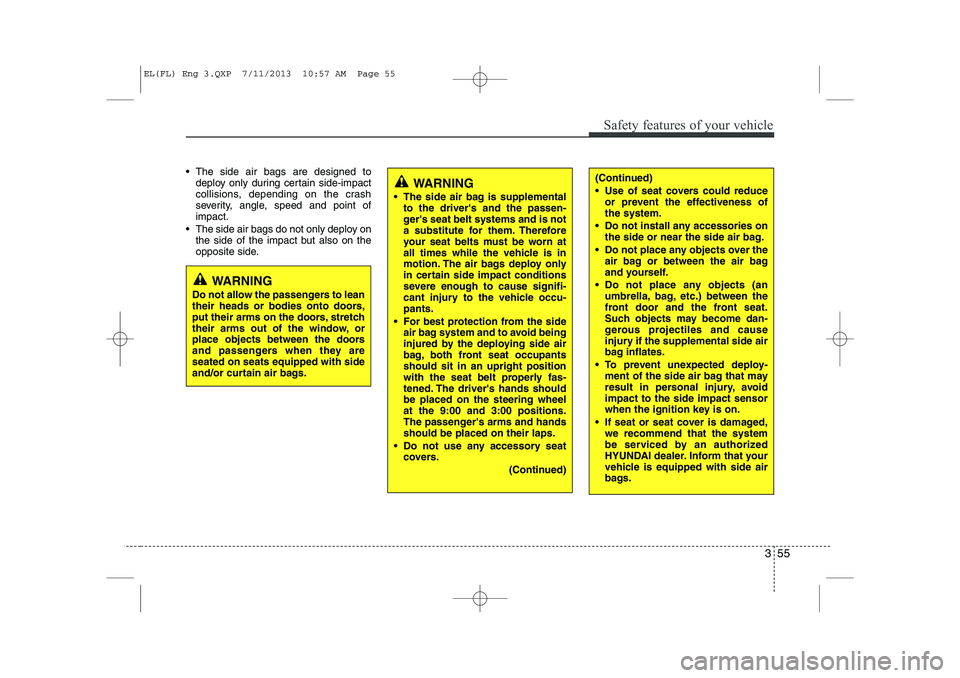
The side air bags are designed todeploy only during certain side-impact
collisions, depending on the crash
severity, angle, speed and point ofimpact.
The side air bags do not only deploy on the side of the impact but also on the
opposite side.(Continued)
Use of seat covers could reduceor prevent the effectiveness of the system.
Do not install any accessories on the side or near the side air bag.
Do not place any objects over the air bag or between the air bag
and yourself.
Do not place any objects (an umbrella, bag, etc.) between the
front door and the front seat.
Such objects may become dan-
gerous projectiles and cause
injury if the supplemental side air
bag inflates.
To prevent unexpected deploy- ment of the side air bag that may
result in personal injury, avoidimpact to the side impact sensor
when the ignition key is on.
If seat or seat cover is damaged, we recommend that the system
be serviced by an authorized
HYUNDAI dealer. Inform that your
vehicle is equipped with side air
bags.WARNING
The side air bag is supplemental to the driver's and the passen-
ger's seat belt systems and is not
a substitute for them. Therefore
your seat belts must be worn at
all times while the vehicle is in
motion. The air bags deploy only
in certain side impact conditions
severe enough to cause signifi-
cant injury to the vehicle occu-pants.
For best protection from the side air bag system and to avoid being
injured by the deploying side air
bag, both front seat occupantsshould sit in an upright position
with the seat belt properly fas-
tened. The driver's hands shouldbe placed on the steering wheelat the 9:00 and 3:00 positions.
The passenger's arms and handsshould be placed on their laps.
Do not use any accessory seat covers.
(Continued)
WARNING
Do not allow the passengers to lean
their heads or bodies onto doors,
put their arms on the doors, stretch
their arms out of the window, or
place objects between the doors
and passengers when they areseated on seats equipped with side
and/or curtain air bags.
EL(FL) Eng 3.QXP 7/11/2013 10:57 AM Page 55