warning Hyundai Kona 2018 Owner's Guide
[x] Cancel search | Manufacturer: HYUNDAI, Model Year: 2018, Model line: Kona, Model: Hyundai Kona 2018Pages: 523, PDF Size: 33.6 MB
Page 49 of 523
2-30
Safety system of your vehicle
Information
Both the driver's and front passen- ger's pre-tensioner seat belts may be
activated in certain frontal or side
collisions.
When the pre-tensioner seat belts are activated, a loud noise may be
heard and fine dust, which may
appear to be smoke, may be visible
in the passenger compartment.
These are normal operating condi-
tions and are not hazardous.
Although it is non-toxic, the fine dust may cause skin irritation and should
not be inhaled for prolonged periods.
Wash all exposed skin areas thor-
oughly after an accident in which the
pre-tensioner seat belts were activat-
ed.Additional seat belt safety pre- cautions
Seat belt use during pregnancy
The seat belt should always be used
during pregnancy. The best way to
protect your unborn child is to protect
yourself by always wearing the seatbelt.
Pregnant women should always wear
a lap-shoulder seat belt. Place the
shoulder belt across your chest, rout-
ed between your breasts and away
from your neck. Place the lap belt
below your belly so that it fits SNUGLY
across your hips and pelvic bone,
under the rounded part of the belly.
Seat belt use and children
Infant and small children
Most countries have Child Restraint
System laws which require children to
travel in approved Child Restraint
System devices, including booster
seats. The age at which seat belts can
be used instead of Child Restraint
System differs among countries, so
you should be aware of the specific
requirements in your country, and
where you are travelling. Infant and
Child Restraint System must be prop-
erly placed and installed in a rear seat.
For more information refer to the “Child
Restraint Systems” in this chapter.
i
To reduce the risk of serious
injury or death to an unborn
child during an accident, preg-
nant women should NEVER
place the lap portion of the seat
belt above or over the area ofthe abdomen where the unborn
child is located.
WARNING
Page 50 of 523
2-31
Safety system of your vehicle
2
Small children are best protected
from injury in an accident when prop-
erly restrained in the rear seat by a
Child Restraint System that meets
the requirements of the Safety
Standards of your country. Before
buying any Child Restraint System,
make sure that it has a label certify-
ing that it meets Safety Standard of
your country.The Child Restraint System must be
appropriate for your child's height
and weight. Check the label on the
Child Restraint System for this infor-
mation. Refer to “Child Restraint
Systems” in this chapter.
Larger children
Children under age 13 and who are
too large for a booster seat should
always occupy the rear seat and use
the available lap/shoulder belts. Aseat belt should lie across the upper
thighs and be snug across the shoul-
der and chest to restrain the child
safely. Check belt fit periodically. A
child's squirming could put the belt
out of position. In the event of an acci-
dent, children are afforded the best
safety restrained by a proper Child
Restraint System in the rear seats.
If a larger child over age 13 must be seated in the front seat, the child
must be securely restrained by the
available lap/shoulder belt and theseat should be placed in the rear-most position.
If the shoulder belt portion slightly
touches the child’s neck or face, tryplacing the child closer to the center
of the vehicle. If the shoulder belt still
touches their face or neck, they need
to be returned to an appropriatebooster seat in the rear seat.
Seat belt use and injured people
A seat belt should be used when an
injured person is being transported.
Consult a physician for specific rec-
ommendations.
ALWAYS properly restrain
infants and small children in a
Child Restraint System appropri-
ate for the child’s height andweight.
To reduce the risk of serious
injury or death to a child and
other passengers, NEVER hold a
child in your lap or arms when
the vehicle is moving. The violent
forces created during an acci-
dent will tear the child from your
arms and throw the child against
the interior of the vehicle.
WARNING
Always make sure larger chil-
dren’s seat belts are worn and
properly adjusted.
NEVER allow the shoulder
belt to contact the child’s
neck or face.
Do not allow more than one
child to use a single seat belt.
WARNING
Page 51 of 523
2-32
Safety system of your vehicle
One person per belt
Two people (including children) should
never attempt to use a single seat belt.
This could increase the severity of
injuries in case of an accident.
Do not lie down
Sitting in a reclined position when
the vehicle is in motion can be dan-
gerous. Even when buckled up, the
protections of your restraint system
(seat belts and/or air bags) is greatly
reduced by reclining your seatback.
Seat belts must be snug against your
hips and chest to work properly.
During an accident, you could be
thrown into the seat belt, causing
neck or other injuries.
The more the seat back is reclined,
the greater the chance for the pas-senger's hips to slide under the lap
belt or the passenger's neck to strikethe shoulder belt.
Care of seat belts
Seat belt systems should never be
disassembled or modified. In addi-
tion, care should be taken to assure
that seat belts and belt hardware are
not damaged by seat hinges, doors
or other abuse.
Periodic inspection
All seat belts should be inspected
periodically for wear or damage of
any kind. Any damaged parts should
be replaced as soon as possible.
Keep belts clean and dry
Seat belts should be kept clean and
dry. If belts become dirty, they can be
cleaned by using a mild soap solution
and warm water. Bleach, dye, strong
detergents or abrasives should not be
used because they may damage and
weaken the fabric.
When to replace seat belts
The entire seat belt assembly or
assemblies should be replaced if the
vehicle has been involved in an acci-
dent. This should be done even if no
damage is visible. We recommend that
you consult an authorized HYUNDAI
dealer.
NEVER ride with a reclined
seatback when the vehicle is
moving.
Riding with a reclined seatback
increases your chance of seri-
ous or fatal injuries in the event
of a collision or sudden stop.
Driver and passengers should
always sit well back in their
seats, properly belted, and with
the seatbacks upright.
WARNING
Page 52 of 523
2-33
Safety system of your vehicle
2
CCHH IILL DD RR EESSTT RR AA IINN TT SS YY SSTT EEMM (( CC RR SS))
Our recommendation:
Children always in the rear
Children under age 13 should always
ride in the rear seats and must
always be properly restrained to min-
imize the risk of injury in an accident,
sudden stop or sudden maneuver.
According to accident statistics, chil-
dren are safer when properly
restrained in the rear seats than in
the front seat. Children too large for a
Child Restraint System must use the
seat belts provided. Most countries have regulations
which require children to travel in
approved Child Restraint Systems.
The laws governing the age or
height/weight restrictions at whichseat belts can be used instead of
Child Restraint System differs
among countries, so you should be
aware of the specific requirements in
your country, and where you are trav-elling.
Child Restraint Systems must be
properly installed in the vehicle seat.
Always use a commercially available
Child Restraint System that meets
the requirements of your country.
Child Restraint System (CRS)
Infants and younger children must be
restrained in an appropriate rearward-
facing or forward-facing CRS that has
first been properly secured to the seat
of the vehicle. Read and comply with
the instructions for installation and
use provided by the manufacturer of
the Child Restraint System.
Always properly restrain children
in the vehicle. Children of all ages
are safer when riding in the rear
seats. Never place a rearward-facing Child Restraint System on
the front passenger seat, unless
the air bag is deactivated.
WARNING
Always follow the Child Restraint
System manufacturer’s instruc-
tions for installation and use.
Always properly restrain your
child in the Child RestraintSystem.
Do not use an infant carrier or
a child safety seat that “hooks”
over a seatback, it may not pro-
vide adequate protection in an
accident.
After an accident, we recom-
mend a HYUNDAI dealer to
check the Child Restraint
System, seat belts, ISOFIX
anchorages and top-tether
anchorages.
WARNING
Page 55 of 523
2-36
Safety system of your vehicle
Installing a Child Restraint System (CRS)After selecting a proper Child Restraint
System for your child and checking
that the Child Restraint System fits
properly on the seating position, there
are three general steps for a properinstallation:
Properly secure the Child Restraint
System to the vehicle.
All Child
Restraint Systems must be secured
to the vehicle with the lap belt or lap
part of a lap/shoulder belt or withthe ISOFIX top-tether and/or ISOFIX
anchorage and/or with the supportleg.
Make sure the Child Restraint
System is firmly secured. After
installing a Child Restraint System
to the vehicle, push and pull the
seat forward and from side-to-side
to verify that it is securely attached
to the seat. A Child RestraintSystem secured with a seat belt
should be installed as firmly as
possible. However, some side-to-
side movement can be expected. When installing a Child Restraint
System, adjust the vehicle seat and
seatback (up and down, forward and
rearward) so that your child fits in
the Child Restraint System in a con-
fortable manner.
Secure the child in the ChildRestraint System. Make sure the
child is properly strapped in the
Child Restraint System according
to the Child Restraint System man-
ufacturer’s instructions.
Before installing your Child
Restraint System always:
Read and follow the instructions
provided by the manufacturer ofthe Child Restraint System.
Failure to follow all warnings and instructions could increase
the risk of the SERIOUS INJURY
or DEATH if an accident occurs.
WARNING
If the vehicle headrest prevents
proper installation of a Child
Restraint System, the headrestof the respective seating posi-tion shall be readjusted or
entirely removed.
WARNING
A Child Restraint System in a
closed vehicle can become very
hot. To prevent burns, check the
seating surface and buckles
before placing your child in theChild Restraint System.
CAUTION
Page 56 of 523
2-37
Safety system of your vehicle
2
ISOFIX anchorage and top-teth-er anchorage (ISOFIX anchorage
system) for children
The ISOFIX system holds a Child
Restraint System during driving and in
an accident. This system is designed to
make installation of the Child Restraint
System easier and reduce the possi-
bility of improperly installing your
Child Restraint System. The ISOFIX
system uses anchors in the vehicleand attachments on the Child
Restraint System. The ISOFIX sys-tem eliminates the need to use seat
belts to secure the Child Restraint
System to the rear seats.
ISOFIX anchorages are metal bars
built into the vehicle. There are two
lower anchors for each ISOFIX seat-ing position that will accommodate a
Child Restraint System with lower
attachments.
To use the ISOFIX system in your vehi-
cle, you must have a Child Restraint
System with ISOFIX attachments.
The Child Restraint System manu-
facturer will provide you with instruc-
tions on how to use the Child
Restraint System with its attach-
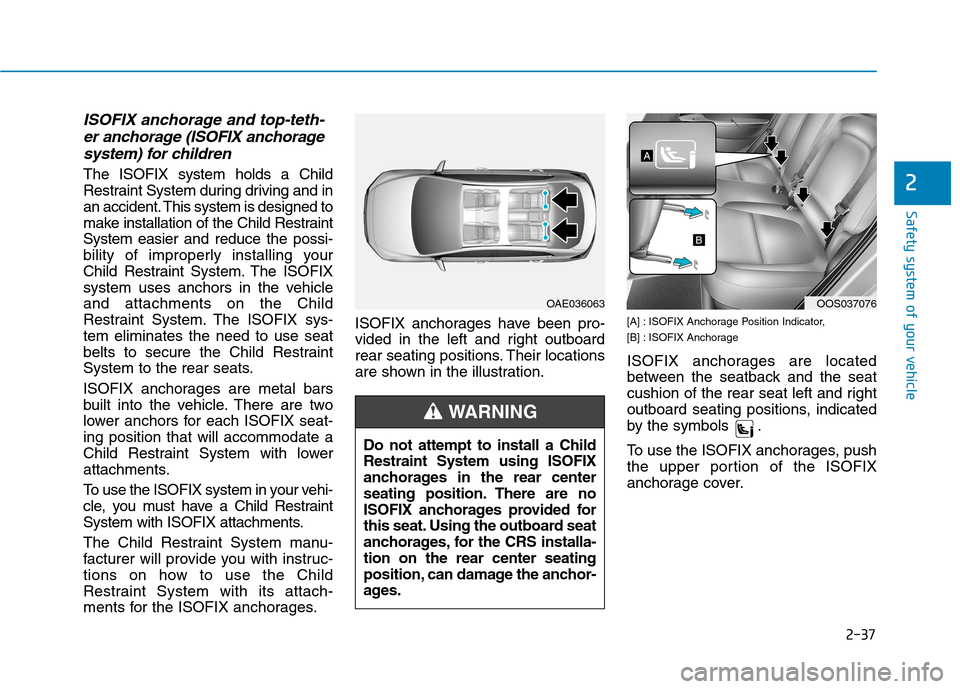
ments for the ISOFIX anchorages. ISOFIX anchorages have been pro-
vided in the left and right outboard
rear seating positions. Their locations
are shown in the illustration.
[A] : ISOFIX Anchorage Position Indicator,
[B] : ISOFIX Anchorage
ISOFIX anchorages are located
between the seatback and the seat
cushion of the rear seat left and right
outboard seating positions, indicated
by the symbols .
To use the ISOFIX anchorages, push
the upper portion
of the ISOFIX
anchorage cover.
OOS037076
Do not attempt to install a Child Restraint System using ISOFIX
anchorages in the rear center
seating position. There are no
ISOFIX anchorages provided for
this seat. Using the outboard seat
anchorages, for the CRS installa-tion on the rear center seating
position, can damage the anchor-
ages.
WARNING
OAE036063
Page 57 of 523
2-38
Safety system of your vehicle
Securing a Child RestraintSystem with the “ISOFIX
Anchorage System”
To install an i-Size or ISOFIX-compat-
ible Child Restraint System in either ofthe rear outboard seating positions:
1. Move the seat belt buckle away from the ISOFIX anchorages.
2. Move any other objects away from the anchorages that could prevent
a secure connection between the
Child Restraint System and the
ISOFIX anchorages.
3. Place the Child Restraint System on the vehicle seat, then attach the
seat to the ISOFIX anchorages
according to the instructions provid-
ed by the Child Restraint System
manufacturer.
4. Follow the instructions of the Child Restraint System's manufacturer
for proper installation and connec-tion of the ISOFIX attachments on
the Child Restraint System to the
ISOFIX anchorages.
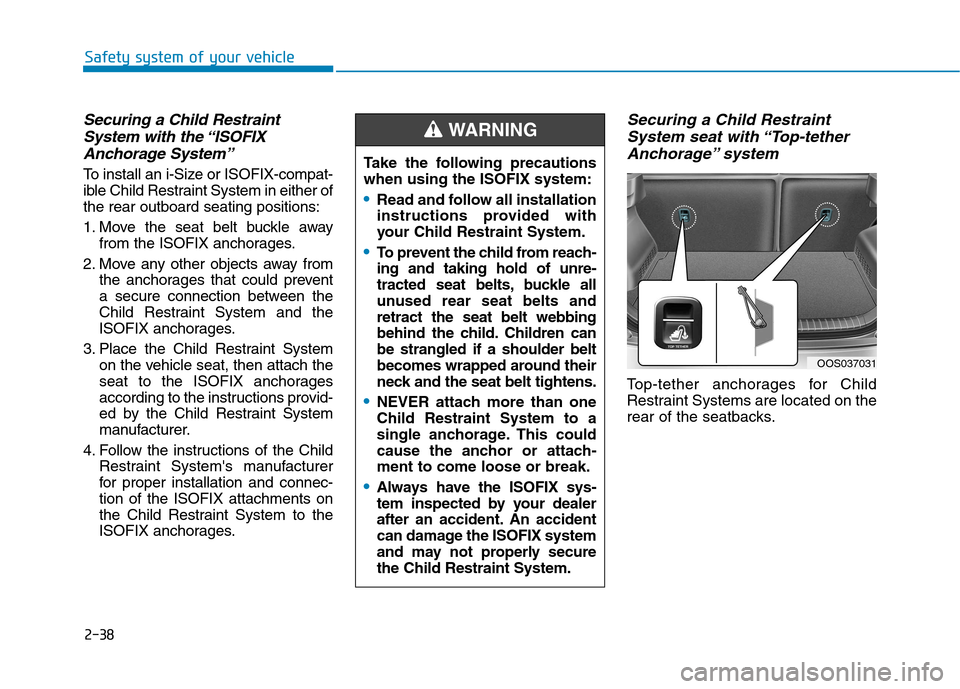
Securing a Child Restraint
System seat with “Top-tether
Anchorage” system
Top-tether anchorages for Child
Restraint Systems are located on the
rear of the seatbacks.
Take the following precautionswhen using the ISOFIX system:
Read and follow all installation
instructions provided with
your Child Restraint System.
To prevent the child from reach- ing and taking hold of unre-
tracted seat belts, buckle all
unused rear seat belts andretract the seat belt webbing
behind the child. Children canbe strangled if a shoulder belt
becomes wrapped around their
neck and the seat belt tightens.
NEVER attach more than one Child Restraint System to a
single anchorage. This could
cause the anchor or attach-ment to come loose or break.
Always have the ISOFIX sys-
tem inspected by your dealer
after an accident. An accident
can damage the ISOFIX system
and may not properly securethe Child Restraint System.
WARNING
OOS037031
Page 58 of 523
2-39
Safety system of your vehicle
2
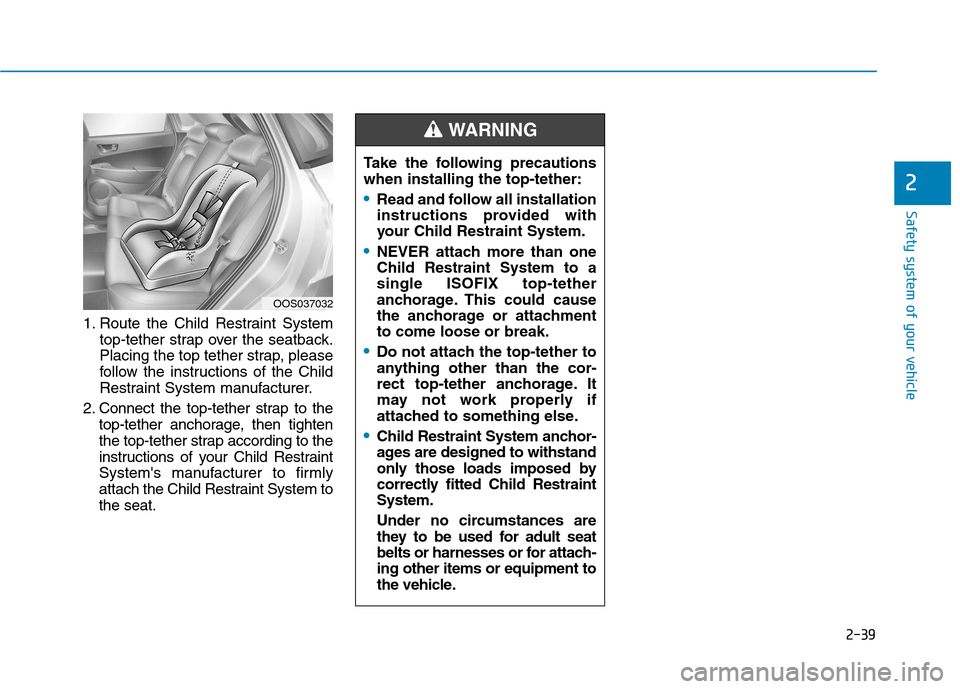
1. Route the Child Restraint Systemtop-tether strap over the seatback.
Placing the top tether strap, please
follow the instructions of the Child
Restraint System manufacturer.
2. Connect the top-tether strap to the top-tether anchorage, then tighten
the top-tether strap according to the
instructions of your Child Restraint
System's manufacturer to firmly
attach the Child Restraint System tothe seat.
OOS037032 Take the following precautions when installing the top-tether:
Read and follow all installation
instructions provided with
your Child Restraint System.
NEVER attach more than one Child Restraint System to asingle ISOFIX top-tether
anchorage. This could cause
the anchorage or attachmentto come loose or break.
Do not attach the top-tether to
anything other than the cor-
rect top-tether anchorage. It
may not work properly if
attached to something else.
Child Restraint System anchor-
ages are designed to withstand
only those loads imposed by
correctly fitted Child RestraintSystem.
Under no circumstances are
they to be used for adult seat
belts or harnesses or for attach-ing other items or equipment to
the vehicle.
WARNING
Page 62 of 523
2-43
Safety system of your vehicle
2
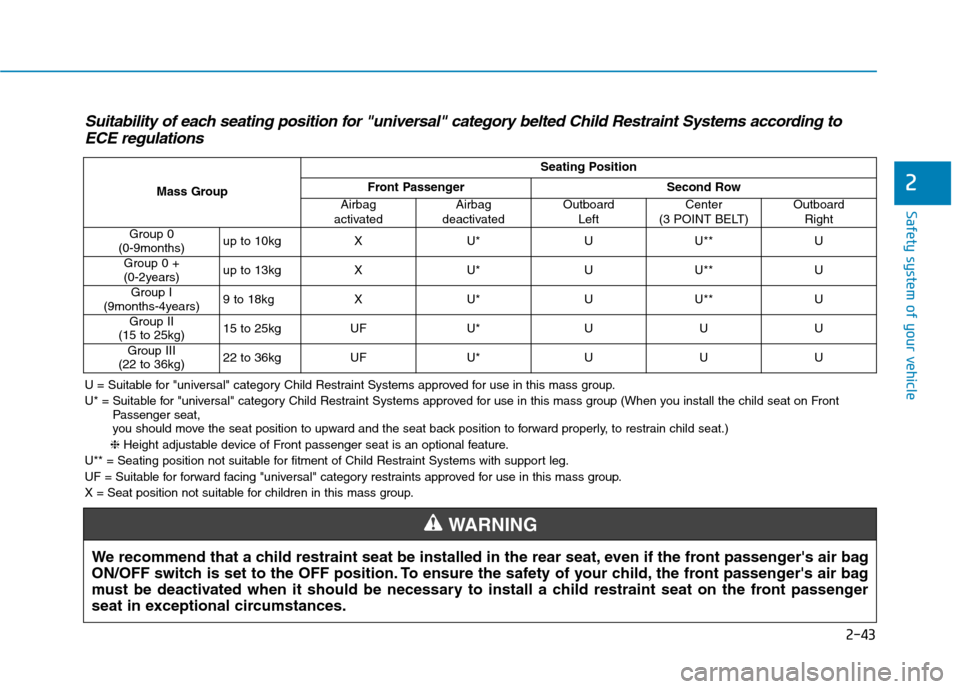
Suitability of each seating position for "universal" category belted Child Restraint Systems according toECE regulations
U = Suitable for "universal" category Child Restraint Systems approved for use in this mass group.
U* = Suitable for "universal" category Child Restraint Systems approved for use in this mass group (When you install the child seat on Front Passenger seat,
you should move the seat position to upward and the seat back position to forward properly, to restrain child seat.)
❈ Height adjustable device of Front passenger seat is an optional feature.
U** = Seating position not suitable for fitment of Child Restraint Systems with support leg.
UF = Suitable for forward facing "universal" category restraints approved for use in this mass group.
X = Seat position not suitable for children in this mass group.
We recommend that a child restraint seat be installed in the rear seat, even if the front passenger's air bag
ON/OFF switch is set to the OFF position. To ensure the safety of your child, the front passenger's air bag
must be deactivated when it should be necessary to install a child restraint seat on the front passenger
seat in exceptional circumstances.
WARNING
Mass Group
Seating Position
Front PassengerSecond Row
Airbag
activatedAirbag
deactivatedOutboard LeftCenter
(3 POINT BELT)Outboard Right
Group 0
(0-9months)up to 10kgXU*UU**U
Group 0 +
(0-2years)up to 13kgXU*UU**U
Group I
(9months-4years)9 to 18kgXU*UU**U
Group II
(15 to 25kg)15 to 25kgUFU*UUU
Group III
(22 to 36kg)22 to 36kgUFU*UUU
Page 66 of 523
2-47
Safety system of your vehicle
2
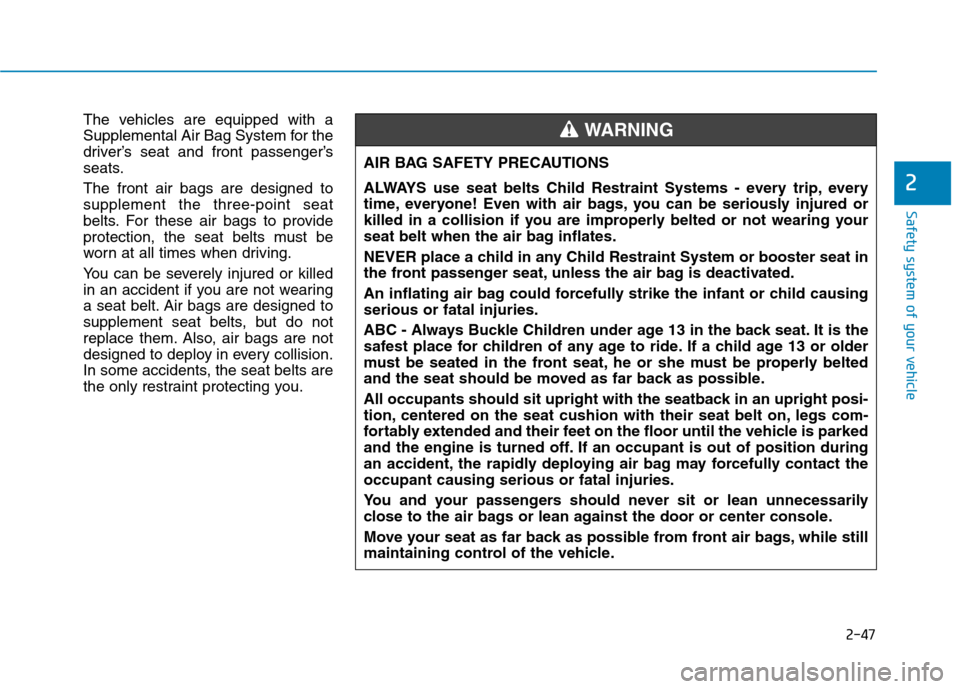
The vehicles are equipped with a
Supplemental Air Bag System for the
driver’s seat and front passenger’s
seats. The front air bags are designed to supplement the three-point seat
belts. For these air bags to provide
protection, the seat belts must be
worn at all times when driving.
You can be severely injured or killed
in an accident if you are not wearing
a seat belt. Air bags are designed to
supplement seat belts, but do not
replace them. Also, air bags are not
designed to deploy in every collision.
In some accidents, the seat belts are
the only restraint protecting you.AIR BAG SAFETY PRECAUTIONS
ALWAYS use seat belts Child Restraint Systems - every trip, every
time, everyone! Even with air bags, you can be seriously injured or
killed in a collision if you are improperly belted or not wearing your
seat belt when the air bag inflates.
NEVER place a child in any Child Restraint System or booster seat in
the front passenger seat, unless the air bag is deactivated.
An inflating air bag could forcefully strike the infant or child causing serious or fatal injuries.
ABC - Always Buckle Children under age 13 in the back seat. It is the
safest place for children of any age to ride. If a child age 13 or older
must be seated in the front seat, he or she must be properly belted
and the seat should be moved as far back as possible.
All occupants should sit upright with the seatback in an upright posi-
tion, centered on the seat cushion with their seat belt on, legs com-
fortably extended and their feet on the floor until the vehicle is parked
and the engine is turned off. If an occupant is out of position during
an accident, the rapidly deploying air bag may forcefully contact theoccupant causing serious or fatal injuries.
You and your passengers should never sit or lean unnecessarily
close to the air bags or lean against the door or center console.
Move your seat as far back as possible from front air bags, while still
maintaining control of the vehicle.WARNING