weight HYUNDAI KONA 2022 Owners Manual
[x] Cancel search | Manufacturer: HYUNDAI, Model Year: 2022, Model line: KONA, Model: HYUNDAI KONA 2022Pages: 579, PDF Size: 35.31 MB
Page 14 of 579
2
2. Vehicle Information,
Consumer Information and
Reporting Safety Defects
Exterior overview (I) ...........................................................................................2-2
Exterior overview (II) ......................................................................................... 2-4
Interior overview (I) .......................................................................................... 2-6
Interior overview (II) .......................................................................................... 2-7
Engine compartment ........................................................................................ 2-8
Dimensions ........................................................................................................ 2-9
Engine ................................................................................................................ 2-9
Bulb wattage .................................................................................................... 2-10
Tires and wheels ............................................................................................... 2-11
Air conditioning system ................................................................................... 2-12
Volume and weight .......................................................................................... 2-12
Recommended lubricants and capacities ..................................................... 2-13
Recommended SAE viscosity number ......................................................................2-14
Vehicle Identification Number (VIN) .............................................................. 2-15
Vehicle certification label ................................................................................ 2-15
Tire specification and pressure label .............................................................. 2-15
Engine number ................................................................................................. 2-16
Refrigerant label .............................................................................................. 2-16
Consumer information .................................................................................... 2-17
Reporting safety defects ................................................................................. 2-18
Page 25 of 579
Vehicle Information, Consumer Information and Reporting Safety Defects
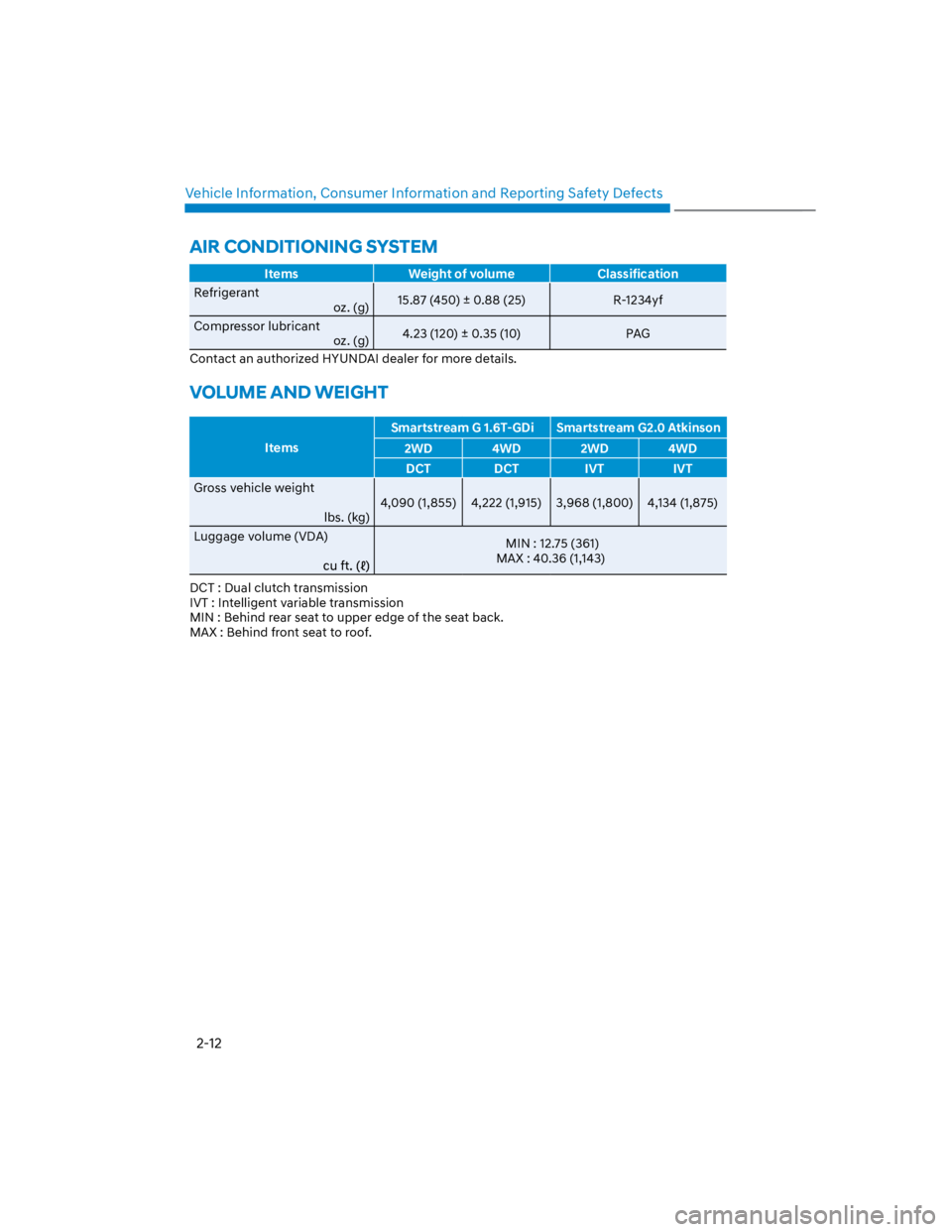
2-12
Items Weight of volume Classification
Refrigerant
oz. (g)15.87 (450) ± 0.88 (25) R-1234yf
Compressor lubricant
oz. (g)4.23 (120) ± 0.35 (10) PAG
Contact an authorized HYUNDAI dealer for more details.
VOLUME AND WEIGHT
Items
Smartstream G 1.6T-GDi Smartstream G2.0 Atkinson
2WD 4WD 2WD 4WD
DCT DCT IVT IVT
Gross vehicle weight
lbs. (kg)
4,090 (1,855) 4,222 (1,915) 3,968 (1,800) 4,134 (1,875)
Luggage volume (VDA) MIN : 12.75 (361)
MAX : 40.36 (1,143)
DCT : Dual clutch transmission
IVT : Intelligent variable transmission
MIN : Behind rear seat to upper edge of the seat back.
MAX : Behind front seat to roof.
AIR CONDITIONING SYSTEM
Page 59 of 579
Seats & Safety System
3-28
WARNING
ALWAYS properly restrain infants and
small children in a Child Restraint
System appropriate for the child’s
height and weight.
To reduce the risk of serious injury or
death to a child and other passengers,
NEVER hold a child in your lap or arms
when the vehicle is moving. The violent
forces created during an accident will
tear the child from your arms and throw
the child against the interior of the
vehicle.
Small children are best protected from
injury in an accident when properly
restrained in the rear seat by a Child
Restraint System that meets the
requirements of the Safety Standards of
your country. Before buying any Child
Restraint System, make sure that it has
a label certifying that it meets Safety
Standard of your country.
The Child Restraint System must be
appropriate for your child’s height and
weight. Check the label on the Child
Restraint System for this information.
Refer to “Child Restraint Systems”
section in this chapter.
Larger children
Children under age 13 and who are
too large for a booster seat should
always occupy the rear seat and use the
available lap/shoulder belts. A seat belt
should lie across the upper thighs and
be snug across the shoulder and chest
to restrain the child safely. Check belt fit
periodically. A child’s squirming could
put the belt out of position. In the event
of an accident, children are afforded the
best safety restrained by a proper Child
Restraint System in the rear seats.
If a larger child over age 13 must be
seated in the front seat, the child must
be securely restrained by the available
lap/shoulder belt and the seat should be
placed in the rearmost position.
If the shoulder belt portion slightly
touches the child’s neck or face, try
placing the child closer to the center
of the vehicle. If the shoulder belt still
touches their face or neck, they need to
be returned to an appropriate booster
seat in the rear seat.
WARNING
Always make sure larger children’s
seat belts are worn and properly
adjusted.
NEVER allow the shoulder belt to
contact the child’s neck or face.
Do not allow more than one child to
use a single seat belt.
Page 61 of 579
Seats & Safety System
3-30
Children Always in the Rear
WARNING
Always properly restrain children in the
vehicle. Children of all ages are safer
when restrained in the rear seat. A child
riding in the front passenger seat can
be forcefully struck by an inflating air
bag resulting in SERIOUS INJURY or
DEATH.
Children under age 13 should always
ride in the rear seats and must always be
properly restrained to minimize the risk
of injury in an accident, sudden stop or
sudden maneuver.
According to accident statistics, children
are safer when properly restrained in the
rear seats than in the front seat. Even
with air bags, children can be seriously
injured or killed. Children too large for a
Child Restraint System must use the seat
belts provided.
All 50 states have child restraint laws
which require children to travel in
approved Child Restraint Systems.
The laws governing the age or height/
weight restrictions at which seat belts
can be used instead of Child Restraint
System differs among states, so
you should be aware of the specific
requirements in your country, and where
you are travelling.
Child Restraint Systems must be properly
placed and installed in the rear seat.
You must use a commercially available
Child Restraint System that meets the
requirements of the Federal Motor
Vehicle Safety Standards (FMVSS 213).
Child Restraint Systems are generally
designed to be secured in a vehicle seat
by lap belt portion of a lap/shoulder belt,
or by a LATCH system in the rear seats of
the vehicle.
Child Restraint System (CRS)
Infants and younger children must be
restrained in an appropriate rearward-
facing or forward-facing CRS that has
first been properly secured to the seat
of the vehicle. Read and comply with
the instructions for installation and use
provided by the manufacturer of the
Child Restraint System.
WARNING
An improperly secured child restraint
can increase the risk of SERIOUS
INJURY or DEATH in an accident. Always
take the following precautions when
using a Child Restraint System:
NEVER install a child or infant
restraint in the front passenger's
seat.
Always properly secure the child
restraint to a rear seat of the vehicle.
Always follow the child restraint
system manufacturer's instructions
for installation and use.
Always properly restrain your child in
the child restraint.
If the vehicle head restraint prevents
proper installation of a child seat
(as described in the child restraint
system manual), the head restraint of
the respective seating position shall
be readjusted or entirely removed.
Do not use an infant carrier or a
child safety seat that "hooks" over
a seatback, it may not provide
adequate protection in an accident.
After an accident, have an authorized
HYUNDAI dealer check the child
restraint system, seat belts, tether
anchors and lower anchors.
Page 62 of 579
03
3-31
Selecting a Child Restraint
System (CRS)
When selecting a Child Restraint System
for your child, always:
Make sure the Child Restraint System
has a label certifying that it meets
applicable Federal Motor Vehicle
Safety Standards (FMVSS 213).
Select a Child Restraint System based
on your child’s height and weight. The
required label or the instructions for
use typically provide this information.
Select a Child Restraint System that
fits the vehicle seating position where
it will be used.
Read and comply with the warnings
and instructions for installation and
use provided with the Child Restraint
System.
Child Restraint System types
There are three main types of Child
Restraint Systems: rearward-facing,
forward-facing and booster Child
Restraint Systems.
They are classified according to the
child’s age, height and weight.
OOS037028N
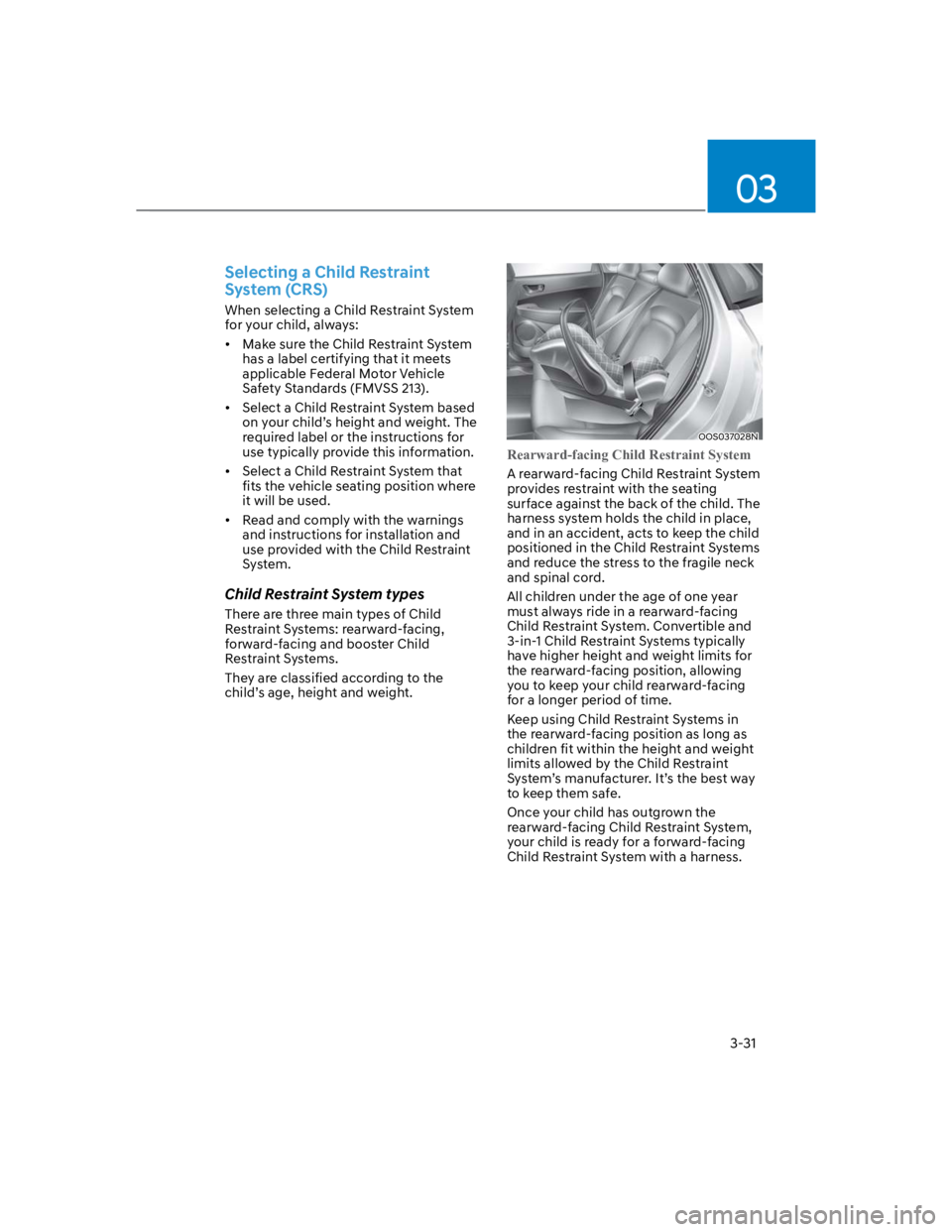
Rearward-facing Child Restraint System
A rearward-facing Child Restraint System
provides restraint with the seating
surface against the back of the child. The
harness system holds the child in place,
and in an accident, acts to keep the child
positioned in the Child Restraint Systems
and reduce the stress to the fragile neck
and spinal cord.
All children under the age of one year
must always ride in a rearward-facing
Child Restraint System. Convertible and
3-in-1 Child Restraint Systems typically
have higher height and weight limits for
the rearward-facing position, allowing
you to keep your child rearward-facing
for a longer period of time.
Keep using Child Restraint Systems in
the rearward-facing position as long as
children fit within the height and weight
limits allowed by the Child Restraint
System’s manufacturer. It’s the best way
to keep them safe.
Once your child has outgrown the
rearward-facing Child Restraint System,
your child is ready for a forward-facing
Child Restraint System with a harness.
Page 63 of 579
Seats & Safety System
3-32
WARNING
NEVER install a child or infant restraint
in the front passenger's seat.
Placing a rearward-facing child restraint
in the front seat can result in SERIOUS
INJURY or DEATH if the child restraint is
struck by an inflating air bag.
OOS037029N
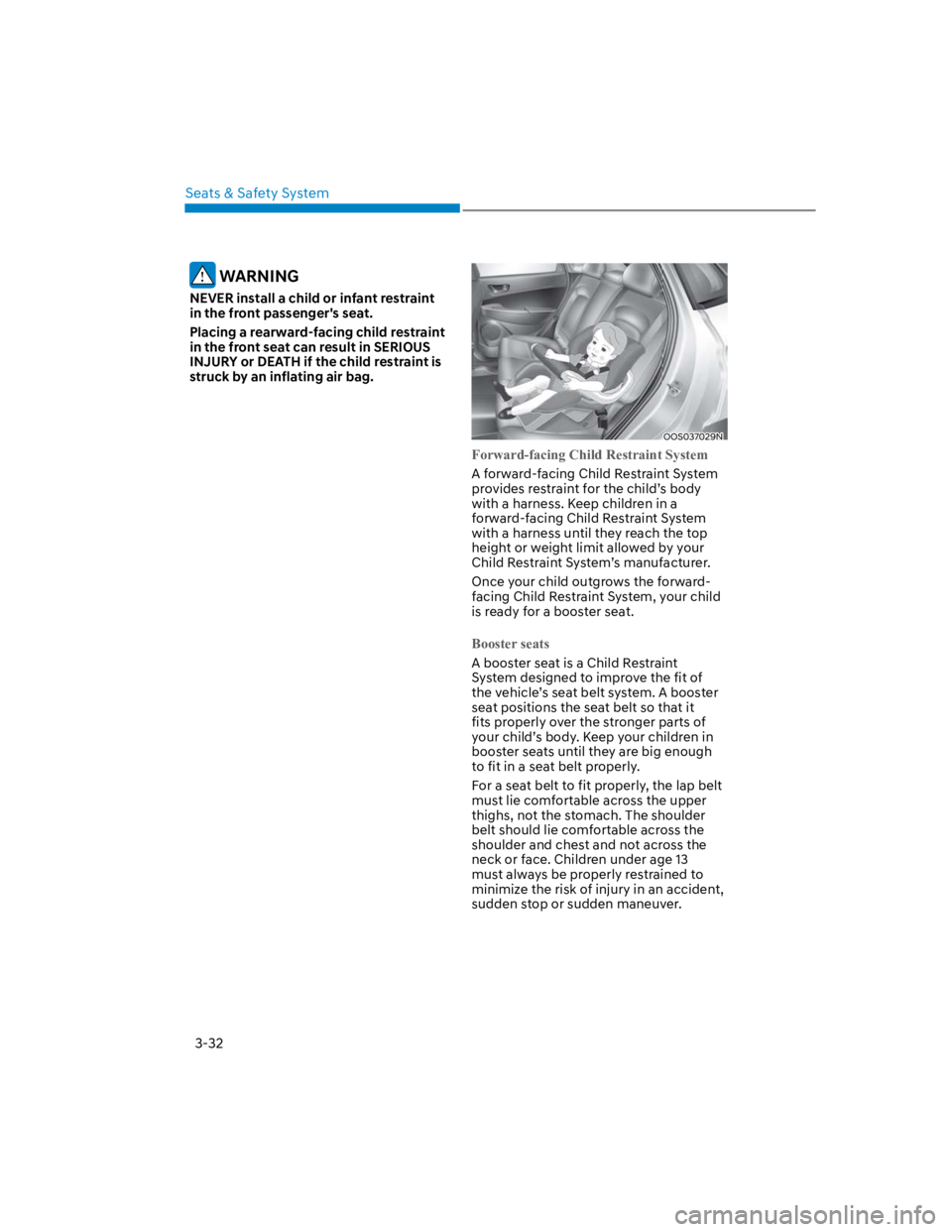
Forward-facing Child Restraint System
A forward-facing Child Restraint System
provides restraint for the child’s body
with a harness. Keep children in a
forward-facing Child Restraint System
with a harness until they reach the top
height or weight limit allowed by your
Child Restraint System’s manufacturer.
Once your child outgrows the forward-
facing Child Restraint System, your child
is ready for a booster seat.
Booster seats
A booster seat is a Child Restraint
System designed to improve the fit of
the vehicle’s seat belt system. A booster
seat positions the seat belt so that it
fits properly over the stronger parts of
your child’s body. Keep your children in
booster seats until they are big enough
to fit in a seat belt properly.
For a seat belt to fit properly, the lap belt
must lie comfortable across the upper
thighs, not the stomach. The shoulder
belt should lie comfortable across the
shoulder and chest and not across the
neck or face. Children under age 13
must always be properly restrained to
minimize the risk of injury in an accident,
sudden stop or sudden maneuver.
Page 67 of 579
Seats & Safety System
3-36
WARNING
Take the following precautions when
using the LATCH system:
Read and follow all installation
instructions provided with your Child
Restraint System.
To prevent the child from reaching
and taking hold of unretracted
seat belts, buckle all unused rear
seat belts and retract the seat belt
webbing behind the child. Children
can be strangled if a shoulder belt
becomes wrapped around their neck
and the seat belt tightens.
NEVER attach more than one
Child Restraint System to a single
anchorage. This could cause the
anchor or attachment to come loose
or break.
Always have the LATCH system
inspected by your dealer after an
accident. An accident can damage
the LATCH system and may not
properly secure the Child Restraint
System.
NOTICE
The recommended weight for the
LATCH system is under 65 lb. (30 kg).
How to determine an appropriate child
restraint weight: Child weight + Child
restraint system weight < 65 lb. (30kg)
Securing a Child Restraint System
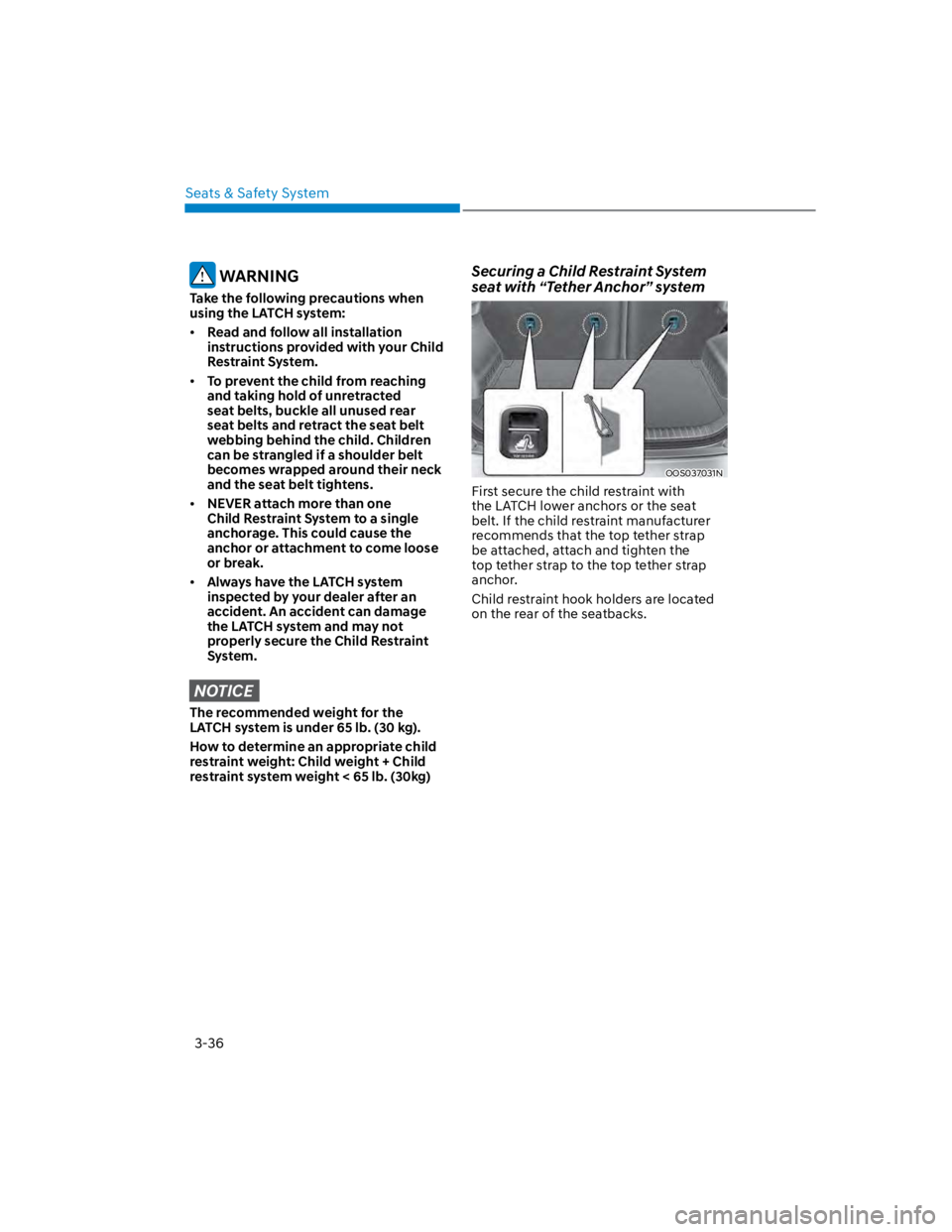
seat with “Tether Anchor” system
OOS037031N
First secure the child restraint with
the LATCH lower anchors or the seat
belt. If the child restraint manufacturer
recommends that the top tether strap
be attached, attach and tighten the
top tether strap to the top tether strap
anchor.
Child restraint hook holders are located
on the rear of the seatbacks.
Page 82 of 579

03
3-51
Main components of the Occupant
Classification System
A detection device located within the
front passenger seat cushion.
Electronic system to help determine
whether the passenger air bag
systems should be activated or
deactivated.
An indicator light located on the
instrument panel which illuminates
the words “PASSENGER AIR BAG OFF”
indicating the front passenger air bag
system is deactivated.
The instrument panel air bag indicator
light is interconnected with the OCS.
The OCS is designed to help detect
the presence of a properly-seated
front passenger and determine if the
passenger’s front air bag should be
enabled (may inflate) or not.
The purpose is to help reduce the risk
of injury or death from an inflating air
bag to certain front passenger seat
occupants, such as children, by requiring
the air bag to be automatically turned
OFF.
For example, if a child restraint of the
type specified in the regulations is on the
seat, the occupant classification sensor
can detect it and cause the air bag to
turn OFF.
Front passenger seat adult occupants
who are properly seated and wearing the
seat belt properly, should not cause the
passenger air bag to be automatically
turned OFF. For smaller adults it may turn
OFF, however, if the occupant does not
sit in the seat properly (for example, by
not sitting upright, by sitting on the edge
of the seat, or by otherwise being out of
position), this could cause the sensor to
turn the air bag OFF.
You will find the “PASSENGER AIR BAG
OFF” indicator on the overhead console
panel. This system detects the conditions
1-4 in the following table and activates or
deactivates the front passenger air bag
based on these conditions.
Always be sure that you and all vehicle
occupants are seated properly and
wearing the seat belt properly for the
most effective protection by the air bag
and the seat belt.
The OCS may not function properly if the
passenger takes actions which can affect
the classification system. These include:
Failing to sit in an upright position.
Leaning against the door or center
console.
Sitting towards the sides of the front
of the seat.
Putting their legs on the dashboard or
resting them on other locations which
reduce the passenger weight on the
front seat.
Wearing the seat belt improperly.
Reclining the seatback.
Wearing thick clothes like ski wear or
hip protection wear.
Putting an additional thick cushion on
the seat.
Putting electrical devices (e.g.
notebook, satellite radio) on the seat
with inverter charging.
Page 84 of 579
03
3-53
WARNING
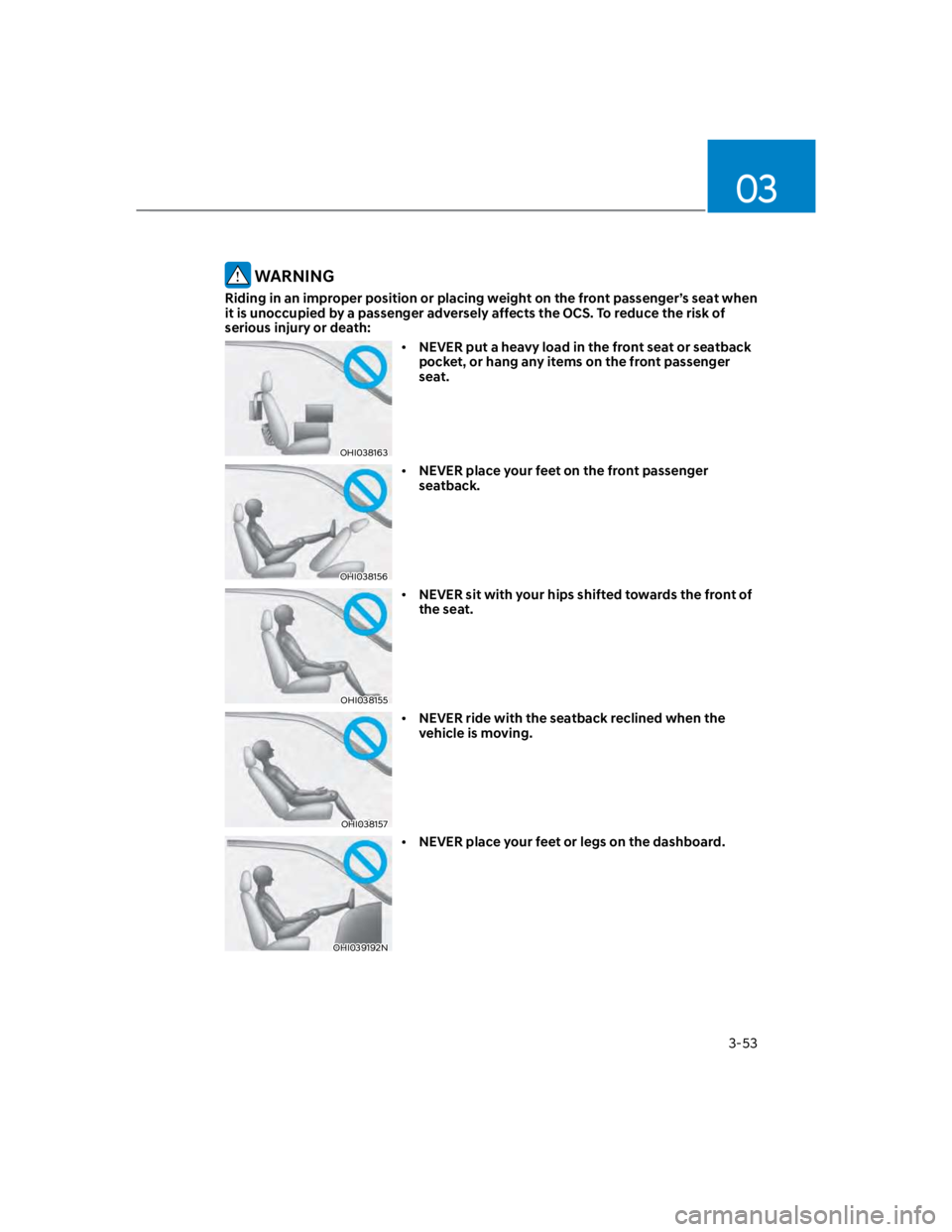
Riding in an improper position or placing weight on the front passenger’s seat when
it is unoccupied by a passenger adversely affects the OCS. To reduce the risk of
serious injury or death:
OHI038163
NEVER put a heavy load in the front seat or seatback
pocket, or hang any items on the front passenger
seat.
OHI038156
NEVER place your feet on the front passenger
seatback.
OHI038155
NEVER sit with your hips shifted towards the front of
the seat.
OHI038157
NEVER ride with the seatback reclined when the
vehicle is moving.
OHI039192N
NEVER place your feet or legs on the dashboard.
Page 248 of 579
Convenient features
5-114
Luggage net holder (if equipped)
OOS047068
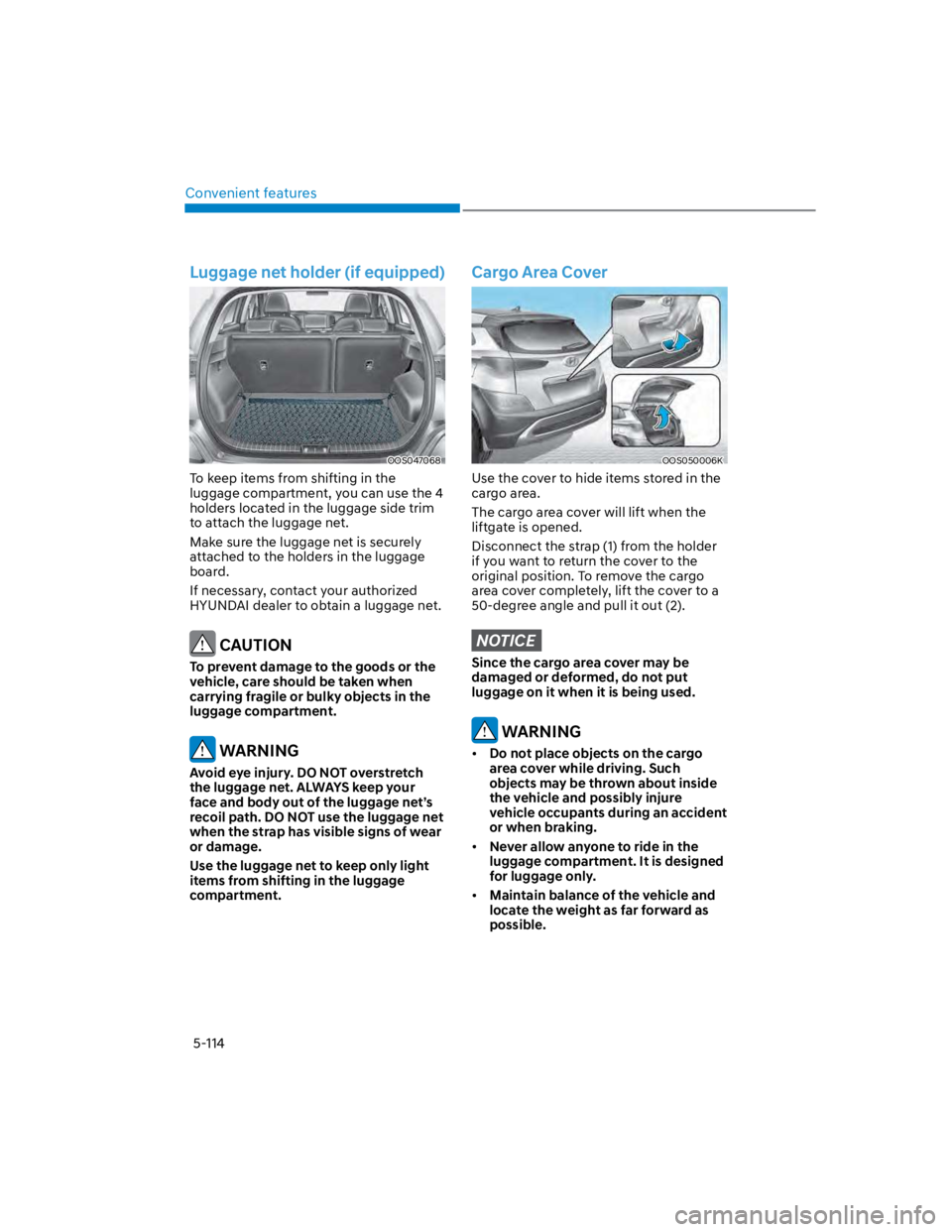
To keep items from shifting in the
luggage compartment, you can use the 4
holders located in the luggage side trim
to attach the luggage net.
Make sure the luggage net is securely
attached to the holders in the luggage
board.
If necessary, contact your authorized
HYUNDAI dealer to obtain a luggage net.
CAUTION
To prevent damage to the goods or the
vehicle, care should be taken when
carrying fragile or bulky objects in the
luggage compartment.
WARNING
Avoid eye injury. DO NOT overstretch
the luggage net. ALWAYS keep your
face and body out of the luggage net’s
recoil path. DO NOT use the luggage net
when the strap has visible signs of wear
or damage.
Use the luggage net to keep only light
items from shifting in the luggage
compartment.
Cargo Area Cover
OOS050006K
Use the cover to hide items stored in the
cargo area.
The cargo area cover will lift when the
liftgate is opened.
Disconnect the strap (1) from the holder
if you want to return the cover to the
original position. To remove the cargo
area cover completely, lift the cover to a
50-degree angle and pull it out (2).
NOTICE
Since the cargo area cover may be
damaged or deformed, do not put
luggage on it when it is being used.
WARNING
Do not place objects on the cargo
area cover while driving. Such
objects may be thrown about inside
the vehicle and possibly injure
vehicle occupants during an accident
or when braking.
Never allow anyone to ride in the
luggage compartment. It is designed
for luggage only.
Maintain balance of the vehicle and
locate the weight as far forward as
possible.