display HYUNDAI KONA EV 2021 Owners Manual
[x] Cancel search | Manufacturer: HYUNDAI, Model Year: 2021, Model line: KONA EV, Model: HYUNDAI KONA EV 2021Pages: 478, PDF Size: 32.83 MB
Page 362 of 478
6-3
What to do in an emergency
If you Have a Flat Tire While
Driving
If a tire goes flat while you are driving:
Take your foot off the accelerator
pedal and let the vehicle slow down
while driving straight ahead. Do not
apply the brakes immediately to
slow down the vehicle, but use the
paddle shifter (left side lever) to
increase regenerative braking con-
trol. Do not attempt to pull off the
road suddenly as this may cause
loss of vehicle control. When the
vehicle has slowed to such a speed
that it is safe to do so, brake care-
fully and pull off the road. Drive off
the road as far as possible and park
on firm, level ground. If you are on
a divided highway, do not park in
the median area between the two
traffic lanes.
When the vehicle is stopped, press
the hazard warning flasher button,
shift to P(Park), apply the parking
brake, and place the POWER but-
ton in the OFF position. Have all passengers get out of the
vehicle. Be sure they all get out on
the side of the vehicle that is away
from traffic.
Follow the instructions provided
later in this chapter.
Confirm the EV Battery SOC
Level
Confirm that the vehicle is in P
(Park). The vehicle can only be
started when the gear is in P
(Park).
Confirm the State of Charge (SOC)
percentage level on the charge
gauge or in the head unit display.
Inspect the 12V auxiliary battery
connections in the EV motor com-
partment to make sure they are
clean and tight.
Turn on the headlamps. If the
headlamps are not illuminating
properly, the 12V auxiliary battery
voltage may be low.
Do not push or pull the vehicle to
start it. This could cause damage to
your vehicle. See instructions for
"Jump Starting" provided in this
chapter.
6
I IF
F
T
TH
HE
E
V
VE
EH
HI
IC
CL
LE
E
W
WI
IL
LL
L
N
NO
OT
T
S ST
TA
AR
RT
T
Page 366 of 478
6-7
What to do in an emergency
6
T TI
IR
RE
E
P
PR
RE
ES
SS
SU
UR
RE
E
M
MO
ON
NI
IT
TO
OR
RI
IN
NG
G
S
SY
YS
ST
TE
EM
M
(
(T
TP
PM
MS
S)
)
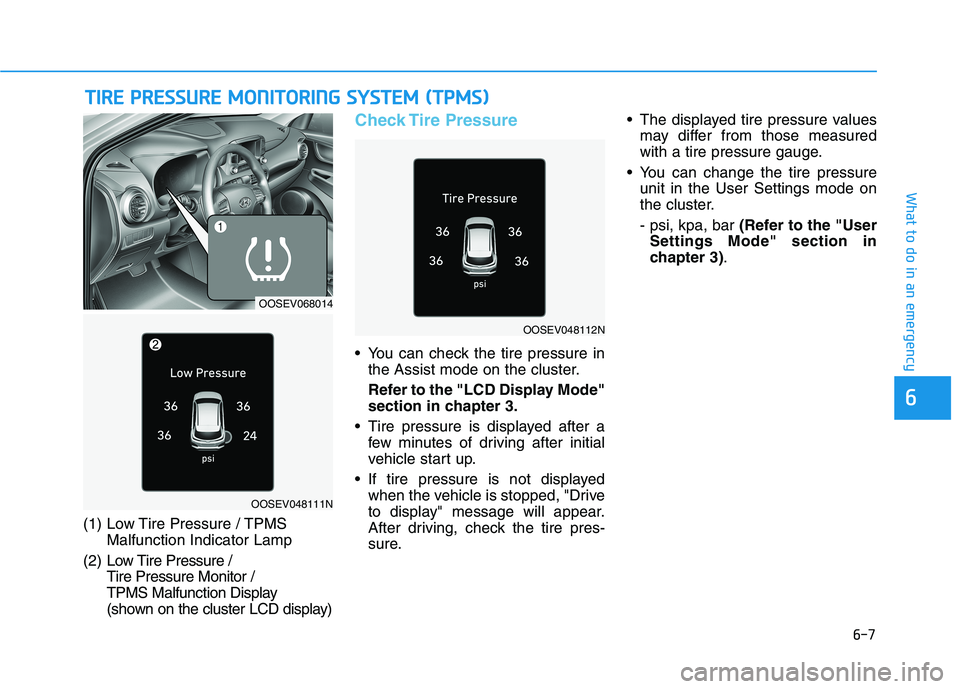
(1) Low Tire Pressure / TPMS
Malfunction Indicator Lamp
(2) Low Tire Pressure /
Tire Pressure Monitor /
TPMS Malfunction Display
(shown on the cluster LCD display)
Check Tire Pressure
You can check the tire pressure in
the Assist mode on the cluster.
Refer to the "LCD Display Mode"
section in chapter 3.
Tire pressure is displayed after a
few minutes of driving after initial
vehicle start up.
If tire pressure is not displayed
when the vehicle is stopped, "Drive
to display" message will appear.
After driving, check the tire pres-
sure. The displayed tire pressure values
may differ from those measured
with a tire pressure gauge.
You can change the tire pressure
unit in the User Settings mode on
the cluster.
- psi, kpa, bar (Refer to the "User
Settings Mode" section in
chapter 3).
OOSEV048112N
OOSEV068014
OOSEV048111N
Page 368 of 478
6-9
What to do in an emergency
6
If any of the below happens, have
the system checked by an author-
ized HYUNDAI dealer.
1. The Low Tire Pressure TPMS
Malfunction Indicator does not
illuminate for 3 seconds when
the POWER button is placed to
the ON position or vehicle is ON
( indicator ON).
2. The TPMS Malfunction Indicator
remains illuminated after blink-
ing for approximately 1 minute.
3. The Low Tire Pressure LCD dis-
play remains illuminated
Low Tire Pressure
Telltale
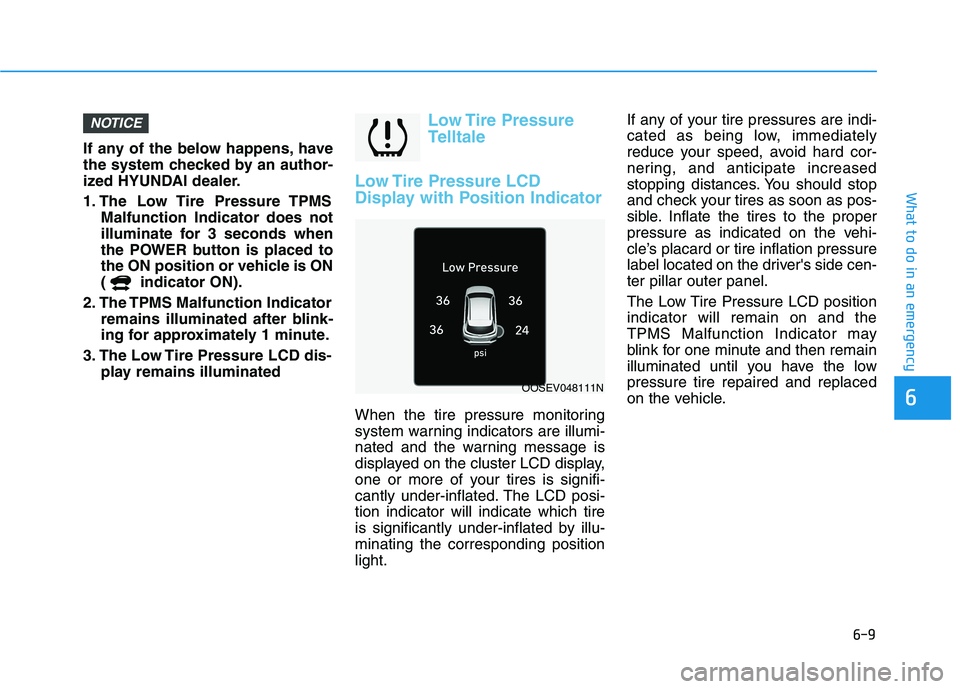
Low Tire Pressure LCD
Display with Position Indicator
When the tire pressure monitoring
system warning indicators are illumi-
nated and the warning message is
displayed on the cluster LCD display,
one or more of your tires is signifi-
cantly under-inflated. The LCD posi-
tion indicator will indicate which tire
is significantly under-inflated by illu-
minating the corresponding position
light.If any of your tire pressures are indi-
cated as being low, immediately
reduce your speed, avoid hard cor-
nering, and anticipate increased
stopping distances. You should stop
and check your tires as soon as pos-
sible. Inflate the tires to the proper
pressure as indicated on the vehi-
cle’s placard or tire inflation pressure
label located on the driver's side cen-
ter pillar outer panel.
The Low Tire Pressure LCD position
indicator will remain on and the
TPMS Malfunction Indicator may
blink for one minute and then remain
illuminated until you have the low
pressure tire repaired and replaced
on the vehicle.
NOTICE
OOSEV048111N
Page 369 of 478
6-10
What to do in an emergency
TPMS Malfunction
Indicator
The TPMS Malfunction Indicator will
illuminate after it blinks for approxi-
mately one minute when there is a
problem with the Tire Pressure
Monitoring System.
Have the system checked by an
authorized HYUNDAI dealer as soon
as possible.
If there is a malfunction with the
TPMS, the individual tire pres-
sures in the cluster LCD display
will not be available. Have the sys-
tem checked by an authorized
HYUNDAI dealer as soon as possi-
ble.
NOTICE
In winter or cold weather, the
Low Tire Pressure Telltale may
be illuminated if the tire pres-
sure was adjusted to the recom-
mended tire inflation pressure
in warm weather. It does not
mean your TPMS is malfunc-
tioning because the decreased
temperature leads to a propor-
tional lowering of tire pressure.
When you drive your vehicle
from a warm area to a cold area
or from a cold area to a warm
area, or the outside temperature
is greatly higher or lower, you
should check the tire inflation
pressure and adjust the tires to
the recommended tire inflation
pressure.
CAUTION
Low pressure damage
Significantly low tire pressure
makes the vehicle unstable and
can contribute to loss of vehicle
control and increased braking
distances.
Continued driving on low pres-
sure tires can cause the tires to
overheat and fail.
WARNING
Page 374 of 478
6-15
What to do in an emergency
6
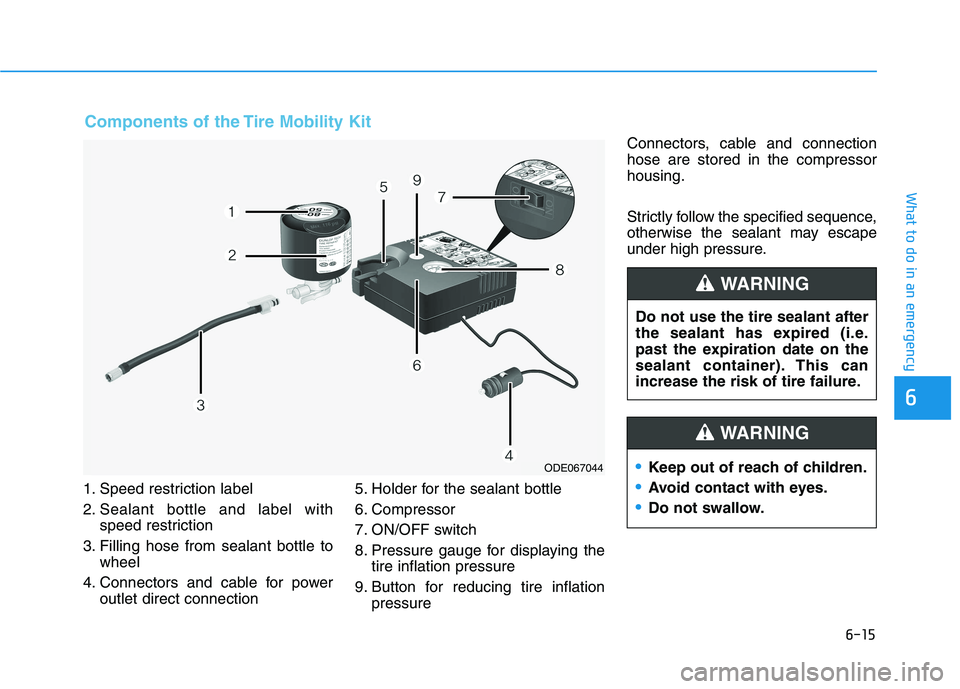
1. Speed restriction label
2. Sealant bottle and label with
speed restriction
3. Filling hose from sealant bottle to
wheel
4. Connectors and cable for power
outlet direct connection5. Holder for the sealant bottle
6. Compressor
7. ON/OFF switch
8. Pressure gauge for displaying the
tire inflation pressure
9. Button for reducing tire inflation
pressureConnectors, cable and connection
hose are stored in the compressor
housing.
Strictly follow the specified sequence,
otherwise the sealant may escape
under high pressure.
Components of the Tire Mobility Kit
ODE067044
Do not use the tire sealant after
the sealant has expired (i.e.
past the expiration date on the
sealant container). This can
increase the risk of tire failure.
WARNING
Keep out of reach of children.
Avoid contact with eyes.
Do not swallow.
WARNING
Page 413 of 478
7-31
7
Maintenance
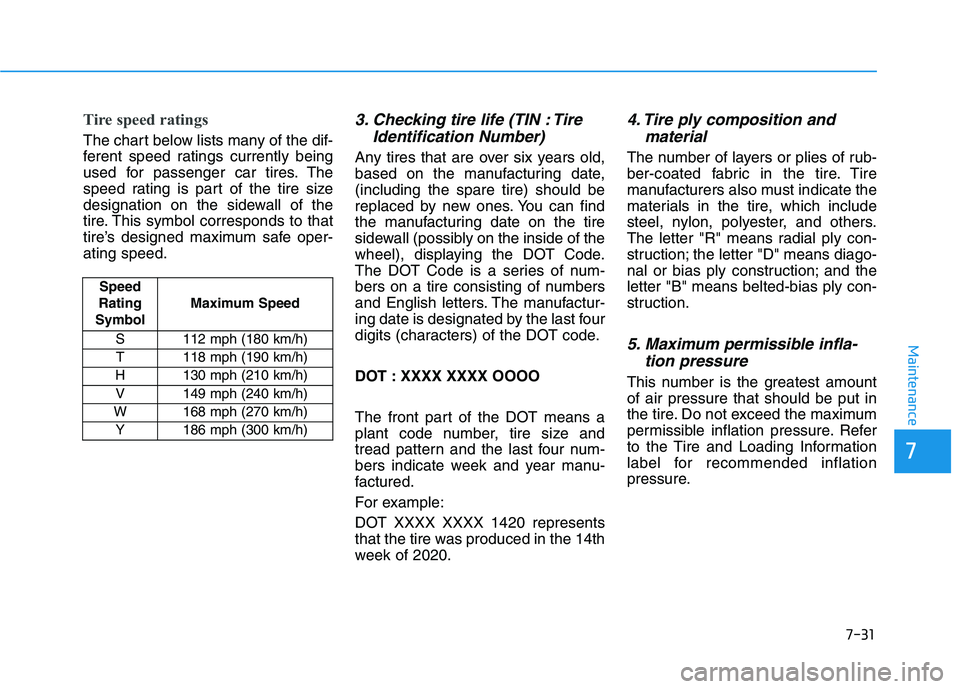
Tire speed ratings
The chart below lists many of the dif-
ferent speed ratings currently being
used for passenger car tires. The
speed rating is part of the tire size
designation on the sidewall of the
tire. This symbol corresponds to that
tire’s designed maximum safe oper-
ating speed.
3. Checking tire life (TIN : Tire
Identification Number)
Any tires that are over six years old,
based on the manufacturing date,
(including the spare tire) should be
replaced by new ones. You can find
the manufacturing date on the tire
sidewall (possibly on the inside of the
wheel), displaying the DOT Code.
The DOT Code is a series of num-
bers on a tire consisting of numbers
and English letters. The manufactur-
ing date is designated by the last four
digits (characters) of the DOT code.
DOT : XXXX XXXX OOOO
The front part of the DOT means a
plant code number, tire size and
tread pattern and the last four num-
bers indicate week and year manu-
factured.
For example:
DOT XXXX XXXX 1420 represents
that the tire was produced in the 14th
week of 2020.
4. Tire ply composition and
material
The number of layers or plies of rub-
ber-coated fabric in the tire. Tire
manufacturers also must indicate the
materials in the tire, which include
steel, nylon, polyester, and others.
The letter "R" means radial ply con-
struction; the letter "D" means diago-
nal or bias ply construction; and the
letter "B" means belted-bias ply con-
struction.
5. Maximum permissible infla-
tion pressure
This number is the greatest amount
of air pressure that should be put in
the tire. Do not exceed the maximum
permissible inflation pressure. Refer
to the Tire and Loading Information
label for recommended inflation
pressure.
Speed
Rating
SymbolMaximum Speed
S 112 mph (180 km/h)
T 118 mph (190 km/h)
H 130 mph (210 km/h)
V 149 mph (240 km/h)
W 168 mph (270 km/h)
Y186 mph (300 km/h)
Page 427 of 478
7-45
7
Maintenance
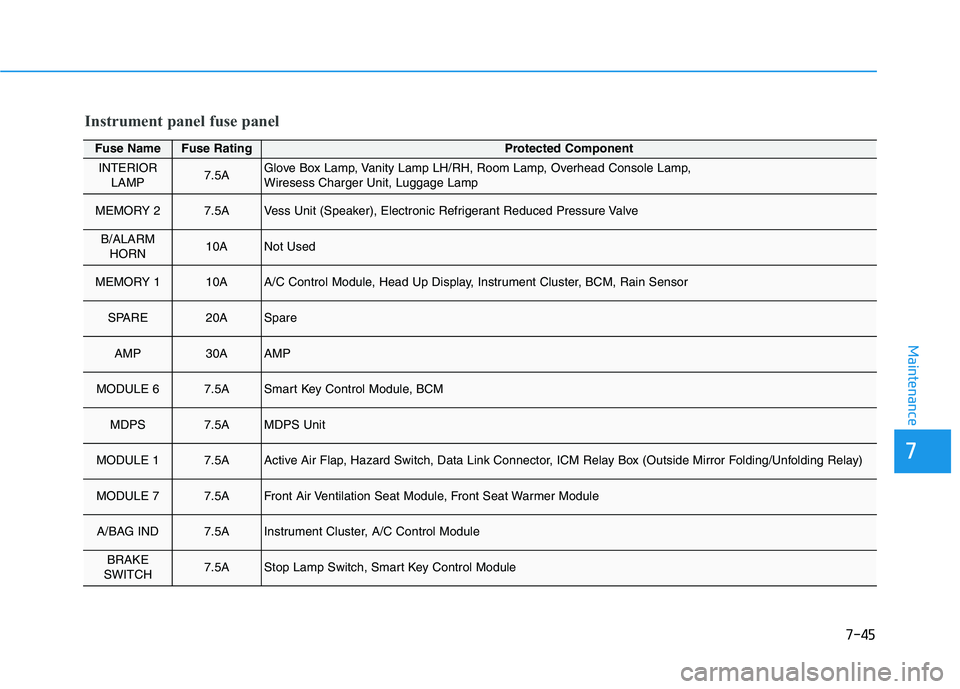
Fuse NameFuse RatingProtected Component
INTERIOR
LAMP7.5AGlove Box Lamp, Vanity Lamp LH/RH, Room Lamp, Overhead Console Lamp,
Wiresess Charger Unit, Luggage Lamp
MEMORY 27.5AVess Unit (Speaker), Electronic Refrigerant Reduced Pressure Valve
B/ALARM
HORN10ANot Used
MEMORY 110AA/C Control Module, Head Up Display, Instrument Cluster, BCM, Rain Sensor
SPARE20ASpare
AMP30AAMP
MODULE 67.5ASmart Key Control Module, BCM
MDPS7.5AMDPS Unit
MODULE 17.5AActive Air Flap, Hazard Switch, Data Link Connector, ICM Relay Box (Outside Mirror Folding/Unfolding Relay)
MODULE 77.5AFront Air Ventilation Seat Module, Front Seat Warmer Module
A/BAG IND7.5AInstrument Cluster, A/C Control Module
BRAKE
SWITCH7.5AStop Lamp Switch, Smart Key Control Module
Instrument panel fuse panel
Page 428 of 478
7-46
Maintenance
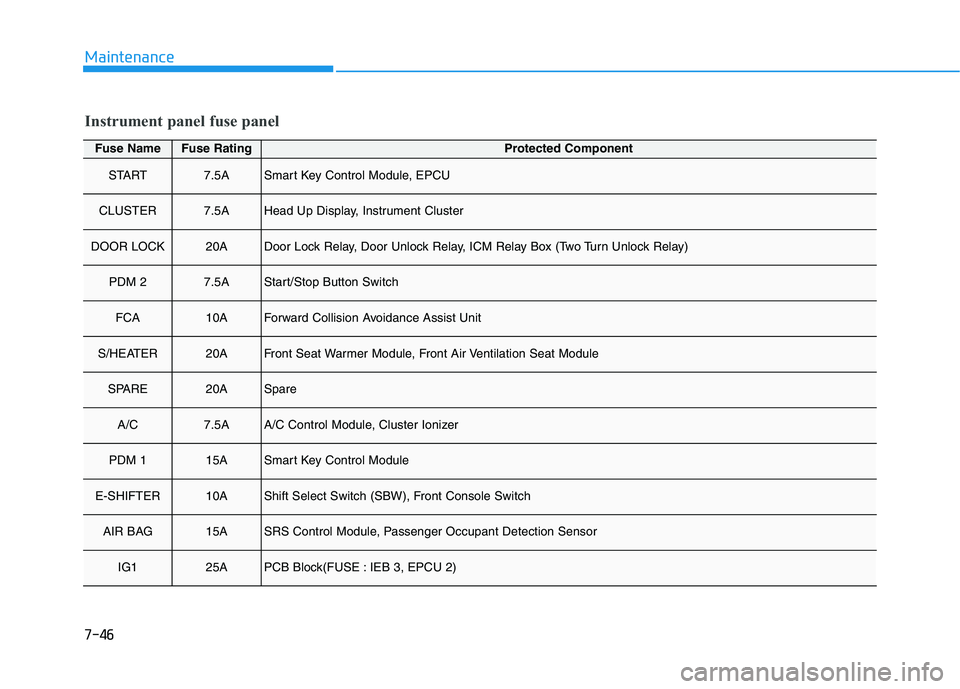
Fuse NameFuse RatingProtected Component
START7.5ASmart Key Control Module, EPCU
CLUSTER7.5AHead Up Display, Instrument Cluster
DOOR LOCK20ADoor Lock Relay, Door Unlock Relay, ICM Relay Box (Two Turn Unlock Relay)
PDM 27.5AStart/Stop Button Switch
FCA10AForward Collision Avoidance Assist Unit
S/HEATER20AFront Seat Warmer Module, Front Air Ventilation Seat Module
SPARE20ASpare
A/C7.5AA/C Control Module, Cluster Ionizer
PDM 115ASmart Key Control Module
E-SHIFTER10AShift Select Switch (SBW), Front Console Switch
AIR BAG15ASRS Control Module, Passenger Occupant Detection Sensor
IG125APCB Block(FUSE : IEB 3, EPCU 2)
Instrument panel fuse panel
Page 468 of 478
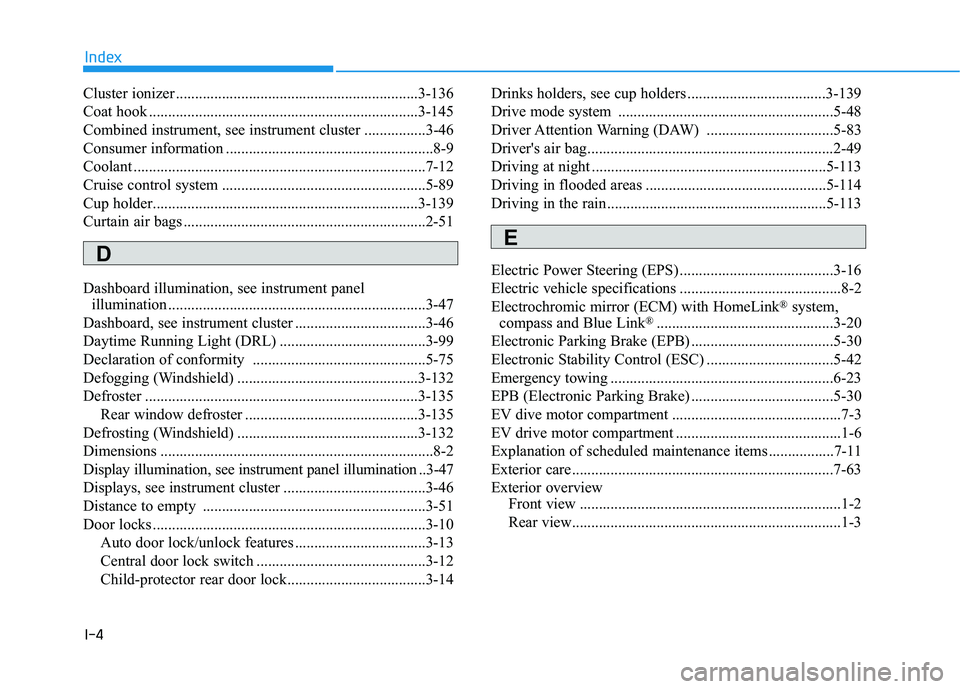
I-4
Cluster ionizer ...............................................................3-136
Coat hook ......................................................................3-145
Combined instrument, see instrument cluster ................3-46
Consumer information ......................................................8-9
Coolant ............................................................................7-12
Cruise control system .....................................................5-89
Cup holder.....................................................................3-139
Curtain air bags ...............................................................2-51
Dashboard illumination, see instrument panel
illumination ...................................................................3-47
Dashboard, see instrument cluster ..................................3-46
Daytime Running Light (DRL) ......................................3-99
Declaration of conformity .............................................5-75
Defogging (Windshield) ...............................................3-132
Defroster .......................................................................3-135
Rear window defroster .............................................3-135
Defrosting (Windshield) ...............................................3-132
Dimensions .......................................................................8-2
Display illumination, see instrument panel illumination ..3-47
Displays, see instrument cluster .....................................3-46
Distance to empty ..........................................................3-51
Door locks .......................................................................3-10
Auto door lock/unlock features ..................................3-13
Central door lock switch ............................................3-12
Child-protector rear door lock....................................3-14Drinks holders, see cup holders ....................................3-139
Drive mode system ........................................................5-48
Driver Attention Warning (DAW) .................................5-83
Driver's air bag................................................................2-49
Driving at night .............................................................5-113
Driving in flooded areas ...............................................5-114
Driving in the rain .........................................................5-113
Electric Power Steering (EPS) ........................................3-16
Electric vehicle specifications ..........................................8-2
Electrochromic mirror (ECM) with HomeLink
®system,
compass and Blue Link®..............................................3-20
Electronic Parking Brake (EPB) .....................................5-30
Electronic Stability Control (ESC) .................................5-42
Emergency towing ..........................................................6-23
EPB (Electronic Parking Brake) .....................................5-30
EV dive motor compartment ............................................7-3
EV drive motor compartment ...........................................1-6
Explanation of scheduled maintenance items .................7-11
Exterior care....................................................................7-63
Exterior overview
Front view ....................................................................1-2
Rear view......................................................................1-3
Index
D
E
Page 469 of 478
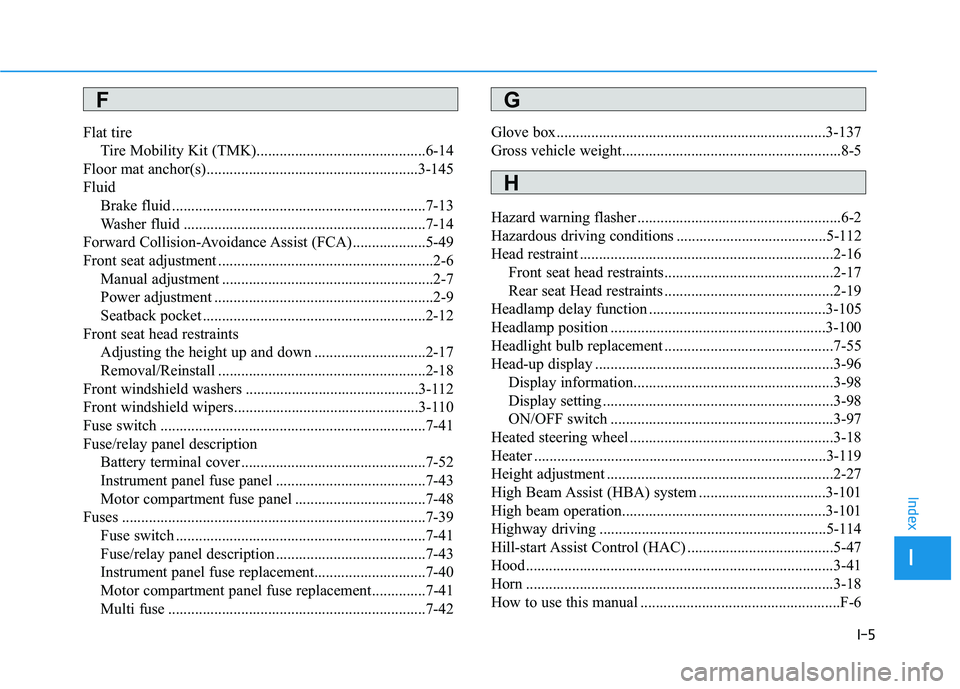
I-5
Flat tire
Tire Mobility Kit (TMK)............................................6-14
Floor mat anchor(s).......................................................3-145
Fluid
Brake fluid ..................................................................7-13
Washer fluid ...............................................................7-14
Forward Collision-Avoidance Assist (FCA)...................5-49
Front seat adjustment ........................................................2-6
Manual adjustment .......................................................2-7
Power adjustment .........................................................2-9
Seatback pocket ..........................................................2-12
Front seat head restraints
Adjusting the height up and down .............................2-17
Removal/Reinstall ......................................................2-18
Front windshield washers .............................................3-112
Front windshield wipers................................................3-110
Fuse switch .....................................................................7-41
Fuse/relay panel description
Battery terminal cover ................................................7-52
Instrument panel fuse panel .......................................7-43
Motor compartment fuse panel ..................................7-48
Fuses ...............................................................................7-39
Fuse switch .................................................................7-41
Fuse/relay panel description .......................................7-43
Instrument panel fuse replacement.............................7-40
Motor compartment panel fuse replacement..............7-41
Multi fuse ...................................................................7-42Glove box......................................................................3-137
Gross vehicle weight.........................................................8-5
Hazard warning flasher .....................................................6-2
Hazardous driving conditions .......................................5-112
Head restraint ..................................................................2-16
Front seat head restraints............................................2-17
Rear seat Head restraints ............................................2-19
Headlamp delay function ..............................................3-105
Headlamp position ........................................................3-100
Headlight bulb replacement ............................................7-55
Head-up display ..............................................................3-96
Display information....................................................3-98
Display setting ............................................................3-98
ON/OFF switch ..........................................................3-97
Heated steering wheel .....................................................3-18
Heater ............................................................................3-119
Height adjustment ...........................................................2-27
High Beam Assist (HBA) system .................................3-101
High beam operation.....................................................3-101
Highway driving ...........................................................5-114
Hill-start Assist Control (HAC) ......................................5-47
Hood................................................................................3-41
Horn ................................................................................3-18
How to use this manual ....................................................F-6
I
Index
F
H
G